

|
시장보고서
상품코드
2156871
마이크로 초음파 시스템 : 시장 점유율 분석, 업계 동향과 통계, 성장 예측(2026-2031년)Micro-Ultrasound Systems - Market Share Analysis, Industry Trends & Statistics, Growth Forecasts (2026 - 2031) |
||||||
 Mordor Intelligence
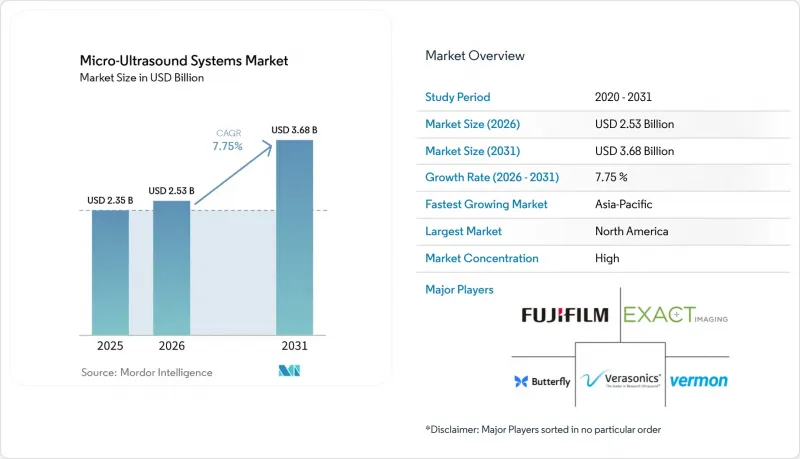
에 따르면 마이크로 초음파 시스템 시장 규모는 2025년 23억 5,000만 달러에서 2026년에는 25억 3,000만 달러로 확대하며, 2026-2031년에 CAGR 7.75%로 추이하며, 2031년까지 36억 8,000만 달러에 달할 것으로 예측됩니다.
전 세계 마이크로 초음파 시스템 시장의 동향 및 인사이트
고해상도·실시간 영상 진단의 도입 확대
마이크로 초음파 시스템 시장은 29 MHz-70MHz의 작동 주파수와 검사 현장에서의 실시간 처리를 결합한 시스템에 의해 지원되고 있습니다. 이 주파수 대역을 통해 임상의는 사후 영상 진단을 기다릴 필요 없이 검사 중에 표층의 미세한 해부학적 구조를 시각화할 수 있습니다. 이러한 시스템은 특정 워크플로우에서 기존에는 MRI나 조직병리학이 필요했던 미세한 해부학적 세부 사항을 표시할 수 있습니다. 다만, 이러한 시스템은 모든 영상 진단법을 광범위하게 대체하기보다는 특정 임상 적응증을 위해 설계되었습니다. 2026년 리뷰에 따르면 전립선암 검출을 위한 AI 탑재 모델은 곡선 아래 면적(AUC) 최대 0.871, 민감도 92.5%, 특이도 68.1%를 달성한 것으로 보고되었습니다.
AI 툴은 영상 해석의 일관성을 높이고, 극소수의 고도로 전문화된 사용자에 대한 의존도를 낮추며, 병원이 여러 거점에 걸쳐 임상의를 양성하기 위한 보다 명확한 기반을 제공할 수 있습니다. 이는 근골격계 및 안과 진료에서 중요한 의미를 지닙니다. 이러한 분야에서는 고해상도 영상 진단을 통해 MRI에 수반되는 설비 투자 비용, 예약 제약, 혹은 별도의 물리적 공간 확보 없이도 진단 평가의 정확도를 향상시킬 수 있기 때문입니다. 다기관 대응 AI 모델이 상용화됨에 따라 더 많은 의뢰 의사가 적절한 환자를 진료소의 마이크로 초음파 검사로 유도하게 될 것입니다. 이를 통해 진단 지연을 단축하고, 진료과 간 환자 이동을 간소화하며, 검사 건수를 늘릴 수 있게 됩니다.
표적형 전립선 생검 워크플로우의 확대
표적형 전립선 생검은 비뇨기과 의사가 이미 경직장 시술에 사용하고 있는 임상 워크플로우에 부합하므로 마이크로 초음파 시스템 시장의 주요 시장 촉진요인이 되고 있습니다. OPTIMUM 무작위 임상시험은 20개 기관의 생검 경험이 없는 남성 802명을 대상으로 실시되었으며, 글리슨 등급 2 이상 전립선암의 검출에 있으며, 마이크로 초음파 유도 생검이 MRI 융합 유도 생검에 뒤지지 않는 것으로 확인되었습니다.
29 MHz 시스템을 활용하면 의사는 별도로 MRI 예약 시간을 확보하지 않고도 표적에 맞춘 영상 진단과 생검을 수행할 수 있습니다. 이를 통해 임상적 우려가 발생한 후 진단 시술이 이루어지기까지의 실질적인 지연을 해소할 수 있습니다. 이는 방사선과에서 긴 대기 시간이 발생하는 의료기관의 처리 능력 향상으로 이어지며, 그렇지 않았다면 여러 번 내원해야 했던 환자들의 예약 조정이 용이해집니다. Exact Imaging사는 주요 의료 시스템과의 연계를 강화하며 성장세를 이어가고 있으며, 2026년에 북미 영업팀을 확충했습니다. 임상 지침에 포함된 PRI-MUS 점수 산정 프로토콜은 의료 기관 간에 보다 일관된 진단 성능을 지원할 뿐만 아니라, 의료진이 영상 소견에 대해 논의할 수 있는 공통된 방법을 제공합니다.
초고주파 영역에서의 제한된 침투 깊이
침투 깊이의 한계로 인해 심부 조직 진료 현장에서의 마이크로 초음파 시스템 시장은 제약을 받고 있으며, 이는 단기적인 상업적 문제라기보다는 물리적 제약으로 남아 있습니다. 40MHz를 초과하면 실용적인 침투 깊이가 10mm에서 15 mm 미만으로 떨어지기 때문에 임상의가 표재 구조의 깊은 곳까지 관찰해야 하는 심부 복부, 골반저, 심벽의 영상 진단에서 사용이 제한됩니다. 따라서 얕은 깊이에서 영상의 정밀도가 유용한 경우에도, 이러한 검사에서 고주파 장치는 MRI, CT 또는 기존의 초음파 검사를 직접 대체할 수는 없습니다.
혈관내 투여는 병변 평가시 깊이 문제를 해결할 수 있지만, 시술 비용, 장비 요구 사항 및 임상적 복잡성이 증가하므로 그 사용은 특정 고위험 사례로 제한됩니다. 유럽 의학 및 생물학 초음파 학회 연합(EFSUMB)은 혈관 초음파 탄성 영상의 일상적인 임상 판단에 대한 사용을 권장하지 않는다고 지적하고 있습니다. 컴파운딩 및 코히어런트 평면파 이미징과 같은 신호 처리 기법을 통해 15 MHz에서 30MHz 주파수 대역의 장단점을 부분적으로 개선하는 것은 가능합니다. 그러나 이러한 기술들은 심부 조직 영상에서 구조적인 한계를 제거하는 것은 아니며, 또한 기존 초음파의 모든 용도를 마이크로 초음파로 대체하는 것도 아닙니다.
부문 분석
2025년, 고주파 프로브 및 트랜스듀서는 마이크로 초음파 시스템 시장 점유율의 39.31%를 차지했습니다. 이러한 선도적인 위상은 트랜스듀서 교체가 필요하고, 멀티 프로브를 사용한 워크플로가 콘솔의 초기 구입 비용에 추가적인 지출을 초래하므로 지속적인 조달이 이루어지고 있음을 반영합니다. 실제로 진료과에 따라 해부학적 부위, 환자의 체위, 시술 요건에 따라 서로 다른 프로브가 필요하므로 초기 시스템 판매 후에도 프로브 라인업이 중요합니다. 구매자는 해상도, 사용 편의성, 호환성, 서비스 지원을 종합적으로 평가하므로 프로브의 전문성은 임상 영상 분야에서 중요한 경쟁 고려 사항이 되고 있습니다. Kolo Medical이 시판하고 있는 CMUT 기반 프로브는 최대 38+MHz의 주파수에서 작동하며, 고해상도의 피부과, 안과, 근골격계 영상 촬영을 지원합니다. 이러한 제품 라인업은 개별 임상 용도에 맞춰 프로브 설계를 맞춤화하고, 사용자가 특정 검사에 적합한 툴을 선택할 수 있도록 지원할 수 있는 공급업체에 유리하게 작용합니다. 또한 전임상 영상 센터의 증가에 따라 장기 연구 프로그램에서 일상적인 소모품, 위치 결정 보조 기구, 교체용 부품에 대한 수요가 높아지고 있으며, 액세서리 및 소모품 시장도 혜택을 보고 있습니다.
소프트웨어 플랫폼은 2031년까지 연평균 성장률(CAGR) 12.65%로 성장할 것으로 예측되며, 이는 제품 유형 중 가장 높은 성장률입니다. 마이크로 초음파 시스템 시장내 소프트웨어 플랫폼 시장 규모는 병변의 자동 점수 산정, PRI-MUS 위험 평가, 그리고 MRI 퓨전 오버레이에 대한 수요에 힘입고 있습니다. 구매자들은 다양한 임상의가 일관되게 사용할 수 있고 기존 문서화 업무와 연동될 수 있는 영상 진단 시스템을 원하고 있으므로 이러한 기능들은 경쟁 입찰에서 시스템 선정에 점점 더 큰 영향을 미치고 있습니다. 소프트웨어는 조작자에 따른 편차를 관리하고, 이미지를 기존 임상 워크플로우(영상 검토, 보고서 작성, 후속 조치 협의 등)에 통합하는 데 도움이 됩니다. 마이크로 초음파 시스템 업계는 소프트웨어 라이선스 수익이 하드웨어 매출을 보완하고, 도입 후에도 지속적인 비즈니스 관계를 지원하는 모델로 전환되고 있습니다. 소프트웨어 부가율이 높아지면, 장비 판매 대수 증가가 불안정한 경우에도, 특히 의료 기관이 시스템 운영 경험을 쌓은 후 모듈을 추가하는 경우 등 지속적인 수익 증대로 이어집니다. 검증된 영상 분석과 신뢰성 높은 워크플로우 지원을 결합한 공급업체는 이러한 변화로부터 더 큰 혜택을 누릴 수 있는 위치에 있습니다.
2025년, 카트형 시스템은 마이크로 초음파 시스템 시장의 35.24%를 차지했습니다. 이러한 확고한 입지는 전립선 영상 진단 및 혈관내 시술에 필요한 계산 처리의 안정성과 고정 개구 어레이 덕분입니다. 카트형 시스템의 도입은 복잡한 시술을 관리하고, 전용 영상 진단실을 유지하며, 전문 팀에 의한 정기적인 사용을 지원할 수 있는 3차 의료 기관이나 학술기관에서 일반적입니다. 전용 임상실, 훈련된 직원, 확립된 기술 지원이 갖춰진 환경에서는 일관된 영상 진단을 지원할 수 있습니다. 또한 이러한 시스템은 영상 데이터를 더 광범위한 임상의 그룹이나 전자 건강 기록과 연동해야 하는 시설에도 적합합니다. 탁상형 연구용 시스템은 제약 및 학술연구 분야에서 다르지만 꾸준한 역할을 수행하고 있습니다. 후지필름 비주얼소닉스는 ‘Vevo F2xc’를 심혈관 및 종양학 연구를 위한 광대역 연구 플랫폼으로 포지셔닝하고 있습니다.
핸드헬드형 시스템은 2031년까지 연평균 성장률(CAGR) 13.42%로 성장할 것으로 예측되며, 가장 두드러진 성장을 보일 폼팩터가 될 전망입니다. 휴대성 덕분에 진료 현장 바로 근처에서 고해상도 검사를 실시할 수 있게 되어, 특히 진료 공간이 제한적이거나 장비 예산이 적은 진료소에서 도입에 필요한 설비 투자를 절감할 수 있습니다. CMUT-on-ASIC의 통합을 통해 하드웨어 플랫폼의 크기를 축소하면서도 실용적인 화질을 유지하는 소형 전용 설계 장치를 구현할 수 있습니다. 앞서 언급한 기회는 카트형 장비를 도입하기에는 무리가 있는 특정 진단 과정에서 휴대용 시스템을 활용할 수 있는 독립 비뇨기과 진료소에 특히 의미가 큽니다. 현재의 핸드헬드형 제품 중 1만 달러 미만의 가격대, 29 MHz의 영상 촬영 능력, 그리고 검증된 AI 스코어링 프로토콜을 하나의 디바이스에 통합한 제품은 아직 존재하지 않습니다. 따라서 마이크로 초음파 시스템 시장에서는 컴팩트한 설계, 화질, 임상 검증, 그리고 세척, 보관, 데이터 관리와 같은 실용적 요건 간의 균형을 둘러싸고 경쟁이 격화될 가능성이 있습니다. 휴대용 기기가 일상 진료 현장에서 이미 자리 잡은 기기를 대체하기 위해서는 전문의 사용자가 요구하는 신뢰성과 워크플로우 요건을 충족해야 합니다.
지역별 분석
2025년, 북미는 마이크로 초음파 시스템 시장의 36.21%를 차지했습니다. 이 지역의 입지는 확립된 보험 환급 제도, 주요 기기 제조업체, 그리고 초음파 기기에 대한 활발한 FDA 승인 환경에 의해 지원되고 있으며, 이로 인해 의료 제공자가 새로운 시스템을 평가하고 조달하기가 용이해졌습니다. 미국은 비뇨기과 의료계가 마이크로 초음파 유도 전립선 생검의 임상적 근거를 신속하게 평가해 온 덕분에 최대 국내 시장이 되었습니다. 캐나다에서는 대학 병원의 도입과 토론토에서 Exact Imaging사의 현지 시장 입지가 시장 확대에 기여하고 있습니다. 멕시코는 여전히 초기 단계에 있지만, 비뇨기과 전문 클리닉이 판매 대리점과의 제휴를 통해 수요를 조성하고 있으며, 전립선 관리에 특화된 서비스 내에서 이 기술을 도입하고 있습니다. MRI의 긴 대기 시간과 높은 검사 비용으로 인해 특히 의료 제공자가 지역 협력 체계 내에서 영상 진단과 생검을 통합적으로 실시할 수 있는 경우, 전립선암 초기 평가에서 진료소 기반의 마이크로 초음파의 매력이 높아질 가능성이 있습니다.
유럽은 마이크로 초음파 시스템 시장에서 여전히 2위 지역 시장이며, 독일, 영국, 프랑스가 주요 구매국입니다. EU 의료기기 규정(MDR)은 시장 진입 요건을 표준화하는 동시에 시판 후 감시 책임을 강화하고 있으며, 공급업체와 의료 제공자에게 더 큰 행정적 부담을 주고 있습니다. 영국 NHS Shared Business Services의 체계나 독일 IQWiG 절차는 새로운 영상 진단 기술에 대해 서로 다른 환급 일정을 만들어낼 가능성이 있습니다. 유럽의 비뇨기과 학회는 전립선 생검에 관한 지침 수립에서 동등한 수준의 아시아 시스템보다 더 진전을 보이고 있으며, 의료 제공자가 임상 지침과 지불 절차를 연계할 수 있는 경우 조기 도입이 촉진되고 있습니다. 이탈리아와 스페인에서는 암 검진 활동 및 민간 의료 네트워크를 통해 수요가 확대되고 있습니다. 북유럽 국가들과 네덜란드는 전임상 연구를 위한 구매를 통해 수요에 기여하고 있습니다. 필립스는 2026년 7월, AI를 활용한 워크플로우, FDA 510(k) 승인 및 CE 마크를 획득한 초음파 진단 기기 ‘Alturion’을 출시했으며, 2026년 6월에는 ‘Elevate Plus’에 대해 FDA 승인을 획득했습니다.
아시아태평양은 2031년까지 연평균 성장률(CAGR) 12.15%로 성장할 것으로 예측되며, 이는 지역별 성장률 중 가장 높은 수치입니다. 중국의 의료 현대화에 따라 진단 인프라가 2급 및 3급 도시로 확대되고 있으며, 이곳에서는 중저가 시스템이 비용 중심의 수요를 충족시켜 의료 기관이 주요 대도시권 외 지역의 환자들에게도 가까운 곳에서 영상 진단 서비스를 제공할 수 있도록 지원하고 있습니다. 인도의 의료기기용 ‘생산 연계 인센티브(PLI)’ 제도는 초음파 기기 부품에 대한 국내 생산 능력을 구축하고 있으며, 수입 의존도를 낮출 수 있습니다. 이러한 현지 생산에 대한 집중은 병원이 수입 장비와 국내 공급망을 통해 조립된 시스템을 비교할 때, 더 경쟁력 있는 기관용 가격 책정을 지원하는 결과로 이어집니다. 한국과 호주는 GE 헬스케어, 필립스, 지멘스의 신제품에 있으며, 조기 도입 시장 및 레퍼런스 사이트로서의 역할을 수행하고 있습니다. 일본에서는 고령화가 진행되고 있으며, 진단 서비스 수요에 계속해서 영향을 미치고 있지만, 보험 급여 재검토 및 임상 현장 도입에는 시간이 걸릴 가능성이 있습니다. 중동 및 아프리카, 남미는 도입 초기 단계에 있는 지역이며, GCC 국가들은 3차 의료 분야의 영상 진단에 투자를 확대하고 있고, 브라질에서는 판매 제휴, 현지 연수, 비뇨기과 의료 제공자와의 보다 집중적인 협력을 통해 암 전문 워크플로우를 구축하고 있습니다.
기타 혜택:
- 엑셀 형식의 시장 예측(ME) 시트
- 3개월간의 애널리스트 지원
자주 묻는 질문
목차
제1장 서론
- 조사 전제조건과 시장 정의
- 조사 범위
제2장 조사 방법
제3장 개요
제4장 시장 구도
- 시장 개요
- 시장 성장 촉진요인
- 시장 성장 억제요인
- 공급망 분석
- 규제 상황
- 기술 전망
- Porter's Five Forces 분석
제5장 시장 규모와 성장 예측
- 제품 유형별
- 폼팩터별
- 기술별
- 용도별
- 최종사용자별
- 지역별
- 북미
- 미국
- 캐나다
- 멕시코
- 유럽
- 독일
- 영국
- 프랑스
- 이탈리아
- 스페인
- 기타 유럽 국가
- 아시아태평양
- 중국
- 일본
- 인도
- 호주
- 한국
- 기타 아시아태평양 국가
- 중동 및 아프리카
- GCC
- 남아프리카공화국
- 기타 중동 및 아프리카 국가
- 남미
- 브라질
- 아르헨티나
- 기타 남미 국가
- 북미
제6장 경쟁 구도
- 시장 집중도
- 시장 점유율 분석
- 기업 개요
- ACULAB Co., Ltd.
- Bruker Corporation
- Butterfly Network, Inc.
- Canon Medical Systems Corporation
- Esaote S.p.A.
- Exact Imaging Inc.
- Fujifilm Holdings Corporation
- GE HealthCare Technologies Inc.
- Hologic, Inc.
- Kolo Medical, LLC
- Koninklijke Philips N.V.
- Revvity, Inc.
- Samsung Medison Co., Ltd.
- Shenzhen Mindray Bio-Medical Electronics Co., Ltd.
- Siemens Healthineers AG
- Verasonics, Inc.
- Vermon S.A.S.
제7장 시장 기회와 향후 전망
KSA 26.10.29According to Mordor Intelligence, the Micro-Ultrasound systems market size is expected to grow from USD 2.35 billion in 2025 to USD 2.53 billion in 2026 and is forecast to reach USD 3.68 billion by 2031 at 7.75% CAGR over 2026-2031.
Global Micro-Ultrasound Systems Market Trends and Insights
Increasing Adoption Of High-Resolution, Real-Time Imaging
The Micro-ultrasound systems market is supported by systems that combine 29 MHz to 70 MHz operating frequencies with real-time processing at the point of examination. This range helps clinicians visualize fine superficial anatomy during an assessment rather than waiting for a later imaging review. These systems can show microanatomical detail that previously required MRI or histopathology in selected workflows. Still, they remain designed for defined clinical indications rather than broad replacement of every imaging method. A 2026 review reported that AI-enabled models for prostate cancer detection achieved an area under the curve of up to 0.871, with 92.5% sensitivity and 68.1% specificity.
AI tools can make interpretation more consistent, reduce dependence on a small group of highly specialized users, and give hospitals a clearer basis for training clinicians across several sites. This matters in musculoskeletal and ophthalmology care, where high-resolution imaging may improve diagnostic assessment without the capital cost, scheduling requirements, or separate physical space associated with MRI. As multisite AI models move into commercial use, more referring physicians may direct suitable patients to office-based micro-ultrasound, which can reduce diagnostic delays, simplify patient movement between departments, and raise procedure volumes.
Expansion Of Targeted Prostate Biopsy Workflows
Targeted prostate biopsy is a central demand driver for the Micro-ultrasound systems market because it fits the clinical workflow that urologists already use for transrectal procedures. The OPTIMUM randomized trial included 802 biopsy-naive men across 20 centers and found that micro-ultrasound-guided biopsy was non-inferior to MRI fusion-guided biopsy for the detection of Gleason Grade Group 2 or higher prostate cancer.
A 29 MHz system allows the physician to perform targeted imaging and biopsy without a separate MRI scheduling cycle, which can remove a practical delay between a clinical concern and a diagnostic procedure. This can improve throughput where radiology departments face long queues, and it can make scheduling easier for patients who would otherwise need several appointments. Exact Imaging expanded its North American commercial team in 2026 as it built momentum with major health systems. The PRI-MUS scoring protocol, which is included in clinical guidelines, can support more consistent diagnostic performance across institutions and can give providers a common method for discussing imaging findings.
Limited Penetration Depth At Ultra-High Frequencies
Limited penetration depth restricts the Micro-ultrasound systems market in deep-tissue care settings and remains a physical constraint rather than a short-term commercial issue. Above 40 MHz, usable penetration depth falls below 10 mm to 15 mm, which limits use in deep abdominal, pelvic floor, and cardiac wall imaging, where clinicians need a view beyond superficial structures. High-frequency devices, therefore, do not directly replace MRI, CT, or conventional ultrasound in these procedures, even where the image detail at shallower depths is valuable.
Intravascular delivery can address the depth issue for lesion assessment, but it adds procedure cost, device requirements, and clinical complexity that limit use to selected high-risk cases. The European Federation of Societies for Ultrasound in Medicine and Biology noted that vascular ultrasound elastography was not recommended for routine clinical decision-making. Signal-processing methods such as compounding and coherent plane-wave imaging can partly improve the trade-off at 15 MHz to 30 MHz. Still, they do not remove the structural limit on deep-tissue imaging or open every conventional ultrasound application to micro-ultrasound.
Other drivers and restraints analyzed in the detailed report include:
- Growth Of Preclinical And Translational Imaging Research
- CMUT And PMUT Miniaturization For High-Frequency Imaging
- Clinical Evidence And Reimbursement Uncertainty Outside Urology
For complete list of drivers and restraints, kindly check the Table Of Contents.
Segment Analysis
High-frequency probes and transducers held 39.31% of the micro-ultrasound systems market share in 2025. Their leading position reflects recurring procurement because transducers require replacement, and multiprobe workflows add spending beyond the original console purchase. In practice, a department can need different probes for different anatomy, patient positioning, and procedural requirements, which makes the probe portfolio important after the first system sale. Probe specialization is becoming an important competitive consideration in clinical imaging because buyers assess resolution, ease of handling, compatibility, and service support together. Kolo Medical's commercially available CMUT-based probes operate at frequencies up to 38+ MHz for high-resolution dermatology, ophthalmology, and musculoskeletal imaging. This product mix favors suppliers that can tailor probe design to individual clinical uses and help users select the right tool for a defined examination. Accessories and consumables also benefit as more preclinical imaging centers add systems and require routine supplies, positioning aids, and replacement components during long research programs.
Software platforms are forecast to grow at a 12.65% CAGR through 2031, the highest rate among product types. The Micro-ultrasound systems market size for software platforms is supported by demand for automated lesion scoring, PRI-MUS risk assessment, and MRI-fusion overlays. These functions increasingly influence system selection in competitive tenders because buyers want an imaging system that can be used consistently by different clinicians and linked to existing documentation practices. Software can help users manage operator variation and integrate images into existing clinical workflows, including review, reporting, and follow-up discussions. The Micro-ultrasound systems industry is moving toward a model where software licensing can supplement hardware revenue and support a continuing commercial relationship after installation. Higher software attachment can improve recurring revenue even when equipment unit growth is uneven, especially where providers add modules after gaining experience with a system. Suppliers that combine validated image analysis with dependable workflow support are better placed to benefit from this shift.
Cart-based systems held 35.24% of the Micro-ultrasound systems market in 2025. Their established position is tied to the computing stability and fixed-aperture arrays needed for prostate imaging and intravascular procedures. Cart-based installations are common in tertiary hospitals and academic centers that manage complex procedures, maintain dedicated imaging rooms, and can support regular use by a specialist team. They can support consistent imaging in settings where a dedicated clinical room, trained staff, and established technical support are available. These systems also suit facilities that need to connect imaging data with a wider group of clinicians and electronic records. Tabletop research systems serve a different but steady role in pharmaceutical and academic studies. FUJIFILM VisualSonics positions the Vevo F2xc as a wide-frequency research platform for cardiovascular and oncology work.
Handheld systems are forecast to grow at a 13.42% CAGR through 2031, making them the fastest-growing form factor. Portability can bring high-resolution assessment closer to the point of care and reduce the capital commitment needed for office-based adoption, particularly where a practice has limited space or a smaller equipment budget. CMUT-on-ASIC integration creates a possible path for smaller, purpose-built devices that retain useful image quality while reducing the size of the hardware platform. The opportunity that was mentioned above is particularly relevant to independent urology practices that may not be a cart-based purchase but can use a portable system within a focused diagnostic pathway. Current handheld options have not yet combined a sub-USD 10,000 price point, 29 MHz imaging capability, and a validated AI scoring protocol in one device. The Micro-ultrasound systems market may therefore see competition focus on the balance between compact design, image quality, clinical validation, and the practical demands of cleaning, storage, and data management. A portable device must still meet the reliability and workflow needs of specialist users before it can replace more established equipment in a routine setting.
Complete Report Scope:
- By Product Type
- Imaging Consoles
- High-Frequency Probes and Transducers
- Software Platforms
- Accessories and Consumables
- By Form Factor
- Cart-Based Systems
- Handheld Systems
- Tabletop Research Systems
- Others
- By Technology
- High-Frequency Ultrasound
- 2D Micro-Ultrasound
- 3D and 4D Micro-Ultrasound
- Doppler Micro-Ultrasound
- Elastography
- Other Technologies
- By Application
- Urology and Prostate Imaging
- Oncology Research
- Cardiovascular and Intravascular Imaging
- Ophthalmology and Anterior-Segment Imaging
- Obstetrics and Gynecology
- Musculoskeletal and Rheumatology Imaging
- Neurology and Neurovascular Research
- Other Applications
- By End User
- Hospitals and Health Systems
- Diagnostic Centers
- Specialized Clinics and Ambulatory Surgery Centers
- Academic and Research Institutions
- Pharmaceutical and Biotechnology Companies
- Other End Users
- By Geography
- North America
- United States
- Canada
- Mexico
- Europe
- Germany
- United Kingdom
- France
- Italy
- Spain
- Rest of Europe
- Asia-Pacific
- China
- Japan
- India
- Australia
- South Korea
- Rest of Asia-Pacific
- Middle East and Africa
- GCC
- South Africa
- Rest of Middle East and Africa
- South America
- Brazil
- Argentina
- Rest of South America
- North America
Geography Analysis
North America held 36.21% of the Micro-ultrasound systems market in 2025. The region's position is supported by established reimbursement infrastructure, leading equipment manufacturers, and an active FDA clearance environment for ultrasound devices, which can make new systems easier for providers to evaluate and procure. The United States is the largest national market because its urology community has rapidly considered the clinical evidence for micro-ultrasound-guided prostate biopsy. Canada contributes through procurement by academic medical centers and Exact Imaging's home-market presence in Toronto. Mexico remains at an earlier stage, although specialty urology clinics are building demand through distributor relationships and introducing the technology within focused prostate care services. Long MRI wait times and high procedure costs can increase the appeal of office-based micro-ultrasound for initial prostate cancer assessment, particularly where providers can perform imaging and biopsy within a coordinated local pathway.
Europe remained the second-largest regional base for the Micro-ultrasound systems market, with Germany, the United Kingdom, and France as key procurement countries. The EU Medical Device Regulation has standardized market access requirements while increasing post-market surveillance responsibilities, creating greater administrative demands for suppliers and health care providers. The United Kingdom's NHS Shared Business Services framework and Germany's IQWiG process can create different reimbursement timelines for new imaging technologies. European urology bodies have made more guideline progress for prostate biopsy than comparable Asian systems, which supports earlier adoption where providers can connect clinical guidance to payment pathways. Italy and Spain are gaining demand through oncology screening activity and private health care networks. The Nordics and the Netherlands contribute through preclinical research purchases. Philips launched the Alturion ultrasound system in July 2026 with AI-powered workflows, FDA 510(k) clearance, and a CE mark, and received FDA clearance for Elevate Plus in June 2026.
Asia-Pacific is forecast to grow at a 12.15% CAGR through 2031, the fastest regional rate. China's health care modernization is extending diagnostic infrastructure into tier-2 and tier-3 cities, where mid-tier systems can meet cost-sensitive demand and help providers offer imaging services closer to patients outside the largest metropolitan areas. India's Production Linked Incentive scheme for medical devices is building local capacity for ultrasound components and can reduce import dependence. This local manufacturing focus can also support more competitive institutional pricing when hospitals compare imported equipment with systems assembled through domestic supply chains. South Korea and Australia serve as early-adoption and reference-site markets for new releases from GE HealthCare, Philips, and Siemens. Japan's aging population remains relevant to demand for diagnostic services, although reimbursement review and clinical adoption can take time. The Middle East, Africa, and South America are earlier-stage regions, with GCC countries investing in tertiary-care imaging and Brazil building specialist oncology workflows through distribution relationships, local training, and more focused engagement with urology providers.
- ACULAB Co., Ltd.
- Bruker
- Butterfly Network, Inc.
- Canon
- Esaote S.p.A.
- Exact Imaging Inc.
- FUJIFILM
- GE HealthCare Technologies Inc.
- Hologic
- Kolo Medical, LLC
- Koninklijke Philips
- Revvity, Inc.
- Samsung Group
- Mindray
- Siemens Healthineers
- Verasonics, Inc.
- Vermon S.A.S.
Additional Benefits:
- The market estimate (ME) sheet in Excel format
- 3 months of analyst support
TABLE OF CONTENTS
1 Introduction
- 1.1 Study Assumptions and Market Definition
- 1.2 Scope of the Study
2 Research Methodology
3 Executive Summary
4 Market Landscape
- 4.1 Market Overview
- 4.2 Market Drivers
- 4.2.1 Increasing Adoption of High-Resolution, Real-Time Imaging
- 4.2.2 Expansion of Targeted Prostate Biopsy Workflows
- 4.2.3 Growth of Preclinical and Translational Imaging Research
- 4.2.4 CMUT and PMUT Miniaturization for High-Frequency Imaging
- 4.2.5 Procedure-Level Economics of MRI-Alternative Screening Pathways
- 4.3 Market Restraints
- 4.3.1 Limited Penetration Depth at Ultra-High Frequencies
- 4.3.2 Clinical Evidence and Reimbursement Uncertainty Outside Urology
- 4.3.3 Shortage of Specialized Acoustic Engineering and Clinical-Applications Talent
- 4.4 Supply-Chain Analysis
- 4.5 Regulatory Landscape
- 4.6 Technological Outlook
- 4.7 Porter's Five Forces Analysis
- 4.7.1 Bargaining Power of Suppliers
- 4.7.2 Bargaining Power of Buyers
- 4.7.3 Threat of New Entrants
- 4.7.4 Threat of Substitutes
- 4.7.5 Competitive Rivalry
5 Market Size & Growth Forecasts (Value, USD)
- 5.1 By Product Type
- 5.1.1 Imaging Consoles
- 5.1.2 High-Frequency Probes and Transducers
- 5.1.3 Software Platforms
- 5.1.4 Accessories and Consumables
- 5.2 By Form Factor
- 5.2.1 Cart-Based Systems
- 5.2.2 Handheld Systems
- 5.2.3 Tabletop Research Systems
- 5.2.4 Others
- 5.3 By Technology
- 5.3.1 High-Frequency Ultrasound
- 5.3.2 2D Micro-Ultrasound
- 5.3.3 3D and 4D Micro-Ultrasound
- 5.3.4 Doppler Micro-Ultrasound
- 5.3.5 Elastography
- 5.3.6 Other Technologies
- 5.4 By Application
- 5.4.1 Urology and Prostate Imaging
- 5.4.2 Oncology Research
- 5.4.3 Cardiovascular and Intravascular Imaging
- 5.4.4 Ophthalmology and Anterior-Segment Imaging
- 5.4.5 Obstetrics and Gynecology
- 5.4.6 Musculoskeletal and Rheumatology Imaging
- 5.4.7 Neurology and Neurovascular Research
- 5.4.8 Other Applications
- 5.5 By End User
- 5.5.1 Hospitals and Health Systems
- 5.5.2 Diagnostic Centers
- 5.5.3 Specialized Clinics and Ambulatory Surgery Centers
- 5.5.4 Academic and Research Institutions
- 5.5.5 Pharmaceutical and Biotechnology Companies
- 5.5.6 Other End Users
- 5.6 By Geography
- 5.6.1 North America
- 5.6.1.1 United States
- 5.6.1.2 Canada
- 5.6.1.3 Mexico
- 5.6.2 Europe
- 5.6.2.1 Germany
- 5.6.2.2 United Kingdom
- 5.6.2.3 France
- 5.6.2.4 Italy
- 5.6.2.5 Spain
- 5.6.2.6 Rest of Europe
- 5.6.3 Asia-Pacific
- 5.6.3.1 China
- 5.6.3.2 Japan
- 5.6.3.3 India
- 5.6.3.4 Australia
- 5.6.3.5 South Korea
- 5.6.3.6 Rest of Asia-Pacific
- 5.6.4 Middle East and Africa
- 5.6.4.1 GCC
- 5.6.4.2 South Africa
- 5.6.4.3 Rest of Middle East and Africa
- 5.6.5 South America
- 5.6.5.1 Brazil
- 5.6.5.2 Argentina
- 5.6.5.3 Rest of South America
- 5.6.1 North America
6 Competitive Landscape
- 6.1 Market Concentration
- 6.2 Market Share Analysis
- 6.3 Company Profiles (includes Global Level Overview, Market Level Overview, Core Segments, Financials as available, Strategic Information, Market Rank/Share, Products and Services, Recent Developments)
- 6.3.1 ACULAB Co., Ltd.
- 6.3.2 Bruker Corporation
- 6.3.3 Butterfly Network, Inc.
- 6.3.4 Canon Medical Systems Corporation
- 6.3.5 Esaote S.p.A.
- 6.3.6 Exact Imaging Inc.
- 6.3.7 Fujifilm Holdings Corporation
- 6.3.8 GE HealthCare Technologies Inc.
- 6.3.9 Hologic, Inc.
- 6.3.10 Kolo Medical, LLC
- 6.3.11 Koninklijke Philips N.V.
- 6.3.12 Revvity, Inc.
- 6.3.13 Samsung Medison Co., Ltd.
- 6.3.14 Shenzhen Mindray Bio-Medical Electronics Co., Ltd.
- 6.3.15 Siemens Healthineers AG
- 6.3.16 Verasonics, Inc.
- 6.3.17 Vermon S.A.S.
7 Market Opportunities and Future Outlook
- 7.1 White-Space and Unmet-Need Assessment


