

|
시장보고서
상품코드
2156958
신경혈관내 코일 : 시장 점유율 분석, 업계 동향과 통계, 성장 예측(2026-2031년)Neuroendovascular Coil - Market Share Analysis, Industry Trends & Statistics, Growth Forecasts (2026 - 2031) |
||||||
 Mordor Intelligence
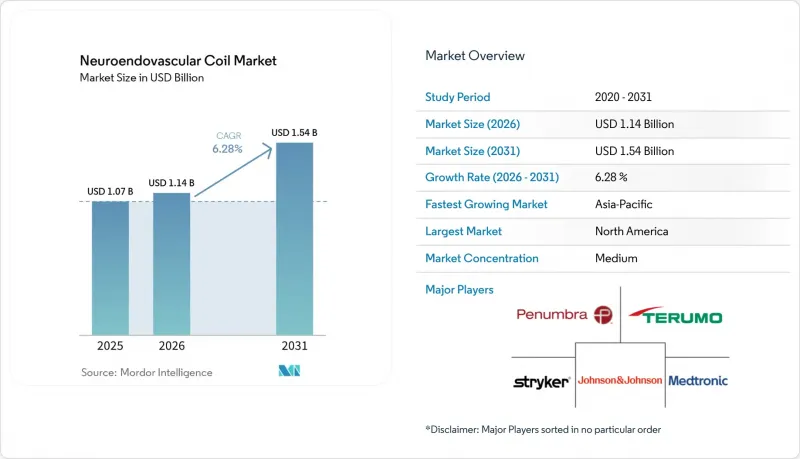
에 따르면 신경혈관내 코일 시장 규모는 2025년 10억 7,000만 달러, 2026년 11억 4,000만 달러에서 2031년까지 15억 4,000만 달러로 확대될 것으로 예측되고 있으며, 2026-2031년까지 연평균 성장률(CAGR)은 6.28%에 달할 전망입니다.
전 세계 신경혈관내 코일 시장의 동향 및 인사이트
두개내 동맥류 및 뇌졸중 발생률 증가
미파열 두개내 동맥류의 검출 범위가 확대됨에 따라 기존에는 파열 후 응급 치료가 중심이었던 치료 분야의 한 영역에 변화가 일어나고 있습니다. 2025년에 실시된 304,848명의 피험자를 대상으로 한 체계적 문헌인사이트 및 메타분석에 따르면 전 세계 유병률은 5.4%(95% 신뢰구간: 4.2%-6.8%)로 추정되었습니다. 이 리뷰에서는 여성의 경우 오즈비가 1.722, 고혈압의 경우 1.579, 흡연의 경우 2.266으로 나타났으며, 여러 위험 요인이 중첩되는 집단이 확인되었습니다. 일본과 한국에서 자기공명혈관조영술(MRA)을 통한 선별검사로 인해 응급 진료에 이르기 전 초기 단계에서 무증상 동맥류가 발견되고 있으며, 이것이 치료 방침을 결정짓고 있습니다. 조기 진단을 통해 임상팀은 해부학적 구조, 치료의 내구성, 시술 계획 및 이용 가능한 코일 플랫폼의 특성을 검토할 수 있는 시간을 더 많이 확보할 수 있게 됩니다. 따라서 신경혈관내 코일 시장은 응급 처치를 주요 목적으로 하는 베어 플래티넘 코일의 사용에서 계획적인 선택적 수술에 사용되는 차별화된 기기로 전환될 가능성이 있습니다. 특히 환자가 증상으로 인해 긴급한 중재가 필요해지기 전에 명확한 의뢰 경로에 진입하여 임상의가 보다 유연한 시술 옵션을 검토할 수 있는 경우, 이러한 경향이 두드러지게 나타납니다.
저침습적 동맥류 치료로의 지향
혈관내 치료는 특히 저침습적 치료법이 임상적으로 적합한 경우, 파열된 두개내 동맥류를 가진 많은 환자의 치료에서 여전히 중심적인 역할을 하고 있습니다. 2025년 분석에 따르면 사망률, 기능적 예후, 중대한 합병증 및 중환자실(ICU) 입원 기간 등 모든 항목에서 혈관내 코일 치료는 외과적 클리핑에 비해 계층적 예후 승률이 75% 더 높은 것으로 보고되었습니다. 이 증거는 적절한 사례에서 혈관내 치료를 우선시하는 접근 방식을 지원하지만, 치료법의 선택은 여전히 임상 증상 및 동맥류의 해부학적 특성에 달려 있습니다. 또한 이 증거는 다양한 형태의 동맥류에 대응하고 기존 진료 서비스에서 사용되는 카테터 시스템과 병용 가능한 코일에 대한 수요를 더욱 강화하고 있습니다. 병원은 시술 교육을 통해 숙련도를 유지할 수 있으며, 이를 통해 신경혈관 팀 전체에서 혈관내 치료 기술이 일관되게 활용되도록 촉진됩니다. 임상의가 더 광범위한 환자군에 대해 최소 침습적 치료를 적용할 수 있는 능력을 유지할 수 있다면, 신경혈관 코일 시장에도 이점이 있습니다. 이는 시급한 임상적 필요와 기존 신경혈관 진료 부서 내에서 이용 가능한 자원을 모두 고려한 치료 계획을 지원할 수 있기 때문입니다.
높은 시술 비용과 전문 인력 부족
신경 중재술을 통한 동맥류 치료에는 막대한 설비 투자와 고도로 전문화된 임상 인력이 필요하며, 이는 자원이 제한된 환경에서 도입을 저해할 가능성이 있습니다. 바이플레인 투시실, 중재적 신경방사선학 팀, 그리고 지속적인 모니터링 능력은 많은 2차 의료기관이 쉽게 자금을 조달하거나 유지 관리하기 어려운 핵심 요건입니다. 미국 신경방사선학회(SNRS)는 2026년 메디케어 의사 보수 일정에 관한 의견서에서 지방 지역의 인력 부족 문제를 지적하고 있습니다. 전문의 밀도가 낮으면 해당 지역에서 시행 가능한 시술이 제한되어, 지역 의료기관이 안정적인 서비스를 유지하기 어려워집니다. 또한 특히 사례 수가 불확실한 경우, 병원이 첨단 코일 플랫폼의 재고 수준을 정당화하기도 어려워집니다. 그 결과, 신경혈관내 코일 시장은 치료에 필요한 인력, 장비, 모니터링 자원을 갖춘 도시 지역의 병원이나 기타 사례 수가 많은 시설에 집중된 상태를 유지하고 있으며, 많은 소규모 의료기관은 환자가 복잡한 신경 중재 시술을 필요로 할 때 타 병원으로의 의뢰 경로에 의존할 수밖에 없는 상황에 처해 있습니다.
부문 분석
2025년, 신경 혈관내 코일 시장 규모의 58.31%를 베어 플래티넘 코일이 차지했습니다. 이는 오랜 기간에 걸친 임상 사용 실적과 시술에 대한 폭넓은 숙련도에 힘입은 결과입니다. 많은 마이크로카테터 및 박리 시스템과 호환되므로, 병원에서는 다양한 크기와 형태의 동맥류에 폭넓게 사용되고 있습니다. 이러한 확립된 역할 덕분에, 환자의 해부학적 구조가 특수한 기기를 필요로 하지 않는 경우에도 임상의는 일관된 접근 방식을 취할 수 있습니다. 일상적인 시술에서 특히 병원이 일회용 소모품 비용을 관리해야 하는 경우, 가격은 여전히 중요한 요소입니다. 하이드로겔 코팅 코일은 2031년까지 연평균 성장률(CAGR) 8.65%로 성장할 것으로 예측되며, 이는 고위험 해부학적 상황에 대한 차별화된 가치 제안을 반영한 것입니다.
하이드로겔 코팅 코일의 신경혈관내 치료 시장 규모는 혈액과 접촉 후 팽창하여 동맥류 주머니의 더 넓은 범위를 차지한다는 이 소재의 특성에 힘입고 있습니다. 6건의 무작위 대조 시험을 대상으로 한 최신 메타분석에 따르면 하이드로겔 코팅 코일이 베어 플래티넘 코일보다 1년 후 폐색 경과가 더 양호한 것으로 나타났습니다. 이 결과에는 혈전 형성의 증가와 동맥류강내 충진 진행의 감소가 포함되어 있으며, 이 두 가지 모두 임상의가 내구성을 평가할 때 중요한 요소가 됩니다. 생체활성 코일과 복합 코일도 코팅이 신생 내피화를 촉진하는 것을 목적으로 하고 있으므로 규모는 작지만 전략적으로 중요한 위치를 차지하고 있습니다. 2025년의 체외 연구에서는 하이드로 코일이 베어 플래티넘 코일보다 더 빠르고 현저한 내피 세포 증식을 보인 것으로 보고되었습니다. 코팅된 기기는 넓은 경부, 복잡한 형태, 그리고 과거 치료 이력이 있는 동맥류에 가장 적합하지만, 베어 플래티넘 제품은 여전히 많은 단순한 사례에 적합합니다.
2025년, 두개내 동맥류 색전술은 신경혈관내 코일 시장 규모의 68.24%를 차지하며, 이러한 기기의 주요 적응증이 되었습니다. 코일 색전술은 적응증에 해당하는 동맥류에 대한 핵심 치료 옵션이기 때문에 이 적응증은 신경 중재 시술 분야 전체에서 많은 시술 건수를 차지하고 있습니다. 병변의 해부학적 구조의 다양성에 대응하기 위해서는 다양한 크기, 모양 및 전개 형태의 제품이 필요합니다. 임상적 증거 또한 파열된 동맥류에 대한 혈관내 치료의 지속적인 역할을 지원하고 있습니다. 2025년에 실시된 3차 의료기관 연구에 따르면 사망률, 기능적 결과, 중대한 합병증, 중환자실(ICU) 입원 기간 등 각 지표에서 코일 색전술이 외과적 클리핑에 비해 계층적 결과 달성률이 75% 더 높은 것으로 보고되었습니다.
포괄적인 뇌졸중 네트워크를 통해 시간적 제약이 있는 신경혈관 치료에 대한 접근성이 확대됨에 따라 뇌졸중 치료 시장은 2031년까지 연평균 성장률(CAGR) 7.42%로 성장할 것으로 예측됩니다. 코일은 정확한 배치와 제어된 전개가 요구되는 특정 출혈성 뇌졸중 치료에서 중요한 역할을 합니다. 이러한 용도로 인해 공급업체의 임상적 역할은 주요 적응증인 동맥류 치료의 범위를 넘어 확장되고 있습니다. 동정맥 기형 수술에서는 방사선 수술 전에 코일을 사용하여 병변의 부피를 줄일 수 있습니다. 동정맥루 색전술은 규모는 작지만 기술적으로 첨단 시술로, 배치의 정확도가 특히 중요합니다. 신경혈관내 코일 시장은 다양한 제품 포트폴리오를 보유하고 있으며, 특정 시술 범주에서의 보험 급여 제도 변경에 따른 영향을 덜 받기 때문에 여러 적응증 분야에서 혜택을 보고 있습니다.
지역별 분석
북미는 확립된 보험 지급 제도와 대학 병원의 높은 시술 건수에 힘입어 2025년 신경혈관내 코일 시장의 36.61% 점유율을 기록했습니다. 이 지역, 특히 미국에는 종합 뇌졸중 센터와 첨단 신경혈관내 치료 서비스의 밀집된 네트워크가 구축되어 있습니다. 미국내 뇌색전술 지급 측면에서 CPT 코드 61624 및 61626은 여전히 중요한 위치를 차지하고 있습니다. 신경중재외과학회(Society of NeuroInterventional Surgery)는 2026년 옹호 활동에서 이러한 코드에 대한 지급 보호를 위해 노력했습니다. 또한 미국 규제 당국의 승인도 신규 코일 시스템에 있으며, 중요한 경로가 되고 있으며, FDA 기록에는 2024-2026년에 걸친 관련 승인 내역이 기재되어 있습니다. 캐나다와 멕시코도 지역내 수요를 지원하고 있지만, 전문의 확보와 첨단 인프라는 여전히 주요 도시 지역에 집중되어 있습니다. 따라서 이 지역의 시술 건수와 구매력은 포괄적인 신경혈관 팀과 표준화된 치료 프로토콜을 유지할 수 있는 시설이 잘 갖춰진 병원에 의해 계속해서 주도되고 있습니다.
유럽은 신경혈관내 코일 시장에서 두 번째로 큰 지역 시장이며, 독일, 영국, 프랑스, 이탈리아, 스페인이 주도적인 역할을 하고 있습니다. 이 지역에서는 신경 중재술 연수 프로그램이 확립되어 있으며, 많은 국가의 의료제도에서 코일 색전술은 동맥류 및 뇌졸중의 일상적인 치료에 포함되어 있습니다. 유럽연합(EU)의 의료기기 규정은 새로운 코일 설계에 대해 상세한 기술 문서와 생체적합성 증거를 요구하고 있습니다. 이러한 요건은 시장 출시 과정을 장기화시킬 가능성이 있지만, 한편으로는 필요한 기준을 충족하지 못하는 제품의 진입을 제한하는 역할도 합니다. WallabyPhenox사는 2025년 11월 CE 마크 승인 후, Avenir Pico 코일을 유럽에서 제한적으로 출시할 것이라고 보고했습니다. 가격 규제, 공식적인 의료 기술 평가, 그리고 증거에 기반한 병원의 조달 정책 또한 유럽 전역의 신경혈관 코일 시장을 형성하고 있으며, 임상적 타당성 검증, 규제 관련 문서 정비, 그리고 의료기관의 조달 요건을 충족할 수 있는 능력 모두가 지속적인 보급을 위해 중요한 요소가 되는 환경이 조성되고 있습니다.
아시아태평양은 2031년까지 연평균 성장률(CAGR) 8.25%로 성장할 것으로 예측되며, 이는 신경혈관내 코일 시장에서 지역별 가장 높은 성장률입니다. 동아시아에서는 신경혈관 질환의 부담이 막대한 반면, 전문 치료를 수용할 수 있는 역량도 확대되고 있습니다. 2026년 4월, 일본뇌신경외과학회는 급성 파열 동맥류에 대한 스텐트 보조 코일 색전술에 관한 권고안을 발표했습니다. 인도에서는 민간 병원 네트워크에 대한 디지털 감산 혈관조영술(DSA) 투자를 통해 치료 접근성이 확대되고 있는 반면, 한국에서는 성숙하고 지속적으로 성장하는 신경 중재술 생태계가 형성되어 있습니다. 호주는 국제 임상 지침에 부합하는 높은 시술 기준을 유지하고 있으며, 브라질은 대학 부속 뇌졸중 센터 및 민간 병원에 대한 투자를 통해 치료 체계를 확충하고 있습니다. 걸프협력회의(GCC) 회원국에서는 3차 의료 수준의 신경혈관 시설이 건설되고 있으며, 중동 및 아프리카 전역에 새로운 치료 거점이 생겨나고 있습니다. 그러나 이 광범위한 지역에서는 여전히 전문 인력, 첨단 영상 진단, 그리고 정기적인 동맥류 색전술 서비스에 필요한 임상 지원에 대한 접근성에 편차가 나타나고 있습니다.
기타 혜택:
- 엑셀 형식의 시장 예측(ME) 시트
- 3개월간의 애널리스트 지원
자주 묻는 질문
목차
제1장 서론
- 조사 전제조건과 시장 정의
- 조사 범위
제2장 조사 방법
제3장 개요
제4장 시장 구도
- 시장 개요
- 시장 성장 촉진요인
- 시장 성장 억제요인
- 공급망 분석
- 규제 상황
- 기술 전망
- Porter's Five Forces 분석
제5장 시장 규모와 성장 예측
- 제품 유형별
- 용도별
- 박리 메커니즘별
- 최종사용자별
- 지역별
- 북미
- 미국
- 캐나다
- 멕시코
- 유럽
- 독일
- 영국
- 프랑스
- 이탈리아
- 스페인
- 기타 유럽 국가
- 아시아태평양
- 중국
- 일본
- 인도
- 호주
- 한국
- 기타 아시아태평양 국가
- 중동 및 아프리카
- GCC
- 남아프리카공화국
- 기타 중동 및 아프리카 국가
- 남미
- 브라질
- 아르헨티나
- 기타 남미 국가
- 북미
제6장 경쟁 구도
- 시장 집중도
- 시장 점유율 분석
- 기업 개요
- Acandis GmbH
- ASAHI INTECC CO., LTD.
- BALT Group
- Boston Scientific Corporation
- Cook Medical LLC
- Johnson & Johnson
- Kaneka Corporation
- Lepu Medical Technology(Beijing) Co., Ltd.
- Medtronic plc
- MicroPort Scientific Corporation
- Penumbra, Inc.
- phenox GmbH
- Rapid Medical Ltd.
- Shape Memory Medical Inc.
- Stryker Corporation
- Terumo Corporation
- Wallaby Medical
- Zylox-Tonbridge Medical Technology Co., Ltd.
제7장 시장 기회와 향후 전망
KSA 26.10.29According to Mordor Intelligence, the neuroendovascular coil market size is projected to expand from USD 1.07 billion in 2025 and USD 1.14 billion in 2026 to USD 1.54 billion by 2031, registering a CAGR of 6.28% between 2026 and 2031.
Global Neuroendovascular Coil Market Trends and Insights
Rising Incidence of Intracranial Aneurysms and Stroke
The wider detection of unruptured intracranial aneurysms is changing a procedure category that was historically centered on urgent treatment after rupture. A 2025 systematic review and meta-analysis covering 304,848 subjects estimated global prevalence at 5.4%, with a 95% confidence interval of 4.2% to 6.8%. Female sex had an odds ratio of 1.722, hypertension had an odds ratio of 1.579, and smoking had an odds ratio of 2.266 in the review, which identifies a population with several overlapping risk factors. Magnetic resonance angiography screening in Japan and South Korea is identifying asymptomatic aneurysms earlier, before an emergency presentation, which determines the treatment route. Earlier diagnosis gives clinical teams more time to consider anatomy, treatment durability, procedural planning, and the characteristics of available coil platforms. The neuroendovascular coil market can therefore shift from emergency-led bare platinum use toward differentiated devices used in planned elective procedures, especially when patients enter a defined referral pathway before symptoms require urgent intervention, and clinicians can evaluate device options with greater procedural flexibility.
Preference for Minimally Invasive Aneurysm Treatment
Endovascular treatment remains central to care for many patients with ruptured intracranial aneurysms, particularly when a less invasive path is clinically suitable. A 2025 analysis reported a 75% higher hierarchical-outcome win ratio for endovascular coiling than surgical clipping across mortality, functional outcome, major complications, and intensive care unit stay. This evidence supports an endovascular-first approach in suitable cases, although treatment selection continues to depend on clinical presentation and aneurysm anatomy. It also reinforces demand for coils that address a range of aneurysm shapes and work with the catheter systems used in established services. Hospitals can maintain familiarity through procedural training, which supports consistent use of endovascular techniques across their neurovascular teams. The neuroendovascular coil market benefits when clinicians retain the ability to use less invasive treatment across a broader set of patients, because this can support treatment planning that considers both immediate clinical needs and the resources available within established neurovascular services.
High Procedure Costs and Specialist Workforce Shortages
Neurointerventional aneurysm treatment requires substantial capital investment and highly specialized clinical staffing, which can restrict adoption in lower-resource settings. Biplane fluoroscopy suites, interventional neuroradiology teams, and sustained monitoring capacity are core requirements that many secondary hospitals cannot easily finance or maintain. The American Society of Neuroradiology noted workforce shortages in rural areas in its comments on the 2026 Medicare physician fee schedule. Lower specialist density limits the procedures that a region can perform and makes it harder for local facilities to maintain a consistent service. It also limits the inventory levels that hospitals can justify for advanced coil platforms, especially where case volumes are uncertain. The neuroendovascular coil market consequently remains concentrated in urban hospitals and other high-volume centers with the staff, equipment, and monitoring resources required for care, leaving many smaller facilities dependent on referral pathways when patients require complex neurointerventional treatment.
Other drivers and restraints analyzed in the detailed report include:
- Aging Population and Neurovascular Risk-Factor Burden
- Expansion of Neurointerventional Infrastructure and Reimbursement
- Retreatment Risk From Recanalization and Coil Compaction
For complete list of drivers and restraints, kindly check the Table Of Contents.
Segment Analysis
Bare platinum coils accounted for 58.31% of the neuroendovascular coil market size in 2025, supported by long clinical use and broad procedural familiarity. Hospitals use them across a wide range of aneurysm sizes and shapes because they work with many microcatheters and detachment systems. Their established role helps clinicians use a consistent approach when patient anatomy does not require a specialized device. Price remains important in routine procedures, particularly where hospitals must control the cost of disposable supplies. Hydrogel-coated coils are forecast to grow at an 8.65% CAGR through 2031, reflecting a different value proposition for higher-risk anatomy.
The neuroendovascular coil market size for hydrogel-coated coils is supported by the material's ability to expand after blood contact and occupy more of the aneurysm sac. An updated meta-analysis of 6 randomized controlled trials found a more favorable 1-year occlusion trajectory for hydrogel-coated coils than bare platinum coils. The findings included greater thrombosis and less progression to body filling, both of which matter when clinicians assess durability. Bioactive and complex coils also hold a smaller but strategically important position because their coatings aim to support neoendothelialization. A 2025 in-vitro study reported earlier and greater endothelial cell proliferation on hydrocoils than on bare platinum coils. Coated devices are most relevant for wide-neck, complex, and previously treated aneurysms, while bare platinum products remain suitable for many simpler cases.
Intracranial aneurysm embolization represented 68.24% of the neuroendovascular coil market size in 2025, making it the main application for these devices. The indication has a large procedure base across neurointerventional services because coiling is a core treatment option for suitable aneurysms. It requires products in different sizes, shapes, and detachment formats to address variation in lesion anatomy. The clinical evidence base also supports the sustained role of endovascular treatment for ruptured aneurysms. A 2025 tertiary-center study reported a 75% higher hierarchical-outcome win ratio for coiling than for surgical clipping across mortality, functional outcome, major complications, and intensive care unit stay.
Stroke intervention is forecast to grow at a 7.42% CAGR through 2031 as comprehensive stroke networks expand access to time-sensitive neurovascular care. Coils are relevant in selected hemorrhagic stroke procedures, where precise placement and controlled deployment are needed. This use broadens the clinical role of suppliers beyond the main aneurysm indication. Arteriovenous malformation procedures can use coils before radiosurgery to reduce lesion volume. Arteriovenous fistula embolization is a smaller but technically demanding application where placement precision is particularly important. The neuroendovascular coil market benefits from several applications because diversified portfolios are less exposed to a reimbursement change in one procedure category.
Complete Report Scope:
- By Product Type
- Bare Platinum Coils
- Hydrogel-Coated Coils
- Bioactive / Complex Coils
- By Application
- Intracranial Aneurysm Embolization
- Arteriovenous Malformation Embolization
- Arteriovenous Fistula Embolization
- Stroke Intervention
- Other Applications
- By Detachment Mechanism
- Electrolytic Detachable Coils
- Mechanical Detachable Coils
- Hydraulic / Hydrostatic
- Thermal / Electrothermal
- By End User
- Hospitals
- Specialty Neurology Centers
- Ambulatory Surgical Centers
- Other End Users
- By Geography
- North America
- United States
- Canada
- Mexico
- Europe
- Germany
- United Kingdom
- France
- Italy
- Spain
- Rest of Europe
- Asia-Pacific
- China
- Japan
- India
- Australia
- South Korea
- Rest of Asia-Pacific
- Middle East and Africa
- GCC
- South Africa
- Rest of Middle East and Africa
- South America
- Brazil
- Argentina
- Rest of South America
- North America
Geography Analysis
North America held 36.61% of the neuroendovascular coil market share in 2025, supported by established reimbursement and high procedure volumes at academic medical institutions. The region has a dense network of comprehensive stroke centers and advanced neurointerventional services, especially in the United States. CPT codes 61624 and 61626 remain important to payment for cerebral embolization procedures in the United States. The Society of NeuroInterventional Surgery addressed payment protection for these codes in its 2026 advocacy work. U.S. regulatory clearance is also an important route for novel coil systems, with FDA records documenting relevant clearances from 2024 to 2026. Canada and Mexico add to regional demand, although specialist availability and advanced infrastructure remain concentrated in primary urban centers. Hence, the region's procedures and purchasing power continue to be led by well-equipped hospitals that can maintain comprehensive neurovascular teams and standardized treatment pathways.
Europe is the second-largest geographic market in the neuroendovascular coil market, led by Germany, the United Kingdom, France, Italy, and Spain. The region has established neurointerventional training pathways, and coil embolization is integrated into routine aneurysm and stroke care in many national health systems. European Union medical device regulation requires extensive technical documentation and biocompatibility evidence for new coil designs. These requirements can extend the launch process, but they also limit the entry of products that cannot meet the required standards. WallabyPhenox reported a limited European release of the Avenir Pico coil after CE Mark approval in November 2025. Price controls, formal health technology assessments, and evidence-focused hospital procurement also shape the neuroendovascular coil market across Europe, creating a setting in which clinical validation, regulatory documentation, and the ability to meet institutional purchasing requirements are all important to sustained adoption.
Asia-Pacific is forecast to grow at an 8.25% CAGR through 2031, which is the fastest regional rate in the neuroendovascular coil market. East Asia combines a substantial neurovascular disease burden with expanding capacity for specialist treatment. In April 2026, the Japan Neurosurgical Society published an advisory on stent-assisted coil embolization for acute ruptured aneurysms. India is increasing access through digital subtraction angiography investment in private hospital networks, while South Korea has a mature and growing neurointerventional ecosystem. Australia maintains high procedural standards aligned with international clinical guidelines, and Brazil is expanding capacity through academic stroke centers and private hospital investment. Gulf Cooperation Council countries are building tertiary neurovascular facilities, creating new treatment sites across the Middle East and Africa. However, the broader region still faces uneven access to specialist staff, advanced imaging, and the clinical support needed for regular aneurysm embolization services.
- Acandis
- Asahi Intecc
- BALT Group
- Boston Scientific
- Cook Group
- Johnson & Johnson
- Kaneka
- Lepu Medical Technology (Beijing) Co., Ltd.
- Medtronic
- MicroPort
- Penumbra
- Phenox
- Rapid Medical Ltd.
- Shape Memory Medical
- Stryker
- Terumo
- Wallaby Medical
- Zylox-Tonbridge Medical Technology Co., Ltd.
Additional Benefits:
- The market estimate (ME) sheet in Excel format
- 3 months of analyst support
TABLE OF CONTENTS
1 Introduction
- 1.1 Study Assumptions and Market Definition
- 1.2 Scope of the Study
2 Research Methodology
3 Executive Summary
4 Market Landscape
- 4.1 Market Overview
- 4.2 Market Drivers
- 4.2.1 Rising Incidence of Intracranial Aneurysms and Stroke
- 4.2.2 Preference for Minimally Invasive Aneurysm Treatment
- 4.2.3 Aging Population and Neurovascular Risk-Factor Burden
- 4.2.4 Expansion of Neurointerventional Infrastructure and Reimbursement
- 4.2.5 Adoption of Hydrogel and Bioactive Coil Technologies
- 4.2.6 Higher Procedural Efficiency Through High-Volume Coil Platforms
- 4.3 Market Restraints
- 4.3.1 High Procedure Costs and Specialist Workforce Shortages
- 4.3.2 Stringent Regulatory Approval and Clinical Evidence Requirements
- 4.3.3 Retreatment Risk From Recanalization and Coil Compaction
- 4.3.4 Dependence on Adjunct Devices and Antiplatelet Therapy in Complex Cases
- 4.4 Supply-Chain Analysis
- 4.5 Regulatory Landscape
- 4.6 Technological Outlook
- 4.7 Porter's Five Forces Analysis
- 4.7.1 Threat of New Entrants
- 4.7.2 Bargaining Power of Suppliers
- 4.7.3 Bargaining Power of Buyers
- 4.7.4 Threat of Substitutes
- 4.7.5 Competitive Rivalry
5 Market Size & Growth Forecasts (Value, USD)
- 5.1 By Product Type
- 5.1.1 Bare Platinum Coils
- 5.1.2 Hydrogel-Coated Coils
- 5.1.3 Bioactive / Complex Coils
- 5.2 By Application
- 5.2.1 Intracranial Aneurysm Embolization
- 5.2.2 Arteriovenous Malformation Embolization
- 5.2.3 Arteriovenous Fistula Embolization
- 5.2.4 Stroke Intervention
- 5.2.5 Other Applications
- 5.3 By Detachment Mechanism
- 5.3.1 Electrolytic Detachable Coils
- 5.3.2 Mechanical Detachable Coils
- 5.3.3 Hydraulic / Hydrostatic
- 5.3.4 Thermal / Electrothermal
- 5.4 By End User
- 5.4.1 Hospitals
- 5.4.2 Specialty Neurology Centers
- 5.4.3 Ambulatory Surgical Centers
- 5.4.4 Other End Users
- 5.5 By Geography
- 5.5.1 North America
- 5.5.1.1 United States
- 5.5.1.2 Canada
- 5.5.1.3 Mexico
- 5.5.2 Europe
- 5.5.2.1 Germany
- 5.5.2.2 United Kingdom
- 5.5.2.3 France
- 5.5.2.4 Italy
- 5.5.2.5 Spain
- 5.5.2.6 Rest of Europe
- 5.5.3 Asia-Pacific
- 5.5.3.1 China
- 5.5.3.2 Japan
- 5.5.3.3 India
- 5.5.3.4 Australia
- 5.5.3.5 South Korea
- 5.5.3.6 Rest of Asia-Pacific
- 5.5.4 Middle East and Africa
- 5.5.4.1 GCC
- 5.5.4.2 South Africa
- 5.5.4.3 Rest of Middle East and Africa
- 5.5.5 South America
- 5.5.5.1 Brazil
- 5.5.5.2 Argentina
- 5.5.5.3 Rest of South America
- 5.5.1 North America
6 Competitive Landscape
- 6.1 Market Concentration
- 6.2 Market Share Analysis
- 6.3 Company Profiles (includes Global Level Overview, Market Level Overview, Core Segments, Financials as available, Strategic Information, Market Rank/Share, Products and Services, Recent Developments)
- 6.3.1 Acandis GmbH
- 6.3.2 ASAHI INTECC CO., LTD.
- 6.3.3 BALT Group
- 6.3.4 Boston Scientific Corporation
- 6.3.5 Cook Medical LLC
- 6.3.6 Johnson & Johnson
- 6.3.7 Kaneka Corporation
- 6.3.8 Lepu Medical Technology (Beijing) Co., Ltd.
- 6.3.9 Medtronic plc
- 6.3.10 MicroPort Scientific Corporation
- 6.3.11 Penumbra, Inc.
- 6.3.12 phenox GmbH
- 6.3.13 Rapid Medical Ltd.
- 6.3.14 Shape Memory Medical Inc.
- 6.3.15 Stryker Corporation
- 6.3.16 Terumo Corporation
- 6.3.17 Wallaby Medical
- 6.3.18 Zylox-Tonbridge Medical Technology Co., Ltd.
7 Market Opportunities and Future Outlook
- 7.1 White-Space and Unmet-Need Assessment


