

|
시장보고서
상품코드
2156985
드론 초분광 검사 : 시장 점유율 분석, 업계 동향과 통계, 성장 예측(2026-2031년)Drone Hyperspectral Inspection - Market Share Analysis, Industry Trends & Statistics, Growth Forecasts (2026 - 2031) |
||||||
 Mordor Intelligence
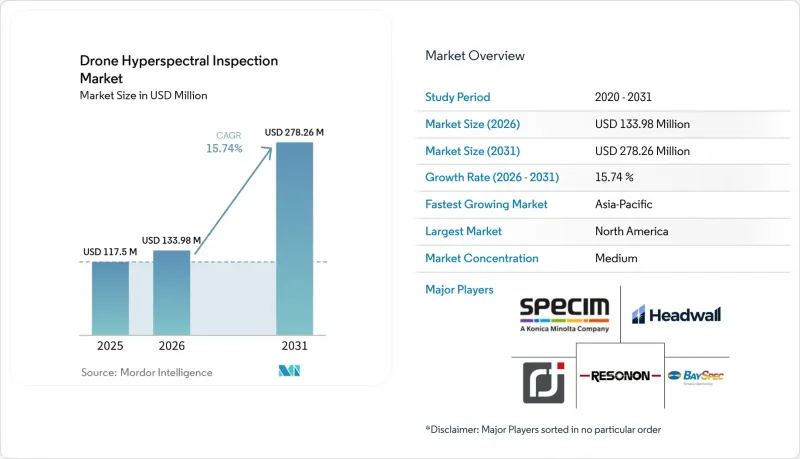
에 따르면 드론에 의한 초분광 검사 시장 규모는 2025년에 1억 1,750만 달러, 2026년에 1억 3,398만 달러에 달하며, 2031년까지 2억 7,826만 달러에 달할 것으로 예측되고 있으며, 2026-2031년에 CAGR 15.74%로 확대할 것으로 전망되고 있습니다.
전 세계 드론 하이퍼스펙트럼 검사 시장의 동향 및 인사이트
소형 UAS용 하이퍼스펙트럼 탑재 장비의 소형화
스냅숏형 측정 장비의 탑재 중량은 2018년 2.8kg에서 2025년에는 600g 미만으로 감소했습니다. 이로 인해 대형 헥사콥터나 고정익 항공기 이외의 활용 옵션이 확대되면서, 드론 하이퍼스펙트럼 검사 시장에서 이용 가능한 플랫폼의 기반이 넓어지고 있습니다. 헤드월 포토닉스(Headwall Photonics)는 2025년 11월, DJI Matrice 350용 ‘Nano HP VNIR’ 시스템을 출시했습니다. 이 회사는 이 시스템을 해당 플랫폼용으로 인증받은, LiDAR를 내장한 유일한 하이퍼스펙트럼 페이로드라고 설명하고 있습니다. 미국 육군의 ‘중소기업 혁신 연구(SBIR)’ 프로그램은 그룹 1 및 그룹 2 UAS를 위해 계속해서 소형이며 내부 보정이 완료된 센서를 요구하고 있습니다. 페이로드의 질량이 감소함에 따라 기체에 대한 요구 사항이 완화되어, 분산된 검사 거점 간에 기체 군을 배치하는 과정을 간소화할 수 있습니다. 이러한 이점은 여러 고객 거점 간에 신속하게 장비를 이동시켜야 하는 서비스 제공업체에게 특히 중요합니다.
AI를 활용한 스펙트럼 분석을 통한 준실시간 검사
는 실용적인 현장 정보로 변환할 수 있습니다. 2025년 연구에서는 VNIR 푸시블룸형 UAS에서 5,000프레임의 이미지에 대해 1,000밀리초 이내에 기내에서 방사 보정이 수행되었음이 입증되었으며, 2026년 9월에는 베이징에서 비행 시험이 계획되어 있습니다. 비행 중 처리를 통해 착륙 후 데이터 다운로드 및 확인에 따른 지연을 줄일 수 있습니다. 이를 통해 기체와 인력이 현장에 머무른 채로 이상 부위를 조사할 수 있게 됩니다. 또한 관련 신호가 감지되었을 때 비행 경로의 수정을 지원할 수도 있습니다. 이러한 기능을 통해 점검 장소가 원격지에 있거나 접근이 제한된 경우에도 1회 비행 시간당 가치를 높일 수 있습니다.
높은 페이로드, 보정 및 데이터 처리 비용
완전히 통합된 시스템의 가격은 전문적인 운영 지원을 포함하지 않더라도 15만 달러를 초과하는 경우가 있으며, 소규모 검사 서비스 제공업체의 자체 소유를 제한하고 하도급 이용을 촉진하고 있습니다. SWIR 그레이팅 분광계의 무게는 보통 2-3kg이며, 이로 인해 멀티로터의 비행 지속 시간이 12-18분으로 단축될 수 있습니다. 이와 유사한 탑재 하중으로 인해 고도 80m에서 1회 비행으로 조사 가능한 면적은 4.2 ha로 제한될 수 있습니다. 암전류 보정, 방사 측정 정규화, 대기 보정이 필요하며, 결과 제공까지 추가 작업이 발생합니다. 2025년 반도체 관세 인상으로 인해 InGaAs 초점면 어레이의 공급 집중에 따른 위험이 높아졌습니다. 이러한 요인들로 인해 광업 및 인프라 분야의 사용자들 사이에서 드론 하이퍼스펙트럼 검사 시장의 확산이 둔화되고 있습니다.
부문 분석
2025년, 멀티로터형 드론은 확립된 페이로드 통합 옵션을 바탕으로 드론 하이퍼스펙트럼 검사 시장 점유율의 46.73%를 차지했습니다. Headwall사와 Specim사는 DJI Matrice 기종용 사전 조정된 VNIR 패키지를 제공하고 있습니다. 수직 이착륙기는 타워, 광산 채굴면, 산업 구조물 주변에서의 근거리 작업에 적합합니다. 또한 이 플랫폼을 통해 현장에서 반복적으로 다양한 각도에서 정찰이 필요한 경우, 작업자가 호버링을 수행할 수 있습니다. 고정익 항공기는 대규모 농림업 조사에서 계속해서 중요한 역할을 수행하고 있습니다. 그 항속 거리 덕분에 활주로나 이륙 조건이 갖춰진 장소에서는 광범위한 데이터 수집이 가능합니다. 단일 로터 시스템은 고지대나 중량이 큰 광산 채굴면의 탑재 하중에서 여전히 중요한 역할을 수행하고 있습니다. 이러한 기체는 멀티로터 구성으로는 필요한 장비를 안전하게 탑재할 수 없는 보다 제한적인 역할을 담당하고 있습니다. 상용 멀티로터 플랫폼의 도입 실적은 운영자에게 드론 하이퍼스펙트럼 검사 시장에 쉽게 진입할 수 있는 발판이 되고 있습니다.
하이브리드 VTOL 드론은 드론 하이퍼스펙트럼 검사 시장에서 2026-2031년까지 연평균 성장률(CAGR) 18.93%로 성장할 것으로 예측됩니다. 이러한 시스템은 수직 이륙과 고정익을 이용한 순항을 결합하여 조사 경로의 커버리지를 향상시킵니다. 시판 모델 중에는 6-15kg의 탑재량과 4-10시간의 비행 지속 시간을 갖춘 제품이 마련되어 있습니다. AeroVironment사는 2025년 9월 자사의 JUMP 20 VTOL에 Arkeus HSOR 탑재체를 통합했습니다. 이 회사에 따르면 이 구성으로 13시간 이상의 비행 지속 시간과 500 nm를 초과하는 시야 외(BLOS) 비행 범위를 실현했다고 합니다. 비행 시간이 길어짐에 따라 파이프라인이나 송전망 계약에서 필요한 비행 횟수를 줄일 수 있습니다. 이를 통해 서비스 제공 기업의 헥타르당 비용을 절감할 가능성이 있습니다. 또한 공급업체의 광역 점검 가격 책정 방식에도 변화를 가져올 가능성이 있습니다. 따라서 드론 하이퍼스펙트럼 점검 시장에서는 호버링 능력보다 거리가 더 중요시되는 상황에서 하이브리드 기체가 더욱 빈번하게 활용될 것으로 보입니다.
VNIR은 사용 사례가 충분히 확립되어 있으며, 2025년에는 부문 점유율의 48.61%를 차지했습니다. 400-1,000 nm의 파장 범위는 식생 평가, 지표면 광물학 및 포장재의 조성 분석에 활용됩니다. 또한 CMOS 기반 검출기는 비교적 도입하기 쉬운 기술적 접근 방식을 제공합니다. Specim사의 AFX10 및 Headwall사의 Nano HP 시리즈 페이로드는 멀티로터 기체에 VNIR을 도입하는 것을 지원합니다. 이를 GNSS 및 IMU 장비와 통합함으로써 측량 설정을 간소화할 수 있습니다. 1,000-1,700 nm를 커버하는 SWIR-I는 수분 매핑 및 특정 광물 분류에 활용됩니다. 또한 근적외선 영역에서의 탄화수소 탐지에도 활용됩니다. 이러한 실용적인 기반을 바탕으로, 드론 하이퍼스펙트럼 검사 시장에서 VNIR에 대한 수요는 계속해서 증가할 것으로 예상됩니다.
SWIR-II는 2026-2031년에 연평균 성장률(CAGR) 18.47%로 확대될 것으로 예측되며, 이는 각 스펙트럼 대역 중 가장 높은 성장률입니다. 1,700-2,500 nm 파장 대역에서는 점토 광물과 탄산염을 더 높은 특이도로 식별할 수 있습니다. 광업 회사는 이 정보를 광물 매핑 및 오염 분석에 활용하고 있습니다. 파이프라인 사업자들도 이 광범위한 커버리지에 의존하는 메탄 관련 스펙트럼 시그니처를 필요로 합니다. Flyscan사가 2026년 4월에 발표한 내용에 따르면 HySpex사의 SWIR 포드를 활용한 상업용 파이프라인 적용 사례가 제시되었습니다. 2025년에 실시된 우라늄 폐광에 대한 조사에서는 VNIR 및 SWIR 데이터를 동기화하여 수집함으로써 오염 물질 확산 매핑의 정확도가 향상된다는 사실이 밝혀졌습니다. MWIR 및 LWIR은 여전히 국방 분야나 고온 산업 모니터링을 위한 특수 구성으로 활용되고 있습니다. 드론 기반 하이퍼스펙트럼 검사 시장에서는 추가적인 스펙트럼 성능으로 인해 높은 시스템 비용이 정당화되는 임무에서 이러한 파장대가 계속해서 채택될 전망입니다.
지역별 분석
2025년, 북미는 드론 하이퍼스펙트럼 검사 시장 점유율의 34.71%를 차지했습니다. 미국 연방 정부의 방위 조달, 성숙한 무인 검사 생태계, 그리고 확립된 석유 및 가스 및 공공사업 분야의 응용이 이 지역의 수요를 지원했습니다. 미 육군은 2026년 7월 Resonon사의 ‘Pika SWIR’ 패키지, 2026년 8월 Cubert사의 ‘ULTRIS X20 Plus’ 시스템에 대해 단독 조달을 통한 입찰 공고를 발표했습니다. 이러한 구매는 상업적 점검 주기에 대한 의존도가 낮은 센서 수요를 지원하는 것입니다.
연방항공청(FAA)은 2026년 4월 1일 섹션 927 면제 절차를 도입하여, 요건을 충족하는 운항에 대한 시야 외 비행 승인 절차를 간소화했습니다. 제안된 파트 108 규정은 2026년 7월 현재 심사 중이며, 이 규정이 확정되면 사례별 면제가 영구적인 승인으로 대체될 가능성이 있습니다. 이를 통해 장거리 파이프라인 및 송전선 점검시 발생할 수 있는 계획상의 마찰이 완화될 수 있습니다. 북미는 규제 및 조달 체계가 광범위한 정기 프로그램을 지원하고 있다는 점에서 여전히 우위를 유지하고 있습니다.
아시아태평양은 2026-2031년까지 연평균 성장률(CAGR) 18.21%로 성장할 것으로 예측됩니다. 중국은 2025년, 하이퍼스펙트럼 기술 연구개발에 11억 5,000만 위안(1억 5,800만 달러 상당)을 배정했습니다. 또한 2026년 1분기 기준, 중국 출원인이 보유한 유효한 하이퍼스펙트럼 관련 특허의 비율은 32.5%에 달하여 2020년의 18.9%에서 증가했습니다. 2025년 전 세계에서 출원된 3,120건의 특허 출원 중 스냅숏 이미징, 압축 센싱을 통한 재구성, 경량 광학 시스템이 61.4%를 차지했습니다. 한편, 2025년도 일본의 국내 드론 시장 규모는 4,973억 엔(34억 달러 상당)에 달했습니다. 인도군의 GPS 비호환 UAS 센싱에 대한 수요는 국내 페이로드 개발을 촉진하고 있습니다. 유럽은 Specim, Cubert, Norsk Elektro Optikk, Senop의 거점으로 자리 잡고 있으며, 2025년에는 유럽의 프로젝트를 통해 VNIR-SWIR을 이용한 오염 모니터링의 유효성이 입증되었으나, 유럽연합 항공안전청(EASA)의 요건으로 인해 다자간 프로그램의 시행이 복잡해지고 있습니다. 중동 및 아프리카의 수요는 광업 및 석유 및 가스 검사와 관련되어 있으며, 남미에서는 광업 및 정밀농업 조사가 주를 이루고 있습니다.
기타 혜택:
- 엑셀 형식의 시장 예측(ME) 시트
- 3개월간의 애널리스트 지원
자주 묻는 질문
목차
제1장 서론
- 조사 전제조건과 시장 정의
- 조사 범위
제2장 조사 방법
제3장 개요
제4장 시장 구도
- 시장 개요
- 시장 성장 촉진요인
- 시장 성장 억제요인
- 거시경제 요인이 시장에 미치는 영향
- 업계의 공급망 분석
- 기술 동향
- 규제 상황
- Porter's Five Forces 분석
제5장 시장 규모와 성장 예측
- 플랫폼 유형별
- 센서 분광 범위별
- 이미징 아키텍처별
- 최종사용자 산업별
- 지역별
- 북미
- 미국
- 캐나다
- 멕시코
- 남미
- 브라질
- 아르헨티나
- 기타 남미 국가
- 유럽
- 독일
- 영국
- 프랑스
- 이탈리아
- 스페인
- 기타 유럽 국가
- 아시아태평양
- 중국
- 일본
- 인도
- 한국
- 기타 아시아태평양 국가
- 중동 및 아프리카
- 중동
- 사우디아라비아
- 아랍에미리트
- 튀르키예
- 기타 중동 국가
- 아프리카
- 남아프리카공화국
- 나이지리아
- 기타 아프리카 국가
- 중동
- 북미
제6장 경쟁 구도
- 시장 집중도
- 전략적 동향
- 시장 점유율 분석
- 기업 개요
- Headwall Photonics, Inc.
- Specim, Spectral Imaging Ltd.
- Resonon, Inc.
- Cubert GmbH
- BaySpec, Inc.
- Telops Inc.
- Norsk Elektro Optikk AS
- Senop Oy
- ITRES Research Limited
- Zolix Instruments Co., Ltd.
- Surface Optics Corporation
- HinaLea Imaging, Inc.
- XIMEA GmbH
- HySpex GmbH
- Haip Solutions Oy
- Spectricon AS
- Spectral Devices Inc.
- TruTag Technologies, Inc.
- Sichuan Dualix Spectral Imaging Technology Co., Ltd.
- Optosky Technology Co., Ltd.
- Titan Electro-Optics Co., Ltd.
- LiSen Optics Co., Ltd.
- South GNSS Navigation Co., Ltd.
제7장 시장 기회와 향후 전망
KSA 26.10.29According to Mordor Intelligence, the drone hyperspectral inspection market size is projected to be USD 117.50 million in 2025, USD 133.98 million in 2026, and reach USD 278.26 million by 2031, expanding at a CAGR of 15.74% from 2026 to 2031.
Global Drone Hyperspectral Inspection Market Trends and Insights
Miniaturization of Hyperspectral Payloads for Small UAS
Payload weight fell from 2.8 kg in 2018 to below 600 g in 2025 for snapshot instruments, expanding deployment options beyond large hexacopters and fixed-wing aircraft and broadening the available platform base for the Drone Hyperspectral Inspection Market. Headwall Photonics launched the Nano HP VNIR system for the DJI Matrice 350 in November 2025. The company described it as the only hyperspectral payload with integrated LiDAR certified for that platform. The U.S. Army Small Business Innovation Research program continues to seek compact, internally calibrated sensors for Group 1 and Group 2 UAS. Lower payload mass reduces aircraft requirements and can simplify fleet deployment across dispersed inspection locations. The benefit is particularly relevant to service providers that must move equipment quickly among multiple client sites.
AI-Enabled Spectral Analytics for Near-Real-Time Inspection
can be converted into usable field information. A 2025 study demonstrated onboard radiometric correction for 5,000 image frames within 1,000 ms on a VNIR pushbroom UAS, with Beijing flight trials planned for September 2026. Processing during a flight can reduce the delay caused by downloading and reviewing data after landing. This allows crews to examine anomalous areas while aircraft and personnel remain on site. It can also support a revised flight path when a relevant signal is detected. These capabilities increase the value of each flight hour when inspection locations are remote or access is restricted.
High Payload, Calibration, and Data-Processing Cost
A fully integrated system can exceed USD 150,000 before specialized operating support is included, limiting in-house ownership for smaller inspection service providers and encouraging subcontracting. SWIR grating spectrometers commonly weigh 2-3 kg, which can reduce multi-rotor endurance to 12-18 minutes. The same payload burden can limit a sortie to 4.2 ha at an altitude of 80 m. Dark-current correction, radiometric normalization, and atmospheric compensation add work before results can be delivered. Semiconductor tariff increases in 2025 raised exposure to the concentrated supply of InGaAs focal-plane arrays. These factors slow wider use of the Drone Hyperspectral Inspection Market among mining and infrastructure users.
Other drivers and restraints analyzed in the detailed report include:
- High-Resolution and Frequent-Revisit Needs in Mining and Environmental Monitoring
- Expansion of Non-Destructive Infrastructure and Industrial Inspection
- Limited Flight Endurance and Illumination Dependence
For complete list of drivers and restraints, kindly check the Table Of Contents.
Segment Analysis
Multi-rotor drones accounted for 46.73% of the Drone Hyperspectral Inspection Market share in 2025, supported by established payload integration options. Headwall and Specim offer pre-aligned VNIR packages for DJI Matrice aircraft. Vertical takeoff and landing suits close-range work around towers, mine faces, and industrial structures. The platform also allows crews to hover when a site needs repeat viewing angles. Fixed-wing aircraft continue to play a role in large agricultural and forestry surveys. Their endurance supports wider-area collection where runway or launch conditions allow operations. Single-rotor systems remain relevant for high-altitude sites and heavier mine-face payloads. These aircraft fill a narrower role where a multi-rotor configuration cannot safely carry the required equipment. The installed base of commercial multi-rotor platforms gives operators a familiar entry point into the Drone Hyperspectral Inspection Market.
Hybrid VTOL drones are projected to expand at an 18.93% CAGR from 2026 to 2031 within the Drone Hyperspectral Inspection Market. These systems combine vertical launch with fixed-wing cruise, thereby improving corridor coverage. Commercial models are available with 6-15 kg payload capacity and 4-10 hours of endurance. AeroVironment integrated the Arkeus HSOR payload with its JUMP 20 VTOL in September 2025. The company stated that the configuration has more than 13 hours of endurance and more than 500 nm of beyond-line-of-sight range. Longer flight time can reduce the number of launches required for a pipeline or transmission contract. This may lower per-hectare costs for service firms. It can also change how suppliers price wide-area inspections. The Drone Hyperspectral Inspection Market may therefore see hybrid aircraft used more often where distance is more important than hover capability.
VNIR held 48.61% of the segment share in 2025 because its use cases are well established. The 400-1,000 nm range supports vegetation assessment, surface mineralogy, and pavement composition. CMOS-based detectors also provide a comparatively accessible technical path. Specim AFX10 and Headwall Nano HP series payloads support VNIR deployment on multi-rotor aircraft. Their integration with GNSS and IMU equipment can simplify survey setup. SWIR-I, covering 1,000-1,700 nm, supports moisture mapping and selected mineral classification. It also has uses in near-infrared hydrocarbon detection. This practical basis supports continued demand for VNIR within the Drone Hyperspectral Inspection Market.
SWIR-II is projected to expand at an 18.47% CAGR from 2026 to 2031, the highest rate among spectral ranges. The 1,700-2,500 nm range can distinguish clay minerals and carbonates with greater specificity. Mining companies use this information for mineral mapping and contamination analysis. Pipeline operators also need methane-related spectral signatures that rely on this broader coverage. Flyscan's April 2026 announcement showed a commercial pipeline application using a HySpex SWIR pod. A 2025 study on uranium legacy mines found that co-aligned VNIR-SWIR data improved contamination-dispersal mapping. MWIR and LWIR remain specialized configurations for defense and high-temperature industrial monitoring. The Drone Hyperspectral Inspection Market is likely to retain these ranges for missions where their added spectral capability justifies a higher system cost.
Complete Report Scope:
- By Platform Type
- Fixed-Wing Drones
- Multi-Rotor Drones
- Single-Rotor Drones
- Hybrid VTOL Drones
- By Sensor Spectral Range
- VNIR, 400-1,000 nm
- SWIR-I (NIR-SWIR), 1,000-1,700 nm
- SWIR-II, 1,700-2,500 nm
- MWIR and LWIR, above 2,500 nm
- By Imaging Architecture
- Pushbroom and Line-Scan
- Snapshot and Area-Scan
- Tunable-Filter
- Fourier-Transform and Interferometric
- Other Imaging Architectures
- By End-User Industry
- Mining and Metals Companies
- Utilities and Infrastructure Operators
- Agriculture and Forestry Enterprises
- Government and Defense Organizations
- Research Institutions
- Other End-User Industries
- By Geography
- North America
- United States
- Canada
- Mexico
- South America
- Brazil
- Argentina
- Rest of South America
- Europe
- Germany
- United Kingdom
- France
- Italy
- Spain
- Rest of Europe
- Asia-Pacific
- China
- Japan
- India
- South Korea
- Rest of Asia-Pacific
- Middle East and Africa
- Middle East
- Saudi Arabia
- United Arab Emirates
- Turkey
- Rest of the Middle East
- Africa
- South Africa
- Nigeria
- Rest of Africa
- Middle East
- North America
Geography Analysis
North America accounted for 34.71% of the Drone Hyperspectral Inspection Market share in 2025. U.S. federal defense procurement, a mature unmanned inspection ecosystem, and established oil and gas and utility applications supported regional demand. The U.S. Army issued sole-source solicitations for a Resonon Pika SWIR package in July 2026 and a Cubert ULTRIS X20 Plus system in August 2026. These purchases support sensor demand that is less dependent on commercial inspection cycles.
The Federal Aviation Administration implemented its Section 927 waiver process on April 1, 2026, streamlining beyond-visual-line-of-sight approvals for qualifying operations. The proposed Part 108 rule was under review in July 2026 and, if finalized, could replace case-by-case waivers with standing approvals. This could reduce planning friction for long pipeline and transmission inspections. North America retains an advantage where regulation and procurement support recurring large-area programs.
Asia-Pacific is projected to expand at an 18.21% CAGR from 2026 to 2031. China allocated CNY 1.15 billion, equivalent to USD 158 million, to hyperspectral research and development in 2025, while Chinese applicants held 32.5% of active hyperspectral patents in Q1 2026, up from 18.9% in 2020. Snapshot imaging, compressed-sensing reconstruction, and lightweight optics represented 61.4% of 3,120 global applications filed in 2025, while Japan's domestic drone business reached JPY 497.3 billion, equivalent to USD 3.4 billion, in fiscal year 2025. India's military requirement for GPS-denied UAS sensing supports domestic payload development. Europe remains a center for Specim, Cubert, Norsk Elektro Optikk, and Senop, while European projects validated VNIR-SWIR contamination monitoring in 2025, and European Union Aviation Safety Agency requirements complicate multi-country programs. The Middle East and Africa demand is tied to mining and oil and gas inspections, while South America relies on mining and precision agriculture surveys.
- Headwall Photonics, Inc.
- Specim, Spectral Imaging Ltd.
- Resonon, Inc.
- Cubert GmbH
- BaySpec, Inc.
- Telops Inc.
- Norsk Elektro Optikk AS
- Senop Oy
- ITRES Research Limited
- Zolix Instruments Co., Ltd.
- Surface Optics Corporation
- HinaLea Imaging, Inc.
- XIMEA GmbH
- HySpex GmbH
- Haip Solutions Oy
- Spectricon AS
- Spectral Devices Inc.
- TruTag Technologies, Inc.
- Sichuan Dualix Spectral Imaging Technology Co., Ltd.
- Optosky Technology Co., Ltd.
- Titan Electro-Optics Co., Ltd.
- LiSen Optics Co., Ltd.
- South GNSS Navigation Co., Ltd.
Additional Benefits:
- The market estimate (ME) sheet in Excel format
- 3 months of analyst support
TABLE OF CONTENTS
1 INTRODUCTION
- 1.1 Study Assumptions and Market Definition
- 1.2 Scope of the Study
2 RESEARCH METHODOLOGY
3 EXECUTIVE SUMMARY
4 MARKET LANDSCAPE
- 4.1 Market Overview
- 4.2 Market Drivers
- 4.2.1 Miniaturization of Hyperspectral Payloads for Small UAS
- 4.2.2 AI-Enabled Spectral Analytics for Near-Real-Time Inspection
- 4.2.3 High-Resolution and Frequent-Revisit Needs in Mining and Environmental Monitoring
- 4.2.4 Expansion of Non-Destructive Infrastructure and Industrial Inspection
- 4.2.5 Vertical-Face and Oblique-View Inspection from Purpose-Built UAS Payloads
- 4.2.6 Spectral Digital Twins for Asset and Terrain Condition Monitoring
- 4.3 Market Restraints
- 4.3.1 High Payload, Calibration, and Data-Processing Cost
- 4.3.2 Limited Flight Endurance and Illumination Dependence
- 4.3.3 Weak Interoperability with Inspection and Mine-Planning Software
- 4.3.4 Shortage of Validated Spectral Libraries and Mission-Ready Operators
- 4.4 Impact of Macroeconomic Factors on the Market
- 4.5 Industry Supply-Chain Analysis
- 4.6 Technology Outlook
- 4.7 Regulatory Landscape
- 4.8 Porter's Five Forces Analysis
- 4.8.1 Threat of New Entrants
- 4.8.2 Bargaining Power of Suppliers
- 4.8.3 Bargaining Power of Buyers
- 4.8.4 Threat of Substitutes
- 4.8.5 Intensity of Competitive Rivalry
5 MARKET SIZE AND GROWTH FORECASTS (VALUE)
- 5.1 By Platform Type
- 5.1.1 Fixed-Wing Drones
- 5.1.2 Multi-Rotor Drones
- 5.1.3 Single-Rotor Drones
- 5.1.4 Hybrid VTOL Drones
- 5.2 By Sensor Spectral Range
- 5.2.1 VNIR, 400-1,000 nm
- 5.2.2 SWIR-I (NIR-SWIR), 1,000-1,700 nm
- 5.2.3 SWIR-II, 1,700-2,500 nm
- 5.2.4 MWIR and LWIR, above 2,500 nm
- 5.3 By Imaging Architecture
- 5.3.1 Pushbroom and Line-Scan
- 5.3.2 Snapshot and Area-Scan
- 5.3.3 Tunable-Filter
- 5.3.4 Fourier-Transform and Interferometric
- 5.3.5 Other Imaging Architectures
- 5.4 By End-User Industry
- 5.4.1 Mining and Metals Companies
- 5.4.2 Utilities and Infrastructure Operators
- 5.4.3 Agriculture and Forestry Enterprises
- 5.4.4 Government and Defense Organizations
- 5.4.5 Research Institutions
- 5.4.6 Other End-User Industries
- 5.5 By Geography
- 5.5.1 North America
- 5.5.1.1 United States
- 5.5.1.2 Canada
- 5.5.1.3 Mexico
- 5.5.2 South America
- 5.5.2.1 Brazil
- 5.5.2.2 Argentina
- 5.5.2.3 Rest of South America
- 5.5.3 Europe
- 5.5.3.1 Germany
- 5.5.3.2 United Kingdom
- 5.5.3.3 France
- 5.5.3.4 Italy
- 5.5.3.5 Spain
- 5.5.3.6 Rest of Europe
- 5.5.4 Asia-Pacific
- 5.5.4.1 China
- 5.5.4.2 Japan
- 5.5.4.3 India
- 5.5.4.4 South Korea
- 5.5.4.5 Rest of Asia-Pacific
- 5.5.5 Middle East and Africa
- 5.5.5.1 Middle East
- 5.5.5.1.1 Saudi Arabia
- 5.5.5.1.2 United Arab Emirates
- 5.5.5.1.3 Turkey
- 5.5.5.1.4 Rest of the Middle East
- 5.5.5.2 Africa
- 5.5.5.2.1 South Africa
- 5.5.5.2.2 Nigeria
- 5.5.5.2.3 Rest of Africa
- 5.5.5.1 Middle East
- 5.5.1 North America
6 COMPETITIVE LANDSCAPE
- 6.1 Market Concentration
- 6.2 Strategic Moves
- 6.3 Market Share Analysis
- 6.4 Company Profiles (includes Global Level Overview, Market Level Overview, Core Segments, Financials as available, Strategic Information, Market RankandShare, Products and Services, Recent Developments)
- 6.4.1 Headwall Photonics, Inc.
- 6.4.2 Specim, Spectral Imaging Ltd.
- 6.4.3 Resonon, Inc.
- 6.4.4 Cubert GmbH
- 6.4.5 BaySpec, Inc.
- 6.4.6 Telops Inc.
- 6.4.7 Norsk Elektro Optikk AS
- 6.4.8 Senop Oy
- 6.4.9 ITRES Research Limited
- 6.4.10 Zolix Instruments Co., Ltd.
- 6.4.11 Surface Optics Corporation
- 6.4.12 HinaLea Imaging, Inc.
- 6.4.13 XIMEA GmbH
- 6.4.14 HySpex GmbH
- 6.4.15 Haip Solutions Oy
- 6.4.16 Spectricon AS
- 6.4.17 Spectral Devices Inc.
- 6.4.18 TruTag Technologies, Inc.
- 6.4.19 Sichuan Dualix Spectral Imaging Technology Co., Ltd.
- 6.4.20 Optosky Technology Co., Ltd.
- 6.4.21 Titan Electro-Optics Co., Ltd.
- 6.4.22 LiSen Optics Co., Ltd.
- 6.4.23 South GNSS Navigation Co., Ltd.
7 MARKET OPPORTUNITIES AND FUTURE OUTLOOK
- 7.1 White-Space and Unmet-Need Assessment


