

|
시장보고서
상품코드
2157087
오픈 네트워크 배포 준비 상황 : 시장 점유율 분석, 업계 동향과 통계, 성장 예측(2026-2031년)Open Network Deployment Readiness - Market Share Analysis, Industry Trends & Statistics, Growth Forecasts (2026 - 2031) |
||||||
 Mordor Intelligence
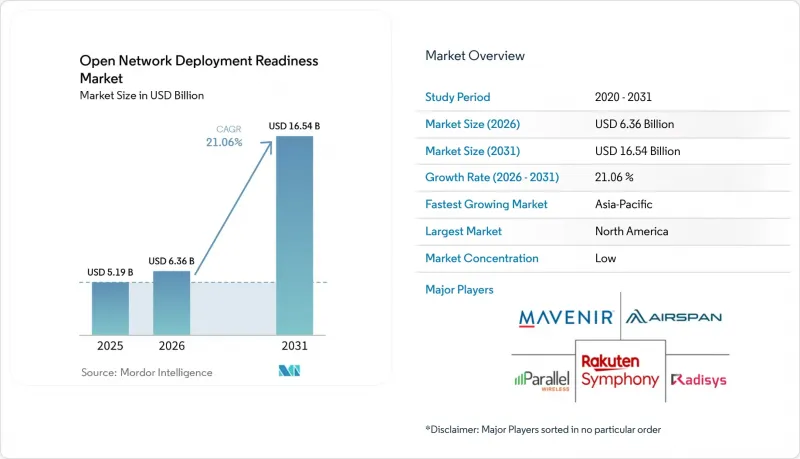
에 따르면 오픈 네트워크 도입 준비 시장 규모는 2025년 51억 9,000만 달러에서 2026년에는 63억 6,000만 달러로 확대하며, 2026-2031년에 CAGR 21.06%로 추이하며, 2031년에는 165억 4,000만 달러에 달할 것으로 예측됩니다.
전 세계 오픈 네트워크 도입 준비 시장의 동향 및 인사이트
5G 및 클라우드 네이티브를 통한 네트워크 현대화
클라우드 네이티브 5G 네트워크를 통해 소프트웨어 정의 기지국은 현장에 직접 방문하지 않고도 구성 변경을 적용받을 수 있게 되어, 다중 벤더 배포에 필요한 테스트 및 준비 시간이 단축됩니다. AT&T는 2026년까지 무선 장비 교체 프로그램의 50% 이상이 완료되고, 네트워크 트래픽의 절반 이상을 오픈 호환 하드웨어가 담당하게 될 것이라고 보고했습니다. 이 회사는 또한 두 도시에서 Cloud RAN의 본격적인 운영을 추진 중이며, 이 기술이 실제 운영 네트워크로 전환되고 있음을 보여주고 있습니다. O2 Telefonica는 2025년 독일 오펜바흐에서 상용 5G 독립형(SA) 네트워크에 에릭슨의 Cloud RAN을 도입했습니다. NTT 도코모는 2026년 3월 온프레미스와 클라우드를 결합한 하이브리드 환경에서 상용 5G 코어 서비스를 개시했으며, 에이전트형 AI를 통한 자동화로 도입 시간을 80% 단축했다고 보고했습니다. 이러한 노력은 오픈 네트워크 도입 준비 시장에서 자동화, 오케스트레이션 및 통합 기능의 가치를 높이고 있습니다.
개방적이고 안전한 통신 공급망에 대한 정부 자금 지원
공적 자금은 정책적 공약에서 테스트, 제품 개발, 시스템 통합을 지원하는 보조금으로 전환되고 있습니다. 미국 국립통신정보국(NTIA)은 ‘공공 무선 공급망 혁신 기금’의 제1차 및 제2차 공모를 통해 35개 프로젝트에 총 5억 5,000만 달러 이상을 지원했습니다. 제3차 공모에서는 멀티 벤더 Open RAN 도입을 위한 소프트웨어 및 통합 자동화에 최대 4억 5,000만 달러가 배정되었습니다. 영국의 ‘오픈 네트워크 연구개발 기금’은 2025년 평균 환율을 기준으로 2026년 3월까지 테스트 인프라, 제품 개발 및 상용화를 위한 준비 활동에 2억 5,000만 파운드(3억 2,000만 달러)를 지원했습니다. 2026년 4월, 일본 경제산업성(METI)은 7개국에 걸친 Open RAN 및 RAN 지능형 컨트롤러 도입을 위해 라쿠텐 심포니에 최대 80억 엔(5,020만 달러)의 보조금을 지급하기로 결정했습니다. 이러한 조치는 상호 운용성이 입증된 공급업체를 우대함으로써, 오픈 네트워크 도입 준비 시장을 지원하기 위한 것입니다.
다중 벤더 간의 상호 운용성 및 통합의 복잡성
공급업체가 공표된 규격에 부합하더라도, 다중 벤더 통합은 여전히 상용 도입에 있으며, 주요 제약 요인으로 남아 있습니다. 전기통신과학연구소는 2025년에 3GPP 및 O-RAN 얼라이언스의 사양을 준수하는 장비라 하더라도 상호 운용성 문제가 발생할 수 있음을 밝혔습니다. 문제점으로는 타이머 설정, 메시지 처리, 비트레이트 호환성, 그리고 표준 버전의 차이 등이 꼽혔습니다. ATIS의 ‘Open RAN Minimum Viable Profile Version 2’에서는 해석, 설정 및 옵션 기능의 차이가 상호 운용성을 어렵게 하고 있다고 지적하고 있습니다. 통신사업자와 시스템 통합사업자는 서로 경쟁 관계에 있을 수 있는 공급업체들 간에 디버깅 작업을 조율해야 합니다. 또한 개별 구성 요소가 업데이트될 때마다 인증 절차의 일부가 다시 시작될 가능성이 있으며, 오픈 네트워크 도입 준비 시장에 지속적인 비용이 추가될 것입니다.
부문 분석
2025년, 하드웨어는 오픈 네트워크 도입 준비 시장 점유율의 48.37%를 차지했습니다. 통신사업자가 오픈 네트워크 아키텍처로 전환할 때, 일반적으로 무선 장비 조달이 그 출발점이 됩니다. 또한 무선 장비는 RAN 업그레이드 주기에서 자본 지출의 상당 부분을 차지하고 있습니다. 2025년 조달 주기에서는 4G 장비 교체가 유럽 및 북미 전역에서 계획된 5G 커버리지 확대와 연계되었습니다. 소프트웨어는 컨테이너화된 네트워크 기능과 클라우드 네이티브 오케스트레이션 툴을 제공합니다. 이러한 제품은 일회성 구매가 아닌, 지속적인 라이선스 계약을 통해 판매되는 사례가 늘고 있습니다.
서비스 시장은 2026-2031년에 연평균 성장률(CAGR) 22.32%로 확대될 것으로 예측됩니다. 시스템 통합, 멀티벤더 테스트 및 관리형 오케스트레이션은 많은 이동통신사업자가 보유한 사내 엔지니어링 역량을 초과하는 경우가 있습니다. NTT 도코모는 2026년 7월, 에릭슨의 O-RAN 얼라이언스 준수 RAN 프로세서 ‘6672’의 상용 도입을 완료했으며, 이전 세대에 비해 용량 효율이 최대 4배 향상되고 에너지 소비량이 50% 이상 감소했다고 보고했습니다. 또한 이 프로세서는 멀티 벤더 무선 유닛 간의 상호 운용성도 지원합니다. 2026년 6월, Mavenir는 통신사업자의 AI 서비스를 위해 토큰 기반 과금 방식을 채택한 Red Hat과의 통합 AI 플랫폼을 발표했습니다. 오픈 네트워크 도입 준비 시장에서는 Airspan, Benetel, Baicells 등 무선 유닛 전문 기업이 소프트웨어 및 서비스 제공업체와는 별도로 경쟁을 펼치고 있습니다.
2025년, 무선 유닛은 아키텍처 계층에서 38.65%라는 최대 점유율을 차지했습니다. 이는 네트워크와 주파수 대역을 연결하는 물리적 인터페이스이므로, 통신사업자는 오픈 네트워크 프로그램의 초기 단계에서 이를 업그레이드하거나 교체해야 합니다. 현재 여러 공급업체가 다양한 주파수 대역을 지원하는 O-RAN 준수 무선 유닛을 제공하고 있습니다. 또한 무선 유닛은 자본 집약적이며, 일상적인 네트워크 운영에서 매우 두드러진 존재입니다. 소프트웨어 계층의 경우, 중앙 집중형 유닛과 RAN 지능형 컨트롤러가 상용화되고 있습니다. RAN 지능형 컨트롤러는 AI를 활용한 네트워크 최적화를 위한 xApps 및 rApps를 호스팅합니다.
분산형 유닛 시장 규모는 2026-2031년에 연평균 성장률(CAGR) 21.84%로 확대될 것으로 예측됩니다. 통신사업자는 이 계층을 활용하여 베이스밴드 처리를 상용 서버에서 실행 가능한 소프트웨어 배포형 기능으로 분해하고 있습니다. 이를 통해 사이트당 연산 비용을 절감하고, 클라우드 네이티브 수명주기관리를 지원할 수 있게 됩니다. 라쿠텐 모바일은 2026년 2월, AirHop Communications 및 Future Connections사의 타사 rApps를 포함하여 RAN 지능형 컨트롤러 애플리케이션의 전국적 배포를 완료했습니다. 또한 Rakuten Symphony는 2026년 1월, 일본 OTIC로부터 O-RAN 적합성 및 상호운용성 배지 인증을 획득했습니다. 이 인증은 오픈 네트워크 도입 준비 시장에서의 공급업체 선정에 영향을 미칠 가능성이 있습니다.
지역별 분석
2025년, 북미는 42.19%의 점유율을 차지했습니다. AT&T의 무선 장비 교체 프로그램이 이 지역의 상업적 입지를 지원한 반면, NTIA는 첫 두 차례의 자금 지원 라운드를 통해 35건의 시험 및 상용화 프로젝트에 5억 5,000만 달러 이상을 지원했습니다. 미배정된 미국 무선 혁신 기금(Wireless Innovation Fund)의 8억 5,000만 달러 규모의 지원 약속이 취소됨에 따라 하드웨어 및 소프트웨어 개발자가 이용할 수 있는 단기적인 공공 공동 투자가 감소했습니다. 또한 NTIA는 5,000만 달러를 투자하여 AI 네이티브 6G 아키텍처를 모색할 새로운 기회를 계획했습니다. 캐나다에서는 농촌 및 외딴 지역의 연결성을 향상시키기 위해 개방형 기술의 활용을 확대하고 있습니다. Mavenir사는 2026년 2월, 클라우드 네이티브 가상화 RAN 및 패킷 코어 상에서 Terrestar사의 하이브리드 위성 IoT 서비스를 구축했습니다. 남미는 여전히 초기 단계에 있지만, 일본 경제산업성(METI)이 지원하는 ‘Rakuten Symphony’ 구상은 2026년 5월부터 2029년 3월까지 볼리비아와 파라과이에서 오픈 네트워크 구축을 위한 준비 시장을 지원하고 있습니다.
유럽에서는 오픈 네트워크 도입 준비 시장에서 시험 단계에서 상용 규모 활동으로 전환되고 있습니다. 통신사업자들은 공급업체 기반의 다각화와 레거시 시스템 및 오픈 무선 시스템의 공존 관리라는 과제에 직면해 있습니다. 보더폰과 삼성이 2025년에 시작한 프로그램은 독일에서 시작되어 5년 동안 수천 곳의 거점으로 확대될 예정입니다. 이 전개에는 2G, 4G, 5G를 지원하는 가상화 RAN 소프트웨어, O-RAN 무선 장비 및 AI 기반 자동화 툴이 포함됩니다. 도이치 통신, 오렌지, 텔레포니카, 보다폰을 포함한 더 광범위한 통신사업자들이 Open RAN 도입을 약속하고 있습니다. 러시아의 기여는 여전히 제한적인 수준에 머물러 있습니다. 이는 제재와 지정학적 제약으로 인해 러시아가 유럽 전체의 오픈 네트워크 생태계에서 고립되어 있기 때문입니다. 오픈 네트워크 도입 준비 시장において, 이 지역의 다음 단계는 멀티벤더에 의한 시범 운영을 각 국내 시장 전체에서 재현 가능한 프로그램으로 발전시키는 데 달려 있습니다.
아시아태평양은 2026-2031년까지 연평균 성장률(CAGR) 22.48%를 기록하며 가장 빠르게 성장하는 지역이 될 것으로 예측됩니다. 일본의 오픈 가상화 RAN 운영 활동과 인도의 국내 통신 장비 제조 프로그램이 이러한 성장을 지원하고 있습니다. NTT 도코모, KDDI, 소프트뱅크, 라쿠텐 모바일은 각각 다른 단계에서 오픈 RAN 및 가상화 RAN 프로그램을 추진하고 있습니다. 라쿠텐 모바일은 해당 지역의 다른 통신사업자들에게 대규모 운영 실적이라는 귀중한 참고 사례를 제공하고 있습니다. NTT 도코모가 2026년 7월에 도입한 프로세서는 이전 세대에 비해 최대 4배의 용량 효율을 실현하고, 에너지 소비량을 50% 이상 줄였다고 보고되었습니다. 인도는 생산 연계형 인센티브 제도 하에서 136건의 통신 장비 제조 프로젝트를 승인했습니다. 중동 및 아프리카는 오픈 네트워크 도입 준비 시장에서 성장 단계에 있는 지역으로, 사우디아라비아, 아랍에미리트(UAE), 터키, 남아프리카공화국, 나이지리아, 이집트가 오픈 네트워크 접근 방식을 평가하거나 시범 도입하고 있습니다.
기타 혜택:
- 엑셀 형식의 시장 예측(ME) 시트
- 3개월간의 애널리스트 지원
자주 묻는 질문
목차
제1장 서론
- 조사 전제조건과 시장 정의
- 조사 범위
제2장 조사 방법
제3장 개요
제4장 시장 구도
- 시장 개요
- 거시경제 요인이 시장에 미치는 영향
- 시장 성장 촉진요인
- 시장 성장 억제요인
- 업계 밸류체인 분석
- 규제 상황
- 기술 전망
- Porter's Five Forces 분석
제5장 시장 규모와 성장 예측
- 컴포넌트별
- 아키텍처 층별
- 도입 단계별
- 최종사용자별
- 지역별
- 북미
- 미국
- 캐나다
- 멕시코
- 남미
- 브라질
- 아르헨티나
- 기타 남미 국가
- 유럽
- 독일
- 영국
- 프랑스
- 이탈리아
- 스페인
- 러시아
- 기타 유럽 국가
- 아시아태평양
- 중국
- 일본
- 인도
- 한국
- 호주·뉴질랜드
- 기타 아시아태평양 국가
- 중동
- 사우디아라비아
- 아랍에미리트
- 튀르키예
- 기타 중동 국가
- 아프리카
- 남아프리카공화국
- 나이지리아
- 이집트
- 기타 아프리카 국가
- 북미
제6장 경쟁 구도
- 시장 집중도
- 전략적 동향
- 시장 점유율 분석
- 기업 개요
- Mavenir Systems, Inc.
- Parallel Wireless, Inc.
- Airspan Networks Holdings Inc.
- Radisys Corporation
- Rakuten Symphony, Inc.
- JMA Wireless, LLC
- ASOCS Ltd.
- Comba Telecom Systems Holdings Limited
- Picocom Technology Limited
- Azcom Technology S.r.l.
- SOLiD, Inc.
- Baicells Technologies Co., Ltd.
- Benetel Limited
- Amarisoft, S.A.S.
- Druid Software Limited
- Sercomm Corporation
- VVDN Technologies Private Limited
- AmpliTech Group, Inc.
제7장 시장 기회와 향후 전망
KSA 26.10.30According to Mordor Intelligence, the open network deployment readiness market size is expected to grow from USD 5.19 billion in 2025 to USD 6.36 billion in 2026 and is forecast to reach USD 16.54 billion by 2031 at 21.06% CAGR over 2026-2031.
Global Open Network Deployment Readiness Market Trends and Insights
5G and Cloud-Native Network Modernization
Cloud-native 5G networks allow software-defined base stations to receive configuration changes without physical site visits, reducing the time required to test and prepare multi-vendor deployments. AT&T reported that more than 50% of its radio replacement program had been completed by 2026, and open-capable hardware carried more than half of its network traffic. The company also progressed Cloud RAN live operations in 2 cities, which shows that the technology is moving into operational networks. O2 Telefonica deployed Ericsson Cloud RAN in a commercial 5G standalone network in Offenbach, Germany, in 2025. NTT DOCOMO launched commercial 5G Core services in a hybrid on-premises and cloud environment in March 2026 and reported an 80% reduction in deployment time through agentic AI automation. These programs raise the value of automation, orchestration, and integration capabilities in the open network deployment readiness market.
Government Funding for Open and Secure Telecom Supply Chains
Public funding has moved from policy commitments toward grants that support testing, product development, and system integration. The US National Telecommunications and Information Administration awarded more than USD 550 million across 35 projects through the first 2 rounds of its Public Wireless Supply Chain Innovation Fund. A third round made up to USD 450 million available for software and integration automation for multi-vendor Open RAN deployments. The UK Open Networks Research and Development Fund provided GBP 250 million (USD 320 million) at the 2025 average exchange rate, through March 2026, for test infrastructure, product development, and commercial readiness activities. In April 2026, Japan's METI selected Rakuten Symphony for a grant of up to JPY 8 billion (USD 50.2 million) for Open RAN and RAN Intelligent Controller deployments across 7 countries. These measures support the open network deployment readiness market by favoring suppliers with verified interoperability.
Multi-Vendor Interoperability and Integration Complexity
Multi-vendor integration remains a central constraint to commercial adoption, even when suppliers adhere to published standards. The Institute for Telecommunication Sciences found in 2025 that equipment compliant with 3GPP and O-RAN Alliance specifications could still produce interoperability events. The issues included timer configuration, message handling, bitrate compatibility, and differences between standard versions. The ATIS Open RAN Minimum Viable Profile Version 2 noted that differing interpretations, configurations, and optional features make interoperability difficult. Operators and system integrators must coordinate debugging work among suppliers that may compete with one another. Each update to an individual component can also restart elements of the qualification process and add continuing cost to the open network deployment readiness market.
Other drivers and restraints analyzed in the detailed report include:
- Demand for Vendor Diversity and Network Resilience
- Expansion of Private and Enterprise 5G Networks
- Immature Commercial Scale and Performance Evidence
For complete list of drivers and restraints, kindly check the Table Of Contents.
Segment Analysis
Hardware held 48.37% of the open network deployment readiness market share in 2025. Radio unit procurement is normally the starting point for an operator moving to an open network architecture. Radio equipment also represents a large share of capital spending during a RAN upgrade cycle. The 2025 procurement cycle aligned 4G equipment replacement with planned 5G coverage expansion across Europe and North America. Software provides containerized network functions and cloud-native orchestration tools. These products are increasingly sold through recurring license arrangements rather than single purchases.
Services are projected to expand at a 22.32% CAGR from 2026 to 2031. System integration, multi-vendor testing, and managed orchestration can exceed the internal engineering capacity available to many mobile operators. NTT DOCOMO completed a commercial deployment of Ericsson's O-RAN Alliance-compliant RAN Processor 6672 in July 2026, reporting up to 4 times higher capacity efficiency and more than 50% lower energy use than the prior generation. The processor also supported interoperability among multi-vendor radio units. In June 2026, Mavenir introduced an Integrated AI Platform with Red Hat that used token-based consumption for operator AI services. Within the open network deployment readiness market, radio-unit specialists, including Airspan, Benetel, and Baicells, compete separately from software and service providers.
The radio unit held the largest share of the architecture layer at 38.65% in 2025. It is the physical interface that connects the network to the spectrum, so operators must upgrade or replace it early in an open network program. Multiple suppliers now offer O-RAN-compliant radio units across frequency bands. Radio units are also capital-intensive and highly visible in daily network operations. Centralized units and RAN Intelligent Controllers are gaining commercial use as software layers. The RAN Intelligent Controller hosts xApps and rApps for AI-enabled network optimization.
Distributed unit is projected to grow at a 21.84% CAGR from 2026 to 2031. Operators use this layer to disaggregate baseband processing into software-deployable functions that can run on commercial off-the-shelf servers. This can reduce per-site compute costs and support cloud-native lifecycle management. Rakuten Mobile completed a nationwide deployment of RAN Intelligent Controller applications in February 2026, including third-party rApps from AirHop Communications and Future Connections. Rakuten Symphony also received O-RAN conformance and Interoperability Badge certifications from Japan OTIC in January 2026. Certification can shape supplier selection in the open network deployment readiness market.
Complete Report Scope:
- By Component
- Hardware
- Software
- Services
- By Architecture Layer
- Radio Unit
- Distributed Unit
- Centralized Unit
- RAN Intelligent Controller
- Other Architecture Layers
- By Deployment Phase
- Greenfield Deployment
- Brownfield Modernization
- Pilot and Field Trial
- Other Deployment Phases
- By End User
- Mobile Network Operators
- Neutral-Host Providers
- Enterprises and Industry Verticals
- Government and Defense Organizations
- By Geography
- North America
- United States
- Canada
- Mexico
- South America
- Brazil
- Argentina
- Rest of South America
- Europe
- Germany
- United Kingdom
- France
- Italy
- Spain
- Russia
- Rest of Europe
- Asia-Pacific
- China
- Japan
- India
- South Korea
- Australia and New Zealand
- Rest of Asia-Pacific
- Middle East
- Saudi Arabia
- United Arab Emirates
- Turkey
- Rest of Middle East
- Africa
- South Africa
- Nigeria
- Egypt
- Rest of Africa
- North America
Geography Analysis
North America held 42.19% share in 2025. AT&T's radio swap program supported the region's commercial position, while the NTIA funded more than USD 550 million across 35 testing and commercialization projects through the first 2 funding rounds. The rescission of USD 850 million in unallocated US Wireless Innovation Fund commitments reduced near-term public co-investment available to hardware and software developers. NTIA also planned a new opportunity using USD 50 million to explore AI-native 6G architecture. Canada is broadening the use of open technologies for rural and remote connectivity. Mavenir deployed Terrestar's hybrid satellite IoT service over a cloud-native virtualized RAN and packet core in February 2026. South America remains early stage, though the METI-backed Rakuten Symphony initiative supports the open network deployment readiness market in Bolivia and Paraguay from May 2026 through March 2029.
Europe is moving from trials toward commercial-scale activity in the open network deployment readiness market. Operators face pressure to diversify their supplier base and manage the coexistence of legacy and open radio systems. Vodafone's 2025 program with Samsung began in Germany and is scheduled to extend across thousands of sites over 5 years. The rollout includes virtualized RAN software supporting 2G, 4G, and 5G, O-RAN radios, and AI-based automation tools. A wider group of operators, including Deutsche Telekom, Orange, Telefonica, and Vodafone, has committed to Open RAN adoption. Russia's contribution remains limited because sanctions and geopolitical constraints isolate it from the wider European open network ecosystem. For the open network deployment readiness market, the region's next stage depends on turning multi-vendor trials into repeatable programs across national markets.
Asia-Pacific is projected to be the fastest-growing region at a 22.48% CAGR from 2026 to 2031. Japan's operational open virtualized RAN activity and India's domestic telecom equipment manufacturing program support this growth. NTT DOCOMO, KDDI, SoftBank, and Rakuten Mobile are advancing Open RAN and virtualized RAN programs at different stages. Rakuten Mobile provides a large operational reference for other regional operators. NTT DOCOMO's July 2026 processor deployment reported up to 4 times higher capacity efficiency and more than 50% lower energy consumption than the prior generation. India approved 136 telecom equipment manufacturing projects under its production-linked incentive scheme. The Middle East and Africa are growth-stage areas in the open network deployment readiness market, with Saudi Arabia, the UAE, Turkey, South Africa, Nigeria, and Egypt evaluating or piloting open network approaches.
- Mavenir Systems, Inc.
- Parallel Wireless, Inc.
- Airspan Networks Holdings Inc.
- Radisys Corporation
- Rakuten Symphony, Inc.
- JMA Wireless, LLC
- ASOCS Ltd.
- Comba Telecom Systems Holdings Limited
- Picocom Technology Limited
- Azcom Technology S.r.l.
- SOLiD, Inc.
- Baicells Technologies Co., Ltd.
- Benetel Limited
- Amarisoft, S.A.S.
- Druid Software Limited
- Sercomm Corporation
- VVDN Technologies Private Limited
- AmpliTech Group, Inc.
Additional Benefits:
- The market estimate (ME) sheet in Excel format
- 3 months of analyst support
TABLE OF CONTENTS
1 INTRODUCTION
- 1.1 Study Assumptions and Market Definition
- 1.2 Scope of the Study
2 RESEARCH METHODOLOGY
3 EXECUTIVE SUMMARY
4 MARKET LANDSCAPE
- 4.1 Market Overview
- 4.2 Impact of Macroeconomic Factors on the Market
- 4.3 Market Drivers
- 4.3.1 5G and Cloud-Native Network Modernization
- 4.3.2 Government Funding for Open and Secure Telecom Supply Chains
- 4.3.3 Demand for Vendor Diversity and Network Resilience
- 4.3.4 Expansion of Private and Enterprise 5G Networks
- 4.3.5 Reusable Test Automation Reducing Readiness-Cycle Time
- 4.3.6 Open RAN Reference Platforms for Rapid Field Replication
- 4.4 Market Restraints
- 4.4.1 Multi-Vendor Interoperability and Integration Complexity
- 4.4.2 Immature Commercial Scale and Performance Evidence
- 4.4.3 Timing, Synchronization, and Energy-Efficiency Gaps
- 4.4.4 Shortage of Open Network Integration Skills
- 4.5 Industry Value Chain Analysis
- 4.6 Regulatory Landscape
- 4.7 Technological Outlook
- 4.8 Porter's Five Forces Analysis
- 4.8.1 Bargaining Power of Suppliers
- 4.8.2 Bargaining Power of Buyers
- 4.8.3 Threat of New Entrants
- 4.8.4 Threat of Substitutes
- 4.8.5 Rivalry Among Existing Competitors
5 MARKET SIZE AND GROWTH FORECASTS (VALUE)
- 5.1 By Component
- 5.1.1 Hardware
- 5.1.2 Software
- 5.1.3 Services
- 5.2 By Architecture Layer
- 5.2.1 Radio Unit
- 5.2.2 Distributed Unit
- 5.2.3 Centralized Unit
- 5.2.4 RAN Intelligent Controller
- 5.2.5 Other Architecture Layers
- 5.3 By Deployment Phase
- 5.3.1 Greenfield Deployment
- 5.3.2 Brownfield Modernization
- 5.3.3 Pilot and Field Trial
- 5.3.4 Other Deployment Phases
- 5.4 By End User
- 5.4.1 Mobile Network Operators
- 5.4.2 Neutral-Host Providers
- 5.4.3 Enterprises and Industry Verticals
- 5.4.4 Government and Defense Organizations
- 5.5 By Geography
- 5.5.1 North America
- 5.5.1.1 United States
- 5.5.1.2 Canada
- 5.5.1.3 Mexico
- 5.5.2 South America
- 5.5.2.1 Brazil
- 5.5.2.2 Argentina
- 5.5.2.3 Rest of South America
- 5.5.3 Europe
- 5.5.3.1 Germany
- 5.5.3.2 United Kingdom
- 5.5.3.3 France
- 5.5.3.4 Italy
- 5.5.3.5 Spain
- 5.5.3.6 Russia
- 5.5.3.7 Rest of Europe
- 5.5.4 Asia-Pacific
- 5.5.4.1 China
- 5.5.4.2 Japan
- 5.5.4.3 India
- 5.5.4.4 South Korea
- 5.5.4.5 Australia and New Zealand
- 5.5.4.6 Rest of Asia-Pacific
- 5.5.5 Middle East
- 5.5.5.1 Saudi Arabia
- 5.5.5.2 United Arab Emirates
- 5.5.5.3 Turkey
- 5.5.5.4 Rest of Middle East
- 5.5.6 Africa
- 5.5.6.1 South Africa
- 5.5.6.2 Nigeria
- 5.5.6.3 Egypt
- 5.5.6.4 Rest of Africa
- 5.5.1 North America
6 COMPETITIVE LANDSCAPE
- 6.1 Market Concentration
- 6.2 Strategic Moves
- 6.3 Market Share Analysis
- 6.4 Company Profiles (includes Global Level Overview, Market Level Overview, Core Segments, Financials as available, Strategic Information, Market Rank/Share, Products and Services, Recent Developments)
- 6.4.1 Mavenir Systems, Inc.
- 6.4.2 Parallel Wireless, Inc.
- 6.4.3 Airspan Networks Holdings Inc.
- 6.4.4 Radisys Corporation
- 6.4.5 Rakuten Symphony, Inc.
- 6.4.6 JMA Wireless, LLC
- 6.4.7 ASOCS Ltd.
- 6.4.8 Comba Telecom Systems Holdings Limited
- 6.4.9 Picocom Technology Limited
- 6.4.10 Azcom Technology S.r.l.
- 6.4.11 SOLiD, Inc.
- 6.4.12 Baicells Technologies Co., Ltd.
- 6.4.13 Benetel Limited
- 6.4.14 Amarisoft, S.A.S.
- 6.4.15 Druid Software Limited
- 6.4.16 Sercomm Corporation
- 6.4.17 VVDN Technologies Private Limited
- 6.4.18 AmpliTech Group, Inc.
7 MARKET OPPORTUNITIES AND FUTURE OUTLOOK
- 7.1 White-Space and Unmet-Need Assessment


