

|
시장보고서
상품코드
2157097
금속 성형 장비 : 시장 점유율 분석, 업계 동향과 통계, 성장 예측(2026-2031년)Metal Forming Equipment - Market Share Analysis, Industry Trends & Statistics, Growth Forecasts (2026 - 2031) |
||||||
 Mordor Intelligence
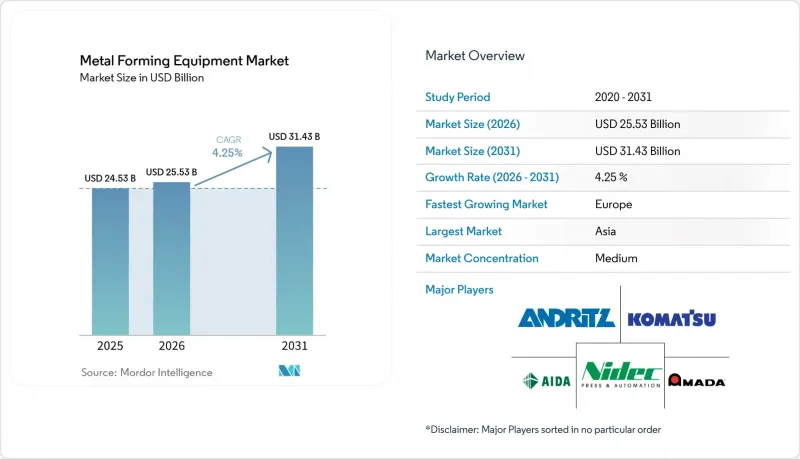
에 따르면 금속 성형 장비 시장 규모는 2025년에 245억 3,000만 달러로 평가되며, 2026년 255억 3,000만 달러에서 2031년까지 314억 3,000만 달러에 달할 것으로 예측되고 있으며, 예측 기간(2026-2031년)에 CAGR은 4.25%에 달할 전망입니다.
세계 금속 성형 장비 시장의 동향 및 인사이트
자동차의 전동화 및 경량화
배터리식 전기자동차(BEV) 플랫폼은 금속 성형 장비 시장에서 사용되는 장비의 구성을 변화시키고 있습니다. 배터리 인클로저, 모터 하우징 및 구조 부재에는 초고장력강의 정밀한 성형이 요구됩니다. 신일철주금에 따르면 일부 자동차용 강종은 최대 2.0 GPa의 인장 강도에 달하고 있으며, 이로 인해 프로그래밍 가능한 슬라이드 동작과 제어된 힘의 가해가 점점 더 필요해지고 있습니다. 1,500 MPa급 냉간 성형용 강재에 대한 조사에서도 DP1470 및 MS1500 등급에는 최적화된 성형 조건과 적응형 프레스 제어가 필요함이 밝혀졌습니다. 기존의 고정 속도식 기계 프레스로는 동등한 동작 범위를 확실하게 제공할 수 없습니다. 따라서 신차 프로그램은 단순한 설비 수요의 점진적 증가에 그치지 않고, 기존 설비의 교체 수요로 이어질 가능성도 있습니다.
자동화 및 스마트 제조
통합 성형 셀을 통해 금속 성형 설비 시장의 투자는 실시간 품질 모니터링 기능을 갖춘 설비로 점차 전환되고 있습니다. ANDRITZ Schuler사는 2026년 1월, 서보 제어식 유압 펌프 구동, 인더스트리 4.0 인터페이스, 그리고 분당 최대 85 스트로크의 스트로크 속도를 갖춘 ‘HFA plus+’ 파인 블랭킹 시리즈를 발표했습니다. 이 회사에 따르면 이 새로운 구동 시스템은 고정 속도의 유압 시스템에 비해 에너지 효율을 두 자릿수만큼 향상시킨다고 합니다. 이러한 기능 덕분에 보다 일관된 공정 제어가 가능해지며, 공급업체는 생산 현황을 기록할 수 있게 됩니다. 또한 자동 벤딩 시스템은 제조업체가 유인 및 무인 교대 근무를 운영하는 데에도 도움이 됩니다. 설비뿐만 아니라 모니터링, 제어, 유지보수 서비스를 제공하는 공급업체는 생산성과 인력 제약이라는 두 가지 문제를 모두 해결할 수 있습니다.
고액의 설비 투자와 긴 갱신 주기
높은 설비 비용과 긴 수명은 금속 성형 장비 시장의 현대화를 지연시키는 요인이 될 수 있습니다. 연방준비제도이사회(FRB) 보고서에 따르면 2026년 6월 미국의 제조업 설비 가동률은 75.7%로, 1972-2025년까지의 평균치인 78.2%보다 낮습니다. 기존 생산 능력으로 인해 단기적으로는 설비를 추가해야 할 시급성이 낮아질 가능성이 있습니다. NIST 보고서에 따르면 감가상각 대상 제조 자산은 3조 3,000억 달러(이 중 기계·설비는 2조 6,000억 달러)에 달하지만, 감가상각 대상 자산 중 ‘신규’로 분류된 것은 고작 4.9%에 불과했습니다. 이는 자본 기반의 노후화와 자산의 사용 연한을 연장하려는 경향을 반영한 것입니다. 중소규모 가공업체의 경우, 서보 시스템이나 디지털 통합 시스템의 전체 수명 주기 비용을 충당하기 어려울 수 있습니다.
부문별 분석
2025년, 프레스기는 금속 성형 설비 시장 규모의 39%를 차지했습니다. 이는 대량 생산 공장에서의 자동차 화이트 바디 프레스 가공, 금속 가공 제품 및 산업용 부품 생산에 힘입은 결과입니다. 확립된 금형과 예측 가능한 부품 설계를 활용한 반복 작업을 수행하는 공장에서는 기계식 및 유압식 프레스기가 여전히 주류를 이루고 있습니다. 서보 프레스는 2026-2031년까지 연평균 성장률(CAGR) 6.8%로 성장할 것으로 예상되며, 이는 각종 설비 중 가장 높은 성장률입니다. 프로그래밍 가능한 슬라이드 동작을 통해 작업 영역 내의 서로 다른 위치에 힘을 가할 수 있으며, 특정 재료나 부품에 맞춰 조정할 수 있습니다. 이 기능은 AHSS(고장력강) 성형 및 배터리 모듈과 정밀 부품의 힘 특성 추적성을 지원합니다.
ANDRITZ Schuler사의 HFA plus+ 파인 블랭킹 시스템은 서보 제어 펌프 구동 장치와 공정 모니터링 인터페이스를 갖추고 있으며, 금속 성형 설비 업계의 투자 방향을 제시하고 있습니다. 프레스 브레이크 및 굽힘 가공기는 협업 로봇을 통합함으로써 별도의 전용 인프라를 크게 구축하지 않고도 유연하고 자동화된 굽힘 가공이 가능해졌습니다. 단조 설비는 니켈 및 티타늄계 소재로 제작된 압축기나 터빈 디스크의 국내 생산 능력을 확대하고 있는 항공우주 제조업체에서 활용되고 있습니다. 롤 성형 장치는 건설 및 재생 가능 에너지 프로젝트에 사용되는 구조용 프로파일의 제조를 지원하고 있습니다. 와이어, 튜브, 프로파일 성형 장치 및 압출 프레스는 전기 인프라 및 자동차용 서브프레임 용도로 활용되고 있습니다.
2025년 금속 성형 장비 시장에서 스탬핑 및 펀칭은 공정 매출의 28.5%를 차지했으며, 그 중심은 순차 금형을 사용하여 제조되는 자동차 차체 패널 및 구조용 브래킷이었습니다. 순차 금형은 부품 생산량이 많고 재현성이 중요한 상황에서 효율적인 처리량을 실현합니다. 굽힘 가공은 CNC 프레스 브레이크 및 자동 셀을 통해 일반 제조, 건설, 산업 기계 분야를 지원하고 있습니다. 심압착 가공은 연료 및 배터리용 케이스, 가전제품 본체, 정밀 의료용 하우징 분야에서 여전히 중요한 역할을 하고 있습니다. 단조는 결정립 조직과 반복 성능이 중요한 항공우주, 방위, 그리고 산업용 구동계 부품을 지원하고 있습니다.
하이드로포밍은 2026-2031년까지 연평균 성장률(CAGR) 7.1%로 성장할 것으로 예측되며, 이는 성형 공정 중 가장 높은 성장률입니다. 이 기술을 통해 개별 프레스 가공을 줄이고, 부품 수를 감소시키며, 조립 작업을 경감하는 동시에 중공 구조 부재를 제조할 수 있습니다. 이러한 용도는 단일 금형으로 복잡한 형상을 성형해야 하는 경량 배터리식 전기자동차의 차체 구조와 관련이 있습니다. 압연, 압출 성형 및 관련 공정은 스케이트보드 플랫폼이나 재생에너지용 랙 시스템을 위한 알루미늄 형재 제조를 지원하고 있습니다. EU의 자동차 배기가스 규제와 미국의 CAFE 기준은 경량 부품을 가공하는 설비에 대한 수요를 지속적으로 지원하고 있습니다.
지역별 분석
아시아태평양은 중국의 전기자동차 생산 거점과 광범위한 산업 생산 능력을 바탕으로 2025년 금속 성형 설비 시장 규모의 53.1%를 차지했습니다. 이 지역에서는 배터리 인클로저, 모터 하우징, 경량 구조 부재 제조를 위한 서보 프레스 라인, 하이드로포밍 셀 및 고톤수 단조 프레스에 대한 수요가 있습니다. 인도에서는 자동차, 방위, 내구 소비재 분야의 생산 능력 투자를 통해 추가적인 성장 기회가 기대되고 있습니다. 일본과 한국은 서보 전동화로의 업그레이드 및 정밀 단조 시스템을 위한 성숙한 교체 시장이 되고 있습니다. 베트남, 태국, 인도네시아에서는 자동차 및 전자기기 제조업체들의 니어쇼어링 투자가 잇따르고 있습니다.
북미는 자동차 생산과 확대되는 전기자동차(EV) 조립 거점에 힘입어 2025년에는 지역별 시장 규모에서 2위를 차지했습니다. ‘2026년 미국 리쇼어링 조사’에 따르면 응답한 OEM의 63%가 2026년 또는 2027년에 국내 설비 투자를 계획하고 있는 것으로 나타났습니다. 또한 36%가 2026년에 리쇼어링을 적극적으로 실행하고 있는 것으로 밝혀졌습니다. 캐나다는 미국의 자동차 공급망과의 통합 및 이와 관련된 부품 수요의 혜택을 받고 있습니다. 멕시코 누에보레온주와 과나후아토주의 클러스터는 계속해서 1차 공급업체들의 투자를 유치하고 있습니다.
유럽에서는 2026-2031년까지 연평균 성장률(CAGR) 5.2%로 성장할 것으로 예측되며, 이는 금속 성형 장비 시장에서 지역별 가장 빠른 성장 속도입니다. 독일, 이탈리아, 프랑스에는 서보 프레스 라인, CNC 프레스 브레이크, 통합 성형 셀과 같은 고부가가치 설비가 도입되고 있습니다. 기능 안전 및 에너지 효율에 관한 요건이 특히 자동차 및 정밀 기계 제조 공장의 설비 갱신을 촉진하고 있습니다. 브라질에서는 자동차 부문을 통해 프레스 기계에 대한 안정적인 수요가 지원되고 있습니다. ANDRITZ Schuler사는 2025년 7월 브라질의 Maxiforja사에 6,500톤 단조 프레스를 납품했으며, 모로코 탕헤르에 위치한 AK Nova Automotive사에 트랜스퍼 프레스를 납품했습니다. 사우디아라비아와 아랍에미리트에서는 산업 다각화에 따라 판금 및 구조 부품의 생산 능력이 확대되고 있으며, 장기적인 비즈니스 기회가 예상됩니다.
기타 혜택:
- 엑셀 형식의 시장 예측(ME) 시트
- 3개월간의 애널리스트 지원
자주 묻는 질문
목차
제1장 서론
- 조사 전제조건과 시장 정의
- 조사 범위
제2장 조사 방법
제3장 개요
제4장 시장 구도
- 시장 개요
- 시장 성장 촉진요인
- 시장 성장 억제요인
- 밸류·공급망 분석
- 규제 상황
- 기술 전망
- 지정학적 이벤트가 시장에 미치는 영향의 평가
제5장 시장 규모와 성장 예측
- 기기 유형별
- 성형 프로세스별
- 성형 재료별
- 최종 용도 산업별
- 지역별
- 북미
- 미국
- 캐나다
- 멕시코
- 남미
- 브라질
- 아르헨티나
- 기타 남미 국가
- 유럽
- 독일
- 이탈리아
- 프랑스
- 영국
- 스페인
- 러시아
- 기타 유럽 국가
- 아시아태평양
- 중국
- 일본
- 인도
- 한국
- ASEAN(싱가포르, 말레이시아, 인도네시아, 태국, 베트남, 필리핀, 미얀마, 캄보디아, 라오스, 브루나이)
- 호주
- 기타 아시아태평양 국가
- 중동 및 아프리카
- 사우디아라비아
- 아랍에미리트
- 튀르키예
- 남아프리카공화국
- 기타 중동 및 아프리카 국가
- 북미
제6장 경쟁 구도
- 시장 집중도
- 전략적 동향
- 시장 점유율 분석
- 기업 개요
- ANDRITZ Schuler Group
- AIDA Engineering, Ltd.
- Komatsu Industries Corp.
- AMADA Group/AMADA Press System Co., Ltd.
- Nidec Press & Automation
- Fagor Arrasate S. Coop.
- JIER Machine-Tool Group Co., Ltd.
- Yangli Group
- Chin Fong Machine Industrial Co., Ltd.
- SEYI Machinery Co., Ltd.
- SIMPAC Inc.
- TRUMPF SE+Co. KG
- Bystronic AG
- Salvagnini Italia S.p.A.
- LVD Company NV
- Ermaksan Makina Sanayi ve Ticaret A.S.
- Prima Power/Prima Industrie S.p.A.
- SMS group GmbH
- Siempelkamp Maschinen-und Anlagenbau GmbH
- LASCO Umformtechnik GmbH
- Tianjin Tianduan Press Co., Ltd.(GENERTEC Tianduan)
- Beckwood Press Company
- Macrodyne Technologies Inc.
제7장 시장 기회와 향후 전망
KSA 26.10.30According to Mordor Intelligence, the metal forming equipment market size was valued at USD 24.53 billion in 2025, and is estimated to grow from USD 25.53 billion in 2026 to reach USD 31.43 billion by 2031, at a CAGR of 4.25% during the forecast period (2026-2031).
Global Metal Forming Equipment Market Trends and Insights
Automotive Electrification and Lightweighting
Battery electric vehicle platforms are changing the mix of equipment used in the metal forming equipment market. Battery enclosures, motor housing, and structural members need controlled forming of ultra-high-strength steels. Nippon Steel reported that some automotive grades reach tensile strengths of up to 2.0 GPa, which increases the need for programmable slide motion and controlled force delivery. Research on 1,500 MPa-class cold-forming steels also showed that DP1470 and MS1500 grades need tailored forming conditions and adaptive press control. Conventional fixed-speed mechanical presses cannot reliably provide the same operating range. New vehicle programs can therefore lead to replacement demand rather than only incremental equipment demand.
Automation and Smart Manufacturing
Integrated forming cells are shifting spending in the metal forming equipment market toward equipment with real-time quality monitoring. ANDRITZ Schuler introduced its HFA plus+ fineblanking series in January 2026 with servo-controlled hydraulic pump drives, Industry 4.0 interfaces, and stroke rates of up to 85 strokes per minute. The company stated that the new drives deliver double-digit energy-efficiency gains against fixed-speed hydraulic systems. These capabilities support more consistent process control and allow suppliers to document production conditions. Automated bending systems also help manufacturers operate manned and unmanned shifts. Suppliers that offer monitoring, controls, and maintenance alongside equipment can address both productivity and labor constraints.
High Capital Investment and Long Replacement Cycles
High equipment costs and long useful lives can delay modernization in the metal forming equipment market. The Federal Reserve reported the United States manufacturing capacity utilization of 75.7% in June 2026, below the 1972-2025 average of 78.2%. Existing capacity can reduce the urgency to add equipment in the near term. NIST reported USD 3.3 trillion in depreciable manufacturing assets, including USD 2.6 trillion in machinery and equipment, while only 4.9% of depreciable assets were classified as new. This reflects an aging capital base and a preference for extending asset life. Small and mid-sized fabricators can find it difficult to fund the full lifecycle cost of servo and digitally integrated systems.
Other drivers and restraints analyzed in the detailed report include:
- Adoption of High-Strength and Lightweight Materials
- Reshoring and Expansion of Regional Manufacturing Capacity
- Raw Material and Critical Component Price Volatility
For complete list of drivers and restraints, kindly check the Table Of Contents.
Segment Analysis
Press machines held 39% of the metal forming equipment market size in 2025, supported by automotive body-in-white stamping, fabricated metal products, and industrial-parts production across high-volume manufacturing plants. Mechanical and hydraulic variants remained the volume base for plants handling repeat work with established tooling and predictable part designs. Servo presses are forecast to grow at a 6.8% CAGR from 2026 to 2031, the fastest rate among equipment types. Their programmable slide motion can deliver force at different points in the working zone and can be adapted to a specific material or part. This capability supports AHSS forming and force-signature traceability for battery modules and precision components.
ANDRITZ Schuler's HFA plus+ fineblanking system shows the investment direction in the metal forming equipment industry, with servo-controlled pump drives and process-monitoring interfaces. Press brakes and bending machines benefit from collaborative robot integration that supports flexible, automated bending without the same level of dedicated infrastructure. Forging equipment serves aerospace producers expanding domestic capacity for compressor and turbine disks made from nickel- and titanium-based materials. Roll-forming equipment supports structural profiles used in construction and renewable-energy projects. Wire, tube, and profile forming equipment and extrusion presses serve electrical infrastructure and automotive sub-frame applications.
Stamping and punching held 28.5% of process revenue within the metal forming equipment market in 2025, led by automotive body panels and structural brackets produced through progressive dies. Progressive dies support efficient throughput where part volumes remain high and repeatability is important. Bending supports general fabrication, construction, and industrial machinery through CNC press brakes and automated cells. Deep drawing remains important for fuel and battery enclosures, appliance bodies, and precision medical housings. Forging supports aerospace, defense, and industrial drivetrain components where grain structure and cyclic performance are important.
Hydroforming is forecast to grow at a 7.1% CAGR from 2026 to 2031, the fastest rate among forming processes. It can create hollow structural members with fewer separate stampings, lower part counts, and less assembly work. This application is relevant to lightweight battery electric vehicle body structures that need complex geometry from a single tool. Rolling, extrusion, and related processes support aluminum profiles for skateboard platforms and renewable-energy racking systems. EU carbon dioxide fleet requirements and the United States CAFE standards sustain the case for equipment that processes lightweight components.
Complete Report Scope:
- By Equipment Type
- Press Machines
- Mechanical Presses
- Hydraulic Presses
- Servo Presses
- Other General-Purpose Presses
- Press Brakes and Bending Machines
- Hydraulic Press Brakes
- Servo / Electric Press Brakes
- Mechanical Press Brakes
- Other Bending Machines
- Forging Equipment
- Forging Presses
- Forging Hammers
- Upsetting and Heading Machines
- Other Forging Equipment
- Roll Forming and Plate/Profile Rolling Equipment
- Roll Forming Machines
- Plate Rolling Machines
- Section and Profile Rolling Machines
- Other Secondary Rolling/Forming Equipment
- Wire, Tube and Profile Forming Equipment
- Wire and Bar Drawing/Forming Equipment
- Tube Forming and Bending Equipment
- Profile Forming Equipment
- Extrusion Presses
- Hydroforming Equipment
- Other Metal Forming Equipment
- Press Machines
- By Forming Process
- Stamping and Punching
- Deep Drawing
- Bending
- Forging
- Rolling and Roll Forming
- Extrusion
- Hydroforming
- Other Forming Processes
- By Material Formed
- Carbon and Low-Alloy Steel
- Stainless Steel
- Aluminum and Aluminum Alloys
- Copper and Copper Alloys
- Titanium, Nickel and Other Non-Ferrous Metals
- Other Materials
- By End-Use Industry
- Automotive and Transportation
- Aerospace and Defense
- Industrial Machinery and Capital Equipment
- Metal Products and Fabrication
- Electrical and Electronics
- Construction and Infrastructure
- Energy and Power
- Consumer Appliances and Durable Goods
- Medical and Precision Manufacturing
- Other End-Use Industries
- By Geography
- North America
- United States
- Canada
- Mexico
- South America
- Brazil
- Argentina
- Rest of South America
- Europe
- Germany
- Italy
- France
- United Kingdom
- Spain
- Russia
- Rest of Europe
- Asia-Pacific
- China
- Japan
- India
- South Korea
- ASEAN (Singapore, Malaysia, Indonesia, Thailand, Vietnam, Philippines, Myanmar, Cambodia, Laos, Brunei)
- Australia
- Rest of Asia-Pacific
- Middle East & Africa
- Saudi Arabia
- United Arab Emirates
- Turkey
- South Africa
- Rest of Middle East & Africa
- North America
Geography Analysis
Asia-Pacific held 53.1% of the metal forming equipment market size in 2025, supported by China's electric-vehicle production base and broad industrial manufacturing capacity. The region needs servo stamping lines, hydroforming cells, and high-tonnage forging presses for battery enclosures, motor housings, and lightweight structural members. India offers incremental opportunity through capacity investment across automotive, defense, and consumer durables. Japan and South Korea are mature replacement markets for servo-electric upgrades and precision forging systems. Vietnam, Thailand, and Indonesia are receiving near-shoring investment from automotive and electronics manufacturers.
North America was the second-largest regional market in 2025, supported by vehicle production and an expanding electric-vehicle assembly footprint. The 2026 USA Reshoring Survey found that 63% of responding OEMs planned domestic capital expenditures in 2026 or 2027. It also found that 36% were actively executing reshoring in 2026. Canada benefits from integration with the United States automotive supply chain and its related demand for components. Mexico's Nuevo Leon and Guanajuato clusters continue to attract tier-1 supplier investment.
Europe is forecast to grow at a 5.2% CAGR from 2026 to 2031, the fastest regional pace in the metal forming equipment market. Germany, Italy, and France have a high-value installed base of servo press lines, CNC press brakes, and integrated forming cells. Functional safety and energy-efficiency requirements support replacement, especially in automotive and precision-engineering plants. Brazil supports consistent press-machine demand through its automotive sector. ANDRITZ Schuler delivered a 6,500-ton forging press to Maxiforja in Brazil in July 2025 and a transfer press to AK Nova Automotive in Tangier, Morocco. Saudi Arabia and the United Arab Emirates offer longer-term opportunities as industrial diversification adds sheet-metal and structural-component capacity.
- ANDRITZ Schuler Group
- AIDA Engineering, Ltd.
- Komatsu Industries Corp.
- AMADA Group / AMADA Press System Co., Ltd.
- Nidec Press & Automation
- Fagor Arrasate S. Coop.
- JIER Machine-Tool Group Co., Ltd.
- Yangli Group
- Chin Fong Machine Industrial Co., Ltd.
- SEYI Machinery Co., Ltd.
- SIMPAC Inc.
- TRUMPF SE + Co. KG
- Bystronic AG
- Salvagnini Italia S.p.A.
- LVD Company NV
- Ermaksan Makina Sanayi ve Ticaret A.S.
- Prima Power / Prima Industrie S.p.A.
- SMS group GmbH
- Siempelkamp Maschinen- und Anlagenbau GmbH
- LASCO Umformtechnik GmbH
- Tianjin Tianduan Press Co., Ltd. (GENERTEC Tianduan)
- Beckwood Press Company
- Macrodyne Technologies Inc.
Additional Benefits:
- The market estimate (ME) sheet in Excel format
- 3 months of analyst support
TABLE OF CONTENTS
1 INTRODUCTION
- 1.1 Study Assumptions and Market Definition
- 1.2 Scope of the Study
2 RESEARCH METHODOLOGY
3 EXECUTIVE SUMMARY
4 MARKET LANDSCAPE
- 4.1 Market Overview
- 4.1.1 Metal Forming Equipment Industry Structure
- 4.1.2 Sheet-Metal vs. Bulk-Metal Forming Equipment
- 4.1.3 Standard Machines vs. Engineered Forming Systems
- 4.2 Market Drivers
- 4.2.1 Automotive Electrification and Lightweighting
- 4.2.2 Adoption of High-Strength and Lightweight Materials
- 4.2.3 Automation and Smart Manufacturing
- 4.2.4 Reshoring and Expansion of Regional Manufacturing Capacity
- 4.2.5 Infrastructure and Industrial Capital Investment
- 4.2.6 Renewable Energy and Electrification Equipment Manufacturing
- 4.3 Market Restraints
- 4.3.1 High Capital Investment and Long Replacement Cycles
- 4.3.2 Tooling and Die Costs
- 4.3.3 Skilled Operator, Tooling and Controls Talent Shortages
- 4.3.4 Raw Material and Critical Component Price Volatility
- 4.3.5 Integration of Legacy Equipment with Automated Production Systems
- 4.4 Value / Supply-Chain Analysis
- 4.4.1 Structural Materials and Machine Components
- 4.4.2 Drives, Hydraulics, Motors and Controls
- 4.4.3 Tooling and Die Ecosystem
- 4.4.4 Metal Forming Equipment Manufacturers
- 4.4.5 Automation and System Integrators
- 4.4.6 Distribution and Dealer Network
- 4.4.7 Service, Retrofit and Lifecycle Support
- 4.5 Regulatory Landscape
- 4.5.1 Machinery Safety and Functional Safety
- 4.5.2 Energy Efficiency and Environmental Requirements
- 4.5.3 End-Industry Qualification Requirements
- 4.5.4 Trade, Tariffs and Export Controls
- 4.6 Technological Outlook
- 4.6.1 Servo and Advanced Drive Technologies
- 4.6.2 CNC and Advanced Process Controls
- 4.6.3 Robotics and Automated Material Handling
- 4.6.4 Connected Machines and IIoT
- 4.6.5 Predictive Maintenance and Condition Monitoring
- 4.6.6 Energy-Efficient Forming Systems
- 4.6.7 Advanced High-Strength and Lightweight Material Forming
- 4.7 Impact Assessment of Geopolitical Events on the Market
5 MARKET SIZE AND GROWTH FORECASTS (Value, In USD Billion)
- 5.1 By Equipment Type
- 5.1.1 Press Machines
- 5.1.1.1 Mechanical Presses
- 5.1.1.2 Hydraulic Presses
- 5.1.1.3 Servo Presses
- 5.1.1.4 Other General-Purpose Presses
- 5.1.2 Press Brakes and Bending Machines
- 5.1.2.1 Hydraulic Press Brakes
- 5.1.2.2 Servo / Electric Press Brakes
- 5.1.2.3 Mechanical Press Brakes
- 5.1.2.4 Other Bending Machines
- 5.1.3 Forging Equipment
- 5.1.3.1 Forging Presses
- 5.1.3.2 Forging Hammers
- 5.1.3.3 Upsetting and Heading Machines
- 5.1.3.4 Other Forging Equipment
- 5.1.4 Roll Forming and Plate/Profile Rolling Equipment
- 5.1.4.1 Roll Forming Machines
- 5.1.4.2 Plate Rolling Machines
- 5.1.4.3 Section and Profile Rolling Machines
- 5.1.4.4 Other Secondary Rolling/Forming Equipment
- 5.1.5 Wire, Tube and Profile Forming Equipment
- 5.1.5.1 Wire and Bar Drawing/Forming Equipment
- 5.1.5.2 Tube Forming and Bending Equipment
- 5.1.5.3 Profile Forming Equipment
- 5.1.6 Extrusion Presses
- 5.1.7 Hydroforming Equipment
- 5.1.8 Other Metal Forming Equipment
- 5.1.1 Press Machines
- 5.2 By Forming Process
- 5.2.1 Stamping and Punching
- 5.2.2 Deep Drawing
- 5.2.3 Bending
- 5.2.4 Forging
- 5.2.5 Rolling and Roll Forming
- 5.2.6 Extrusion
- 5.2.7 Hydroforming
- 5.2.8 Other Forming Processes
- 5.3 By Material Formed
- 5.3.1 Carbon and Low-Alloy Steel
- 5.3.2 Stainless Steel
- 5.3.3 Aluminum and Aluminum Alloys
- 5.3.4 Copper and Copper Alloys
- 5.3.5 Titanium, Nickel and Other Non-Ferrous Metals
- 5.3.6 Other Materials
- 5.4 By End-Use Industry
- 5.4.1 Automotive and Transportation
- 5.4.2 Aerospace and Defense
- 5.4.3 Industrial Machinery and Capital Equipment
- 5.4.4 Metal Products and Fabrication
- 5.4.5 Electrical and Electronics
- 5.4.6 Construction and Infrastructure
- 5.4.7 Energy and Power
- 5.4.8 Consumer Appliances and Durable Goods
- 5.4.9 Medical and Precision Manufacturing
- 5.4.10 Other End-Use Industries
- 5.5 By Geography
- 5.5.1 North America
- 5.5.1.1 United States
- 5.5.1.2 Canada
- 5.5.1.3 Mexico
- 5.5.2 South America
- 5.5.2.1 Brazil
- 5.5.2.2 Argentina
- 5.5.2.3 Rest of South America
- 5.5.3 Europe
- 5.5.3.1 Germany
- 5.5.3.2 Italy
- 5.5.3.3 France
- 5.5.3.4 United Kingdom
- 5.5.3.5 Spain
- 5.5.3.6 Russia
- 5.5.3.7 Rest of Europe
- 5.5.4 Asia-Pacific
- 5.5.4.1 China
- 5.5.4.2 Japan
- 5.5.4.3 India
- 5.5.4.4 South Korea
- 5.5.4.5 ASEAN (Singapore, Malaysia, Indonesia, Thailand, Vietnam, Philippines, Myanmar, Cambodia, Laos, Brunei)
- 5.5.4.6 Australia
- 5.5.4.7 Rest of Asia-Pacific
- 5.5.5 Middle East & Africa
- 5.5.5.1 Saudi Arabia
- 5.5.5.2 United Arab Emirates
- 5.5.5.3 Turkey
- 5.5.5.4 South Africa
- 5.5.5.5 Rest of Middle East & Africa
- 5.5.1 North America
6 COMPETITIVE LANDSCAPE
- 6.1 Market Concentration
- 6.2 Strategic Moves
- 6.3 Market Share Analysis
- 6.4 Company Profiles (includes Global Level Overview, Market Level Overview, Core Segments, Financials as available, Strategic Information, Products and Services, Recent Developments)
- 6.4.1 ANDRITZ Schuler Group
- 6.4.2 AIDA Engineering, Ltd.
- 6.4.3 Komatsu Industries Corp.
- 6.4.4 AMADA Group / AMADA Press System Co., Ltd.
- 6.4.5 Nidec Press & Automation
- 6.4.6 Fagor Arrasate S. Coop.
- 6.4.7 JIER Machine-Tool Group Co., Ltd.
- 6.4.8 Yangli Group
- 6.4.9 Chin Fong Machine Industrial Co., Ltd.
- 6.4.10 SEYI Machinery Co., Ltd.
- 6.4.11 SIMPAC Inc.
- 6.4.12 TRUMPF SE + Co. KG
- 6.4.13 Bystronic AG
- 6.4.14 Salvagnini Italia S.p.A.
- 6.4.15 LVD Company NV
- 6.4.16 Ermaksan Makina Sanayi ve Ticaret A.S.
- 6.4.17 Prima Power / Prima Industrie S.p.A.
- 6.4.18 SMS group GmbH
- 6.4.19 Siempelkamp Maschinen- und Anlagenbau GmbH
- 6.4.20 LASCO Umformtechnik GmbH
- 6.4.21 Tianjin Tianduan Press Co., Ltd. (GENERTEC Tianduan)
- 6.4.22 Beckwood Press Company
- 6.4.23 Macrodyne Technologies Inc.
7 MARKET OPPORTUNITIES AND FUTURE OUTLOOK
- 7.1 White-Space and Unmet-Need Assessment
- 7.1.1 Servo and Energy-Efficient Forming Equipment
- 7.1.2 Automation and Flexible Manufacturing Cells
- 7.1.3 Retrofit and Digitalization of Legacy Equipment
- 7.1.4 EV, Battery and Lightweight Structural Component Manufacturing
- 7.1.5 Advanced High-Strength and Lightweight Material Forming
- 7.1.6 Manufacturing Localization in Emerging Markets
- 7.1.7 Future Demand by Equipment Type and End-Use Industry


