

|
시장보고서
상품코드
2157140
생분해성 플라스틱 : 시장 점유율 분석, 업계 동향과 통계, 성장 예측(2026-2031년)Biodegradable Plastics - Market Share Analysis, Industry Trends & Statistics, Growth Forecasts (2026 - 2031) |
||||||
 Mordor Intelligence
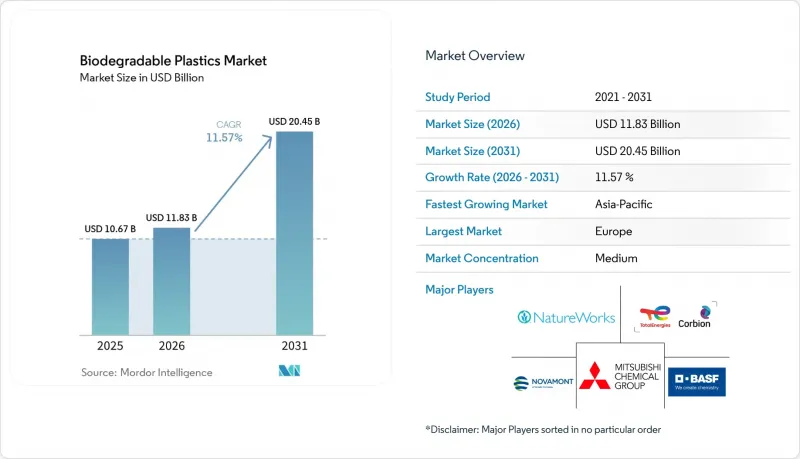
에 따르면 생분해성 플라스틱 시장 규모는 2025년에 106억 7,000만 달러로 평가되며, 2026년 118억 3,000만 달러에서 2031년까지 204억 5,000만 달러에 달할 것으로 예측되고 있으며, 예측 기간(2026-2031년)에 CAGR은 11.57%에 달할 전망입니다.
세계 생분해성 플라스틱 시장의 동향 및 인사이트
일회용 플라스틱 규제 및 확대된 생산자 책임
EU의 ‘포장 및 포장 폐기물 규정’은 2026년 8월 12일부터 전면 시행되고 있으며, 포장 폐기물, 재사용 및 생산자 책임에 관한 요건을 규정하고 있습니다. 이 규정은 재료 선택이 생산자 책임 비용에 영향을 미치는 경우, 퇴비화 가능한 형태를 장려하고 있습니다. 요금 조정을 통해 규정 준수 비용을 관리하는 구매자에게 인증된 퇴비화 가능 포장의 매력을 높일 수 있습니다. 포장 가공업체들은 EN 13432의 퇴비화 요건을 장기 공급 계약에 포함시키고 있습니다. 아시아태평양 및 미국의 일부 주에서 시행되고 있는 유사한 생산자 책임 조치로 인해 생분해성 플라스틱 시장의 잠재적 수요 기반이 확대되고 있습니다. 이러한 조치로 인해 포장 조달 과정에서 인증, 공급 안정성 및 규제 대응 준비의 중요성이 더욱 커지고 있습니다.
소매업체 및 외식 산업 브랜드의 지속가능한 포장재 조달
주요 소매업체와 외식업체는 인증된 퇴비화 가능 소재에 대한 수요를 지원하기 위해 포장 관련 목표를 설정하고 있습니다. Grupo Bimbo는 2025년 말까지 자사의 포장을 재활용 가능, 생분해성 또는 퇴비화 가능하게 만드는 것을 목표로 삼았습니다. 이러한 목표에 따라 포장 담당 팀은 더 광범위한 규제가 시행되기 전에 수많은 제품에 걸쳐 소재 선택지를 평가해야 했습니다. 아마존은 ‘Circular Bio-based Europe’ 프로그램의 지원을 받은 프로젝트를 통해 스페인에서 Novamont사의 바이오 기반 배송용 봉투 ‘Mater-Bi’를 시범 도입했습니다. 외식 산업에서의 활용은 일회용 제품 사용량이 많은 반면, 소재 전환이 비교적 용이하므로 여전히 중요한 위치를 차지하고 있습니다. 기업의 탄소 공개 및 내부 탄소 가격 책정도 소재 선정 결정에 영향을 미치고 있으며, 예를 들어 시세이도는 2025년 제조 투자 결정에 내부 탄소 가격 책정을 적용했습니다.
원자재 및 에너지 가격 변동
폴리젖산(PLA) 및 전분 혼합 소재 제조업체들은 농산물 가격 변동의 영향을 받기 쉬운 상황에 놓여 있습니다. 또한 해당 비용 구조에는 에너지 집약적인 가공 및 물류 비용도 포함되어 있으며, 이 모든 요인이 복합적으로 작용하여 비용 측면의 압박으로 이어지고 있습니다. 2025년 초, 미국 중서부의 가뭄과 브라질의 사탕수수 수출량 감소로 인해 옥수수 전분 비용이 상승했고, PLA의 이익률이 하락했습니다. 석유화학 제조업체는 통합된 원료 공급 시스템이나 선물 헤지 전략을 활용할 수 있지만, 많은 바이오폴리머 제조업체에게는 이러한 수단을 활용하기 어렵습니다. 조사에서는 식용 작물을 원료로 하는 대안으로, 염애성 및 내열성 미생물 플랫폼을 이용한 리그노셀룰로오스계 바이오매스에서 폴리하이드록시아카노에이트(PHA)를 생산하는 방안이 검토되고 있습니다. 이러한 접근 방식을 통해 향후 원료 의존도를 낮출 가능성은 있지만, 생분해성 플라스틱 시장에서 상업적 규모의 생산은 여전히 제한적입니다.
부문 분석
2025년, 생분해성 플라스틱 시장에서 전분 블렌드는 40.23%를 차지했습니다. 이러한 위상은 배합 개발이 광범위하게 진행되고 있으며, 비닐봉지, 식품 접촉용 필름, 농업용 멀치 필름에서의 사용이 확대되고 있음을 반영합니다. 이러한 용도에서는 EN 13432 산업용 퇴비화 인증을 활용하여 제품 수명 종료시 처리에 관한 주장을 지원할 수 있습니다. 그러나 전분 블렌드는 요구 사항이 까다로운 용도에서 PHA가 제공하는 해양 생분해성, 가정용 퇴비화 가능성, 혹은 기계적 성능을 갖추고 있지 않습니다. 이러한 차이가 각 소재의 경쟁적 위치를 결정짓고 있습니다. 2025년 11월, 노바몬트(Novamont)사는 자사의 ‘Mater-Bi’ 멀치 필름에 대해 무기질 토양 개량재로서의 인증을 획득함으로써, 기존의 산업용 퇴비화 환경을 넘어선 검증 경로를 확대했습니다.
PHA는 2031년까지 연평균 성장률(CAGR) 19.60%를 기록할 것으로 예측되며, 이는 생분해성 플라스틱 시장에서 폴리머 유형 중 가장 높은 수치입니다. 이 인증은 해양 생분해성 어구, 가정용 퇴비화가 가능한 플렉서블 필름, 생체 적합성 의료용 포장 등의 용도를 지원하고 있습니다. 2026년 5월, CJ 바이오매트리얼은 종이 재질의 푸드서비스용 식기를 위한 100% PHA 기반 압출 코팅 수지 ‘PHACT CB0504A’를 출시했습니다. 회사에 따르면 이 수지는 TUV 오스트리아의‘OK compost HOME’, ‘INDUSTRIAL’, ‘MARINE’ 인증을 획득했다고 합니다. 이번 출시는 특수 용도를 넘어 푸드서비스 분야에 주력하고 있음을 보여줍니다. PLA는 여전히 경질 포장이나 열성형 트레이에 널리 사용되고 있는 반면, PBAT와 PBS는 유연 필름이나 특수 용도로 사용되고 있습니다.
지역별 분석
2025년, 유럽은 생분해성 플라스틱 시장 점유율의 38.84%를 차지했습니다. 이는 규제 요건, 산업용 퇴비화 처리 능력, 그리고 확립된 생산 거점에 힘입은 결과입니다. 노바몬트사의 이탈리아내 각 거점의 연간 총 생산 능력은 15만 톤입니다. 독일, 이탈리아, 프랑스가 유럽 소비의 대부분을 차지하며, 규제 대상인 포장 용도에 대한 수요를 창출하고 있습니다. 이탈리아의 바이오폴리머 클러스터는 원료 공급, 폴리머 생산 및 하류 가공을 통합하고 있습니다. 북미는 두 번째로 큰 지역 시장이며, 캘리포니아주, 오리건주, 콜로라도주에서 시행되는 주 차원의 확대 생산자 책임(EPR) 조치가 수요를 형성하고 있습니다. 유럽에서 사업을 운영하는 미국 브랜드는 보다 광범위한 조달 프로그램에서 EN 13432를 준수하는 사양을 표준화할 수 있습니다.
아시아태평양은 2026-2031년까지 연평균 성장률(CAGR) 12.84%로 성장할 것으로 예상되며, 생분해성 플라스틱 시장에서 가장 높은 지역별 성장률을 보이고 있습니다. 중국의 플라스틱 규제, 인도의 EPR 의무화, 그리고 국내 폴리부틸렌 아디페이트 테레프탈레이트(PBAT) 생산 능력 확대가 이 지역의 전망을 지원하고 있습니다. Kingfa, Wanhua, Sinopec, Huafon은 산업 규모로 PBAT 생산을 확대하고 있습니다. 이러한 생산 능력 확대로 인해 가격에 민감한 포장재 구매자에게는 단가가 하락하고, 중국 외 생산자에 대한 경쟁 압력이 높아질 것입니다. 네이처웍스(NatureWorks)는 2026년 4월 태국 나콘사완에 완전 통합형 ‘인지오(Ingeo)’ 폴리젖산(PLA) 제조 시설을 개장했습니다. 이 시설의 연간 생산 능력은 7만 5,000톤이며, 현지산 사탕수수를 원료로 사용하여 동남아시아 가공업체들의 수입 의존도를 낮출 것입니다. 인도에서는 카테고리 IV 퇴비화 가능 플라스틱의 100% 회수가 의무화되어 있지만, 산업용 퇴비화 능력이 제한적이어서 이 요건이 수요에 미치는 완전한 영향은 아직 나타나지 않고 있습니다.
남미에서는 브라질의 사탕수수 생산과 바이오에탄올 발효 인프라에 힘입어 원료 공급이 확보되어 있습니다. 브라질 주요 지역의 사탕수수 수확량은 헥타르당 54톤에서 111톤 사이입니다. 국내 규제가 정비됨에 따라 브라질은 PLA 및 PHA의 생산 거점으로 부상할 가능성이 있습니다. 아르헨티나도 농업 원료의 공급원으로서 추가적인 공급을 제공하고 있지만, 바이오폴리머 제조는 여전히 시범 단계에 머물러 있습니다. 중동 및 아프리카는 지역 시장 중 규모가 가장 작지만, 사우디아라비아의 바이오 기반 소재 관련 노력과 남아프리카공화국 소매업체의 요구 사항으로 인해 수요가 발생하고 있습니다. 플라스틱 폐기물에 대한 규제 강화는 2031년까지 해당 지역의 시장 발전을 촉진할 가능성이 있습니다.
기타 혜택:
- 엑셀 형식의 시장 예측(ME) 시트
- 3개월간의 애널리스트 지원
자주 묻는 질문
목차
제1장 서론
- 조사 전제조건과 시장 정의
- 조사 범위
제2장 조사 방법
제3장 개요
제4장 시장 구도
- 시장 개요
- 시장 성장 촉진요인
- 시장 성장 억제요인
- 밸류체인 분석
- Porter's Five Forces 분석
제5장 시장 규모와 성장 예측
- 유형별
- 제품 형태별
- 최종사용자 산업별
- 지역별
- 아시아태평양
- 중국
- 인도
- 일본
- 한국
- ASEAN 국가
- 기타 아시아태평양 국가
- 북미
- 미국
- 캐나다
- 멕시코
- 유럽
- 독일
- 영국
- 프랑스
- 이탈리아
- 북유럽 국가
- 러시아
- 기타 유럽 국가
- 남미
- 브라질
- 아르헨티나
- 기타 남미 국가
- 중동 및 아프리카
- 사우디아라비아
- 남아프리카공화국
- 기타 중동 및 아프리카 국가
- 아시아태평양
제6장 경쟁 구도
- 시장 집중도
- 전략적 동향
- 시장 점유율·순위 분석
- 기업 개요
- BASF
- Biome Bioplastics
- BIOTEC Biologische Naturverpackungen GmbH & Co. KG
- Braskem
- CJ CheilJedang Corp.
- Danimer Scientific
- FKuR Kunststoff GmbH
- KANEKA CORPORATION
- KURARAY CO., LTD.
- Mitsubishi Chemical Group Corporation
- NatureWorks LLC
- Novamont S.p.A.
- PTT MCC Biochem Co., Ltd.
- RWDC Industries Limited
- TORAY INDUSTRIES, INC.
- TotalEnergies Corbion
제7장 시장 기회와 향후 전망
KSA 26.10.30According to Mordor Intelligence, the biodegradable plastics market size was valued at USD 10.67 billion in 2025 and is estimated to grow from USD 11.83 billion in 2026 to reach USD 20.45 billion by 2031, at a CAGR of 11.57% during the forecast period (2026-2031).
Global Biodegradable Plastics Market Trends and Insights
Single-Use Plastic Restrictions and Extended Producer Responsibility
The EU Packaging and Packaging Waste Regulation has applied in full since August 12, 2026, establishing requirements for packaging waste, reuse, and producer responsibility. The regulation supports compostable formats where material selection affects producer responsibility costs. Fee modulation can make certified compostable packaging more attractive to buyers managing compliance costs. Packaging converters are incorporating EN 13432 compostability requirements into long-term supply agreements. Similar producer responsibility measures across Asia-Pacific and several U.S. states are expanding the addressable demand base for the biodegradable plastics market. These measures increase the importance of certification, supply reliability, and regulatory readiness in packaging procurement.
Sustainable Packaging Procurement by Retailers and Foodservice Brands
Major retailers and foodservice operators are using packaging targets to support demand for certified compostable materials. Grupo Bimbo worked toward making its packaging recyclable, biodegradable, or compostable by the end of 2025. These targets required packaging teams to evaluate material options across numerous products before broader regulations took effect. Amazon trialed Novamont Mater-Bi bio-based delivery bags in Spain through a project supported by the Circular Bio-based Europe program. Foodservice applications remain relevant because they combine high single-use with relatively straightforward material transitions. Corporate carbon disclosure and internal carbon pricing also influence material selection decisions, as Shiseido applied internal carbon pricing to its 2025 manufacturing investment decisions.
Feedstock and Energy Price Volatility
Polylactic acid (PLA) and starch-blend manufacturers are exposed to agricultural commodity cycles. Their cost structures also include energy-intensive processing and logistics, creating concurrent cost pressures. Drought conditions in the U.S. Midwest and lower Brazilian sugarcane exports in early 2025 increased corn starch costs and reduced PLA margins. Petrochemical producers can leverage integrated feedstock systems and futures hedging strategies, which are less accessible to many biopolymer producers. Research has explored the production of polyhydroxyalkanoates (PHA) from lignocellulosic biomass using halophilic and thermophilic microbial platforms as an alternative to food-crop feedstocks. These approaches may reduce feedstock exposure over time; however, commercial-scale production remains limited in the biodegradable plastics market.
Other drivers and restraints analyzed in the detailed report include:
- Performance and Cost Improvements in Polylactic Acid (PLA), Polybutylene Adipate Terephthalate (PBAT), and Polyhydroxyalkanoates (PHA) Formulations
- Biodegradable Agricultural Mulch Film Adoption
- Cost Premium Versus Commodity Plastics and Composting Gaps
For complete list of drivers and restraints, kindly check the Table Of Contents.
Segment Analysis
Starch blends accounted for 40.23% of the biodegradable plastics market in 2025. Their position reflects extensive formulation development and use in carrier bags, food-contact films, and agricultural mulch films. These applications can use EN 13432 industrial composting certification to support end-of-life claims. However, starch blends do not provide the marine biodegradability, home compostability, or mechanical performance that PHA offers in demanding applications. This distinction defines the competitive positioning of each material. In November 2025, Novamont secured certification for its Mater-Bi mulch film as an inorganic soil improver, expanding its validation pathway beyond conventional industrial composting environments.
PHA is forecast to register a 19.60% CAGR through 2031, the highest among polymer types in the biodegradable plastics market. Its certifications support applications including marine-biodegradable fishing materials, home-compostable flexible films, and biocompatible medical packaging. In May 2026, CJ Biomaterials launched PHACT CB0504A, an all-PHA extrusion-coating resin for paper food service ware. The company stated that the resin received TUV Austria OK compost HOME, INDUSTRIAL, and MARINE certifications. The launch indicates a focus on foodservice applications beyond specialty uses. PLA remains widely used in rigid packaging and thermoformed trays, while PBAT and PBS are used in flexible-film and specialty applications.
Complete Report Scope:
- By Type
- Polylactic Acid (PLA)
- Starch Blends
- Polybutylene Adipate Terephthalate (PBAT)
- Polybutylene Succinate (PBS)
- Polyhydroxyalkanoates (PHA)
- Cellulose-Based Plastics
- Other Biodegradable Plastics
- By Product Form
- Resins and Compounds
- Films and Sheets
- Molded Products
- Others
- By End-User Industry
- Packaging
- Consumer Goods
- Agriculture and Horticulture
- Textile
- Other End-Use Industries
- By Geography
- Asia-Pacific
- China
- India
- Japan
- South Korea
- ASEAN Countries
- Rest of Asia-Pacific
- North America
- United States
- Canada
- Mexico
- Europe
- Germany
- United Kingdom
- France
- Italy
- NORDIC Countries
- Russia
- Rest of Europe
- South America
- Brazil
- Argentina
- Rest of South America
- Middle East and Africa
- Saudi Arabia
- South Africa
- Rest of Middle East and Africa
- Asia-Pacific
Geography Analysis
Europe accounted for 38.84% of the biodegradable plastics market share in 2025, supported by regulatory requirements, industrial composting capacity, and an established production base. Novamont's Italian sites have a combined annual capacity of 150,000 tons. Germany, Italy, and France account for most European consumption and generate demand for regulated packaging applications. Italy's biopolymer cluster integrates raw material supply, polymer production, and downstream conversion. North America is the second-largest regional market, where state-level extended producer responsibility (EPR) measures in California, Oregon, and Colorado shape demand. U.S. brands serving European operations can standardize EN 13432-compliant specifications across broader procurement programs.
Asia-Pacific is projected to grow at a CAGR of 12.84% during 2026-2031, representing the highest regional growth rate in the biodegradable plastics market. China's plastic restrictions, India's EPR mandates, and the expansion of domestic polybutylene adipate terephthalate (PBAT) capacity support the regional outlook. Kingfa, Wanhua, Sinopec, and Huafon are expanding PBAT production at an industrial scale. This capacity expansion reduces unit prices for cost-sensitive packaging buyers and increases competitive pressure on producers outside China. NatureWorks opened its fully integrated Ingeo polylactic acid (PLA) facility in Nakhon Sawan, Thailand, in April 2026. The facility has an annual capacity of 75,000 tons, uses locally sourced sugarcane, and reduces Southeast Asian converters' dependence on imports. India requires 100% collection of Category IV compostable plastics; however, limited industrial composting capacity delays the full impact of this requirement on demand.
South America has feedstock availability, driven by Brazil's sugarcane production and bioethanol fermentation infrastructure. Sugarcane yields in key Brazilian regions range from 54 to 111 tons per hectare. As domestic regulations mature, Brazil could emerge as a production location for PLA and PHA. Argentina provides additional agricultural feedstock availability, although biopolymer manufacturing remains at the pilot stage. The Middle East and Africa represent the smallest regional markets; however, Saudi initiatives for bio-based materials and South African retailer requirements are generating demand. Stricter plastic waste regulations could support market development in the region through 2031.
- BASF
- Biome Bioplastics
- BIOTEC Biologische Naturverpackungen GmbH & Co. KG
- Braskem
- CJ CheilJedang Corp.
- Danimer Scientific
- FKuR Kunststoff GmbH
- KANEKA CORPORATION
- KURARAY CO., LTD.
- Mitsubishi Chemical Group Corporation
- NatureWorks LLC
- Novamont S.p.A.
- PTT MCC Biochem Co., Ltd.
- RWDC Industries Limited
- TORAY INDUSTRIES, INC.
- TotalEnergies Corbion
Additional Benefits:
- The market estimate (ME) sheet in Excel format
- 3 months of analyst support
TABLE OF CONTENTS
1 Introduction
- 1.1 Study Assumptions and Market Definition
- 1.2 Scope of the Study
2 Research Methodology
3 Executive Summary
4 Market Landscape
- 4.1 Market Overview
- 4.2 Market Drivers
- 4.2.1 Single-Use Plastic Restrictions and Extended Producer Responsibility
- 4.2.2 Sustainable Packaging Procurement by Retailers and Foodservice Brands
- 4.2.3 Performance and Cost Improvements in PLA, PBAT and PHA Formulations
- 4.2.4 Biodegradable Agricultural Mulch Film Adoption
- 4.2.5 Corporate Carbon Disclosure and Internal Carbon Pricing
- 4.3 Market Restraints
- 4.3.1 Feedstock and Energy Price Volatility
- 4.3.2 Cost Premium Versus Commodity Plastics
- 4.3.3 Industrial Composting and Separate-Collection Gaps
- 4.4 Value Chain Analysis
- 4.5 Porter's Five Forces Analysis
- 4.5.1 Bargaining Power of Suppliers
- 4.5.2 Bargaining Power of Buyers
- 4.5.3 Threat of New Entrants
- 4.5.4 Threat of Substitutes
- 4.5.5 Competitive Rivalry
5 Market Size and Growth Forecasts (Value)
- 5.1 By Type
- 5.1.1 Polylactic Acid (PLA)
- 5.1.2 Starch Blends
- 5.1.3 Polybutylene Adipate Terephthalate (PBAT)
- 5.1.4 Polybutylene Succinate (PBS)
- 5.1.5 Polyhydroxyalkanoates (PHA)
- 5.1.6 Cellulose-Based Plastics
- 5.1.7 Other Biodegradable Plastics
- 5.2 By Product Form
- 5.2.1 Resins and Compounds
- 5.2.2 Films and Sheets
- 5.2.3 Molded Products
- 5.2.4 Others
- 5.3 By End-User Industry
- 5.3.1 Packaging
- 5.3.2 Consumer Goods
- 5.3.3 Agriculture and Horticulture
- 5.3.4 Textile
- 5.3.5 Other End-Use Industries
- 5.4 By Geography
- 5.4.1 Asia-Pacific
- 5.4.1.1 China
- 5.4.1.2 India
- 5.4.1.3 Japan
- 5.4.1.4 South Korea
- 5.4.1.5 ASEAN Countries
- 5.4.1.6 Rest of Asia-Pacific
- 5.4.2 North America
- 5.4.2.1 United States
- 5.4.2.2 Canada
- 5.4.2.3 Mexico
- 5.4.3 Europe
- 5.4.3.1 Germany
- 5.4.3.2 United Kingdom
- 5.4.3.3 France
- 5.4.3.4 Italy
- 5.4.3.5 NORDIC Countries
- 5.4.3.6 Russia
- 5.4.3.7 Rest of Europe
- 5.4.4 South America
- 5.4.4.1 Brazil
- 5.4.4.2 Argentina
- 5.4.4.3 Rest of South America
- 5.4.5 Middle East and Africa
- 5.4.5.1 Saudi Arabia
- 5.4.5.2 South Africa
- 5.4.5.3 Rest of Middle East and Africa
- 5.4.1 Asia-Pacific
6 Competitive Landscape
- 6.1 Market Concentration
- 6.2 Strategic Moves
- 6.3 Market Share (%)/Ranking Analysis
- 6.4 Company Profiles (includes Global Overview, Market Overview, Core Segments, Financials as available, Strategic Information, Products and Services, and Recent Developments)
- 6.4.1 BASF
- 6.4.2 Biome Bioplastics
- 6.4.3 BIOTEC Biologische Naturverpackungen GmbH & Co. KG
- 6.4.4 Braskem
- 6.4.5 CJ CheilJedang Corp.
- 6.4.6 Danimer Scientific
- 6.4.7 FKuR Kunststoff GmbH
- 6.4.8 KANEKA CORPORATION
- 6.4.9 KURARAY CO., LTD.
- 6.4.10 Mitsubishi Chemical Group Corporation
- 6.4.11 NatureWorks LLC
- 6.4.12 Novamont S.p.A.
- 6.4.13 PTT MCC Biochem Co., Ltd.
- 6.4.14 RWDC Industries Limited
- 6.4.15 TORAY INDUSTRIES, INC.
- 6.4.16 TotalEnergies Corbion
7 Market Opportunities and Future Outlook
- 7.1 White-Space and Unmet-Need Assessment


