

|
시장보고서
상품코드
2038346
희귀 가스 시장 : 시장 기회, 성장요인, 업계 동향 분석 및 예측(2026-2035년)Rare Gas Market Opportunity, Growth Drivers, Industry Trend Analysis, and Forecast 2026 - 2035 |
||||||

세계의 희귀 가스 시장은 2025년에 37억 달러로 평가되었고, CAGR 4.4%로 성장할 전망이며, 2035년까지 58억 달러에 이를 것으로 추정되고 있습니다.
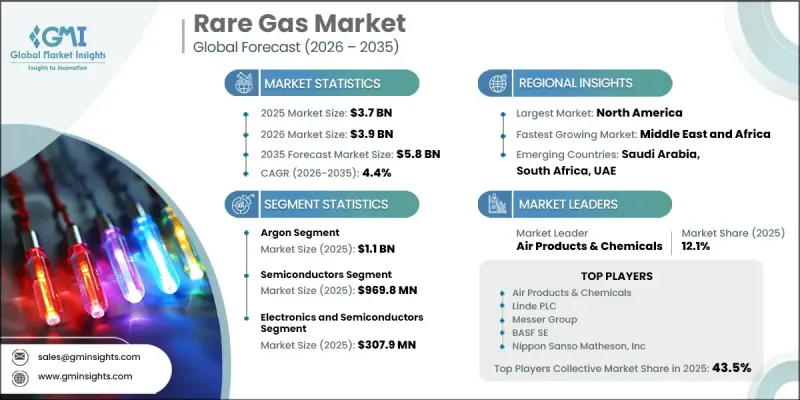
희귀 가스는 헬륨, 네온, 아르곤, 크립톤, 크세논, 라돈을 포함하며, 모두 화학적 반응성이 극히 낮다는 특징이 있습니다. 불활성 특성으로 인해 화학적 안정성과 비반응성이 필수적인 환경에서 효과적으로 기능합니다. 이들 가스는 대기 중에 미량으로 자연적으로 존재하며, 주로 공기 분리 장치나 천연가스 처리 기술을 통해 추출됩니다. 각 가스는 끓는점, 밀도, 열전도율과 같은 고유한 물리적 특성을 가지고 있으며, 이는 다양한 용도 분야에서 산업적 적합성을 결정합니다. 헬륨은 저밀도와 냉각 특성으로 널리 평가받고 있으며, 아르곤은 산업 환경에서 차폐 및 단열재로 널리 사용되고 있습니다. 전반적으로 희귀 가스는 광범위한 기술 및 산업 시스템에서 공정 안정성과 운영 효율성을 유지하는 데 매우 중요한 역할을 합니다. 극저온 공학 및 가스 정제 기술의 지속적인 발전으로 추출 효율과 순도 수준이 크게 향상되었습니다. 또한, 가스 회수 및 재활용 시스템의 도입으로 보다 지속가능한 이용이 가능해져 산업 사이클 내에서 희귀 가스를 재사용할 수 있게 됨으로써 공급 제약이 완화되었습니다.
| 시장 범위 | |
|---|---|
| 개시 연도 | 2025년 |
| 예측 기간 | 2026-2035년 |
| 개시 연도 시장 규모 | 37억 달러 |
| 예측 시장 규모 | 58억 달러 |
| CAGR | 4.4% |
2025년 아르곤 부문 시장 규모는 11억 달러에 달했습니다. 아르곤은 우수한 불활성 특성으로 인해 제어된 제조 환경, 금속 가공 공정 및 산화 방지 및 공정 안정성이 요구되는 다양한 산업 용도 분야에 매우 적합하여 그 수요가 지속적으로 증가하고 있습니다.
반도체 부문은 2025년 9억 6,980만 달러 시장 규모를 기록했습니다. 이 부문의 성장은 초순도 기준이 필수적인 첨단 제조 및 정밀 산업에서 희귀 가스의 사용 확대에 힘입어 성장하고 있습니다. 이러한 가스는 불활성 환경을 필요로 하는 통제된 의료 시술에도 사용됩니다. 또한, 반도체 산업은 제조 공정의 정확성과 일관성을 보장하기 위해 고순도 희귀 가스에 크게 의존하고 있으며, 이를 통해 첨단 전자 부품 및 시스템 생산을 지원하고 있습니다.
북미의 희귀 가스 시장은 2025년 11억 달러로 평가되었고, 2035년 16억 달러로 성장할 것으로 예측됩니다. 이 지역 수요는 의료, 항공우주, 전자, 전자, 과학 연구 등 다양한 분야에서 고순도 가스 공급과 신뢰할 수 있는 유통망을 필요로 하는 분야가 많아지면서 지속적으로 견조한 수요를 보이고 있습니다. 미국은 반도체 제조, 의료용 영상 진단 기술, 우주 탐사 프로그램 및 산업 생산 활동에서 헬륨, 아르곤 및 기타 희귀 가스의 지속적인 사용에 힘입어 주요 소비국이 되고 있습니다.
자주 묻는 질문
목차
제1장 조사 방법 및 범위
제2장 주요 요약
제3장 업계 인사이트
제4장 경쟁 구도
제5장 시장 추산 및 예측 : 유형별(2022-2035년)
제6장 시장 추산 및 예측 : 기능별(2022-2035년)
제7장 시장 추산 및 예측 : 최종 용도별(2022-2035년)
제8장 시장 추산 및 예측 : 지역별(2022-2035년)
제9장 기업 개요
AJY 26.06.11The Global Rare Gas Market was valued at USD 3.7 billion in 2025 and is estimated to grow at a CAGR of 4.4% to reach USD 5.8 billion by 2035.
Rare gases, also known as noble gases, include helium, neon, argon, krypton, xenon, and radon, all of which are characterized by extremely low chemical reactivity. Their inert behavior allows them to function effectively in environments where chemical stability and non-reactivity are essential. These gases are naturally present in the atmosphere in trace quantities and are primarily extracted through air separation units and natural gas processing techniques. Each gas has distinct physical properties such as boiling point, density, and thermal conductivity, which determine its industrial suitability across multiple applications. Helium is widely valued for its low density and cooling properties, while argon is extensively used for shielding and insulation in industrial environments. Overall, rare gases play a critical role in maintaining process stability and operational efficiency across a wide range of technical and industrial systems. Continuous advancements in cryogenic engineering and gas purification technologies have significantly improved extraction efficiency and purity levels. In addition, the integration of gas recovery and recycling systems has enabled more sustainable utilization, allowing rare gases to be reused within industrial cycles and reducing supply constraints.
| Market Scope | |
|---|---|
| Start Year | 2025 |
| Forecast Year | 2026-2035 |
| Start Value | $3.7 Billion |
| Forecast Value | $5.8 Billion |
| CAGR | 4.4% |
The argon segment accounted for USD 1.1 billion in 2025. Demand for argon continues to rise due to its excellent inert properties, which make it highly suitable for controlled manufacturing environments, metal processing operations, and various industrial applications where oxidation prevention and process stability are required.
The semiconductor segment generated USD 969.8 million in 2025. Growth in this segment is supported by increasing utilization of rare gases across advanced manufacturing and precision-driven industries, where ultra-high purity standards are essential. These gases are also used in healthcare applications for controlled medical procedures requiring inert environments. Additionally, the semiconductor industry relies heavily on high-purity rare gases to ensure accuracy and consistency during fabrication processes, supporting the production of advanced electronic components and systems.
North America Rare Gas Market is projected to grow from USD 1.1 billion in 2025 to USD 1.6 billion in 2035. Demand in the region remains strong due to widespread application across healthcare, aerospace, electronics, and scientific research sectors, all of which require high-purity gas supplies and reliable distribution networks. The United States continues to be a key consumer, driven by sustained usage of helium, argon, and other rare gases in semiconductor manufacturing, medical imaging technologies, space exploration programs, and industrial production activities.
Major players operating in the Global Rare Gas Industry include Iwatani Corporation, Messer Group, Air Products & Chemicals, Praxair, BASF SE, American Gas Products, Nippon Sanso Matheson, Inc, Axcel Gases, Ingas LLC, and Dakota Gasification Co. Companies operating in the Rare Gas Market are focusing on strengthening their market position through investments in advanced extraction technologies and high-efficiency air separation systems that improve yield and purity levels. Strategic emphasis is placed on expanding cryogenic processing capabilities and upgrading purification infrastructure to meet rising demand from high-precision industries. Many players are also prioritizing the development of sustainable gas recovery and recycling solutions to reduce waste and improve resource efficiency. Long-term supply agreements with semiconductor manufacturers, healthcare providers, and industrial clients are being used to ensure stable revenue streams. Additionally, firms are expanding global distribution networks and strengthening logistics capabilities to ensure uninterrupted supply.
Table of Contents
Chapter 1 Methodology & Scope
- 1.1 Market scope and definition
- 1.2 Research design
- 1.2.1 Research approach
- 1.2.2 Data collection methods
- 1.3 Data mining sources
- 1.3.1 Global
- 1.3.2 Regional/Country
- 1.4 Base estimates and calculations
- 1.4.1 Base year calculation
- 1.4.2 Key trends for market estimation
- 1.5 Primary research and validation
- 1.5.1 Primary sources
- 1.6 Forecast model
- 1.7 Research assumptions and limitations
Chapter 2 Executive Summary
- 2.1 Industry 360° synopsis
- 2.2 Key market trends
- 2.2.1 Type
- 2.2.2 Function
- 2.2.3 End Use
- 2.2.4 Regional
- 2.3 TAM Analysis, 2026-2035
- 2.4 CXO perspectives: Strategic imperatives
- 2.5 Future outlook and strategic recommendations
Chapter 3 Industry Insights
- 3.1 Industry ecosystem analysis
- 3.1.1 Supplier landscape
- 3.1.2 Profit margin
- 3.1.3 Value addition at each stage
- 3.1.4 Factor affecting the value chain
- 3.1.5 Disruptions
- 3.2 Industry impact forces
- 3.2.1 Growth drivers
- 3.2.1.1 Rising electronics and semiconductor manufacturing
- 3.2.1.2 Increasing demand from healthcare applications
- 3.2.1.3 Expanding industrial welding and fabrication
- 3.2.2 Pitfalls/challenge
- 3.2.2.1 Limited natural availability of rare gases
- 3.2.2.2 High storage and transportation requirements
- 3.2.3 Opportunities
- 3.2.3.1 Development of gas recycling technologies
- 3.2.3.2 Growth in advanced manufacturing applications
- 3.2.1 Growth drivers
- 3.3 Growth potential analysis
- 3.4 Regulatory landscape
- 3.4.1 North America
- 3.4.2 Europe
- 3.4.3 Asia Pacific
- 3.4.4 Latin America
- 3.4.5 Middle East & Africa
- 3.5 Porter's analysis
- 3.6 PESTEL analysis
- 3.7 Technology and innovation landscape
- 3.7.1 Current technological trends
- 3.7.2 Emerging technologies
- 3.8 Price trends
- 3.8.1 By region
- 3.8.2 By type
- 3.9 Future market trends
- 3.10 Patent landscape
- 3.11 Trade statistics (HS code)
- 3.11.1 Major importing countries
- 3.11.2 Major exporting countries
- 3.12 Sustainability and environmental aspects
- 3.12.1 Sustainable practices
- 3.12.2 Waste reduction strategies
- 3.12.3 Energy efficiency in production
- 3.12.4 Eco-friendly initiatives
- 3.13 Carbon footprint consideration
Chapter 4 Competitive Landscape, 2025
- 4.1 Introduction
- 4.2 Company market share analysis
- 4.2.1 By region
- 4.2.1.1 North America
- 4.2.1.2 Europe
- 4.2.1.3 Asia Pacific
- 4.2.1.4 LATAM
- 4.2.1.5 MEA
- 4.2.1 By region
- 4.3 Company matrix analysis
- 4.4 Competitive analysis of major market players
- 4.5 Competitive positioning matrix
- 4.6 Key developments
- 4.6.1 Mergers & acquisitions
- 4.6.2 Partnerships & collaborations
- 4.6.3 New product launches
- 4.6.4 Expansion plans
Chapter 5 Market Estimates and Forecast, By Type, 2022-2035 (USD Billion) (Kilo Tons)
- 5.1 Key trends
- 5.2 Helium
- 5.3 Neon
- 5.4 Argon
- 5.5 Krypton
- 5.6 Xenon
- 5.7 Radon
Chapter 6 Market Estimates and Forecast, By Function, 2022-2035 (USD Billion) (Kilo Tons)
- 6.1 Key trends
- 6.2 Illumination
- 6.3 Insulation
- 6.4 Scanning
- 6.5 Anaesthesia
- 6.6 Semiconductors
- 6.7 Satellites
Chapter 7 Market Estimates and Forecast, By End Use, 2022-2035 (USD Billion) (Kilo Tons)
- 7.1 Key trends
- 7.2 Healthcare
- 7.3 Lighting
- 7.4 Electronics and semiconductors
- 7.5 Manufacturing and fabrication
- 7.6 Energy and power
- 7.7 Aerospace and aviation
- 7.8 Others
Chapter 8 Market Estimates and Forecast, By Region, 2022-2035 (USD Billion) (Kilo Tons)
- 8.1 Key trends
- 8.2 North America
- 8.2.1 U.S.
- 8.2.2 Canada
- 8.3 Europe
- 8.3.1 Germany
- 8.3.2 UK
- 8.3.3 France
- 8.3.4 Spain
- 8.3.5 Italy
- 8.3.6 Rest of Europe
- 8.4 Asia Pacific
- 8.4.1 China
- 8.4.2 India
- 8.4.3 Japan
- 8.4.4 Australia
- 8.4.5 South Korea
- 8.4.6 Rest of Asia Pacific
- 8.5 Latin America
- 8.5.1 Brazil
- 8.5.2 Mexico
- 8.5.3 Argentina
- 8.5.4 Rest of Latin America
- 8.6 Middle East and Africa
- 8.6.1 Saudi Arabia
- 8.6.2 South Africa
- 8.6.3 UAE
- 8.6.4 Rest of Middle East and Africa
Chapter 9 Company Profiles
- 9.1 Air Products & Chemicals
- 9.2 American Gas Products
- 9.3 Axcel Gases
- 9.4 BASF SE
- 9.5 Dakota Gasification Co.
- 9.6 Ingas LLC
- 9.7 Iwatani Corporation
- 9.8 Nippon Sanso Matheson, Inc
- 9.9 Messer Group
- 9.10 Praxair


