

|
시장보고서
상품코드
2073438
희가스 : 시장 점유율 분석, 업계 동향 및 통계, 성장 예측(2026-2031년)Noble Gas - Market Share Analysis, Industry Trends & Statistics, Growth Forecasts (2026 - 2031) |
||||||
 Mordor Intelligence
Mordor Intelligence에 의하면, 희가스 시장 규모는 2026년에 62억 4,000만 입방미터에 달할 것으로 예상되고, 예측 기간(2026-2031년) CAGR 4.03%로 성장해 2031년에는 76억 입방미터에 이를 것으로 전망되고 있습니다.
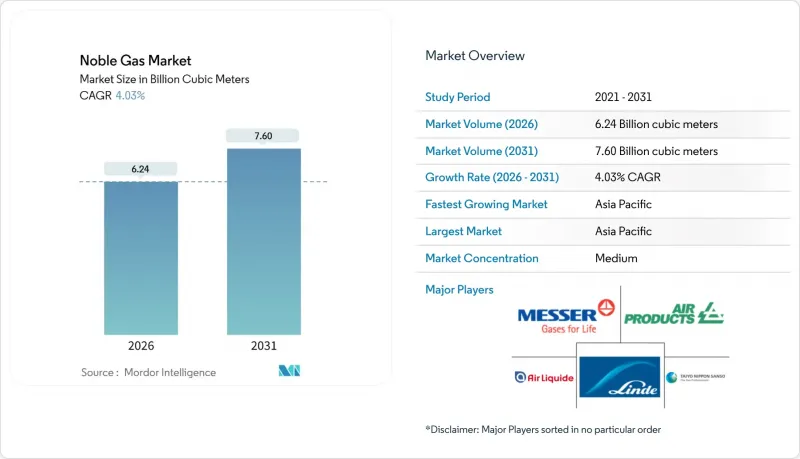
본 보고서는 유형별(헬륨, 크립톤, 아르곤, 네온, 크세논, 라돈) 및 지역별(아시아태평양, 북미, 유럽, 남미, 중동 및 아프리카)로 분류되어 있습니다. 시장 전망은 수량(입방미터) 기준으로 제시되어 있습니다.
세계의 희가스 시장 동향 및 인사이트
초고순도 헬륨에 대한 의료 수요 증가
초전도 자석을 4.2켈빈이라는 극저온 상태로 유지하기 위해 여전히 대량의 헬륨이 필요한 MRI 시스템의 전 세계 도입 대수는 고령화에 따른 영상 진단 수요 증가를 배경으로 늘어나고 있습니다. Philips의 ‘BlueSeal"자석은 헬륨 소비량을 대폭 줄이는 데 성공했지만, 이미 도입된 장비의 대부분은 여전히 구형 장치이며, 헬륨에 대한 상당한 수요가 계속될 것으로 확실시되고 있습니다. 미국과 독일의 병원들은 현물 가격 상승에 대응하고 가격 안정을 도모하기 위해 헬륨 공급 계약 기간을 연장했습니다. 한편, 일본에서는 휴대용 MRI 시제품이 임상 검사를 시작하면서 수요의 변화가 예상되고 있습니다. 그러나 극저온 냉매를 사용하지 않는 설계는 아직 초기 단계에 있기 때문에 희가스 시장 내 헬륨 산업 수요 기반으로서 의료 부문은 여전히 중요한 위치를 차지하고 있습니다.
철강·자동차 산업에서의 용접 활동 부활
2024년, 중국은 대량의 조강을 생산하여 팬데믹 이전의 생산량을 회복하는 한편, 차폐 용접에서 아르곤 사용을 확대했습니다. 전기차용 배터리 팩을 제조하려면 순도 99.996% 이상의 아르곤이 필요하며, 테슬라의 상하이 공장만으로도 중국 시장 공급량의 일부를 소비했습니다. 유럽의 자동차 제조업체들은 용접 침투 깊이를 높이기 위해 헬륨을 병용하는 레이저-아크 하이브리드 용접 방식으로 전환하고 있으며, 2024년에는 독일, 프랑스, 스페인에서 헬륨 소비량이 증가했습니다. 제조업체들은 유럽의 전력 가격 급등을 완화하기 위해 전력 비용에 연동된 다년 계약을 선호하여 채택했습니다. 이처럼 용접 시장의 견조한 추세가 희가스 시장에서 아르곤이 차지하는 지배적인 위치를 더욱 공고히 하고 있습니다.
헬륨과 네온의 가격 변동
2024년부터 2025년에 걸쳐, 미국의 헬륨 현물 가격은 클리프사이드 저장 시설의 가동 중단과 러시아산 수출 감소로 인해 변동을 보였습니다. 네온 가격은 우크라이나가 생산을 중단했을 때 더욱 급격한 상승세를 보였습니다. 중국 공급업체들이 시장에 진입하면서, 2025년에 신규 생산 능력이 가동될 때까지 높은 가격에 거래되었습니다. 대형 반도체 제조업체들은 수량 보장 계약을 통해 위험을 회피했지만, 중소 OEM 업체들은 이익률 압박에 직면하여 설비 투자가 위축되었습니다. 이러한 변동성 증가는 불필요한 소비를 억제할 뿐만 아니라, 운전자금 수요를 증가시켜 희가스 시장의 단기적인 성장을 둔화시키고 있습니다.
부문별 분석
2025년, 아르곤은 불활성 가스 시장의 출하량의 56.12%를 차지했습니다. 이는 전 세계 철강 및 자동차 공장에서 금속 불활성 가스용접(MIG)과 텅스텐 불활성 가스용접(TIG)이 널리 사용되고 있는 현실을 반영한 것입니다. 중국 내 전기차 생산과 배터리 팩 제조의 급증으로 아르곤 수요가 증가했으며, 또한 인도의 ‘생산 연계형 인센티브(PLI)"제도에 따른 생산 능력 확대로 인해 2025년 내내 높은 인수량이 유지되었습니다. 아르곤으로 인한 희가스 시장 규모는 절대값 기준으로 계속 확대될 것으로 예상되지만, 네온의 성장률이 아르곤을 상회함에 따라 그 점유율은 점차 낮아질 전망입니다.
네온은 극자외선(EUV) 리소그래피 공정에서 심자외선(DUV) 장비에 비해 웨이퍼 1장당 가스 소비량이 3배에 달하기 때문에 2031년까지 연평균 성장률(CAGR) 7.12%를 나타낼 것으로 예측되며, 이는 희가스 중 가장 빠른 성장 속도입니다. 헬륨 수요는 북미 광상의 고갈과 가격 변동으로 인해 최종 소비자들이 재활용으로 눈을 돌리는 경향이 있었기 때문에 소폭 상승에 그쳤습니다. 크립톤은 복층 유리 규격에 따라 수요가 서서히 증가했으며, 크세논은 꾸준한 위성 발사 속도의 혜택을 받았습니다. 이러한 변화에도 불구하고 아르곤은 여전히 불활성 가스 시장의 핵심을 차지하고 있는 반면, 네온은 포트폴리오 전체의 재균형을 주도하는 주요 성장 동력이 되고 있습니다.
지역별 분석
아시아태평양은 2025년 희가스 시장 규모의 51.12%를 차지했으며, 반도체 팹 건설, 철강 생산 능력 확대, 전기차 생산 가속화에 힘입어 2031년까지 연평균 성장률(CAGR) 5.64%를 나타낼 것으로 전망됩니다. 2025년, 칩 제조업체들은 3nm 공정으로 전환하면서 대만과 한국의 네온 소비량이 증가했습니다. 한편, 2024년에는 구자라트주에서 에어 리퀴드(Air Liquide)사가 새로운 공기 분리 설비를 가동함에 따라 인도 내 물량이 대폭 증가했습니다. 시장을 주도하는 중국은 전 세계 아르곤 소비량에서 큰 비중을 차지했습니다.
2025년, 북미는 안정적인 시장 점유율을 유지했으나, 캔자스주와 텍사스주의 기존 헬륨 매장층이 고갈되어 가고 있어, 국내 헬륨 공급 과잉 상태에서 수입 의존으로 전환되고 있습니다. 한편, 앨버타주와 서스캐처원주의 탐사 기업들은 그 공급 격차를 메우기 위해 경쟁하고 있습니다. 주요 동향으로, 에어프로덕츠사는 루이지애나주에 5억 달러를 투자하여 멕시코만 연안의 가스 유출에서 헬륨을 회수하는 데 주력하고 있습니다. 유럽은 높은 전력 비용과 노후화된 극저온 인프라로 인해 어려움을 겪고 있습니다. 이러한 문제들로 인해 공급의 유연성이 제한되고 있기 때문에 업계 선도 기업인 린데(Linde)와 메서(Messer)는 신규 시설 건설보다 기존 시설의 개보수를 우선시하고 있습니다. 남미와 중동은 브라질의 철강 생산과 사우디아라비아의 석유화학 사업에 의해 지탱되고 있습니다. 이 지역 특유 수요는 GCC 전역에 걸쳐 있는 걸프 크라이오사의 네트워크를 통해 더욱 뒷받침되고 있습니다.
기타 혜택
- 엑셀 형식 시장 예측(ME) 시트
- 3개월간의 애널리스트 지원
자주 묻는 질문
목차
제1장 서론
제2장 조사 방법
제3장 주요 요약
제4장 시장 구도
제5장 시장 규모 및 성장 예측
제6장 경쟁 구도
제7장 시장 기회 및 향후 전망
KTH 26.07.08According to Mordor Intelligence, the noble gas market size is estimated at 6.24 billion cubic meters in 2026, and is expected to reach 7.60 billion cubic meters by 2031, at a CAGR of 4.03% during the forecast period (2026-2031).
This report is Segmented by Type (Helium, Krypton, Argon, Neon, Xenon, and Radon), and Geography (Asia-Pacific, North America, Europe, South America, and Middle-East and Africa). Market Forecasts are Provided in Terms of Volume (Cubic Meters).
Global Noble Gas Market Trends and Insights
Rising Healthcare Demand for Ultra-High-Purity Helium
Global installations of MRI systems, which still rely on substantial helium volumes to maintain superconducting magnets at a chilly 4.2 Kelvin, have been growing, driven by an aging population's increasing need for imaging procedures. While Philips' BlueSeal magnet has successfully slashed helium consumption, a significant portion of the installed base still comprises legacy equipment, ensuring a meaningful helium demand persists. Hospitals in the United States and Germany, reacting to rising spot quotes, extended their replenishment contracts to longer terms, aiming for price stability. Meanwhile, Japan's portable MRI prototypes embarked on clinical trials, hinting at a potential demand shift. Yet, with cryogen-free designs still in their infancy, the healthcare sector remains a cornerstone for helium industry demand within the noble gas market.
Resurgence of Steel and Automotive Welding Activity
In 2024, China produced a high quantity of crude steel, restoring pre-pandemic throughput and accelerating argon uptake for shielded welding. Electric-vehicle battery-pack fabrication needs argon purities above 99.996%, and Tesla's Shanghai plant alone consumed a portion of China's merchant supply. European automakers have shifted to laser-arc hybrid welding that co-uses helium to deepen weld penetration, adding to consumption across Germany, France, and Spain in 2024. Fabricators favored multi-year agreements indexed to power costs to mitigate European electricity price spikes. Robust welding dynamics therefore reinforce argon's dominant role within the noble gas market.
Helium and Neon Price Volatility
In 2024-2025, the United States' helium spot prices fluctuated due to outages at the Cliffside storage site and reduced exports from Russia. Neon prices experienced sharper spikes when Ukraine halted production. Chinese suppliers stepped in, commanding premium prices until new capacity became operational in 2025. While major semiconductor companies shielded themselves through volume-commitment contracts, smaller OEMs faced margin pressures, leading to a slowdown in capital expenditures. This heightened volatility not only dampens discretionary consumption but also increases working-capital requirements, moderating short-term growth in the noble gas market.
Other drivers and restraints analyzed in the detailed report include:
- Expansion of Semiconductor Fabs in Asia-Pacific
- Rapid Uptake of Additive-Manufacturing Shielding Atmospheres
- Energy-Intensive Cryogenic Separation Costs
For complete list of drivers and restraints, kindly check the Table Of Contents.
Segment Analysis
Argon held 56.12% of the noble gas market volume in 2025, reflecting entrenched use in metal-inert-gas and tungsten-inert-gas welding across global steel and automotive plants. China's surge in electric-vehicle output and battery-pack fabrication lifted argon demand, and India's capacity expansions under the Production-Linked Incentive scheme sustained elevated off-take through 2025. The noble gas market size attributed to argon is forecast to continue expanding in absolute terms, although its share erodes gradually as neon growth outpaces it.
Neon is projected to grow at a 7.12% CAGR through 2031, the fastest among noble gases, as extreme ultraviolet lithography triples gas consumption per wafer compared with deep ultraviolet tools. Helium demand rose modestly, constrained by North American field depletion and price swings that pushed end users toward recycling. Krypton enjoyed incremental pull from insulating-glass standards, while xenon benefited from a robust satellite launch cadence. Despite these shifts, argon remains the anchor of the noble gas market, whereas neon represents the principal growth lever driving rebalancing across the portfolio.
Complete Report Scope:
- By Type
- Helium
- Healthcare
- Electronics
- Welding Cover Gas
- Lifting Gas
- Controlled Atmospheres
- Leak Detection
- Breathing Mixtures
- Analytical Gas
- Other Applications/End-user Industries
- Krypton
- Construction (Insulating Glass)
- Lighting
- Excimer Lasers
- Other Applications/End-user Industries
- Argon
- Protective Gas for Welding
- Electronics and Semiconductor
- Lighting
- Other Applications/End-user Industries
- Neon
- Electronics (Lasers)
- Display Components
- Lighting
- Other Applications/End-user Industries
- Xenon
- Lighting
- Satellites
- Healthcare (Anesthetics)
- Electronics (Photolithiography)
- Electronics (Lasers)
- Plasma/AMOLED Screens
- Other Applications/End-user Industries
- Radon
- Helium
- By Geography
- Asia-Pacific
- China
- India
- Japan
- South Korea
- ASEAN Countries
- Rest of Asia-Pacific
- North America
- United States
- Canada
- Mexico
- Europe
- Germany
- Belgium
- United Kingdom
- Italy
- France
- Spain
- Russia
- Netherlands
- Rest of Europe
- South America
- Brazil
- Argentina
- Rest of South America
- Middle-East and Africa
- Saudi Arabia
- South Africa
- Rest of Middle-East and Africa
- Asia-Pacific
Geography Analysis
Asia-Pacific accounted for 51.12% of the noble gas market volume in 2025 and is tracking a 5.64% CAGR to 2031, bolstered by semiconductor fab build-outs, steel capacity expansions, and accelerating electric-vehicle production. In 2025, chipmakers advanced to 3 nm nodes, leading Taiwan and South Korea to increase neon consumption. Meanwhile, in 2024, India witnessed significant volume growth, thanks to new air-separation units launched by Air Liquide in Gujarat. Dominating the scene, China accounted for a substantial share of global argon consumption.
In 2025, North America maintained a steady share but is shifting from a domestic helium surplus to a reliance on imports, as traditional reservoirs in Kansas and Texas dwindle. Meanwhile, exploration companies in Alberta and Saskatchewan are racing to bridge the gap. In a significant move, Air Products has committed USD 500 million in Louisiana, focusing on helium recovery from Gulf Coast gas streams. Europe grapples with high power costs and an aging cryogenic infrastructure. These challenges limit supply flexibility, leading industry giants Linde and Messer to prioritize retrofitting existing facilities over establishing new ones. South America and the Middle East are buoyed by Brazil's steel production and Saudi Arabia's petrochemical initiatives. This localized demand is further bolstered by Gulf Cryo's expanded network across the GCC.
- Air Liquide
- Air Products and Chemicals Inc.
- Airgas Inc.
- American Gas
- BASF SE
- Buzwair Industrial Gases Factories
- First Helium
- Gulf Cryo
- ITM Power
- Iwatani Corporation.
- Linde plc
- MATHESON TRI-GAS INC.
- Messer North America, Inc.
- Praxair Technology, Inc.
- Ras Gas Company Limited
- Royal Dutch Shell PLC
- TAIYO NIPPON SANSO CORPORATION
Additional Benefits:
- The market estimate (ME) sheet in Excel format
- 3 months of analyst support
TABLE OF CONTENTS
1 Introduction
- 1.1 Study Assumptions and Market Definition
- 1.2 Scope of the Study
2 Research Methodology
3 Executive Summary
4 Market Landscape
- 4.1 Market Overview
- 4.2 Market Drivers
- 4.2.1 Rising healthcare demand for ultra-high-purity helium
- 4.2.2 Resurgence of steel and automotive welding activity
- 4.2.3 Expansion of semiconductor fabs in Asia-Pacific
- 4.2.4 Rapid uptake of additive-manufacturing shielding atmospheres
- 4.2.5 Exploration of low-carbon, primary-helium fields in Africa and Canada
- 4.3 Market Restraints
- 4.3.1 Helium and neon price volatility
- 4.3.2 Energy-intensive cryogenic separation costs
- 4.3.3 Tightening export controls on critical gases
- 4.4 Value Chain Analysis
- 4.5 Porter's Five Forces
- 4.5.1 Bargaining Power of Suppliers
- 4.5.2 Bargaining Power of Consumers
- 4.5.3 Threat of New Entrants
- 4.5.4 Threat of Substitute Products and Services
- 4.5.5 Degree of Competition
5 Market Size and Growth Forecasts (Volume)
- 5.1 By Type
- 5.1.1 Helium
- 5.1.1.1 Healthcare
- 5.1.1.2 Electronics
- 5.1.1.3 Welding Cover Gas
- 5.1.1.4 Lifting Gas
- 5.1.1.5 Controlled Atmospheres
- 5.1.1.6 Leak Detection
- 5.1.1.7 Breathing Mixtures
- 5.1.1.8 Analytical Gas
- 5.1.1.9 Other Applications/End-user Industries
- 5.1.2 Krypton
- 5.1.2.1 Construction (Insulating Glass)
- 5.1.2.2 Lighting
- 5.1.2.3 Excimer Lasers
- 5.1.2.4 Other Applications/End-user Industries
- 5.1.3 Argon
- 5.1.3.1 Protective Gas for Welding
- 5.1.3.2 Electronics and Semiconductor
- 5.1.3.3 Lighting
- 5.1.3.4 Other Applications/End-user Industries
- 5.1.4 Neon
- 5.1.4.1 Electronics (Lasers)
- 5.1.4.2 Display Components
- 5.1.4.3 Lighting
- 5.1.4.4 Other Applications/End-user Industries
- 5.1.5 Xenon
- 5.1.5.1 Lighting
- 5.1.5.2 Satellites
- 5.1.5.3 Healthcare (Anesthetics)
- 5.1.5.4 Electronics (Photolithiography)
- 5.1.5.5 Electronics (Lasers)
- 5.1.5.6 Plasma/AMOLED Screens
- 5.1.5.7 Other Applications/End-user Industries
- 5.1.6 Radon
- 5.1.1 Helium
- 5.2 By Geography
- 5.2.1 Asia-Pacific
- 5.2.1.1 China
- 5.2.1.2 India
- 5.2.1.3 Japan
- 5.2.1.4 South Korea
- 5.2.1.5 ASEAN Countries
- 5.2.1.6 Rest of Asia-Pacific
- 5.2.2 North America
- 5.2.2.1 United States
- 5.2.2.2 Canada
- 5.2.2.3 Mexico
- 5.2.3 Europe
- 5.2.3.1 Germany
- 5.2.3.2 Belgium
- 5.2.3.3 United Kingdom
- 5.2.3.4 Italy
- 5.2.3.5 France
- 5.2.3.6 Spain
- 5.2.3.7 Russia
- 5.2.3.8 Netherlands
- 5.2.3.9 Rest of Europe
- 5.2.4 South America
- 5.2.4.1 Brazil
- 5.2.4.2 Argentina
- 5.2.4.3 Rest of South America
- 5.2.5 Middle-East and Africa
- 5.2.5.1 Saudi Arabia
- 5.2.5.2 South Africa
- 5.2.5.3 Rest of Middle-East and Africa
- 5.2.1 Asia-Pacific
6 Competitive Landscape
- 6.1 Market Concentration
- 6.2 Strategic Moves
- 6.3 Market Share/Ranking Analysis
- 6.4 Company Profiles (includes Global-level Overview, Market-level Overview, Core Segments, Financials, Strategic Information, Market Rank/Share, Products and Services, Recent Developments)
- 6.4.1 Air Liquide
- 6.4.2 Air Products and Chemicals Inc.
- 6.4.3 Airgas Inc.
- 6.4.4 American Gas
- 6.4.5 BASF SE
- 6.4.6 Buzwair Industrial Gases Factories
- 6.4.7 First Helium
- 6.4.8 Gulf Cryo
- 6.4.9 ITM Power
- 6.4.10 Iwatani Corporation.
- 6.4.11 Linde plc
- 6.4.12 MATHESON TRI-GAS INC.
- 6.4.13 Messer North America, Inc.
- 6.4.14 Praxair Technology, Inc.
- 6.4.15 Ras Gas Company Limited
- 6.4.16 Royal Dutch Shell PLC
- 6.4.17 TAIYO NIPPON SANSO CORPORATION
7 Market Opportunities and Future Outlook
- 7.1 White-space and Unmet-Need Assessment


