

|
시장보고서
상품코드
2087973
창고 자동화 시장(물류 자동화) - 2032년까지 640억 달러 규모에 이를 전망 : 기술별(AGV/AMR, ASRS, 컨베이어, 구분해 오더 피킹, AIDC, 팔레타이징, ATLS, WMS/WES/WCS), 업계별, 지역 및 국가별(제6판)Warehouse Automation Market (Logistics Automation) Worth $64 Billion by 2032 - By Technology (AGV/AMR, ASRS, Conveyors, Sortation, Order Picking, AIDC, Palletizing, ATLS, and WMS/WES/WCS), By Industry, By Region & Country - 6th Edition |
||||||
 LogisticsIQ
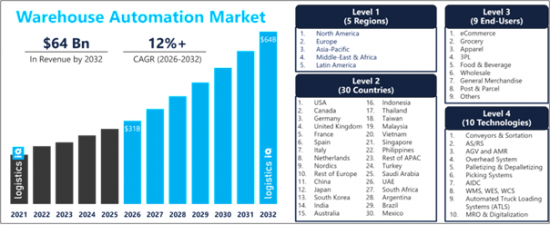
세계 창고 자동화 시장은 전략적 전환점에 도달했습니다. 거시경제의 조정과 구조적 재편이라는 이미 널리 알려진 단계를 넘어 이 분야는 광범위하고 급속한 확대 국면에 접어들고 있습니다. LogisticsIQ의 직접적인 정량 모델 분석에 따르면, 전 세계 창고 자동화 시장 규모는 2032년까지 640억 달러에 달할 것으로 예상되며, 2026년부터 2032년까지 연평균 성장률(CAGR) 12%의 가속화된 성장이 지속될 것으로 전망됩니다.
시장의 관심은 종종 주목도가 높은 도입 사례에 쏠리기 마련이지만, 그 이면에 숨겨진 현실은 가혹합니다. 전 세계에서 운영 중인 창고의 80%는 여전히 전적으로 수작업에 의존하고 있으며, 자동화를 통한 지원은 전혀 이루어지지 않고 있습니다. 이러한 심각한 구조적 공백은 기업의 상업적 성장, 기술 갱신 주기, 그리고 사모펀드 자본의 투입에 있어 전례 없는 수십억 달러 규모의 성장 여지를 의미합니다.
본 조사는 모든 기업 Tier에 걸쳐 결정적인 세계 기준 도구로서의 역할을 수행합니다. 시스템 통합사업자에는 주요 경쟁사와의 벤치마크를, 모바일 로봇 OEM 업체에는 명확한 소프트웨어 통합 로드맵을, 부품 제조업체에는 정확한 목표 수요 규모를, 1차 공급업체 경영 컨설팅 회사에는 검증된 모델링 기준을, 그리고 투자 회사에는 기업 가치를 평가하는 데 필요한 정확한 데이터를 제공합니다. 100명 이상의 이해관계자를 대상으로 한 심층 인터뷰와 700개 이상의 세계 기업을 대상으로 한 철저한 평가를 바탕으로 작성된 본 시장 조사 보고서 제6판은 오늘날 업계를 특징짓는 구조적 변화를 명확히 보여주고 있습니다.
창고 자동화의 촉진요인:
- 그린필드에서 브라운필드로의 구조적 전환: 거시경제적 요인으로 인해 전 세계적으로 신규 그린필드 건설이 둔화되는 가운데, 업계의 주요 가치 창출원은 기존 브라운필드 자산의 개보수로 결정적으로 전환되고 있습니다. 본 보고서에서는 레이아웃상의 제약이 기존 컨베이어 수요를 어떻게 변화시키고, 고밀도 큐브형 AS/RS 및 인프라가 필요 없는 모바일 플리트의 도입을 촉진하고 있는지를 분석했습니다.
- 소프트웨어 정의 오케스트레이션으로의 전환: 하드웨어의 성능 특성이 표준화됨에 따라, 업계의 경쟁 우위는 물리적 장비에서 소프트웨어 기반 오케스트레이션으로 이동하고 있습니다. 본 보고서에서는 창고 운영 시스템(WES)과 AI 머신 비전 플랫폼이 어떻게 융합되어 장비 선정에 영향을 미치고 있는지를 종합적으로 고찰하고, 소프트웨어 개발자, 비전 솔루션 제공업체, 시스템 통합사업자 각 주체에 있어 업계 동향을 근본적으로 재구성하고 있는 현황을 밝힙니다.
- 자동화 최전선의 정량화: 기존 기법에 그치지 않고, 자동화된 단품 피킹을 수행하는 자율주행 로봇(AMR)부터 터미널 도크의 병목 현상 해소를 목적으로 설계된 자동 트럭 적재 시스템(ATLS)에 이르기까지, 최첨단 솔루션의 정확한 재무적 성과를 산출하고 있습니다. 특히 중요한 점으로, 본 보고서에서는 MRO(유지보수·수리·정비) 및 디지털 서비스가 어떻게 확대되어 기술 공급업체를 주기적인 프로젝트 설비 투자의 침체로부터 보호하고, 높은 수익률을 자랑하는 지속적인 수익을 창출하고 있는지를 추적하고 있습니다.
주요 조사 결과
인력 부족, 전자상거래의 성장, 그리고 변화하는 소비자의 기대에 따라 공급망이 재편되는 가운데, 창고 자동화 도입이 가속화되고 있습니다.
- 미국, 독일, 중국이 주요 시장 : 미국, 중국, 독일은 세계 제조, 무역, 물류의 주요 거점으로서의 지위를 바탕으로 창고 자동화 분야를 계속해서 선도하고 있습니다. 북미는 여전히 최대의 지역 시장이며, 한편 유럽은 전 세계 물류 활동의 약 3분의 1을 차지하고 있으며, 업계를 선도하는 많은 자동화 업체들이 이곳에 거점을 두고 있습니다. 앞으로 가장 빠른 성장이 예상되는 곳은 아시아태평양, 특히 인도와 동남아시아입니다. 이는 전자상거래의 강력한 성장과 공급망의 현대화에 힘입은 결과입니다. 한편, 중동, 브라질, 멕시코, 폴란드, 체코 공화국 등의 신흥 시장도 기업들이 공급망의 다각화와 지역화를 추진함에 따라 그 존재감을 높여가고 있습니다.
- 온라인 식료품이 창고 자동화의 가장 큰 매력으로 부상: 식료품은 주문량이 많고, 재고 보충 주기가 빈번하며, 엄격한 신선도 요건이 요구되기 때문에 여전히 물류 부담이 가장 큰 소매 부문 중 하나입니다. 온라인 식료품 매출이 지속적으로 확대되고 소매업체들이 보다 신속한 주문 처리 모델을 추구함에 따라, 마이크로 풀필먼트 센터(MFC), 로봇 공학 및 자동화 창고 시스템에 대한 자동화 투자가 가속화되고 있습니다. 월마트와 심보틱, 크로거(Kroger)와 오카도(Ocado), 알리바바(Alibaba)의 프레시포(Freshippo)와 같은 주요 소매업체 및 솔루션 제공업체들은 자동화의 전략적 중요성을 보여주고 있으며, 업계 추산에 따르면 MFC 시장은 연평균 약 15%의 성장률에 힘입어 2032년까지 100억 달러를 넘어설 가능성이 있다고 합니다. 온라인 식료품 판매, 마이크로 풀필먼트 센터(MFC), 초고속 배송에 힘입어 가속화되는 자동화 수준은 향후 5년 동안 가장 큰 기회가 될 것으로 예상되며, AutoStore, Ocado, Exotec, Symbotic, Attabotics, OPEX, Fabric, Geek+, Urbx Logistics와 같은 다양한 솔루션 제공업체들이 이를 주도해 나갈 것입니다.
- AGV/AMR은 앞으로도 도입해야 할 핵심 기술이 될 전망입니다. 전자상거래의 주문 처리 요구 사항 가속화, 인력 부족, 그리고 유연하고 확장성이 뛰어난 자동화에 대한 수요에 힘입어, AGV 및 AMR 시장은 창고 자동화 분야에서 가장 빠르게 성장하는 부문이 될 것으로 예측됩니다. 기존의 고정형 자동화와는 달리, AMR은 인프라 변경을 최소화하면서 도입할 수 있기 때문에 신속한 투자 회수(ROI)와 업무 민첩성을 추구하는 중소규모 창고에게 특히 매력적인 선택지가 되고 있습니다. 그 결과, 2032년까지 모바일 로봇이 창고 자동화 시장의 25% 이상을 차지할 것으로 예상되며, Geek+, Hai Robotics, GreyOrange, Locus Robotics, Quicktron, Hikrobot, Seegrid, MiR(Teradyne), OTTO Motors, 오므론 등의 기술 제공업체들이 주도적인 역할을 할 것으로 전망됩니다. ASRS 솔루션은 여전히 높은 처리 능력을 제공하고 있지만, AMR은 도입 비용이 저렴하고 유연성이 뛰어나며, 동적인 주문 처리 업무에 대응할 수 있는 능력 덕분에 점점 더 선호되고 있습니다. 새로운 주요 동향으로는 AI가 탑재된 로봇 매니퓰레이터와 이동형 피킹 로봇의 통합을 들 수 있습니다. 이 시스템들은 자율 주행과 로봇 팔을 결합하여 개별 상품 피킹, 분류, 팔레트 하역 및 혼합 케이스 주문 처리를 자동화함으로써, 창고 자동화의 범위를 한층 더 확대되고 있습니다.
- 피킹 시스템은 여전히 수작업이 주를 이룹니다. 주문 피킹은 현대 창고에서 여전히 가장 노동 집약적이고 운영상 복잡한 작업으로 남아 있으며, 자동화 투자의 주요 중점 분야가 되고 있습니다. 전자상거래나 온라인 식료품 판매 등 SKU 수가 많은 환경에서는 수작업별 피킹이 여전히 중요한 역할을 하고 있지만, 창고에서는 생산성, 정확도 및 노동 효율을 높이기 위해 굿-투-퍼슨(GTP) 시스템, RFID를 활용한 식별, 픽-투-라이트, 픽-투-보이스와 같은 기술의 도입이 점점 더 확대되고 있습니다. 피킹 시스템 시장 규모는 2032년까지 약 50억 달러에 달할 것으로 전망됩니다. 자동 창고 시스템(ASRS)과 로봇 피킹 솔루션은 상품 출고 및 주문 처리를 효율화함으로써 인력에 대한 의존도를 더욱 낮추고 있습니다. 최신 혁신의 흐름은 AI를 탑재한 단품 피킹 로봇과, 다양한 제품, 불규칙한 형태, 여러 SKU가 혼재된 주문을 더 높은 정확도와 속도로 처리할 수 있는 로봇 매니퓰레이터에 초점을 맞추었습니다. Dexterity, Covariant, Plus One Robotics, Berkshire Grey, RightHand Robotics, Fizyr, Osaro, Pickr AI와 같은 기업들은 비전 유도형 로봇 피킹 기술을 추진하고 있으며, 그동안 로봇 기술로는 대응하기 어려웠던 점점 더 복잡해지는 피킹 작업의 자동화를 창고에서 가능하게 함으로써, 완전 자율형 주문 처리 업무로의 전환을 가속화하고 있습니다.
창고 자동화 시장 보고서의 주요 내용
- 창고 자동화 공급업체와 업계 전문가들은 구조적인 인력 부족, 전자상거래의 지속적인 성장, 그리고 공급망 디지털화의 가속화를 배경으로, 장기적으로 두 자릿수 시장 성장이 지속될 것으로 전망하고 있습니다. 피지컬 AI, 산업용 IoT, 5G 연결, 자율 운영의 융합이 창고 네트워크의 모습을 변화시키고 있으며, 자동화는 회복탄력성, 생산성, 고객 대응 능력을 높이는 전략적 원동력이 되고 있습니다.
- 경쟁 구도 - 창고 자동화 시장은 여전히 적정한 수준의 통합이 진행되고 있으며, 연간 매출액이 10억 달러를 넘는 대기업이 약 15개사, 또한 2억-10억 달러의 매출을 기록하는 중견 기업이 15-20개사 존재합니다. Dematic, Daifuku, SSI Schaefer, Symbotic, Knapp, Vanderlande, Honeywell Intelligrated, Muratec, Beumer, Fortna, Witron 등 업계 선도 기업들이 합쳐서 세계 시장의 절반 이상을 차지하고 있습니다. 동시에 AMR, 로봇 피킹, 큐브형 보관, 마이크로 풀필먼트, AI를 활용한 자율화 등 분야의 신생 전문 기업별 혁신이 점점 더 활발히 추진되고 있으며, Symbotic(심보틱)과 같은 기업들이 주요 경쟁력으로 급부상하고 있습니다.
- MRO 및 디지털 서비스의 중요성이 점점 더 커지고 있습니다. 자동화 창고 솔루션의 도입 기반이 확대됨에 따라, 업계 관계자들은 서비스 및 유지보수 부문의 매출 증가를 예상하고 있습니다. 서비스 사업의 영업이익률은 보통 15-20%인 반면, 신규 설비의 이익률은 3-5%이므로, 이는 수익성에 긍정적인 영향을 미칠 것으로 보입니다. 2032년까지 디지털 서비스를 포함해 약 150억 달러 규모 시장에 달할 것으로 예상되며, 이는 전체 시장의 약 25%를 차지하게 됩니다.
- 또한, 최종 사용자가 고액의 설비 투자에 따른 실시간 과제를 안고 있다는 점을 감안하여, 비즈니스 모델도 변화하고 있습니다. 기업들은 기존의 로봇 공학 프로그램에 비해 유연성과 확장성이 뛰어나고 도입 비용이 저렴하다는 점 때문에 RaaS(Robotics As a Service)에 점점 더 많은 관심을 보이고 있습니다. 'Pick-as-a-Service'의 비즈니스 모델은 일반적으로 피킹 1회당 요금이 부과되는 방식이며, 1회당 6센트에서 10센트 사이입니다. 한편, ‘AMR-as-a-Service’는 일반적으로 월정액 임대 방식으로, 계약 기간에 따라 로봇 1대당월750달러에서 수천 달러까지 비용이 다양합니다.
- 업계 재편 - 지난 5년 동안 자재관리 장비 공급업체들 간의 재편이 진행되고 있습니다. 이는 기존 주요 기업들이 변화하는 시장 동향에 대응하고 자사의 입지를 확고히 하기 위한 수단으로, 신기술 분야의 선도 기업을 인수하는 것이 점점 더 매력적인 선택지가 되고 있기 때문입니다. 록웰 오토메이션(Clearpath Robotics, OTTO Motors), 융하인리히(Magazino), SSI 셰퍼(DS Automotion), 제브라(Fetch Robotics, Matrox), ABB(ASTI), 도요타(Vanderlande, Bastian Solutions, ViaStore), 무라타 기계(Cimcorp), Locus Robotics(Waypoint), 히타치(JR Automation), KPI Solutions(Kuecker Logistics Group, Pulse Integration, QC Software), Ocado(6 River Systems, Kindred, Haddington Dynamics), Element Logic(SDI), Honeywell(Intelligrated, Transnorm), Korber(Cohesio Group, Siemens Logistics, HighJump), Teradyne(MiR, Energid, AutoGuide Mobile Robots), Jungheinrich(Arculus), KION(Dematic), KUKA(Swisslog) 등은 이 업계 재편의 한 예에 불과합니다.
알아두어야 할 사실
- 전 세계 전자상거래 매출액은 지난 10년간 연평균 성장률(CAGR) 20%로 증가하여, 2021년에는 전 세계적으로 5조 달러에 육박했습니다. 2030년까지 10조 달러를 넘어설 것으로 예측됩니다. 또한, 전 세계 온라인 쇼핑 이용자 수가 23억 명을 넘어섰으며, 디지털 소매 채널로의 전환이 계속해서 진행되고 있음이 드러났습니다. 향후 10년 동안 전자상거래가 전 세계 소매 매출의 4분의 1 이상을 차지할 것으로 예상되며, 보다 신속하고 비용 효율적인 주문 처리를 지원하기 위해 자동화된 주문 처리, 로봇 공학, 라스트 마일 물류 및 고처리량 창고 인프라에 대한 대규모 투자가 촉진될 전망입니다.
- 아마존 로보틱스는 창고 자동화 분야에서 가장 영향력 있는 기업 중 하나로 자리매김했으며, 아마존은 2015년 약 3만 대에서 시작해 2025년에는 전 세계 300곳 이상의 주문 처리 및 물류 시설에 100만 대의 로봇을 도입하는 이정표를 넘어섰습니다. 이 회사는 현재 AI를 활용한 새로운 오케스트레이션 플랫폼 'DeepFleet'을 도입하고 있습니다. 이 플랫폼은 지능형 교통 관리와 실시간 최적화를 통해 로봇 군단의 효율을 약 10% 향상시킵니다. 풀필먼트 네트워크를 대대적으로 재설계하고 자동화에 투자한 결과, 아마존은 업무 생산성을 크게 향상시켰을 뿐만 아니라 고객 주문의 약 75%에서 로봇 지원 처리를 실현했습니다. 이와 동시에 아마존은 10억 달러 규모의 ‘Amazon Industrial Innovation Fund(AIIF)’를 통해 혁신을 지속적으로 촉진하며, 로봇공학, AI, 자동화, 주문 처리, 운송, 공급망 솔루션에 걸친 차세대 기술에 투자하고 있습니다.
- 월마트와 심보틱은 전 세계 소매 물류 분야에서 가장 중요한 자동화 파트너십 중 하나를 구축해 왔습니다. 2017년 플로리다주 브룩스빌에 위치한 월마트 물류 센터에 Symbotic의 로봇 플랫폼을 처음 도입한 이래, 이 파트너십은 시범 도입 단계에서 네트워크 전반에 걸친 혁신 이니셔티브로 확대되었습니다. 월마트가 미국 내 42곳의 지역 물류 센터(RDC) 전부를 자동화하기로 결정함에 따라, Symbotic은 현재 AI 기반 로봇 및 소프트웨어 플랫폼을 RDC 네트워크 전체에 도입하고 있습니다. 2025년에 Symbotic은 월마트의 'Advanced Systems and Robotics' 사업부를 인수하고, 월마트의 'Accelerated Pickup and Delivery(APD)' 시설을 위한 차세대 자동화 기술을 개발하기 위한 전략적 합의를 체결함으로써, 양사의 제휴는 한층 더 심화되었습니다. 이 합의에 따라 월마트는 개발 프로그램에 5억 2,000만 달러를 지원하기로 약속했으며, 향후 수년에 걸쳐 400곳의 APD 센터에 자동화 시스템을 도입할 계획입니다. 이로 인해 Symbotic의 향후 수주 잔고에 50억 달러 이상이 추가될 가능성이 있으며, 자동화의 범위도 물류 센터에서 매장 수준의 주문 처리 및 라스트 마일 업무로 확대될 것입니다.
- 동유럽은 니어쇼어링, 전자상거래의 확대, 그리고 공급망이 최종 시장과 가까워지는 추세를 배경으로, 유럽에서 가장 매력적인 창고 자동화 성장 지역 중 하나로 부상하고 있습니다. 폴란드는 이 지역을 대표하는 물류 허브로서의 위상을 확립했으며, 현대식 창고의 총 면적은 3,500만 제곱미터를 넘어 유럽 최대 규모의 창고 시장 중 하나로 꼽히고 있습니다. 또한 전 세계의 소매업체, 제3자 물류(3PL) 업체, 제조업체로부터 막대한 투자를 유치하고 있습니다. 경쟁력 있는 인건비, 심화되는 인력 부족, 그리고 지속적인 인프라 투자로 인해 폴란드, 체코, 슬로바키아, 헝가리 전역에서 로봇, AMR, ASRS 및 창고 관리 소프트웨어의 도입이 가속화되고 있습니다. 기업들이 서유럽 및 동유럽 시장으로의 관문으로서 중동유럽을 점점 더 많이 활용함에 따라, 이 지역에서는 향후 10년 동안 창고 자동화 분야에서 평균 이상의 성장이 예상됩니다.
- 중국은 세계 최대의 전자상거래 생태계, 물류의 급속한 현대화, 그리고 스마트 제조에 대한 정부의 강력한 지원을 바탕으로 창고 자동화 분야에서 세계적인 선도국으로서의 입지를 확고히 하고 있습니다. Geek+, Hai Robotics, Hikrobot, Quicktron, Siasun, Multiway Robotics, VisionNav Robotics, SEER Robotics, Libiao Robotics 등 중국의 차세대 자동화 선도 기업들은 AMR, 자율형 케이스 취급 로봇(ACR), 로봇 피킹, 고밀도 보관, AI를 활용한 창고 오케스트레이션 등 각 분야에서 혁신을 주도하고 있습니다. Geek+는 전 세계 950곳 이상의 물류센터에 솔루션을 도입하여 100억 건 이상의 주문을 처리해 왔습니다. 한편, Quicktron은 전 세계 1,000개 이상의 고객사에 42,000대 이상의 AMR을 도입했으며, 이는 중국 자동화 생태계의 규모와 성숙도를 여실히 보여주고 있습니다. 중국의 각 공급업체들은 비용 경쟁력이 뛰어나고, 소프트웨어 중심이며 확장성이 높은 자동화 플랫폼을 활용하여 유럽, 북미, 동남아시아, 중동으로의 진출을 가속화하고 있으며, 기존의 세계적 선도 기업들에 도전하는 동시에 중국을 창고 자동화 기술의 주요 수출국으로 자리매김하고자 하고 있습니다.
- 경제 전반에 불확실성이 존재함에도 불구하고, 창고 자동화를 위한 설비 투자는 견조한 추세를 보이고 있습니다. 이는 기업 등이 생산성, 노동력의 회복력, 공급망의 민첩성을 점점 더 중요하게 여기고 있기 때문입니다. 대규모 물류 센터에서는 일반적으로 시설 한 곳당 1,000만-1억 달러 이상의 자동화 투자가 이루어지고 있으며, 한편 대형 소매업체와 물류 사업자들은 네트워크 현대화 및 로봇 도입을 위해 계속해서 수십억 달러 규모의 투자를 이어가고 있습니다. 또한 업계에서는 기존의 고정형 자동화에서 모듈식 AMR(자율 이동 로봇), AI 기반 소프트웨어, 그리고 약 2-5년 내에 투자 회수가 가능한 '상품에서 사람으로(Goods-to-Person)' 시스템으로의 전환이 진행되고 있습니다. 초기 투자를 최대 60-80% 절감할 수 있는 'Robotics-as-a-Service(RaaS)' 및 구독형 모델의 급속한 보급과 더불어, 이러한 자금 조달 및 기술 동향에 힘입어 자동화 보급률이 대폭 확대될 것이며, 향후 5년 동안 시장이 두 자릿수 성장을 유지할 것으로 예측됩니다.
이 보고서에서는 어떤 정보를 얻을 수 있는가?
- LogisticsIQ(TM) 독점 시장 맵(15개 이상의 카테고리에 걸쳐 700개 이상의 기업)
- 500페이지 이상, 도표 290개 이상, 8개 주요 산업 분야 및 10가지 기술에 관한 시장 보고서
- 30개 국가 및 지역의 창고 자동화 시장에 대한 상향식 분석
- 생태계를 구성하는 700개 기업에 대한 상세한 분석(140개 이상의 기업 프로파일 포함)
- 밸류체인 전반에 걸쳐 100개 이상의 주요 이해관계자와 진행한 포커스 그룹 토론을 통해, 분석의 타당성을 검증하기 위한 1차 정보를 수집
- 피벗 분석 기능이 포함된 엑셀 파일과 2032년까지의 예측을 포함한 350개 이상 시장 표
- 애널리스트 세션 2회
- 150건 이상의 M&A 및 750건 이상의 자금 조달 사례를 포함한 투자 세부 정보
목차
제1장 주요 요약
제2장 창고 자동화 개요
- 창고 업무 구조
- 창고 관리 시스템(WMS), 창고 시행 시스템(WES), 창고 제어 시스템(WCS)
- 자동 식별·데이터 수집(AIDC)
- 컨베이어, 선별 장비, 오버헤드 시스템
- 이동 로봇-자율 반송차(AGV) 및 자율 이동 로봇(AMR)
- 자동 창고 시스템(AS/RS)
- 팔레타이징/디팔레타이징 시스템
- 피킹 작업
- 자동 트럭 적재 시스템(ATLS)
- MRO, 디지털 서비스, 수명주기 관리
- 신기술과 자동화 미래
제3장 창고 자동화 비즈니스 모델
- 기존 모델 : 프로젝트 기반 시스템 통합
- 파괴적 모델 : 유연한 자동화 서비스
- 하이브리드 모델 : 자동화을 위한 서비스로서의 소프트웨어(SaaS)
- OEM 모델 : 생태계를 지탱한다
- 브라운필드 모델 : 모듈식 전개와 단계적 현대화
제4장 창고 자동화 시장-촉진요인과 과제
- 주요 촉진요인-자동화 필요성을 지지하는 멈출 수 없는 힘
- 주요 시장이 해결해야 할 과제-보급에의 장벽을 넘습니다
제5장 창고 자동화 시장 주요 최종사용자
- Amazo
- JD.com
- Walmart
- Tesco
- Kroger
- Ocado
- ASOS
- Zalando
- DHL Supply Chain
제6장 창고 자동화 시장(기술별)
- 컨베이어 및 분류 시스템
- 오버헤드 시스템
- 자동 창고 시스템(AS/RS)
- 팔레타이징/디팔레타이징 시스템
- 자동 식별 및 데이터 수집
- 자율 반송차(AGV) 및 자율 이동 로봇(AMR)
- 피킹 작업
- WMS, WES, WCS
- 자동 트럭 적재 시스템
- MRO 서비스
제7장 창고 자동화 시장(최종사용자 산업별)
- E-Commerce
- 식료품
- 식품 및 음료
- 패션&의류
- 3PL
- 잡화
- 우편물과 소포
- 도매
- 기타(의약품 및 생명과학, 금속 및 광업, 화학 등)
제8장 창고 자동화 시장 규모(국가별)
- 북미
- 미국
- 캐나다
- 유럽
- 서유럽 : 한정된 도시 공간을 최대한으로 활용한다
- 중앙유럽 및 동유럽 : 급속히 확대하는 지역 허브
- 영국
- 독일
- 프랑스
- 이탈리아
- 스페인
- 네덜란드
- 노르딕
- 기타
- 아시아태평양
- 중국
- 일본
- 한국
- 인도
- 호주
- 동남아시아
- 결론
- 중동 및 아프리카
- 중동은 석유 의존으로부터 탈각을 목표로 해, 지역 물류 거점을 구축하고 있습니다.
- 경제 다각화, 전자상거래, 그리고 지역화가 창고 투자 본연의 자세를 변혁하고 있다
- 자동화 수요를 촉진 하고 있는 것은 3PL, 소매, E-Commerce, 식품 물류 업계
- 국가 레벨 차이
- 사우디아라비아
- 아랍에미리트
- 튀르키예
- 남아프리카공화국
- 결론
- 라틴아메리카
- 라틴아메리카는 역사적으로 분단 되고 있던 물류 네트워크 현대화를 진행시키고 있다
- E-Commerce, 니어쇼어 링, 소매업 현대화가 창고 투자 본연의 자세를 변혁하고 있다
- 자동화 수요는 E-Commerce, 소매, 3PL, 제조 물류에 의해 촉진되고 있다
- 국가 레벨 차이
- 멕시코
- 브라질
- 아르헨티나
- 결론
제9장 경쟁 구도
- 주요 시장 진출기업에 의한 자동화 솔루션 매트릭스
- 시스템 통합사업자
- 창고 관리 소프트웨어 솔루션
- 자동 식별·데이터 수집(AIDC)
- 시장 점유율 분석
- 지역 경관
- 북미
- 서유럽
- 영국
- 중국
- 지역 기업
- 시스템 통합사업자-주요 기업
- Daifuku
- Dematic(KION Group)
- SSI Schaefer
- Vanderlande(Toyota Industries)
- Symbotic
- Fortna
- Murata Machinery(Muratec)
- Knapp
- TGW Logistics Group
- Honeywell Intelligrated
- AGV 및 AMR-주요 기업
- Geek+(중국)
- Locus Robotics(미국)
- Hai Robotics(중국)
- Hikrobot(중국)
- GreyOrange(미국/인도)
- Tier 2 : 전문성 높은 고성장 이노베이터
- AIDC 및 비전 시스템-주요 기업
- Zebra Technologies(미국)
- Datalogic S.p.A.(이탈리아)
- SICK(독일)
- Honeywell SPS(미국)
- SATO(일본)
- Cognex(미국)
- Keyence Corporation(일본)
- Basler AG(독일)
- 소프트웨어(WMS/WES/WCS)-주요 기업
- Blue Yonder(미국)
- Manhattan Associates(미국)
- Oracle(미국)
- SAP(독일)
- Korber Supply Chain - HighJump(독일)
- Infor(미국)
- 산업용 로봇(다관절 로봇)-주요 기업
- Fanuc(일본)
- ABB(스웨덴/스위스)
- Kuka(독일)
- Yaskawa(일본)
- Epson Robots(일본)
- Universal Robots(덴마크)
- 자동 짐을 실음·하역(ATLS)-주요 기업
- Ancra Systems B.V.(네덜란드)
- Joloda Hydraroll(영국)와 Actiw Oy(핀란드)
- Boston Dynamics(미국)
- Dexterity(미국)
- Pickle Robot(미국)
- Slip Robotics(미국)
- Fox Robotics(미국)
제10장 적용 범위와 정의
제11장 조사 방법
LSH 26.07.20The global warehouse automation market has reached a strategic inflection point. Navigating beyond a well-documented phase of macroeconomic calibration and structural realignment, the sector is entering a broad-based, high-velocity expansion phase. Direct quantitative modeling by LogisticsIQ positions the global warehouse automation market to reach $64 Billion by 2032, sustained by an accelerating CAGR of 12% from 2026 through 2032.
While market visibility often centers on high-profile installations, the underlying reality is stark: 80% of operational warehouses worldwide remain completely manual, lacking any automation support. This profound structural vacuum represents an unprecedented, multi-billion-dollar runway for enterprise commercial growth, technology replacement cycles, and private equity capital deployment.
This study serves as the definitive global reference tool across the corporate spectrum. It provides system integrators with critical competitor benchmarking, mobile robotics OEMs with clear software integration pathways, component manufacturers with exact addressable demand sizing, tier-1 management consultancies with validated modeling baselines, and investment firms with the exact data needed to evaluate enterprise multiples. The 6th edition of our market study, synthesized from over 100 deep-dive stakeholder interviews and an exhaustive evaluation of more than 700 global players, provides a clear view to the structural shifts defining the industry today.
Warehouse Automation Drivers:
- The Greenfield-to-Brownfield Structural Pivot: As macroeconomic variables cause a slowdown in new global greenfield construction, the industry’s primary value pool has shifted decisively toward retrofitting existing brownfield assets. This report analyses how layout limitations are altering the demand for traditional conveyors and driving the adoption of high-density Cube-Based AS/RS and infrastructure-free mobile fleets.
- The Software-Defined Orchestration Shift: Hardware performance characteristics are standardizing, causing the industry’s competitive moat to migrate from physical machinery to software orchestration. We provide a comprehensive look at how Warehouse Execution Systems (WES) and AI machine vision platforms are converging to dictate equipment selection, completely reshaping the landscape for software developers, vision providers, and system integrators alike.
- Quantifying the Automation Frontiers: Beyond established modalities, we calculate the exact financial trajectory of frontier solutions, from Autonomous Mobile Robots (AMRs) executing automated piece-picking to Automatic Truck Loading Systems (ATLS) engineered to resolve terminal dock bottlenecks. Crucially, the report tracks how MRO and Digital Services are scaling to generate high-margin, recurring revenues that protect technology vendors from cyclical project capital expenditure downturns.
KEY FINDINGS
Warehouse Automation Adoption Accelerates as Labor Shortages, eCommerce Growth, and Evolving Consumer Expectations Reshape Supply Chains
- US, Germany and China are the key market: The U.S., China, and Germany continue to lead the warehouse automation landscape, supported by their position as major global manufacturing, trade, and logistics hubs. North America remains the largest regional market, while Europe accounts for roughly one-third of global logistics activity and hosts many of the industry’s leading automation providers. Looking ahead, the fastest growth is expected in Asia-Pacific, particularly India and Southeast Asia driven by strong eCommerce growth and supply-chain modernization, while emerging markets such as the Middle East, Brazil, Mexico, Poland, and the Czech Republic are gaining prominence as companies diversify and regionalize their supply chains.
- Online Grocery becoming the top attraction for warehouse automation: Grocery remains one of the most logistics-intensive retail segments due to high order volumes, frequent replenishment cycles, and stringent freshness requirements. As online grocery sales continue to expand and retailers pursue faster fulfillment models, automation investments in micro-fulfillment centers (MFCs), robotics, and automated storage systems are accelerating. Leading retailers and solution providers-including Walmart–Symbotic, Kroger–Ocado, and Alibaba’s Freshippo, have demonstrated the strategic importance of automation, while industry estimates indicate the MFC market could exceed $10 billion by 2032, supported by growth rate of ~15%. Higher automation driven by online grocery, micro-fulfillment centers (MFC) and ultrafast deliveries is going to be biggest opportunity in next 5 years led by different type of solution providers such as AutoStore, Ocado, Exotec, Symbotic, Attabotics, OPEX, Fabric, Geek+, and Urbx Logistics.
- AGV/AMR will remain the key technology to adopt: AGV and AMR market is expected to become the fastest-growing segment of warehouse automation, driven by accelerating eCommerce fulfillment requirements, labour shortages, and the need for flexible, scalable automation. Unlike traditional fixed automation, AMRs can be deployed with minimal infrastructure changes, making them particularly attractive for small and mid-sized warehouses seeking rapid ROI and operational agility. As a result, mobile robotics is expected to account for more than 25% of the warehouse automation market by 2032, led by technology providers such as Geek+, Hai Robotics, GreyOrange, Locus Robotics, Quicktron, Hikrobot, Seegrid, MiR (Teradyne), OTTO Motors, and Omron, among others. While ASRS solutions continue to offer higher throughput, AMRs are increasingly preferred for their lower deployment costs, flexibility, and ability to support dynamic fulfillment operations. A key emerging trend is the integration of AI-enabled robotic manipulators and mobile picking robots, which combine autonomous navigation with robotic arms to automate piece-picking, sortation, depalletizing, and mixed-case order fulfillment, further expanding the scope of warehouse automation.
- Picking systems are still largely manual: Order picking remains the most labor-intensive and operationally complex activity within modern warehouses, making it a key focus area for automation investments. While manual picking continues to play an important role in high-SKU environments such as eCommerce and online grocery, warehouses are increasingly adopting goods-to-person systems, RFID-enabled identification, pick-to-light, and pick-to-voice technologies to improve productivity, accuracy, and labor efficiency in picking system market worth ~$5B by 2032. Automated storage and retrieval systems (ASRS) and robotic picking solutions are further reducing dependence on manual labor by streamlining item retrieval and order fulfillment. The latest wave of innovation is centered on AI-powered piece-picking robots and robotic manipulators capable of handling diverse products, irregular shapes, and mixed-SKU orders with greater accuracy and speed. Companies such as Dexterity, Covariant, Plus One Robotics, Berkshire Grey, RightHand Robotics, Fizyr, Osaro, and Pickr AI are advancing vision-guided robotic picking, enabling warehouses to automate increasingly complex picking tasks that were previously considered too challenging for robotics, thereby accelerating the transition toward fully autonomous fulfillment operations.
Highlights of Warehouse Automation Market Report
- Warehouse automation suppliers and industry experts expect sustained double-digit market expansion over the long term, driven by structural labor shortages, continued eCommerce growth, and accelerating digitalization of supply chains. The convergence of Physical AI, Industrial IoT, 5G connectivity, and autonomous operations is reshaping warehouse networks, making automation a strategic enabler of resilience, productivity, and customer responsiveness.
- Competitive landscape - The warehouse automation market remains moderately consolidated, with approximately 15 large players generating over US$1 billion in annual revenue and another 15–20 mid-sized providers generating US$200 million–US$1 billion. Industry leaders including Dematic, Daifuku, SSI Schaefer, Symbotic, Knapp, Vanderlande, Honeywell Intelligrated, Muratec, Beumer, Fortna, and Witron collectively command over half of the global market. At the same time, innovation is increasingly being driven by emerging specialists in AMRs, robotic picking, cube-based storage, micro-fulfillment, and AI-powered autonomy, with companies such as Symbotic rapidly establishing themselves as major competitive forces.
- Services, both MRO and Digital, importance is increasing – Over the time as the installed base of automated warehouse solutions grows, industry players expect an increase in revenues from services and maintenance, which would have a positive impact on profitability as the service business typically has 15-20% operating margins, versus 3-5% margins for new equipment. It is expected to be ~$15B opportunity by 2032 including digital services which is almost 25% of total market.
- Business models are also changing considering the real time pain points of end-users for high capex. Businesses are increasingly intrigued with RaaS (Robotics As a Service) because of its flexibility, scalability, and lower cost of entry than traditional robotics programs. The business model for pick-as-a-service is usually on a per-pick basis, ranging from 6 cents to 10 cents per pick, while AMR-as-a-service is usually leased on a monthly basis, from US$750 per robot per month to several thousands of dollars per month, depending on the commitment period.
- Industry Consolidation – The past 5 years have seen an increase in consolidation amongst material handling equipment providers as traditional players see acquisition of new technology leaders as an increasingly attractive way of positioning themselves in response to changing market trends. Acquisitions like Rockwell Automation (Clearpath Robotics, OTTO Motors), Jungheinrich (Magazino), SSI Schafer (DS Automotion), Zebra (Fetch Robotics, Matrox), ABB (ASTI), Toyota (Vanderlande, Bastian Solutions, ViaStore), Murata Machinery (Cimcorp), Locus Robotics (Waypoint), Hitachi (JR Automation), KPI Solutions (Kuecker Logistics Group, Pulse Integration, QC Software), Ocado (6 River Systems, Kindred, Haddington Dynamics), Element Logic (SDI), Honeywell (Intelligrated, Transnorm), Korber (Cohesio Group, Siemens Logistics, HighJump), Teradyne (MiR, Energid, AutoGuide Mobile Robots), Jungheinrich (Arculus), KION (Dematic), KUKA (Swisslog) are just some of the examples of this consolidation.
Facts to Know
- Global e-Commerce sales have grown at a CAGR of 20% over the last decade, reaching almost $5 trillion worldwide in 2021 and expected to grow to more than $10 trillion by 2030, while online shopping adoption exceeded 2.3 billion consumers globally, highlighting the continued shift toward digital retail channels. Looking ahead, eCommerce is expected to account for more than a quarter of global retail sales over the next decade, driving significant investments in automated fulfillment, robotics, last-mile logistics, and high-throughput warehouse infrastructure to support faster and more cost-efficient order fulfillment.
- Amazon Robotics has become one of the most influential forces in warehouse automation, with Amazon surpassing the milestone of 1 million deployed robots across more than 300 fulfillment and logistics facilities globally in 2025, compared to approximately 30,000 robots in 2015. The company is now integrating its new AI-powered orchestration platform, DeepFleet, which improves robotic fleet efficiency by roughly 10% through intelligent traffic management and real-time optimization. Following significant fulfillment network redesign efforts and automation investments, Amazon has materially improved operational productivity while enabling robot-assisted handling in approximately 75% of customer orders. In parallel, Amazon continues to stimulate innovation through its US$1 billion Amazon Industrial Innovation Fund (AIIF), investing in next-generation technologies spanning robotics, AI, automation, fulfillment, transportation, and supply chain solutions.
- Walmart and Symbotic have evolved one of the most significant automation partnerships in global retail logistics. After initially deploying Symbotic’s robotics platform at Walmart’s Brooksville, Florida distribution center in 2017, the collaboration expanded from a pilot deployment to a network-wide transformation initiative. Following Walmart’s decision to automate all 42 U.S. regional distribution centers, Symbotic is currently deploying its AI-enabled robotics and software platform across the entire RDC network. In 2025, the partnership deepened further when Symbotic acquired Walmart’s Advanced Systems and Robotics business and signed a strategic agreement to develop next-generation automation for Walmart’s Accelerated Pickup and Delivery (APD) facilities. Under the agreement, Walmart committed US$520 million toward the development program and plans to deploy automation systems across 400 APD centers over multiple years, potentially adding more than US$5 billion to Symbotic’s future backlog while extending automation beyond distribution centers into store-level fulfillment and last-mile operations.
- Eastern Europe is emerging as one of the most attractive warehouse automation growth regions in Europe, driven by nearshoring, eCommerce expansion, and the relocation of supply chains closer to end markets. Poland has established itself as the region’s leading logistics hub, with modern warehouse stock exceeding 35 million sq. m., ranking among the largest warehouse markets in Europe, while attracting significant investment from global retailers, 3PLs, and manufacturers. Competitive labor economics, growing labor shortages, and continued infrastructure investment are accelerating adoption of robotics, AMRs, ASRS, and warehouse software across Poland, the Czech Republic, Slovakia, and Hungary. As companies increasingly use Central and Eastern Europe as a gateway to both Western and Eastern European markets, the region is expected to deliver above-average growth in warehouse automation over the remainder of the decade.
- China has established itself as the global leader in warehouse automation, fuelled by the world’s largest eCommerce ecosystem, rapid logistics modernization, and strong government support for intelligent manufacturing. A new generation of Chinese automation champions, including Geek+, Hai Robotics, Hikrobot, Quicktron, Siasun, Multiway Robotics, VisionNav Robotics, SEER Robotics, and Libiao Robotics, is driving innovation across AMRs, autonomous case-handling robots (ACRs), robotic picking, high-density storage, and AI-enabled warehouse orchestration. Geek+ has deployed solutions across more than 950 warehouses globally and processed over 10 billion orders, while Quicktron has implemented over 42,000 AMRs for more than 1,000 customers worldwide, underscoring the scale and maturity of China’s automation ecosystem. Chinese providers are increasingly expanding into Europe, North America, Southeast Asia, and the Middle East, leveraging cost-competitive, software-centric, and highly scalable automation platforms to challenge established global leaders and position China as a major exporter of warehouse automation technology.
- Warehouse automation capex remains robust despite broader economic uncertainty, as operators increasingly prioritize productivity, labour resilience, and supply-chain agility. Large-scale distribution centers are typically investing anywhere from US$10–100+ million per facility in automation, while leading retailers and logistics providers continue to commit billions of dollars toward network modernization and robotics deployment. The industry is also witnessing a shift from traditional fixed automation toward modular AMRs, AI-driven software, and goods-to-person systems that can deliver payback periods of approximately 2–5 years. Combined with the rapid adoption of Robotics-as-a-Service (RaaS) and subscription-based models, which can lower upfront investments by up to 60–80%, these financing and technology trends are expected to significantly expand automation penetration and sustain double-digit market growth over the next five years.
What will you get in this report?
- LogisticsIQ™ Exclusive Market Map (700+ Players across 15+ categories)
- 500+ Pages and 290+ Exhibits Market Report for 8 major Industry Verticals and 10 Technologies
- A bottom-up analysis of Warehouse Automation market for 30 countries and regions
- In-depth analysis of 700 companies in the ecosystem with more than 140 company profiles
- Focus Group Discussion with 100+ key industry stakeholders across the value chain to collect the first-hand information to validate our analysis
- Excel file with a pivot modelling and 350+ market tables including forecast till 2032
- 2 Analyst Sessions
- Investment details with 150+ M&A and 750+ funding deals
Table of Contents
1 Executive Summary
- 1.1 Market Dynamics
- 1.1.1 Change in Market Dynamics
- 1.1.2 Geopolitical Pressures, Tariffs, and Pricing Impacts
- 1.1.3 Forecast Revisions and Lowered Adoption Curves
- 1.2 A Market at a Strategic Inflection Point
- 1.3 Three Key Forces Driving Unprecedented Demand
- 1.4 The Technology Paradigm Shift
- 1.5 The Future is Intelligent and Autonomous
2 Warehouse Automation Overview
- 2.1 Anatomy of warehouse operations
- 2.1.1 Types of Warehouses
- 2.1.2 Key Areas in a Warehouse or Distribution Center
- 2.1.3 Picking Systems – Still Largely Manual
- 2.1.4 Automated Sorting – Widely Adopted
- 2.1.5 Palletizing Systems – Smarter and More Integrated
- 2.1.6 Automated Storage and Retrieval Systems (AS/RS) – Critical for Fulfillment
- 2.1.7 Warehouse Management Systems (WMS) – The Digital Backbone
- 2.1.8 Key Benefits of Warehouse Automation
- 2.2 Warehouse Management System (WMS) , Warehouse Execution Systems (WES) and Warehouse control systems (WCS)
- 2.3 Automatic Identification and Data Capture (AIDC)
- 2.4 Conveyors, Sorting and Overhead Systems
- 2.5 Mobile Robots - Autonomous Guided Vehicles (AGVs) and Autonomous Mobile Robots (AMRs)
- 2.5.1 Goods-to-Person (G2P) Robots
- 2.5.2 Person-to-Goods (P2G) / Collaborative Picking Robots
- 2.5.3 Sortation Robots
- 2.5.4 Autonomous Case-handling Robots (ACRs)
- 2.5.5 Autonomous Forklifts & Pallet Movers
- 2.5.6 Tugger AGVs/AMRs
- 2.6 Automated Storage and Retrieval System (AS/RS)
- 2.6.1 Unit-Load ASRS
- 2.6.2 Mini-Load Cranes
- 2.6.3 Shuttle-Based Systems
- 2.6.4 Cube-Based ASRS
- 2.6.5 Robotic Mobile Rack ASRS
- 2.6.6 Vertical Storage Systems
- 2.7 Palletizing/Depalletizing Systems
- 2.8 Order Picking
- 2.8.1 Picker-to-Parts Methodologies (Human-Centric Augmentation)
- 2.8.2 Robotic Picking Methodologies
- 2.8.3 Currently available technologies are capable of delivering fully automated picking solutions
- 2.9 Automatic Truck Loading System (ATLS)
- 2.10 MRO, Digital Services, and Lifecycle Management
- 2.11 Emerging Technologies & The Future of Automation
- 2.11.1 Humanoid Robots
- 2.11.2 Other Key Emerging Technologies
3 Warehouse Automation Business Model
- 3.1 The Traditional Model: Project-Based System Integration
- 3.1.1 Operating Model & Value Proposition
- 3.1.2 Economic Model & Strategic Insights
- 3.2 The Disruptive Model: Flexible Automation "As-a-Service"
- 3.2.1 Robotics-as-a-Service (RaaS)
- 3.2.2 Performance-Based & Outcome-Based Models
- 3.3 The Hybrid Model: Software-as-a-Service (SaaS) for Automation
- 3.3.1 Operating Model & Value Proposition
- 3.4 The OEM Model: Powering the Ecosystem
- 3.4.1 Operating Model & Value Proposition
- 3.5 The Brownfield Model: Modular Deployment & Phased Modernization
- 3.5.1 Operating Model & Value Proposition
- 3.5.2 Economic Model & Strategic Insights
4 Warehouse Automation Market - Drivers and Challenges
- 4.1 Key Drivers - The Unstoppable Forces Propelling the Automation Imperative
- 4.1.1 Labor Crisis
- 4.1.2 The eCommerce & Omnichannel Revolution
- 4.1.3 Faster adoption of online grocery worldwide
- 4.1.4 The Strategic Imperative of Supply Chain Resilience
- 4.1.5 The Decarbonization Mandate: Automation as an ESG Enabler
- 4.2 Key Market Challenges - Navigating the Hurdles to Widespread Adoption
- 4.2.1 High Upfront Capital Investment & Economic Headwinds
- 4.2.2 Operational Flexibility & The Pace of Innovation
- 4.2.3 Integration Complexity
- 4.2.4 Cybersecurity Risks
5 Major End-Customers in Warehouse Automation Market
- 5.1 Amazon
- 5.1.1 The Expanding (Accelerating) Role of Robot-Enabled Fulfilment
- 5.1.2 The Benefits of Automation/Robotics
- 5.1.3 Amazon Industrial Innovation Fund
- 5.1.4 There Is Still Room for Improvement
- 5.1.5 Fleet Scaling and Generative AI Infrastructure
- 5.1.6 Amazon – New Technology Deployment and Humanoid Pilots
- 5.1.7 Future Outlook: Next Generation AMRs and Prime Air Expansion
- 5.2 JD.com
- 5.2.1 Automated Warehouse development
- 5.2.2 Deployment of Delivery Drones
- 5.2.3 Autonomous Delivery Robots in Changsha and Hohhot
- 5.3 Walmart
- 5.3.1 Next Gen Fulfillment Centers and partnership with Symbotic
- 5.3.2 Future Outlook & Announced Projects
- 5.3.3 Alphabot Micro-Fulfilment Centre – Transition from Alert Innovation to Symbotic
- 5.4 Tesco
- 5.5 Kroger
- 5.5.1 Kroger-Ocado Partnership
- 5.5.2 Delivery Logistics: Expanded Third-Party Partnerships
- 5.5.3 Autonomous Last Mile Delivery
- 5.5.4 Optimization and In-Store AI Adaptations
- 5.6 Ocado
- 5.6.1 Ocado Smart Platform (OSP)
- 5.6.2 Ocado is distributing and licensing its technology to other retailers
- 5.7 ASOS
- 5.8 Zalando
- 5.8.1 Zalando and Magazino Partnership
- 5.9 DHL Supply Chain
- 5.9.1 DHL and Locus Robotics Partnership
6 Warehouse Automation Market, by Technology
- 6.1 Conveyors and Sortation Systems
- 6.2 Overhead Systems
- 6.2.1 Gantry Robots
- 6.3 Automated Storage and Retrieval System (AS/RS)
- 6.4 Palletizing/De-palletizing Systems
- 6.5 Automatic Identification and Data Capture
- 6.6 Autonomous Guided Vehicles (AGV) & Autonomous Mobile Robots (AMR)
- 6.7 Order Picking
- 6.8 WMS, WES, WCS
- 6.9 Automated Truck Loading Systems
- 6.10 MRO services
7 Warehouse Automation Market, by End-user Industry
- 7.1 E-Commerce
- 7.1.1 Amazon
- 7.1.2 Alibaba (Cainiao Network)
- 7.1.3 JD.com
- 7.2 Grocery
- 7.2.1 Walmart
- 7.2.2 Kroger
- 7.2.3 Ocado Group
- 7.3 Food and Beverage
- 7.3.1 PepsiCo
- 7.3.2 Nestle
- 7.3.3 Anheuser-Busch InBev
- 7.4 Fashion & Apparel
- 7.4.1 Inditex (Zara)
- 7.4.2 Nike
- 7.4.3 Zalando
- 7.5 3PL
- 7.5.1 DHL Supply Chain
- 7.5.2 GXO Logistics
- 7.5.3 Kuehne+Nagel
- 7.6 General Merchandise
- 7.6.1 Target
- 7.6.2 The Home Depot
- 7.7 Post & Parcel
- 7.7.1 UPS
- 7.7.2 FedEx
- 7.7.3 DHL Express
- 7.8 Wholesale
- 7.8.1 W.W. Grainger:
- 7.9 Others (incl. Pharma & Lifesciences, Metals & Mining, Chemicals)
- 7.9.1 McKesson (Pharmaceuticals)
- 7.9.2 BASF (Chemicals)
8 Warehouse Automation Market Size, by country
- 8.1 North America
- 8.1.1 USA
- 8.1.2 Canada
- 8.2 Europe
- 8.2.1 Western Europe: Maximizing Tight Urban Footprints
- 8.2.2 Central & Eastern Europe: The Rapidly Expanding Regional Hub
- 8.2.3 UK
- 8.2.4 Germany
- 8.2.5 France
- 8.2.6 Italy
- 8.2.7 Spain
- 8.2.8 Netherlands
- 8.2.9 Nordic
- 8.2.10 Rest of Europe
- 8.3 Asia-Pacific
- 8.3.1 China
- 8.3.2 Japan
- 8.3.3 South Korea
- 8.3.4 India
- 8.3.5 Australia
- 8.3.6 South East Asia
- 8.3.7 Conclusion
- 8.4 Middle East & Africa
- 8.4.1 The Middle East Is Building Regional Logistics Hubs to Diversify Beyond Oil
- 8.4.2 Economic Diversification, E-commerce and Localization Are Reshaping Warehouse Investments
- 8.4.3 Automation Demand Is Led by 3PL, Retail, E-commerce and Food Logistics
- 8.4.4 Country-Level Differences
- 8.4.5 Saudi Arabia
- 8.4.6 UAE
- 8.4.7 Turkey
- 8.4.8 South Africa
- 8.4.9 Conclusion
- 8.5 Latin America
- 8.5.1 Latin America Is Modernizing Historically Fragmented Logistics Networks
- 8.5.2 E-commerce, Nearshoring and Retail Modernization Are Reshaping Warehouse Investments
- 8.5.3 Automation Demand Is Led by E-commerce, Retail, 3PL and Manufacturing Logistics
- 8.5.4 Country-Level Differences
- 8.5.5 Mexico
- 8.5.6 Brazil
- 8.5.7 Argentina
- 8.5.8 Conclusion
9 Competitive Landscape
- 9.1 Automation Solutions Matrix by key players
- 9.1.1 System Integrators
- 9.1.2 Warehouse Management Software Solutions
- 9.1.3 Automatic Identification and Data Capture (AIDC)
- 9.2 Market Share Analysis
- 9.3 Regional Landscape
- 9.3.1 North America
- 9.3.2 Western Europe
- 9.3.3 United Kingdom
- 9.3.4 China
- 9.3.5 Regional Players
- 9.4 System Integrators – Top Players
- 9.4.1 Daifuku
- 9.4.2 Dematic (KION Group)
- 9.4.3 SSI Schaefer
- 9.4.4 Vanderlande (Toyota Industries)
- 9.4.5 Symbotic
- 9.4.6 Fortna
- 9.4.7 Murata Machinery (Muratec)
- 9.4.8 Knapp
- 9.4.9 TGW Logistics Group
- 9.4.10 Honeywell Intelligrated (American Industrial Partners)
- 9.5 AGV & AMR – Top Players
- 9.5.1 Geek+ (China)
- 9.5.2 Locus Robotics (USA)
- 9.5.3 Hai Robotics (China)
- 9.5.4 Hikrobot (China)
- 9.5.5 GreyOrange (US/India)
- 9.5.6 Tier 2: Specialized & High-Growth Innovators
- 9.6 AIDC & Vision System – Top Players
- 9.6.1 Zebra Technologies (USA)
- 9.6.2 Datalogic S.p.A. (Italy)
- 9.6.3 SICK (Germany)
- 9.6.4 Honeywell SPS (USA)
- 9.6.5 SATO (Japan)
- 9.6.6 Cognex (USA)
- 9.6.7 Keyence Corporation (Japan)
- 9.6.8 Basler AG (Germany)
- 9.7 Software (WMS/WES/WCS) – Top Players
- 9.7.1 Blue Yonder (USA)
- 9.7.2 Manhattan Associates (USA)
- 9.7.3 Oracle (USA)
- 9.7.4 SAP (Germany)
- 9.7.5 Korber Supply Chain – HighJump (Germany)
- 9.7.6 Infor (USA)
- 9.8 Industrial Robots (Articulated Arms) – Top Players
- 9.8.1 Fanuc (Japan)
- 9.8.2 ABB (Sweden/Switzerland)
- 9.8.3 Kuka (Germany)
- 9.8.4 Yaskawa (Japan)
- 9.8.5 Epson Robots (Japan)
- 9.8.6 Universal Robots (Denmark)
- 9.9 Automated Loading & Unloading (ATLS) – Top Players
- 9.9.1 Ancra Systems B.V. (Netherlands)
- 9.9.2 Joloda Hydraroll (UK) and Actiw Oy (Finland)
- 9.9.3 Boston Dynamics (USA)
- 9.9.4 Dexterity (USA)
- 9.9.5 Pickle Robot (USA)
- 9.9.6 Slip Robotics (USA)
- 9.9.7 Fox Robotics (USA)


