

|
시장보고서
상품코드
2124942
유럽의 창고 자동화 : 시장 점유율 분석, 업계 동향 및 통계, 성장 예측(2026-2031년)Europe Warehouse Automation - Market Share Analysis, Industry Trends & Statistics, Growth Forecasts (2026 - 2031) |
||||||
 Mordor Intelligence
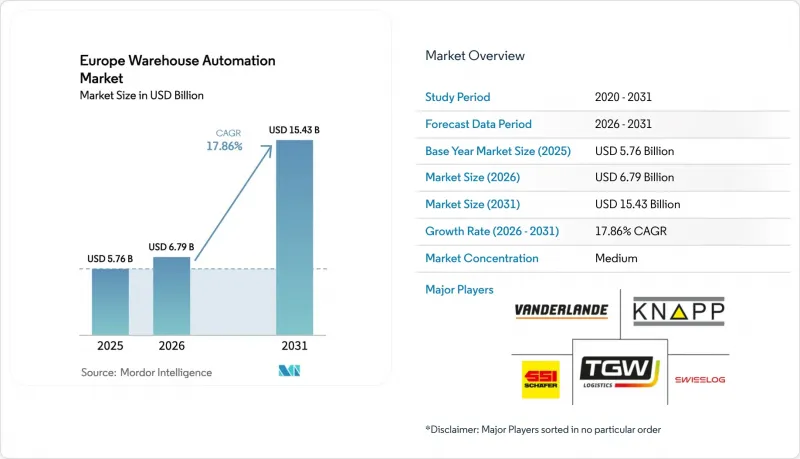
Mordor Intelligence에 의하면, 유럽의 창고 자동화 시장 규모는 2025년 57억 6,000만 달러로 평가되었습니다. 2026년에는 67억 9,000만 달러로 확대되어 2026-2031년에 걸쳐 CAGR 17.86%로 성장을 지속하여, 2031년에는 154억 3,000만 달러에 이를 것으로 예측됩니다.
본 보고서는 구성 요소(하드웨어, 소프트웨어, 서비스), 최종 사용자 산업(식음료, 우편·소포, 기타),기술 유형(AMR, AGV, 큐브형 AS/RS, 셔틀형 AS/RS, 혼합 케이스 팔레타이징용 로봇, 창고 관리 소프트웨어 제품군), 창고 규모(소규모, 중규모, 대규모), 국가별로 분류되어 있습니다. 시장 전망은 금액(달러) 기준으로 제시되어 있습니다.
유럽의 창고 자동화 시장 동향 및 인사이트
전자상거래 주문량의 급격한 증가
2025년까지 7개 시장이 유럽 대륙 전체 전자상거래의 70%를 차지했으며, 루마니아와 헝가리에서는 이미 연간 약 15%의 성장률을 기록하고 있습니다. DHL eCommerce Poland는 성공의 열쇠가 수작업으로는 실현할 수 없는 정교한 경로 최적화, 실시간 소포 추적, 원활한 반품 처리에 있다고 지적합니다. 따라서 사업자들은 재고를 다수의 지역 허브에 분산시켜, 주문이 4개의 국경을 넘는 대신 1-2개의 국경만 넘도록 하고 있습니다. 첨단 주문 조정 엔진은 관세 비용, 운송 시간, 재고 신선도를 바탕으로 어떤 거점이 주문을 처리해야 할지 밀리초 단위로 결정합니다. 자동화 플랫폼은 모든 국가에서 동일한 사용자 인터페이스와 예비 부품 목록을 제공함으로써, 여러 거점으로의 확장을 간소화하고 계약 수주에 성공하고 있습니다.
유럽 제조업에서의 인더스트리 4.0의 급속한 확산
독일의 로봇 밀도(직원 1만 명당 429대)는 공장 자동화 분야의 리더십을 입증하고 있지만, MHP와 루트비히 막시밀리안 대학의 조사에 따르면, 더 광범위한 DACH 지역은 인더스트리 4.0 성숙도 측면에서 중국이나 미국에 뒤처져 있는 것으로 지적되고 있습니다. 제조업체들은 현재 인접한 창고로 디지털화를 확대하고 있어, 생산, 키트 조립, 출하가 하나의 동기화된 루프로 흐르도록 하고 있습니다. MULTIVAC이 볼파르트슈벤덴에서 진행한 1억 유로(1억 1,000만 달러) 규모의 확장 프로젝트에서는 자동화된 물류와 유연한 생산 셀을 결합하여 가동 시간을 확보하고 있습니다. 프라운호퍼 IML의 1,800만 유로(1,980만 달러) 규모의 ‘디지털 테스트베드 에어카고’ 프로젝트는 민관 합동 연구소가 연구 개발의 격차를 메우고 있음을 보여줍니다. 대부분의 사업자가 새로운 건물을 짓는 것보다 기존 시설에 셔틀 통로나 AMR 레인을 설치하는 것을 선호하기 때문에 브라운필드(기존 시설) 개보수가 투자의 대부분을 차지하고 있습니다.
막대한 초기 설비 투자(CAPEX)
‘사람 대 화물’ 시스템은 거점당 100만 달러부터 시작하는 경우가 많아, 많은 중소기업이 도입을 보류하고 있습니다. RaaS(Robotics-as-a-Service) 모델에서는 설비 투자(CAPEX)를 월 사용료로 전환함으로써 도입 비용을 약 10만 달러까지 절감할 수 있게 되었지만, 은행은 여전히 담보나 모회사의 보증을 요구하고 있습니다. TGW는 내부수익률(IRR) 지표를 바탕으로 도입 범위를 결정할 수 있도록 초기 단계부터 재무팀을 참여시키는 것을 권장합니다. DLL의 로봇, 소프트웨어, 통합 비용을 패키지화한 사전 융자 플랜은 대출 기관이 내부 물류용으로 제품을 맞춤화하고 있음을 보여줍니다. 마지막으로, TGW SmartPocket과 같은 포켓 소터는 6개월 만에 가동을 시작할 수 있으며, 기존 소터에 비해 건설비 및 이자 비용을 절감할 수 있습니다.
부문별 분석
2025년 유럽의 창고 자동화 시장 규모 중 하드웨어가 69.60%를 차지했으며, 그 중심은 AS/RS 통로, 컨베이어, AMR 차량입니다. AutoStore와 같은 큐브형 스토리지 시스템은 재고 밀도를 4배 높이는 동시에 피킹 1회당 kW시를 절감하고 있으며, 이는 임대료가 높은 도시 지역의 허브에서 이 시스템이 빠르게 보급되고 있는 이유를 설명해 줍니다. 풀서비스 계약을 통해 가동 시간이 보장되고, 예측 유지보수 분석을 통해 몇 주 전부터 부품 교체 시기가 통보되므로 서비스 수익은 꾸준히 증가하고 있습니다. TGW가 베티 버클리(Betty Berkeley)사와 체결한 20년간의 평생 서비스 계약은 통합업체가 초기 도입을 넘어 지속적인 수익원을 확보하는 방법을 보여주는 좋은 사례입니다.
한편, 소프트웨어 부문은 18.6%라는 가장 높은 연평균 성장률(CAGR)을 기록하고 있으며, AI 오케스트레이션 엔진을 활용하여 기존 기계에서 더 많은 처리 사이클을 끌어냄으로써 하드웨어 예산을 잠식하기 시작했습니다. 창고 운영 시스템은 현재 엣지 GPU를 활용하여 수백 대의 로봇을 마이크로초 단위로 조정하고 있으며, 가치가 철강과 마찬가지로우코드로 이동하고 있음을 입증하고 있습니다.
독일, 프랑스, 영국에서는 익일 배송이 표준이 되었기 때문에 2025년에는 전자상거래와 식료품이 매출의 32.45%를 차지했습니다. ‘다크 스토어’와 상온에서 냉동으로 이어지는 셔틀 레인을 통해 식료품 소매업체는 수작업 없이 서로 다른 온도대의 상품을 혼합한 주문을 한꺼번에 피킹할 수 있게 되었습니다.
한편, 제조업은 연평균 성장률(CAGR) 19.15%를 나타낼 것으로 예측되며, 유럽의 창고 자동화 시장에서의 점유율 확대는 제조 현장의 MES(제조 실행 시스템)와 창고 관리 시스템을 연동시키는 브라운필드 개조를 통해 주도되고 있습니다. 자동차 및 백색 가전 공장에서는 현재 키트용 토트를 조립 라인에 직접 순차적으로 공급함으로써 버퍼 재고를 제거하고 리드 타임을 단축하고 있습니다. 식음료 산업 사업자들은 EU의 콜드체인 규정을 준수하기 위해 -25°C 구역 내에 팔레트 셔틀을 도입하고 있습니다. 한편, B. Braun과 같은 제약 기업들은 GxP 준수 로봇 기술을 통합하여 오염 위험을 최소화하고 있습니다.
기타 혜택
- 엑셀 형식 시장 예측(ME) 시트
- 3개월간의 애널리스트 지원
자주 묻는 질문
목차
제1장 서론
제2장 조사 방법
제3장 주요 요약
제4장 시장 구도
제5장 시장 규모 및 성장 예측
제6장 경쟁 구도
제7장 시장 기회 및 향후 전망
KTH 26.09.14According to Mordor Intelligence, the Europe warehouse automation market size is expected to grow from USD 5.76 billion in 2025 to USD 6.79 billion in 2026 and is forecast to reach USD 15.43 billion by 2031 at 17.86% CAGR over 2026-2031.
This report is Segmented by Component (Hardware, Software, and Services), End-User Industry (Food and Beverage, Post and Parcel, and More), Technology Type (AMR, AGV, Cube-Based AS/RS, Shuttle-Based AS/RS, Mixed-Case Palletizing Robotics, and Warehouse Software Suites), Warehouse Size (Small-Scale, Mid-Scale, and Large-Scale), and Country. The Market Forecasts are Provided in Terms of Value (USD).
Europe Warehouse Automation Market Trends and Insights
Exponential growth in e-commerce order volumes
Seven markets will account for 70% of continental e-commerce by 2025, yet Romania and Hungary already post around 15% annual growth. DHL eCommerce Poland notes that success hinges on advanced route optimization, live parcel tracking, and seamless returns that manual setups cannot match. Operators are therefore dispersing inventory into numerous regional hubs so orders can cross one or two borders instead of four. Sophisticated order-orchestration engines decide in milliseconds which node should fulfill a basket based on duty costs, transit time, and stock freshness. Automation platforms win deals when they offer the same user interface and spare parts lists in every country, simplifying multi-site roll-outs.
Rapid Industry 4.0 adoption across manufacturing
Germany's robot density of 429 units per 10,000 employees underscores leadership in factory automation, yet studies from MHP and Ludwig-Maximilian University flag that the wider DACH region trails China and the U.S. in Industry 4.0 maturity. Manufacturers now extend digitization to adjoining warehouses so production, kitting, and dispatch flow in one synchronized loop. MULTIVAC's EUR 100 million (USD 110 million) expansion in Wolfertschwenden couples automated logistics with flexible production cells to guard uptime. Fraunhofer IML's EUR 18 million (USD 19.8 million) Digital Testbed Air Cargo shows public-private labs filling R&D gaps. Brownfield retrofits dominate spending since most operators prefer installing shuttle aisles and AMR lanes in existing facilities instead of building new shells.
High upfront CAPEX requirements
A person-to-goods system often starts at USD 1 million per site, keeping many SMEs on the sidelines. Robotics-as-a-Service models now cut the entry ticket to roughly USD 100,000 by converting CAPEX into monthly fees, yet banks still demand collateral or parent guarantees. TGW advises involving finance teams from day one so internal rate-of-return metrics shape the scope. DLL's pre-financing packages that bundle robots, software, and integration costs show lenders tailoring products to intralogistics. Finally, pocket sorters like TGW SmartPocket can go live in six months, reducing construction spend and interest costs compared with conventional sorters.
Other drivers and restraints analyzed in the detailed report include:
- Acute warehouse-labor shortages and wage inflation
- EU cross-border trade expansion
- Cyber-security and data-sovereignty concerns
For complete list of drivers and restraints, kindly check the Table Of Contents.
Segment Analysis
Hardware accounted for 69.60% of the European warehouse automation market size in 2025, anchored by AS/RS aisles, conveyors, and AMR fleets. Cube-based storage such as AutoStore achieves four-fold inventory density while trimming kilowatt hours per pick, explaining its rapid uptake in high-rent urban hubs. Services revenue grows steadily as full-service contracts guarantee uptime and predictive-maintenance analytics signal part replacements weeks in advance. TGW's 20-year lifetime-service deal with Betty Barclay illustrates how integrators lock in annuity streams beyond initial installs.
Meanwhile, software recorded the fastest 18.6% CAGR and is starting to eat into hardware budgets by extracting more cycles from existing machines using AI orchestration engines. Warehouse execution systems now tap edge GPUs to orchestrate hundreds of bots in microseconds, proving that value is tilting toward code as much as steel.
E-commerce and groceries held a 32.45% revenue share in 2025 as next-day delivery became the norm in Germany, France, and the UK. Dark stores and ambient-to-frozen shuttle lanes enable grocers to batch-pick mixed-temperature baskets without manual handling.
Manufacturing, however, is projected to grow at a 19.15% CAGR, with Europe warehouse automation market share gains driven by brownfield retrofits that mesh shop-floor MES with warehouse management systems. Automotive and white-goods plants now sequence kitting totes straight to assembly positions, eliminating buffer stock and shrinking lead times. Food-and-beverage operators deploy pallet shuttles inside -25 °C zones to comply with EU cold-chain rules, while pharma players such as B. Braun integrate GxP-compliant robotics to minimize contamination risk.
Complete Report Scope:
- By Component
- Hardware
- Mobile Robots (AGV, AMR)
- Automated Storage and Retrieval Systems (AS/RS)
- Conveyors and Sortation Systems
- Palletizing and Depalletizing Systems
- Automatic ID and Data Capture (AIDC)
- Piece-Picking Robots
- Software
- Warehouse Management Systems (WMS)
- Warehouse Execution Systems (WES)
- Services
- Hardware
- By End-User Industry
- Food and Beverage
- Post and Parcel
- E-commerce and Groceries
- General Merchandise and 3PL
- Apparel and Footwear
- Manufacturing (Durable/Non-Durable)
- Other End-User Industries
- By Technology Type
- Autonomous Mobile Robots (AMR)
- Automated Guided Vehicles (AGV)
- Cube-Based AS/RS (e.g., AutoStore)
- Shuttle-Based AS/RS
- Mixed-Case Palletizing Robotics
- Warehouse Software Suites (WMS/WES/WCS)
- By Warehouse Size
- Small-Scale (<10,000 m2)
- Mid-Scale (10,000-40,000 m2)
- Large-Scale (>40,000 m2)
- By Country
- Germany
- United Kingdom
- France
- Italy
- Spain
- Netherlands
- Rest of Europe
List of Companies Covered in this Report:
- Swisslog Holding AG (KUKA AG)
- SSI Schaefer AG
- TGW Logistics Group GmbH
- KNAPP AG
- Vanderlande Industries B.V.
- Dematic GmbH (KION Group AG)
- WITRON Logistik + Informatik GmbH
- AutoStore Holdings Ltd.
- Ocado Group plc
- Exotec SAS
- Mecalux S.A.
- Korber Supply Chain GmbH
- Geekplus Technology Co. Ltd.
- Locus Robotics Inc.
- GreyOrange Pte. Ltd.
- Jungheinrich AG
- Honeywell Intelligrated
- Bastian Solutions LLC
- BEUMER Group GmbH and Co. KG
- Kardex Holding AG
- HAI Robotics Co. Ltd.
- Cimcorp Oy
Additional Benefits:
- The market estimate (ME) sheet in Excel format
- 3 months of analyst support
TABLE OF CONTENTS
1 INTRODUCTION
- 1.1 Study assumptions and market definition
- 1.2 Scope of the Study
2 RESEARCH METHODOLOGY
3 EXECUTIVE SUMMARY
4 MARKET LANDSCAPE
- 4.1 Market Overview
- 4.2 Market Drivers
- 4.2.1 Exponential growth in e-commerce order volumes
- 4.2.2 Rapid Industry-4.0 adoption across European manufacturing
- 4.2.3 Acute warehouse-labor shortages and wage inflation
- 4.2.4 EU cross-border trade expansion boosting fulfillment demand
- 4.2.5 Stricter cold-chain regulations for perishable goods
- 4.2.6 Edge-AI orchestration cutting latency and energy costs
- 4.3 Market Restraints
- 4.3.1 High upfront CAPEX requirements
- 4.3.2 Cyber-security and data-sovereignty concerns
- 4.3.3 Scarcity of integration talent and long project lead-times
- 4.3.4 Legacy-system interoperability gaps
- 4.4 Industry Value Chain Analysis
- 4.5 Regulatory Landscape
- 4.6 Technological Outlook
- 4.7 Porter's Five Forces Analysis
- 4.7.1 Threat of New Entrants
- 4.7.2 Bargaining Power of Buyers
- 4.7.3 Bargaining Power of Suppliers
- 4.7.4 Threat of Substitutes
- 4.7.5 Intensity of Competitive Rivalry
- 4.8 Warehouse Investment Scenario
- 4.9 Impact of Macroeconomic Trends on the Market
5 MARKET SIZE AND GROWTH FORECASTS (VALUES)
- 5.1 By Component
- 5.1.1 Hardware
- 5.1.1.1 Mobile Robots (AGV, AMR)
- 5.1.1.2 Automated Storage and Retrieval Systems (AS/RS)
- 5.1.1.3 Conveyors and Sortation Systems
- 5.1.1.4 Palletizing and Depalletizing Systems
- 5.1.1.5 Automatic ID and Data Capture (AIDC)
- 5.1.1.6 Piece-Picking Robots
- 5.1.2 Software
- 5.1.2.1 Warehouse Management Systems (WMS)
- 5.1.2.2 Warehouse Execution Systems (WES)
- 5.1.3 Services
- 5.1.1 Hardware
- 5.2 By End-User Industry
- 5.2.1 Food and Beverage
- 5.2.2 Post and Parcel
- 5.2.3 E-commerce and Groceries
- 5.2.4 General Merchandise and 3PL
- 5.2.5 Apparel and Footwear
- 5.2.6 Manufacturing (Durable/Non-Durable)
- 5.2.7 Other End-User Industries
- 5.3 By Technology Type
- 5.3.1 Autonomous Mobile Robots (AMR)
- 5.3.2 Automated Guided Vehicles (AGV)
- 5.3.3 Cube-Based AS/RS (e.g., AutoStore)
- 5.3.4 Shuttle-Based AS/RS
- 5.3.5 Mixed-Case Palletizing Robotics
- 5.3.6 Warehouse Software Suites (WMS/WES/WCS)
- 5.4 By Warehouse Size
- 5.4.1 Small-Scale (<10,000 m2)
- 5.4.2 Mid-Scale (10,000-40,000 m2)
- 5.4.3 Large-Scale (>40,000 m2)
- 5.5 By Country
- 5.5.1 Germany
- 5.5.2 United Kingdom
- 5.5.3 France
- 5.5.4 Italy
- 5.5.5 Spain
- 5.5.6 Netherlands
- 5.5.7 Rest of Europe
6 COMPETITIVE LANDSCAPE
- 6.1 Market Concentration
- 6.2 Strategic Moves
- 6.3 Market Share Analysis
- 6.4 Company Profiles (includes Global-level Overview, Market-level Overview, Core Segments, Financials as available, Strategic Information, Market Rank/Share, Products and Services, Recent Developments)
- 6.4.1 Swisslog Holding AG (KUKA AG)
- 6.4.2 SSI Schaefer AG
- 6.4.3 TGW Logistics Group GmbH
- 6.4.4 KNAPP AG
- 6.4.5 Vanderlande Industries B.V.
- 6.4.6 Dematic GmbH (KION Group AG)
- 6.4.7 WITRON Logistik + Informatik GmbH
- 6.4.8 AutoStore Holdings Ltd.
- 6.4.9 Ocado Group plc
- 6.4.10 Exotec SAS
- 6.4.11 Mecalux S.A.
- 6.4.12 Korber Supply Chain GmbH
- 6.4.13 Geekplus Technology Co. Ltd.
- 6.4.14 Locus Robotics Inc.
- 6.4.15 GreyOrange Pte. Ltd.
- 6.4.16 Jungheinrich AG
- 6.4.17 Honeywell Intelligrated
- 6.4.18 Bastian Solutions LLC
- 6.4.19 BEUMER Group GmbH and Co. KG
- 6.4.20 Kardex Holding AG
- 6.4.21 HAI Robotics Co. Ltd.
- 6.4.22 Cimcorp Oy
7 MARKET OPPORTUNITIES AND FUTURE OUTLOOK
- 7.1 White-space and unmet-need assessment


