

|
시장보고서
상품코드
2043828
희토류 원소 시장 : 점유율 분석, 업계 동향과 통계, 성장 예측(2026-2031년)Rare Earth Elements - Market Share Analysis, Industry Trends & Statistics, Growth Forecasts (2026 - 2031) |
||||||
 Mordor Intelligence
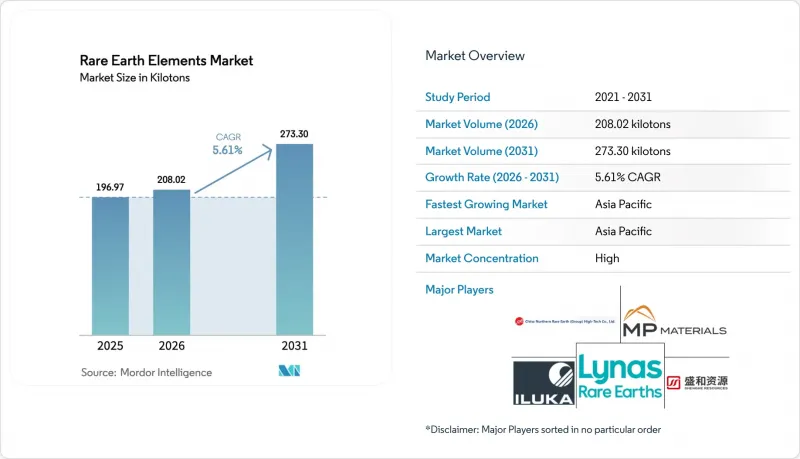
희토류 원소 시장 규모는 2025년에 196.97 킬로톤, 2026년에 208.02 킬로톤이 되어, 2031년까지 273.30 킬로톤에 이를 것으로 예측되며, 2026년부터 2031년까지 CAGR 5.61%로 성장할 전망입니다.
전기자동차 트랙션 모터, 해상풍력 터빈, 그리드 규모의 청정에너지 인프라 관련 구조적 수요가 이러한 성장을 뒷받침하고 있지만, 여전히 남아있는 가공 병목현상과 정책으로 인한 공급충격이 성장세를 둔화시키고 있습니다. 디스프로슘과 테르븀의 대체에 대한 연구는 기술적 제약에 직면해 있으며, 진행 중인 산업 자동화 도입, 항공우주 분야에서의 적층 가공 기술 채택, 그리고 전 세계 배출 기준의 강화는 수요를 더욱 견인하고 있습니다. 공급 측면에서는 채굴과 분리 모두 중국에 대한 과도한 의존도가 가격 변동성을 확대시키고 있으며, 이에 따라 전략적 비축과 다년간의 인수 계약이 이루어지고 있습니다. 이는 단기적으로 공급량을 안정화시키는 한편, 조달비용을 상승시키고 있습니다. 미국, 호주, 유럽 연합(EU)의 정부 인센티브는 미국, 호주, 유럽 연합(EU)의 생산자 간 수직 통합 강화와 더불어 지역화된 미드스트림 공정 생산 능력으로의 전환을 시사하고 있으며, 이는 2031년까지 희토류 원소 시장을 점진적으로 재구성할 것입니다.
세계 희토류 원소 시장 동향과 인사이트
재생에너지용 터빈 자석 수요
직접 구동식 풍력 터빈과 배터리 전기자동차에 선호되는 네오디뮴-철-붕소 자석은 페라이트 대체품에 비해 탁월한 중량 대 출력 비율을 제공합니다. 자석용 희토류에 대한 수요는 주로 풍력에너지 및 모빌리티 분야에 의해 크게 증가할 것으로 예측됩니다. 3MW 해상풍력 터빈 1기당 네오디뮴-프라세오디뮴 및 디스프로슘이 사용되며, 전 세계 해상풍력 발전 설비가 크게 성장하고 있습니다. 전기자동차의 기세는 부인할 수 없으며, 향후 몇 년 동안 출하량이 크게 증가할 것으로 예측됩니다. 그러나 디스프로슘공급이 문제점으로 지적되고 있으며, 그 중 압도적 다수가 중국의 이온클레이 광맥에서 조달되고 있습니다. 또한, 대체품에 대한 탐색이 진행되고 있지만, 열적 안정성을 해치지 않고 함량을 임계치 이하로 낮추기가 어려운 상황입니다. 이러한 자석에 대한 견고한 수요는 2031년까지 희토류 원소 시장에서의 입지를 확고히 하고 있습니다.
그린 테크놀로지의 희토류 원소에 대한 의존성
탈탄소화 정책은 에너지 전환의 기반에 희토류 원소를 포함시키고 있습니다. 수소 연료전지를 구동하는 세륨 산화물 촉매부터 고체 조명을 밝히는 이트륨 형광체까지, 이 원소들은 매우 중요한 역할을 하고 있습니다. 유럽연합(EU)의 'Fit for 55' 이니셔티브와 미국의 '인플레이션 억제법'은 국내 조달을 촉진하고 있지만, 가공 능력 부족이라는 과제에 충분히 대응하지 못하고 있습니다. 니켈수소전지의 란탄 수요는 안정세를 보이고 있습니다. 그러나 신흥 시장의 배기가스 규제가 강화됨에 따라 자동차 촉매에 대한 세륨산화물 수요는 꾸준히 증가하고 있습니다. 여기에는 전략적 리스크가 수반됩니다. 청정기술의 도입 속도가 중국 외 지역의 생산능력 확대보다 빠르기 때문에 OEM 업체들은 중앙집중화된 공급망에 취약한 위치에 놓일 수 있기 때문입니다.
중국 정책에 따른 가격 변동
2025년 10월, 중국 정부는 수출 규제를 확대하고 함량 기준을 도입했습니다. 이 새로운 규정에 따라 다운스트림 제조업체는 완제품에 포함된 모든 희토류 원소의 원산지를 증명해야 합니다. 그 결과, 유럽 수입업체들은 산화 디스프로슘 가격이 급등하는 것을 목격했고, 터빈 OEM 업체들은 급히 공급 계약을 재협상해야 했습니다. 이러한 규제는 2026년 11월까지 유예될 예정이지만, 이 조치는 선례가 되었습니다. 이로 인해 수년간의 오프 테이크 계약이 프리미엄 가격으로 체결되어 희토류 원소 시장이 중국의 정책 변화에 매우 민감하게 반응하고 있다는 사실을 다시 한 번 확인시켜주었습니다.
부문 분석
2025년에는 경희토류가 전체 물량의 87.18%를 차지해, 2031년까지 연평균 5.92%의 성장률을 보일 것으로 예측됩니다. 자동차 촉매의 주요 성분인 산화세륨은 유로7 및 중국 VI 기준의 강화에 힘입어 안정적인 수요를 유지하고 있습니다. 니켈수소전지에 필수적인 랜턴은 매년 안정적인 소비가 예상됩니다. 한편, 네오디뮴-프라세오디뮴 생산은 자석 수요에 힘입어 호조를 보이고 있습니다. 중희토류는 생산량에서 차지하는 비중은 작지만 높은 가격에 거래되고 있습니다. 이는 주로 디스프로슘, 테르븀, 이트륨에 대한 확장 가능한 대체품이 존재하지 않고 공급이 제한적이기 때문입니다. 가장 높은 성장률을 보이는 원소인 디스프로슘은 EV 및 해상풍력 터빈용 고온 자석 수요를 배경으로 CAGR 7.26% 성장할 것으로 예측됩니다.
중국공급 지배력은 가격에 대한 민감도를 높이고 있습니다. 장시성과 광시좡족자치구의 이온 점토 광맥은 세계 디스프로슘 생산량의 대부분을 차지하고 있으며, 유럽과 미국의 OEM 업체들은 정책적 위험에 노출되어 있습니다. 브라운스 레인지(Browns Range)와 노랜즈(Norlands)와 같은 호주 프로젝트는 공급원 다변화에 한줄기 희망을 가져다 주지만, 허가 취득의 장기화와 자금 조달의 어려움에 직면해 있습니다. 그 결과, 분리된 중희토류 산화물을 공급할 수 있는 생산자는 여전히 강력한 가격 결정력을 보유하고 있으며, 희토류 원소 시장의 프리미엄 구조를 공고히 하고 있습니다.
세륨은 촉매 컨버터 및 유리 연마 용도에 힘입어 2025년 원소별 점유율 38.16%를 차지하며 2031년까지 수량 기준 1위를 유지할 것으로 예측됩니다. 예측에 따르면, 세륨은 2031년까지 주도권을 유지할 것으로 보입니다. 네오디뮴과 프라세오디뮴은 중국, 일본, 미국의 영구 자석 생산에 있어 매우 중요한 역할을 하고 있으며, 시장 점유율이 매우 높습니다. 란탄은 주로 유체분해용 촉매와 니켈수소전지에 이용되고 있습니다. 디스프로슘은 시장 점유율은 작지만 단가가 높고, CAGR은 7.26%입니다. 이는 특히 전기자동차 구동 모터와 풍력 터빈용 고온용 자석 제조에서 디스프로슘이 매우 중요하다는 것을 보여줍니다. 테르븀과 이트륨은 시장에서의 틈새 시장은 작지만(테르븀은 녹색 형광체, 이트륨은 세라믹과 LED), 둘 다 비슷한 공급 제약에 직면해 있습니다.
스칸듐은 연간 생산량이 제한적이기 때문에 시장에서 1kg당 가격이 가장 높은데, 이는 희소성과 제품별 회수 문제를 말해줍니다. 그러나 캐나다와 미국의 회수 시설이 가동되면 스칸듐의 용도는 캐빈 브래킷에서 더 큰 항공우주 구조 부품으로 확대되어 희토류 원소 시장에서의 입지를 확대할 수 있습니다.
"희토류 원소 시장 보고서는 제품 유형(경희토류, 중희토류), 원소(세륨, 네오디뮴, 란탄, 디스프로슘, 테르븀, 이트륨, 스칸듐, 기타 원소), 용도(촉매, 세라믹 등), 최종 이용 산업(청정에너지, 가전 등), 지역(아시아, 북미, 유럽 등)으로 구분하여 분석하였습니다. 및 지역(아시아태평양, 북미, 유럽 등)으로 분류되어 있습니다. 시장 예측은 수량(톤) 기준으로 제공됩니다.
지역별 분석
2025년 기준 아시아태평양은 전 세계 생산량의 86.29%를 차지하고 있으며, 2031년까지 연평균 5.97%의 연평균 복합 성장률(CAGR)로 우위를 유지할 것으로 예측됩니다. 중국은 산화물을 생산하고 분리 능력의 대부분을 차지했습니다. 이러한 우위를 바탕으로 중국은 수출 규제 레버리지를 행사할 수 있었고, 그 결과 2025년 10월 이후 유럽에서 디스프로슘 가격이 크게 상승했습니다. 호주는 중국 이외의 주요 공급국으로서 입지를 다지고 있습니다. 아라플라의 노랜드 프로젝트는 2027년까지 네오디뮴-프라세오디뮴 산화물 생산을 목표로 하고 있습니다. 동시에 돌고래자원은 혼합 탄산염 생산을 위한 정련소 건설을 추진하고 있습니다. 의존도를 낮추기 위해 일본과 한국은 라이너스 및 MP 머티리얼즈와 다년 계약을 체결했습니다.
북미에서는 공급의 현지화를 위해 꾸준히 진전을 보이고 있습니다. 2024년 농축액 생산을 시작한 마운틴패스사는 2025년 3분기 중국 수출을 중단하고 캘리포니아 분리 공장으로 원료를 전환했습니다. 미 국방부의 대규모 자본 참여로 2026년 중반 생산 개시를 목표로 하는 중토 회로가 지원되고 있습니다. 기존에는 우라늄에 중점을 두었던 에너지 퓨얼스의 화이트 메사 제련소는 모나자이트 처리로 사업을 전환했습니다. 한편, 유코아는 알래스카에 RapidSX 공장을 건설 중입니다.
2025년 현재 시장에서의 존재감을 보이고 있음에도 불구하고 유럽은 여전히 수입 의존도가 높은 상황입니다. 이는 2030년까지 채굴, 가공, 재활용에 관한 야심찬 목표를 설정한 '중요원료법'에 근거한 것입니다. LKAB의 Per Geijer 광맥은 막대한 산화물 매장량을 자랑하지만, 개발에는 아직 10년이 걸릴 것으로 예측됩니다. Cyclic Materials와 Urban Mining Company의 파일럿 재활용 사업은 이러한 부족을 해소하기 위한 것이지만, 이 지역에는 상업적 규모의 분리 장비가 전혀 존재하지 않습니다. 남미와 중동 및 아프리카을 합해도 전체 물량에서 차지하는 비중은 극히 미미했습니다. 그러나 브라질과 남아공은 2030년 이후 실현될 수 있는 생산능력에 주목하고 있습니다.
기타 특전:
- 엑셀 형식 시장 예측(ME) 시트
- 3개월간 애널리스트 지원
자주 묻는 질문
목차
제1장 서론
제2장 조사 방법
제3장 주요 요약
제4장 시장 구도
제5장 시장 규모와 성장 예측(수량)
제6장 경쟁 구도
제7장 시장 기회와 향후 전망
JHS 26.06.11The Rare Earth Elements Market size is projected to be 196.97 kilotons in 2025, 208.02 kilotons in 2026, and reach 273.30 kilotons by 2031, growing at a CAGR of 5.61% from 2026 to 2031.
Structural demand tied to electric-vehicle traction motors, offshore wind turbines, and grid-scale clean-energy infrastructure underpins this expansion, while lingering processing bottlenecks and policy-induced supply shocks temper the growth trajectory. Ongoing industrial automation roll-outs, additive-manufacturing adoption in aerospace, and tightening global emission standards provide additional demand pull, even as substitution research for dysprosium and terbium remains technically constrained. On the supply side, heavy reliance on China for both mining and separation amplifies price volatility, prompting strategic stockpiling and multi-year offtake agreements that stabilize short-term volumes but inflate procurement costs. Intensifying vertical integration among Western producers, alongside government incentives in the United States, Australia, and the European Union, signals a shift toward regionalized midstream capacity that will progressively reshape the Rare Earth Elements market through 2031.
Global Rare Earth Elements Market Trends and Insights
Renewable-Energy Turbine Magnet Requirement
Neodymium-iron-boron magnets, favored by direct-drive wind turbines and battery-electric vehicles, offer unparalleled weight-to-power ratios compared to ferrite alternatives. Demand for magnet-grade rare earths is expected to grow significantly, predominantly driven by wind energy and mobility sectors. Each 3 MW offshore turbine incorporates neodymium-praseodymium and dysprosium, with global offshore installations experiencing substantial growth. The momentum in electric vehicles is undeniable, with shipments projected to increase significantly in the coming years. However, dysprosium supply poses a challenge, with a staggering majority sourced from China's ionic-clay deposits. Moreover, while efforts to find substitutes are ongoing, they've struggled to dip below a content threshold without jeopardizing thermal stability. This robust demand for magnets solidifies the position of the Rare Earth Elements market through 2031.
Dependency of Green Technology on Rare Earth Elements
Decarbonization policies are weaving rare earth elements into the fabric of the energy transition. From cerium oxide catalysts powering hydrogen fuel cells to yttrium phosphors illuminating solid-state lighting, these elements play a pivotal role. While the European Union's 'Fit for 55' initiative and the U.S. 'Inflation Reduction Act' champion domestic sourcing, they fall short in addressing the processing gap. Demand for lanthanum in nickel-metal-hydride batteries has eased. However, as emission norms tighten in emerging markets, demand for cerium oxide in automotive catalysts remains steady. This presents a strategic risk: the pace of clean-tech adoption might outstrip the growth of non-Chinese capacities, potentially leaving OEMs vulnerable to a concentrated supply chain.
Chinese Policy-Induced Price Volatility
In October 2025, Beijing expanded its export controls, introducing a content threshold. This new rule mandates that downstream producers certify the source of every rare earth atom in their finished goods. As a result, European importers witnessed a dramatic surge in dysprosium oxide prices, compelling turbine OEMs to scramble and renegotiate their supply contracts. While these controls faced a suspension until November 2026, the move set a precedent. It led to multi-year offtake deals being struck at premiums, underscoring the Rare Earth Elements market's heightened sensitivity to shifts in Chinese policy.
Other drivers and restraints analyzed in the detailed report include:
- Growing Demand from Battery Applications
- Scandium-Aluminum Alloys in Aerospace Manufacturing
- Inconsistent Supply of Rare Earth Elements
For complete list of drivers and restraints, kindly check the Table Of Contents.
Segment Analysis
Light rare earths captured 87.18% of volume in 2025 and are set to grow at a 5.92% CAGR through 2031. Cerium oxide, a key player in automotive catalysts, maintains a stable demand, bolstered by tightening Euro 7 and China VI standards. Lanthanum, essential for nickel-metal-hydride batteries, sees consistent consumption yearly. Meanwhile, neodymium-praseodymium production has exemplified the magnet-driven demand. Although heavy rare earths make up a smaller portion of the volume, they command premium prices. This is largely due to dysprosium, terbium, and yttrium's lack of scalable substitutes and their constrained supply. Dysprosium, the fastest-growing element, will track a 7.26% CAGR on the back of high-temperature magnet demand for EVs and offshore turbines.
China's dominance in supply heightens price sensitivity. Ionic-clay deposits in Jiangxi and Guangxi provinces produce a significant portion of the world's dysprosium, putting Western OEMs at risk of policy shocks. While Australian projects like Browns Range and Nolans offer a glimmer of diversification, they grapple with lengthy permitting and financing challenges. Consequently, producers capable of delivering separated heavy oxides retain significant pricing power, solidifying the premium structure in the Rare Earth Elements market.
Cerium commanded 38.16% of the elemental share in 2025, driven by catalytic-converter and glass-polishing uses, and will remain volume leader through 2031. Forecasts indicate cerium will maintain its leadership position through 2031. Neodymium and praseodymium, together accounting for a significant portion of the market, play pivotal roles in the production of permanent magnets across China, Japan, and the U.S. Lanthanum finds its primary applications in fluid-cracking catalysts and nickel-metal-hydride batteries. Dysprosium, despite constituting a smaller share of the market, enjoys a high unit value and a 7.26% CAGR. This underscores dysprosium's critical importance in formulating high-temperature magnets, especially for electric vehicle traction motors and wind turbines. Terbium and yttrium, while occupying smaller market niches-terbium in green phosphors and yttrium in ceramics and LEDs-both grapple with similar supply constraints.
Scandium, with limited annual production, commands the highest price per kilogram in the market, a testament to its rarity and challenges in byproduct recovery. However, should recovery circuits in Canada and the U.S. become operational, scandium's applications could broaden from cabin brackets to encompass larger aerospace structural components, potentially expanding its presence in the Rare Earth Elements market.
The Rare Earth Elements Market Report is Segmented by Product Type (Light and Heavy), Element (Cerium, Neodymium, Lanthanum, Dysprosium, Terbium, Yttrium, Scandium, and Other Elements), Application (Catalysts, Ceramics, and More), End-Use Industry (Clean Energy, Consumer Electronics, and More), and Geography (Asia-Pacific, North America, Europe, and More). Market Forecasts are Provided in Terms of Volume (Tons).
Geography Analysis
Asia-Pacific accounted for 86.29% of global volume in 2025 and will maintain dominance with a 5.97% CAGR to 2031. China produced oxides and commanded the majority of the separation capacity. This dominance allowed China to exert export-control leverage, causing European dysprosium prices to surge significantly post-October 2025. Australia is positioning itself as the leading non-Chinese supplier. Arafura's Nolans project aims to produce neodymium-praseodymium oxide by 2027. Concurrently, Iluka Resources is progressing with a refinery targeting mixed-carbonate output. To mitigate their reliance, Japan and South Korea have inked multi-year contracts with Lynas and MP Materials.
North America is making strides to localize its supply. Mountain Pass, having produced concentrate in 2024, halted exports to China in Q3 2025, redirecting its feed to a separation plant in California. A significant equity stake from the Department of Defense is backing a heavy-earth circuit, targeting output by mid-2026. Energy Fuels' White Mesa mill, traditionally focused on uranium, pivoted to process monazite. Meanwhile, Ucore is in the process of establishing a RapidSX plant in Alaska.
Despite its market presence in 2025, Europe remains heavily reliant on imports. This is in light of the Critical Raw Materials Act, which sets ambitious targets for extraction, processing, and recycling by 2030. While LKAB's Per Geijer deposit boasts significant oxide reserves, its development is a decade away. Pilot recycling initiatives from Cyclic Materials and Urban Mining Company seek to address the shortfall, yet the region lacks any commercial-scale separator. Both South America and the Middle East-Africa regions combined accounted for a minimal share of the total volume. However, Brazil and South Africa are eyeing potential capacities that could materialize post-2030.
- Appia REU
- Arafura Rare Earths
- China Rare Earth Group Resources Technology Co., Ltd.
- China Rare Earth Holdings Limited
- ChinaTungsten
- Energy Fuels Inc.
- Iluka Resources Limited
- Jiangxi Copper Corporation
- Lynas Rare Earths Ltd
- Mitsubishi Corporation RtM Japan Ltd.
- MP Materials
- Northern Minerals
- Northern Rare Earth
- Rio Tinto
- Shenghe Resources Holding Co., Ltd.
- Texas Mineral Resources Corp.
- Ucore Rare Metals Inc.
- Yuyan Rare Earth New Materials Co., Ltd.
Additional Benefits:
- The market estimate (ME) sheet in Excel format
- 3 months of analyst support
TABLE OF CONTENTS
1 Introduction
- 1.1 Study Assumptions and Market Definition
- 1.2 Scope of the Study
2 Research Methodology
3 Executive Summary
4 Market Landscape
- 4.1 Market Overview
- 4.2 Market Drivers
- 4.2.1 Renewable-Energy Turbine Magnet Requirement
- 4.2.2 Dependency of 'Green Technology' on Rare Earth Elements
- 4.2.3 Growing demand from battery applications
- 4.2.4 Scandium-Aluminum Alloys Adoption in Aerospace Manufacturing
- 4.2.5 High Demand in Consumer Electronics
- 4.3 Market Restraints
- 4.3.1 Chinese Policy-Induced Price Volatility
- 4.3.2 Price Volatility Linked to Chinese Policy Shifts
- 4.3.3 Inconsistent Supply of Rare Earth Elements
- 4.4 Value Chain Analysis
- 4.5 Porter's Five Forces
- 4.5.1 Bargaining Power of Suppliers
- 4.5.2 Bargaining Power of Consumers
- 4.5.3 Threat of New Entrants
- 4.5.4 Threat of Substitutes
- 4.5.5 Degree of Competition
- 4.6 Supply Analysis
- 4.7 Regulatory Policy Analysis
- 4.8 Trade Analysis
- 4.9 Price Trend Analysis
- 4.10 Production Cost Analysis
5 Market Size and Growth Forecasts ( Volume)
- 5.1 By Product Type
- 5.1.1 Light Rare Earth Elements
- 5.1.2 Heavy Rare Earth Elements
- 5.2 By Element
- 5.2.1 Cerium
- 5.2.1.1 Oxide
- 5.2.1.2 Sulfide
- 5.2.1.3 Other Compounds
- 5.2.2 Neodymium
- 5.2.2.1 Alloy
- 5.2.3 Lanthanum
- 5.2.3.1 Alloy
- 5.2.3.2 Oxide
- 5.2.3.3 Other Compounds
- 5.2.4 Dysprosium
- 5.2.5 Terbium
- 5.2.6 Yttrium
- 5.2.7 Scandium
- 5.2.8 Other Elements (Promethium, Samarium, etc.)
- 5.2.1 Cerium
- 5.3 By Application
- 5.3.1 Catalysts
- 5.3.2 Ceramics
- 5.3.3 Phosphors
- 5.3.4 Glass and Polishing
- 5.3.5 Metallurgy
- 5.3.6 Magnets
- 5.3.7 Other Applications (Air Cleaning, etc.)
- 5.4 By End-use Industry
- 5.4.1 Clean Energy
- 5.4.2 Consumer Electronics
- 5.4.3 Aerospace and Defense
- 5.4.4 Industrial Automation
- 5.4.5 Healthcare
- 5.4.6 Other End-user Industries (Metallurgy, agriculture, etc.)
- 5.5 By Geography
- 5.5.1 Asia-Pacific
- 5.5.1.1 China
- 5.5.1.2 India
- 5.5.1.3 Japan
- 5.5.1.4 South Korea
- 5.5.1.5 Australia
- 5.5.1.6 Rest of Asia-Pacific
- 5.5.2 North America
- 5.5.2.1 United States
- 5.5.2.2 Canada
- 5.5.2.3 Mexico
- 5.5.3 Europe
- 5.5.3.1 Germany
- 5.5.3.2 United Kingdom
- 5.5.3.3 France
- 5.5.3.4 Italy
- 5.5.3.5 Nordics
- 5.5.3.6 Rest of Europe
- 5.5.4 South America
- 5.5.4.1 Brazil
- 5.5.4.2 Argentina
- 5.5.4.3 Rest of South America
- 5.5.5 Middle-East and Africa
- 5.5.5.1 Saudi Arabia
- 5.5.5.2 United Arab Emirates
- 5.5.5.3 South Africa
- 5.5.5.4 Rest of Middle-East and Africa
- 5.5.1 Asia-Pacific
6 Competitive Landscape
- 6.1 Market Concentration
- 6.2 Strategic Moves
- 6.3 Market Share (%)/Ranking Analysis
- 6.4 Company Profiles (includes Global level Overview, Market level overview, Core Segments, Financials as available, Strategic Information, Market Rank/Share for key companies, Products and Services, and Recent Developments)
- 6.4.1 Appia REU
- 6.4.2 Arafura Rare Earths
- 6.4.3 China Rare Earth Group Resources Technology Co., Ltd.
- 6.4.4 China Rare Earth Holdings Limited
- 6.4.5 ChinaTungsten
- 6.4.6 Energy Fuels Inc.
- 6.4.7 Iluka Resources Limited
- 6.4.8 Jiangxi Copper Corporation
- 6.4.9 Lynas Rare Earths Ltd
- 6.4.10 Mitsubishi Corporation RtM Japan Ltd.
- 6.4.11 MP Materials
- 6.4.12 Northern Minerals
- 6.4.13 Northern Rare Earth
- 6.4.14 Rio Tinto
- 6.4.15 Shenghe Resources Holding Co., Ltd.
- 6.4.16 Texas Mineral Resources Corp.
- 6.4.17 Ucore Rare Metals Inc.
- 6.4.18 Yuyan Rare Earth New Materials Co., Ltd.
7 Market Opportunities and Future Outlook
- 7.1 White-space and Unmet-need Assessment
- 7.2 Growing innovations in exploration and mining technologies


