

|
시장보고서
상품코드
2065447
직원 오프보딩 및 퇴직 관리 소프트웨어 시장 : 시장 점유율 분석, 업계 동향 및 통계, 성장 예측(2026-2031년)Employee Offboarding And Exit Management Software - Market Share Analysis, Industry Trends & Statistics, Growth Forecasts (2026 - 2031) |
||||||
 Mordor Intelligence
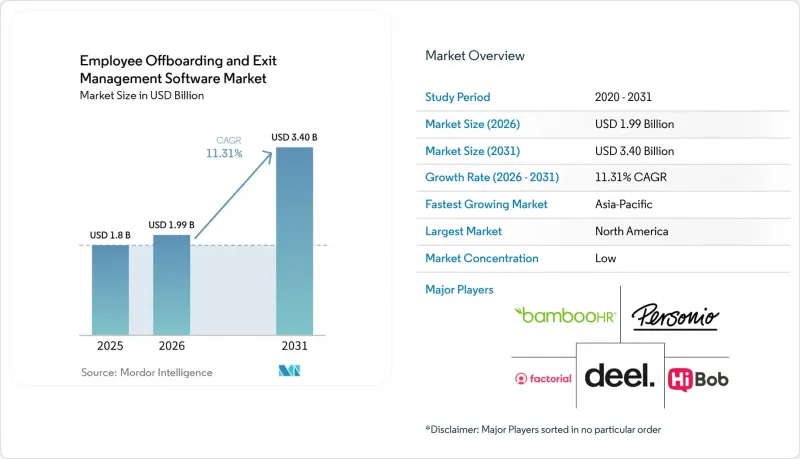
직원 오프보딩 및 퇴직 관리 소프트웨어 시장 규모는 2025년에 18억 달러로 평가되었고, 2026년에 19억 9,000만 달러로 추정되며, 2031년까지 34억 달러에 이를 것으로 예측됩니다.
2026-2031년 연평균 성장률(CAGR) 11.31%로 성장할 것으로 전망됩니다.
본 보고서는 도입 모델별(클라우드 기반, 온프레미스형, 하이브리드형), 기업 규모별(대기업 등), 구성 요소별(소프트웨어, 서비스), 용도별(인사 관리, 규정 준수 관리 등), 최종 사용자 산업 분야별(은행, 금융서비스 및 보험(BFSI), 헬스케어 및 생명과학 등) 및 지역별로 분류되어 있습니다. 시장 전망치는 금액(달러)으로 표시되어 있습니다.
세계의 직원 오프보딩 및 퇴직 관리 소프트웨어 시장 동향 및 인사이트
접근 권한 취소 및 감사 추적과 관련된 규제 압박의 고조
직원 오프보딩 및 퇴직 관리 소프트웨어 시장에서 규제 당국은 접근 권한 삭제 지연을 단순한 일상 업무상의 미비점이 아닌 관리상의 미비점으로 간주하는 경향이 강해지고 있습니다. NIS2 지침에서는 접근 권한 취소, 자산 반환 및 데이터 삭제 증빙 자료를 포함한 문서화된 퇴사 절차가 의무화되어 있으며, 이를 위반할 경우 최대 1,000만 유로(1,130만 달러) 또는 전 세계 연간 매출액의 2%에 해당하는 벌금이 부과될 수 있습니다. 금융 부문에서는 NYDFS가 2025년 10월, 대상 기관에 대해 제3자 서비스 제공업체에 대해서도 온보딩부터 오프보딩에 이르는 접근 라이프사이클 관리를 문서화하여 유지하도록 의무화함으로써 이러한 압박을 더욱 강화했습니다. 또한, GDPR(EU 개인정보보호규정) 제32조에 따라, 퇴직 시 개인 데이터를 취급하는 고용주에게 있어 계정의 안전한 관리와 검증 가능한 관리 업무는 여전히 중요한 과제로 남아 있습니다. 이러한 요인들이 복합적으로 작용함에 따라, 오프보딩 자동화는 채용 규모에 좌우되는 것이 아니라 관리 조치의 이행을 입증해야 할 필요성에 크게 좌우되고 있습니다. 또한, 이로 인해 노동 시장이 위축되고 있는 상황에서도 ‘직원 오프보딩 및 퇴직 관리 솔루션 시장’에는 규정 준수를 중심으로 한 안정적인 수요 기반이 형성되고 있습니다.
인사 업무의 디지털화 및 워크플로우 자동화에 대한 지출
인사 부서는 인력을 그만큼 늘리지 않은 채 더 많은 반복적인 업무를 처리해야 한다는 압박을 끊임없이 받고 있으며, 이로 인해 직원 퇴사 처리 및 퇴직 관리 소프트웨어 시장에서 워크플로우 자동화는 여전히 중요한 과제로 남아 있습니다. 2026년에는 CHRO(최고인사책임자)의 92%가 자사 조직 내 AI의 추가 도입을 예상하고 있으며, 반복 가능한 거래형 워크플로가 보다 광범위한 활용을 위한 자연스러운 영역으로 부상하고 있습니다. 퇴직 체크리스트, 접근 권한 해제 절차, 급여 계산 종료 및 서류 회람은 규칙에 근거하고 있으며 표준화가 용이하기 때문에 이 패턴에 부합합니다. 핵심 인사 시스템 간의 연동이 진전됨에 따라, 고용주들은 인력 계획, 규정 준수 검토 및 프로세스 개선을 위해 체계화된 이직 데이터를 요구하고 있습니다. 이에 따라 이러한 업무를 이메일 교환에만 의존하지 않고, 퇴사 사유, 자산 반환 현황 및 완료 증빙 자료를 활용 가능한 형식으로 수집할 수 있는 플랫폼에 대한 수요가 생겨나고 있습니다. 그 결과, 자동화가 노동 효율성과 관리 가시성 모두에 기여함에 따라, 직원 퇴사 처리 및 이직 관리 소프트웨어 시장에서 도입 근거가 더욱 확대되고 있습니다.
인사, IT, 급여, ID 관리 시스템에 걸친 통합의 복잡성
효율적인 퇴사 워크플로우를 구현하려면 인사 기록, ID 제공업체, 급여 계산 엔진, SaaS 용도, 자산 추적 시스템을 동시에 연동해야 하지만, 많은 조직에서 이는 여전히 어려운 과제입니다. 단 하나의 레이어라도 워크플로우에서 벗어나게 되면, 팀은 이메일을 통한 조율이나 수동적인 후속 조치로 되돌아갈 수밖에 없게 되어, 막 도입한 시스템의 가치가 훼손되고 맙니다. 이는 레거시 ERP 환경과 최신 SaaS 스택이 공존하고, 각 사업 부서마다 약간씩 다른 프로세스가 채택되어 있는 대기업의 경우 특히 어렵습니다. 커넥터 개발, 승인 로직, 예외 처리를 거치다 보니, 첫 번째 자동화 워크플로가本番 환경에서 가동되기까지 도입 기간이 수개월에 달할 가능성이 있습니다. 그 결과, 도입 작업 비용이 기본 구독 요금을 크게 초과할 가능성이 있어 비용 부담이 커집니다. 이로 인해 직원 이직 및 퇴사 관리 솔루션 시장의 도입이 주춤해지면서, 구매자가 명확한 투자 대비 효과(ROI)를 체감할 수 있는 시기가 늦어지게 됩니다.
부문별 분석
2025년, 직원 오프보딩 및 퇴직 관리 소프트웨어 시장에서 클라우드 기반 솔루션의 도입 비중은 69.42%를 차지했습니다. 이는 정책의 중앙 집중식 관리, 인프라 부담 경감, 클라우드 네이티브 ID 관리 도구와의 손쉬운 통합 등 여러 측면에서 구매자들이 클라우드를 선호하는 경향을 반영하고 있습니다. 클라우드 도입이 주도적인 역할을 하고 있다는 점은 인사 업무에서 구독형 소프트웨어로의 전환이나 지속적인 제품 업데이트와 같은 보다 광범위한 흐름과도 부합합니다. 통합된 감사 로그, 공유된 워크플로 템플릿, 그리고 지점 간 신속한 배포를 통해 이 모델은 대규모且t 일관된 실행이 필요한 조직에게 매력적인 선택지가 되고 있습니다. 또한, 클라우드 시스템은 현지의 퇴직 요건이나 내부 통제가 업데이트되었을 때, 고용주가 규정 변경 사항을 신속하게 적용하는 데에도 도움이 됩니다.
하이브리드 모델은 조직이 모든 인사 및 급여 계산 업무 부하를 한 번에 공유 클라우드 환경으로 이전하지 않고도 퇴사 절차를 현대화해 나감에 따라, 2031년까지 연평균 성장률(CAGR) 12.47%로 확대될 것으로 예측됩니다. 하이브리드 설계는 직원 기록, 시스템 로그, 급여 파일마다 데이터 보관 장소에 관한 규정이 서로 다른 관할권에서 특히 유용합니다. 테넌트 공유형 클라우드의 사용이 여전히 제한되고 있는 공공 부문, 국방 분야 및 기타 엄격하게 관리되는 환경에서는 온프레미스 배포가 여전히 중요하게 여겨지고 있습니다. ISO 27001:2022는 모든 도입 옵션에 계속해서 압박을 가하고 있습니다. 왜냐하면 보안 목표, 액세스 변경 및 증거 추적은 주요 환경뿐만 아니라 모든 환경에 걸쳐 정의되어야 하기 때문입니다. ‘직원 이직 및 퇴직 관리 시스템 시장’에서 유연한 호스팅, 감사 가능한 통제 기능, 그리고 로컬 데이터 옵션을 갖춘 공급업체는 단일 지역 아키텍처에 얽매인 공급업체보다 유리한 입장에 있습니다.
2025년에는 대기업이 62.31%의 점유율을 차지했습니다. 이는 소프트웨어 예산 증가, 다중 시스템 환경, 그리고 이직 절차의 각 단계를 문서화해야 한다는 사내의 강력한 압박에 힘입은 결과입니다. 이러한 인수 기업은 대개 복잡한 인사, IT, 급여 계산, 보안 시스템들을 운영하고 있기 때문에 오케스트레이션의 가치를 입증하기 쉬운 상황에 있습니다. 또한, 연결된 시스템의 수가 훨씬 많기 때문에 퇴사 후에도 접근 권한이 그대로 유지될 경우 더 큰 위험에 노출될 수 있습니다. 그 결과, 직원 오프보딩 및 퇴직 관리 소프트웨어 시장의 현재 수익 기반은 여전히 대기업 수요에 의해 지탱되고 있습니다.
중소기업(SME) 시장은 2031년까지 연평균 성장률(CAGR) 13.82%를 나타낼 것으로 예측되며, 이는 해당 부문 수요 구조에 변화를 가져올 것으로 보입니다. 그 주된 이유로는 중소기업이 별도의 시스템을 구매할 필요가 없고, 더 광범위한 구독 서비스의 일부로 이직 워크플로우를 포함한 통합형 인사 플랫폼이 보급되고 있다는 점을 들 수 있습니다. 이로 인해, 그동안 스프레드시트나 간단한 체크리스트를 통해 이직 관리를 해오던 고용주들에게 진입 장벽이 낮아졌습니다. Employment Hero사는 2026년 4월, 연간 경상수익이 3억 호주 달러(1억 9,500만 달러)를 돌파했으며, 35만 개 이상의 기업을 지원하고 있다고 보고했는데, 이는 중소기업 부문에서 현재 달성하고 있는 규모를 입증해 주고 있습니다. 직원 이직 절차 및 퇴직 관리 소프트웨어 시장에서 이는 대기업이 여전히 현재 지출의 대부분을 차지하고 있음에도 불구하고, 고객 기반의 하위 계층에서 성장이 더욱 빠르게 확대되고 있음을 의미합니다.
지역별 분석
2025년, 북미는 퇴직 및 퇴사 관리 소프트웨어 시장 점유율의 41.03%를 차지했습니다. 이는 성숙한 기업 소프트웨어의 도입, 신원 거버넌스에 대한 지출 확대, 그리고 접근 제어 및 감사 대응을 직접적으로 촉진하는 규제 환경에 힘입은 결과입니다. 미국은 대규모 기업 기반은 물론, HR 기술, SaaS 관리, 신원 거버넌스에 이르는 긴밀한 벤더 생태계를 갖추고 있어 해당 지역의 매출 대부분을 창출했습니다. 캐나다와 멕시코도 성장에 기여하고 있으며, 특히 멕시코에서는 국경을 넘는 채용 및 이직 관리에 ‘고용주 대리(Employer-of-Record)’ 구조를 활용하는 다국적 기업들의 관심이 쏠리고 있습니다. 유럽은 GDPR(EU 개인정보보호규정) 의무, NIS2 시행, 그리고 금융 기관을 대상으로 한 DORA 관리 요건에 힘입어 계속해서 2위 지역 시장을 유지하고 있습니다. 독일에서는 해고 관련 절차에서 노동평의회가 공동결정권을 가지고 있기 때문에 오프보딩 워크플로우에는 단순한 범용 템플릿이 아닌 지역에 맞춘 승인 로직이 필요한 경우가 많으며, 이로 인해 복잡성이 더욱 가중되고 있습니다.
아시아태평양은 2031년까지 연평균 성장률(CAGR) 13.71%로 성장할 것으로 예상되며, 직원 퇴사 및 은퇴 관리 소프트웨어 분야에서 가장 빠르게 성장하는 지역 시장이 될 것입니다. 인도는 특히 주목해야 할 시장입니다. Darwinbox사가 2025년 3월에 1억 4,000만 달러를 조달하고, 2025년 8월에는 국제적인 사업 확장과 제품 개발을 지원하기 위해 4,000만 달러를 추가로 조달한 것으로 보아, 해당 지역에서 확장 가능한 HR 플랫폼에 대한 신뢰가 높아지고 있음을 알 수 있습니다. 호주 및 뉴질랜드 역시 활발한 성장 거점으로 자리 잡고 있으며, Employment Hero는 2026년에 이들 시장에 ‘매니지드 고용(Managed Employment)’ 모델을 확대하여 중소기업의 급여 계산, 규정 준수, 인사 관리에 대한 요구를 충족시키고 있습니다. 남미는 여전히 도입 초기 단계에 있지만, 2026년 1월 JumpCloud가 브라질의 MacSolution을 인수한 것은 보다 확실한 퇴사 절차를 뒷받침하는 ID 및 액세스 관리 인프라에 대한 투자가 확대되고 있음을 보여줍니다.
중동 및 아프리카은 여전히 개발도상국 단계에 있으며, 도입은 걸프협력회의(GCC) 회원국에 집중되어 있습니다. 이 지역에서는 디지털화 프로그램과 다국적 기업의 본사가 기업의 인사 관리 현대화를 주도하고 있습니다. 사우디아라비아와 아랍에미리트(UAE)가 특히 중요하게 여겨지는 이유는 현지 노동 규제, 외국인 근로자의 이동, 그리고 엄격한 규정 준수 요건이 적용되는 급여 정산으로 인해, 전 세계 대부분의 표준 양식에서 예상하는 것보다 훨씬 복잡한 퇴사 절차가 발생하기 때문입니다. 2026년 5월, Keka가 전 세계 기업을 대상으로 확대한 급여 및 재무 서비스(GCC에 대한 명확한 대응 포함)는 해당 지역의 퇴사 업무 흐름이 중요한 틈새 시장이 되고 있음을 공급업체가 인식하고 있음을 반영합니다. 아프리카는 여전히 규모가 가장 작은 지역 시장이지만, 수요는 남아프리카공화국, 나이지리아, 그리고 다국적 기업의 자회사들이 보다 체계적인 직원 라이프사이클 관리를 필요로 하는 특정 기술 허브에 집중되어 있습니다.
기타 혜택 :
- 엑셀 형식 시장 예측(ME) 시트
- 3개월간의 애널리스트 지원
자주 묻는 질문
목차
제1장 서론
제2장 조사 방법
제3장 주요 요약
제4장 시장 구도
제5장 시장 규모 및 성장 예측
제6장 경쟁 구도
제7장 시장 기회 및 향후 전망
AJY 26.06.26According to Mordor Intelligence, the employee offboarding and Exit Management Software Market size is projected to be USD 1.80 billion in 2025, USD 1.99 billion in 2026, and reach USD 3.40 billion by 2031, growing at a CAGR of 11.31% from 2026 to 2031.
This report is Segmented by Deployment Model (Cloud-Based, On-Premises, and Hybrid), Enterprise Size (Large Enterprises, and More), Component (Software, and Services), Application (HR Management, Compliance Management, and More), End-User Industry (BFSI, Healthcare and Life Sciences, and More), and Geography. The Market Forecasts are Provided in Terms of Value (USD).
Global Employee Offboarding And Exit Management Software Market Trends and Insights
Rising Regulatory Pressure for Access Revocation And Audit Trails
Regulators increasingly treat delayed access removal as a control failure rather than a routine process gap in the employee offboarding and exit management software market. The NIS2 Directive requires documented offboarding procedures with evidence of access revocation, asset return, and data erasure, and it allows penalties up to EUR 10 million (USD 11.3 million) or 2% of global annual turnover for noncompliance. In the financial sector, NYDFS expanded the pressure in October 2025 by requiring covered entities to maintain documented access lifecycle controls from onboarding through offboarding for third-party service providers as well. GDPR Article 32 has also kept secure account handling and verifiable control operation in active focus for employers handling personal data at exit. This combination makes offboarding automation less tied to hiring volume and more tied to the need to prove control execution. It also provides the Employee Offboarding and Exit Management Solutions Market with a stable, compliance-led demand base, even when labor conditions soften.
HR Digitization and Workflow Automation Spend
HR teams are under steady pressure to complete more repeatable work without increasing staffing at the same pace, which keeps workflow automation high on the agenda in the employee offboarding and exit management software market. In 2026, 92% of CHROs expected further AI adoption in their organizations, with repeatable transactional workflows emerging as a natural area for broader use. Exit checklists, access-removal sequences, payroll closure, and documentation routing fit that pattern because they are rule-based and easy to standardize. As core HR systems become more connected, employers also want structured exit data for workforce planning, compliance reviews, and process improvement. That creates space for platforms to capture exit reasons, return-of-asset status, and completion evidence in a usable format, rather than leaving these tasks in email threads. The result is a broader buying case for the employee offboarding and exit management software market, where automation serves both labor efficiency and control visibility.
Integration Complexity Across HR, IT, Payroll, and Identity Systems
A useful exit workflow must simultaneously connect HR records, identity providers, payroll engines, SaaS applications, and asset-tracking systems, and that is still a hard task in many organizations. If even one layer stays outside the workflow, teams revert to email coordination and manual follow-up, weakening the value of the system they just bought. This is especially difficult in large enterprises where legacy ERP environments sit alongside modern SaaS stacks, and where each business unit may use a slightly different process. Connector development, approval logic, and exception handling can stretch implementation for months before the first automated workflow runs in production. The cost burden then rises because deployment work can move well beyond the base subscription. That slows adoption in the employee offboarding and exit management solutions market and delays the point at which buyers feel a clear return on investment.
Other drivers and restraints analyzed in the detailed report include:
- Hybrid And Distributed Workforce Exit Complexity
- Identity Governance Convergence With HR-Triggered Offboarding
- Sensitive Exit Data Privacy And Security Concerns
For complete list of drivers and restraints, kindly check the Table Of Contents.
Segment Analysis
Cloud-based deployment accounted for 69.42% of the Employee Offboarding and Exit Management Software Market share in 2025, reflecting buyer preference for centralized policy updates, reduced infrastructure burden, and easier integration with cloud-native identity tools. The leading role of cloud deployment also fits the broader shift toward subscription software and continuous product updates in HR operations. Centralized audit logs, shared workflow templates, and faster rollout across sites make the model attractive for organizations that need consistent execution at scale. Cloud systems also help employers apply rule changes quickly when local separation requirements or internal controls are updated.
The hybrid model is projected to expand at a 12.47% CAGR through 2031, as organizations modernize offboarding without moving every HR and payroll workload into a shared cloud environment at once. A hybrid design is especially useful in jurisdictions where data residency rules vary across employee records, system logs, and payroll files. On-premises deployment still matters in the public sector, defense, and other tightly controlled settings where tenant-shared cloud usage remains constrained. ISO 27001:2022 keeps pressure on all deployment choices because security objectives, access changes, and evidence trails must be defined across every environment, not only the primary one. In the Employee Offboarding and Exit Management Systems Market, vendors with flexible hosting, auditable controls, and local data options are in a stronger position than providers tied to a single-region architecture.
Large enterprises held 62.31% share in 2025, supported by higher software budgets, multi-system environments, and stronger internal pressure to document every offboarding step. These buyers typically run complex HR, IT, payroll, and security stacks, making the value of orchestration easier to justify. They also face higher exposure when access remains active after a departure because the number of connected systems is much larger. As a result, enterprise demand continues to anchor the current revenue base of the employee offboarding and exit management software market.
SMEs are projected to grow at a 13.82% CAGR through 2031, altering the category's demand profile. A major reason is the spread of bundled HR platforms that include offboarding workflows as part of broader subscriptions, rather than requiring smaller firms to buy a standalone system. That lowers the entry barrier for employers that previously managed exits with spreadsheets or simple checklists. Employment Hero reported in April 2026 that it had surpassed AUD 300 million (USD 195 million) in annual recurring revenue while supporting more than 350,000 businesses, underscoring the scale now being achieved in the SME-focused segment. In the employee offboarding and exit management software market, this means growth is widening faster at the lower end of the customer base, even as large enterprises continue to account for most of the current spend.
Geography Analysis
North America accounted for 41.03% of the employee offboarding and exit management software market share in 2025, supported by mature enterprise software adoption, deeper identity governance spending, and a regulatory environment that directly pressures access control and audit readiness. The United States generated most of that regional revenue because it combines a large enterprise base with a dense vendor ecosystem across HR technology, SaaS management, and identity governance. Canada and Mexico added incremental growth, with Mexico attracting interest from multinational employers using employer-of-record structures to manage cross-border hiring and separations. Europe remained the second-largest regional market, supported by GDPR obligations, NIS2 enforcement, and the DORA control requirements for financial institutions. Germany adds a further layer because works councils hold codetermination rights in dismissal-related procedures, which means offboarding workflows often need localized approval logic rather than a simple global template.
Asia-Pacific is projected to grow at a 13.71% CAGR through 2031, making it the fastest-expanding regional market for employee offboarding and exit management software. India stands out because Darwinbox raised USD 140 million in March 2025 and then secured another USD 40 million in August 2025 to support international expansion and product development, signaling rising confidence in scalable HR platforms in the region. Australia and New Zealand are also active growth points, with Employment Hero extending its managed employment model across these markets in 2026 to address payroll, compliance, and HR administration needs for SMEs. South America remains at an earlier adoption stage, but JumpCloud's January 2026 acquisition of MacSolution in Brazil points to growing investment in identity and access infrastructure that supports stronger offboarding execution.
The Middle East and Africa region is still emerging, with adoption concentrated in the Gulf Cooperation Council states, where digitization programs and multinational headquarters are driving enterprise HR modernization. Saudi Arabia and the United Arab Emirates matter most because local labor rules, expatriate workforce flows, and compliance-heavy payroll closure create a more complex exit process than many global templates assume. Keka's May 2026 payroll and finance expansion for global employers, with explicit GCC relevance, reflects vendor recognition that the region's separation workflows have become a meaningful niche. Africa remains the smallest regional market, with demand centered on South Africa, Nigeria, and selected technology hubs where multinational subsidiaries need more formal employee lifecycle controls.
- Bamboo HR LLC
- Deel Inc.
- Personio SE and Co. KG
- Hi Bob Ltd.
- EVERYDAY SOFTWARE, S.L.
- HR Cloud, Inc.
- GoCo.io, Inc.
- Enboarder Inc.
- Greytip Software Private Limited
- Darwinbox Digital Solutions Private Limited
- PeopleForce LTD.
- Employment Hero Pty Ltd.
- Keka Inc.
- Zimyo Consulting Private Limited
- 4i Apps Solutions Pvt Ltd.
- BetterCloud, Inc.
- JumpCloud, Inc.
- SailPoint Technologies, Inc.
- Saviynt, Inc.
- Torii Labs Ltd.
Additional Benefits:
- The market estimate (ME) sheet in Excel format
- 3 months of analyst support
TABLE OF CONTENTS
1 INTRODUCTION
- 1.1 Study Assumptions and Market Definition
- 1.2 Scope of the Study
2 RESEARCH METHODOLOGY
3 EXECUTIVE SUMMARY
4 MARKET LANDSCAPE
- 4.1 Market Overview
- 4.2 Market Drivers
- 4.2.1 Rising Regulatory Pressure For Access Revocation and Audit Trails
- 4.2.2 HR Digitization and Workflow Automation Spend
- 4.2.3 Hybrid and Distributed Workforce Exit Complexity
- 4.2.4 Employer Brand and Alumni Experience Prioritization
- 4.2.5 Cross-Border EOR and Global Payroll Separation Complexity
- 4.2.6 Identity Governance Convergence With HR-Triggered Offboarding
- 4.3 Market Restraints
- 4.3.1 Integration Complexity Across HR, IT, Payroll, and Identity Systems
- 4.3.2 Sensitive Exit Data Privacy and Security Concerns
- 4.3.3 Works Council and Jurisdiction-Specific Approval Friction
- 4.3.4 Low Exit Frequency Weakening Standalone ROI For Small Employers
- 4.4 Impact of Macroeconomic Factors on the Market
- 4.5 Industry Value Chain Analysis
- 4.6 Regulatory Landscape
- 4.7 Technological Outlook
- 4.8 Porter's Five Forces Analysis
- 4.8.1 Threat of New Entrants
- 4.8.2 Bargaining Power of Buyers
- 4.8.3 Bargaining Power of Suppliers
- 4.8.4 Threat of Substitutes
- 4.8.5 Intensity of Competitive Rivalry
5 MARKET SIZE AND GROWTH FORECASTS (VALUE)
- 5.1 By Deployment Model
- 5.1.1 Cloud-Based
- 5.1.2 On-Premises
- 5.1.3 Hybrid
- 5.2 By End User Enterprise Size
- 5.2.1 Large Enterprises
- 5.2.2 Small and Medium-Sized Enterprises
- 5.3 By Component
- 5.3.1 Software
- 5.3.2 Services
- 5.4 By Application
- 5.4.1 HR Management
- 5.4.2 Compliance Management
- 5.4.3 IT Access and Asset Recovery
- 5.4.4 Payroll and Final Settlement
- 5.4.5 Knowledge Transfer and Exit Feedback
- 5.4.6 Other Applications
- 5.5 By End User Industry
- 5.5.1 BFSI
- 5.5.2 Healthcare and Life Sciences
- 5.5.3 Information Technology and Telecom
- 5.5.4 Retail and E-commerce
- 5.5.5 Industrial Manufacturing
- 5.5.6 Government and Public Sector
- 5.6 By Geography
- 5.6.1 North America
- 5.6.1.1 United States
- 5.6.1.2 Canada
- 5.6.1.3 Mexico
- 5.6.2 South America
- 5.6.2.1 Brazil
- 5.6.2.2 Argentina
- 5.6.2.3 Rest of South America
- 5.6.3 Europe
- 5.6.3.1 Germany
- 5.6.3.2 United Kingdom
- 5.6.3.3 France
- 5.6.3.4 Italy
- 5.6.3.5 Spain
- 5.6.3.6 Russia
- 5.6.3.7 Netherlands
- 5.6.3.8 Rest of Europe
- 5.6.4 Asia-Pacific
- 5.6.4.1 China
- 5.6.4.2 Japan
- 5.6.4.3 India
- 5.6.4.4 South Korea
- 5.6.4.5 Australia and New Zealand
- 5.6.4.6 Rest of Asia-Pacific
- 5.6.5 Middle East
- 5.6.5.1 Saudi Arabia
- 5.6.5.2 United Arab Emirates
- 5.6.5.3 Rest of Middle East
- 5.6.6 Africa
- 5.6.6.1 South Africa
- 5.6.6.2 Nigeria
- 5.6.6.3 Egypt
- 5.6.6.4 Kenya
- 5.6.6.5 Rest of Africa
- 5.6.1 North America
6 COMPETITIVE LANDSCAPE
- 6.1 Market Concentration
- 6.2 Strategic Moves
- 6.3 Market Share Analysis
- 6.4 Company Profiles (includes Global Level Overview, Market Level Overview, Core Segments, Financials as available, Strategic Information, Market Rank/Share, Products and Services, Recent Developments).
- 6.4.1 Bamboo HR LLC
- 6.4.2 Deel Inc.
- 6.4.3 Personio SE and Co. KG
- 6.4.4 Hi Bob Ltd.
- 6.4.5 EVERYDAY SOFTWARE, S.L.
- 6.4.6 HR Cloud, Inc.
- 6.4.7 GoCo.io, Inc.
- 6.4.8 Enboarder Inc.
- 6.4.9 Greytip Software Private Limited
- 6.4.10 Darwinbox Digital Solutions Private Limited
- 6.4.11 PeopleForce LTD.
- 6.4.12 Employment Hero Pty Ltd.
- 6.4.13 Keka Inc.
- 6.4.14 Zimyo Consulting Private Limited
- 6.4.15 4i Apps Solutions Pvt Ltd.
- 6.4.16 BetterCloud, Inc.
- 6.4.17 JumpCloud, Inc.
- 6.4.18 SailPoint Technologies, Inc.
- 6.4.19 Saviynt, Inc.
- 6.4.20 Torii Labs Ltd.
7 MARKET OPPORTUNITIES AND FUTURE OUTLOOK
- 7.1 White-Space and Unmet-Need Assessment


