

|
시장보고서
상품코드
2065554
블록체인 통합형 ERP(전사적 자원 계획) : 시장 점유율 분석, 산업 동향 및 통계 데이터, 성장 예측(2026-2031년)Blockchain-Integrated ERP - Market Share Analysis, Industry Trends & Statistics, Growth Forecasts (2026 - 2031) |
||||||
 Mordor Intelligence
Mordor Intelligence에 의하면, 블록체인 통합형 ERP(전사적 자원 계획) 시장 규모는 2025년 76억 3,000만 달러로 평가되었습니다. 2026년에는 90억 6,000만 달러로 확대되어 2026년부터 2031년에 걸쳐 CAGR 31.42%로 성장을 지속하여, 2031년에는 355억 3,000만 달러에 이를 것으로 예측됩니다.
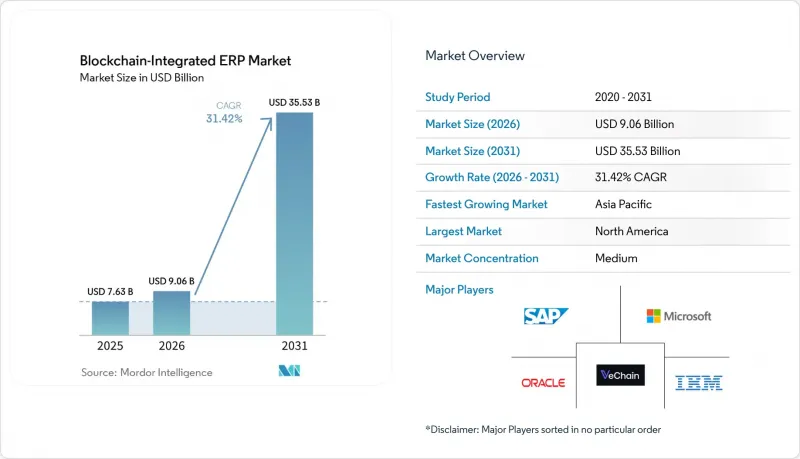
본 보고서는 구성 요소(플랫폼, 서비스), 배포 방식(퍼블릭 클라우드, 프라이빗 클라우드, 하이브리드 클라우드), 기업 규모(대기업, 중소기업), 용도(공급망, 재무, 기타 용도), 업종(제조업, 소매업·전자상거래, 은행, 금융서비스 및 보험(BFSI), 의료, 운송 및 물류, 정부 기관 등) 및 지역별로 분류되어 있습니다. 시장 전망치는 금액(달러)으로 표시되어 있습니다.
세계의 블록체인 통합형 ERP(전사적 자원 계획) 시장 동향 및 인사이트
블록체인을 활용한 공급망 금융 모듈의 급속한 확대
암호 기술을 활용한 납품 증명을 바탕으로 운전자금을 조달하는 공급망 금융 모듈이 기존의 팩토링을 점차 대체하고 있습니다. IBM의 현장 테스트 결과, 분쟁 해결 시간이 68% 단축되었고, 공급업체의 현금 흐름 예측 가능성이 52% 향상된 것으로 나타났습니다. 마이크로소프트와의 제휴를 통해 2025년에는 중소기업을 대상으로 12억 달러 상당의 청구서가 처리되었으며, 블록체인을 기반으로 한 신용 인프라가 충분한 서비스를 받지 못하고 있는 공급업체들에게도 제공될 수 있음이 입증되었습니다. ConsenSys는 독일의 자동차 부품 공급업체를 대상으로 신용장 발급을 자동화하여 은행 수수료를 30% 절감했습니다. ISO 22739의 정의에 따라, 무역 금융 스마트 계약에 공통된 의미 체계가 도입될 것입니다. 동남아시아와 라틴아메리카는 자금 조달 스프레드가 가장 크기 때문에 공급망이 세분화되어 있고 대체적인 신용 공급이 부족한 지역에서 그 영향이 두드러집니다.
규제가 엄격한 분야에서 위조가 불가능한 감사 추적이 충족해야 할 규제 요건
암호자산 시장 규제에서는 디지털 자산 기업에 대해 위조가 불가능한 로그를 유지할 것을 의무화하고 있으며, 그 대상은 현재 토큰화된 증권을 처리하는 ERP 시스템까지 확대되고 있습니다. 미국 증권거래위원회(SEC)의 ‘프로젝트 크립토’에서는 검사관에게 결제 원장에 대한 읽기 전용 접근 권한이 부여되어 있습니다. OECD의 ‘암호자산 보고 프레임워크’는 48개 관할 구역에 대해 표준화된 XML 거래 파일의 제출을 의무화하고 있습니다. FDA의 시범 프로그램에서는 의약품의 로트 정보를 블록체인에 기록해야 합니다. 각 벤더사는 현재 오프체인 데이터 저장소와 온체인 해시를 결합함으로써, GDPR(EU 개인정보보호규정)의 삭제 규정과 감사 가능성을 모두 충족시키고 있습니다. 전 세계 매출의 4%를 초과하는 벌금이 부과되게 됨에 따라, 위조가 불가능한 장부는 금융 및 생명과학 분야에서 더 이상 포기할 수 없는 기반이 되었습니다.
서로 다른 블록체인 프로토콜과 기존 ERP 시스템 간의 상호운용성 문제
피닉스 스트래티지 그룹의 2025년판 가이드에 따르면, SAP 테이블을 하이퍼레저 채널에 매핑하는 미들웨어의 결함으로 인해 프로젝트의 62%가 6개월 이상 지연된 것으로 밝혀졌습니다. Corda의 UTXO 모델은 이더리움의 계정 기반 상태 모델과 상충하기 때문에 기업들은 별도의 검증 레이어를 운영할 수밖에 없습니다. ISO의 TC 307은 크로스체인 API 초안 작성을 목표로 하고 있지만, 공급업체 간의 대립으로 인해 승인이 미뤄지고 있습니다. 도입한 지 20년이 지난 재무 모듈을 보유하고 있는 기업들은 시스템을 완전히 교체하는 식의 전환을 정당화할 수 없기 때문에 취약한 포인트-투-포인트 통합이 장기화되면서 지연과 지원 비용 증가를 초래하고 있습니다. 북미와 유럽의 제조업체들은 다양한 레거시 시스템을 운영하고 있기 때문에 그 영향을 가장 먼저 받고 있습니다.
부문별 분석
2025년 매출 중 플랫폼 라이선스가 55.20%를 차지했으나, 새로운 성장 동인이 규제 대상 워크플로우와 맞물리면서 구현의 복잡성이 증가함에 따라, 2031년까지 서비스 부문의 성장률이 라이선스 부문을 앞지르며 연평균 성장률(CAGR)은 46.30%를 나타낼 것으로 예측됩니다. 컨설팅은 현재 프로젝트 총 예산의 40-50%를 차지하고 있으며, 아키텍처 청사진, 거버넌스 방침, 제로 트러스트 설계 등을 다루고 있습니다. 매니지드 서비스 구독은 노드 성능을 모니터링하거나 합의 클라이언트에 패치를 적용할 인력이 부족한 중소기업 사이에서 인기가 높습니다. IBM, 인포시스, 액센츄어는 모니터링, 키 관리, 스마트 계약 감사를 연간 리테이너 계약에 포함하고 있습니다.
블록체인 통합형 ERP 서비스 시장은 2029년까지 플랫폼 매출을 넘어설 것으로 예측됩니다. 각 벤더사는 핵심이 되는 원장 엔진이 아니라, 업계별 전문 지식(제약 업계의 일련번호 관리, 자동차 업계의 품질 감사, 은행 업계의 담보 결제 등)을 통해 차별화를 꾀하고 있습니다. SAP, Oracle, 마이크로소프트는 각각 ‘Business Technology Platform’, ‘Fusion Cloud ERP’, ‘Dynamics 365’에 Hyperledger Fabric, Corda 또는 자체 개발한 블록체인을 통합함으로써 라이선스 해지율을 낮게 유지하고 있습니다. 순수한 블록체인 기업인 VeChain과 ConsenSys는 거버넌스의 유연성과 오픈소스 툴셋을 제공하겠다는 약속을 통해 신규 프로젝트를 수주하고 있습니다. 예측 기간 동안 자동 코드 생성 및 AI를 활용한 테스트 하네스를 통해 개발 공수가 줄어들 것으로 예상되지만, 규제가 엄격한 업계에서는 전문적인 자문 업무가 여전히 필수적일 것입니다.
하이브리드 클라우드는 2025년 매출의 38.10%를 차지했으며, 연평균 성장률(CAGR) 42.10%의 성장 궤도에 올랐습니다. 기업은 워크로드를 분할하여 개인 데이터나 재무 장부는 기업 방화벽 내의 프라이빗 노드에 배치하는 한편, 기밀성이 낮은 이벤트에 대해서는 생태계의 가시성을 확보하기 위해 퍼블릭 체인이나 컨소시엄 체인에 게시하고 있습니다. 퍼블릭 클라우드는 Amazon Managed Blockchain과 Azure Confidential Ledger를 주력으로 하여 매출의 약 35%를 차지했습니다. 프라이빗 클라우드는 인증 과정에서 단일 테넌트 격리가 의무화되어 있기 때문에 국방, 의료, 정부 분야에서 주류를 이루고 있습니다.
중국의 ‘사이버 보안법’이나 유럽연합(EU)의 ‘GDPR(EU 개인정보보호규정)’과 같은 데이터 현지화 관련 법규로 인해 하이브리드형 도입이 가속화되고 있습니다. SAP의 2026년 2월 업데이트를 통해 고객은 체인의 상태를 여러 리전에 복제할 수 있게 되어, 유럽의 청구서가 EU 역외로 유출되는 것을 확실히 방지할 수 있습니다. Oracle의 멀티클라우드 블루프린트를 통해 동일한 스마트 계약을 Oracle Cloud Infrastructure, Azure 및 AWS의 각 리전에서 실행할 수 있게 되어, 서비스 제공업체의 서비스 중단이나 벤더 종속성에 대한 위험을 분산할 수 있습니다. 엣지 네이티브 도입이 진행되고 있으며, 공장에서는 게이트웨이 어플라이언스에서 경량 Raft 합의 알고리즘을 실행하고, 1시간마다 클라우드 앵커와 동기화함으로써 생산 라인의 지연을 줄이고 있습니다.
지역별 분석
북미는 금융, 기술, 의료 분야의 초기 시범 사업에 힘입어 2025년 지출의 36.50%를 차지하며 1위를 차지했습니다. 와이오밍주, 델라웨어주, 텍사스주에서는 블록체인 친화적인 법률이 제정된 반면, SEC의 지침에 따라 감사 요건이 명확해졌습니다. 캐나다는 광업 공급망과 관련된 시범 사업에 자금을 지원하며, 코발트가 채굴 현장에서 배터리 공장에 이르기까지의 이동을 추적하고 있습니다. 주도적인 입장에 있는 주체들은 주마다 법이 제각각이라 규정 준수가 복잡해지면서, 여러 주에 걸친 사업 확장이 지연되고 있습니다.
아시아태평양은 연평균 성장률(CAGR)이 49.20%로 예상되며, 가장 빠르게 성장하고 있는 지역입니다. 중국의 ‘블록체인 기반 서비스 네트워크(BSSN)’는 저비용 노드 호스팅과 크로스체인 API를 제공합니다. 인도의 전자·정보기술부는 정부 조달 과정에서 분산 원장 기술의 사용을 의무화함으로써 내부 수요를 창출하고 있습니다. 싱가포르 정보통신미디어개발청(IMDA)은 통관 시간을 며칠에서 몇 분으로 단축하는 무역 디지털화에 보조금을 지원하고 있습니다. 한국의 스마트 항만 프로그램에서는 컨테이너에 대체 불가능 토큰(NFT)을 연동함으로써 체선료를 절감하고 있습니다.
2025년 매출 중 유럽이 약 28%를 차지했습니다. 유럽연합(EU)의 ViDA 지침에 따라 실시간 전자 청구서 발행이 의무화됨에 따라, 독일과 프랑스 등 자동차 및 명품 제조 거점에서는 블록체인 시스템 업그레이드가 추진되고 있습니다. GDPR(EU 개인정보보호규정)(일반 데이터 보호 규정)과 데이터 주권 조항이 하이브리드 클라우드 도입을 촉진하고 있습니다. 아랍에미리트와 사우디아라비아의 ‘비전 2030’이 주도하는 중동에서는 토지 등기부터 통관에 이르기까지, 스마트 시티 구상의 핵심으로 블록체인을 자리매김하고 있습니다. 아프리카와 남미는 2025년 수익에서 차지하는 비중이 각각 5% 미만이었으나, 송금 경로, 농산물 원산지 추적, 소액금융 시범 사업을 통해 잠재적인 가능성이 드러났습니다.
전반적으로, 블록체인 통합형 ERP(전사적 자원 계획) 시장은 규제와 혁신의 줄다리기에 직면해 있습니다. 가장 명확한 규정을 갖춘 지역이 가장 먼저 플랫폼 투자를 유치하지만, 현지화 관련 법률로 인해 아키텍처의 유연한 대응이 요구되며, 그 결과 전문 서비스 부문의 수익이 증가합니다. 국경을 초월한 데이터 프레임워크를 능숙하게 활용할 수 있는 기업은 공유 원장을 중심으로 전 세계 공급망이 재구축되는 과정에서 타사를 압도하는 시장 점유율을 확보하게 될 것입니다.
기타 혜택 :
- 엑셀 형식 시장 예측(ME) 시트
- 3개월간의 애널리스트 지원
자주 묻는 질문
목차
제1장 서론
제2장 분석 방법
제3장 주요 요약
제4장 시장 구도
제5장 시장 규모 및 성장률 예측
제6장 경쟁 구도
제7장 시장 기회 및 향후 전망
KTH 26.06.29According to Mordor Intelligence, the blockchain-integrated ERP market size is expected to grow from USD 7.63 billion in 2025 to USD 9.06 billion in 2026 and is forecast to reach USD 35.53 billion by 2031 at 31.42% CAGR over 2026-2031.
This report is Segmented by Component (Platform and Services), Deployment Mode (Public, Private, and Hybrid Cloud), Enterprise Size (Large Enterprisesand SMEs), Application (Supply Chain, Financial, and Other Applications), Industry Vertical (Manufacturing, Retail and E-Commerce, BFSI, Healthcare, Transportation and Logistics Government, and More), and Geography. Market Forecasts are in Value (USD).
Global Blockchain-Integrated ERP Market Trends and Insights
Rapid Expansion of Blockchain-Enabled Supply Chain Finance Modules
Supply-chain finance modules that release working capital upon cryptographic proof of delivery are displacing traditional factoring. IBM field trials showed dispute-resolution times falling 68% and supplier cash-flow predictability improving 52%. Microsoft partnerships unlocked USD 1.2 billion of invoices for small businesses in 2025, proving blockchain credit rails can reach underserved suppliers. ConsenSys automated letter-of-credit issuance for German automotive suppliers, cutting bank fees 30%. ISO 22739 definitions will bring common semantics to trade-finance smart contracts. Because financing spreads are widest in Southeast Asia and Latin America, the impact is pronounced in regions with fragmented supply chains and scarce alternative credit.
Regulatory Mandates for Immutable Audit Trails in Highly Regulated Sectors
Markets in Crypto-Assets Regulation requires digital-asset firms to maintain tamper-proof logs, which now extend to ERP systems processing tokenized securities. The U.S. SEC's Project Crypto grants examiners read-only access to settlement ledgers. OECD's Crypto-Asset Reporting Framework compels 48 jurisdictions to submit standardized XML transaction files. FDA pilots require pharmaceutical batch events to be written on a chain. Vendors now combine off-chain data stores with on-chain hashes to square GDPR erasure rules with auditability. Penalties exceeding 4% of global revenue have made immutable ledgers a non-negotiable foundation in finance and life sciences.
Interoperability Issues Between Heterogeneous Blockchain Protocols and Legacy ERP Systems
Phoenix Strategy Group's 2025 guide found that 62% of projects slipped by more than 6 months due to middleware failures that map SAP tables to Hyperledger channels. Corda's UTXO model clashes with Ethereum's account-based state, forcing firms to run separate reconciliation layers. ISO's TC 307 aims to draft cross-chain APIs, but vendor rivalries postpone ratification. Companies with 20-year-old finance modules cannot justify rip-and-replace migrations, so brittle point-to-point integrations linger, inflating latency and support bills. North American and European manufacturers feel the pain first because they operate diversified legacy estates.
Other drivers and restraints analyzed in the detailed report include:
- Post-Quantum Cryptography Integration to Future-Proof ERP Platforms
- Growing Adoption of Smart-Contract-Driven Procurement Automation
- Uncertain Global Standards Governing Cross-Border On-Chain Data Residency
For complete list of drivers and restraints, kindly check the Table Of Contents.
Segment Analysis
Platform licenses accounted for 55.20% of 2025 revenue, but services are forecast to outgrow licenses at a 46.30% CAGR through 2031 as implementation complexity increases as new drivers intersect regulated workflows. Consulting now swallows 40-50% of total project budgets, covering architecture blueprints, governance policies, and zero-trust design. Managed-services subscriptions are popular among small enterprises that lack staff to monitor node performance and patch consensus clients. IBM, Infosys, and Accenture bundle monitoring, key-management, and smart contract auditing into annual retainers.
The blockchain-integrated ERP services market is projected to eclipse platform revenue by 2029. Vendors differentiate by vertical expertise, pharma serialisation, automotive quality audits, or banking collateral settlements, rather than by core ledger engine. SAP, Oracle, and Microsoft keep license churn low by embedding Hyperledger Fabric, Corda, or proprietary chains into Business Technology Platform, Fusion Cloud ERP, and Dynamics 365, respectively. Pure-play VeChain and ConsenSys win greenfield deals by promising governance flexibility and open-source tooling. Over the forecast horizon, automated code-generation and AI-assisted test harnesses will reduce development hours, yet specialized advisory work will remain essential in highly regulated verticals.
Hybrid cloud commanded 38.10% of 2025 revenue and is on track for a 42.10% CAGR. Enterprises partition workloads so personal data and financial ledgers reside on private nodes behind corporate firewalls, while non-sensitive events post to public or consortium chains for ecosystem visibility. Public cloud attracted roughly 35% of revenue, anchored by Amazon Managed Blockchain and Azure Confidential Ledger. Private cloud is dominant in defense, healthcare, and government because certification processes mandate single-tenant isolation.
Data-localization statutes such as China's Cybersecurity Law and the European Union's GDPR intensify hybrid adoption. SAP's February 2026 updates allow clients to replicate chain state across multiple regions, ensuring that European invoices never leave the bloc. Oracle's multi-cloud blueprint enables identical smart contracts to run across Oracle Cloud Infrastructure, Azure, and AWS regions, hedging against provider outages and vendor lock-in. Edge-native deployments are emerging as factories host lightweight Raft consensus on gateway appliances, synchronizing with cloud anchors hourly to cut latency on production lines.
Geography Analysis
North America led with 36.50% of 2025 spending, buoyed by early pilots in finance, tech, and healthcare. Wyoming, Delaware, and Texas enacted friendly legislation, while SEC guidance clarifies audit expectations. Canada funds mining supply chain pilots, tracking cobalt from pit to battery plant. Despite leadership, fragmented state laws introduce compliance complexity, slowing multi-state rollouts.
Asia-Pacific is the fastest-growing region at a projected 49.20% CAGR. China's Blockchain-based Service Network provides low-cost node hosting and cross-chain APIs. India's Ministry of Electronics and Information Technology mandates the use of distributed ledgers for government procurement, thereby seeding captive demand. Singapore's Infocomm Media Development Authority subsidizes trade digitization that cuts customs clearance times from days to minutes. South Korea's smart-port program attaches non-fungible tokens to containers, reducing demurrage fees.
Europe accounted for about 28% of 2025 revenue. The European Union's ViDA directive makes real-time e-invoicing compulsory, driving blockchain upgrades in automotive and luxury goods manufacturing hubs such as Germany and France. GDPR and data-sovereignty clauses spur adoption of hybrid cloud. The Middle East, spearheaded by the United Arab Emirates and Saudi Arabia's Vision 2030, is placing blockchain at the core of smart-city initiatives, from land registries to customs. Africa and South America each accounted for less than 5% of 2025 revenue, yet remittance corridors, agricultural provenance, and microfinance pilots demonstrate latent potential.
Overall, the blockchain-integrated ERP market faces a regulatory-innovation tension. Regions with the clearest rules attract platform spending first, but localization laws necessitate architectural gymnastics that lift professional-services revenue. Companies capable of navigating cross-border data frameworks will capture an outsized share as global supply networks rewire around shared ledgers.
- Oracle Corporation
- SAP SE
- International Business Machines Corporation
- Microsoft Corporation
- VeChain Technology Co., Ltd.
- ConsenSys Software Inc.
- Chainstack Pte. Ltd.
- Monax Industries Limited
- Accenture Plc
- Huawei Technologies Co., Ltd.
- Infosys Limited
- Inetum S.A.
- Synergix Technologies Pte. Ltd.
- Verizon Communications Inc.
- Wakuu Enterprises Inc.
- Oracle NetSuite LLC
- BlockApps Inc.
- Oracle Corporation (Hyperledger-based ERP)
- Infor, Inc.
- R3 HoldCo LLC
- SAP SE (SAP Business Network Blockchain)
Additional Benefits:
- The market estimate (ME) sheet in Excel format
- 3 months of analyst support
TABLE OF CONTENTS
1 INTRODUCTION
- 1.1 Study Assumptions and Market Definition
- 1.2 Scope of the Study
2 RESEARCH METHODOLOGY
3 EXECUTIVE SUMMARY
4 MARKET LANDSCAPE
- 4.1 Market Overview
- 4.2 Market Drivers
- 4.2.1 Rapid Expansion of Blockchain-Enabled Supply Chain Finance Modules
- 4.2.2 Post-Quantum Cryptography Integration to Future-Proof ERP Platforms
- 4.2.3 Regulatory Mandates for Immutable Audit Trails in Highly Regulated Sectors
- 4.2.4 Convergence of IoT and Tokenized Asset Tracking within ERP Workflows
- 4.2.5 Growing Adoption of Smart-Contract-Driven Procurement Automation
- 4.2.6 Rise of Decentralized Identity Frameworks for Vendor and Employee Access
- 4.3 Market Restraints
- 4.3.1 Interoperability Issues Between Heterogeneous Blockchain Protocols and Legacy ERP Systems
- 4.3.2 Scarcity of Blockchain-Savvy ERP Implementation Talent
- 4.3.3 Uncertain Global Standards Governing Cross-Border On-Chain Data Residency
- 4.3.4 High Energy Consumption Concerns for Permissionless Blockchain Architectures
- 4.4 Industry Value Chain Analysis
- 4.5 Regulatory Landscape
- 4.6 Technological Outlook
- 4.7 Impact of Macroeconomic Factors on the Market
- 4.8 Porter's Five Forces Analysis
- 4.8.1 Bargaining Power of Buyers
- 4.8.2 Bargaining Power of Suppliers
- 4.8.3 Threat of New Entrants
- 4.8.4 Threat of Substitutes
- 4.8.5 Competitive Rivalry
5 MARKET SIZE AND GROWTH FORECASTS (VALUE)
- 5.1 By Component
- 5.1.1 Platform
- 5.1.2 Services
- 5.2 By Deployment Mode
- 5.2.1 Public Cloud
- 5.2.2 Private Cloud
- 5.2.3 Hybrid Cloud
- 5.3 By Enterprise Size
- 5.3.1 Large Enterprises
- 5.3.2 Small and Medium Enterprises
- 5.4 By Application
- 5.4.1 Supply Chain and Logistics Management
- 5.4.2 Financial Management and Auditing
- 5.4.3 Smart Contracts Automation
- 5.4.4 Identity and Access Management
- 5.4.5 Payment Systems
- 5.4.6 Other Applications
- 5.5 By Industry Vertical
- 5.5.1 Manufacturing
- 5.5.2 Retail and e-Commerce
- 5.5.3 Banking, Financial Services and Insurance
- 5.5.4 Healthcare
- 5.5.5 Transportation and Logistics
- 5.5.6 Government
- 5.5.7 Energy and Utilities
- 5.5.8 Others Industry Verticals
- 5.6 By Geography
- 5.6.1 North America
- 5.6.1.1 United States
- 5.6.1.2 Canada
- 5.6.1.3 Mexico
- 5.6.2 South America
- 5.6.2.1 Brazil
- 5.6.2.2 Argentina
- 5.6.2.3 Rest of South America
- 5.6.3 Europe
- 5.6.3.1 Germany
- 5.6.3.2 United Kingdom
- 5.6.3.3 France
- 5.6.3.4 Italy
- 5.6.3.5 Spain
- 5.6.3.6 Russia
- 5.6.3.7 Rest of Europe
- 5.6.4 Asia-Pacific
- 5.6.4.1 China
- 5.6.4.2 Japan
- 5.6.4.3 India
- 5.6.4.4 South Korea
- 5.6.4.5 Australia
- 5.6.4.6 Rest of Asia-Pacific
- 5.6.5 Middle East
- 5.6.5.1 Saudi Arabia
- 5.6.5.2 United Arab Emirates
- 5.6.5.3 Turkey
- 5.6.5.4 Rest of Middle East
- 5.6.6 Africa
- 5.6.6.1 South Africa
- 5.6.6.2 Nigeria
- 5.6.6.3 Rest of Africa
- 5.6.1 North America
6 COMPETITIVE LANDSCAPE
- 6.1 Market Concentration
- 6.2 Strategic Moves
- 6.3 Market Share Analysis
- 6.4 Company Profiles (includes Global Level Overview, Market Level Overview, Core Segments, Financials as available, Strategic Information, Market Rank/Share, Products and Services, Recent Developments)
- 6.4.1 Oracle Corporation
- 6.4.2 SAP SE
- 6.4.3 International Business Machines Corporation
- 6.4.4 Microsoft Corporation
- 6.4.5 VeChain Technology Co., Ltd.
- 6.4.6 ConsenSys Software Inc.
- 6.4.7 Chainstack Pte. Ltd.
- 6.4.8 Monax Industries Limited
- 6.4.9 Accenture Plc
- 6.4.10 Huawei Technologies Co., Ltd.
- 6.4.11 Infosys Limited
- 6.4.12 Inetum S.A.
- 6.4.13 Synergix Technologies Pte. Ltd.
- 6.4.14 Verizon Communications Inc.
- 6.4.15 Wakuu Enterprises Inc.
- 6.4.16 Oracle NetSuite LLC
- 6.4.17 BlockApps Inc.
- 6.4.18 Oracle Corporation (Hyperledger-based ERP)
- 6.4.19 Infor, Inc.
- 6.4.20 R3 HoldCo LLC
- 6.4.21 SAP SE (SAP Business Network Blockchain)
7 MARKET OPPORTUNITIES AND FUTURE OUTLOOK
- 7.1 White-space and Unmet-Need Assessment


