

|
시장보고서
상품코드
2098475
사이버 방위 분야 생성형 인공지능(AI) 시장 : 시장 점유율 분석, 업계 동향 및 통계, 성장 예측(2026-2031년)Generative Artificial Intelligence (AI) In Cyber Defense - Market Share Analysis, Industry Trends & Statistics, Growth Forecasts (2026 - 2031) |
||||||
 Mordor Intelligence
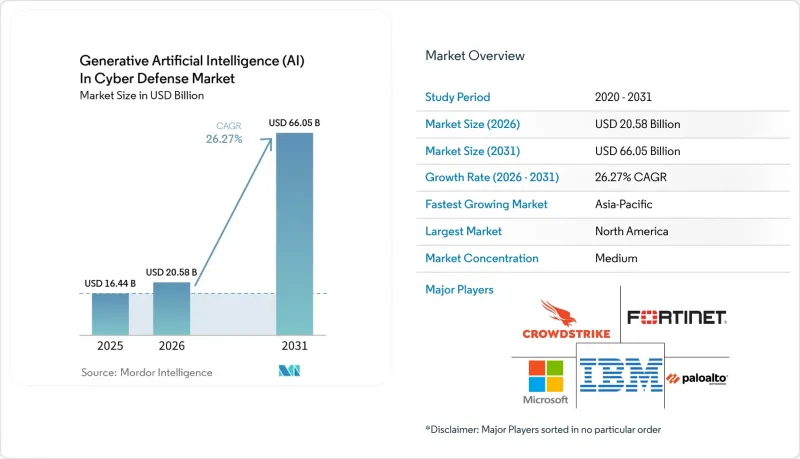
Mordor Intelligence에 의하면, 사이버 방위 분야 생성형 인공지능(AI) 시장 규모는 2025년 164억 4,000만 달러로 평가되었고, 2026년에는 205억 8,000만 달러로 확대될 것으로 추정되고, 2031년까지 660억 5,000만 달러에 이를 것으로 예상되며, 2026-2031년 CAGR 26.27%로 성장할 전망입니다.
본 보고서는 제공 형태별(소프트웨어 및 서비스), 용도별(보안 운영 및 SOC 기능 강화 등), 보안 유형별(인프라 보안 등), 도입 형태별(클라우드 등), 기업 규모별(대기업 등), 최종 사용자 산업별(석유 및 가스 등), 지역별로 분류되어 있습니다. 시장 전망은 금액(달러) 기준으로 제시되어 있습니다.
세계의 사이버 방위 분야 생성형 인공지능(AI) 동향 및 인사이트
AI를 활용한 공격 건수 및 속도 증가
사이버 방위 분야 생성형 인공지능(AI) 시장은 AI를 활용한 피싱, 딥페이크를 통한 사칭, 그리고 인간의 검토 주기를 능가하는 속도로 실행되는 자동화된 정찰의 급증으로 인해 혜택을 보고 있습니다. Zscaler는 자사 네트워크 전반에서 대규모로 수집된 신호를 바탕으로, 2025년 1월부터 12월까지 41만 3,524건의 AI 생성 피싱 사이트가 확인되었다고 보고했으며, 이는 공격자들이 이러한 캠페인을 얼마나 신속하게 산업화하고 있는지를 보여줍니다. 또한 IBM은 2025년 정보 유출 사건 6건 중 1건이 AI 기반 공격에 의한 것이며, 그 주된 목적은 피싱 및 사회공학의 규모 확대에 있었습니다고 보고하여, 공격용 AI가 이미 측정 가능한 운영상의 영향을 미치고 있음을 뒷받침하고 있습니다. 영국 국립사이버보안센터(NCSC)는 AI로 인해 사이버 공격의 규모와 영향이 거의 확실하게 확대될 것이라고 밝혔으며, 특히 소셜 엔지니어링의 경우 문법이나 번역 오류가 더 이상 직원들에게 신뢰할 수 있는 경고 신호가 되지 않을 것이라고 지적했습니다. 따라서 사이버 방위 분야 생성형 인공지능(AI)는 분석가의 속도가 아닌 기계의 속도로 작동하는 감지, 분류 및 대응 엔진으로 전환되고 있습니다. 또한 구매자들은 이메일, ID, 브라우저, 클라우드 등 다양한 채널에 걸쳐 AI가 생성한 방대한 양의 유인 메시지를 단일 워크플로우로 추적할 수 있는 도구를 더욱 중요하게 여기고 있습니다.
모델, 데이터, API 계층에 걸친 AI 공격 표면의 확대
사이버 방위 분야 생성형 인공지능(AI) 시장은 기업 내 AI 도입 확대에 힘입어 성장하고 있습니다. 이로 인해 프롬프트 계층, 모델의 동작, 훈련 데이터 및 연결된 API 전반에 걸쳐 새로운 위험이 발생하고 있습니다. OWASP는 ‘2025년 대규모 언어 모델 용도 상위 10대’에서 프롬프트 주입을 주요 취약점 범주로 지목했습니다. 이에 따라 많은 기업이 AI 전용 모니터링을 실험적인 부가 기능이 아닌 핵심적인 통제 수단으로 다루게 되었습니다. CrowdStrike는 2025년 12월, AI 프롬프트 및 에이전트와의 상호작용 계층이 기업 내에서 가장 빠르게 확대되고 있는 공격 표면 중 하나가 되었다고 밝혔으며, 이로 인해 AI 네이티브 워크플로우를 위해 구축된 제어 수단에 대한 수요가 높아졌습니다. 새로운 AI 용도이 등장할 때마다 모델, ID, 데이터 계보, 도구 호출에 걸친 신뢰의 경계가 확대되면서, 사이버 방위 분야 생성형 인공지능(AI)에 대해 기존의 경계 제어를 차용한 대책의 유효성은 떨어지고 있습니다. 이러한 변화로 인해 모델의 동작을 관찰하고, 프롬프트를 검증하며, 에이전트 상호작용을 모니터링하고, 의심스러운 API 활동을 실시간으로 감지할 수 있는 플랫폼에 대한 투자가 확대되고 있습니다. 또한 AI 보안의 역할은 기존의 사이버 방어를 넘어 모델 거버넌스 및 런타임 정책 적용까지 확대되고 있습니다.
AI 보안 검증에 있어 표준화된 벤치마크의 부재
사이버 방위 분야 생성형 인공지능(AI) 시장에서는 실전적인 공격 환경에서 벤더의 성능을 비교할 수 있는 널리 인정된 방법이 구매자에게 부족하기 때문에 기업의 도입 속도는 여전히 더딘 상황입니다. NISTIR 8596은 여전히 잠정 버전이며, 이는 AI 사이버 보안의 무결성을 보장하기 위한 가장 주목받는 공개 프레임워크 중 하나가 아직 최종 단계에 도달하지 않았음을 의미합니다. MITRE의 'AI 보증 환경(AI Assurance Landscape)'에서는 50개 이상의 프레임워크와 66개의 보증 요건이 매핑되어 있으며, 이 분야에는 중복되는 참조 자료가 많이 존재하지만, 기업이 조달 과정에서 자신 있게 활용할 수 있는 단일 표준 벤치마크는 존재하지 않음을 보여줍니다. OWASP의 ‘인공지능 보안 검증 표준(Artificial Intelligence Security Verification Standard)’ 이니셔티브는 유용하고 검증 가능한 요건을 추가하고 있지만, 보다 성숙한 기업용 보안 표준과 동등한 제도적 무게를 아직 갖추지는 못하고 있습니다. 따라서 사이버 방위 분야 생성형 인공지능(AI)는 여전히 공급업체의 시연이나 사례 연구에 지나치게 의존하고 있으며, 이는 판매 주기의 장기화를 초래하여 확고한 브랜드를 보유한 대형 기존 기업들에게 유리하게 작용할 가능성이 있습니다. 또한 이로 인해 구매자가 AI 보안 투자를 측정 가능한 보험 효과나 이사회 수준의 리스크 성과로 연결하는 능력도 약화되고 있습니다.
부문 분석
2025년 사이버 방위 분야 생성형 인공지능(AI) 시장에서 소프트웨어가 62.14%를 차지했으며, AI 네이티브 플랫폼이 여전히 기업 구매자들에게 주요 조달 단위임이 확인되었습니다. 사이버 방위 분야 생성형 인공지능(AI) 시장에는 보안 코파일럿, AI 보안 플랫폼, 위협 인텔리전스 도구, 보안 분석 엔진 및 취약점 관리 플랫폼이 포함되며, 이들은 현재 보안 스택의 중심에 가까운 위치를 차지하고 있습니다. 플랫폼 번들화가 이러한 우위를 더욱 강화하고 있습니다. 마이크로소프트는 2026년 4월 20일부터 단계적으로 배포를 시작하여 ‘Security Copilot’을 ‘Microsoft 365 E5’에 통합할 것이라고 발표했습니다. 이를 통해 해당 기업의 기존 사용자 기반 전체에서 AI 보안 도입에 대한 추가적인 장벽이 낮아질 것입니다. 또한 마이크로소프트는 2026년 5월, 자사의 멀티모델 에이전트형 스캔 기능을 통해 Windows 네트워크 스택에서 지금까지 알려지지 않았던 16건의 취약점을 발견했다고 발표했습니다. 이는 소프트웨어 플랫폼이 단순한 지원에서 직접적인 발견 및 검증 작업으로 전환되고 있음을 보여줍니다. 그 결과, 사이버 방어 분야의 생성형 인공지능(AI) 시장 구매자들은 단일 환경 전반에 걸쳐 위협 해석, 조사 지원 및 시정 조치 지침을 통합하는 제어 계층으로서 소프트웨어를 점점 더 중요하게 여기고 있습니다.
서비스 시장은 2031년까지 연평균 성장률(CAGR) 27.41%로 확대될 것으로 예측되며, 사이버 방위 분야 생성형 인공지능(AI) 시장에서 가장 빠르게 성장하는 서비스가 될 전망입니다. 이러한 성장은 관리형 AI 보안 운영, 적대적 레드팀 활동, AI 거버넌스 지원, 그리고 많은 사내 팀이 여전히 독자적으로 수행할 수 없는 지속적인 모니터링 프로그램에 의해 주도되고 있습니다. IBM은 2026년 6월 OpenAI의 'Daybreak Cyber Partner Program'에 참여하여 'Project Lightwell'의 일환으로 AI 기반 용도 보안 서비스를 시작했습니다. 이는 IBM과 Red Hat의 50억 달러 투자에 힘입은 것으로, AI 기반 제공 체계를 중심으로 서비스가 재구축되고 있음을 보여줍니다. 서비스 성장률이 더 높은 것은 많은 기업이 감사 추적 기록, 정책 제어, 측정 가능한 성과를 갖춘 재현 가능한 운영 모델로 AI 플랫폼을 전환하기 위해 지원이 필요하다는 현실도 반영하고 있습니다. 따라서 사이버 방위 분야 생성형 인공지능(AI)는 소프트웨어가 플랫폼 계층을 구축하고, 서비스가 그 유효성을 유지하기 위한 희소한 전문 지식을 제공하는 하이브리드 모델로 전환되고 있습니다.
2025년 사이버 방위 분야 생성형 인공지능(AI) 시장에서 보안 운영 및 SOC 기능 강화는 20.18%를 차지하며, 현재 지출액 기준으로 가장 큰 용도 분야가 되었습니다. 이 점유율은 구매자들이 시뮬레이션, 컨텐츠 생성, 포지션 관리와 같은 더 광범위한 이용 사례로 확장하기 전에, 분석가의 과중한 업무 부담을 줄여야 하는 시급한 과제를 반영하고 있습니다. SANS의 2025년 SOC 조사에 따르면, AI 도입은 광범위하게 나타나고 있지만 워크플로우의 성숙도는 제한적인 것으로 나타났습니다. 이는 사이버 방위 분야 생성형 인공지능(AI)에서 SOC 기능 강화가 계속해서 첫 번째 예산 배정을 확보하고 있는 이유를 설명하는 요인 중 하나입니다. 위협 인텔리전스, 보안 컨텐츠 생성 및 보안 자동화는 여전히 밀접하게 연관된 추가 도입 항목으로 남아 있습니다. 이는 SOC 코파일럿부터 도입을 시작한 조직이 일반적으로 사고 대응 주기에 따라 인접한 작업으로 AI를 확장해 나가기 때문입니다. 또한, AI를 활용한 공격은 정적인 플레이북으로는 따라잡을 수 없을 정도로 빠르게 변화하고 있어, 적대적 시뮬레이션 및 레드팀 활동에 대한 예산 우선순위도 높아지고 있습니다.
노출 관리 및 보안 태세 분석은 2031년까지 연평균 성장률(CAGR) 27.52%로 확대될 것으로 예측되며, 사이버 방위 분야 생성형 인공지능(AI)가 적용되는 분야 중 가장 빠르게 성장하는 용도이 될 것입니다. 이러한 추세는 성숙한 보안 팀이 단순히 경보 검토 능력을 강화하는 데 그치지 않고, 악용되기 전에 취약점을 식별하는 데 제한된 투자를 집중하고 있음을 보여줍니다. SentinelOne은 2026년 4월, Anthropic의 'Claude Opus 4.7'과 공격·방어 전문가를 결합한 'Wayfinder Frontier AI Services'를 출시하여, 공격 표면의 지속적인 발견과 우선순위가 지정된 시정 조치를 실현했습니다. 이는 해당 용도이 어떻게 상용화되고 있는지를 보여주는 직접적인 사례입니다. 생성형 모델은 현재 클라우드, ID, 엔드포인트 및 모델 계층의 신호를 신속하게 연계할 수 있어, 기존의 수동 분석으로는 얻을 수 없었던 수준의 명확한 노출 지도를 작성할 수 있게 되었습니다. 따라서 사이버 방위 분야 생성형 인공지능(AI)의 활용 범위는 사후 대응형 보안 지원에서 예방적 위험 정량화 및 AI 특화 보안 태세 관리로 확대되고 있습니다.
지역별 분석
2025년, 북미는 사이버 방위 분야 생성형 인공지능(AI) 시장 규모의 33.19%를 차지하며, 해당 시장에서 가장 규모가 큰 지역 부문으로서의 지위를 유지했습니다. 대기업, 연방 정부 기관, 주요 벤더가 동일한 생태계에 집중되어 있어 미국이 계속해서 수요의 중심이 되고 있습니다. 백악관은 2026년 6월, AI 취약점 감지를 위한 보조금 제도를 포함해 첨단 AI 혁신 및 보안에 대한 연방 정부의 지원을 지시하는 대통령령을 발령함으로써 이 분야에 대한 정책적 뒷받침을 강화했습니다. 또한, 캐나다도 2025년도 예산에서 대규모 국가 주도 AI 인프라 구축에 5년간 9억 2,560만 캐나다 달러(6억 6,210만 달러)를 배정함으로써 해당 지역의 기반을 더욱 강화하고, 관련 AI 보안 대책에 대한 수요를 높이고 있습니다. 이 지역의 강점은 마이크로소프트, 클라우드스트라이크, 팔로알토 네트웍스, 센티넬원, IBM, 구글의 존재로 인해 더욱 강화되고 있으며, 이들 기업은 다른 대부분의 지역보다 빠른 속도로 상용 플랫폼의 출시와 확장을 이어가고 있습니다.
사이버 방위 분야 생성형 인공지능(AI) 부문에서는 유럽이 여전히 2위 지역 블록을 차지하고 있지만, 아시아태평양은 2031년까지 28.07%라는 가장 높은 연평균 성장률(CAGR)을 나타낼 전망입니다. 유럽 수요 패턴은 EU AI법에 의해 크게 형성되고 있습니다. 이 법의 고위험 관련 조항은 2026년 8월 2일에 시행되어 모니터링, 로깅, 거버넌스 도구에 대한 직접적인 수요를 창출했습니다. 독일, 영국, 프랑스는 계속해서 이 지역의 주요 견인차 역할을 하고 있으며, 독일 산업계는 AI를 활용한 운영 기술(OT) 보호에 투자하고 있고, 영국의 국가사이버보안센터(NCSC)는 공개된 위협 평가를 통해 기업의 AI 도입을 지도하고 있습니다. 아시아태평양이 더욱 빠르게 성장하고 있는 것은 디지털 전환, 국가 주도의 사이버 보안 우선 정책, 그리고 클라우드 네이티브 성장에 힘입어 중국, 인도, 일본, 한국, 호주에서의 대상 시장이 확대되고 있기 때문입니다. NRI Secure Technologies는 2026년 2월, 일본의 생성형 AI 이용률이 2024년 65.3%에서 2025년에는 83.2%로 상승했다고 보고했으며, 현재 이용이 사내 업무에서 시스템 수준의 보안 도입으로 심화됨에 따라 향후 큰 전환의 기회가 생길 것임을 시사하고 있습니다.
남미는 사이버 방위 분야 생성형 인공지능(AI)의 성장 시장으로 자리 잡고 있으며, 브라질과 아르헨티나가 주요 수요 중심지입니다. 브라질은 디지털 뱅킹 및 데이터 보호에 대한 기대가 높아지는 가운데, 은행 및 디지털 금융 사업자들이 AI를 활용한 부정 행위 감시 및 사이버 방어 시스템을 도입하고 있어 도입이 활발히 진행되고 있는 국가라고 할 수 있습니다. 중동 및 아프리카에서는 상황에 따라 차이가 나타납니다. 사우디아라비아와 아랍에미리트(UAE)는 AI 및 사이버 방어에 적극적으로 투자하고 있는 반면, 사하라 이남 아프리카의 대부분 지역에서는 도입 성숙도가 여전히 낮은 단계에 머물러 있습니다. 핀테크의 성장, 클라우드 인프라 확충, 국가 주도의 디지털 프로그램, 그리고 규정 준수 요건의 강화로 인해 AI 네이티브 보안 도구의 기반이 확대됨에 따라, 사이버 방위 분야 생성형 인공지능(AI) 시장은 두 지역 모두에서 앞으로도 점진적으로 확대될 것으로 전망됩니다.
기타 혜택 :
- 엑셀 형식 시장 예측(ME) 시트
- 3개월간의 애널리스트 지원
자주 묻는 질문
목차
제1장 서론
제2장 조사 방법
제3장 주요 요약
제4장 시장 구도
제5장 시장 규모 및 성장 예측
제6장 경쟁 구도
제7장 시장 기회 및 향후 전망
AJY 26.08.07According to Mordor Intelligence, the generative artificial intelligence (AI) in Cyber Defense Market size is expected to increase from USD 16.44 billion in 2025 to USD 20.58 billion in 2026 and reach USD 66.05 billion by 2031, growing at a CAGR of 26.27% over 2026-2031.
This report is Segmented by Offering (Software, and Service), Application (Security Operations and SOC Augmentation, and More), Security Type (Infrastructure Security, and More), Deployment (Cloud, and More), Enterprise Size (Large Enterprises, and More), End-User Industry (Oil and Gas, and More), and Geography. The Market Forecasts are Provided in Terms of Value (USD).
Global Generative Artificial Intelligence (AI) In Cyber Defense Market Trends and Insights
Rising AI-Enabled Attack Volume And Speed
The Generative Artificial Intelligence (AI) in Cyber Defense Market is benefiting from a sharp rise in AI-assisted phishing, deepfake impersonation, and automated reconnaissance that outpace human-led review cycles. Zscaler reported 413,524 AI-generated phishing site instances across January to December 2025, based on signals collected at a very large scale across its network, which shows how quickly attackers are industrializing these campaigns. IBM also reported that 1 in 6 breaches in 2025 involved AI-driven attacks, mainly to scale phishing and social engineering, confirming that offensive AI already has a measurable operational impact. The UK National Cyber Security Center stated that AI will almost certainly increase both the volume and impact of cyberattacks, especially in social engineering, where grammar and translation errors are no longer reliable warning signs for employees. The Generative Artificial Intelligence (AI) in Cyber Defense Market is therefore shifting toward detection, triage, and response engines that work at machine speed rather than analyst speed. Buyers are also placing greater value on tools that can track high-volume AI-generated lures across email, identity, browser, and cloud channels in a single workflow.
Expansion of AI Attack Surface Across Model, Data, and API Layers
The Generative Artificial Intelligence (AI) in Cyber Defense Market is also being driven by the spread of enterprise AI deployments, which create new risks across prompt layers, model behavior, training data, and connected APIs. OWASP identified prompt injection as the leading vulnerability class in its 2025 Top 10 for Large Language Model Applications, which pushed many enterprises to treat AI-specific monitoring as a core control rather than an experimental add-on. CrowdStrike stated in December 2025 that the AI prompt and agent interaction layer had become one of the fastest-growing enterprise attack surfaces, which reinforced demand for controls built for AI-native workflows. Each new AI application multiplies the boundaries of trust across models, identities, data lineage, and tool calls, making repurposed perimeter controls less effective in the Generative Artificial Intelligence (AI) in Cyber Defense Market. This change is moving spending toward platforms that can observe model behavior, validate prompts, monitor agent interactions, and flag suspicious API movement in real time. It is also expanding the role of AI security beyond classic cyber defense to include model governance and runtime policy enforcement.
Lack of Standardized Benchmarks for AI Security Validation
The Generative Artificial Intelligence (AI) in Cyber Defense Market still faces slower enterprise adoption because buyers lack a widely accepted way to compare vendor performance under live adversarial conditions. NISTIR 8596 is still in preliminary form, which means one of the most visible public frameworks for AI cybersecurity alignment has not yet reached final status. MITRE's AI Assurance Landscape mapped more than 50 frameworks and 66 assurance needs, which shows that the field has many overlapping references but not one standard benchmark that enterprises can use with confidence in procurement. OWASP's Artificial Intelligence Security Verification Standard effort adds useful testable requirements, but it does not yet carry the same institutional weight as more mature enterprise security standards. The Generative Artificial Intelligence (AI) in Cyber Defense Market, therefore, still relies too heavily on vendor demonstrations and case studies, which can lengthen sales cycles and favor large incumbents with established brands. This also weakens buyers' ability to connect AI security spend with measurable insurance or board-level risk outcomes.
Other drivers and restraints analyzed in the detailed report include:
- Security Operations Center Automation to offset Analyst Shortages
- AI Governance and Auditability Requirements in Regulated Industries
- Liability Uncertainty For Autonomous Security Actions
For complete list of drivers and restraints, kindly check the Table Of Contents.
Segment Analysis
Software held 62.14% of the Generative Artificial Intelligence (AI) in Cyber Defense market in 2025, confirming that AI-native platforms remain the primary procurement unit for enterprise buyers. This part of the Generative Artificial Intelligence (AI) in Cyber Defense Market includes security copilots, AI security platforms, threat intelligence tools, security analytics engines, and vulnerability management platforms that now sit closer to the center of the security stack. Platform bundling is reinforcing that lead, as Microsoft announced that Security Copilot would be included with Microsoft 365 E5 through a phased rollout starting April 20, 2026, lowering the incremental barrier to AI security adoption across its installed base. Microsoft also stated in May 2026 that its multi-model agentic scanning harness discovered 16 previously unknown vulnerabilities in the Windows networking stack, indicating that software platforms are moving from assistance to direct discovery and validation work. As a result, buyers in the Generative Artificial Intelligence (AI) in Cyber Defense industry are increasingly treating software as a control layer that consolidates threat interpretation, investigative support, and remediation guidance across a single environment.
Services are projected to expand at a 27.41% CAGR through 2031, making them the fastest-growing offering in the Generative Artificial Intelligence (AI) in Cyber Defense Market. Growth is coming from managed AI security operations, adversarial red teaming, AI governance support, and continuous monitoring programs that many internal teams still cannot run on their own. IBM entered the OpenAI Daybreak Cyber Partner Program in June 2026 and launched an AI-powered application security service under Project Lightwell, backed by a USD 5 billion commitment from IBM and Red Hat, which shows how services are being rebuilt around AI-enabled delivery. The stronger growth rate for services also reflects the reality that many enterprises need help turning AI platforms into repeatable operating models with audit trails, policy controls, and measurable outcomes. The Generative Artificial Intelligence (AI) in Cyber Defense industry is therefore moving toward a blended model in which software builds the platform layer, while services supply the scarce expertise that keeps it effective.
Security Operations and SOC Augmentation accounted for 20.18% of the Generative Artificial Intelligence (AI) in Cyber Defense Market in 2025, which made it the largest application area by current spending. This share reflects the immediate pressure to reduce analyst overload before buyers expand into broader use cases such as simulation, content generation, and posture management. The SANS 2025 SOC survey found wide AI adoption but limited workflow maturity, which helps explain why SOC augmentation continues to attract first-wave budgets in the Generative Artificial Intelligence (AI) in Cyber Defense Market. Threat intelligence, security content generation, and security automation remain closely linked follow-on purchases, because organizations that start with SOC copilots usually extend AI into adjacent tasks along the incident response cycle. Adversarial simulation and red teaming are also gaining budget priority as AI-assisted attacks change faster than static playbooks can keep pace.
Exposure Management and Security Posture Analysis is projected to expand at a 27.52% CAGR through 2031, making it the fastest-growing application in the Generative Artificial Intelligence (AI) in Cyber Defense Market. That pattern shows that mature security teams are moving marginal investment toward identifying exploitable gaps before they are used, rather than simply adding more alert review capacity. SentinelOne launched Wayfinder Frontier AI Services in April 2026 by pairing Anthropic's Claude Opus 4.7 with offensive and defensive experts for continuous attack surface discovery and prioritized remediation, which is a direct example of how this application is being commercialized. Generative models can now connect cloud, identity, endpoint, and model-layer signals quickly enough to produce clearer exposure maps than manual analysis could previously. The Generative Artificial Intelligence (AI) in Cyber Defense Market is therefore widening from reactive security support into proactive risk quantification and AI-specific posture management.
Complete Report Scope:
- By Offering
- Software
- Security Copilots
- AI Security Platforms
- Threat Intelligence Platforms
- Security Analytics Platforms
- Vulnerability Management Platforms
- Services
- Software
- By Application
- Security Operations and SOC Augmentation
- Threat Intelligence and Threat Analysis
- Vulnerability Management and Exposure Analysis
- Security Content Generation
- Security Automation and Orchestration
- Adversarial Simulation and Red Teaming
- By Security Type
- Infrastructure Security
- Network Security
- Cloud Security
- Endpoint Security
- Application Security
- Identity and Access Management
- Data Security
- Infrastructure Security
- By Deployment
- Cloud
- On-Premises
- Hybrid
- By Enterprise Size
- Large Enterprises
- Small and Medium Enterprises
- By End-user Industry
- Government and Public Administration
- Industrial Manufacturing
- Retail and E-Commerce
- Transportation and Logistics
- Energy and Utilities
- Oil and Gas
- IT and Telecommunication
- Media and Entertainment
- Education and Research Institutions
- Healthcare and Life Sciences
- Banking, Financial Services, and Insurance (BFSI)
- By Geography
- North America
- United States
- Canada
- Mexico
- South America
- Brazil
- Argentina
- Rest of South America
- Europe
- Germany
- United Kingdom
- France
- Italy
- Spain
- Russia
- Rest of Europe
- Asia-Pacific
- China
- India
- Japan
- South Korea
- Australia
- Rest of Asia-Pacific
- Middle East and Africa
- Middle East
- Saudi Arabia
- United Arab Emirates
- Rest of Middle East
- Africa
- South Africa
- Nigeria
- Rest of Africa
- Middle East
- North America
Geography Analysis
North America held 33.19% of the Generative Artificial Intelligence (AI) in Cyber Defense market size in 2025, which kept it as the largest regional segment in the Generative Artificial Intelligence (AI) in Cyber Defense Market. The United States continues to anchor demand because large enterprises, federal agencies, and major vendors are concentrated in the same ecosystem. The White House issued an executive order in June 2026 that directed federal support toward advanced AI innovation and security, including grant pathways for AI vulnerability detection, thereby reinforcing policy backing for this area. Canada also added to the regional base when Budget 2025 allocated CAD 925.6 million, USD 662.1 million, over five years for large-scale sovereign AI infrastructure, which strengthens demand for related AI security controls. The region's strength is further reinforced by the presence of Microsoft, CrowdStrike, Palo Alto Networks, SentinelOne, IBM, and Google, which continue to release and expand commercial platforms faster than in most other geographies.
Europe remains the second-largest regional block in the Generative Artificial Intelligence (AI) in Cyber Defense Market, while Asia-Pacific is projected to record the fastest CAGR at 28.07% through 2031. Europe's demand pattern is strongly shaped by the EU AI Act, whose high-risk provisions became enforceable on August 2, 2026, and created direct demand for monitoring, logging, and governance tools. Germany, the United Kingdom, and France remain the main regional anchors, with German industry investing in AI-powered operational technology protection and the UK National Cyber Security Center guiding enterprise adoption through published threat assessments. Asia-Pacific is expanding faster because digital transformation, state-backed cyber priorities, and cloud-native growth are widening the addressable base across China, India, Japan, South Korea, and Australia. NRI Secure Technologies reported in February 2026 that Japan's generative AI utilization rate rose from 65.3% in 2024 to 83.2% in 2025, suggesting a significant future conversion opportunity as current use deepens from internal work to system-level security deployment.
South America remains an emerging market for Generative Artificial Intelligence (AI) in Cyber Defense, with Brazil and Argentina as the main demand centers. Brazil is the more advanced adopter because banks and digital finance providers are using AI-powered fraud monitoring and cyber defense in response to tighter digital banking and data protection expectations. The Middle East and Africa are more uneven, with Saudi Arabia and the United Arab Emirates investing aggressively in AI and cyber defense, while much of Sub-Saharan Africa remains earlier in its deployment maturity. The Generative Artificial Intelligence (AI) in Cyber Defense Market is still likely to deepen gradually across both regions as fintech growth, cloud buildout, sovereign digital programs, and compliance expectations create a larger base for AI-native security tools.
- Microsoft Corporation
- International Business Machines Corporation
- Google LLC
- CrowdStrike, Inc.
- Palo Alto Networks, Inc.
- SentinelOne, Inc.
- Darktrace Holdings Limited
- Fortinet, Inc.
- Zscaler, Inc.
- Trellix
- Check Point Software Technologies Ltd.
- Cisco Systems, Inc.
- Trend Micro Incorporated
- Sophos Limited
- Rapid7, Inc.
- Tenable Holdings, Inc.
- BlackBerry Limited
- Abnormal Security Corporation
- Snyk Limited
- Lakera Inc.
Additional Benefits:
- The market estimate (ME) sheet in Excel format
- 3 months of analyst support
TABLE OF CONTENTS
1 INTRODUCTION
- 1.1 Study Assumptions and Market Definition
- 1.2 Scope of the Study
2 RESEARCH METHODOLOGY
3 EXECUTIVE SUMMARY
4 MARKET LANDSCAPE
- 4.1 Market Overview
- 4.2 Market Drivers
- 4.2.1 Rising AI-Enabled Attack Volume and Speed
- 4.2.2 Expansion of AI Attack Surface Across Model, Data, and API Layers
- 4.2.3 Security Operations Center Automation to Offset Analyst Shortages
- 4.2.4 AI Governance and Auditability Requirements in Regulated Industries
- 4.2.5 Confidential Computing Demand for Multi-Tenant GenAI Workloads
- 4.2.6 Adversarial Red Teaming and Simulation Demand
- 4.3 Market Restraints
- 4.3.1 Lack of Standardized Benchmarks for AI Security Validation
- 4.3.2 Liability Uncertainty for Autonomous Security Actions
- 4.3.3 Integration Friction With Legacy Security Stacks
- 4.3.4 High Tuning Effort for False Positive Reduction in Dynamic AI Environments
- 4.4 Impact of Macroeconomic Factors on the Market
- 4.5 Industry Value-Chain Analysis
- 4.6 Regulatory Landscape
- 4.7 Technological Outlook
- 4.8 Porter's Five Forces Analysis
- 4.8.1 Bargaining Power of Buyers
- 4.8.2 Bargaining Power of Suppliers
- 4.8.3 Threat of New Entrants
- 4.8.4 Threat of Substitutes
- 4.8.5 Intensity of Competitive Rivalry
5 MARKET SIZE AND GROWTH FORECASTS (VALUE)
- 5.1 By Offering
- 5.1.1 Software
- 5.1.1.1 Security Copilots
- 5.1.1.2 AI Security Platforms
- 5.1.1.3 Threat Intelligence Platforms
- 5.1.1.4 Security Analytics Platforms
- 5.1.1.5 Vulnerability Management Platforms
- 5.1.2 Services
- 5.1.1 Software
- 5.2 By Application
- 5.2.1 Security Operations and SOC Augmentation
- 5.2.2 Threat Intelligence and Threat Analysis
- 5.2.3 Vulnerability Management and Exposure Analysis
- 5.2.4 Security Content Generation
- 5.2.5 Security Automation and Orchestration
- 5.2.6 Adversarial Simulation and Red Teaming
- 5.3 By Security Type
- 5.3.1 Infrastructure Security
- 5.3.1.1 Network Security
- 5.3.1.2 Cloud Security
- 5.3.1.3 Endpoint Security
- 5.3.2 Application Security
- 5.3.3 Identity and Access Management
- 5.3.4 Data Security
- 5.3.1 Infrastructure Security
- 5.4 By Deployment
- 5.4.1 Cloud
- 5.4.2 On-Premises
- 5.4.3 Hybrid
- 5.5 By Enterprise Size
- 5.5.1 Large Enterprises
- 5.5.2 Small and Medium Enterprises
- 5.6 By End-user Industry
- 5.6.1 Government and Public Administration
- 5.6.2 Industrial Manufacturing
- 5.6.3 Retail and E-Commerce
- 5.6.4 Transportation and Logistics
- 5.6.5 Energy and Utilities
- 5.6.6 Oil and Gas
- 5.6.7 IT and Telecommunication
- 5.6.8 Media and Entertainment
- 5.6.9 Education and Research Institutions
- 5.6.10 Healthcare and Life Sciences
- 5.6.11 Banking, Financial Services, and Insurance (BFSI)
- 5.7 By Geography
- 5.7.1 North America
- 5.7.1.1 United States
- 5.7.1.2 Canada
- 5.7.1.3 Mexico
- 5.7.2 South America
- 5.7.2.1 Brazil
- 5.7.2.2 Argentina
- 5.7.2.3 Rest of South America
- 5.7.3 Europe
- 5.7.3.1 Germany
- 5.7.3.2 United Kingdom
- 5.7.3.3 France
- 5.7.3.4 Italy
- 5.7.3.5 Spain
- 5.7.3.6 Russia
- 5.7.3.7 Rest of Europe
- 5.7.4 Asia-Pacific
- 5.7.4.1 China
- 5.7.4.2 India
- 5.7.4.3 Japan
- 5.7.4.4 South Korea
- 5.7.4.5 Australia
- 5.7.4.6 Rest of Asia-Pacific
- 5.7.5 Middle East and Africa
- 5.7.5.1 Middle East
- 5.7.5.1.1 Saudi Arabia
- 5.7.5.1.2 United Arab Emirates
- 5.7.5.1.3 Rest of Middle East
- 5.7.5.2 Africa
- 5.7.5.2.1 South Africa
- 5.7.5.2.2 Nigeria
- 5.7.5.2.3 Rest of Africa
- 5.7.5.1 Middle East
- 5.7.1 North America
6 COMPETITIVE LANDSCAPE
- 6.1 Market Concentration
- 6.2 Strategic Moves
- 6.3 Market Share Analysis
- 6.4 Company Profiles (includes Global Level Overview, Market Level Overview, Core Segments, Financials as available, Strategic Information, Market Rank/Share, Products and Services, Recent Developments)
- 6.4.1 Microsoft Corporation
- 6.4.2 International Business Machines Corporation
- 6.4.3 Google LLC
- 6.4.4 CrowdStrike, Inc.
- 6.4.5 Palo Alto Networks, Inc.
- 6.4.6 SentinelOne, Inc.
- 6.4.7 Darktrace Holdings Limited
- 6.4.8 Fortinet, Inc.
- 6.4.9 Zscaler, Inc.
- 6.4.10 Trellix
- 6.4.11 Check Point Software Technologies Ltd.
- 6.4.12 Cisco Systems, Inc.
- 6.4.13 Trend Micro Incorporated
- 6.4.14 Sophos Limited
- 6.4.15 Rapid7, Inc.
- 6.4.16 Tenable Holdings, Inc.
- 6.4.17 BlackBerry Limited
- 6.4.18 Abnormal Security Corporation
- 6.4.19 Snyk Limited
- 6.4.20 Lakera Inc.
7 MARKET OPPORTUNITIES AND FUTURE OUTLOOK
- 7.1 White-Space and Unmet-Need Assessment


