

|
시장보고서
상품코드
2098478
AI 증강 보안 애널리스트 플랫폼 시장 : 시장 점유율 분석, 업계 동향 및 통계, 성장 예측(2026-2031년)AI-Augmented Security Analyst Platforms - Market Share Analysis, Industry Trends & Statistics, Growth Forecasts (2026 - 2031) |
||||||
 Mordor Intelligence
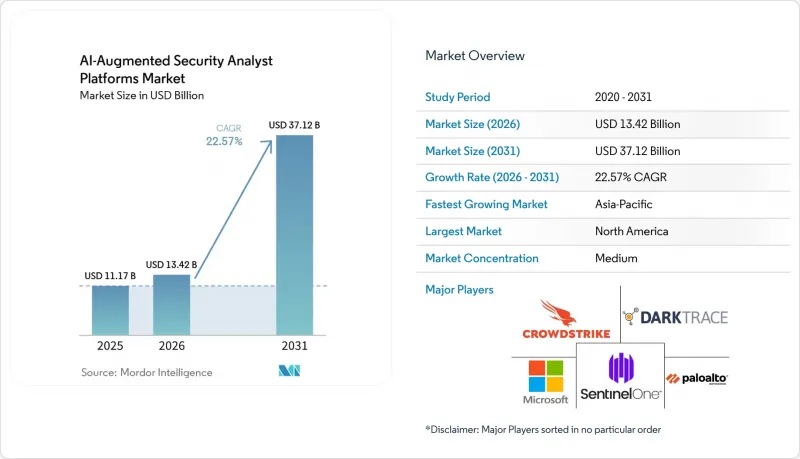
Mordor Intelligence에 의하면, AI 증강 보안 애널리스트 플랫폼 시장 규모는 2025년 112억 달러로 평가되었고, 2026년에는 134억 달러로 확대될 것으로 추정되고, 2026-2031년 CAGR 22.6%로 성장을 지속할 전망이며, 2031년에는 371억 달러에 이를 것으로 예측됩니다.
본 보고서는 컴포넌트별(소프트웨어 및 서비스), 용도별(위협 감지 및 경보 관리 등), 도입 형태별(클라우드, 온프레미스, 하이브리드), 기업 규모별(대기업 및 중소기업), 최종 사용자 산업별(정부 및 공공 기관 등), 그리고 지역별로 분류되어 있습니다. 시장 전망은 금액(달러) 기준으로 제시되어 있습니다.
세계의 AI 증강 보안 애널리스트 플랫폼 시장 동향 및 인사이트
하이브리드 보안 스택 전반에 걸쳐 증가하는 경보량
AI 증강 보안 애널리스트 플랫폼 시장은 하이브리드 환경에서 경보 증가와 분석가의 처리 능력 간의 직접적인 불일치로 인해 혜택을 보고 있습니다. 보안 팀은 현재 클라우드, 온프레미스 및 운영 기술(OT) 환경을 아우르며 업무를 수행하고 있으며, 텔레메트리 데이터가 너무 많은 시스템에 분산되어 있어 수동 검토만으로는 더 이상 충분한 효과를 얻을 수 없습니다. 이 문제는 공격이 각 계층에 미약한 신호를 남길 경우 더욱 심각해집니다. 왜냐하면 이러한 신호들은 엔드포인트, 네트워크, ID, 워크로드 데이터를 상호 연관시켜야 비로소 유용해지는 경우가 많기 때문입니다. 각 벤더들은 SIEM과 XDR 기능을 통합된 운영 계층 내에 통합함으로써 이에 대응하고 있으며, 사일로화된 제품이나 개별 조사 경로로 인해 발생하는 지연을 줄이고 있습니다. AI와 보안 자동화를 활용하는 조직은 수동 방식을 사용하는 조직에 비해 침해 감지 및 봉쇄를 98일 더 빨리 수행하고 있습니다. 또한, 침해 건당 평균 비용 절감액은 220만 달러에 달하며, 이는 AI 증강 보안 애널리스트 플랫폼 시장에 있어 비용 측면에서의 명확한 수요 요인으로 작용하고 있습니다.
경험이 풍부한 보안 분석가의 만성적인 부족
AI 증강 보안 애널리스트 플랫폼 시장은 더 이상 인원 수에만 국한되지 않는 인재 부족에 의해서도 뒷받침되고 있습니다. 현재의 문제는 기술의 깊이에서 비롯됩니다. 많은 조직이 직원을 채용할 수는 있지만, 필요한 수준에서 사고를 조사할 수 있는 숙련된 인재를 충분히 확보하지 못하고 있는 것이 현실입니다. 2026년 조사에 따르면, 조직의 27%가 인재의 역량 격차로 인해 직접적으로 발생한 보안 침해 사고를 경험한 것으로 나타났으며, 규제 준수가 채용을 강력하게 촉진하는 요인으로 작용하고 있음이 밝혀졌습니다. 이러한 인력 부족은 특히 고위직에서 두드러지는데, 다년간의 실무 경험이 요구되기 때문에 채용이 지연되고, 성숙한 사내 보안 운영 팀을 구축하는 데 드는 비용이 치솟고 있습니다. 따라서 AI 증강 보안 애널리스트 플랫폼 시장은 주니어 분석가가 더 깊은 인사이트력과 일관성을 가지고 업무를 수행함으로써, 희소한 고위 직원에 대한 의존도를 낮추고자 하는 구매자들의 관심을 끌고 있습니다.
고위험 보안 판단에서 모델의 설명 가능성 격차
AI 증강 보안 애널리스트 플랫폼 시장은 AI의 권고 사항이 비즈니스에 필수적인 시스템이나 사용자의 접근에 영향을 미칠 경우, 현실적인 한계에 직면하고 있습니다. 규제 대상 조직에서는 보안 조치에 대한 명확한 설명 책임을 요구하는 규정에 따라, 설명·검증·정당화가 가능한 의사결정이 요구됩니다. 따라서 잘못된 격리 조치나 접근 차단이 운영 환경, 규정 준수, 혹은 고객 서비스에 지장을 초래할 가능성이 있는 분야에서는 완전히 자율적인 대응을 도입하기 어려워지고 있습니다. EU의 AI법은 제12조에 근거하여 개인 데이터를 처리하는 고위험 시스템에 대해 로그 보존 및 추적 가능성 확보를 의무화함으로써 이 장벽을 더욱 높이고 있으며, 그 결과 벤더와 구매자에 대한 문서화 기대치가 높아지고 있습니다. 각 벤더사는 조사 절차와 증거의 연쇄를 보여주는 ‘에이전트형 워크플로우’를 통해 이러한 격차를 메우려 노력하고 있지만, 설명 가능성 기준이 더욱 정착되기 전까지는 AI 증강 보안 애널리스트 플랫폼 시장에서 완전 자율형 도입은 여전히 완만한 속도에 그칠 것입니다.
부문 분석
2025년, AI 증강 보안 애널리스트 플랫폼 시장에서 소프트웨어가 63.4%의 점유율을 차지했습니다. 이는 초기 구매 동향이 여전히 플랫폼 구독 및 핵심 제품 라이선스에 집중되어 있음을 뒷받침합니다. AI 지원형 SIEM, XDR 및 위협 인텔리전스 도구가 주요 상용 도입 포인트로 남아 있는 이유는 기업들이 보다 심층적인 프로세스 재설계에 착수하기 전에 우선 플랫폼을 구매하는 것을 여전히 선호하기 때문입니다. 소프트웨어가 주도적인 위치를 차지하고 있다는 사실은 구매자들이 이 카테고리를 어떻게 인식하고 있는지를 반영합니다. 플랫폼의 커버리지, 텔레메트리 통합, 그리고 조사 기능은 일반적으로 운영 지원 계층보다 먼저 평가되기 때문입니다. 그렇지만 AI 증강 보안 애널리스트 플랫폼 시장은 더 이상 소프트웨어만으로 정의되는 것이 아니며, 서비스의 비중이 높아지고 있어 도입 성숙도가 주요 과제로 대두되고 있습니다.
서비스 부문은 2031년까지 연평균 성장률(CAGR) 23.7%로 확대될 것으로 예측되며, AI 증강 보안 애널리스트 플랫폼 시장에서 가장 빠르게 성장하는 분야가 될 것입니다. 이러한 성장 속도는 튜닝, 플레이북 개발, 모델 보정, 프로세스 통합, 지속적인 최적화 등 구매 후 필요한 실무 작업을 반영한 것입니다. 또한, 이 보고서 초안에서는 이러한 추세를 기술 깊이와도 연관 짓고 있습니다. 많은 조직에게 있어 고도의 플랫폼을 구매하는 것 자체는 쉬울지라도, 사내에서 운영 체계를 구축하는 것은 어렵기 때문입니다. 2026년 3월에 보고된 조사에 따르면, 조직의 60%가 단순한 인력 부족이 아닌 기술 격차를 사이버 보안 분야의 주요 과제로 꼽았으며, 이는 외부 도입 및 관리형 지원에 대한 수요를 뒷받침하고 있습니다. 그 결과, AI 증강 보안 애널리스트 플랫폼 시장은 초기 도입 단계에서 보다 서비스 주도형 운영 모델로 전환되고 있는 것으로 나타났습니다.
2025년 AI 증강 보안 애널리스트 플랫폼 시장 규모 중 위협 감지 및 경보 관리가 21.2%를 차지하고 있어, 감지가 여전히 가장 확고하게 자리 잡은 용도 분야임을 보여줍니다. 이러한 우위는 도입 기반의 성숙도에 기인합니다. 기업들은 이 카테고리 내의 다른 어떤 용도 분야보다 오랫동안 AI 지원형 감지 워크플로우에 투자해 왔기 때문입니다. 경보 우선순위 지정 및 이벤트 상관 분석은 많은 보안 팀의 일상적인 운영에서 핵심을 이루고 있으므로, 이 부문은 여전히 중요합니다. 동시에, AI 증강 보안 애널리스트 플랫폼 시장에서는 단순한 신속 대응뿐만 아니라 예방에 중점을 둔 워크플로우에 대한 추가 투자가 뚜렷이 증가하고 있습니다.
노출 관리 및 보안 태세 분석은 2031년까지 연평균 성장률(CAGR) 23.9%를 나타낼 것으로 예측되며, AI 증강 보안 애널리스트 플랫폼 시장에서 가장 빠르게 성장하는 용도 분야가 될 전망입니다. 이러한 변화는 성숙한 구매자들이 공격 표면을 축소하고, 악용 가능한 취약점이 실제 사고로 발전하기 전에 이를 식별하기를 원하고 있음을 보여줍니다. 한 벤더는 2026년 4월, Anthropic사의 ‘Claude Opus 4.7’과 시니어 보안 전문가를 결합하여 지속적인 공격 표면 감지 및 안내형 시정 조치를 실현하는 ‘Wayfinder Frontier AI Services’를 출시하며 이러한 방향으로 한 걸음 내디뎠습니다. 이와 유사한 수요 패턴은 사고 조사, 대응 지원, 오케스트레이션, 위협 헌팅 분야에도 적용되며, 특히 소규모 팀이 시니어 분석가를 추가로 채용하지 않고도 더 광범위한 대응 범위를 확보해야 하는 경우에 효과적입니다. 전반적으로 AI 증강 보안 애널리스트 플랫폼 시장 수요는 경보 대응에서 보안 태세, 취약점 식별, 그리고 안내형 조치로 확대되는 추세를 보이고 있습니다.
지역별 분석
2025년, 북미는 AI 증강 보안 애널리스트 플랫폼 시장의 33.1% 점유율을 차지했으며, 지역별로는 가장 큰 기여를 한 지역이 되었습니다. 이 지역은 기업의 활발한 보안 투자, 플랫폼 벤더의 밀집된 존재, 그리고 사이버 보안 대책 미비로 인한 비용이 증가하는 정책 환경의 혜택을 받고 있습니다. 미국은 여전히 주요 수요 거점이며, 이는 규제상 공시 규정, 공급망 보안에 대한 기대, 그리고 방어 지향적인 규정 준수 프로그램이 더욱 강력한 운영 플랫폼의 필요성을 높이고 있기 때문입니다. 또한, 이 지역에는 하이브리드·멀티클라우드 환경이 고도로 집중되어 있으며, 그 운영 환경은 AI 증강 보안 애널리스트 플랫폼 시장이 해결을 목표로 하는 핵심 과제와 밀접하게 부합합니다. 실용적인 관점에서 볼 때, 보안 팀은 이미 플랫폼 통합, AI 기반 트리아지, 대규모 자동화를 정당화할 수 있을 만큼 충분히 성숙해 있기 때문에 북미는 여전히 가장 성숙한 구매 환경을 갖추고 있습니다.
유럽은 AI 증강 보안 애널리스트 플랫폼 시장에서 여전히 2위 지역 시장이며, 독일, 영국, 프랑스가 주요 수요 거점입니다. 이 지역이 두드러지는 이유는 보안 관련 구매가 현재 NIS2, DORA, EU AI법의 복합적인 영향에 의해 강력하게 형성되고 있으며, 이로 인해 설명 가능성, 감사 가능성, 주권이 벤더 선정의 핵심 요소가 되고 있기 때문입니다. 이로 인해 감지 성능만이 주요 기준으로 남아 있는 시장과는 달리, ‘규정 준수 우선’의 구매 패턴이 형성되고 있습니다. 2026년 6월 ‘Sovereign Cortex with T Security’의 발표는 AI 증강 보안 애널리스트 플랫폼 시장이 의료, 금융 서비스, 공공 부문, 중요 인프라 분야의 구매자를 대상으로 지역 맞춤형 도입 모델을 채택하고 있음을 보여줍니다. 남미에서는 도입이 아직 초기 단계에 있지만, 규제 체계가 유럽 모델에 가까워지고 있어 브라질과 아르헨티나에서 관심이 표출되고 있습니다. 다만, 예산 및 IT 성숙도에 따라 도입 속도에는 여전히 제약이 있습니다.
아시아태평양은 2031년까지 연평균 성장률(CAGR) 24.3%를 나타낼 것으로 예측되며, AI 증강 보안 애널리스트 플랫폼 시장에서 가장 빠르게 성장하는 지역이 될 전망입니다. 이러한 성장은 클라우드 인프라의 확대, 디지털 활용이 활발한 기업 증가, 그리고 여러 시장에서 정부 주도의 사이버 보안 규제 강화에 의해 주도되고 있습니다. 인도는 중요한 전환점을 맞이하고 있습니다. 이는 ‘디지털 개인 데이터 보호’ 프레임워크와 인도 중앙은행이 2026년 6월에 발표한 권고에 따라 금융 부문에서 AI 관련 사이버 위험에 대한 감시가 강화되고 있기 때문입니다. 한국과 일본은 대기업들이 AI를 활용한 보안 운영 역량을 대규모로 구축하는 등, 보다 고도화된 도입 단계로 나아가고 있습니다. 호주에서는 ‘Essential Eight’ 성숙도 모델과 연계된 공공 부문 및 중요 인프라 프로그램을 통해 꾸준한 업그레이드 수요가 뒷받침되고 있습니다. 중동 및 아프리카은 규모는 작지만 성장을 지속하고 있으며, 특히 사우디아라비아와 아랍에미리트(UAE)에서는 AI 보안 기능이 광범위한 디지털 전환 및 국가 사이버 보안 전략의 일환으로 자리 잡으면서 신규 수요가 창출되고 있습니다.
기타 혜택 :
- 엑셀 형식 시장 예측(ME) 시트
- 3개월간의 애널리스트 지원
자주 묻는 질문
목차
제1장 서론
제2장 조사 방법
제3장 주요 요약
제4장 시장 구도
제5장 시장 규모 및 성장 예측
제6장 경쟁 구도
제7장 시장 기회 및 향후 전망
AJY 26.08.07According to Mordor Intelligence, the AI-augmented security analyst platforms market size is expected to grow from USD 11.2 billion in 2025 to USD 13.4 billion in 2026 and is forecast to reach USD 37.1 billion by 2031 at 22.6% CAGR over 2026-2031.
This report is Segmented by Component (Software, and Services), Application (Threat Detection and Alert Management, and More), Deployment (Cloud, On-Premises, and Hybrid), Enterprise Size (Large Enterprises, and Small and Medium Enterprises), End-User Industry (Government and Public Administration, and More), and Geography. The Market Forecasts are Provided in Terms of Value (USD).
Global AI-Augmented Security Analyst Platforms Market Trends and Insights
Escalating Alert Volumes Across Hybrid Security Stacks
The AI-augmented security analyst platforms market is benefiting from a direct mismatch between the growth in alerts and analysts' capacity in hybrid environments. Security teams now work across cloud, on-premises, and operational technology estates, where telemetry is spread across too many systems for manual review to remain effective. This problem is more serious when attacks leave weak signals at each layer, because those signals often become useful only after correlation across endpoint, network, identity, and workload data. Vendors are responding by bringing SIEM and XDR functions together within unified operating layers, reducing the delays caused by siloed products and separate investigation paths. Organizations that use AI and security automation identify and contain breaches 98 days faster than those using manual methods, while average breach savings reach USD 2.2 million per incident, providing the AI-augmented security analyst platforms market with a clear cost-based demand trigger.
Persistent Shortage of Experienced Security Analysts
The AI-augmented security analyst platforms market is also being lifted by a shortage that is no longer limited to headcount alone. The problem now centers on skill depth: many organizations can hire staff but still cannot find enough experienced people to investigate incidents at the required level. In 2026, research showed that 27% of organizations had experienced breaches tied directly to workforce capability gaps, and that regulatory compliance was a strong hiring driver. The shortage is especially visible in senior roles, where long experience requirements slow hiring and raise the cost of building a mature internal security operations team. That is why the AI-augmented security analyst platforms market is attracting buyers who want junior analysts to work with greater depth, consistency, and less dependence on scarce senior staff.
Model Explainability Gaps in High-Risk Security Decisions
The AI-augmented security analyst platforms market faces a real limit when AI recommendations affect business-critical systems or user access. Regulated organizations need decisions that can be explained, reviewed, and defended in accordance with rules that require clear accountability for security actions. That makes it harder to adopt fully autonomous responses in areas where a wrong isolation action or access block could disrupt production, compliance, or customer service. The EU AI Act raises this bar further by requiring high-risk systems processing personal data to preserve logs and ensure traceability under Article 12, thereby increasing documentation expectations for vendors and buyers. Vendors are trying to narrow the gap with agentic workflows that show investigation steps and evidence chains, but the AI-augmented security analyst platforms market will still see slower adoption of full autonomy until explainability standards become more settled.
Other drivers and restraints analyzed in the detailed report include:
- Rising Enterprise Demand for AI-Assisted Triage and Investigation
- Consolidation of SIEM, SOAR, XDR, and UEBA Workflows
- Integration Complexity With Legacy Security Tooling
For complete list of drivers and restraints, kindly check the Table Of Contents.
Segment Analysis
Software held 63.4% of the AI-augmented security analyst platforms market share in 2025, which confirms that the first buying motion still centers on platform subscriptions and core product licenses. AI-assisted SIEM, XDR, and threat intelligence tools remain the primary commercial entry points because enterprises still prefer buying a platform before committing to deeper process redesign. The software lead also reflects how buyers frame the category, since platform coverage, telemetry integration, and investigation capability are usually evaluated before operational support layers. Even so, the AI-augmented security analyst platforms market is no longer defined solely by software, as services are gaining weight, with deployment maturity as the main challenge.
Services are projected to expand at a 23.7% CAGR through 2031, making it the fastest-growing component of the AI-augmented security analyst platforms market. That pace reflects the practical work needed after purchase, including tuning, playbook development, model calibration, process alignment, and ongoing optimization. The draft also ties this pattern to skills depth because many organizations can buy advanced platforms more easily than they can operationalize them internally. Research reported in March 2026 found that 60% of organizations identified skills gaps, rather than simple headcount shortages, as their main cybersecurity challenge, supporting demand for external implementation and managed support. The result is a component mix where the AI-augmented security analyst platforms market is moving from first-stage adoption toward a more service-led operating model.
Threat Detection and Alert Management accounted for 21.2% of the AI-augmented security analyst platforms market size in 2025, showing that detection remains the most established application area. This lead stems from installed-base maturity, as enterprises have funded AI-assisted detection workflows longer than any other application group in the category. The segment still matters because alert triage and event correlation are the daily operating core of many security teams. At the same time, the AI-augmented security analyst platforms market is showing a clear shift in marginal spending toward prevention-focused workflows rather than only faster reaction.
Exposure Management and Security Posture Analysis is projected to grow at 23.9% CAGR through 2031, making it the fastest-growing application in the AI-augmented security analyst platforms market. That shift shows that mature buyers now want to reduce the attack surface and identify exploitable gaps before they become active incidents. One vendor moved in this direction in April 2026 with Wayfinder Frontier AI Services, which paired Anthropic's Claude Opus 4.7 with senior security experts for continuous attack surface discovery and guided remediation. The same demand pattern supports incident investigation, response assistance, orchestration, and threat hunting, especially where smaller teams need deeper coverage without adding more senior analysts. Overall, application demand in the AI-augmented security analyst platforms market is broadening from alert handling into posture, exposure, and guided action.
Complete Report Scope:
- By Component
- Software
- AI-Assisted SIEM Platforms
- AI-Assisted XDR Platforms
- AI Threat Intelligence Platforms
- Others
- Services
- Software
- By Application
- Threat Detection and Alert Management
- Incident Investigation and Root Cause Analysis
- Response Assistance and Orchestration
- Threat Hunting
- Exposure Management and Security Posture Analysis
- By Deployment
- Cloud
- On-Premises
- Hybrid
- By Enterprise Size
- Large Enterprises
- Small and Medium Enterprises
- By End-user Industry
- Government and Public Administration
- Industrial Manufacturing
- Retail and E-Commerce
- Transportation and Logistics
- Energy and Utilities
- Oil and Gas
- IT and Telecommunication
- Media and Entertainment
- Education and Research Institutions
- Healthcare and Life Sciences
- Banking, Financial Services, and Insurance (BFSI)
- Other End User Industries
- By Geography
- North America
- United States
- Canada
- Mexico
- South America
- Brazil
- Argentina
- Rest of South America
- Europe
- Germany
- United Kingdom
- France
- Italy
- Spain
- Russia
- Rest of Europe
- Asia-Pacific
- China
- India
- Japan
- South Korea
- Australia
- Rest of Asia-Pacific
- Middle East and Africa
- Middle East
- Saudi Arabia
- United Arab Emirates
- Rest of Middle East
- Africa
- South Africa
- Nigeria
- Rest of Africa
- Middle East
- North America
Geography Analysis
North America held 33.1% of the AI-augmented security analyst platforms market share in 2025, which made it the largest regional contributor. The region benefits from deep enterprise security spending, a dense presence of platform vendors, and a policy environment in which the cost of weak cybersecurity controls is rising. The United States remains the main demand center because regulatory disclosure rules, supply chain security expectations, and defense-oriented compliance programs all increase the need for stronger operating platforms. The region also has a high concentration of hybrid multi-cloud environments, and that operating context closely matches the core problem the AI-augmented security analyst platforms market is built to solve. In practical terms, North America remains the most mature buying environment because security teams are already far enough along to justify platform consolidation, AI-assisted triage, and automation at scale.
Europe remains the second-largest regional market for AI-augmented security analyst platforms, with Germany, the United Kingdom, and France as the main demand centers. The region stands out because security purchases are now strongly shaped by the combined effect of NIS2, DORA, and the EU AI Act, which together make explainability, auditability, and sovereignty central to vendor selection. This produces a compliance-first buying pattern that differs from markets where detection performance alone remains the lead criterion. The June 2026 Sovereign Cortex with T Security announcement shows how the AI-augmented security analyst platforms market is adapting with regionalized deployment models for healthcare, financial services, public sector, and critical infrastructure buyers. South America is still earlier in adoption, with Brazil and Argentina showing interest as regulatory ideas begin to move closer to European models, though budgets and IT maturity still limit speed.
Asia-Pacific is forecast to grow at a 24.3% CAGR through 2031, making it the fastest-growing regional band in the AI-augmented security analyst platforms market. Growth is being driven by cloud infrastructure expansion, a rising base of digitally active enterprises, and stronger government-backed cybersecurity mandates across several markets. India is an important trigger point because the Digital Personal Data Protection framework and the Reserve Bank of India's June 2026 advisory are increasing scrutiny of AI-related cyber risk in the financial sector. South Korea and Japan are moving through more advanced adoption paths where large companies are building AI-enabled security operations capabilities at scale. Australia supports steady upgrade demand through public sector and critical infrastructure programs linked to the Essential Eight maturity model. The Middle East and Africa are growing from a smaller base, though Saudi Arabia and the UAE are creating greenfield demand as AI security capabilities become part of broader digital transformation and national cybersecurity agendas.
- Exabeam
- Securonix, Inc.
- Vectra AI, Inc.
- Darktrace plc
- SentinelOne, Inc.
- Palo Alto Networks, Inc.
- CrowdStrike, Inc.
- IBM Corporation
- Microsoft Corporation
- Cisco Systems, Inc.
- Elastic N.V.
- Stellar Cyber
- Swimlane, Inc.
- Torq, Inc.
- ReliaQuest, LLC
- Rapid7, Inc.
- Trellix, Inc.
- Anomali
- Armis, Inc.
- Google LLC
Additional Benefits:
- The market estimate (ME) sheet in Excel format
- 3 months of analyst support
TABLE OF CONTENTS
1 INTRODUCTION
- 1.1 Study Assumptions and Market Definition
- 1.2 Scope of the Study
2 RESEARCH METHODOLOGY
3 EXECUTIVE SUMMARY
4 MARKET LANDSCAPE
- 4.1 Market Overview
- 4.2 Market Drivers
- 4.2.1 Escalating Alert Volumes Across Hybrid Security Stacks
- 4.2.2 Persistent Shortage of Experienced Security Analysts
- 4.2.3 Rising Enterprise Demand for AI-Assisted Triage and Investigation
- 4.2.4 Consolidation of SIEM, SOAR, XDR, and UEBA Workflows
- 4.2.5 Higher Spend on Autonomous Response in Regulated Industries
- 4.2.6 Growing Need for Continuous 24/7 Threat Hunting at Lower Unit Cost
- 4.3 Market Restraints
- 4.3.1 Model Explainability Gaps in High-Risk Security Decisions
- 4.3.2 Integration Complexity With Legacy Security Tooling
- 4.3.3 Data Sovereignty and Privacy Constraints on Training Data
- 4.3.4 Trust Deficit Around AI-Driven False Positives and Autonomous Action
- 4.4 Impact of Macroeconomic Factors on the Market
- 4.5 Industry Value-Chain Analysis
- 4.6 Regulatory Landscape
- 4.7 Technological Outlook
- 4.8 Porter's Five Forces Analysis
- 4.8.1 Bargaining Power of Buyers
- 4.8.2 Bargaining Power of Suppliers
- 4.8.3 Threat of New Entrants
- 4.8.4 Threat of Substitutes
- 4.8.5 Intensity of Competitive Rivalry
5 MARKET SIZE AND GROWTH FORECASTS (VALUE)
- 5.1 By Component
- 5.1.1 Software
- 5.1.1.1 AI-Assisted SIEM Platforms
- 5.1.1.2 AI-Assisted XDR Platforms
- 5.1.1.3 AI Threat Intelligence Platforms
- 5.1.1.4 Others
- 5.1.2 Services
- 5.1.1 Software
- 5.2 By Application
- 5.2.1 Threat Detection and Alert Management
- 5.2.2 Incident Investigation and Root Cause Analysis
- 5.2.3 Response Assistance and Orchestration
- 5.2.4 Threat Hunting
- 5.2.5 Exposure Management and Security Posture Analysis
- 5.3 By Deployment
- 5.3.1 Cloud
- 5.3.2 On-Premises
- 5.3.3 Hybrid
- 5.4 By Enterprise Size
- 5.4.1 Large Enterprises
- 5.4.2 Small and Medium Enterprises
- 5.5 By End-user Industry
- 5.5.1 Government and Public Administration
- 5.5.2 Industrial Manufacturing
- 5.5.3 Retail and E-Commerce
- 5.5.4 Transportation and Logistics
- 5.5.5 Energy and Utilities
- 5.5.6 Oil and Gas
- 5.5.7 IT and Telecommunication
- 5.5.8 Media and Entertainment
- 5.5.9 Education and Research Institutions
- 5.5.10 Healthcare and Life Sciences
- 5.5.11 Banking, Financial Services, and Insurance (BFSI)
- 5.5.12 Other End User Industries
- 5.6 By Geography
- 5.6.1 North America
- 5.6.1.1 United States
- 5.6.1.2 Canada
- 5.6.1.3 Mexico
- 5.6.2 South America
- 5.6.2.1 Brazil
- 5.6.2.2 Argentina
- 5.6.2.3 Rest of South America
- 5.6.3 Europe
- 5.6.3.1 Germany
- 5.6.3.2 United Kingdom
- 5.6.3.3 France
- 5.6.3.4 Italy
- 5.6.3.5 Spain
- 5.6.3.6 Russia
- 5.6.3.7 Rest of Europe
- 5.6.4 Asia-Pacific
- 5.6.4.1 China
- 5.6.4.2 India
- 5.6.4.3 Japan
- 5.6.4.4 South Korea
- 5.6.4.5 Australia
- 5.6.4.6 Rest of Asia-Pacific
- 5.6.5 Middle East and Africa
- 5.6.5.1 Middle East
- 5.6.5.1.1 Saudi Arabia
- 5.6.5.1.2 United Arab Emirates
- 5.6.5.1.3 Rest of Middle East
- 5.6.5.2 Africa
- 5.6.5.2.1 South Africa
- 5.6.5.2.2 Nigeria
- 5.6.5.2.3 Rest of Africa
- 5.6.5.1 Middle East
- 5.6.1 North America
6 COMPETITIVE LANDSCAPE
- 6.1 Market Concentration
- 6.2 Strategic Moves
- 6.3 Market Share Analysis
- 6.4 Company Profiles (includes Global Level Overview, Market Level Overview, Core Segments, Financials as available, Strategic Information, Market Rank/Share, Products and Services, Recent Developments)
- 6.4.1 Exabeam
- 6.4.2 Securonix, Inc.
- 6.4.3 Vectra AI, Inc.
- 6.4.4 Darktrace plc
- 6.4.5 SentinelOne, Inc.
- 6.4.6 Palo Alto Networks, Inc.
- 6.4.7 CrowdStrike, Inc.
- 6.4.8 IBM Corporation
- 6.4.9 Microsoft Corporation
- 6.4.10 Cisco Systems, Inc.
- 6.4.11 Elastic N.V.
- 6.4.12 Stellar Cyber
- 6.4.13 Swimlane, Inc.
- 6.4.14 Torq, Inc.
- 6.4.15 ReliaQuest, LLC
- 6.4.16 Rapid7, Inc.
- 6.4.17 Trellix, Inc.
- 6.4.18 Anomali
- 6.4.19 Armis, Inc.
- 6.4.20 Google LLC
7 MARKET OPPORTUNITIES AND FUTURE OUTLOOK
- 7.1 White-Space and Unmet-Need Assessment


