

|
시장보고서
상품코드
2098476
적대적 알고리즘 경쟁 및 방어형 AI 시장 : 시장 점유율 분석, 업계 동향 및 통계, 성장 예측(2026-2031년)Adversarial Algorithmic Competition and Defensive AI - Market Share Analysis, Industry Trends & Statistics, Growth Forecasts (2026 - 2031) |
||||||
 Mordor Intelligence
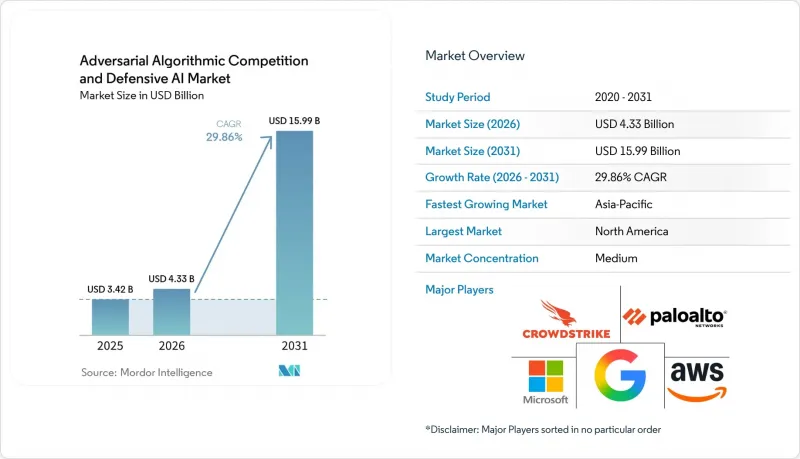
Mordor Intelligence에 의하면, 적대적 알고리즘 경쟁 및 방어형 AI 시장 규모는 2025년 34억 2,000만 달러로 평가되었고, 2026년에는 43억 3,000만 달러로 확대될 것으로 추정되고, 2026-2031년 CAGR 29.86%로 성장을 지속할 전망이며, 2031년에는 159억 9,000만 달러에 이를 것으로 예측됩니다.
본 보고서는 제공별(소프트웨어 및 서비스), 보안 평가 중점 분야별(프롬프트 주입 및 탈옥 테스트 등), 배포별(클라우드, 온프레미스, 하이브리드), 기업 규모별(대기업 등), 최종 사용자 산업별(은행, 금융서비스 및 보험(BFSI), 헬스케어 및 생명과학 등), 지역별로 분류되어 있습니다. 시장 전망은 금액(달러)으로 표시됩니다.
세계의 적대적 알고리즘 경쟁 및 방어형 AI 시장 동향 및 인사이트
규제 대상 워크플로우에서의 생성형 AI 및 에이전트형 AI의 급속한 도입
규제 대상 부문은 초기 시범 단계를 넘어섰으며, 적대적 알고리즘 경쟁 및 방어형 AI 시장은 AI가 현재 더 강력한 감독이 필요한 고객 서비스, 규정 준수, 부정 심사 및 임상 지원 업무와 연계되어 있다는 점에서 혜택을 받고 있습니다. 금융 서비스 분야에서는 캠브리지 대안 금융 센터(Cambridge Alternative Finance Centre)가 2026년 4월에 발표한 보고서에 따르면, 조사 대상 기관의 71%가 생성형 AI를 적극적으로 도입하고 있으며, 52%는 에이전트형 AI를 적극적으로 도입하고 있고, 48%는 적대적 AI의 위협을 가장 큰 우려 사항으로 꼽았습니다. 의료 분야에서도 유사한 경향이 나타나며, NVIDIA의 보고서에 따르면 2026년에는 69%의 조직이 생성형 AI 또는 대규모 언어 모델을 활용하고 있으며, 이는 2025년의 54%에서 증가한 수치입니다. 한편, 40%의 조직은 HIPAA, FDA 승인 절차 및 GDPR(EU 개인정보보호규정)이 자사의 에이전트형 AI 도입 전략을 형성하고 있다고 응답했습니다. 이것이 중요한 이유는 에이전트형 시스템이 단일 모델 경계 내에 머무르지 않고 도구, 데이터베이스, 용도 계층과 연동되기 때문에 악용이 발생할 수 있는 지점이 넓어지기 때문입니다. 그 결과, 적대적 알고리즘 경쟁 및 방어형 AI 시장에서는 고립된 모델의 동작이 아닌 전체 워크플로우를 아우르는 테스트에 대한 수요가 증가하고 있습니다.
프롬프트 주입, 탈옥, 모델 변조 공격의 빈도 증가
공격 기법은 점점 더 효과적이 되어가고 있으며, 이것이 적대적 알고리즘 경쟁 및 방어형 AI 시장의 성장을 직접적으로 견인하고 있습니다. 2026년 6월 『Scientific Reports』지에 게재된 연구에 따르면, 단순한 필터링 규칙을 우회할 수 있을 정도로 읽기 쉬운 프롬프트를 사용하여 여러 오픈 웨이트형 70억 파라미터 모델 패밀리를 대상으로 한 탈옥 공격의 종합 성공률이 91.1%에서 94.6%에 달한 것으로 보고되었습니다. 2025년 프롬프트 주입 공격에 관한 리뷰에서는 기업 도입 사례의 53%가 RAG(Retrieval-Augmented Generation) 및 에이전트형 파이프라인에 의존하고 있다는 점도 지적되었으며, 이로 인해 런타임 시 변조되거나 조작된 외부 컨텐츠가 모델의 동작에 영향을 미칠 위험이 높아지고 있습니다. 동 리뷰에서는 시스템의 프롬프트 유출 및 벡터·임베딩 취약점이 명확한 우려 사항으로 대두되고 있음을 강조하고 있으며, 공격의 분류 체계가 안정된 패턴으로 정착되기는커녕 오히려 확대되고 있음을 보여주고 있습니다. 이 프레임워크를 통해 수행된 조사에서는 수백만 건의 문서 속에 정교하게 제작된 악의적인 문서 5건을 섞어 넣기만 해도 90%의 공격 성공률을 달성할 수 있음이 밝혀졌으며, 이는 적대적 알고리즘 경쟁과 방어형 AI 시장이 지속적이고 자동화된 레드팀 활동으로 전환되고 있는 이유를 설명하는 한 요인이 되고 있습니다.
적대적 AI 보안 전문 인력 부족
적대적 AI의 기술 격차는 적대적 알고리즘 경쟁 및 방어형 AI 시장의 확장 속도에 대한 현실적인 제약으로 여전히 남아 있습니다. 리눅스 재단(Linux Foundation)의 2025년 세계 기술 인력 보고서에 따르면, 조사 대상 조직의 68%가 AI 및 ML 분야에서 인력 부족을 겪고 있는 반면, 전용 AI 보안 관리 역량을 보유하고 있다고 응답한 곳은 고작 25%에 그쳤습니다. Fortinet도 2025년에 이러한 추세를 뒷받침하며, IT 의사결정권자의 97%가 AI 보안 솔루션 도입을 계획하고 있는 반면, 48%는 도입 시 주요 과제로 충분한 AI 전문 지식을 갖춘 인재 부족을 꼽았습니다. 또한, CyberSeek은 2025년 6월, 미국 사이버 보안 인재의 수급 비율이 74%에 그치고 있음을 보여주며, AI 전문 보안 직종의 채용 기간이 기존 보안 직종에 비해 21% 더 길어졌습니다고 보고했습니다. 이러한 상황으로 인해 조직들은 자동화 도구 및 관리형 서비스로의 전환을 불가피하게 겪고 있으며, 이는 적대적 알고리즘 경쟁 및 방어형 AI 시장의 일부 지출 분야를 뒷받침하는 한편, 사내에서의 완전한 도입을 지연시키고 있습니다.
부문 분석
2025년, 소프트웨어는 적대적 알고리즘 경쟁 및 방어형 AI 시장에서 61.22%의 점유율을 차지했습니다. 이러한 위상은 수동적이고 파편화된 워크플로우를 대체하는 레드팀 플랫폼, 모델 보안 테스트 도구, 딥페이크 감지 제품, 방어형 모니터링 시스템이 수동적이고 파편화된 워크플로우를 대체함으로써 달성되었습니다. 소프트웨어 분야의 가장 큰 변화는 플랫폼 통합으로, 구매자들은 모델 스캔, 보안 태세 모니터링, 적대적 테스트 실행, 실행 시 제어를 지원할 수 있는 단일 환경을 선호하는 경향을 보이고 있습니다. 팔로알토 네트웍스는 2025년 4월 ‘Prisma AIRS’를 출시한 데 이어, 2026년 ‘사이버 위크’에서 AI 에이전트, 용도, 모델, 데이터 세트를 더 광범위하게 포괄하도록 플랫폼을 확장함으로써 이러한 방향성을 보여주었습니다. 이러한 통합 설계의 가치는 기술적인 측면에만 국한되지 않습니다. 왜냐하면 적대적 알고리즘 경쟁 및 방어형 AI 시장에서는 규정 준수 요건에 부합하고 감사에 대응할 수 있는 증거를 생성할 수 있는 플랫폼이 현재 높이 평가받고 있기 때문입니다. 규제 대상 부문의 구매자들은 테스트 기록, 거버넌스 조치 및 실행 시 조사 결과가 내부 위험 검토 및 외부 의무를 충족하는 형식으로 문서화될 수 있다는 증거를 점점 더 요구하고 있습니다.
이 서비스 시장은 2031년까지 연평균 성장률(CAGR) 30.91%로 확대될 것으로 예측되며, 적대적 알고리즘 경쟁 및 방어형 AI 시장에서 가장 빠르게 성장하는 부문이 될 전망입니다. 그 주된 이유는 간단합니다. 많은 기업에서 끊임없이 진화하는 공격 기법, 새로운 모델의 출시, 빈번한 워크플로우 업데이트에 대응할 수 있는 사내 팀이 여전히 부족하기 때문입니다. CrowdStrike는 2024년 11월 ‘AI Red Team Services’를 출시하며 이러한 수요에 발 빠르게 대응했고, OWASP 스타일의 공격 경로를 따르는 AI 시스템 및 대규모 언어 모델에 대한 예방적 평가를 서비스의 핵심으로 삼았습니다. 매니지드 서비스에 대한 수요가 증가하고 있는 또 다른 이유는 프롬프트 변경, 모델 업데이트, 외부 도구와의 연동 시마다 새로운 테스트 요구 사항이 발생하지만, 사내 팀으로는 이를 예정대로 대응하지 못할 가능성이 있기 때문입니다. 그 결과, 소프트웨어가 여전히 더 큰 수익원임에도 불구하고, 적대적 알고리즘 경쟁 및 방어형 AI 업계에서 서비스 부문이 가장 빠르게 성장하고 있습니다.
위협 인텔리전스와 위협 분석은 보안 평가 하위 부문 중 가장 큰 비중을 차지하며, 2025년에는 19.14%의 점유율을 기록할 것으로 전망됩니다. 모델 오용, 프롬프트 주입, 개인정보 유출, 포이즌링, 합성 미디어 악용 등은 단일한 공통 공격 패턴을 따르지 않기 때문에 기업들은 여전히 위협에 대한 이해부터 시작하고 있습니다. 현재 주요 고객들은 단일한 알려진 취약점에 대한 단편적인 점검이 아닌, 여러 테스트 관점을 결합한 다각적인 프로그램을 기대하고 있습니다. 캠브리지 대안 금융 센터(Cambridge Alternative Finance Centre)의 보고서에 따르면, 금융 기관의 50%, 규제 당국의 57%가 적대적 AI와 관련된 사이버 위협을 가장 큰 우려 사항으로 간주하고 있으며, 이는 초기 단계의 위협 분석이 여전히 우선순위인 이유를 설명해 줍니다. 실제로 구매자들은 이 평가 계층을 활용하여 모델, 프롬프트, 훈련 파이프라인, 도구 연동 에이전트 중 어디에서 더 상세한 테스트를 수행해야 할지 결정하고 있습니다. 이러한 프런트엔드로서의 역할 덕분에, 새로운 카테고리가 세력을 확장하고 있는 상황에서도 위협 분석은 상업적 수요의 중심을 계속 차지하고 있습니다.
지속적인 AI 보안 모니터링 시장은 2031년까지 연평균 성장률(CAGR) 31.02%로 확대될 것으로 예측되며, 적대적 알고리즘 경쟁 및 방어형 AI 시장에서 가장 빠르게 성장하는 핵심 분야가 될 전망입니다. 정적인 도입 전 테스트에서는 모델이 실제 데이터, 변화하는 프롬프트 및 실제 사용자의 행동을 처리하기 시작한 후에야 비로소 나타나는 문제를 놓칠 가능성이 있습니다. OpenSSF는 2025년 8월, 보안 점검이 데이터 수집부터 추론 시 모니터링에 이르기까지 ML 라이프사이클 전반에 통합되어야 한다고 밝혔습니다. 마이크로소프트는 2026년 5월, 에이전트 안전성 시나리오 및 적대적 공격 조사 결과를 일회성 연습이 아닌 재현 가능한 CI 파이프라인 테스트로 전환하는 ‘RAMPART’를 오픈소스로 공개함으로써 이러한 움직임을 뒷받침했습니다. 보안 테스트를 정기적인 검토가 아닌 엔지니어링상의 통제 수단으로 다루는 팀이 늘어남에 따라, 적대적 알고리즘 경쟁 및 방어형 AI 시장의 이 분야는 다른 모든 평가 범주를 능가하는 성장을 이어갈 것으로 전망됩니다.
지역별 분석
2025년, 북미는 적대적 알고리즘 경쟁 및 방어형 AI 시장의 32.18%를 차지했으며, 최대의 지역별 매출 기준을 형성했습니다. 이 지역은 AI 우선 기업, 선진적인 사이버 보안 벤더, 그리고 공식적인 AI 감독 체제 구축을 신속하게 추진하고 있는 규제 대상 부문이 밀접하게 공존하고 있다는 이점이 있습니다. NIST는 2024년에 공개된 GenAI 프로파일과 현재 조달 요건 수립에 영향을 미치고 있는 2026년 4월의 중요 인프라 프로파일에 관한 개념 노트 등, AI 위험 관리 프레임워크 이니셔티브를 통해 이러한 환경을 강화했습니다. 또한, 캐나다도 G7 프로세스와 연계된 2026년판 중소기업용 AI 도입 툴킷을 통해 탄력을 받고 있으며, 이를 통해 중견 기업의 보다 체계적인 AI 도입이 지원되고 있습니다. 멕시코는 여전히 도입 주기의 초기 단계에 있지만, 금융 서비스의 디지털화와 미국 주도의 AI 플랫폼의 지역적 확장이 적대적 알고리즘 경쟁 및 방어형 AI 시장에서 보다 광범위한 수요 기반 구축에 기여하고 있습니다.
아시아태평양은 2031년까지 연평균 성장률(CAGR) 31.46%를 나타낼 것으로 예측되며, 적대적 알고리즘 경쟁 및 방어형 AI 시장에서 모든 지역 중 가장 빠른 성장률을 보이고 있습니다. 이러한 성장세는 AI 도입뿐만 아니라, 기업들이 지역 전체에서 여러 가지 규정 준수 체계를 동시에 준수해야 하는 경우가 많다는 사실에서도 기인합니다. 일본은 2025년 6월 4일에 2025년 법률 제53호를 공포한 후, 2025년 9월에 ‘국가 AI 기본계획’을 수립했습니다. 이 계획은 AI 개발 및 이용에 대한 보다 체계적인 보장을 촉진하기 위한 것입니다. 중국은 2026년 5월에 자율형 AI에 관한 최초의 정책 체계를 도입했으며, ‘사이버 보안법’ 개정을 통해 사이버 보안 규제 내 AI 거버넌스가 명확해졌습니다. 이에 따라 최고 벌금은 5,000만 위안(690만 달러) 또는 전년도 매출액의 5%로 상향 조정되었습니다. 한국의 ‘AI 기본법’도 2026년에 새로운 법적 구속력을 갖게 되며, 이러한 프레임워크가 맞물리면서 해당 지역 기업들이 테스트 및 보증 역량을 확보하는 빈도가 높아지고 있습니다.
유럽은 적대적 알고리즘 경쟁 및 방어형 AI 시장에서 여전히 구조적으로 중요한 위치를 차지하고 있습니다. 이는 규제가 정책 논의 단계에서 직접적인 시행 단계로 전환되었기 때문입니다. EU AI법은 2026년 8월 2일부터 전면적으로 적용되며, 이 법에서 규정하는 고위험 시스템에 대한 취급 요건으로 인해 금융 서비스, 의료, 중요 인프라, 교육 각 분야에서 명확한 조달 요인이 발생하고 있습니다. 독일, 영국, 프랑스가 현재 수요를 뒷받침하고 있지만, 남유럽 및 동유럽 국가들은 AI 성숙도 곡선 자체보다 규정 준수 일정을 더 엄격하게 준수하고 있습니다. 사우디아라비아와 UAE가 주도하는 중동 및 아프리카, 그리고 브라질과 아르헨티나가 주도하는 남미 지역은 현재로서는 기여도가 아직 낮지만, 대규모 규정 준수 주기가 도래하기 전에 플랫폼에서 조기 입지를 확보하고자 하는 벤더들에게 유용한 진입 시장이 되고 있습니다.
기타 혜택 :
- 엑셀 형식 시장 예측(ME) 시트
- 3개월간의 애널리스트 지원
자주 묻는 질문
목차
제1장 서론
제2장 조사 방법
제3장 주요 요약
제4장 시장 구도
제5장 시장 규모 및 성장 예측
제6장 경쟁 구도
제7장 시장 기회 및 향후 전망
AJY 26.08.07According to Mordor Intelligence, the adversarial algorithmic competition and defensive AI market size is expected to grow from USD 3.42 billion in 2025 to USD 4.33 billion in 2026 and is forecast to reach USD 15.99 billion by 2031 at 29.86% CAGR over 2026-2031.
This report is Segmented by Offering (Software, and Services), Security Assessment Focus (Prompt Injection and Jailbreak Testing, and More), Deployment (Cloud, On-Premises, and Hybrid), Enterprise Size (Large Enterprises, and More), End-User Industry (BFSI, Healthcare and Life Sciences, and More), and Geography. The Market Forecasts are Provided in Terms of Value (USD).
Global Adversarial Algorithmic Competition and Defensive AI Market Trends and Insights
Rapid Adoption Of Generative and Agentic AI in Regulated Workflows
Regulated sectors have moved past early pilots, and the adversarial algorithmic competition and defensive AI market are benefiting from how AI is now tied to customer service, compliance, fraud review, and clinical support tasks that require stronger oversight. In financial services, the Cambridge Center for Alternative Finance reported in April 2026 that 71% of surveyed institutions were actively adopting GenAI, 52% were actively adopting agentic AI, and 48% identified adversarial AI threats as a top concern. Healthcare showed a similar pattern, as NVIDIA reported that 69% of organizations were using generative AI or large language models in 2026, up from 54% in 2025, while 40% said HIPAA, FDA approval processes, and GDPR were shaping their agentic AI approach. This matters because agentic systems do not stay within a single model boundary; they connect to tools, databases, and application layers, widening the number of points where misuse can occur. As a result, the adversarial algorithmic competition and defensive AI market is seeing stronger demand for testing that covers full workflows rather than isolated model behavior.
Rising Frequency Of Prompt Injection, Jailbreak, and Model Tampering Attacks
Attack methods are becoming more effective, and that is a direct growth driver for the adversarial algorithmic competition and defensive AI market. A June 2026 study in Scientific Reports recorded aggregate jailbreak attack success rates of 91.1% to 94.6% across several open-weight 7-billion-parameter model families, using prompts that remained readable enough to bypass simple filtering rules. The 2025 review of prompt injection attacks also noted that 53% of enterprise deployments rely on retrieval-augmented generation and agentic pipelines, which increases the risk that poisoned or manipulated external content can influence model behavior at runtime. The same review highlighted that system prompt leakage and vector and embedding weaknesses had become distinct areas of concern, showing that the attack taxonomy is expanding rather than settling into a stable pattern. Research discussed in that framework also showed that 5 carefully crafted poisoned documents among millions could achieve a 90% attack success rate, which helps explain why the adversarial algorithmic competition and the defensive AI market are moving toward continuous, automated red teaming.
Shortage of Specialized Adversarial AI Security Talent
The adversarial AI skills gap remains a practical limit on how fast the adversarial algorithmic competition and defensive AI market can scale. The Linux Foundation found in its 2025 global tech talent report that 68% of surveyed organizations were understaffed in AI and ML, while only 25% reported dedicated AI security management capabilities. Fortinet reinforced this pattern in 2025, reporting that 97% of IT decision-makers planned to deploy AI security solutions, yet 48% cited the lack of staff with enough AI expertise as the primary implementation challenge. CyberSeek also showed in June 2025 that the United States cybersecurity workforce supply-demand ratio stood at 74%, and recruiting periods for AI-specific security roles ran 21% longer than those for traditional security positions. This is pushing organizations toward automated tools and managed services, which support some spending categories inside the adversarial algorithmic competition and defensive AI market, even while it slows full in-house adoption.
Other drivers and restraints analyzed in the detailed report include:
- Regulatory Pressure For AI Safety, Auditability, and Robustness Testing
- Expansion of AI Governance Programs in Large Enterprises
- High Cost Of Continuous Testing, Tooling, and Expert Services
For complete list of drivers and restraints, kindly check the Table Of Contents.
Segment Analysis
Software held 61.22% share of the adversarial algorithmic competition and defensive AI market in 2025. That position came from red teaming platforms, model security testing tools, deepfake detection products, and defensive monitoring systems that are replacing manual and fragmented workflows. The biggest shift inside software is platform convergence, as buyers prefer a single environment that can scan models, monitor posture, run adversarial tests, and support runtime controls. Palo Alto Networks showed that direction when it introduced Prisma AIRS in April 2025 and later expanded the platform during Cyber Week 2026 with broader coverage for AI agents, applications, models, and datasets. The value of that integrated design is not only technical, because the adversarial algorithmic competition and the defensive AI market now reward platforms that can also generate audit-ready evidence aligned with compliance expectations. Buyers in regulated sectors increasingly want proof that testing records, governance actions, and runtime findings can be documented in a form that satisfies internal risk reviews and external obligations.
Services are projected to expand at a 30.91% CAGR through 2031, making it the fastest-growing segment in the adversarial algorithmic competition and defensive AI market. The core reason is simple: many enterprises still lack internal teams that can keep up with evolving attack methods, new model releases, and frequent workflow updates. CrowdStrike moved early on that demand when it launched AI Red Team Services in November 2024, positioning the service around proactive assessments for AI systems and large language models aligned with OWASP-style attack paths. Managed service demand also rises because each prompt change, model update, or external tool connection can create a fresh testing requirement that internal teams may not be ready to handle on schedule. That is why the services side of the adversarial algorithmic competition and defensive AI industry is expanding fastest, even while software remains the larger revenue pool.
Threat Intelligence and Threat Analysis accounted for the largest security assessment sub-segment, with a 19.14% share in 2025. Enterprises still begin with threat understanding because model misuse, prompt injection, privacy leakage, poisoning, and synthetic media abuse do not follow one common attack pattern. Large clients now expect multi-focus programs that combine several testing lenses rather than isolated checks against a single known weakness. The Cambridge Center for Alternative Finance reported that 50% of financial institutions and 57% of regulators saw adversarial AI-related cyber threats as a top concern, which helps explain why early threat analysis remains a priority. In practice, buyers use this assessment layer to decide where deeper testing should sit across models, prompts, training pipelines, and tool-connected agents. That front-end role keeps threat analysis central to commercial demand even as newer categories gain speed.
Continuous AI Security Monitoring is projected to expand at a 31.02% CAGR through 2031, making it the fastest-growing focus area in the adversarial algorithmic competition and defensive AI market. Static pre-deployment testing can miss issues that only appear after the model begins to handle live data, changing prompts, and real user behavior. OpenSSF stated in August 2025 that security checks should be embedded across the full ML lifecycle, from data ingestion through monitoring at inference time. Microsoft reinforced that move in May 2026 by open-sourcing RAMPART, which turns agent safety scenarios and adversarial findings into repeatable CI pipeline tests rather than one-off exercises. As more teams treat security testing as an engineering control instead of a periodic review, this part of the adversarial algorithmic competition and defensive AI market is likely to keep outpacing every other assessment category.
Complete Report Scope:
- By Offering
- Software
- AI Red Teaming Platforms
- Model Security Testing Platforms
- Deepfake Detection Platforms
- Defensive AI Monitoring Platforms
- Services
- Software
- By Security Assessment Focus
- Prompt Injection and Jailbreak Testing
- Model Theft and Privacy Testing
- Training Pipeline and Data Poisoning Testing
- Deepfake and Synthetic Media Defense
- Continuous AI Security Monitoring
- By Deployment
- Cloud
- On-Premises
- Hybrid
- By Enterprise Size
- Large Enterprises
- Small and Medium Enterprises
- By End-user Industry
- BFSI
- Healthcare and Life Sciences
- Information Technology and Telecom
- Retail and E-commerce
- Industrial Manufacturing
- Government and Public Sector
- Other End-user Industries
- By Geography
- North America
- United States
- Canada
- Mexico
- South America
- Brazil
- Argentina
- Rest of South America
- Europe
- Germany
- United Kingdom
- France
- Italy
- Spain
- Russia
- Rest of Europe
- Asia-Pacific
- China
- India
- Japan
- South Korea
- Australia
- Rest of Asia-Pacific
- Middle East and Africa
- Middle East
- Saudi Arabia
- United Arab Emirates
- Rest of Middle East
- Africa
- South Africa
- Nigeria
- Rest of Africa
- Middle East
- North America
Geography Analysis
North America accounted for 32.18% of the adversarial algorithmic competition and defensive AI market in 2025, making it the largest regional revenue base. The region benefits from a dense mix of AI-first enterprises, advanced cybersecurity vendors, and regulated sectors that are moving faster on formal AI oversight. NIST strengthened that environment through its AI Risk Management Framework work, including the GenAI profile released in 2024 and the April 2026 concept note for a critical infrastructure profile that is now shaping procurement language. Canada also added momentum through its 2026 SME AI deployment toolkit linked to the G7 process, which supports more structured adoption among mid-sized organizations. Mexico remains earlier in the cycle, but financial services digitization and the regional expansion of United States-led AI platforms are helping build a broader demand base for adversarial algorithmic competition and the defensive AI market.
Asia-Pacific is projected to grow at a 31.46% CAGR through 2031, the fastest among all regions in the adversarial algorithmic competition and defensive AI market. Its momentum comes not only from AI adoption but also from the fact that enterprises often face multiple compliance frameworks across the region simultaneously. Japan enacted Act No. 53 of 2025 on June 4, 2025, and later established the National AI Basic Plan in September 2025, which encourages more structured assurance for AI development and use. China introduced its first policy framework on agentic AI in May 2026, and amendments to the Cybersecurity Law clarified AI governance within cybersecurity regulation, raising maximum fines to CNY 50 million (USD 6.9 million) or 5% of prior-year turnover. South Korea's AI Basic Act adds another binding layer in 2026, and together these frameworks are increasing the frequency with which regional enterprises procure testing and assurance capabilities.
Europe remains structurally important in the adversarial algorithmic competition and defensive AI market because regulation has moved from policy discussion into direct implementation. The EU AI Act becomes fully applicable on August 2, 2026, and its treatment of high-risk systems has created a clear procurement trigger in financial services, healthcare, critical infrastructure, and education. Germany, the United Kingdom, and France anchor current demand, while Southern and Eastern Europe are following compliance timelines more closely than pure AI maturity curves. The Middle East and Africa, led by Saudi Arabia and the UAE, and South America, led by Brazil and Argentina, are still smaller contributors today, but they are becoming useful entry markets for vendors that want early platform positions before larger compliance cycles arrive.
- Microsoft Corporation
- Google LLC
- Amazon Web Services Inc.
- International Business Machines Corporation
- Palo Alto Networks Inc.
- CrowdStrike Holdings, Inc.
- SentinelOne, Inc.
- Darktrace plc
- Check Point Software Technologies Ltd.
- Fortinet, Inc.
- Rapid7, Inc.
- Trend Micro Incorporated
- Cisco Systems, Inc.
- BlackBerry Limited
- Elastic N.V.
- Vectra AI, Inc.
- Noma Security Ltd.
- Protect AI, Inc.
- Adversa AI Ltd.
- HiddenLayer, Inc.
Additional Benefits:
- The market estimate (ME) sheet in Excel format
- 3 months of analyst support
TABLE OF CONTENTS
1 INTRODUCTION
- 1.1 Study Assumptions and Market Definition
- 1.2 Scope of the Study
2 RESEARCH METHODOLOGY
3 EXECUTIVE SUMMARY
4 MARKET LANDSCAPE
- 4.1 Market Overview
- 4.2 Market Drivers
- 4.2.1 Rapid Adoption of Generative and Agentic AI in Regulated Workflows
- 4.2.2 Rising Frequency of Prompt Injection, Jailbreak, and Model Tampering Attacks
- 4.2.3 Regulatory Pressure for AI Safety, Auditability, and Robustness Testing
- 4.2.4 Expansion of AI Governance Programs in Large Enterprises
- 4.2.5 Demand for Continuous Red Teaming in DevSecOps and MLOps Pipelines
- 4.2.6 Increasing Use of AI in High Stakes Decision Systems
- 4.3 Market Restraints
- 4.3.1 Shortage of Specialized Adversarial AI Security Talent
- 4.3.2 High Cost of Continuous Testing, Tooling, and Expert Services
- 4.3.3 Explainability Gaps and Liability Uncertainty in Autonomous AI Defenses
- 4.3.4 Fragmented Data Provenance and Cross Border Compliance Constraints
- 4.4 Impact of Macroeconomic Factors on the Market
- 4.5 Industry Value-Chain Analysis
- 4.6 Regulatory Landscape
- 4.7 Technological Outlook
- 4.8 Porter's Five Forces Analysis
- 4.8.1 Bargaining Power of Buyers
- 4.8.2 Bargaining Power of Suppliers
- 4.8.3 Threat of New Entrants
- 4.8.4 Threat of Substitutes
- 4.8.5 Intensity of Competitive Rivalry
5 MARKET SIZE AND GROWTH FORECASTS (VALUE)
- 5.1 By Offering
- 5.1.1 Software
- 5.1.1.1 AI Red Teaming Platforms
- 5.1.1.2 Model Security Testing Platforms
- 5.1.1.3 Deepfake Detection Platforms
- 5.1.1.4 Defensive AI Monitoring Platforms
- 5.1.2 Services
- 5.1.1 Software
- 5.2 By Security Assessment Focus
- 5.2.1 Prompt Injection and Jailbreak Testing
- 5.2.2 Model Theft and Privacy Testing
- 5.2.3 Training Pipeline and Data Poisoning Testing
- 5.2.4 Deepfake and Synthetic Media Defense
- 5.2.5 Continuous AI Security Monitoring
- 5.3 By Deployment
- 5.3.1 Cloud
- 5.3.2 On-Premises
- 5.3.3 Hybrid
- 5.4 By Enterprise Size
- 5.4.1 Large Enterprises
- 5.4.2 Small and Medium Enterprises
- 5.5 By End-user Industry
- 5.5.1 BFSI
- 5.5.2 Healthcare and Life Sciences
- 5.5.3 Information Technology and Telecom
- 5.5.4 Retail and E-commerce
- 5.5.5 Industrial Manufacturing
- 5.5.6 Government and Public Sector
- 5.5.7 Other End-user Industries
- 5.6 By Geography
- 5.6.1 North America
- 5.6.1.1 United States
- 5.6.1.2 Canada
- 5.6.1.3 Mexico
- 5.6.2 South America
- 5.6.2.1 Brazil
- 5.6.2.2 Argentina
- 5.6.2.3 Rest of South America
- 5.6.3 Europe
- 5.6.3.1 Germany
- 5.6.3.2 United Kingdom
- 5.6.3.3 France
- 5.6.3.4 Italy
- 5.6.3.5 Spain
- 5.6.3.6 Russia
- 5.6.3.7 Rest of Europe
- 5.6.4 Asia-Pacific
- 5.6.4.1 China
- 5.6.4.2 India
- 5.6.4.3 Japan
- 5.6.4.4 South Korea
- 5.6.4.5 Australia
- 5.6.4.6 Rest of Asia-Pacific
- 5.6.5 Middle East and Africa
- 5.6.5.1 Middle East
- 5.6.5.1.1 Saudi Arabia
- 5.6.5.1.2 United Arab Emirates
- 5.6.5.1.3 Rest of Middle East
- 5.6.5.2 Africa
- 5.6.5.2.1 South Africa
- 5.6.5.2.2 Nigeria
- 5.6.5.2.3 Rest of Africa
- 5.6.5.1 Middle East
- 5.6.1 North America
6 COMPETITIVE LANDSCAPE
- 6.1 Market Concentration
- 6.2 Strategic Moves
- 6.3 Market Share Analysis
- 6.4 Company Profiles (includes Global Level Overview, Market Level Overview, Core Segments, Financials as available, Strategic Information, Market Rank/Share, Products and Services, Recent Developments)
- 6.4.1 Microsoft Corporation
- 6.4.2 Google LLC
- 6.4.3 Amazon Web Services Inc.
- 6.4.4 International Business Machines Corporation
- 6.4.5 Palo Alto Networks Inc.
- 6.4.6 CrowdStrike Holdings, Inc.
- 6.4.7 SentinelOne, Inc.
- 6.4.8 Darktrace plc
- 6.4.9 Check Point Software Technologies Ltd.
- 6.4.10 Fortinet, Inc.
- 6.4.11 Rapid7, Inc.
- 6.4.12 Trend Micro Incorporated
- 6.4.13 Cisco Systems, Inc.
- 6.4.14 BlackBerry Limited
- 6.4.15 Elastic N.V.
- 6.4.16 Vectra AI, Inc.
- 6.4.17 Noma Security Ltd.
- 6.4.18 Protect AI, Inc.
- 6.4.19 Adversa AI Ltd.
- 6.4.20 HiddenLayer, Inc.
7 MARKET OPPORTUNITIES AND FUTURE OUTLOOK
- 7.1 White-Space and Unmet-Need Assessment


