

|
시장보고서
상품코드
2098563
BFSI 분야 ITSM : 시장 점유율 분석, 업계 동향 및 통계, 성장 예측(2026-2031년)ITSM In BFSI - Market Share Analysis, Industry Trends & Statistics, Growth Forecasts (2026 - 2031) |
||||||
 Mordor Intelligence
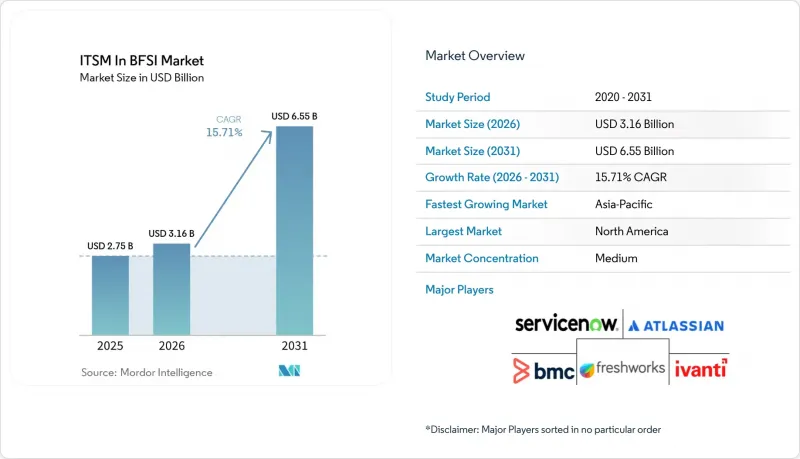
Mordor Intelligence에 의하면, BFSI 분야 ITSM 시장 규모는 2025년에 27억 5,000만 달러로 평가되었습니다. 2026년 31억 6,000만 달러, 2031년 65억 5,000만 달러에 이를 것으로 예측되며, 2026년부터 2031년에 걸쳐 CAGR 15.71%로 성장할 전망입니다.
본 보고서는 구성 요소(솔루션, 서비스), 도입 형태(클라우드, On-Premise, 하이브리드), 용도(서비스 데스크 및 인시던트 관리, 자산 및 구성 관리, 변경 및 릴리스 관리, 서비스 요청 관리 등), 기업 규모(대기업, 중소기업(SME)), 지역별로 분류되어 있습니다. 시장 전망은 금액(달러) 기준으로 제시되어 있습니다.
세계의 BFSI 분야 ITSM 시장 동향 및 인사이트
GenAI를 활용한 인시던트 해결 및 워크플로우 자동화
BFSI 분야 ITSM은 서비스 워크플로우 내에서 생성형 AI로의 명확한 전환으로 인해 혜택을 보고 있으며, 특히 금융 기관이 첫 번째 대응 시 신속한 해결이나 내부 지원 가용성 향상을 추구하는 분야에서 이러한 경향이 두드러집니다. 커먼웰스 은행(Commonwealth Bank)은 2025년, Microsoft Teams를 통해 1,000명 이상의 현장 직원을 대상으로 ChatIT 어시스턴트를 도입했습니다. 이 도구는 기기 및 연결 관련 인시던트를 2분 이내에 해결함으로써, 일상 업무에서 AI가 어떻게 시간이 많이 소요되는 다단계 헬프데스크 라우팅을 대체할 수 있는지를 보여주었습니다. BFSI 분야 ITSM은 AI가 인력 배분을 변화시키는 방식에 의해서도 형성되고 있습니다. 이는 정형화된 티켓 업무가 자동 처리로 전환되는 한편, 인간 팀은 예외 사항 검토, 정책 일관성 확인 및 자동화된 조치의 검증에 더 중점을 두게 되었기 때문입니다. ServiceNow와 Fiserv는 2026년 1월 전략적 제휴를 확대하여, Fiserv는 수천 개의 금융 기관 고객을 지원하는 IT 및 고객 서비스 환경 전반에 금융 서비스 운영 및 ITSM용 Now Assist를 도입했습니다. 2026년 4월에 발표된 동료 심사 연구에 따르면, 대규모 언어 모델과 워크플로 자동화를 결합한 아키텍처가 자율형 IT 서비스 환경에서 인시던트 해결, 변경 관리 및 문제 관리에 있어 기술적으로 실현 가능함이 확인되었습니다. 또한, 금융안정위원회(FSB)는 2026년 6월, 금융 기관에서의 AI 안전 도입은 데이터 품질, 모델 리스크 관리, 그리고 제3자 AI 거버넌스에 달려 있다고 밝혔습니다. 이에 따라 BFSI 분야 ITSM에서 거버넌스 기능은 선택 사항이 아니라 여전히 핵심적인 위치를 유지하고 있습니다.
규제 대상 BFSI 환경에서의 클라우드 네이티브 서비스 관리 도입
BFSI 분야 ITSM에서는 컴플라이언스 팀이 최신 워크플로우, 안정적인 감사 증거, 그리고 로컬 패치 주기에 대한 의존도 감소를 필요로 하고 있기 때문에 클라우드 네이티브 방식의 제공에 대한 수요가 증가하고 있습니다. 유럽은행감독청(EBA)은 DORA가 2025년 1월 17일부터 적용되기 시작했다고 밝혔습니다. 이에 따라 ICT 위험 관리, 인시던트 보고 및 제3자 관련 정보 요건이 유럽 전역의 금융 기관 운영 환경에 직접 통합되었습니다. 이러한 상황에서 BFSI 분야 ITSM에서는 클라우드 플랫폼이 선호되고 있습니다. 이는 관리형 업그레이드를 통해 규제 변경과 워크플로우 변경 간의 시차를 단축하고, 개별 로컬 환경을 유지하는 운영상의 부담을 경감시킬 수 있기 때문입니다. 또한 변경, 인시던트, 규정 준수 기록이 클라우드 플랫폼 내에 저장되면 구매자는 해당 기록의 연속성을 저해할 수 있는 어떠한 움직임에도 신중을 기하게 되므로, 이 요인은 BFSI 분야 ITSM에서 공급업체와의 관계를 장기화하는 데에도 기여하고 있습니다. 그렇다고 해서 이 요인만으로 실행 위험이 사라지는 것은 아닙니다. 이전 과정에는 여전히 엄격한 데이터 정리, 명확한 롤백 계획, 그리고 단일 컷오버 이벤트가 아닌 단계적인 운영 변경이 필수적이기 때문입니다. 그 결과, BFSI 분야 ITSM에서 클라우드 도입은 단순한 호스팅 결정이 아닌, 운영 복원력과 연계된 거버넌스 프로그램으로서 추진되고 있습니다.
레거시 ITSM의 마이그레이션 위험과 프로세스 재구축의 부담
BFSI 분야 ITSM은 패치, 맞춤형 커넥터, 프로세스 우회책 등을 통해 수년에 걸쳐 확장되어 온 레거시 시스템이라는 형태로 여전히 큰 장벽에 직면해 있습니다. 이로 인해 BFSI 분야 ITSM 발전은 지연되고 있습니다. 이는 구매자가 새로운 플랫폼에서 가치를 창출하기 전에 워크플로우 재설계, 서비스 기록 정리, 운영 모델 통합을 수행해야 하는 경우가 많기 때문입니다. 이러한 과제는 은행이나 보험사가 공통된 운영 기준이 아닌 각사의 프로세스상 예외 사항에 기반하여 구축된 구식 On-Premise형 서비스 데스크를 여전히 운영하고 있는 경우 특히 두드러집니다. 금융 기관이 현대화에 본격적으로 착수하더라도, 그 작업은 대개 여러 단계에 걸쳐 진행되며, 대규모 플랫폼 도입 프로그램 이후 이사회나 운영 팀이 기대하는 생산성 향상이 지연되는 경우가 흔합니다. 이러한 제약은 BFSI 분야 ITSM에서 제품 기능의 부족 때문이 아니라, 수년에 걸쳐 축적된 프로세스의 불일치를 해소해야 하는 운영상의 부담에서 기인합니다. 따라서 BFSI 업계에서 ITSM을 성공적으로 도입하기 위해서는 전환 파트너의 활용, 단계적 도입, 그리고 철저한 거버넌스가 여전히 필수적입니다.
부문 분석
2025년, BFSI 분야 ITSM 시장에서 솔루션이 67.30%의 시장 점유율을 차지했습니다. 이는 규제 환경 하에서 금융 기관들이 여전히 단편적인 도구 구매보다 패키지화된 워크플로우의 종합적인 적용 범위를 훨씬 더 선호하고 있음을 보여줍니다. BFSI 분야 ITSM에서 이러한 경향은 금융 기관이 도입 위험을 줄이기를 원할 때, 변경 관리, 디스커버리, CMDB 지원, 규정 준수 보고와 같은 사전 설정된 기능이 지닌 가치를 반영하고 있습니다. 또한, BFSI 분야 ITSM 구매자는 솔루션 주도형 조달을 활용함으로써 팀이 지원, 문서화 및 내부 검토 시 설명 책임을 져야 하는 병행 도구의 수를 줄이고 있습니다. 감사 대상인 금융 기관은 워크플로우, 서비스 기록 및 통제 증거 전반의 일관성을 중시하기 때문에 이를 통해 솔루션 계층의 구조적 견고성이 유지됩니다. 게다가 구매자들은 초기 도입 후 핵심 ITSM에서 인접한 거버넌스 및 운영 모듈로 확장하는 경우가 많기 때문에 대규모 플랫폼 계약 체결도 촉진되고 있습니다.
서비스 시장은 2026년부터 2031년까지 연평균 성장률(CAGR) 15.35%를 나타낼 것으로 예측되며, 소프트웨어가 여전히 큰 수익 기반임에도 불구하고 서비스는 더 빠르게 성장하는 분야가 되고 있습니다. BFSI 분야 ITSM에서 이러한 추세는 일상적인 도입 작업에서 AI 거버넌스, 예외 처리, 운영 모델 설계, 그리고 통제 일관성에 관한 부가가치가 높은 자문 업무로의 전환을 반영하고 있습니다. Freshworks와 Unisys는 2025년 2월, 120개국 이상의 중견 및 대기업 고객을 대상으로 하는 전략적 제휴를 발표했습니다. 이는 소프트웨어 판매와 마찬가지로 서비스 제공을 중심으로 한 채널 체제가 구축되고 있음을 보여줍니다. 따라서 BFSI 분야 ITSM에서는 자동화로 인해 서비스 수요가 감소하지 않을 것입니다. 자동화를 통해 업무가 더욱 세밀하고 전문성이 높은 업무로 전환되기 때문입니다. 실제로 BFSI 분야 ITSM은 금융 기관이 전환 지원, AI 감독, 운영 변경 관리 및 규제 대상 프로세스에 관한 증거 자료 준비를 필요로 하는 한 계속해서 서비스 수익을 창출하고 있습니다.
2025년 시점에서 BFSI 분야 ITSM 시장 규모의 68.10%를 클라우드가 차지했으며, 이는 신규 및 확장되는 도입의 대부분에서 매니지드 딜리버리가 표준 아키텍처로 자리 잡고 있음을 뒷받침합니다. BFSI 분야 ITSM에서 클라우드가 이러한 입지를 확립한 것은 금융 기관들이 보다 신속한 업그레이드, 유연한 용량, 그리고 분산된 팀 전반에 걸친 최신 규정 준수 워크플로우의 손쉬운 배포를 중시하기 때문입니다. 또한, 클라우드는 2031년까지 연평균 성장률(CAGR) 14.90%로 확대될 것으로 예상되며, 이는 주요 도입 모델이 여전히 빠르게 성장하는 분야이며, 성장세가 주춤해지고 있는 성숙한 부문이 아님을 보여줍니다. ServiceNow는 2026년, 분기별 릴리스에 규정 준수 및 PCI 관련 기능을 포함하는 등 금융 서비스 플랫폼의 기능 확충을 지속했습니다. 이는 지연되기 쉬운 On-Premise 패치 적용 주기에 비해 지속적인 제공(Continuous Delivery)의 우위를 부각시키는 것입니다. 이러한 운영 논리는 규제 일정 및 서비스 연속성이 현재의 워크플로우와 제어 템플릿에 의존하는 클라우드 제공에 대한 구매자의 신뢰를 강화하고 있습니다.
BFSI 분야 ITSM에서는 일부 워크로드가 여전히 높은 수준의 데이터 기밀성을 수반하거나, 로컬 관리가 요구되거나, 혹은 여러 관할 구역에 걸친 단계적 현대화 계획이 진행 중인 경우가 있기 때문에 하이브리드 및 On-Premise 모델은 여전히 중요한 위치를 차지하고 있습니다. 이것이 바로 클라우드가 가장 크고 빠르게 성장하고 있음에도 불구하고, BFSI 분야 ITSM이 클라우드 전용 구조로 전환되지 않은 이유입니다. BMC의 BBVA 사례가 보여주듯이, 대규모의 다지역에 걸친 금융 기관이라 하더라도, 분산된 지역 시스템을 단일 운영 모델로 통합하는 과정에서 여전히 단계적인 아키텍처 선택에 의존할 수 있습니다. 많은 금융 기관에서 하이브리드 배포는 데이터, 통합 및 내부 책임 체계가 재편되는 동안 서비스 연속성을 보호하는 전환 경로로서의 역할을 하고 있습니다. BFSI 분야 ITSM이 이러한 혼합 아키텍처를 계속 지원하는 이유는 거버넌스의 성숙도가 지역, 사업 부문, 이용 사례에 따라 다르기 때문입니다. 그 결과, 클라우드는 계속해서 투자의 전략적 중심이 되는 한편, 하이브리드 환경은 기밀성이 높은 프로세스를 보호하고 대규모 전환을 관리 가능한 범위로 제한하고 있습니다.
지역별 분석
2025년, 북미는 BFSI 분야 ITSM 시장 점유율의 40.15%를 차지하며, 지출 및 벤더 활동의 최대 지역 거점으로서의 지위를 유지했습니다. 이 지역이 BFSI 분야 ITSM 시장을 주도하는 이유는 금융 기관들이 구조화된 서비스 관리가 필요한 엄격한 감사, 사이버 보안, 결제 및 운영 감독 요건 하에서 운영되고 있기 때문입니다. 또한, 대규모 플랫폼 프로그램을 광범위하게 지원할 수 있는 주요 은행, 보험사, 결제 처리 업체 및 기술 파트너가 집중되어 있는 점도 이 지역의 강점입니다. 북미 BFSI 분야 ITSM 시장은 성숙한 벤더 생태계에 의해서도 형성되어 있으며, 이를 통해 구매자는 고급 AI 기능과 전문 서비스, 나아가 마이그레이션 및 거버넌스 업무에 이르는 광범위한 파트너 네트워크를 활용할 수 있습니다. 이러한 성숙도는 제품 출시 주기를 가속화하지만, 구매자가 모듈의 폭뿐만 아니라 AI 제어 기능, 플랫폼 간 상호 운용성, 증거의 질까지 비교 검토하기 때문에 벤더 평가의 난이도도 높아지고 있습니다.
아시아태평양은 2031년까지 연평균 성장률(CAGR) 15.30%를 나타낼 것으로 예측되며, BFSI 분야 ITSM 분야에서 가장 두드러진 성장을 보일 지역 부문이 될 전망입니다. 아시아태평양 전체 BFSI 분야 ITSM 성장은 선진 금융 센터의 현대화 프로그램과 급속히 디지털화되는 은행 시스템에 1세대 구조화된 서비스 관리가 도입됨에 따라 뒷받침되고 있습니다. 일본이 두드러지는 이유는 각 기관이 워크플로우 현대화를 실무 성과로 연결하고 있기 때문입니다. SMBC Nikko Securities는 2026년 4월, OutSystems 도입을 통해 용도 구축 시간을 최대 50% 단축하고, 사내 개발자 수를 5명에서 20명으로 확대했다고 보고했습니다. 또한 BFSI 분야 ITSM은 기업 AI 거버넌스 활동 강화를 통해 지역적으로도 확산되고 있습니다. 그 예로, 미즈호 파이낸셜 그룹(Mizuho Financial Group)이 2026년에 접근 제어 및 완벽한 감사 로그 기능을 갖춘 Dify 환경을 전사적으로 도입한 것을 들 수 있습니다. 이러한 사례들은 이 지역에서 워크플로우의 디지털화, 내부 거버넌스, 그리고 확장 가능한 서비스 설계가 별개의 단계가 아닌 하나로 통합되어 진행되고 있음을 보여줍니다.
유럽은 BFSI 분야 ITSM 분야에서 지역별 2위의 규모를 차지하고 있으며, DORA는 여전히 그 수요 패턴을 주도하는 가장 명확한 단일 요인으로 남아 있습니다. 유럽은행감독청(EBA)이 발표한 DORA 준비 및 보고 의무에 관한 지침은 금융 기관이 조직 전체에 걸쳐 ICT 위험, 사고 및 제3자 관련 기록을 일관되게 유지해야 할 필요성을 더욱 강조하고 있습니다. 따라서 유럽 BFSI 분야 ITSM에서는 감사에 대응할 수 있는 워크플로우, 변경 사항의 추적 가능성, 그리고 플랫폼 수준에서의 증거 생성이 중시되고 있습니다. 주요 지역 이외에도 남미, 중동 및 아프리카 및 아시아태평양의 소규모 경제권에서도 디지털 뱅킹의 확대와 공식적인 복원력에 대한 기대가 지속적으로 높아지고 있어, BFSI 분야 ITSM에서 점유율은 낮지만 여전히 의미 있는 기회가 존재합니다.
기타 혜택 :
- 엑셀 형식 시장 예측(ME) 시트
- 3개월간의 애널리스트 지원
자주 묻는 질문
목차
제1장 서론
제2장 조사 방법
제3장 주요 요약
제4장 시장 구도
제5장 시장 규모 및 성장 예측
제6장 경쟁 구도
제7장 시장 기회 및 향후 전망
KTH 26.08.10According to Mordor Intelligence, the ITSM in BFSI market size is projected to be USD 2.75 billion in 2025, USD 3.16 billion in 2026, and reach USD 6.55 billion by 2031, growing at a CAGR of 15.71% from 2026 to 2031.
This report is Segmented by Component (Solutions and Services), Deployment (Cloud, On-Premise, and Hybrid), Application (Service Desk and Incident Management, Asset and Configuration Management, Change and Release Management, Service Request Management, and More), Enterprise Size (Large Enterprises and Small and Mid-Size Enterprises (SME)), and Geography. The Market Forecasts are Provided in Terms of Value (USD).
Global ITSM In BFSI Market Trends and Insights
GenAI-Enabled Incident Resolution and Workflow Automation
The ITSM in the BFSI market is benefiting from a clear shift toward generative AI inside service workflows, especially where financial institutions want faster first-contact resolution and better internal support availability. Commonwealth Bank deployed its ChatIT assistant in 2025 through Microsoft Teams for more than 1,000 frontline employees, and the tool resolved device and connectivity incidents within 2 minutes, which showed how AI could replace slower multi-step helpdesk routing in daily operations. The ITSM in the BFSI market is also being shaped by the way AI changes labor allocation, because routine ticket work is moving toward automated handling while human teams focus more on exception review, policy alignment, and validation of automated actions. ServiceNow and Fiserv expanded their strategic commitment in January 2026, with Fiserv deploying Now Assist for Financial Services Operations and ITSM across IT and customer service environments that support thousands of financial institution clients. A peer-reviewed study published in April 2026 confirmed that architectures combining large language models with workflow automation are technically viable for incident resolution, change management, and problem management in autonomous IT service environments. The Financial Stability Board also stated in June 2026 that safe AI adoption in financial institutions depends on data quality, model risk management, and third-party AI governance, which keeps governance capability central to the ITSM in BFSI market rather than optional.
Cloud-Native Service Management Adoption in Regulated BFSI Environments
The ITSM in BFSI market is seeing stronger demand for cloud-native delivery because compliance teams need current workflows, stable audit evidence, and less dependence on local patch cycles. The European Banking Authority noted that DORA became applicable from January 17, 2025, which placed ICT risk management, incident reporting, and third-party information requirements directly into the operating environment of financial entities across Europe. In that setting, the ITSM in BFSI market favors cloud platforms because managed upgrades shorten the lag between regulatory change and workflow change, and they reduce the operational burden of maintaining separate local installations. This driver is also supporting longer vendor relationships in the ITSM in BFSI market, because once change, incident, and compliance records sit inside a cloud platform, buyers become cautious about any move that could interrupt continuity of those records. The same driver does not remove execution risk, because migration still depends on disciplined data cleanup, clear rollback planning, and staged operating changes rather than a single cutover event. As a result, cloud adoption in the ITSM in BFSI market is moving ahead as a governance program tied to operational resilience, not just as a hosting decision.
Legacy ITSM Migration Risk and Process Reengineering Burden
The ITSM in BFSI market still faces a major barrier in the form of legacy estates that were extended for years through patches, custom connectors, and process workarounds. This slows the ITSM in BFSI market because buyers often need to redesign workflows, clean service records, and align operating models before they can gain value from a new platform. The challenge is strongest where banks and insurers still run older on-premise service desks that were built around local process exceptions rather than common operating standards. Even when institutions commit to modernization, the work often stretches over multiple phases and delays the productivity gains that boards and operating teams expect after a large platform program. The restraint is not about a lack of product functionality in the ITSM in BFSI market, but about the operational burden of untangling years of accumulated process variance. That is why migration partners, phased delivery, and governance discipline remain critical to successful adoption in the ITSM in BFSI market.
Other drivers and restraints analyzed in the detailed report include:
- Audit-Ready Change, Risk, and Compliance Workflows
- FinOps and Service Cost Governance Inside ITSM
- Data Residency, Privacy, and Model-Governance Constraints
For complete list of drivers and restraints, kindly check the Table Of Contents.
Segment Analysis
Solutions accounted for 67.30% of the ITSM in BFSI market share in 2025, which shows how strongly institutions still prefer packaged workflow coverage over fragmented tool buying in regulated environments. Within the ITSM in BFSI market, that preference reflects the value of preconfigured capabilities such as change management, discovery, CMDB support, and compliance reporting when institutions want lower deployment risk. Buyers in the ITSM in BFSI market also use solution-led procurement to reduce the number of parallel tools that teams must support, document, and defend during internal review. This keeps the solutions layer structurally strong because audited institutions place a premium on consistency across workflows, service records, and control evidence. It also supports larger platform contracts because buyers often expand from core ITSM into adjacent governance and operations modules after initial adoption.
Services are projected to grow at a 15.35% CAGR from 2026 to 2031, which makes them the faster-moving component even as software remains the larger revenue base. In the ITSM in BFSI market, this pattern reflects the shift from routine implementation work toward higher-value advisory activity around AI governance, exception handling, operating model design, and control alignment. Freshworks and Unisys announced a strategic partnership in February 2025 to target mid-market and large enterprise customers in more than 120 countries, which showed how channel capacity is being built around service delivery as much as around software sales. The ITSM in BFSI industry is therefore not seeing automation remove services demand, because automation shifts the work toward more sensitive and more specialized tasks. In practice, the ITSM in BFSI market keeps generating services revenue wherever institutions need migration support, AI oversight, operating change management, and evidence preparation for regulated processes.
Cloud held 68.10% of the ITSM in BFSI market size in 2025, which confirms that managed delivery has become the default architecture for a large part of new and expanding implementations. In the ITSM in BFSI market, cloud has gained this position because institutions value faster upgrades, elastic capacity, and easier rollout of updated compliance workflows across distributed teams. Cloud is also projected to expand at a 14.90% CAGR through 2031, which shows that the leading deployment model is still the faster-growing one rather than a mature segment losing momentum. ServiceNow continued to widen its financial services platform capabilities in 2026, including compliance and PCI-related features in its quarterly releases, which highlights the advantage of continuous delivery over slower local patching cycles. That operating logic strengthens buyer confidence in cloud delivery, where regulatory timetables and service continuity depend on current workflows and current control templates.
Hybrid and on-premise models remain relevant in the ITSM in BFSI market because some workloads still involve higher data sensitivity, local control expectations, or staged modernization plans across multiple jurisdictions. This is why the ITSM in BFSI market has not shifted into a cloud-only structure even though cloud has the largest and fastest-growing position. BMC's BBVA example showed that a large multi-region institution can still rely on phased architecture choices while it consolidates fragmented regional systems into a single operating model. In many institutions, hybrid deployment acts as a transition path that protects service continuity while data, integrations, and internal responsibilities are reorganized. The ITSM in BFSI industry continues to support these mixed architectures because governance maturity differs across geographies, business units, and use cases. As a result, cloud remains the strategic center of spending, while hybrid environments protect sensitive processes and keep large migrations manageable.
Complete Report Scope:
- By Component
- Solutions
- Services
- By Deployment
- Cloud
- On-premise
- Hybrid
- By Application
- Service Desk and Incident Management
- Asset and Configuration Management
- Change and Release Management
- Service Request Management
- Knowledge Management
- Other Applications
- By Enterprise Size
- Large Enterprises
- Small and Mid-size Enterprises (SME)
- By Geography
- North America
- United States
- Canada
- Mexico
- South America
- Brazil
- Argentina
- Rest of South America
- Europe
- Germany
- United Kingdom
- France
- Russia
- Spain
- Rest of Europe
- Asia-Pacific
- China
- Japan
- India
- South Korea
- Southeast Asia
- Rest of Asia-Pacific
- Middle East and Africa
- Middle East
- Saudi Arabia
- United Arab Emirates
- Turkey
- Rest of Middle East
- Africa
- South Africa
- Nigeria
- Egypt
- Rest of Africa
- Middle East
- North America
Geography Analysis
North America held 40.15% of the ITSM in BFSI market share in 2025, which kept it as the largest regional base for spending and vendor activity. The region leads the ITSM in BFSI market because financial institutions operate under strong audit, cyber, payment, and operational oversight requirements that all favor structured service management. It also benefits from a deep concentration of large banks, insurers, processors, and technology partners that can support complex platform programs at scale. The ITSM in BFSI market in North America is also shaped by a mature vendor ecosystem, which gives buyers access to advanced AI features, specialist services, and wider partner coverage across migration and governance work. That maturity raises product velocity, but it also makes vendor evaluation more demanding because buyers compare not only module breadth but also AI control, platform interoperability, and evidence quality.
Asia-Pacific is projected to grow at a 15.30% CAGR through 2031, making it the fastest-growing regional segment in the ITSM in BFSI market. Growth in the ITSM in BFSI market across Asia-Pacific is being supported by modernization programs in developed financial centers and by first-generation structured service management buying in fast-digitizing banking systems. Japan stands out because institutions are tying workflow modernization to practical delivery gains, and SMBC Nikko Securities reported in April 2026 that its use of OutSystems reduced application build time by up to 50% and expanded its internal developer base from 5 to 20 members. The ITSM in BFSI market is also gaining regional depth through stronger enterprise AI governance activity, including Mizuho Financial Group's 2026 enterprise rollout of its Dify environment with controlled access and full audit logging. These examples show a region where workflow digitization, internal governance, and scalable service design are moving together rather than in separate phases.
Europe held the second-largest regional position in the ITSM in BFSI market, and DORA remains the clearest single catalyst for that demand pattern. The European Banking Authority's guidance around DORA preparation and reporting obligations has reinforced the need for financial institutions to maintain consistent ICT risk, incident, and third-party records across operating entities. The ITSM in BFSI market in Europe therefore places high value on audit-ready workflows, change traceability, and platform-level evidence generation. Outside the largest regions, South America, the Middle East and Africa, and smaller Asia-Pacific economies still represent lower-share but meaningful opportunity in the ITSM in BFSI market as digital banking expansion and formal resilience expectations continue to rise.
- ServiceNow Inc.
- BMC Software, Inc.
- Atlassian Corporation Plc
- Ivanti, Inc.
- Freshworks Inc.
- OpenText Corporation
- IBM Corporation
- Broadcom Inc.
- ManageEngine (Zoho Corporation Pvt. Ltd.)
- SolarWinds Corporation
- EasyVista, Inc.
- SysAid Technologies Ltd.
- TOPdesk BV
- 4me, Inc.
- Hornbill Service Management Ltd.
- Efecte Plc
- NinjaOne, LLC
- Aisera, Inc.
- Halo Service Solutions Ltd.
- InvGate S.R.L.
Additional Benefits:
- The market estimate (ME) sheet in Excel format
- 3 months of analyst support
TABLE OF CONTENTS
1 INTRODUCTION
- 1.1 Study Assumptions and Market Definition
- 1.2 Scope of the Study
2 RESEARCH METHODOLOGY
3 EXECUTIVE SUMMARY
4 MARKET LANDSCAPE
- 4.1 Market Overview
- 4.2 Market Drivers
- 4.2.1 Cloud-Native Service Management Adoption in Regulated BFSI Environments
- 4.2.2 GenAI-Enabled Incident Resolution and Workflow Automation
- 4.2.3 FinOps and Service Cost Governance Inside ITSM
- 4.2.4 Audit-Ready Change, Risk, and Compliance Workflows
- 4.2.5 Hybrid Workforce Service Delivery Expectations in Banks and Insurers
- 4.2.6 Low-Code Enterprise Service Management Expansion Beyond IT
- 4.3 Market Restraints
- 4.3.1 Legacy ITSM Migration Risk and Process Reengineering Burden
- 4.3.2 Data Residency, Privacy, and Model-Governance Constraints
- 4.3.3 High Integration Complexity Across Core Banking and Security Stacks
- 4.3.4 Change Fatigue From Tool Sprawl and User Adoption Resistance
- 4.4 Industry Value Chain Analysis
- 4.5 Regulatory Landscape
- 4.6 Technological Outlook
- 4.7 Porter's Five Forces Analysis
- 4.7.1 Bargaining Power of Suppliers
- 4.7.2 Bargaining Power of Buyers
- 4.7.3 Threat of New Entrants
- 4.7.4 Threat of Substitutes
- 4.7.5 Intensity of Competitive Rivalry
- 4.8 Impact of Macroeconomic Factors on the Market
5 MARKET SIZE AND GROWTH FORECASTS (VALUES)
- 5.1 By Component
- 5.1.1 Solutions
- 5.1.2 Services
- 5.2 By Deployment
- 5.2.1 Cloud
- 5.2.2 On-premise
- 5.2.3 Hybrid
- 5.3 By Application
- 5.3.1 Service Desk and Incident Management
- 5.3.2 Asset and Configuration Management
- 5.3.3 Change and Release Management
- 5.3.4 Service Request Management
- 5.3.5 Knowledge Management
- 5.3.6 Other Applications
- 5.4 By Enterprise Size
- 5.4.1 Large Enterprises
- 5.4.2 Small and Mid-size Enterprises (SME)
- 5.5 By Geography
- 5.5.1 North America
- 5.5.1.1 United States
- 5.5.1.2 Canada
- 5.5.1.3 Mexico
- 5.5.2 South America
- 5.5.2.1 Brazil
- 5.5.2.2 Argentina
- 5.5.2.3 Rest of South America
- 5.5.3 Europe
- 5.5.3.1 Germany
- 5.5.3.2 United Kingdom
- 5.5.3.3 France
- 5.5.3.4 Russia
- 5.5.3.5 Spain
- 5.5.3.6 Rest of Europe
- 5.5.4 Asia-Pacific
- 5.5.4.1 China
- 5.5.4.2 Japan
- 5.5.4.3 India
- 5.5.4.4 South Korea
- 5.5.4.5 Southeast Asia
- 5.5.4.6 Rest of Asia-Pacific
- 5.5.5 Middle East and Africa
- 5.5.5.1 Middle East
- 5.5.5.1.1 Saudi Arabia
- 5.5.5.1.2 United Arab Emirates
- 5.5.5.1.3 Turkey
- 5.5.5.1.4 Rest of Middle East
- 5.5.5.2 Africa
- 5.5.5.2.1 South Africa
- 5.5.5.2.2 Nigeria
- 5.5.5.2.3 Egypt
- 5.5.5.2.4 Rest of Africa
- 5.5.5.1 Middle East
- 5.5.1 North America
6 COMPETITIVE LANDSCAPE
- 6.1 Market Concentration
- 6.2 Strategic Moves
- 6.3 Market Share Analysis
- 6.4 Company Profiles (includes Global Level Overview, Market Level Overview, Core Segments, Financials as available, Strategic Information, Market Rank/Share, Products and Services, Recent Developments)
- 6.4.1 ServiceNow Inc.
- 6.4.2 BMC Software, Inc.
- 6.4.3 Atlassian Corporation Plc
- 6.4.4 Ivanti, Inc.
- 6.4.5 Freshworks Inc.
- 6.4.6 OpenText Corporation
- 6.4.7 IBM Corporation
- 6.4.8 Broadcom Inc.
- 6.4.9 ManageEngine (Zoho Corporation Pvt. Ltd.)
- 6.4.10 SolarWinds Corporation
- 6.4.11 EasyVista, Inc.
- 6.4.12 SysAid Technologies Ltd.
- 6.4.13 TOPdesk BV
- 6.4.14 4me, Inc.
- 6.4.15 Hornbill Service Management Ltd.
- 6.4.16 Efecte Plc
- 6.4.17 NinjaOne, LLC
- 6.4.18 Aisera, Inc.
- 6.4.19 Halo Service Solutions Ltd.
- 6.4.20 InvGate S.R.L.
7 MARKET OPPORTUNITIES AND FUTURE OUTLOOK
- 7.1 White-Space and Unmet-Need Assessment


