

|
시장보고서
상품코드
2099462
북미의 고객 여정 분석 : 시장 점유율 분석, 업계 동향 및 통계, 성장 예측(2026-2031년)North America Customer Journey Analytics - Market Share Analysis, Industry Trends & Statistics, Growth Forecasts (2026 - 2031) |
||||||
 Mordor Intelligence
Mordor Intelligence에 의하면, 북미의 고객 여정 분석 시장 규모는 2025년 73억 5,000만 달러로 평가되었습니다. 2026년 88억 달러에서 2031년까지 215억 6,000만 달러로 확대되고 2026년부터 2031년까지 연평균 복합 성장률(CAGR)은 19.64%를 나타낼 전망입니다.
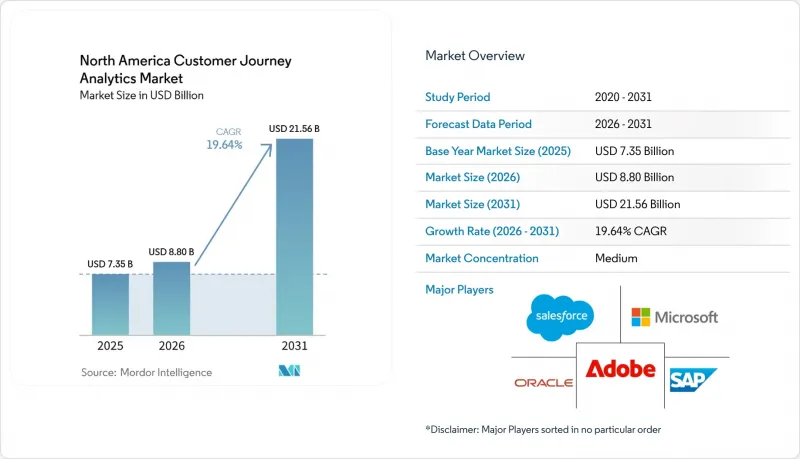
본 보고서는 구성 요소(솔루션 및 서비스), 배포 방식(클라우드, On-Premise, 하이브리드), 용도(캠페인 및 고객 여정 오케스트레이션 등), 기업 규모(대기업, 중소기업), 최종 사용자 산업(미디어 및 엔터테인먼트 등), 그리고 지역별로 분류되어 있습니다. 시장 전망은 금액(달러) 기준으로 제시되어 있습니다.
북미의 고객 여정 분석 시장 동향 및 인사이트
AI를 활용한 여정 인사이트의 가속화
에이전트형 AI 덕분에 북미의 고객 여정 분석 시장은 실행 중심 단계로 전환되고 있습니다. 이는 기업들이 플랫폼에 대해 단순히 무슨 일이 일어났는지를 설명하는 것뿐만 아니라, 조치를 권장하고 실행하기를 기대하게 되었기 때문입니다. 이러한 변화가 중요한 이유는 여정 데이터가 더 이상 캠페인이나 서비스 이벤트 종료 후에만 활용되는 것이 아니라, 구매자들이 상호작용이 진행 중인 단계에서 반응할 수 있는 시스템을 점점 더 요구하고 있기 때문입니다. 어도비는 ‘Customer Journey Analytics B2B Edition’을 출시하여 여정 인텔리전스의 역할을 보다 광범위한 경험 워크플로우로 확장함으로써 이러한 변화를 더욱 명확히 했습니다. 이를 통해 분석이 계정 수준 및 이해관계자 수준의 의사결정과 더욱 밀접하게 연결되어 있음을 보여주었습니다. 세일즈포스도 ‘Agentforce 3’를 출시하며 자율적인 문제 해결, 가시성, 그리고 더 광범위한 언어 지원을 강조함으로써 유사한 방향성을 강화했습니다. 이 모든 것은 고객 여정이 인간의 개입으로 인한 지연을 최소화하며 해석되고 대응된다는 것을 시사합니다. 북미의 고객 여정 분석 시장의 실질적인 영향으로는 AI를 활용한 각 상호작용을 통해 더 많은 행동 데이터가 생성됨에 따라, 결과적으로 채널 전반에 걸쳐 신호를 정리하고 관리할 수 있는 플랫폼의 가치가 높아지고 있습니다. 시간이 지남에 따라 경쟁의 초점은 단순한 대시보드의 폭이 아니라 모델의 품질, 오케스트레이션 속도, 거버넌스의 심도로 이동하고 있습니다.
통합된 고객 가시성에 대한 수요 증가
북미의 고객 여정 분석 시장이 확대되고 있는 또 다른 이유는 많은 기업이 여전히 웹사이트, 모바일 앱, 상거래 시스템, 컨택 센터 및 오프라인 거래에 걸친 고객 행동을 하나의 실용적인 뷰로 통합하는 데 어려움을 겪고 있기 때문입니다. AI 기반 추천은 그 기반이 되는 ID 데이터나 이벤트 데이터의 품질과 지속성에 좌우되기 때문에 이 문제를 무시하기 어렵습니다. 어도비는 2025년 6월, 이 과제를 해결하기 위해 ‘고객 여정 분석 B2B 에디션’을 발표했습니다. 이 솔루션은 계정 수준, 구매 그룹 수준 및 영업 기회 수준의 분석 기능을 갖추고 있어, 소비자 여정에 그치지 않고 복잡한 기업 구매 환경에서도 통합된 가시성을 제공합니다. NICE 역시 Salesforce Data Cloud와의 통합을 강화함으로써 이러한 방향으로 나아갔습니다. 제로 카피 액세스를 통해 시스템 간 레코드 복제 필요성이 줄어들어, 조직은 추가적인 데이터 마이그레이션이나 대조 과정을 거치지 않고도 연동된 데이터를 활용할 수 있게 됩니다. 따라서 통합된 가시성에 대한 필요성은 단순한 보고서 작성상의 선호도가 아니라, 일관된 개인화, 고객 유지 워크플로우, 그리고 부서 간 고객 책임 체계를 추구하는 기업에게 있어 기본적인 운영 요건으로 자리 잡고 있습니다. 이러한 요구 사항이 확산됨에 따라, 북미의 고객 여정 분석 시장에서는 단일 기능 내에 고립되지 않고 여러 데이터 환경을 아우를 수 있는 벤더가 지지를 얻고 있습니다.
레거시 데이터 스택과의 고도화된 통합의 복잡성
통합은 북미의 고객 여정 분석 시장에서 여전히 가장 뿌리 깊은 운영상의 제약으로 남아 있습니다. 그 이유는 많은 구매자가 여러 기술 주기에 걸쳐 구축된, 서로 연동되지 않는 CRM, ERP, 커머스, 서비스, 컨택 센터 환경을 여전히 관리하고 있기 때문입니다. 이 과제는 기술적인 측면에만 국한되지 않습니다. 각 시스템에는 고유한 소유권 규칙, 맞춤형 워크플로우, 고객 레코드 정의가 존재하는 경우가 많기 때문입니다. NICE는 2025년 8월, 이 과제에 대응하기 위해 Salesforce Service Cloud 및 Data Cloud와의 연동을 확대했습니다. 여기에는 제로 카피 양방향 액세스도 포함되어 있어, 도입 지연 및 데이터 마이그레이션 중복이라는 주요 원인 중 하나를 직접 해결했습니다. 커넥터의 성능이 향상되었음에도 불구하고, 많은 조직에서는 고객 여정 분석이 운영 측면에서 신뢰할 수 있게 되기까지 긴 도입 기간이 필요하며, 이는 전담 엔지니어링 팀을 보유하지 않은 중견 기업의 도입을 지연시키고 있습니다. 이것이 북미의 고객 여정 분석 시장에 미치는 영향으로, 조달 담당자들은 기능 목록의 폭보다는 탄탄한 서비스, 검증된 커넥터 라이브러리, 명확한 마이그레이션 경로를 갖춘 벤더를 우선시하는 경향이 있습니다. 또한, 초기 도입 후 운영을 시작한 후에도 지속적인 통합 지원이 필요한 경우가 많기 때문에 솔루션보다 서비스 분야의 성장이 빠른 것도 이러한 이유 때문입니다.
부문 분석
2025년에는 솔루션이 매출의 70.15%를 차지하며, 소프트웨어 플랫폼이 북미 고객 여정 분석 시장의 중심적인 위치를 계속 차지했습니다. 고객 여정 분석에는 이벤트 수집, 신원 확인, 시각화, 오케스트레이션, 거버넌스가 필요하지만, 사내 팀이 이를 신속하게 구축하거나 동등한 규모로 유지하는 경우는 드물기 때문에 기업들은 여전히 전용 시스템을 선호합니다. 이러한 경향은 일시적인 것이 아니라 구조적인 것입니다. 대부분의 구매자는 여러 부서에 걸쳐 독자적인 스택을 구축하고 지원하는 것보다 검증된 운영 환경을 선호하기 때문입니다. 또한, 솔루션은 대규모 조직의 조달 프로세스 특성에서도 혜택을 받고 있습니다. 이러한 조직에서는 분석의 유연성과 마찬가지로 표준화 및 공급업체의 책임이 중시되기 때문입니다. 이 때문에 도입 요구 사항이 더욱 복잡해지더라도 북미의 고객 여정 분석 시장은 플랫폼에 대한 지출을 기반으로 계속 성장해 왔습니다.
한편, 서비스 시장은 2031년까지 연평균 성장률(CAGR) 22.59%로 확대될 것으로 예측되며, 가장 빠르게 성장하는 부문이 될 전망입니다. 서비스 분야의 성장은 단순한 설정 작업을 넘어서는 것을 반영합니다. 현재 많은 도입 사례에서 운영 개시 후의 관리형 최적화, 통합 지원, 여정 설계, 거버넌스 조정 및 변경 관리가 요구되고 있기 때문입니다. Pegasystems는 2026년 6월 ‘Customer Engagement Studio’를 출시하여, AI 제공을 거버넌스가 적용된 워크플로우 및 성과와 더욱 밀접하게 연계함으로써 이러한 방향성을 강화했습니다. 이는 가치가 단순한 라이선스 접근 권한뿐만 아니라 실행 지원과 점점 더 밀접하게 연결되는 모델을 뒷받침하는 것입니다. 고객 여정 분석 업계에서 이러한 변화는 플랫폼이 일상 업무의 일부가 된 후, 강력한 전문 서비스 및 관리형 서비스를 보유한 벤더일수록 고객 계정을 더 확실하게 유지할 수 있음을 의미합니다. 또한 북미의 고객 여정 분석 시장에서 소프트웨어, 도입 깊이, 그리고 측정 가능한 비즈니스 성과를 단일 관계 내에서 결합할 수 있는 벤더가 높이 평가받는 이유도 여기에 설명되어 있습니다.
2025년 시점에서 북미의 고객 여정 분석 시장에서 클라우드가 차지하는 비중은 65.29%에 달하며, 2031년까지 연평균 성장률(CAGR) 22.09%로 가장 빠른 성장을 기록할 것으로 예측됩니다. 이러한 조합이 중요한 이유는 전환이 여전히 진행 중이며, 클라우드가 성숙기에 접어들어 성장이 자연스럽게 둔화되는 단계에는 아직 도달하지 않았음을 보여주기 때문입니다. 구매자들이 계속해서 클라우드를 선택하는 이유는 인프라 관리 부담을 줄이고, 기능 제공을 가속화하며, AI 기반 분석의 탄력적인 컴퓨팅 요구 사항을 충족할 수 있기 때문입니다. 또한 On-Premise 인프라의 업그레이드를 기다릴 필요 없이 새로운 신호 유형을 추가하거나 새로운 채널을 지원하기 쉽게 해줍니다. 따라서 북미의 고객 여정 분석 시장에서는 클라우드를 단순한 호스팅 모델이 아닌, 더 신속한 실험과 더 광범위한 여정 가시화를 실현하기 위한 기반 아키텍처로 계속해서 인식하고 있습니다.
Contentsquare는 2026년 3월, 이러한 추세를 반영하여 클라우드 네이티브 접근 방식을 통해 신호 수집 대상을 웹사이트, 모바일 앱, AI 어시스턴트, 지원 대화로 확대했습니다. 이는 채널 확장이 표준화되어 가는 가운데, 클라우드 플랫폼이 큰 도입 마찰 없이 새로운 데이터 유형을 통합하는 데 더 적합하기 때문에 중요한 의미를 지닙니다. On-Premise 모델은 기밀 데이터나 내부 심사 프로세스에 대한 관리를 조직이 더 엄격하게 수행할 수 있는 의료 및 금융 서비스 분야에서 여전히 그 가치를 유지하고 있습니다. 또한, 분석 및 오케스트레이션의 유연성을 추구하면서도 특정 데이터 세트를 관리된 사내 환경에 보관하고자 하는 대기업에게도 하이브리드 구성은 여전히 유효합니다. 고객 여정 분석 업계에서 이러한 대안들은 여전히 역할을 하고 있지만, 북미의 고객 여정 분석 시장은 분명히 ‘클라우드 우선’ 구매 패턴으로 전환되고 있습니다. 그 이유는 AI 주도형 새로운 이용 사례의 대부분이 확장성이 더 뛰어난 환경에서 더 효과적으로 작동하기 때문입니다.
기타 혜택 :
- 엑셀 형식 시장 예측(ME) 시트
- 3개월간의 애널리스트 지원
자주 묻는 질문
목차
제1장 서론
제2장 조사 방법
제3장 주요 요약
제4장 시장 구도
제5장 시장 규모 및 성장 예측
제6장 경쟁 구도
제7장 시장 기회 및 향후 전망
KTH 26.08.10According to Mordor Intelligence, the North America customer journey analytics market size is projected to expand from USD 7.35 billion in 2025 and USD 8.80 billion in 2026 to USD 21.56 billion by 2031, registering a CAGR of 19.64% between 2026 and 2031.
This report is Segmented by Component (Solutions, and Services), Deployment Mode (Cloud, On-Premises, and Hybrid), Application (Campaign and Journey Orchestration, and More), End-User Enterprise Size (Large Enterprises, and Small and Mid-Size Enterprises), End-User Industry (Media and Entertainment, and More), and Geography. The Market Forecasts are Provided in Terms of Value (USD).
North America Customer Journey Analytics Market Trends and Insights
Acceleration of AI-Driven Journey Insights
Agentic AI is pushing the North America customer journey analytics market into a more execution-focused phase, because enterprises now expect platforms to recommend and trigger actions rather than only explain what happened. That change matters because journey data is no longer being used only after a campaign or service event ends, and buyers increasingly want systems that can react while the interaction is still active. Adobe made this shift more visible when it launched the Customer Journey Analytics B2B Edition and expanded the role of journey intelligence across broader experience workflows, demonstrating how analytics is being tied more closely to account- and stakeholder-level decisioning. Salesforce reinforced the same direction when it launched Agentforce 3 and highlighted autonomous resolution, observability, and broader language support, all of which point to customer journeys being interpreted and acted on with less human delay. The practical effect on the North America customer journey analytics market is that each AI-assisted interaction generates more behavioral data, thereby increasing the value of platforms that can organize and govern signals across channels. Over time, this is moving competition toward model quality, orchestration speed, and governance depth, rather than simple dashboard breadth.
Rising Demand for Unified Customer Visibility
The North America customer journey analytics market is also expanding because many enterprises still struggle to connect customer behavior across websites, mobile apps, commerce systems, contact centers, and offline transactions into one usable view. That problem has become harder to ignore because AI-driven recommendations are only as strong as the quality and continuity of the underlying identity and event data. Adobe addressed this issue in June 2025 when it introduced the Customer Journey Analytics B2B Edition, with account-level, buying group-level, and opportunity-level analysis, extending unified visibility into complex enterprise buying environments beyond consumer journeys. NICE also moved in this direction by tightening integration with Salesforce Data Cloud, as zero-copy access reduces the need to duplicate records across systems and helps organizations work with connected data without adding another layer of movement and reconciliation. The need for unified visibility is therefore not a reporting preference; it is becoming a basic operating requirement for enterprises that want consistent personalization, retention workflows, and cross-functional customer accountability. As that requirement spreads, the North America customer journey analytics market is favoring vendors that can span multiple data environments rather than remain isolated within a single function.
High Integration Complexity with Legacy Data Stacks
Integration remains the most stubborn operating restraint in the North America customer journey analytics market because many buyers still manage disconnected CRM, ERP, commerce, service, and contact center environments built over several technology cycles. The challenge is not only technical, as each system often has its own ownership rules, custom workflows, and definitions of the customer record. NICE responded to this issue in August 2025 by expanding integration with Salesforce Service Cloud and Data Cloud, including zero-copy bidirectional access, which directly addressed one of the biggest causes of deployment delay and duplicated data movement. Even with better connectors, many organizations still need long implementation windows before journey analytics becomes operationally reliable, and this slows adoption among mid-sized companies that lack dedicated engineering teams. The effect on the North America customer journey analytics market is that procurement often favors vendors with stronger services, proven connector libraries, and clearer migration paths rather than the broadest feature list. This is also why services are growing faster than solutions, because buyers frequently need ongoing integration support after the initial deployment goes live.
Other drivers and restraints analyzed in the detailed report include:
- Omnichannel Experience Personalization Requirements
- Real-Time Churn Reduction and Retention Prioritization
- Privacy and Consent Management Constraints
For complete list of drivers and restraints, kindly check the Table Of Contents.
Segment Analysis
Solutions accounted for 70.15% of revenue in 2025, keeping software platforms at the center of the North America customer journey analytics market. Enterprises still preferred purpose-built systems because journey analytics requires event collection, identity stitching, visualization, orchestration, and governance, in a form that internal teams rarely build quickly or maintain at a comparable scale. That preference is structural rather than temporary, because most buyers prefer a tested operating environment rather than creating and supporting their own stack across multiple departments. Solutions also benefit from the way procurement works in larger organizations, where standardization and vendor accountability matter as much as analytical flexibility. This kept the North America customer journey analytics market anchored in platform spending, even as implementation needs became more complex.
Services, however, are projected to expand at a 22.59% CAGR through 2031, making them the fastest-growing segment. Growth in services reflects more than setup work, because many deployments now require managed optimization, integration support, journey design, governance tuning, and change management after launch. Pegasystems strengthened this direction in June 2026 when it introduced Customer Engagement Studio and linked AI delivery more closely to governed workflows and outcomes, which supports a model in which value is increasingly tied to execution support rather than only license access. In the customer journey analytics industry, that shift means vendors with strong professional and managed services can better protect accounts once the platform becomes part of daily operations. It also explains why the North America customer journey analytics market is rewarding vendors that can combine software, implementation depth, and measurable business outcomes in a single relationship.
Cloud accounted for 65.29% of the North America customer journey analytics market in 2025 and is also projected to post the fastest growth at a 22.09% CAGR through 2031. This combination is important because it shows that migration is still underway and that the cloud has not yet reached a point where growth naturally tapers off due to maturity. Buyers continue to choose the cloud because it reduces infrastructure management, enables faster feature delivery, and meets the elastic computing needs of AI-driven analytics. It also makes it easier to add new signal types and support new channels without waiting for local infrastructure upgrades. The North America customer journey analytics market, therefore, continues to treat cloud not simply as a hosting model, but as the base architecture for faster experimentation and broader journey visibility.
Contentsquare reflected this pattern in March 2026, expanding signal ingestion to websites, mobile apps, AI assistants, and support conversations via a cloud-native approach. That matters because channel expansion is becoming the norm, and cloud platforms are better positioned to absorb new data types without significant deployment friction. On-premises models still retain value in healthcare and financial services, where organizations can maintain greater control over sensitive data and internal review processes. Hybrid setups also remain relevant for large enterprises that want the flexibility of analytics and orchestration while keeping selected datasets in controlled internal environments. In the customer journey analytics industry, these alternatives keep a role, but the North America customer journey analytics market is clearly moving toward cloud-first buying patterns because most new AI-led use cases work better in more scalable environments.
Complete Report Scope:
- By Component
- Solutions
- Services
- By Deployment Mode
- Cloud
- On-Premises
- Hybrid
- By Application
- Journey Mapping and Visualisation
- Campaign and Journey Orchestration
- Brand and Product Management
- Customer Behaviour and Attribution
- By End-User Enterprise Size
- Large Enterprises
- Small and Mid-Size Enterprises
- By End-User Industry
- Banking, Financial Services, and Insurance (BFSI)
- Retail and eCommerce
- Information Technology and Telecom
- Healthcare and Life-Sciences
- Media and Entertainment
- Travel and Hospitality
- Automotive and Mobility
- Other End-User Industries
- By Geography
- United States
- Canada
- Mexico
List of Companies Covered in this Report:
- Adobe Inc.
- Salesforce, Inc.
- NICE Ltd.
- Genesys Cloud Services, Inc.
- Medallia, Inc.
- SAP SE
- Microsoft Corporation
- Oracle Corporation
- IBM Corporation
- SAS Institute Inc.
- Amplitude, Inc.
- Acoustic, Inc.
- Verint Systems Inc.
- Quadient S.A.
- Dynatrace, Inc.
- Contentsquare S.A.S.
- ChurnZero, Inc.
- Pega Systems Inc.
- Qualtrics, LLC
- Woopra, Inc.
Additional Benefits:
- The market estimate (ME) sheet in Excel format
- 3 months of analyst support
TABLE OF CONTENTS
1 INTRODUCTION
- 1.1 Study Assumptions and Market Definition
- 1.2 Scope of the Study
2 RESEARCH METHODOLOGY
3 EXECUTIVE SUMMARY
4 MARKET LANDSCAPE
- 4.1 Market Overview
- 4.2 Market Drivers
- 4.2.1 Rising Demand for Unified Customer Visibility
- 4.2.2 Acceleration of AI-Driven Journey Insights
- 4.2.3 Omnichannel Experience Personalization Requirements
- 4.2.4 Real-Time Churn Reduction and Retention Prioritization
- 4.2.5 Privacy-First Analytics Architecture Adoption
- 4.2.6 Expansion of Journey Analytics into Revenue Operations
- 4.3 Market Restraints
- 4.3.1 High Integration Complexity with Legacy Data Stacks
- 4.3.2 Privacy and Consent Management Constraints
- 4.3.3 High Total Cost of Ownership for Enterprise Rollouts
- 4.3.4 Shortage of Journey Analytics Implementation Talent
- 4.4 Industry Value Chain Analysis
- 4.5 Impact of Macroeconomic Factors on the Market
- 4.6 Technology Outlook
- 4.7 Regulatory Landscape
- 4.8 Porter's Five Forces Analysis
- 4.8.1 Threat of New Entrants
- 4.8.2 Bargaining Power of Suppliers
- 4.8.3 Bargaining Power of Buyers
- 4.8.4 Threat of Substitutes
- 4.8.5 Competitive Rivalry
5 MARKET SIZE AND GROWTH FORECASTS (VALUE)
- 5.1 By Component
- 5.1.1 Solutions
- 5.1.2 Services
- 5.2 By Deployment Mode
- 5.2.1 Cloud
- 5.2.2 On-Premises
- 5.2.3 Hybrid
- 5.3 By Application
- 5.3.1 Journey Mapping and Visualisation
- 5.3.2 Campaign and Journey Orchestration
- 5.3.3 Brand and Product Management
- 5.3.4 Customer Behaviour and Attribution
- 5.4 By End-User Enterprise Size
- 5.4.1 Large Enterprises
- 5.4.2 Small and Mid-Size Enterprises
- 5.5 By End-User Industry
- 5.5.1 Banking, Financial Services, and Insurance (BFSI)
- 5.5.2 Retail and eCommerce
- 5.5.3 Information Technology and Telecom
- 5.5.4 Healthcare and Life-Sciences
- 5.5.5 Media and Entertainment
- 5.5.6 Travel and Hospitality
- 5.5.7 Automotive and Mobility
- 5.5.8 Other End-User Industries
- 5.6 By Geography
- 5.6.1 United States
- 5.6.2 Canada
- 5.6.3 Mexico
6 COMPETITIVE LANDSCAPE
- 6.1 Market Concentration
- 6.2 Strategic Moves
- 6.3 Market Share Analysis
- 6.4 Company Profiles (includes Global Level Overview, Market Level Overview, Core Segments, Financials as available, Strategic Information, Market Rank/Share, Products and Services, Recent Developments)
- 6.4.1 Adobe Inc.
- 6.4.2 Salesforce, Inc.
- 6.4.3 NICE Ltd.
- 6.4.4 Genesys Cloud Services, Inc.
- 6.4.5 Medallia, Inc.
- 6.4.6 SAP SE
- 6.4.7 Microsoft Corporation
- 6.4.8 Oracle Corporation
- 6.4.9 IBM Corporation
- 6.4.10 SAS Institute Inc.
- 6.4.11 Amplitude, Inc.
- 6.4.12 Acoustic, Inc.
- 6.4.13 Verint Systems Inc.
- 6.4.14 Quadient S.A.
- 6.4.15 Dynatrace, Inc.
- 6.4.16 Contentsquare S.A.S.
- 6.4.17 ChurnZero, Inc.
- 6.4.18 Pega Systems Inc.
- 6.4.19 Qualtrics, LLC
- 6.4.20 Woopra, Inc.
7 MARKET OPPORTUNITIES AND FUTURE OUTLOOK
- 7.1 White-Space and Unmet-Need Assessment


