

|
시장보고서
상품코드
2099801
고객 여정 오케스트레이션 시장 : 시장 점유율 분석, 업계 동향 및 통계, 성장 예측(2026-2031년)Customer Journey Orchestration - Market Share Analysis, Industry Trends & Statistics, Growth Forecasts (2026 - 2031) |
||||||
 Mordor Intelligence
Mordor Intelligence에 의하면, 고객 여정 오케스트레이션 시장 규모는 2025년에 115억 6,000만 달러로 평가되었고, 2026년 130억 9,000만 달러에서 2031년까지 244억 1,000만 달러에 이를 것으로 예측되며, 2026-2031년 CAGR 13.27%로 성장할 전망입니다.
본 보고서는 구성 요소별(소프트웨어 및 서비스), 배포 방식별(클라우드, 온프레미스, 하이브리드), 용도별(고객 여정 설계 및 경험 관리 등), 조직 규모별(대기업 및 중소기업), 최종 사용자 산업별(소매 및 전자상거래 등), 지역별로 분류되어 있습니다. 시장 예측은 금액(달러) 기준으로 제시되어 있습니다.
세계의 고객 여정 오케스트레이션 시장 동향 및 인사이트
실시간 맞춤형 여정에 대한 수요 증가
정적인 캠페인만으로는 디지털 채널 전반에 걸쳐 높아지는 고객의 기대에 충분히 부응할 수 없기 때문에 실시간 개인화는 고객 여정 오케스트레이션 시장에서 단순한 옵션 기능에서 핵심 운영 요건으로 전환되고 있습니다. 기업들은 동일한 상호작용 창 내에서 현재 행동, 최근 구매 내역, 채널 컨텍스트 및 서비스 이력을 반영할 수 있는 시스템을 점점 더 요구하고 있습니다. Adobe는 2025년 9월, 고객 경험 혁신을 위한 AI 에이전트의 일반 제공을 시작했다고 발표하며 이러한 변화를 뒷받침했습니다. 여기에는 정의된 목표에 따라 웹, 모바일, 앱, 이메일에 걸친 여정을 생성하고 오케스트레이션하는 'Adobe Journey Optimizer'의 'Journey Agent'가 포함됩니다. Twilio도 2026년 5월, Conversation Orchestrator, Conversation Memory, Conversation Intelligence를 출시하며 유사한 방향성을 추진했습니다. 이 모든 기능은 고객의 맥락을 유지하고, 채널 전반에 걸쳐 AI와 인간의 협업적 상호작용을 지원하기 위해 구축되었습니다. 점점 더 많은 벤더들이 제품 로드맵의 중심에 실시간 오케스트레이션을 두면서, 고객 여정 오케스트레이션 시장은 캠페인별 실행이 아닌 지속적인 참여 모델로 전환되고 있습니다.
터치포인트 간에 파편화된 고객 데이터를 통합해야 할 필요성 증가
고객 데이터의 파편화는 고객 여정 오케스트레이션 시장에서 효과적인 오케스트레이션을 실현하는 데 있어 여전히 가장 뚜렷한 장벽 중 하나입니다. 그 이유는 신호가 CRM, 커머스, 서비스, 분석과 같은 서로 다른 시스템에 분산되어 있는 경우가 많기 때문입니다. 이러한 기록들이 연동되지 않으면 여정의 논리가 불완전해지며, 다음 조치는 완전한 관계성이 아닌 부분적인 맥락을 바탕으로 결정되고 맙니다. Adobe는 2025년 3월, 이 문제를 해결하기 위해 'Experience Platform Agent Orchestrator'를 출시했습니다. 이는 Acxiom, AWS, Genesys, IBM, Microsoft, SAP, ServiceNow, Workday와의 파트너십을 바탕으로 하며, 고객 서비스, ERP(전사적 자원 관리), 협업, 데이터 관리 환경에 걸친 협업적 실행을 가능하게 합니다. 이러한 벤더들의 동향은 구매자들이 의사 결정의 질을 평가할 뿐만 아니라, 플랫폼이 기존 엔터프라이즈 스택에 얼마나 원활하게 통합될 수 있는지를 검증하고 있음을 보여줍니다. 이로 인해 고객 여정 오케스트레이션 시장, 특히 여러 레거시 플랫폼을 보유한 대규모 고객의 경우, 생태계의 폭이 경쟁의 핵심 요소 중 하나가 되고 있습니다.
레거시 CRM, CDP 및 마케팅 시스템과의 통합 복잡성
많은 대기업이 새로운 오케스트레이션 계층을 기존의 CRM, 마케팅, 커머스, 서비스 시스템에 연결하려고 시도하고 있기 때문에 통합의 복잡성은 여전히 고객 여정 오케스트레이션 시장에 큰 걸림돌이 되고 있습니다. 이러한 환경은 대개 고객 신호를 실시간으로 전송하도록 설계되지 않았으며, 이로 인해 도입이 지연되고 운영의 단편화가 초래되고 있습니다. Adobe Experience Platform Agent Orchestrator의 파트너 주도형 구조는 구매자들이 고객 서비스, 엔터프라이즈 애플리케이션, 협업 도구, 데이터 환경에 걸친 인증된 통합을 얼마나 중요하게 여기는지를 보여줍니다. 또한 SAP와 Google Cloud도 2026년 4월 제휴를 확대하여 SAP Engagement Cloud, SAP CX, Joule, Gemini Enterprise에 걸친 멀티 에이전트 AI를 지원했습니다. 이는 기존 엔터프라이즈 시스템과 새로운 오케스트레이션 및 AI 워크플로를 연계하려는 시장 전반의 요구를 반영한 것입니다. 이러한 환경 전반에 걸친 통합이 더욱 간소화되기 전까지는 고객 여정 오케스트레이션 시장은 기업용 판매 주기가 장기화되고, 복잡한 계정에 대한 도입이 더욱 신중하게 선별되는 상황에 계속 직면할 것입니다.
부문 분석
2025년 고객 여정 오케스트레이션 시장에서 소프트웨어는 76.84%의 점유율을 차지했으며, 이는 이 부문의 기업 지출이 플랫폼 주도적이라는 특성을 반영합니다. 구매 기업들은 여정 빌더, 실시간 의사결정 엔진, 고객 데이터 커넥터, 그리고 채널 간 핵심 오케스트레이션 계층에 계속해서 가장 큰 가치를 부여하고 있습니다. 이는 또한 기업이 고객 경험 운영을 현대화할 때, 일회성 맞춤형 구축보다 재사용 가능한 참여 시스템을 여전히 선호하고 있음을 보여줍니다. 이미 도입된 소프트웨어 기반이 중요한 이유는 플랫폼에서 발생하는 지속적인 수익을 통해 벤더가 AI 기능, 규정 준수 관리 및 보다 심층적인 생태계 통합에 자금을 투입할 여지가 넓어지기 때문입니다.
서비스 분야는 2031년까지 연평균 성장률(CAGR) 15.92%를 나타낼 것으로 예측되며, 도입 및 거버넌스 요구 사항을 사내 팀만으로는 관리하기 어려워짐에 따라 가장 빠르게 확대될 구성 요소가 될 전망입니다. 이러한 확대는 더 많은 사업 부문에서 플랫폼 도입에 뒤이어 이루어지는 구현, 시스템 통합, 운영 관리, 교육 및 최적화 작업과 밀접하게 관련되어 있습니다. AI를 활용한 도입에는 모델 모니터링, 고객 여정 테스트, 컨텐츠 관리와 관련된 새로운 운영 관행이 요구되므로, 고객 여정 오케스트레이션 시장에서는 이러한 측면에서 더 광범위한 변화가 나타납니다. 그 결과, 서비스가 성장하고 있는 것은 소프트웨어의 중요성이 떨어지고 있기 때문이 아니라, 기업의 구매 담당자들이 소프트웨어의 가치를 대규모로 이끌어내기 위해 외부 지원을 점점 더 필요로 하고 있기 때문입니다.
2025년 고객 여정 오케스트레이션 시장 규모에서 클라우드는 61.63%의 점유율을 차지했으며, 이는 여전히 확장 가능하고 중앙 집중식으로 업데이트되는 환경이 도입의 주류를 이루고 있음을 보여줍니다. 기업들은 클라우드 도입이 일반적으로 가져다주는 인프라 부담 경감, 릴리스 주기 단축, 그리고 기성 AI 기능에 대한 손쉬운 접근을 중요하게 여기고 있습니다. 이로 인해, 특히 마케팅, 서비스, 커머스 각 팀에서 가치 실현까지의 시간을 단축하고자 하는 기업들에게 클라우드가 새로운 전개에서 중심적인 위치를 계속 차지하고 있습니다. 따라서 고객 여정 오케스트레이션 시장의 현재 구조는 광범위한 기업 도입에 있어 기본 아키텍처로서 여전히 클라우드로 기울어져 있습니다.
온프레미스 환경은 2031년까지 연평균 성장률(CAGR) 15.37%로 확대될 것으로 예측되며, 이로 인해 최대 규모 모델과 가장 높은 성장률을 보이는 모델이 일치하지 않는 이례적인 패턴이 나타나고 있습니다. 이러한 변화는 데이터 주권, 산업별 규정 준수, 그리고 기밀성이 높은 의사결정 데이터를 관리된 환경 밖으로 이전하는 것에 대한 구매자들의 신중한 태도와 관련이 있습니다. Braze는 2026년 4월, 이러한 압박에 대응하여 Google Cloud 상에서 BrazeAI Decisioning Studio의 EU 호스팅을 시작했습니다. 이는 유럽의 데이터 상주 요건을 직접 충족하기 위한 조치입니다. 하이브리드 배포도 같은 이유로 중요성이 커지고 있습니다. 많은 구매자가 클라우드 기반의 추론 및 조정을 원하면서도, 특정 고객 기록이나 규제 대상 워크플로는 자사가 관리하는 시스템에 가까운 곳에 보관하기를 원하기 때문입니다.
지역별 분석
2025년, 북미는 고객 여정 오케스트레이션 시장 점유율의 39.18%를 차지했으며, 이 지역은 계속해서 선두 자리를 유지했습니다. 이 지역은 기업들의 조기 도입, 높은 기술 투자, 그리고 고객 경험 및 CRM 워크플로우를 제공하는 주요 벤더 다수가 거점을 두고 있다는 이점이 있습니다. 또한, 엔터프라이즈 용도의 도입 기반이 광범위하기 때문에 북미는 마케팅, 서비스, 커머스에 걸쳐 있는 오케스트레이션 기능을 위한 자연스러운 출시 시장이 되고 있습니다. 미국의 고객 여정 오케스트레이션 시장은 주요 플랫폼 벤더들이 엔터프라이즈 데이터와 크로스 채널 참여를 중심으로 AI 주도형 로드맵을 지속적으로 구축하고 있어 특히 활기를 띠고 있습니다. 반면, 주 차원의 개인정보 보호 규제로 인해 구매자들은 동의 거버넌스와 데이터 활용의 경계에 더욱 주의를 기울여야 하는 상황에 놓여 있습니다.
유럽은 기업 수요가 왕성하여 고객 여정 오케스트레이션 시장에서 여전히 중요한 위치를 차지하고 있지만, 도입 결정은 개인정보 보호, 데이터 저장 위치, 감사 요건에 따라 더 크게 좌우되고 있습니다. 독일, 영국, 프랑스는 특히 고객과의 상호작용이 빈번하고 규제가 엄격한 BFSI(은행 및 금융 및 보험) 및 통신 분야에서 계속해서 지역 수요의 중심이 되고 있습니다. Braze는 2026년 4월, 이러한 환경에 대응하기 위해 Google Cloud에서 BrazeAI Decisioning Studio의 EU 호스팅을 시작하여, 실시간 의사결정 데이터가 유럽연합(EU) 역외로 유출되지 않도록 했습니다. 따라서 이 지역은 규제 구조가 고객 여정 오케스트레이션 시장의 플랫폼 아키텍처를 어떻게 재구성할 수 있는지를 보여주는 가장 명확한 사례 중 하나로 남아 있습니다.
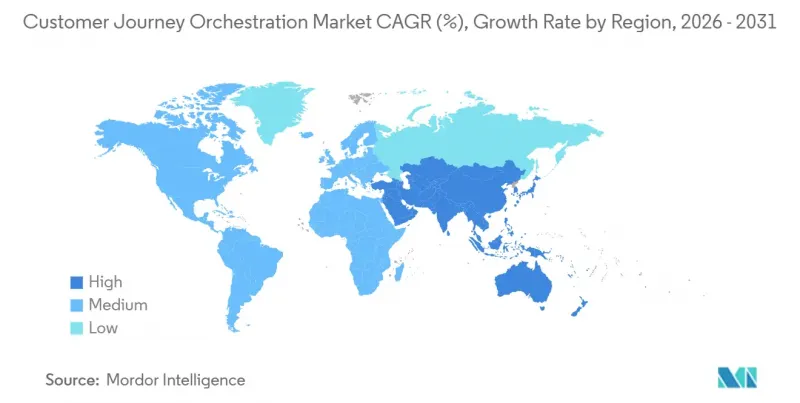
아시아태평양은 2031년까지 연평균 성장률(CAGR) 18.43%로 확대될 것으로 예상되며, 고객 여정 오케스트레이션 시장에서 가장 빠르게 성장하는 지역이 될 것입니다. 중국, 인도, 일본, 한국, 호주가 주요 수요 거점으로 부상하고 있으며, 대규모 디지털 사용자 기반과 실시간 참여에 대한 기대감 고조가 이를 뒷받침하고 있습니다. 이 지역 대부분에서 나타나는 ‘모바일 퍼스트’ 행동 양식으로 인해, 각 벤더들은 기존의 이메일 중심 참여 패턴에 대한 의존도가 낮은 오케스트레이션 모델에 대응해야 할 필요에 직면해 있습니다. 동남아시아에서는 메시징 주도형 상거래와 앱 중심의 서비스 이용 행태로 인해, 방대한 디지털 접점에 신속하게 대응할 수 있는 오케스트레이션이 필요해지면서 성장세가 더욱 가속화되고 있습니다. 또한, 지역의 개인정보 보호 규정 및 거주지 관련 요건이 제품 설계와 분리하기 어려워짐에 따라, 이와 유사한 기회가 현지화 및 데이터 거버넌스에 대한 관심도 불러일으키고 있습니다.
- Salesforce, Inc.
- Adobe Inc.
- Oracle Corporation
- Microsoft Corporation
- IBM Corporation
- SAP SE
- NICE Ltd.
- Genesys Cloud Services, Inc.
- Pegasystems Inc.
- Twilio Inc.
- Braze, Inc.
- Sprinklr, Inc.
- Medallia, Inc.
- Qualtrics International Inc.
- Verint Systems Inc.
- SAS Institute Inc.
- Acquia, Inc.
- Contentsquare
- Quadient S.A.
- Tealium Inc.
- Insider
- MoEngage, Inc.
- Amperity, Inc.
- Dynamic Yield by Mastercard
- InMoment, Inc.
기타 혜택 :
- 엑셀 형식 시장 예측(ME) 시트
- 3개월간의 애널리스트 지원
자주 묻는 질문
목차
제1장 서론
제2장 조사 방법
제3장 주요 요약
제4장 시장 구도
제5장 시장 규모 및 성장 예측
제6장 경쟁 구도
제7장 시장 기회 및 향후 전망
AJY 26.08.11According to Mordor Intelligence, the customer journey orchestration market size is projected to be USD 11.56 billion in 2025, USD 13.09 billion in 2026, and reach USD 24.41 billion by 2031, growing at a CAGR of 13.27% from 2026 to 2031.
This report is Segmented by Component (Software, and Services), Deployment Mode (Cloud, On-Premises, and Hybrid), Application (Customer Journey Design and Experience Management, and More), Organization Size (Large Enterprises, and Small and Medium Enterprises), End User Industry (Retail and E-Commerce, and More), and Geography. The Market Forecasts are Provided in Terms of Value (USD).
Global Customer Journey Orchestration Market Trends and Insights
Rising Demand for Real-Time Personalized Journeys
Real-time personalization is moving from an optional feature to a core operating requirement in the customer journey orchestration market because static campaigns are not meeting rising customer expectations across digital channels. Enterprises increasingly want systems that can react to current behavior, recent purchases, channel context, and service history within the same interaction window. Adobe reinforced this shift in September 2025 when it announced the general availability of AI agents for customer experience transformation, including Journey Agent in Adobe Journey Optimizer that creates and orchestrates journeys across web, mobile, app, and email based on defined goals. Twilio pushed the same direction in May 2026 with Conversation Orchestrator, Conversation Memory, and Conversation Intelligence, all built to preserve customer context and support coordinated AI and human interactions across channels. As more vendors center their product roadmaps on real-time orchestration, the customer journey orchestration market is moving toward continuous engagement models rather than campaign-by-campaign execution.
Growing Need to Unify Fragmented Customer Data Across Touchpoints
Fragmented customer data remains one of the clearest barriers to useful orchestration in the customer journey orchestration market because signals often sit across separate CRM, commerce, service, and analytics systems. When those records do not connect, journey logic becomes incomplete, and the next action is based on partial context instead of the full relationship. Adobe addressed this problem in March 2025 through the launch of Experience Platform Agent Orchestrator, supported by partnerships with Acxiom, AWS, Genesys, IBM, Microsoft, SAP, ServiceNow, and Workday to enable coordinated execution across customer service, enterprise resource planning, collaboration, and data management environments. That vendor behavior shows that buyers are not only evaluating decisioning quality, but they are also testing how well a platform can sit across the existing enterprise stack. This keeps ecosystem breadth close to the center of competition in the customer journey orchestration market, especially in large accounts with multiple legacy platforms.
Integration Complexity with Legacy CRM, CDP, and Marketing Systems
Integration complexity is still a meaningful brake on the customer journey orchestration market because many large organizations are trying to connect new orchestration layers to older CRM, marketing, commerce, and service systems. Those environments were often not designed to emit customer signals in real time, which slows implementation and keeps activation fragmented. The partner-heavy structure of Adobe Experience Platform Agent Orchestrator shows how much value buyers place on certified integrations across customer service, enterprise applications, collaboration tools, and data environments. SAP and Google Cloud also expanded their partnership in April 2026 to support multi-agent AI across SAP Engagement Cloud, SAP CX, Joule, and Gemini Enterprise, which reflects the wider market need to bridge established enterprise systems with newer orchestration and AI workflows. Until integration becomes simpler across those environments, the customer journey orchestration market will continue to face longer enterprise sales cycles and more selective rollouts in complex accounts.
Other drivers and restraints analyzed in the detailed report include:
- Expansion of AI-Driven Decisioning and Next-Best-Action Automation
- Increasing Adoption of Cloud-Native Customer Experience Stacks
- Data Privacy, Consent, and Governance Constraints
For complete list of drivers and restraints, kindly check the Table Of Contents.
Segment Analysis
Software held 76.84% share in the customer journey orchestration market in 2025, which reflects the platform-led nature of enterprise spending in this category. Buyers continue to allocate most value to journey builders, real-time decisioning engines, customer data connectors, and the core orchestration layer that sits across channels. This also shows that enterprises still prefer reusable systems of engagement over one-off custom builds when they modernize customer experience operations. The installed software base matters because recurring platform revenue gives vendors more room to fund AI features, compliance controls, and deeper ecosystem integration.
Services are projected to grow at 15.92% CAGR through 2031, making them the faster-moving component as deployment and governance needs become harder to manage with internal teams alone. That expansion is tied to implementation, system integration, managed operations, training, and optimization work that follows platform adoption across more business units. The customer journey orchestration market is seeing a broader shift here because AI-enabled deployment requires new operating practices around model oversight, journey testing, and content management. As a result, services are growing not because software is weakening, but because enterprise buyers increasingly need outside support to activate software value at scale.
Cloud accounted for 61.63% share of the customer journey orchestration market size in 2025, which shows that most deployments still favor scalable and centrally updated environments. Enterprises value the lower infrastructure burden, the faster release cycle, and the easier access to prebuilt AI features that cloud deployment usually provides. This keeps cloud at the center of new rollouts, especially for companies that want faster time to value across marketing, service, and commerce teams. The current structure of the customer journey orchestration market, therefore, still leans toward cloud as the default architecture for broad enterprise adoption.
On-premises is projected to expand at 15.37% CAGR through 2031, which creates an unusual pattern where the largest model and the fastest-growing model are not the same. The shift is linked to data sovereignty, sector-specific compliance, and buyer caution around moving sensitive decisioning data outside controlled environments. Braze responded to that pressure in April 2026 through EU hosting on Google Cloud for BrazeAI Decisioning Studio, a move aimed directly at European data residency needs. Hybrid deployment is gaining relevance for the same reason because many buyers want cloud-based inference and coordination while keeping selected customer records or regulated workflows closer to their own governed systems.
Complete Report Scope:
- By Component
- Software
- Services
- By Deployment Mode
- Cloud
- On-Premises
- Hybrid
- By Application
- Customer Journey Design and Experience Management
- Campaign Management
- Personalization
- Analytics and Reporting
- Journey Optimization
- By Organization Size
- Large Enterprises
- Small and Medium Enterprises
- By End User Industry
- BFSI
- Retail and E-Commerce
- IT and Telecommunications
- Healthcare
- Travel and Hospitality
- Media and Entertainment
- Other End User Industries
- By Geography
- North America
- United States
- Canada
- Mexico
- South America
- Brazil
- Argentina
- Rest of South America
- Europe
- Germany
- United Kingdom
- France
- Italy
- Spain
- Russia
- Rest of Europe
- Asia-Pacific
- China
- India
- Japan
- South Korea
- Australia
- Rest of Asia-Pacific
- Middle East and Africa
- Middle East
- Saudi Arabia
- United Arab Emirates
- Rest of Middle East
- Africa
- South Africa
- Nigeria
- Rest of Africa
- Middle East
- North America
Geography Analysis
North America held 39.18% of the customer journey orchestration market share in 2025, which kept the region in the lead. The region benefits from early enterprise adoption, high technology spending, and the presence of many of the largest software vendors serving customer experience and CRM workflows. A large installed base of enterprise applications also makes North America a natural launch market for orchestration features that extend across marketing, service, and commerce. The customer journey orchestration market in the United States remains especially active because major platform vendors continue to build AI-led roadmaps around enterprise data and cross-channel engagement. At the same time, state-level privacy rules are pushing buyers to pay closer attention to consent governance and data activation boundaries.
Europe remains important in the customer journey orchestration market because enterprise demand is strong, but deployment choices are shaped more heavily by privacy, residency, and audit requirements. Germany, the United Kingdom, and France continue to anchor regional demand, especially in BFSI and telecommunications, where customer interactions are frequent and regulated. Braze addressed this environment in April 2026 with EU hosting on Google Cloud for BrazeAI Decisioning Studio, so that real-time decisioning data no longer leaves the European Union region. The region, therefore, remains one of the clearest examples of how regulatory structure can reshape platform architecture in the customer journey orchestration market.
Asia-Pacific is projected to expand at 18.43% CAGR through 2031, making it the fastest-growing geography in the customer journey orchestration market. China, India, Japan, South Korea, and Australia are the main demand centers, supported by large digital user bases and rising expectations for real-time engagement. Mobile-first behavior across much of the region is pushing vendors to support orchestration models that are less dependent on traditional email-heavy engagement patterns. Southeast Asia adds another layer of momentum because messaging-led commerce and app-centric service behavior require orchestration that can react quickly across high-volume digital touchpoints. The same opportunity is drawing attention to localization and data governance, since regional privacy rules and residency expectations are becoming harder to separate from product design.
- Salesforce, Inc.
- Adobe Inc.
- Oracle Corporation
- Microsoft Corporation
- IBM Corporation
- SAP SE
- NICE Ltd.
- Genesys Cloud Services, Inc.
- Pegasystems Inc.
- Twilio Inc.
- Braze, Inc.
- Sprinklr, Inc.
- Medallia, Inc.
- Qualtrics International Inc.
- Verint Systems Inc.
- SAS Institute Inc.
- Acquia, Inc.
- Contentsquare
- Quadient S.A.
- Tealium Inc.
- Insider
- MoEngage, Inc.
- Amperity, Inc.
- Dynamic Yield by Mastercard
- InMoment, Inc.
Additional Benefits:
- The market estimate (ME) sheet in Excel format
- 3 months of analyst support
TABLE OF CONTENTS
1 INTRODUCTION
- 1.1 Study Assumptions and Market Definition
- 1.2 Scope of the Study
2 RESEARCH METHODOLOGY
3 EXECUTIVE SUMMARY
4 MARKET LANDSCAPE
- 4.1 Market Overview
- 4.2 Market Drivers
- 4.2.1 Rising Demand for Real-Time Personalized Journeys
- 4.2.2 Growing Need to Unify Fragmented Customer Data Across Touchpoints
- 4.2.3 Expansion of AI-Driven Decisioning and Next-Best-Action Automation
- 4.2.4 Increasing Adoption of Cloud-Native Customer Experience Stacks
- 4.2.5 Rising Pressure To Improve Conversion in High-Consideration Digital Journeys
- 4.2.6 Lower-Lift Orchestration Use Cases Emerging in Mid-Market Enterprises
- 4.3 Market Restraints
- 4.3.1 Integration Complexity With Legacy CRM, CDP, and Marketing Systems
- 4.3.2 Data Privacy, Consent, and Governance Constraints
- 4.3.3 Difficulty Proving Incremental ROI Across Siloed Business Units
- 4.3.4 Shortage of Specialized Journey Design and Analytics Talent
- 4.4 Industry Value-Chain Analysis
- 4.5 Regulatory Landscape
- 4.6 Technological Outlook
- 4.7 Impact of Macroeconomic Factors on the Market
- 4.8 Porter's Five Forces Analysis
- 4.8.1 Threat Of New Entrants
- 4.8.2 Bargaining Power Of Buyers
- 4.8.3 Bargaining Power Of Suppliers
- 4.8.4 Threat Of Substitutes
- 4.8.5 Intensity of Competitive Rivalry
5 MARKET SIZE AND GROWTH FORECASTS (VALUE)
- 5.1 By Component
- 5.1.1 Software
- 5.1.2 Services
- 5.2 By Deployment Mode
- 5.2.1 Cloud
- 5.2.2 On-Premises
- 5.2.3 Hybrid
- 5.3 By Application
- 5.3.1 Customer Journey Design and Experience Management
- 5.3.2 Campaign Management
- 5.3.3 Personalization
- 5.3.4 Analytics and Reporting
- 5.3.5 Journey Optimization
- 5.4 By Organization Size
- 5.4.1 Large Enterprises
- 5.4.2 Small and Medium Enterprises
- 5.5 By End User Industry
- 5.5.1 BFSI
- 5.5.2 Retail and E-Commerce
- 5.5.3 IT and Telecommunications
- 5.5.4 Healthcare
- 5.5.5 Travel and Hospitality
- 5.5.6 Media and Entertainment
- 5.5.7 Other End User Industries
- 5.6 By Geography
- 5.6.1 North America
- 5.6.1.1 United States
- 5.6.1.2 Canada
- 5.6.1.3 Mexico
- 5.6.2 South America
- 5.6.2.1 Brazil
- 5.6.2.2 Argentina
- 5.6.2.3 Rest of South America
- 5.6.3 Europe
- 5.6.3.1 Germany
- 5.6.3.2 United Kingdom
- 5.6.3.3 France
- 5.6.3.4 Italy
- 5.6.3.5 Spain
- 5.6.3.6 Russia
- 5.6.3.7 Rest of Europe
- 5.6.4 Asia-Pacific
- 5.6.4.1 China
- 5.6.4.2 India
- 5.6.4.3 Japan
- 5.6.4.4 South Korea
- 5.6.4.5 Australia
- 5.6.4.6 Rest of Asia-Pacific
- 5.6.5 Middle East and Africa
- 5.6.5.1 Middle East
- 5.6.5.1.1 Saudi Arabia
- 5.6.5.1.2 United Arab Emirates
- 5.6.5.1.3 Rest of Middle East
- 5.6.5.2 Africa
- 5.6.5.2.1 South Africa
- 5.6.5.2.2 Nigeria
- 5.6.5.2.3 Rest of Africa
- 5.6.5.1 Middle East
- 5.6.1 North America
6 COMPETITIVE LANDSCAPE
- 6.1 Market Concentration
- 6.2 Strategic Moves
- 6.3 Market Share Analysis
- 6.4 Company Profiles (includes Global Level Overview, Market Level Overview, Core Segments, Financials as available, Strategic Information, Market Rank/Share, Products and Services, Recent Developments)
- 6.4.1 Salesforce, Inc.
- 6.4.2 Adobe Inc.
- 6.4.3 Oracle Corporation
- 6.4.4 Microsoft Corporation
- 6.4.5 IBM Corporation
- 6.4.6 SAP SE
- 6.4.7 NICE Ltd.
- 6.4.8 Genesys Cloud Services, Inc.
- 6.4.9 Pegasystems Inc.
- 6.4.10 Twilio Inc.
- 6.4.11 Braze, Inc.
- 6.4.12 Sprinklr, Inc.
- 6.4.13 Medallia, Inc.
- 6.4.14 Qualtrics International Inc.
- 6.4.15 Verint Systems Inc.
- 6.4.16 SAS Institute Inc.
- 6.4.17 Acquia, Inc.
- 6.4.18 Contentsquare
- 6.4.19 Quadient S.A.
- 6.4.20 Tealium Inc.
- 6.4.21 Insider
- 6.4.22 MoEngage, Inc.
- 6.4.23 Amperity, Inc.
- 6.4.24 Dynamic Yield by Mastercard
- 6.4.25 InMoment, Inc.
7 MARKET OPPORTUNITIES AND FUTURE OUTLOOK
- 7.1 White-Space and Unmet-Need Assessment


