
|
시장보고서
상품코드
2099964
헬스케어용 OTT 시장 : 시장 점유율 분석, 업계 동향 및 통계, 성장 예측(2026-2031년)OTT For Healthcare - Market Share Analysis, Industry Trends & Statistics, Growth Forecasts (2026 - 2031) |
||||||
 Mordor Intelligence
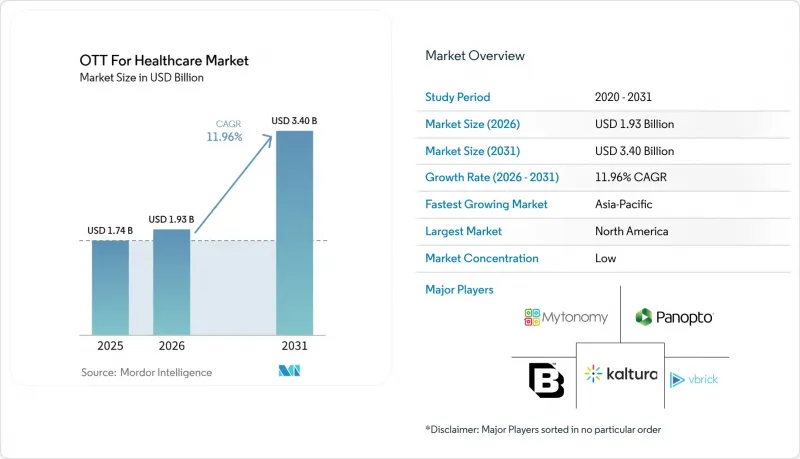
Mordor Intelligence에 의하면, 헬스케어용 OTT 시장 규모는 2025년에 17억 4,000만 달러로 평가되었고, 2031년까지 34억 달러에 이를 것으로 예측되며, 2026-2031년 CAGR 11.96%로 성장할 전망입니다.
본 보고서는 기기 유형별(스마트폰·태블릿, 스마트 TV, 노트북·데스크톱 PC), 스트리밍 유형별(라이브 스트리밍, 온디맨드 스트리밍), 최종 사용자별(병원·의료 시스템, 진료소·의사 그룹, 제약·생명과학 기업), 지역별(북미, 유럽, 아시아태평양, 아프리카 등)로 분류되어 있습니다. 시장 예측은 금액(달러) 기준으로 제시되어 있습니다.
세계의 헬스케어용 OTT 시장 동향 및 인사이트
안전한 환자 교육용 동영상 포털에 대한 수요 증가
헬스케어용 OTT 시장은 공식적인 의료 제공 및 보험 환급과 관련된 워크플로우에서 환자 교육의 중요성이 더욱 부각됨에 따라 성장하고 있습니다. 2025년 8월에 시행된 CMS의 TEAM 모델은 주요 외과적 치료 경로에서의 치료 결과와 보다 체계화된 치료 관리를 연계했습니다. 이를 통해 병원 시스템 내에서 할당, 추적 및 평가가 가능한 교육 제공의 가치가 높아졌습니다. Mytonomy사는 2025년 8월, 병상 수 1,100개 규모의 대학 부속 의료 센터 환자들이 1회 세션당 평균 24분 동안 동영상을 시청했다고 보고했습니다. 또한, 별도의 400명 환자 코호트에서는 동영상 이용과 관련하여 치료 계획 준수율이 77%에 달한 것으로 나타났으며, 이를 통해 병원 구매 담당자에게 규정 준수를 충족하는 교육 플랫폼 도입의 구체적인 이용 사례가 제시되었습니다. 이에 따라 헬스케어용 OTT 시장은 더욱 워크플로우 중심형으로 변화하고 있습니다. 의료 제공업체들은 환자가 스스로 자료를 검색하는 데 의존하기보다는 EHR을 통해 컨텐츠가 할당되는 플랫폼을 점점 더 선호하고 있기 때문입니다. 따라서 Epic MyChart와 연동된 의료 시스템에서는 처방 시점에 컨텐츠를 전달하거나 문서 작성을 자동화하고, 품질 및 규정 준수 요건을 충족하는 추적 가능한 기록을 유지할 수 있는 공급업체가 선호되고 있습니다. 그 결과, 헬스케어용 OTT 시장은 단순한 선택적 디지털 참여에 대한 투자라기보다는 임상 인프라에 대한 투자에 가까워지고 있습니다.
하이브리드 케어 및 디지털 프론트도어 프로그램의 확대
헬스케어용 OTT 시장이 확대되고 있는 또 다른 이유는 하이브리드 케어 모델의 보급으로 인해, 한 명의 환자와의 관계에 연계된 영상 기반 상호작용 횟수가 증가하고 있기 때문입니다. 원격 의료, 원격 모니터링, 초진 접수, 트리아지, 예약, 교육이 단일 브랜드화된 접근 경로 내에 통합됨에 따라, 의료 제공업체는 규정 준수를 충족하는 동일한 환경 내에서 실시간 및 온디맨드 영상 기능을 모두 필요로 합니다. TytoCare는 2025년 11월, Teladoc Health의 ‘24/7 Care’ 및 ‘Primary360’ 프로그램과의 제휴를 발표했습니다. 이를 통해 임상 등급의 가상 진료가 가정 내로 더욱 확대되었으며, 진료 제공에 있어 가정이 더 적극적인 진입점으로서의 역할이 강화되었습니다. 이러한 변화는 헬스케어용 OTT 시장에 중요한 의미를 지닙니다. 보안이나 연속성을 저해하지 않으면서 병상 환경, 재택 환경, 그리고 의료 제공업체의 워크플로우 전반에 걸쳐 작동하는 비디오 시스템에 대한 수요를 높이기 때문입니다. 또한, 기업의 ‘디지털 프론트 도어(Digital Front Door)’ 이니셔티브로 인해 스트리밍에 대한 의사결정권이 고립된 부서에서 보다 광범위한 의료 시스템 계약으로 이전되는 경우가 많아짐에 따라 구매 동향도 변화하고 있습니다. 이러한 추세는 계약 규모 확대를 촉진하며, 단일 플랫폼으로 여러 치료 경로를 아우를 수 있는 공급업체에게 헬스케어 OTT 시장을 더욱 매력적으로 만듭니다.
HIPAA, 동의 및 데이터 소재지 관련 규정 준수 문제
헬스케어용 OTT 시장은 여전히 큰 제약에 직면해 있습니다. 규정 준수를 충족하는 도입을 위해서는 안전한 기업와 암호화된 파일 전송 이상의 조치가 필요하기 때문입니다. 구매자들은 비즈니스 제휴 계약(BAA) 준수, 전송 중 및 저장 시 암호화, 감사 가능한 로그 기록, 접근 제어, 그리고 현지 데이터 처리 요건을 충족하는 인프라 옵션을 기대합니다. 이로 인해 헬스케어용 OTT 시장의 비용 하한선이 상승하게 되며, 특히 대규모 내부 규정 준수 팀이나 장기적인 조달 역량을 갖추지 못한 중규모 병원 및 의사 그룹의 경우 그 영향이 두드러집니다. 또한, 다국적 의료 시스템의 경우, 미국과 유럽의 데이터 규제 프레임워크가 플랫폼 아키텍처, 호스팅 결정 및 국경을 넘는 워크플로우를 동시에 좌우하기 때문에 더욱 복잡한 상황에 직면해 있습니다. SOC 2 Type II나 ISO 27001과 같은 규정 준수 인증은 신규 시장 진출기업에게 진입 장벽을 더욱 높여, 기업의 심사를 통과할 수 있는 공급업체의 선택지를 좁히고 있습니다. 이로 인해 소규모 의료 기관에서의 도입이 주춤하고 있지만, 그러한 조직이라 할지라도 비용 대비 효과가 높은 환자 교육 및 임상 커뮤니케이션 도구의 혜택을 크게 누릴 수 있을 것입니다.
부문 분석
2025년, 스마트 TV는 매출의 28.34%를 차지하며 병실 전체에서 병상 교육, 환자와의 소통, 엔터테인먼트 제공의 중심적인 역할을 수행했습니다. 헬스케어용 OTT 시장의 이 분야는 화면이 의료기관에 의해 관리되고, 이미 병실의 워크플로우와 연동되어 있는 통제된 입원 환경에 기반을 두고 있었습니다. 병원이 이러한 관리 기능을 중시하는 이유는 환자에게 교육 컨텐츠를 푸시 전송할 수 있고, 기록을 보다 일관성 있게 관리할 수 있으며, 퇴원 준비나 특정 처치와 관련된 컨텐츠와 연동할 수 있기 때문입니다. 또한 TV의 역할은 수동적인 시청에 그치지 않습니다. 최신 도입 환경에서는 접근 제어를 약화시키지 않으면서도 안전한 캐스팅 기능과 더욱 친숙한 컨텐츠 경험이 점점 더 지원되고 있기 때문입니다. 그 결과, 개인용 기기에서의 이용이 확대되고 있음에도 불구하고, 헬스케어용 OTT 시장에서는 스마트 TV가 주도적인 역할을 유지하고 있습니다.
스마트폰 및 태블릿은 2031년까지 연평균 성장률(CAGR) 12.11%를 나타낼 것으로 예측되며, 헬스케어용 OTT 시장에서 가장 빠르게 성장하고 있는 기기군입니다. 이러한 성장은 입원 전부터 시작되어 퇴원 후에도 이어지는 치료 과정과 밀접한 관련이 있습니다. 왜냐하면 동영상 컨텐츠와의 상호작용이 더 이상 병상에서 끝나지 않고, 환자가 집으로 돌아간 후에도 지속되기 때문입니다. Nonius Health사는 Philips(Philips)와 제휴하여 주요 제조업체의 전문 의료용 TV에 Apple AirPlay 및 Google Cast 인증 기능을 도입했습니다. 이는 의료 제공업체가 개인의 기기 사용 습관과 병원이 관리하는 화면 간의 가교 역할을 모색하고 있음을 보여줍니다. 의료 OTT 업계에서 노트북과 데스크톱 컴퓨터는 여전히 중요한 역할을 수행하고 있습니다. 이는 직원 교육, 지속 의학 교육(CME) 접근, 그리고 관리상의 동영상 검토가 많은 경우 여전히 관리된 워크스테이션 환경에 의존하고 있기 때문입니다. 키오스크나 셋톱 솔루션과 같은 다른 기기 형태는 앞으로도 틈새 시장에서 계속 활용될 것이지만, 현재의 기기 구성은 헬스케어용 OTT 시장에서 병원 수준의 관리 기능과 소비자 수준의 편의성을 모두 최적화해야 함을 시사합니다.
지역별 분석
2025년, 북미는 매출의 42.56%를 차지했으며, 헬스케어용 OTT 시장에서 가장 규모가 큰 지역 점유율을 기록했습니다. 이 지역은 EHR(전자건강기록)의 높은 보급률, 보다 성숙한 병원의 디지털 예산, 그리고 조달 과정에서 디지털 기반 환자 참여의 정당화를 용이하게 하는 상환 구조 등의 혜택을 누리고 있습니다. 미국은 여전히 최대의 국내 시장이며, 이는 규정 준수를 충족하는 영상 인프라가 가치 기반 의료, 문서화된 환자 교육, 의료 기관의 워크플로우 통합과 점점 더 밀접하게 연결되어 있기 때문입니다. 캐나다와 멕시코는 여전히 지역적 기회 규모는 작지만, 신뢰할 수 있는 원격 통신 도구가 필요한 원격 의료 접근 프로그램 및 서비스 모델을 통해 두 국가 모두 시장에 기여하고 있습니다. 이로 인해 북미의 헬스케어 OTT 시장은 매우 활발한 상태를 유지하고 있으며, 특히 의료 제공업체가 환자와 직원 모두를 위한 이용 사례를 지원하는 안전한 플랫폼을 필요로 하는 지역에서 이러한 경향이 두드러집니다.
유럽의 헬스케어용 OTT 시장은 각국의 의료 제도, 디지털 투자 속도, 데이터 거버넌스 요건에 따라 도입 진행 상황이 다르기 때문에 지역별 특징이 더욱 두드러집니다. 영국과 독일은 여전히 주요 투자 거점이지만, 프랑스, 스페인, 이탈리아에서도 자금 지원 및 현대화 프로그램을 통해 병원의 디지털화가 광범위하게 진행되고 있습니다. GDPR(EU 개인정보보호규정) 의무는 국경을 넘어 사업을 전개하는 조직에게 플랫폼 아키텍처, 공급업체 선정, 호스팅 선택에 영향을 미치는 공식적인 데이터 처리 요건을 추가하는 것입니다. 또한, ‘유럽 헬스 데이터 스페이스(European Health Data Space)’ 이니셔티브는 화상 상담 기록을 포함한 환자 관련 정보가 해당 지역 내에서 어떻게 처리·공유되어야 하는지에 대한 기대감을 형성하고 있습니다. 이러한 상황은 수요를 뒷받침하는 한편, 의료 제공업체의 업무 흐름에 지장을 주지 않으면서 현지 호스팅 및 거버넌스 요건을 충족할 수 있는 공급업체에게 유리한 조건을 제공합니다.
아시아태평양은 2031년까지 연평균 성장률(CAGR) 12.57%로 확대될 것으로 예측되며, 헬스케어 OTT 시장 규모 측면에서 가장 빠르게 성장하는 지역 블록이 될 전망입니다. 이러한 성장은 5G의 보급, 여러 국가에서의 높은 스마트폰 보급률, 그리고 커넥티드 케어에 대한 접근성을 확대하는 정부 주도의 디지털 헬스 프로그램에 의해 뒷받침되고 있습니다. 특히 인도는 ‘아유슈만 바라트 디지털 미션(Ayushman Bharat Digital Mission)’을 통해 대규모 공공 디지털 헬스 인프라를 구축하고 있어, 전체 케어 네트워크 전반에 걸쳐 환자 교육 및 참여 도구의 활용 확대가 촉진되고 있습니다. 중국, 일본, 한국, 호주 역시 의료 제공업체들이 원격 의료, 만성 질환 관리, 노인 돌봄 분야로 비디오 활용을 확대함에 따라 중요한 성장 요인으로 작용하고 있습니다. 남미, 중동 및 아프리카는 여전히 초기 단계 시장이지만, 모바일 우선 모델과 각국의 디지털 헬스 전략을 통해 지역 사회의 건강 커뮤니케이션 및 의약품 교육을 위한 새로운 채널이 점차 개척되고 있습니다.
기타 혜택 :
- 엑셀 형식 시장 예측(ME) 시트
- 3개월간의 애널리스트 지원
자주 묻는 질문
목차
제1장 서론
제2장 조사 방법
제3장 주요 요약
제4장 시장 구도
제5장 시장 규모 및 성장 예측
제6장 경쟁 구도
제7장 시장 기회 및 향후 전망
AJY 26.08.07According to Mordor Intelligence, the OTT for healthcare market size was valued at USD 1.74 billion in 2025 and is projected to reach USD 3.40 billion by 2031, advancing at an 11.96% CAGR over 2026-2031.
This report is Segmented by Device Type (Smartphones and Tablets, Smart TVs, and Laptops and Desktops), Streaming Type (Live Streaming, and On-Demand Streaming), End User (Hospitals and Health Systems, Clinics and Physician Groups, and Pharmaceutical and Life Sciences Companies), and Geography (North America, Europe, Asia-Pacific, Africa and More). The Market Forecasts are Provided in Terms of Value (USD).
Global OTT For Healthcare Market Trends and Insights
Rising Demand For Secure Patient Education Video Portals
The OTT for healthcare market is gaining from the way patient education has become more visible within formal care delivery and reimbursement-linked workflows. The CMS TEAM model took effect in August 2025 and tied episode outcomes across major surgical pathways to more structured care management, which raised the value of education delivery that can be assigned, tracked, and reviewed within hospital systems. Mytonomy reported in August 2025 that patients at a 1,100-bed academic medical center averaged 24 minutes of viewing per session, and a separate 400-patient cohort showed 77% care-plan adherence linked to video use, which gave hospital buyers a concrete operating case for compliant education platforms. This has made the OTT for healthcare market more workflow-driven because providers increasingly prefer platforms that can assign content through the EHR rather than depend on patients to search for material on their own. Health systems with Epic MyChart integration are therefore favoring vendors that can automate delivery at the point of order, document completion, and maintain a traceable record for quality and compliance needs. As a result, the OTT for healthcare market is moving closer to clinical infrastructure spending rather than optional digital engagement spending.
Expansion Of Hybrid Care And Digital Front Door Programs
The OTT for healthcare market is also expanding because hybrid care models have increased the number of video interactions tied to a single patient relationship. When telehealth, remote monitoring, intake, triage, scheduling, and education sit inside one branded access path, providers need both live and on-demand video within the same compliant environment. TytoCare announced in November 2025 that it integrated with Teladoc Health's 24/7 Care and Primary360 programs, extending clinical-grade virtual care further into the home and reinforcing the home as a more active entry point for care delivery. This shift matters for the OTT for healthcare market because it increases demand for video systems that can work across bedside settings, home settings, and provider workflows without breaking security or continuity. It also changes the buying motion, since enterprise digital front door initiatives often pull streaming decisions away from isolated departments and into broader health system contracts. That pattern supports higher contract value and makes the healthcare OTT market more attractive to vendors that can cover multiple care pathways with one platform.
HIPAA, Consent, And Data Residency Compliance Complexity
The OTT for healthcare market still faces a meaningful constraint because compliant deployment requires more than a secure player or encrypted file delivery. Buyers expect Business Associate Agreement support, encryption in transit and at rest, audit-ready logging, access control, and infrastructure choices that fit local data handling requirements. That raises the cost floor for the OTT for the healthcare market, especially for mid-sized hospitals and physician groups that do not have large internal compliance teams or long procurement capacity. Multinational health systems also face added complexity when U.S. and European data frameworks shape platform architecture, hosting decisions, and cross-border workflows at the same time. Compliance credentials such as SOC 2 Type II and ISO 27001 further raise the barrier for new entrants and narrow the field of vendors that can pass enterprise review. This slows adoption in smaller accounts even though those organizations may benefit strongly from cost-efficient patient education and clinical communication tools.
Other drivers and restraints analyzed in the detailed report include:
- Growth Of Clinical Microlearning And Continuous Medical Education Video Libraries
- Need For Auditable Content Governance, Access Control, And Archiving
- Fragmented Buyer Workflows Across IT, Clinical, And Communications Teams
For complete list of drivers and restraints, kindly check the Table Of Contents.
Segment Analysis
Smart TVs held 28.34% of revenue in 2025, which placed them at the center of bedside education, patient communication, and entertainment delivery across hospital rooms. This portion of the OTT for healthcare market remained anchored in managed inpatient environments where the screen is institution-controlled and already linked to room workflows. Hospitals value that control because education can be pushed to the patient, logged more consistently, and aligned with discharge preparation or procedure-specific content. The role of the television also extends beyond passive viewing because modern deployments increasingly support secure casting and a more familiar content experience without weakening access controls. As a result, the healthcare OTT market has kept smart TVs in a leading role even while usage expands across personal devices.
Smartphones and tablets are projected to advance at a 12.11% CAGR through 2031, which makes them the fastest-growing device group in the OTT for healthcare market. Growth is tied to care journeys that start before admission and continue after discharge, since video engagement now follows the patient into the home rather than stopping at the bedside. Nonius Health, in partnership with Philips, deployed certified Apple AirPlay and Google Cast across professional healthcare TVs from major manufacturers, which shows how providers are trying to bridge personal-device habits with hospital-managed screens. Laptops and desktops still matter inside the healthcare OTT industry because staff training, CME access, and administrative video review often remain tied to managed workstation environments. Other device formats such as kiosks and set-top solutions will continue to serve niche settings, but the device mix now points to a OTT for healthcare market that must optimize both hospital-grade control and consumer-grade convenience.
Complete Report Scope:
- By Device Type
- Smartphones and Tablets
- Smart TVs
- Laptops and Desktops
- Other Device Types
- By Streaming Type
- Live Streaming
- On-demand Streaming
- Other Streaming Type
- By End User
- Hospitals And Health Systems
- Clinics And Physician Groups
- Pharmaceutical And Life Sciences Companies
- Other End Users
- By Geography
- North America
- United States
- Canada
- Mexico
- Europe
- United Kingdom
- Germany
- France
- Spain
- Italy
- Rest of Europe
- Asia-Pacific
- China
- Japan
- India
- South Korea
- Australia
- Rest of Asia-Pacific
- Middle East
- Saudi Arabia
- United Arab Emirates
- Rest of Middle East
- Africa
- South Africa
- Egypt
- Rest of Africa
- South America
- Brazil
- Argentina
- Rest of South America
- North America
Geography Analysis
North America held 42.56% of revenue in 2025, giving it the largest regional position in the OTT for healthcare market share. The region benefits from strong EHR penetration, more mature hospital digital budgets, and reimbursement structures that make digital patient engagement easier to justify in procurement. The United States remains the largest national market because compliant video infrastructure is increasingly tied to value-based care, documented patient education, and institutional workflow integration. Canada and Mexico still represent smaller regional opportunities, but both contribute through telehealth access programs and service models that need dependable remote communication tools. This keeps the healthcare OTT market highly active in North America, especially where providers want secure platforms that serve both patient-facing and staff-facing use cases.
Europe presents a more differentiated regional profile in the OTT for healthcare market because adoption strength varies by national health system, digital investment pace, and data governance requirements. The United Kingdom and Germany remain leading investment centers, while broader hospital digitization is also moving forward in France, Spain, and Italy through funding support and modernization programs. GDPR obligations add a formal data handling layer that influences platform architecture, vendor selection, and hosting choices for organizations operating across borders. The European Health Data Space workstream is also shaping expectations around how patient-related information, including video interaction records, may be processed and shared within the region. These conditions support demand, but they also favor vendors that can meet local hosting and governance expectations without increasing workflow friction for providers.
Asia-Pacific is projected to expand at a 12.57% CAGR through 2031, making it the fastest-growing regional block in the healthcare OTT market size. Growth is being supported by 5G expansion, high smartphone usage in several countries, and government-backed digital health programs that widen access to connected care pathways. India stands out because the Ayushman Bharat Digital Mission is building public digital health infrastructure at very large scale, which supports broader use of patient education and engagement tools across care networks. China, Japan, South Korea, and Australia are also important contributors as providers extend video use into telehealth, chronic disease management, and aged-care settings. South America, the Middle East, and Africa remain earlier-stage markets, but mobile-first models and national digital health strategies are gradually opening new channels for community health communication and pharmaceutical education.
- Brightcove Inc.
- Kaltura, Inc.
- Panopto, Inc.
- Vbrick Systems, Inc.
- Mytonomy, Inc.
- WebMD Ignite
- Elsevier B.V.
- Wolters Kluwer N.V.
- Healthcare Learning Innovations LLC
- Enghouse Systems Limited
- Haivision Systems Inc.
- Wowza Media Systems, LLC
- IPV Curator
- Muvi LLC
- V-Unite Limited
- Mediasite LLC
- Cisco Systems, Inc.
- Microsoft Corporation
- Vimeo, Inc.
- Dacast Inc.
- JW Player, Inc.
Additional Benefits:
- The market estimate (ME) sheet in Excel format
- 3 months of analyst support
TABLE OF CONTENTS
1 INTRODUCTION
- 1.1 Study Assumptions and Market Definition
- 1.2 Scope of the Study
2 RESEARCH METHODOLOGY
3 EXECUTIVE SUMMARY
4 MARKET LANDSCAPE
- 4.1 Market Overview
- 4.2 Market Drivers
- 4.2.1 Rising Demand For Secure Patient Education Video Portals
- 4.2.2 Expansion Of Hybrid Care And Digital Front Door Programs
- 4.2.3 Growth Of Clinical Microlearning And Continuous Medical Education Video Libraries
- 4.2.4 Need For Auditable Content Governance, Access Control, And Archiving
- 4.2.5 Integration Of Video Engagement Data Into Care Journey Analytics
- 4.2.6 Shift To Multi-Channel Hospital Communication And Branded Health Apps
- 4.3 Market Restraints
- 4.3.1 HIPAA, Consent, And Data Residency Compliance Complexity
- 4.3.2 Fragmented Buyer Workflows Across IT, Clinical, And Communications Teams
- 4.3.3 High Content Production And Localization Costs For Specialized Medical Video
- 4.3.4 Limited Reimbursement Linkage For Patient Engagement Content
- 4.4 Impact of Macroeconomic Factors on the Market
- 4.5 Industry Value Chain Analysis
- 4.6 Regulatory Landscape
- 4.7 Technological Outlook
- 4.8 Porter's Five Forces Analysis
- 4.8.1 Bargaining Power Of Suppliers
- 4.8.2 Bargaining Power Of Buyers
- 4.8.3 Threat Of New Entrants
- 4.8.4 Threat Of Substitutes
- 4.8.5 Intensity Of Competitive Rivalry
5 MARKET SIZE AND GROWTH FORECASTS (VALUE)
- 5.1 By Device Type
- 5.1.1 Smartphones and Tablets
- 5.1.2 Smart TVs
- 5.1.3 Laptops and Desktops
- 5.1.4 Other Device Types
- 5.2 By Streaming Type
- 5.2.1 Live Streaming
- 5.2.2 On-demand Streaming
- 5.2.3 Other Streaming Type
- 5.3 By End User
- 5.3.1 Hospitals And Health Systems
- 5.3.2 Clinics And Physician Groups
- 5.3.3 Pharmaceutical And Life Sciences Companies
- 5.3.4 Other End Users
- 5.4 By Geography
- 5.4.1 North America
- 5.4.1.1 United States
- 5.4.1.2 Canada
- 5.4.1.3 Mexico
- 5.4.2 Europe
- 5.4.2.1 United Kingdom
- 5.4.2.2 Germany
- 5.4.2.3 France
- 5.4.2.4 Spain
- 5.4.2.5 Italy
- 5.4.2.6 Rest of Europe
- 5.4.3 Asia-Pacific
- 5.4.3.1 China
- 5.4.3.2 Japan
- 5.4.3.3 India
- 5.4.3.4 South Korea
- 5.4.3.5 Australia
- 5.4.3.6 Rest of Asia-Pacific
- 5.4.4 Middle East
- 5.4.4.1 Saudi Arabia
- 5.4.4.2 United Arab Emirates
- 5.4.4.3 Rest of Middle East
- 5.4.5 Africa
- 5.4.5.1 South Africa
- 5.4.5.2 Egypt
- 5.4.5.3 Rest of Africa
- 5.4.6 South America
- 5.4.6.1 Brazil
- 5.4.6.2 Argentina
- 5.4.6.3 Rest of South America
- 5.4.1 North America
6 COMPETITIVE LANDSCAPE
- 6.1 Market Concentration
- 6.2 Strategic Moves
- 6.3 Market Share Analysis
- 6.4 Company Profiles (includes Global Level Overview, Market Level Overview, Core Segments, Financials as available, Strategic Information, Market Rank/Share, Products and Services, Recent Developments)
- 6.4.1 Brightcove Inc.
- 6.4.2 Kaltura, Inc.
- 6.4.3 Panopto, Inc.
- 6.4.4 Vbrick Systems, Inc.
- 6.4.5 Mytonomy, Inc.
- 6.4.6 WebMD Ignite
- 6.4.7 Elsevier B.V.
- 6.4.8 Wolters Kluwer N.V.
- 6.4.9 Healthcare Learning Innovations LLC
- 6.4.10 Enghouse Systems Limited
- 6.4.11 Haivision Systems Inc.
- 6.4.12 Wowza Media Systems, LLC
- 6.4.13 IPV Curator
- 6.4.14 Muvi LLC
- 6.4.15 V-Unite Limited
- 6.4.16 Mediasite LLC
- 6.4.17 Cisco Systems, Inc.
- 6.4.18 Microsoft Corporation
- 6.4.19 Vimeo, Inc.
- 6.4.20 Dacast Inc.
- 6.4.21 JW Player, Inc.
7 MARKET OPPORTUNITIES AND FUTURE OUTLOOK
- 7.1 White-space and Unmet-Need Assessment