

|
시장보고서
상품코드
2100721
미국의 방출 조절 비료 시장 : 점유율 분석, 업계 동향 및 통계, 성장 예측(2026-2031년)United States Controlled Release Fertilizers - Market Share Analysis, Industry Trends & Statistics, Growth Forecasts (2026 - 2031) |
||||||
 Mordor Intelligence
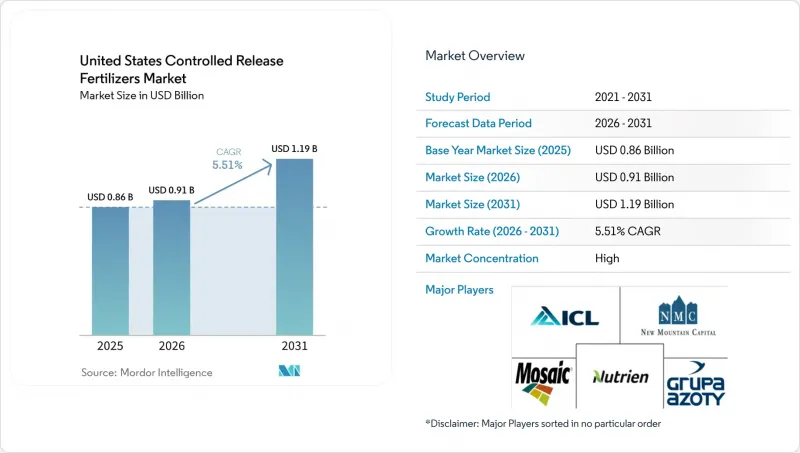
Mordor Intelligence에 의하면, 미국 방출 조절 비료 시장 규모는 2025년에 8억 6,000만 달러로 평가되었고 2026년 9억 1,000만 달러에서 2031년까지 11억 9,000만 달러에 이를 것으로 예측되며, 예측 기간(2026-2031년) CAGR은 5.51%를 나타낼 전망입니다.
본 보고서는 코팅 유형(폴리머 코팅, 폴리머·유황 코팅, 기타) 및 작물 유형(밭작물, 원예작물, 잔디 및 관상용 식물)별로 분류되어 있습니다. 시장 전망은 금액 및 수량 기준으로 제시되어 있습니다.
미국 방출 조절 비료 시장 동향 및 인사이트
정밀 농업 도입으로 영양분 이용 효율 향상
가변 시비 기술과 서방형 제품을 결합함으로써, 토양 특성이 서로 다른 각 구역에서 시비 위치와 시비 시기를 모두 최적화할 수 있습니다. 미국 농무부(USDA) 경제조업체국의 보고서에 따르면, 2024년 옥수수 재배 면적에서 정밀 시비의 대부분에 폴리머 코팅 요소가 사용되어, 수확량 저하를 초래하지 않으면서 총 질소 사용량을 15-20% 절감할 수 있었습니다고 합니다. GPS 안내 시스템의 보급으로 인해, 기존 비료 시비 방식에서는 영양분이 낭비되기 쉬웠던 밭 가장자리 부분의 중복 시비가 최소화되고 있습니다. 이러한 이점은 투입 비용 절감, 토양 건전성 향상, 유출 기준 준수로 이어져 광대한 재배 면적을 가진 줄 재배 농업에서 광범위한 보급을 뒷받침하고 있습니다.
주 정부의 유출 규제 강화가 CRF 보급을 뒷받침
오하이오주의 H2Ohio 프로그램은 2024년에 방출 조절 비료의 프리미엄 가격에 대한 비용 분담의 대부분을 부담함으로써, 130만 에이커에 달하는 지역에서 제품의 시범 도입이 급증했습니다. 체서피크만 연안 각 주는 일일 최대 허용 부하량(TMDL) 규제를 강화하고, 농가들에게 영양소 이용 효율 향상을 문서로 입증할 것을 의무화했습니다. 서방형 기술은 기온이나 수분 조건이 작물의 흡수에 적합할 때만 질소를 방출함으로써 이러한 의무를 충족시키고, 이를 통해 침출을 줄입니다. 규제 위반에 대한 제재는 미국 방출 조절 비료 시장 솔루션으로의 전환을 더욱 촉진하고 있습니다.
기존 요소와의 가격 차이
코팅 비료는 프리일 요소보다 40-60% 비싸며, 옥수수 수익률이 하락하고 있는 상황에서는 진입 장벽이 됩니다. 2024년에는 천연가스 가격이 안정되었으나, 코팅재의 원료가 되는 석유화학제품 가격은 여전히 변동이 심해 가격 차이는 확대되었습니다. 현금 흐름이 제한적인 소규모 농업 경영자들은 도입을 통해 구체적인 수확량 향상이나 노동력 절감 효과를 얻을 수 있다는 것이 확인될 때까지 도입을 미루는 경향이 있어, 그 결과 기존 방식의 질소 다용형 재배 시스템에서의 보급은 더딘 상태입니다.
부문 분석
2025년, 폴리머 코팅 비료는 미국 방출 조절 비료 시장 점유율의 58.0%를 차지했습니다. 이러한 주도적 지위는 단위 비용 절감에 기여하는 걸프 코스트 생산 시설의 규모의 경제와, 옥수수, 대두, 잔디, 특수 작물 시스템에서 입증된 성능에 의해 뒷받침되고 있습니다. 폴리머 코팅 요소 및 폴리머 코팅 다영양소 혼합물은 영양소 이용 효율 향상, 영양소 손실 감소, 시비 빈도 감소를 가능하게 하기 때문에 여전히 널리 채택되고 있습니다. 코팅 기술의 지속적인 발전으로 인해 생산성 향상과 환경 성능 개선을 추구하는 생산자들 사이에서 채택이 더욱 확대될 것으로 예측됩니다.
폴리머·유황 코팅 비료는 가장 빠르게 성장하는 부문으로, 2026년부터 2031년까지 연평균 성장률(CAGR) 7.4%를 나타낼 것으로 예측됩니다. 이러한 성장을 주도하는 것은 영양소 방출을 제어하는 기능과, 유황 결핍 토양에서 점점 더 필요해지고 있는 유황 공급을 결합한 이중 이점을 지닌 배합입니다. 유황에 반응하는 작물의 재배 확대, 균형 잡힌 영양 관리에 대한 인식 제고, 그리고 비료 이용 효율 향상에 대한 수요가 이러한 채택을 뒷받침하고 있습니다. 또한, 비용 경쟁력을 유지하면서 영양소 방출 성능을 향상시키는 코팅 기술의 지속적인 혁신으로 인해 폴리머·유황 코팅 비료에 대한 수요가 더욱 가속화될 것으로 예측됩니다.
기타 혜택:
- 엑셀 형식 시장 예측(ME) 시트
- 3개월간의 애널리스트 지원
자주 묻는 질문
목차
제1장 서론
제2장 개 보고서의 내용
제3장 주요 요약 및 주요 조사 결과
제4장 주요 업계 동향
제5장 시장 규모와 성장 예측
제6장 경쟁 구도
제7장 비료 업계 CEO가 직면하는 중요 전략적 과제
JHS 26.08.11According to Mordor Intelligence, the United States controlled release fertilizers market size was valued at USD 0.86 billion in 2025 and estimated to grow from USD 0.91 billion in 2026 to reach USD 1.19 billion by 2031, at a CAGR of 5.51% during the forecast period (2026-2031).
This report is Segmented by Coating Type (Polymer Coated, Polymer-Sulfur Coated, Others) and by Crop Type (Field Crops, Horticultural Crops, Turf and Ornamental). The Market Forecasts are Provided in Terms of Value (USD) and Volume (Metric Tons).
United States Controlled Release Fertilizers Market Trends and Insights
Precision Agriculture Adoption Boosting Nutrient Use Efficiency
Variable-rate technology, paired with controlled-release products, optimizes both placement and timing across zones with varying soil profiles. The USDA Economic Research Service reported that the majority of corn acreage precision coverage in 2024 utilized polymer-coated urea, resulting in a 15-20% reduction in total nitrogen use without yield loss . Wider GPS guidance use minimizes overlap at field edges, where conventional applications often waste nutrients. These gains translate into lower input costs, improved soil health, and compliance with runoff standards, reinforcing broad uptake across large-acreage row-crop operations.
Stricter State Runoff Rules Encouraging CRF Uptake
Ohio's H2Ohio program covered the majority of the cost-share on controlled-release premiums in 2024, spurring a surge in product trials across 1.3 million acres . Chesapeake Bay states tightened total maximum daily load mandates, requiring farmers to document nutrient-use efficiency gains. Controlled release technologies meet these obligations by releasing nitrogen only when temperature and moisture conditions favor crop uptake, thereby reducing leaching. Financial penalties for non-compliance further motivate the transition to the United States-controlled release of fertilizers market solutions.
Premium Price Gap Versus Conventional Urea
Coated fertilizers cost 40-60% more than prilled urea, a hurdle when corn margins tighten. In 2024, natural gas costs eased, but petrochemical inputs for coatings remained volatile, widening the premium. Smaller operators with limited cash flow tend to delay adoption until they learn that the adoption demonstrates tangible yield or labor savings, thereby slowing penetration in traditional nitrogen-intensive systems.
Other drivers and restraints analyzed in the detailed report include:
- Rising Turf and Ornamental Spending in Sun Belt Metros
- United States Manufactures Biodegradable Coatings Lowering Cost Barriers
- Farmer Awareness Still Low Among Corn Belt Independents
For complete list of drivers and restraints, kindly check the Table Of Contents.
Segment Analysis
Polymer-coated fertilizers accounted for 58.0% of the United States controlled release fertilizers market share in 2025. Their leadership is supported by scale economies at Gulf Coast production facilities, which help reduce unit costs, and by proven performance across corn, soybean, turf, and specialty crop systems. Polymer-coated urea and polymer-coated multi-nutrient blends remain widely adopted due to their ability to improve nutrient-use efficiency, reduce nutrient losses, and lower application frequency. Continued advancements in coating technologies are anticipated to further strengthen adoption among growers seeking productivity gains and improved environmental performance.
Polymer-sulfur-coated fertilizers represent the fastest-growing segment and are projected to register a CAGR of 7.4% during 2026-2031. Growth is driven by their dual-benefit formulation, which combines controlled nutrient release with supplemental sulfur nutrition that is increasingly required in sulfur-deficient soils. Rising cultivation of sulfur-responsive crops, growing awareness of balanced nutrient management, and the need to improve fertilizer-use efficiency are supporting adoption. In addition, ongoing innovations in coating technologies that enhance nutrient-release performance while maintaining cost competitiveness are anticipated to further accelerate demand for polymer-sulfur-coated fertilizers.
Complete Report Scope:
- By Coating Type
- Polymer Coated
- Polymer-Sulfur Coated
- Others
- By Crop Type
- Field Crops
- Horticultural Crops
- Turf and Ornamental
List of Companies Covered in this Report:
- Nutrien Ltd.
- The Mosaic Company
- ICL Group Ltd.
- Koch Fertilizer LLC
- Scotts Miracle-Gro Company
- Yara International ASA
- Haifa Chemicals Ltd.
- Agro-Culture Liquid Fertilizers, LLC
- J.R. Simplot Company
- Helena Agri-Enterprises, LLC
- The Andersons, Inc.
- Florikan ESA LLC (New Mountain Capital)
- Grupa Azoty S.A. (COMPO Expert)
- Pursell AgriTech, LLC
- Knox Fertilizer Company, Inc.
Additional Benefits:
- The market estimate (ME) sheet in Excel format
- 3 months of analyst support
TABLE OF CONTENTS
1 INTRODUCTION
- 1.1 Study Assumptions and Market Definition
- 1.2 Scope of the Study
- 1.3 Research Methodology
2 REPORT OFFERS
3 EXECUTIVE SUMMARY AND KEY FINDINGS
4 KEY INDUSTRY TRENDS
- 4.1 Acreage of Major Crop Types
- 4.1.1 Field Crops
- 4.1.2 Horticultural Crops
- 4.2 Average Nutrient Application Rates
- 4.2.1 Field Crops
- 4.2.2 Horticultural Crops
- 4.3 Regulatory Framework
- 4.4 Value Chain and Distribution Channel Analysis
- 4.5 Market Drivers
- 4.5.1 Precision-ag adoption boosting nutrient-use efficiency
- 4.5.2 Stricter state runoff rules encouraging CRF uptake
- 4.5.3 Rising turf-and-ornamental spending in Sun Belt metros
- 4.5.4 United States manufactures biodegradable coatings lowering cost barriers
- 4.5.5 USDA climate-smart pilot incentives for N-use reduction
- 4.5.6 Expanding polymer-coated urea capacity in Louisiana and Georgia
- 4.6 Market Restraints
- 4.6.1 Premium price gap versus conventional urea
- 4.6.2 Supply-chain exposure to imported coating resins
- 4.6.3 Farmer awareness still low in Corn Belt independents
- 4.6.4 Uncertain ROI under volatile commodity prices
5 MARKET SIZE AND GROWTH FORECASTS (VALUE AND VOLUME)
- 5.1 By Coating Type
- 5.1.1 Polymer Coated
- 5.1.2 Polymer-Sulfur Coated
- 5.1.3 Others
- 5.2 By Crop Type
- 5.2.1 Field Crops
- 5.2.2 Horticultural Crops
- 5.2.3 Turf and Ornamental
6 COMPETITIVE LANDSCAPE
- 6.1 Market Concentration
- 6.2 Strategic Moves
- 6.3 Market Share Analysis
- 6.4 Company Profiles (includes Global Level Overview, Market Level Overview, Core Segments, Financials as available, Strategic Information, Market Rank/Share, Products and Services, Recent Developments)
- 6.4.1 Nutrien Ltd.
- 6.4.2 The Mosaic Company
- 6.4.3 ICL Group Ltd.
- 6.4.4 Koch Fertilizer LLC
- 6.4.5 Scotts Miracle-Gro Company
- 6.4.6 Yara International ASA
- 6.4.7 Haifa Chemicals Ltd.
- 6.4.8 Agro-Culture Liquid Fertilizers, LLC
- 6.4.9 J.R. Simplot Company
- 6.4.10 Helena Agri-Enterprises, LLC
- 6.4.11 The Andersons, Inc.
- 6.4.12 Florikan ESA LLC (New Mountain Capital)
- 6.4.13 Grupa Azoty S.A. (COMPO Expert)
- 6.4.14 Pursell AgriTech, LLC
- 6.4.15 Knox Fertilizer Company, Inc.


