|
시장보고서
상품코드
2113210
프랑스의 태양에너지 : 시장 점유율 분석, 업계 동향과 통계, 성장 예측(2026-2031년)France Solar Energy - Market Share Analysis, Industry Trends & Statistics, Growth Forecasts (2026 - 2031) |
||||||
 Mordor Intelligence
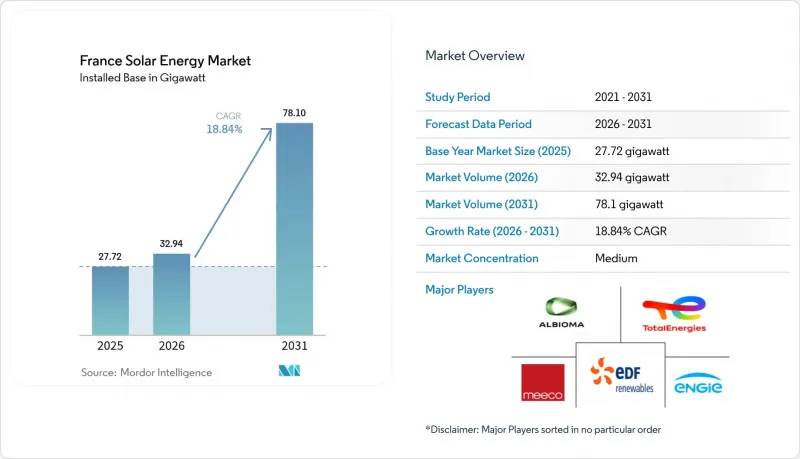
Mordor Intelligence에 의하면, 2026년 프랑스 태양광발전 시장 규모는 32.94기가와트라고 추정되며, 2025년 27.72기가와트에서 확대되어 2031년에는 78.1기가와트에 이를 것으로 예측됩니다.
또한, 2026년부터 2031년까지 연평균 성장률(CAGR) 18.84%를 기록하며 성장할 것으로 전망됩니다.
본 보고서는 기술별(태양광 발전 및 집광형 태양광 발전), 계통 연계 형태별(계통 연계형 및 독립형), 그리고 최종 사용자별(유틸리티 규모, 상업 및 산업용, 주거용)로 분류되어 있습니다. 시장 규모 및 예측은 설치 용량(GW) 단위로 표시되어 있습니다.
프랑스 태양광 발전 시장 동향 및 인사이트
FIT에서 CfD로의 전환이 투자자의 IRR을 뒷받침
정부가 설정하는 고정가격임베디드제도(FiT)에서 경쟁적인 차액결제계약(CfD) 경매로의 전환으로 납세자의 부담이 경감되는 동시에, 개발업체에게는 20년에 걸친 수익의 확실성이 보장되었습니다. 2024년 지상 설치형 입찰의 낙찰가는 전년의 63.3유로/MWh에 비해 54.45유로/MWh로 하락했으나, 은행이 시장 가격이 아닌 계약에 기반한 현금 흐름을 보증하고 있기 때문에 레버리지를 적용하지 않은 내부수익률(IRR)은 7-8% 선에서 유지되고 있습니다. 독립발전사업자(IPP)가 낙찰량의 48%를 확보함으로써, CfD가 시장 진입의 문을 넓혀 프랑스 태양광 시장의 다양화를 촉진하고 있음이 입증되었습니다. 현재, 입찰 보증금 몰수 조항에 따라 개발 사업자는 18개월 이내에 파이낸셜 클로즈를 달성해야 할 의무가 있으며, 이로 인해 조기 계통 연계 예약 및 보다 엄격한 실사 수행이 촉진되고 있습니다. 또한, 이 제도를 통해 현물 가격이 행사 가격을 초과할 경우, 국가는 초과 수익을 회수할 수 있어 재생에너지에 대한 공공 지원이 유지되고 있습니다.
LCOE 및 경매 정산 가격의 하락
2024년에는 양면 수광형 모듈의 효율이 21-22%에 달하고, 추적식 시스템 도입으로 발전량이 15-20% 향상됨에 따라 대규모 태양광 발전의 LCOE는 42-48유로/MWh까지 하락했습니다. 지붕형 태양광 발전 경매도 이러한 하락 추세를 반영하여, 2024년 100-500kW 시스템의 평균 낙찰 가격은 2023년의 105유로/MWh에서 89유로/MWh로 하락했습니다. 개발업체들은 두 자릿수 이익률을 유지하기 위해 공급망 합리화와 설계 표준화에 주력했습니다. 기업 구매자들은 즉시 이 기회를 포착했습니다. 2024년 토탈에너지(TotalEnergies)가 체결한 15년짜리 전력 구매 계약(PPA)에서는 전력 가격이 MWh당 52유로로 설정되었는데, 이는 소매 요금보다 저렴하며 그리드 패리티보다 낮은 수준입니다. 발전 비용의 하락으로 자가 소비형 태양광 발전 시스템의 투자 회수 기간이 6년 미만으로 단축되어, 프랑스 태양광 발전 시장에서 분산형 도입이 가속화되고 있습니다.
계통 연계 대기 목록과 인허가 지연
2024년에는 RTE의 변전소가 급증하는 신청 건수를 감당하지 못해 평균 계통 연계 기간이 18-24개월로 연장되었습니다. 생물 다양성 관련 규제가 강화됨에 따라 환경 영향 평가에 현재 12-18개월이 소요되고 있으며, 이의 제기로 인해 최대 1년이 추가되므로 경매에서 낙찰된 용량의 20-25%가 가동 개시 기한을 맞추지 못할 우려가 있습니다. 2024년에는 철도 및 고속도로 인근 프로젝트에 대한 신속 처리 절차가 도입되었으나, 지가 급등으로 인해 도입 진척이 더딘 상황입니다. 자금 면에서의 제약도 우려되고 있습니다. RTE의 연간 투자액은 20-30억 유로인 반면, 2035년까지 필요한 자금은 1,000억 유로에 달하기 때문에 지속적인 병목 현상이 발생하여 프랑스 태양광 발전 시장의 성장을 둔화시킬 가능성이 있습니다.
부문별 분석
태양광 발전(PV)은 설치량의 100.00%를 차지하며, 2025년에는 27.72 GW에 달할 것으로 예상되어 프랑스의 태양에너지 시장에서 PV의 절대적인 우위를 여실히 보여주고 있습니다. 집광형 태양열 발전(CSP)은 직접 표준 일사량이 1,400 kWh/m2를 넘는 경우가 거의 없어 CSP의 실용화 기준을 크게 밑돌고 있기 때문에 여전히 상업적인 도입은 보이지 않습니다. 결정질 실리콘 모듈이 95%의 점유율을 차지하는 한편, 지상 설치형 어레이의 45%에서 양면 패널이 채택되면서 발전량이 10-15% 향상되었습니다. 페로브스카이트-실리콘 탠덤 셀은 실증 실험에서 28%의 효율을 달성하여, 향후 성능 향상이 기대됩니다. 부유식 태양광 발전은 규모는 작지만, 토지가 제한된 저수지 등에서 확대되고 있으며, CRE(프랑스 재생에너지 기관)의 입찰에서는 축전 시스템을 통합한 하이브리드 프로젝트가 계속해서 우선적으로 선정되고 있습니다.
프랑스의 태양광 발전 시장은 기술의 급속한 성숙화의 혜택을 받고 있으며, 그 증거로 남부 지역에서 단축 추적기의 보급률이 60%에 달하고, 성능 비율을 2-3포인트 향상시키는 디지털 자산 관리 도구가 도입되고 있다는 점을 들 수 있습니다. 정책적 노력도 태양광 발전의 우위를 뒷받침하고 있으며, 입찰 용량의 80%는 지상 설치형 및 옥상 설치형 태양광 발전에 배정되고, 나머지는 하이브리드형 또는 농업용 태양광 발전(아그리 PV) 설계에 확보되어 있습니다. 앞으로 Carbon사의 3.4GW 헤테로접합 모듈 공장을 비롯한 국내 모듈 공장들이 공급망의 회복력을 높여, 2026년까지 현지 조달률 요건을 충족할 가능성이 있습니다.
기타 혜택:
- 엑셀 형식 시장 예측(ME) 시트
- 3개월간의 애널리스트 지원
자주 묻는 질문
목차
제1장 서론
제2장 조사 방법
제3장 주요 요약
제4장 시장 구도
제5장 시장 규모와 성장 예측
제6장 경쟁 구도
제7장 시장 기회와 향후 전망
LSH 26.08.24According to Mordor Intelligence, France solar energy market size in 2026 is estimated at 32.94 gigawatt, growing from 2025 value of 27.72 gigawatt with 2031 projections showing 78.1 gigawatt, growing at 18.84% CAGR over 2026-2031.
This report is Segmented by Technology (Solar Photovoltaic and Concentrated Solar Power), Grid Type (On-Grid and Off-Grid), and End-User (Utility-Scale, Commercial and Industrial, and Residential). The Market Sizes and Forecasts are Provided in Terms of Installed Capacity (GW).
France Solar Energy Market Trends and Insights
FiT-to-CfD Transition Sustaining Investor IRR
The move from administratively set tariffs to competitive CfD auctions cut taxpayer exposure while giving developers 20-year revenue certainty. The 2024 ground-mounted tender cleared at EUR 54.45/MWh versus EUR 63.3/MWh a year earlier, yet unlevered internal rates of return held near 7-8% as banks underwrite contracted cash flows instead of merchant prices. Independent power producers captured 48% of the awarded volume, proving that CfDs democratize participation and diversify the France solar energy market. Bid-bond forfeiture clauses now oblige developers to reach financial close within 18 months, prompting early grid-connection reservations and more rigorous due diligence practices. The structure also allows the state to claw back excess revenues if spot prices exceed the strike price, preserving public support for renewables.
Declining LCOE and Auction Clearing Prices
Utility-scale LCOE fell to EUR 42-48/MWh in 2024 as bifacial efficiencies hit 21-22% and tracker adoption boosted yields by 15-20%. Rooftop auctions mirrored this decline, averaging EUR 89/MWh for 100-500 kW systems in 2024, down from EUR 105/MWh in 2023. Developers responded by streamlining supply chains and standardizing designs to protect double-digit margins. Corporate buyers quickly seized the opportunity: a 15-year PPA signed by TotalEnergies in 2024 priced power at EUR 52/MWh, which is cheaper than retail tariffs and below grid parity. Lower generation costs have shortened payback periods for behind-the-meter arrays to under six years, catalyzing distributed adoption in the France solar energy market.
Grid Connection Queue and Permitting Delays
Average connection times lengthened to 18-24 months in 2024 as RTE's substations could not keep up with the surge in applications. Environmental impact assessments now take 12-18 months under stricter biodiversity rules, while appeals add up to another year, placing 20-25% of auctioned capacity in danger of missing commissioning deadlines. Although fast-track procedures for projects along railways and highways were introduced in 2024, higher land costs have slowed uptake. Funding constraints also loom; RTE invests EUR 2-3 billion annually against a EUR 100 billion need through 2035, implying sustained bottlenecks that could dampen the France solar energy market.
Other drivers and restraints analyzed in the detailed report include:
- 2030 Solar Plan 60 GW Target
- Mandatory PV on Parking Lots and Large Roofs
- Module Price Volatility
For complete list of drivers and restraints, kindly check the Table Of Contents.
Segment Analysis
Solar photovoltaic accounted for 100.00% of installations, underscoring the absolute dominance of PV within the France solar energy market at 27.72 GW in 2025. Concentrated solar power (CSP) remains commercially absent because direct normal irradiance seldom exceeds 1,400 kWh/m2, far below the threshold for CSP viability. Crystalline-silicon modules hold 95% share, while bifacial panels now appear in 45% of ground-mounted arrays, improving yields by 10-15%. Perovskite-silicon tandem cells reached 28% efficiency in pilot settings, hinting at future upgrades. Floating PV is small but growing on reservoirs where land is scarce, and CRE tenders continue to prioritize hybrid projects that integrate storage.
The France solar energy market benefits from rapid technology maturity, evidenced by single-axis tracker penetration of 60% in southern provinces and digital asset-management tools that raise performance ratios by 2-3 percentage points. Policy levers reinforce PV's edge; 80% of auction capacity is allocated to ground-mounted and rooftop PV, with the rest reserved for hybrid or agri-PV designs. Looking ahead, domestic module factories such as Carbon's 3.4 GW heterojunction facility improve supply-chain resilience and may satisfy local-content rules by 2026.
Complete Report Scope:
- By Technology
- Solar Photovoltaic (PV)
- Concentrated Solar Power (CSP)
- By Grid Type
- On-Grid
- Off-Grid
- By End-User
- Utility-Scale
- Commercial and Industrial (C&I)
- Residential
- By Component (Qualitative Analysis)
- Solar Modules/Panels
- Inverters (String, Central, Micro)
- Mounting and Tracking Systems
- Balance-of-System and Electricals
- Energy Storage and Hybrid Integration
List of Companies Covered in this Report:
- EDF Renewables
- ENGIE SA
- TotalEnergies SE
- Neoen SA
- Voltalia SA
- Albioma SA
- Urbasolar
- Photosol
- Sonnedix
- Akuo Energy
- Cap Vert Energie
- Reden Solar
- Amarenco
- Enerparc AG
- BayWa r.e.
- Quadran (Q Energy)
- Solairedirect
- Meeco AG
- Wagner Solar GmbH
- Arkolia Energies
Additional Benefits:
- The market estimate (ME) sheet in Excel format
- 3 months of analyst support
TABLE OF CONTENTS
1 Introduction
- 1.1 Study Assumptions & Market Definition
- 1.2 Scope of the Study
2 Research Methodology
3 Executive Summary
4 Market Landscape
- 4.1 Market Overview
- 4.2 Market Drivers
- 4.2.1 FiT-to-CfD transition sustaining investor IRR
- 4.2.2 Declining LCOE & auction clearing prices
- 4.2.3 2030 Solar Plan: 60 GW target
- 4.2.4 Mandatory PV on parking lots & large roofs
- 4.2.5 Agri-PV pilots unlocking farmland pipeline
- 4.2.6 Hybrid PV-storage design in CRE tenders
- 4.3 Market Restraints
- 4.3.1 Grid connection queue & permitting delays
- 4.3.2 Land-use & biodiversity opposition
- 4.3.3 Module price volatility amid global oversupply
- 4.3.4 Rising local-content requirements raising capex
- 4.4 Supply-Chain Analysis
- 4.5 Regulatory Landscape
- 4.6 Technological Outlook
- 4.7 Porters Five Forces
- 4.7.1 Threat of New Entrants
- 4.7.2 Bargaining Power of Suppliers
- 4.7.3 Bargaining Power of Buyers
- 4.7.4 Threat of Substitutes
- 4.7.5 Competitive Rivalry
- 4.8 PESTLE Analysis
5 Market Size & Growth Forecasts
- 5.1 By Technology
- 5.1.1 Solar Photovoltaic (PV)
- 5.1.2 Concentrated Solar Power (CSP)
- 5.2 By Grid Type
- 5.2.1 On-Grid
- 5.2.2 Off-Grid
- 5.3 By End-User
- 5.3.1 Utility-Scale
- 5.3.2 Commercial and Industrial (C&I)
- 5.3.3 Residential
- 5.4 By Component (Qualitative Analysis)
- 5.4.1 Solar Modules/Panels
- 5.4.2 Inverters (String, Central, Micro)
- 5.4.3 Mounting and Tracking Systems
- 5.4.4 Balance-of-System and Electricals
- 5.4.5 Energy Storage and Hybrid Integration
6 Competitive Landscape
- 6.1 Market Concentration
- 6.2 Strategic Moves (M&A, Partnerships, PPAs)
- 6.3 Market Share Analysis (Market Rank/Share for key companies)
- 6.4 Company Profiles (includes Global level Overview, Market level overview, Core Segments, Financials as available, Strategic Information, Products & Services, and Recent Developments)
- 6.4.1 EDF Renewables
- 6.4.2 ENGIE SA
- 6.4.3 TotalEnergies SE
- 6.4.4 Neoen SA
- 6.4.5 Voltalia SA
- 6.4.6 Albioma SA
- 6.4.7 Urbasolar
- 6.4.8 Photosol
- 6.4.9 Sonnedix
- 6.4.10 Akuo Energy
- 6.4.11 Cap Vert Energie
- 6.4.12 Reden Solar
- 6.4.13 Amarenco
- 6.4.14 Enerparc AG
- 6.4.15 BayWa r.e.
- 6.4.16 Quadran (Q Energy)
- 6.4.17 Solairedirect
- 6.4.18 Meeco AG
- 6.4.19 Wagner Solar GmbH
- 6.4.20 Arkolia Energies
7 Market Opportunities & Future Outlook
- 7.1 White-Space & Unmet-Need Assessment