|
시장보고서
상품코드
2120369
태국의 태양에너지 : 시장 점유율 분석, 업계 동향과 통계, 성장 예측(2026-2031년)Thailand Solar Energy - Market Share Analysis, Industry Trends & Statistics, Growth Forecasts (2026 - 2031) |
||||||
 Mordor Intelligence
Mordor Intelligence에 따르면 태국의 태양에너지 시장 규모는 2025년 5.20기가와트로부터 2026년에는 5.55기가와트로 확대하며, 2026-2031년에 CAGR 6.78%로 추이하며, 2031년에는 7.71기가와트에 달할 것으로 예측됩니다.
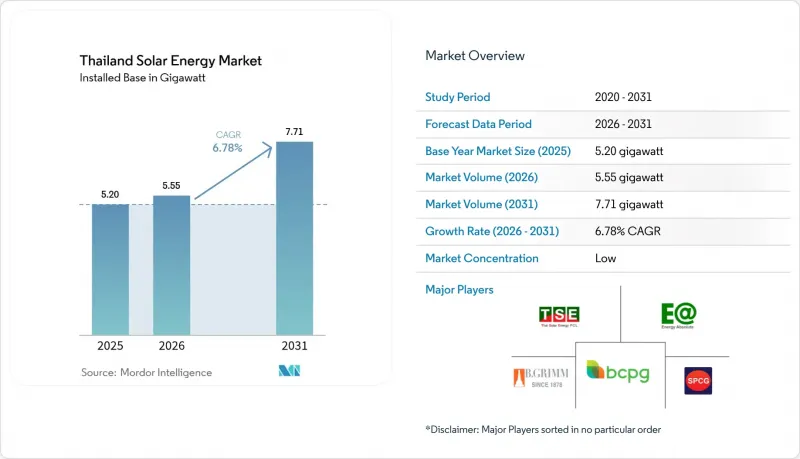
이 보고서는 기술별(태양광 및 집중형 태양광), 계통 연계 형태별(계통 연계형 및 독립형), 최종사용자별(유틸리티 규모, 상업·산업용, 주거용)로 분류되어 있습니다. 시장 규모 및 전망은 설치 용량(GW) 단위로 표시되어 있습니다.
태국 태양광 시장의 동향 및 인사이트
소매 전기 요금 상승 및 전력 가격 변동
2024년 소매 전기 요금은 1kWh당 4.15-4.18바트 수준을 유지했으나, 태국 전력공사(EGAT)는 누적 약 980억 바트의 적자를 보고했으며, 2025년 말까지 8-12%의 요금 인상이 이루어질 가능성이 높은 것으로 보입니다. 동부 경제 회랑(EEC)의 제조사들은 현재 옥상 태양광발전을 가스 가격 변동에 대한 헤지 수단으로 간주하고 있습니다. 이는 일반적인 1MW 규모의 설비라면 7년 이내에 투자 회수가 가능하기 때문입니다. 에너지 정책·기획국의 데이터에 따르면 가스 화력 발전소가 여전히 송전망 전력의 약 60%를 공급하고 있으며, 이로 인해 전기 요금은 LNG 현물 수입 가격에 연동되고 있습니다. 유럽연합(EU)의 탄소국경조정세(CBAM) 적용 대상인 상업용 구매자들은 수출 마진을 지키기 위해 태양광 에너지 도입을 가속화하고 있습니다. 그 결과 발생한 수요로 인해 태국의 태양광 시장은 온사이트 시스템과 제3자 자금 조달 시스템 모두에서 새로운 활력을 얻고 있습니다.
양면수광형 및 TOPCon 태양광 모듈의 급속한 비용 하락
2024년에는 양면수광형 모듈의 평균 가격이 1와트당 0.10-0.12달러까지 하락한 반면, TOPCon 셀은 비용이 약간 더 높을 뿐 24-25%의 효율을 달성했습니다. 개발업체들은 현재 수년에 걸친 공급 계약을 협상 중이며, 2027년까지 부품 가격을 고정하여 균등화 발전 비용을 안정화하고 있습니다. 자본 집약도의 감소로 인해 소규모 옥상 설치 프로젝트의 경우에도 넷 빌링 제도 하에서 5년 내에 투자 회수가 가능해졌습니다. 중국 공장의 공급 과잉으로 인해 제품이 동남아시아로 유입되면서 현지 가격은 더욱 하락했습니다. 2024년에는 태국에서 조립된 패널에 대한 미국의 반덤핑 관세로 인해 수출 경로가 재편되었지만, 국내 공급 과잉이 현지 프로젝트에 더 광범위한 가격 완화를 가져왔습니다.
장기화되는 계통 연계 승인 및 출력 억제 리스크
개발업자에 따르면 전력회사가 계통 연계를 승인하기 전에 전압 안정성 조사나 변전소 용량 심사를 수행해야 하므로 승인까지 6-18개월이 소요된다고 보고되고 있습니다. 10MW를 초과하는 프로젝트의 경우, 환경영향 평가나 국가에너지정책평의회의 승인도 필요하며, 이로 인해 착공 전 기간이 연장되고 보유 비용이 증가합니다. 2024년에는 태양광 에너지 도입률이 주간 수요의 18%를 초과한 배전선에서 발전 제한 발생 시간이 총 50시간에 달했습니다. 실시간 가격 책정이나 전력 저장 의무화가 없는 경우, 발전량 과잉으로 인해 강제 정지가 발생하여 프로젝트 수익에 타격을 입히게 됩니다. 이러한 장애로 인해 예측 성장률은 1퍼센트 포인트 가까이 하향 조정되었습니다.
부문별 분석
2025년 설치 용량의 100.00%를 태양광 시스템이 차지할 것으로 보이며, 2031년까지 연평균 6.72%의 성장률로 확대될 것으로 예상됩니다. 태국의 태양광 시장 규모는 2025년에 5.20 GW에 도달하고, 2031년까지 7.71 GW에 달할 것으로 예상됩니다. 태국의 습도가 높은 기후에서는 집광형 태양광이 경제적으로 현실적이지 않기 때문에 태양광 기술은 계속해서 큰 점유율을 유지할 것으로 보입니다. 반사된 일사량을 포착하는 양면수광형 모듈은 부유식 태양광발전 입찰에서 빠르게 표준화되고 있으며, 우볼라타나 프로젝트에서는 단면 수광형 어레이에 비해 5-8% 더 높은 출력이 확인되었습니다. 24-25%의 변환 효율을 자랑하는 TOPCon 셀은 토지 제약으로 인해 높은 가격 책정이 정당화되는 대규모 발전소 입찰에서 PERC 모듈을 앞지르고 있습니다.
지속적인 비용 하락으로 인해 태양광과 집광형 태양광의 경제적 격차는 확대되고 있습니다. 집광형 태양 에너지는 몬순 시즌에는 거의 달성되지 않는 ‘직사 일사량’ 수준을 필요로 하기 때문입니다. 에너지부가 발표한 2024년 고정가격매입제도(FIT) 일정에서는 집광형 태양열발전이 제외되어, 사실상 태양 에너지의 독점 체제가 굳어지고 있습니다. 앞으로 국제에너지기구(IEA)의 데이터에 따르면 2027년까지 모듈 가격이 추가로 15-20% 하락할 것으로 예측되고 있으며, 이에 따라 태국에서 태양광 기술이 상업적으로 실현 가능한 유일한 태양 에너지 옵션으로 남을 것이 확실시되고 있습니다.
기타 혜택:
- 엑셀 형식의 시장 예측(ME) 시트
- 3개월간의 애널리스트 지원
자주 묻는 질문
목차
제1장 서론
제2장 조사 방법
제3장 개요
제4장 시장 구도
제5장 시장 규모와 성장 예측
제6장 경쟁 구도
제7장 시장 기회와 향후 전망
KSA 26.09.02According to Mordor Intelligence, the Thailand solar energy market size is expected to grow from 5.20 gigawatt in 2025 to 5.55 gigawatt in 2026 and is forecast to reach 7.71 gigawatt by 2031 at 6.78% CAGR over 2026-2031.
This report is Segmented by Technology (Solar Photovoltaic and Concentrated Solar Power), Grid Type (On-Grid and Off-Grid), and End-User (Utility-Scale, Commercial and Industrial, and Residential). The Market Sizes and Forecasts are Provided in Terms of Installed Capacity (GW).
Thailand Solar Energy Market Trends and Insights
Rising Retail-Grid Tariffs and Electricity-Price Volatility
Retail tariffs remained at THB 4.15-4.18 per kWh in 2024; however, the Electricity Generating Authority of Thailand reported cumulative losses of nearly THB 98 billion, suggesting an 8-12% tariff hike by late 2025 is likely. Manufacturers in the Eastern Economic Corridor now view rooftop solar as a hedge against gas price swings, as a typical 1 MW installation pays for itself within seven years. Data from the Energy Policy and Planning Office show that gas-fired units still supply about 60% of the grid's electricity, linking tariffs to spot LNG imports. Commercial buyers facing European Union carbon-border fees have accelerated solar procurement to protect export margins. The resulting demand is giving the Thai solar energy market fresh momentum across both on-site and third-party financed systems.
Rapid Cost Decline of Bifacial and TOPCon PV Modules
Average bifacial module prices declined to USD 0.10-0.12 per watt in 2024, while TOPCon cells achieved 24-25% efficiencies at only marginally higher costs. Developers now negotiate multi-year supply contracts, locking in component prices to 2027 and stabilizing levelized energy costs. Lower capital intensity has enabled smaller rooftops to achieve five-year paybacks even under net-billing. Oversupply in Chinese factories diverted products to Southeast Asia, further pushing down local prices. Although United States antidumping tariffs on Thai-assembled panels reshuffled export channels in 2024, domestic oversupply created broader price relief for local projects.
Long-Cycle Grid-Connection Approvals and Curtailment Risks
Developers report approval times of six to eighteen months because utilities must conduct voltage-stability studies and substation-capacity reviews before granting interconnection. Projects larger than 10 MW also require environmental impact assessments and National Energy Policy Council sign-offs, which extend pre-construction periods and increase holding costs. In 2024, curtailment events totaled up to fifty hours in feeders where solar penetration exceeded 18% of daytime demand. Absent real-time pricing or mandatory storage, over-generation causes forced shutdowns that undermine project revenue. These obstacles shave nearly one percentage point off forecast growth.
Other drivers and restraints analyzed in the detailed report include:
- Direct PPA Pilot Opening Commercial and Industrial Demand
- Government Push for 2.7 GW Floating-Solar Hybrids
- Saturated Feeders in Bangkok and Eastern Economic Corridor
For complete list of drivers and restraints, kindly check the Table Of Contents.
Segment Analysis
Photovoltaic systems accounted for 100.00% of the installed capacity in 2025 and are expected to expand at a 6.72% growth rate through 2031. The Thailand solar energy market size for photovoltaic technology reached 5.20 GW in 2025 and is expected to reach 7.71 GW by 2031, maintaining a significant share, as concentrated solar power remains economically impractical under Thailand's humid climate. Bifacial modules that capture reflected irradiance are quickly becoming standard in floating-solar tenders, with the Ubolratana project registering 5-8% higher output than monofacial arrays. TOPCon cells, which offer 24-25% conversion efficiency, are overtaking PERC modules in utility-scale bids where land constraints justify premium pricing.
Continuous cost declines widen the economic gap between photovoltaic and concentrated solar power, which needs direct-normal-irradiance levels rarely achieved in the monsoon season. The Ministry of Energy's 2024 feed-in-tariff schedule excludes concentrated solar power, effectively cementing photovoltaics' monopoly. Looking forward, International Energy Agency data project module prices dropping another 15-20% by 2027, ensuring photovoltaic technologies remain the only commercially viable solar option in Thailand.
Complete Report Scope:
- By Technology
- Solar Photovoltaic (PV)
- Concentrated Solar Power (CSP)
- By Grid Type
- On-Grid
- Off-Grid
- By End-User
- Utility-Scale
- Commercial and Industrial (C&I)
- Residential
- By Component (Qualitative Analysis)
- Solar Modules/Panels
- Inverters (String, Central, Micro)
- Mounting and Tracking Systems
- Balance-of-System and Electricals
- Energy Storage and Hybrid Integration
List of Companies Covered in this Report:
- SPCG PLC
- BCPG PLC
- Thai Solar Energy PLC
- B.Grimm Power PLC
- Energy Absolute PLC
- Solartron PLC
- Delta Electronics (Thailand) PLC
- Huawei Technologies Co. Ltd.
- Sungrow Power Supply Co. Ltd.
- JinkoSolar Holding Co. Ltd.
- Trina Solar Co. Ltd.
- LONGi Green Energy Co. Ltd.
- Canadian Solar Inc.
- First Solar Inc.
- Risen Energy Co. Ltd.
- Seraphim Solar Group
- Sharp Energy Solutions Corp.
- Hitachi Energy Thailand
- Black & Veatch Holding Co.
- Marubeni Corp.
Additional Benefits:
- The market estimate (ME) sheet in Excel format
- 3 months of analyst support
TABLE OF CONTENTS
1 Introduction
- 1.1 Study Assumptions & Market Definition
- 1.2 Scope of the Study
2 Research Methodology
3 Executive Summary
4 Market Landscape
- 4.1 Market Overview
- 4.2 Market Drivers
- 4.2.1 Rising retail-grid tariffs & electricity-price volatility
- 4.2.2 Rapid cost decline of bifacial & TOPCon PV modules
- 4.2.3 Direct-PPA pilot opening C&I demand flood-gates
- 4.2.4 Government push for 2.7 GW floating-solar hybrids
- 4.2.5 Agro-PV programs easing land-acquisition risks
- 4.2.6 Growing demand for green RECs from export-oriented firms
- 4.3 Market Restraints
- 4.3.1 Long-cycle grid-connection approvals & curtailment risks
- 4.3.2 Saturated feeders in Bangkok & Eastern Economic Corridor
- 4.3.3 Rising import tariffs on Thai modules in US/EU markets
- 4.3.4 Limited domestic Li-ion cell production for BESS
- 4.4 Supply-Chain Analysis
- 4.5 Regulatory Landscape
- 4.6 Technological Outlook
- 4.7 Porter's Five Forces
- 4.7.1 Threat of New Entrants
- 4.7.2 Bargaining Power of Suppliers
- 4.7.3 Bargaining Power of Buyers
- 4.7.4 Threat of Substitutes
- 4.7.5 Industry Rivalry
- 4.8 PESTLE Analysis
5 Market Size & Growth Forecasts
- 5.1 By Technology
- 5.1.1 Solar Photovoltaic (PV)
- 5.1.2 Concentrated Solar Power (CSP)
- 5.2 By Grid Type
- 5.2.1 On-Grid
- 5.2.2 Off-Grid
- 5.3 By End-User
- 5.3.1 Utility-Scale
- 5.3.2 Commercial and Industrial (C&I)
- 5.3.3 Residential
- 5.4 By Component (Qualitative Analysis)
- 5.4.1 Solar Modules/Panels
- 5.4.2 Inverters (String, Central, Micro)
- 5.4.3 Mounting and Tracking Systems
- 5.4.4 Balance-of-System and Electricals
- 5.4.5 Energy Storage and Hybrid Integration
6 Competitive Landscape
- 6.1 Market Concentration
- 6.2 Strategic Moves (M&A, Partnerships, PPAs)
- 6.3 Market Share Analysis (Market Rank/Share for key companies)
- 6.4 Company Profiles (includes Global level Overview, Market level overview, Core Segments, Financials as available, Strategic Information, Products & Services, and Recent Developments)
- 6.4.1 SPCG PLC
- 6.4.2 BCPG PLC
- 6.4.3 Thai Solar Energy PLC
- 6.4.4 B.Grimm Power PLC
- 6.4.5 Energy Absolute PLC
- 6.4.6 Solartron PLC
- 6.4.7 Delta Electronics (Thailand) PLC
- 6.4.8 Huawei Technologies Co. Ltd.
- 6.4.9 Sungrow Power Supply Co. Ltd.
- 6.4.10 JinkoSolar Holding Co. Ltd.
- 6.4.11 Trina Solar Co. Ltd.
- 6.4.12 LONGi Green Energy Co. Ltd.
- 6.4.13 Canadian Solar Inc.
- 6.4.14 First Solar Inc.
- 6.4.15 Risen Energy Co. Ltd.
- 6.4.16 Seraphim Solar Group
- 6.4.17 Sharp Energy Solutions Corp.
- 6.4.18 Hitachi Energy Thailand
- 6.4.19 Black & Veatch Holding Co.
- 6.4.20 Marubeni Corp.
7 Market Opportunities & Future Outlook
- 7.1 White-space & Unmet-Need Assessment