

|
시장보고서
상품코드
2114478
중력 주조 시장 : 시장 점유율 분석, 업계 동향 및 통계, 성장 예측(2026-2031년)Gravity Die Casting - Market Share Analysis, Industry Trends & Statistics, Growth Forecasts (2026 - 2031) |
||||||
 Mordor Intelligence
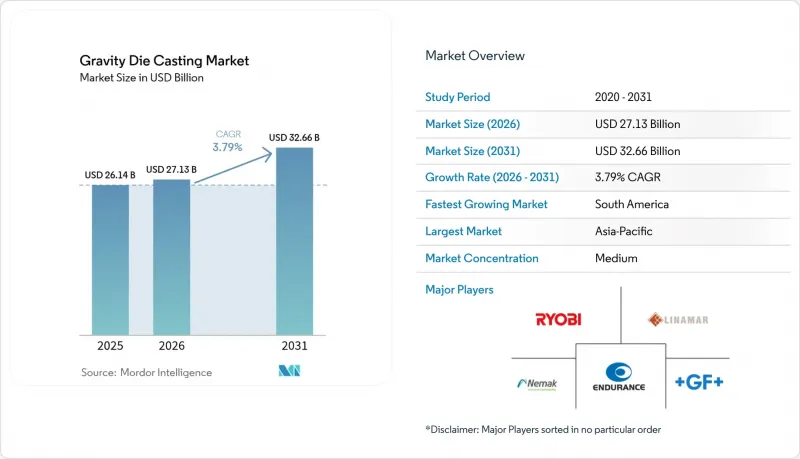
Mordor Intelligence에 의하면, 2026년 중력 주조 시장 규모는 271억 3,000만 달러로 추정되고, 2025년 261억 4,000만 달러에서 2031년에는 326억 6,000만 달러에 이를 것으로 예측됩니다.
2026-2031년 연평균 성장률(CAGR) 3.79%로 성장할 것으로 전망됩니다.
본 보고서는 재료 유형별(알루미늄 합금 등), 용도별(자동차 부품, 전기 및 전자 기기 등), 제품 유형별(엔진 블록, 변속기 하우징, 휠 등), 공정 유형별(표준 중력 다이캐스팅 및 틸트 포어링 중력 다이캐스팅), 그리고 지역별로 분류되어 있습니다. 시장 전망은 금액(달러) 기준으로 제시되어 있습니다.
세계의 중력 주조 시장 동향 및 인사이트
고강도 중력 주조용 합금의 채택
고급 A356 및 A380의 배합으로 인해 기계적 무결성을 유지하면서 유동성이 향상되었기 때문에 설계자는 섀시 브래킷 및 스티어링 하우징에서 주조 부품을 단조 부품으로 대체할 수 있게 되었습니다. 나노 입자 강화 AA7075는 얇은 터빈 휠에서 단조품에 가까운 인장 특성을 발휘함과 동시에 경량화를 실현하고 있으며, 이는 합금의 혁신을 통해 복잡한 부품도 중력 주조 시장의 범위에 포함될 수 있음을 보여줍니다. 희토류 원소를 배합함으로써 마그네슘 합금 개발자들은 갈바닉 부식 및 가연성에 대한 우려를 해소했습니다. 이러한 진전으로 인해 항공우주 구조물 및 전기자동차의 기어박스 커버에 마그네슘 주조를 적용할 수 있는 길이 열렸습니다. 사프란(Safran)이 보유한 첨단 초합금 블레이드 블랭크에 관한 특허는 중온 터빈 단계에서 인베스트먼트 주조보다 중력 주조가 점점 더 주류가 되고 있음을 뒷받침합니다. 고온 환경에서의 운용에 적합한 합금이 더욱 이용 가능해짐에 따라, 중력 주조의 적용 범위는 확대되고 있습니다.
자동화 및 틸트 포어를 통한 생산성 향상
서보 제어식 틸트 포어 셀은 주입 시 난류와 산화물 혼입을 줄여 초기 성형 수율을 향상시키는 동시에 사이클 타임을 단축합니다. 유럽과 미국에서는 로봇 기술이 숙련된 노동력 부족을 해소하고, 무인 연속 가동을 가능하게 하여 생산 유연성을 높이고 있습니다. 예를 들어, KUKA사의 자동 셀은 주입 프로파일을 기록하여 클라우드 기반 대시보드로 전송함으로써 워크플로우를 최적화하고 있습니다. 이러한 인사이트를 바탕으로 열 분포에 변화가 발생할 때 작동하는 예측 유지보수가 가능해져, 일관된 품질을 확보함과 동시에 가동 중지 시간을 최소화하고 있습니다. 또한, 중국의 여러 제조업체들은 특히 대칭형 기어 하우징에서 리버스 틸트 주조 기술을 채택함으로써 재료 효율을 높이고 폐기물을 줄이고 있습니다. 이 기법은 긴 러너 시스템을 불필요하게 만들어 금속 사용을 최적화할 뿐만 아니라, 생산 공정의 합리화도 도모합니다. 이러한 혁신 기술들이 종합적으로 다이캐스팅 업계를 변화시키고 있습니다. 자동화, 데이터 분석 및 공정 발전을 결합함으로써 효율 향상, 스크랩 감소, 그리고 다품종 생산 요구에 대한 대응을 실현하고 있습니다.
대량 생산 부품에서의 HPDC로의 전환
고압 다이캐스팅(HPDC)은 사이클 타임이 짧고 비용 효율이 뛰어나기 때문에 하우징이나 브래킷 등의 부품 제조에 점점 더 널리 채택되고 있습니다. 제조 능력의 확대로 확장성이 향상되고 단가가 절감되므로, HPDC는 중력 주조를 대체할 수 있는 경쟁력 있는 대안이 되고 있습니다. 고연성 합금의 기술 발전으로 충돌 안전 기준을 충족하는 얇은 두께 구현이 가능해져, 안전성을 저해하지 않으면서 경량화를 지원하고 있습니다. OEM 간 세계 플랫폼 공유를 통해 재검증이 필요 없이 단일 금형 세트를 여러 거점에서 공용할 수 있게 되어, 물류가 합리화되고 시장 출시까지의 시간이 단축됩니다. HPDC의 우수한 표면 마감 덕분에 휠이나 브래킷 등의 부품에서 2차 가공이 불필요한 경우가 많아, 대량 생산 및 비용 효율성을 중시하는 용도에서 중력 주조에 대한 비용적 우위가 더욱 강화됩니다.
부문 분석
2025년, 알루미늄은 중력 다이캐스팅 시장에서 80.12%의 점유율을 차지했습니다. 이는 전 세계적인 재활용 노력과 유동성과 인장 강도의 균형을 모두 갖춘 표준 합금이 주도한 결과입니다. 마그네슘은 희토류 합금화 기술의 발전으로 가연성 문제가 해결되고, 프리미엄 전기차용 경량 드라이브 케이싱에 대한 수요가 증가함에 따라 2031년까지 연평균 성장률(CAGR) 4.68%로 시장을 주도할 것으로 전망됩니다. 알루미늄은 주조 원료의 대부분을 공급하는 광범위한 스크랩 네트워크의 혜택을 받고 있으며, 이를 통해 원자재 비용 변동이 억제되고, EU의 에코디자인 감사에서 지속 가능한 제품으로서의 주장도 뒷받침되고 있습니다. 아시아의 제련소는 수력 발전 기반의 저탄소 1차 알루미늄을 공급하고 있어, 스코프 3 배출량 감축을 목표로 하는 유럽의 OEM 제조업체들로부터 관심을 받고 있습니다.
알루미늄은 열교환기 플레이트, 실린더 헤드, 인버터 하우징 덮개에서 여전히 지배적인 위치를 유지하고 있으며, 이러한 부품에서는 실리콘 첨가를 통해 주조 시 유동성과 기밀성이 향상되고 있습니다. 한편, 마그네슘은 다이캐스팅 방식의 변속기 케이스에 그치지 않고, 방화벽 보강재 및 시트 프레임으로 용도가 확대되고 있습니다. 이는 쇼트피닝을 통한 표면 경화로 인해 100 MPa에서 피로 수명이 1,000만 사이클까지 향상되기 때문입니다. 유럽에서는 차량 중량이 1,000kg 미만인 경우 적용되는 우대 조치가 마그네슘의 보급에 더욱 박차를 가하고 있습니다.
2025년, 중력 주조 시장의 62.55%를 자동차 부품이 차지했으며, 이는 주로 엔진 블록 및 변속기 하우징에 관한 장기 계약에 기인합니다. 대조적으로, 항공우주 부품은 2026-2031년 연평균 성장률(CAGR) 4.61%로 가장 높은 성장률을 보일 것으로 예측됩니다. 하이브리드 및 배터리 플랫폼으로의 전환을 추진하는 각 자동차 제조업체는 레인지 익스텐더 모듈 및 상용 픽업 트럭용 대형 터보 디젤 프로그램에서 중력 주조를 통한 엔진 블록 채택을 유지하고 있습니다. 서브프레임 및 서스펜션 너클과 같은 차량 구조 부품의 경우, 강도 요구 사항이 HPDC 합금의 강도 요구 사항을 초과하는 경우 중력 주조가 적합한 경우가 많습니다.
항공우주 분야에서는 주조 알루미늄으로 제작된 리브와 윙렛용 금속 부품이 빌렛 가공에 비해 기계 가공 폐기물을 줄일 수 있기 때문에 2020년부터 2023년까지의 침체기를 거쳐 항공사들의 납품이 확대되는 가운데 비용 면에서 큰 이점을 제공합니다. 더 높은 추력 대 중량비를 가진 터빈을 추구하는 방위 프로그램에서는 고비용의 인베스트먼트 주조를 대체하는 중력 주조를 통한 초합금 스테이터 베인의 평가가 진행되고 있습니다. 전자기기용 주조품 또한 유망한 분야입니다. 5G 기지국 케이스에는 EMI 차폐와 열전도 경로가 요구되지만, 중력 주조 알루미늄은 압출 성형된 케이스보다 이를 더 효율적으로 실현합니다.
지역별 분석
2025년, 아시아태평양은 중력 다이캐스팅 시장의 46.78% 점유율을 차지했습니다. 이는 중국의 광범위한 합금 공급망과 수직 통합된 주조 클러스터에 힘입은 결과입니다. 각 지역 정부는 주전로와 금형에 센서를 통합하는 ‘인더스트리 4.0’으로의 전환을 위해 보조금을 지급하고 있으며, 유럽보다 신속하게 디지털화 도입을 추진하고 있습니다. 일본의 항공우주 및 정밀 전자기기 부문에서는 고신뢰성 주조품에 대한 프리미엄 수요가 지속되는 반면, 한국의 1차 공급업체들은 로봇 공학을 활용하여 미국계 현지 법인에 e-액슬 하우징을 수출하고 있습니다.
남미는 미국의 OEM 기업들이 조달처를 다각화하는 가운데, 브라질과 멕시코로의 자동차 산업 니어쇼어링이 추진력이 되어 2031년까지 4.78%라는 가장 높은 연평균 성장률(CAGR)을 보일 것으로 예측됩니다. 칠레와 페루의 광업 확대에 따라 대형 분쇄기 프레임과 굴삭기 암이 필요해지고 있으며, 이러한 부품의 경우 용접 가공품보다 두꺼운 두께의 중력 주조 부품이 선호되고 있습니다. 브라질의 현지 조달 의무는 지역 금형 설계 센터의 발전을 촉진하여 리드 타임 단축과 주요 금형에 대한 수입 관세 인하로 이어지고 있습니다. 북미에서는 숙련된 노동자 부족 문제를 해결하기 위해 자동화가 우선시되고 있으며, 미시간주와 온타리오주의 공장에서는 클라우드 기반 품질 대시보드와 연동된 로봇을 이용한 틸트 주조 라인이 도입되고 있습니다. 환경 허가 취득 절차는 EU 규제에 비해 비교적 완만하지만, 에너지 비용 상승으로 인해 폐쇄형 용광로의 열 회수 프로젝트가 촉진되고 있습니다. 유럽에서는 VOC(휘발성 유기 화합물) 및 분진에 관한 규제가 강화되어 규정 준수 비용은 증가하고 있지만, 저탄소 알루미늄 주물의 수출 기회도 생겨나고 있습니다. 중동 및 아프리카는 항공기 MRO 부품과 방위용 포탄에 초점을 맞추며 주요 시장으로 부상하고 있습니다.
기타 혜택 :
- 엑셀 형식 시장 예측(ME) 시트
- 3개월간의 애널리스트 지원
자주 묻는 질문
목차
제1장 서론
제2장 조사 방법
제3장 주요 요약
제4장 시장 구도
제5장 시장 규모 및 성장 예측
제6장 경쟁 구도
제7장 시장 기회 및 향후 전망
AJY 26.08.26According to Mordor Intelligence, gravity die casting market size in 2026 is estimated at USD 27.13 billion, growing from 2025 value of USD 26.14 billion with 2031 projections showing USD 32.66 billion, growing at 3.79% CAGR over 2026-2031.
This report is Segmented by Material Type (Aluminum Alloys, and More), Application (Automotive Components, Electrical & Electronics, and More), Product Type (Engine Blocks, Transmission Housings, Wheels, and More), Process Type (Standard Gravity Die Casting and Tilt-Pouring Gravity Die Casting), and Geography. The Market Forecasts are Provided in Terms of Value (USD).
Global Gravity Die Casting Market Trends and Insights
Adoption of High-Strength Gravity-Cast Alloys
Advanced A356 and A380 formulations enhance fluidity while maintaining mechanical integrity, allowing designers to replace cast parts with forgings in chassis brackets and steering housings. Nanoparticle-reinforced AA7075 achieves near-wrought tensile properties and mass savings in thin-wall turbine wheels, illustrating how alloy innovations enable complex parts to remain within the gravity die casting market. By incorporating rare earth elements, developers of magnesium alloys have addressed concerns related to galvanic corrosion and flammability. This advancement paves the way for magnesium casting in aerospace structures and electric vehicle gearbox covers. Safran's patents on advanced super-alloy blade blanks underscore the growing dominance of gravity casting over investment casting in medium-temperature turbine stages. As more alloys become available for higher-temperature operations, the applications for gravity casting are expanding.
Automation and Tilt-Pour Productivity Gains
Servo-controlled tilt-pour cells cut fill turbulence and oxide inclusion, lifting first-pass yield rates and trimming cycle time . Across Europe and the United States, robotics is addressing skilled labor shortages, facilitating continuous unmanned operations, and boosting production flexibility. For instance, KUKA's automated cells are refining workflows by logging pour profiles and relaying them to cloud-based dashboards. Such insights enable predictive maintenance, which activates when thermal patterns shift, ensuring consistent quality and minimizing downtime. Additionally, Chinese manufacturers are enhancing material efficiency and cutting waste by adopting reverse-tilt casting techniques, especially for symmetric gear housings. This approach, which dispenses with extended runner systems, not only optimizes metal use but also streamlines production. Collectively, these innovations are transforming the die casting industry, combining automation, data analytics, and process advancements to enhance efficiency, reduce scrap, and meet the demands of high-mix manufacturing.
HPDC Substitution in High-Volume Parts
High-pressure die casting (HPDC) is increasingly used for producing components such as housings and brackets due to its fast cycle times and cost efficiency. Expanding manufacturing capacity enhances scalability, reduces unit costs, and makes HPDC a competitive alternative to gravity casting. Advancements in high-ductility alloys enable thinner walls that meet crash standards, supporting lightweighting without compromising safety. Global platform sharing among OEMs allows a single mold set to be used across multiple sites without requiring revalidation, streamlining logistics, and speeding up the time-to-market. HPDC's superior surface finishes often eliminate the need for secondary machining on components like wheels and brackets, further strengthening its cost advantage over gravity casting in high-volume, cost-sensitive applications.
Other drivers and restraints analyzed in the detailed report include:
- Automotive and EV Lightweighting Push
- Regulatory Fuel-Efficiency Mandates
- OEM Giga Casting Cannibalization Risk
For complete list of drivers and restraints, kindly check the Table Of Contents.
Segment Analysis
Aluminum held an 80.12% gravity die casting market share in 2025, driven by global recycling initiatives and standard alloys, which strike a balance between flow and tensile strength. Magnesium is set to outpace at a 4.68% CAGR through 2031 as breakthroughs in rare-earth alloying tackle flammability, pushing the gravity die casting market toward lighter drive casings in premium EVs. Aluminum benefits from a vast scrap network that supplies most of its foundry feedstock, dampening raw material cost swings and supporting sustainable product claims under EU ecodesign audits. Asian smelters offer low-carbon primary aluminum backed by hydroelectric power, raising interest from European OEMs seeking Scope 3 emission cuts.
Aluminum's dominance persists in heat-exchanger plates, cylinder heads, and inverter housing lids, where silicon additions confer casting fluidity and pressure tightness. Magnesium, meanwhile, is expanding beyond die-cast transmission cases into firewall stiffeners and seat frames, due to shot-peen surface hardening, which increases fatigue life to 10 million cycles at 100 MPa. Incentives in Europe for vehicles with a curb weight of under 1,000 kg add extra impetus for Mg penetration.
The automotive component accounted for 62.55% of the gravity die casting market size in 2025, primarily due to long-term contracts for engine blocks and transmission housings. In contrast, the aerospace parts are forecasted to grow at the fastest rate, with a 4.61% CAGR from 2026 to 2031. Automakers shifting to hybrid and battery platforms are maintaining gravity-cast engine blocks for range-extender modules and larger turbo-diesel programs aimed at commercial pickups. Structural vehicle parts, such as subframes and suspension knuckles, often justify gravity casting when the strength requirements exceed those of HPDC alloys.
In aerospace, cast aluminum ribs and winglet fittings reduce machining waste compared to billet routes, presenting a compelling cost case as airlines ramp up deliveries after a 2020-2023 downturn. Defense programs seeking higher thrust-to-weight turbines are evaluating gravity-cast super-alloy stator vanes that replace costlier investment-castings. Electronics castings are another bright spot; 5G base-station housings demand EMI shielding and thermal paths that gravity cast aluminum provides more efficiently than extruded boxes.
Complete Report Scope:
- By Material Type
- Aluminum Alloys
- Zinc Alloys
- Magnesium Alloys
- By Application
- Automotive Components
- Electrical and Electronics
- Aerospace Parts
- Industrial Machinery
- Consumer Goods
- By Product Type
- Engine Blocks
- Transmission Housings
- Wheels
- Die-Cast Housings
- Structural Components
- Others
- By Process Type
- Standard Gravity Die Casting
- Tilt-Pouring Gravity Die Casting
- By Geography
- North America
- United States
- Canada
- Rest of North America
- South America
- Brazil
- Argentina
- Rest of South America
- Europe
- Germany
- United Kingdom
- France
- Italy
- Spain
- Rest of Europe
- Asia-Pacific
- China
- India
- Japan
- South Korea
- Rest of Asia-Pacific
- Middle East and Africa
- United Arab Emirates
- Saudi Arabia
- South Africa
- Turkey
- Rest of Middle East and Africa
- North America
Geography Analysis
Asia-Pacific held 46.78% of the gravity die casting market share in 2025, anchored by China's extensive alloy supply chain and vertically integrated casting clusters. Regional governments subsidize Industry 4.0 retrofits that embed sensors in ladles and dies, driving digital adoption faster than in Europe. Japan's aerospace and precision electronics sectors sustain premium demand for high-integrity castings, while South Korea's Tier-1 suppliers leverage robotics to export e-axle housings to US transplants.
South America is expected to record the fastest CAGR of 4.78% through 2031, driven by automotive nearshoring to Brazil and Mexico as the United States OEMs diversify their sourcing. Mining expansions in Chile and Peru require large crusher frames and excavator arms, which favor thick-section, gravity-cast components over fabricated ones. Local content mandates in Brazil stimulate regional die design centers, shortening lead times and lowering import duties on critical tooling. North America prioritizes automation to counter skilled labor shortages, with Michigan and Ontario plants installing robotic tilt-pour lines linked to cloud-based quality dashboards. Environmental permitting processes remain comparatively lenient versus EU rules, yet rising energy costs encourage closed-loop furnace heat recovery projects. Europe tightens VOC and dust rules, raising compliance costs but creating opportunities for exporting low-carbon aluminum castings. The Middle East and Africa are emerging as key markets, focusing on aircraft MRO parts and defense shells.
- Nemak SAB de CV
- Endurance Technologies Ltd.
- Ryobi Ltd.
- Pace Industries LLC
- Bocar SA de CV
- Sundaram-Clayton Ltd.
- Shiloh Industries Inc.
- LTH Castings
- Rockman Industries
- Linamar Corporation
- Koch Enterprises (Gibbs)
- Hitchiner Mfg. Co.
- ATA Casting Technology Co.
- Georg Fischer AG
- Sunrise Metal Technology
- Alcoa Corporation
Additional Benefits:
- The market estimate (ME) sheet in Excel format
- 3 months of analyst support
TABLE OF CONTENTS
1 Introduction
- 1.1 Study Assumptions and Market Definition
- 1.2 Scope of the Study
2 Research Methodology
3 Executive Summary
4 Market Landscape
- 4.1 Market Overview
- 4.2 Market Drivers
- 4.2.1 Automotive and EV Lightweighting Push
- 4.2.2 Adoption of High-Strength Gravity-Cast Alloys
- 4.2.3 Regulatory Fuel-Efficiency Mandates
- 4.2.4 Automation and Tilt-Pour Productivity Gains
- 4.2.5 EU BAT-Driven Low-VOC Compliance Demand
- 4.2.6 AM-Enabled Complex Core Designs
- 4.3 Market Restraints
- 4.3.1 HPDC Substitution in High-Volume Parts
- 4.3.2 Aluminum and Mg Price Volatility
- 4.3.3 Skilled-Operator Shortage for Tilt-Pour Lines
- 4.3.4 OEM Giga Casting Cannibalization Risk
- 4.4 Value / Supply-Chain Analysis
- 4.5 Regulatory Landscape
- 4.6 Technological Outlook
- 4.7 Porter's Five Forces
- 4.7.1 Bargaining Power of Suppliers
- 4.7.2 Bargaining Power of Buyers
- 4.7.3 Threat of New Entrants
- 4.7.4 Threat of Substitutes
- 4.7.5 Competitive Rivalry
5 Market Size and Growth Forecasts (Value (USD))
- 5.1 By Material Type
- 5.1.1 Aluminum Alloys
- 5.1.2 Zinc Alloys
- 5.1.3 Magnesium Alloys
- 5.2 By Application
- 5.2.1 Automotive Components
- 5.2.2 Electrical and Electronics
- 5.2.3 Aerospace Parts
- 5.2.4 Industrial Machinery
- 5.2.5 Consumer Goods
- 5.3 By Product Type
- 5.3.1 Engine Blocks
- 5.3.2 Transmission Housings
- 5.3.3 Wheels
- 5.3.4 Die-Cast Housings
- 5.3.5 Structural Components
- 5.3.6 Others
- 5.4 By Process Type
- 5.4.1 Standard Gravity Die Casting
- 5.4.2 Tilt-Pouring Gravity Die Casting
- 5.5 By Geography
- 5.5.1 North America
- 5.5.1.1 United States
- 5.5.1.2 Canada
- 5.5.1.3 Rest of North America
- 5.5.2 South America
- 5.5.2.1 Brazil
- 5.5.2.2 Argentina
- 5.5.2.3 Rest of South America
- 5.5.3 Europe
- 5.5.3.1 Germany
- 5.5.3.2 United Kingdom
- 5.5.3.3 France
- 5.5.3.4 Italy
- 5.5.3.5 Spain
- 5.5.3.6 Rest of Europe
- 5.5.4 Asia-Pacific
- 5.5.4.1 China
- 5.5.4.2 India
- 5.5.4.3 Japan
- 5.5.4.4 South Korea
- 5.5.4.5 Rest of Asia-Pacific
- 5.5.5 Middle East and Africa
- 5.5.5.1 United Arab Emirates
- 5.5.5.2 Saudi Arabia
- 5.5.5.3 South Africa
- 5.5.5.4 Turkey
- 5.5.5.5 Rest of Middle East and Africa
- 5.5.1 North America
6 Competitive Landscape
- 6.1 Market Concentration
- 6.2 Strategic Moves
- 6.3 Market Share Analysis
- 6.4 Company Profiles (Includes Global level Overview, Market level overview, Core Segments, Financials as available, Strategic Information, Market Rank/Share for key companies, Products and Services, and Recent Developments)
- 6.4.1 Nemak SAB de CV
- 6.4.2 Endurance Technologies Ltd.
- 6.4.3 Ryobi Ltd.
- 6.4.4 Pace Industries LLC
- 6.4.5 Bocar SA de CV
- 6.4.6 Sundaram-Clayton Ltd.
- 6.4.7 Shiloh Industries Inc.
- 6.4.8 LTH Castings
- 6.4.9 Rockman Industries
- 6.4.10 Linamar Corporation
- 6.4.11 Koch Enterprises (Gibbs)
- 6.4.12 Hitchiner Mfg. Co.
- 6.4.13 ATA Casting Technology Co.
- 6.4.14 Georg Fischer AG
- 6.4.15 Sunrise Metal Technology
- 6.4.16 Alcoa Corporation


