

|
시장보고서
상품코드
2114488
다이캐스팅 기계 시장 : 시장 점유율 분석, 업계 동향 및 통계, 성장 예측(2026-2031년)Die Casting Machinery - Market Share Analysis, Industry Trends & Statistics, Growth Forecasts (2026 - 2031) |
||||||
 Mordor Intelligence
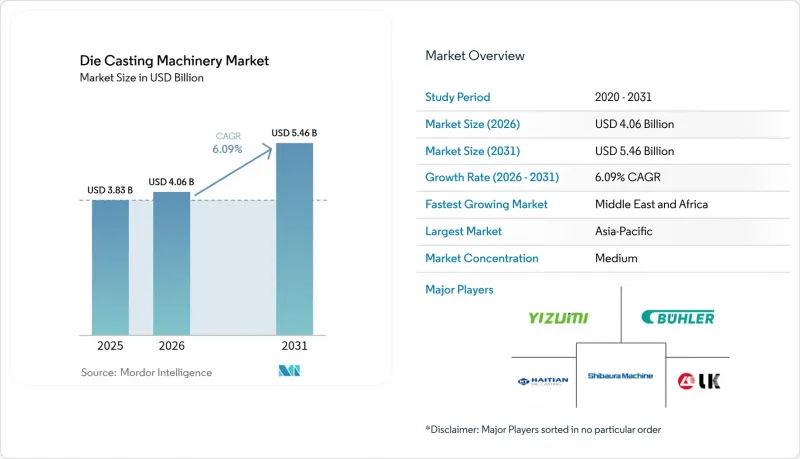
Mordor Intelligence에 의하면, 다이캐스팅 기계 시장 규모는 2025년 38억 3,000만 달러로 평가되었고, 2026년에는 40억 6,000만 달러로 추정되고, 2026-2031년 CAGR 6.09%로 성장을 지속할 전망이며, 2031년에는 54억 6,000만 달러에 이를 것으로 예측됩니다.
본 보고서는 기계 유형별(핫 챔버 다이캐스팅 기계 및 콜드 챔버 다이캐스팅 기계), 재료 유형별(알루미늄 등), 최종 사용자 산업별(자동차, 전기 및 전자 기기 등), 펀칭 능력별(50톤 미만 등), 자동화 수준별(수동, 반자동, 완전 자동), 및 지역별로 분류되어 있습니다. 시장 예측은 금액(달러) 기준으로 제시되어 있습니다.
세계의 다이캐스팅 기계 시장 동향 및 인사이트
EV 주도형 메가 및 기가 주조 수요의 급증
고톤수 프레스 기계는 리어 언더바디 주조품을 단일 부품으로 생산하여 여러 구성 요소를 대체함으로써 생산 효율을 높입니다. 테슬라 프로그램의 성공에 힘입어 포드, 볼보, GM은 차량의 전체 수명 주기 동안 기가 프레스를 통한 공급에 의존하는 구조 아키텍처 도입을 단행했습니다. Wanfeng Aowe를 비롯한 중국의 OEM 기업들은 섀시 일체형 배터리 팩 수요를 확보하기 위해 마그네슘 메가 주조 시험을 확대되고 있습니다. 경쟁이 치열해지는 가운데, 다이캐스팅 기계 시장은 기존의 중톤수 라인과 중요한 구조 부품에 특화된 고액 투자형 기가 프레스 설비라는 두 가지 명확한 부문으로 분화되고 있습니다. 배터리와 섀시의 통합이 설계 표준으로 자리 잡음에 따라, 수요 전망은 2030년 이후까지 이어지며, 3개 대륙에 걸친 여러 공장에 대한 투자 열풍이 확실시되고 있습니다.
전자 기기의 소형화가 핫 챔버 수요를 끌어올리고 있다.
반도체 패키징의 진화에 따라 고정밀 다이캐스팅 솔루션에 대한 수요가 급증하고 있습니다. 범프 피치가 좁아짐에 따라, 엄격한 가공 공차를 자랑하는 하우징 및 히트 스프레더에 대한 수요가 높아지고 있습니다. 이러한 엄격한 기준을 충족하기 위해, 특히 아연과 마그네슘을 사용하는 고속 사이클 핫 챔버 시스템이 주목받고 있습니다. TSMC나 인텔과 같은 대기업을 지원하는 주조 제조업체들은 현대 전자기기 제조의 요구에 부응하기 위해, 뛰어난 용융금속 온도 제어와 빠른 사이클 타임을 실현하는 멀티 슬라이드 주조 셀을 채택하고 있습니다. 5G 인프라 분야에서는 대규모 마그네슘 주조 라인이 안테나 하우징 등 경량 부품을 공급하고 있으며, 이는 핫 챔버 주조 기술의 유용성을 더욱 입증하고 있습니다. 다이아몬드 반도체나 양자 컴퓨팅과 같은 새로운 응용 분야에서는 고도의 열 관리가 요구될 것으로 예상되어, 핫 챔버 시스템의 중요성은 더욱 높아지고 있습니다. 다양한 제품 유형에 신속하게 대응할 수 있기 때문에 유연성과 정밀도가 요구되는 다품종 생산 환경에서 핫 챔버 시스템은 이상적인 선택지가 되고 있습니다.
알루미늄 및 마그네슘 가격 변동
2024년, LME의 알루미늄 가격은 1미터톤당 2,100달러에서 2,400달러 사이에서 변동했으나, 마그네슘 가격은 중국 공급이 집중되어 있어 더욱 격렬한 등락을 보였습니다. 완성 부품의 중요한 비용 요소인 원자재는 주조 마진에 압박을 가하고 있습니다. 주조 제조업체들은 가격 변동을 관리하기 위해 헤지 전략을 채택하고 있습니다. 생산량은 증가하고 있음에도 불구하고, 일부 제조업체는 투입 비용의 변동으로 인해 매출 감소에 직면하고 있습니다. 에너지 비용, 특히 용해로용 전력은 수익성에 큰 영향을 미치고 있습니다. 가격의 급등은 즉각적인 재정적 부담으로 이어집니다. 주조 제조업체들은 공급처 다각화나 합금 대체와 같은 단기적 대책을 강구하고 있지만, 이는 일시적인 완화책에 불과합니다. 비용의 불안정성이 지속됨에 따라 다이캐스팅 기계 시장에 대한 투자는 주춤하고 있으며, 기술 발전이 계속되고 있음에도 불구하고 이해관계자들은 신중한 태도를 취하고 있습니다.
부문 분석
2025년, 다이캐스팅 기계 시장 점유율의 63.72%를 콜드 챔버 방식이 차지했으며, 이는 고온 알루미늄 합금에 대한 적합성을 반영하고 있습니다. 핫 챔버식 기계는 도입 대수는 적지만, 전자제품 관련 수주가 확대됨에 따라 연평균 성장률(CAGR) 6.58%로 성장을 지속하고 있습니다. 각 OEM 업체들이 EV 차체의 단일 주조 부품으로의 전환을 추진함에 따라, 기가 프레스·콜드 챔버 라인과 관련된 다이캐스팅 기계 시장 규모는 확대되고 있으며, 평균 톤수도 상승 추세를 보이고 있습니다. 현재 두 기계 등급 모두에 통합형 서보 샷 시스템과 폐쇄 루프 냉각 시스템이 탑재되면서 기능의 수렴이 진행되고 있는 것으로 나타났습니다.
핫 챔버의 틈새 시장에서는 아연용 멀티 슬라이드 플랫폼이 5G 무선 기기 케이스에 요구되는 30초의 택트 타임 요건을 충족하는 반면, 마그네슘 시스템은 내식성보다 경량화가 우선시되는 분야에서 우위를 발휘하고 있습니다. 인더스트리 4.0 모듈은 두 유형의 기계 모두에 사후 장착이 가능하며, 용융 금속 및 플런저 데이터를 수집하여 클라우드 분석에 활용하고 있습니다. 열 회수 옵션과 하이브리드 구동식 유압 시스템을 통해 전력 소비가 절감되고 총 소유 비용이 개선되고 있습니다. 품질 허용 범위가 좁아지는 가운데, 두 유형의 기계 모두 프레스 출구에서 니어넷 형상을 검증하기 위해 인라인 X선 및 초음파 검사를 채택하고 있습니다. 각 OEM사의 듀얼 공급업체 조달 전략에 따라 다이캐스팅 기계 시장 전체에서 수요의 다양성이 유지되고 있습니다.
알루미늄은 EV 플랫폼에서 뛰어난 강도 대 중량 비율을 가지고 있어, 2025년 다이캐스팅 기계 시장 규모에서 72.75%라는 압도적인 점유율을 차지했습니다. 알루미늄보다 35% 가벼운 마그네슘은 통신 기기 및 노트북 케이스의 경량화 추세에 힘입어 2031년까지 연평균 성장률(CAGR) 7.42%로 성장할 전망입니다. 자동차 기가캐스팅에서는 충돌 시 에너지 흡수를 위해 여전히 알루미늄이 사용되고 있지만, 내장용 브래킷이나 스티어링 휠에는 마그네슘이 점점 더 많이 채택되고 있습니다.
아연은 짧은 사이클 타임에서 치수 안정성이 높이 평가되고 있어, 복잡한 형상의 하드웨어나 MEMS 하우징에 여전히 필수적인 소재입니다. 알루미늄·스칸듐 등의 새로운 합금군은 배터리 케이스의 용접성을 향상시켜 적용 범위를 넓히고 있습니다. 비철금속 가격 변동에 따라 사용자들은 선물 계약을 기반으로 합금을 혼합하고 있습니다. 그러나 미션 크리티컬 부품의 경우, 비용 요인보다 성능 요건이 점점 더 우선시되고 있습니다. 용융 품질을 지속적으로 모니터링함으로써 보온로를 오염시키지 않고 합금을 전환할 수 있게 되었으며, 이 기법은 다이캐스팅 기계 시장 전반에 걸쳐 보급되고 있습니다.
지역별 분석
아시아태평양은 중국의 비용 효율이 뛰어난 공급망과 인도의 전기차(EV) 조립 거점 확장에 힘입어 2025년 매출의 46.55%를 차지했습니다. 일본 기업들은 고급 기계 수출과 다이아몬드 반도체 연구 개발을 지속하며 지역 혁신을 뒷받침하고 있습니다. 한국의 대형 패키징 기업들은 핫 챔버 설비에 대한 수요를 견인하고 있는 반면, 아세안(ASEAN) 국가들에서는 중규모 생산 라인을 위한 수탁 제조 허브가 육성되고 있습니다.
유럽의 성장은 BAT-2024 규정에 따라 에너지 소비가 많은 프레스가 공장에서 퇴출되는 가운데, 규제 준수를 목적으로 한 설비 갱신에 힘입고 있습니다. 독일의 ReGAIN 컨소시엄은 AI 어시스턴트와 저탄소 전력 계약을 융합한 시범 프로젝트로 기능하고 있습니다. 이탈리아 롬바르디아 주의 클러스터에서는 컨포멀 냉각 공구가 대규모로 채택되고 있는 반면, 북유럽의 파운드리에서는 엄격한 배출량 상한선을 준수하기 위해 폐쇄형 물 순환 시스템 도입이 진행되고 있습니다.
중동 및 아프리카는 절대량 측면에서는 아직 초기 단계에 있지만, 경제 다각화 청사진에 따라 알루미늄 제련소, 송전망 업그레이드, 기술 양성 아카데미에 대한 자금 지원이 이루어짐에 따라 연평균 성장률(CAGR) 7.74%를 나타낼 것으로 예측됩니다. 사우디아라비아의 ‘비전 2030’은 현지 자동차 부품 프로그램을 뒷받침하고 있으며, 이집트는 EU에 관세 없이 진출하기를 원하는 전자기기 조립 제조업체를 유치하고 있습니다. 송전망의 제약으로 인해 기가프레스 도입은 여전히 저해되고 있지만, 모듈식 마이크로그리드 및 태양광 발전에 의한 열병합 발전 프로젝트를 통해 향후 10년 동안 대규모 프레스 도입의 기회가 열릴 것으로 기대됩니다. 북미는 생산량 증가 측면에서 아시아에 뒤처져 있지만, 국내 구조용 주조 능력을 우대하는 전기차(EV) 세제 혜택의 수혜를 받고 있습니다. 생산의 국내 복귀(리쇼어링) 움직임과 ‘바이 아메리칸(Buy American)’ 조항에 힘입어, 다이캐스팅 기계 시장에서 이 지역의 점유율은 더욱 공고해지고 있습니다.
기타 혜택 :
- 엑셀 형식 시장 예측(ME) 시트
- 3개월간 애널리스트 지원
자주 묻는 질문
목차
제1장 서론
제2장 조사 방법
제3장 주요 요약
제4장 시장 구도
제5장 시장 규모 및 성장 예측
제6장 경쟁 구도
제7장 시장 기회 및 향후 전망
AJY 26.08.26According to Mordor Intelligence, the die casting machinery market size is expected to grow from USD 3.83 billion in 2025 to USD 4.06 billion in 2026 and is forecast to reach USD 5.46 billion by 2031 at 6.09% CAGR over 2026-2031.
This report is Segmented by Machine Type (Hot Chamber Die Casting Machines and Cold Chamber Die Casting Machines), Material Type (Aluminum and More), End-User Industry (Automotive, Electrical and Electronics, and More), Punching Capacity (Below 50 Tons and More), Automation Level (Manual, Semi-Automated, and Fully Automated), and Geography. The Market Forecasts are Provided in Terms of Value (USD).
Global Die Casting Machinery Market Trends and Insights
EV-Led Mega-/Giga-Casting Demand Surge
High-tonnage presses produce single-piece rear underbody castings, replacing multiple components and streamlining production. Tesla's program success encouraged Ford, Volvo, and GM to commit to structural architectures that depend on giga-press supplies throughout the vehicle lifecycle. Chinese OEMs such as Wanfeng Aowe are expanding magnesium mega-cast trials, aiming to capitalize on chassis-integrated battery packs. As competition intensifies, the die casting machinery market is bifurcating into two distinct segments: conventional mid-tonnage lines and high-investment giga-press setups, which are tailored for significant structural components. Demand visibility extends beyond 2030 as battery-to-chassis integration becomes a design standard, ensuring multi-plant investment waves across three continents.
Electronics Miniaturization Boosting Hot-Chamber Demand
As semiconductor packaging evolves, the demand for precise die casting solutions surges. With bump pitches tightening, there's a heightened demand for casings and heat-spreaders that boast tight machining tolerances. To meet these exacting standards, fast-cycle hot-chamber systems, particularly those utilizing zinc and magnesium, are gaining traction. Foundries supporting major players like TSMC and Intel are adopting multi-slide casting cells, which offer superior melt temperature control and rapid cycle times to meet the needs of modern electronics manufacturing. In 5G infrastructure, large-scale magnesium casting lines are supplying lightweight components, such as antenna housings, which reinforces the case for hot-chamber casting technologies. Emerging applications in diamond semiconductors and quantum computing are expected to demand advanced thermal management, further solidifying the relevance of hot-chamber systems. Their quick adaptability to various product types makes them ideal for high-mix production environments that require flexibility and precision.
Aluminum and Magnesium Price Volatility
LME aluminum prices fluctuated between USD 2,100 and USD 2,400 per metric ton during 2024, while magnesium prices gyrated even more sharply due to heavy Chinese supply concentration. Raw materials, a significant cost component for finished components, are pressuring casting margins. Foundries are adopting hedging strategies to manage volatility. Despite higher production volumes, some manufacturers face revenue declines due to fluctuating input costs. Energy costs, particularly electricity for melt furnaces, have a significant impact on profitability. Price spikes lead to immediate financial strain. Foundries are using short-term measures, such as dual sourcing and alloy substitution, but these offer only temporary relief. Persistent cost instability is dampening investment in the die casting machinery market, with stakeholders adopting cautious approaches despite ongoing technological advancements.
Other drivers and restraints analyzed in the detailed report include:
- Industry 4.0 Retrofits Replacing Legacy Presses
- EU BAT-2024 Compliance Driving Energy-Efficient Upgrades
- Grid Amperage Deficits in Emerging Markets
For complete list of drivers and restraints, kindly check the Table Of Contents.
Segment Analysis
Cold-chamber units accounted for 63.72% of the die casting machinery market share in 2025, reflecting their suitability for high-temperature aluminum alloys. Hot-chamber machines, while smaller in installed base, are tracking a 6.58% CAGR as electronics contracts escalate. The die casting machinery market size attached to giga-press cold-chamber lines is growing as OEMs transition to single-piece EV body castings, driving the average tonnage upward. Integrated servo shot systems and closed-loop cooling now appear on both machine classes, signaling feature convergence.
In hot-chamber niches, zinc multi-slide platforms meet 30-second takt-time mandates for 5G radio casings, whereas magnesium systems win where weight trimming outranks corrosion concerns. Industry 4.0 modules retrofit across both types, collecting melt and plunger data for cloud analytics. Heat-recovery options and hybrid drive hydraulics cut power draw, improving total cost of ownership. As quality tolerance windows shrink, both machine types embrace inline X-ray and ultrasonic inspection to verify near-net geometry at the press exit. Dual-supplier sourcing strategies by OEMs sustain demand diversity across the die casting machinery market.
Aluminum held a commanding 72.75% share of the 2025 die casting machinery market size due to its favorable strength-to-weight ratio for EV platforms. Magnesium, which is 35% lighter, is on track for a 7.42% CAGR through 2031 as telecom gear and laptop frames pursue weight savings. Automotive giga-casting still relies on aluminum for crash energy absorption, but interior brackets and steering wheels are increasingly being made from magnesium.
Zinc remains vital for intricately detailed hardware and MEMS housings, as it is favored for its dimensional stability at low cycle times. New alloy families, such as aluminum-scandium, improve weldability in battery enclosures, broadening the application scope. Volatility in base-metal pricing prompts users to blend alloys based on forward contracts, but performance needs increasingly trump cost factors for mission-critical parts. Continuous melt-quality monitoring facilitates switching between alloys without contaminating holding furnaces, a practice gaining traction across the die-casting machinery market.
Complete Report Scope:
- By Machine Type
- Hot Chamber Die Casting Machines
- Cold Chamber Die Casting Machines
- By Material Type
- Aluminum
- Zinc
- Magnesium
- Others
- By End-User Industry
- Automotive
- Electrical and Electronics
- Aerospace
- Industrial Manufacturing
- Others
- By Punching Capacity
- Below 50 Tons
- 50 - 100 Tons
- Above 100 Tons
- By Automation Level
- Manual
- Semi-Automated
- Fully Automated
- By Geography
- North America
- United States
- Canada
- Rest of North America
- South America
- Brazil
- Argentina
- Rest of South America
- Europe
- Germany
- United Kingdom
- France
- Italy
- Spain
- Rest of Europe
- Asia-Pacific
- China
- India
- Japan
- South Korea
- Rest of Asia-Pacific
- Middle East and Africa
- United Arab Emirates
- Saudi Arabia
- South Africa
- Turkey
- Rest of Middle East and Africa
- North America
Geography Analysis
Asia-Pacific secured 46.55% of 2025 revenue, lifted by China's cost-efficient supply chain and India's ascending EV assembly footprint. Japanese firms sustain premium machine exports and diamond semiconductor research and development, undergirding regional innovation. South Korea's packaging giants are reinforcing demand for hot-chamber equipment, while ASEAN nations are incubating contract manufacturing hubs for mid-capacity lines.
Europe's growth rests on compliance-driven replacement as BAT-2024 forces energy-wasteful presses off the floor. Germany's ReGAIN consortium serves as a pilot, merging AI assistants with low-carbon electricity contracts. Italy's Lombardy cluster adopts conformal-cooling tooling at scale, while Nordic foundries push closed-loop water systems to align with strict emissions caps.
The Middle East and Africa, although still in its early stages in terms of absolute volume, is expected to record a 7.74% CAGR as economic diversification blueprints finance aluminum smelters, grid upgrades, and skill academies. Saudi Arabia's Vision 2030 triggers local automotive component programs, and Egypt courts electronics assemblers seeking tariff-free access to the EU. Grid limitations still hinder giga-press rollouts, but modular micro-grids and solar cogeneration projects aim to unlock large-scale press opportunities in the coming decade. North America trails Asia in tonnage additions but benefits from EV tax incentives that favor domestic structural casting capacity. Reshoring campaigns and Buy American clauses further bolster the regional share of the die casting machinery market.
- Buhler Group
- L.K. Technology Holdings Limited
- Shibaura Machine
- Haitian Die Casting
- Yizumi Holdings Co., Ltd.
- ItalpresseGauss
- Toyo Machine Manufacturing Co., Ltd
- UBE Machinery Inc.
- Birch Machinery Company
- Guangdong Hongtu Technology (Holdings) Co.,Ltd.
- Colosio Srl
- Zitai Precision Machinery Co., Ltd.
- Suzhou Sanji Foundry Equipment Co.,Ltd
- Wuxi Xinjiasheng
- Pace Industries LLC
- Dynacast (Form Technologies)
Additional Benefits:
- The market estimate (ME) sheet in Excel format
- 3 months of analyst support
TABLE OF CONTENTS
1 Introduction
- 1.1 Study Assumptions and Market Definition
- 1.2 Scope of the Study
2 Research Methodology
3 Executive Summary
4 Market Landscape
- 4.1 Market Overview
- 4.2 Market Drivers
- 4.2.1 EV-Led Mega-/Giga-Casting Demand Surge
- 4.2.2 Electronics Miniaturization Boosting Hot-Chamber Demand
- 4.2.3 Industry 4.0 Retrofits Replacing Legacy Presses
- 4.2.4 EU BAT-2024 Compliance Driving Energy-Efficient Upgrades
- 4.2.5 Brown-Field Rheocasting Retro-Kits for Structural Parts
- 4.2.6 Additive Manufactured Conformal Dies Cutting Change-Over Time
- 4.3 Market Restraints
- 4.3.1 Aluminum and Mg Price Volatility
- 4.3.2 EUR 10 m-Plus Giga-Press CAPEX Barrier
- 4.3.3 Grid Amperage Deficits in Emerging Markets
- 4.3.4 Short Supply of Ultra-Premium Hot-Work Tool Steels
- 4.4 Value / Supply-Chain Analysis
- 4.5 Regulatory Landscape
- 4.6 Technological Outlook
- 4.7 Porter's Five Forces
- 4.7.1 Threat of New Entrants
- 4.7.2 Bargaining Power of Suppliers
- 4.7.3 Bargaining Power of Buyers
- 4.7.4 Threat of Substitutes
- 4.7.5 Competitive Rivalry
5 Market Size and Growth Forecasts (Value, USD)
- 5.1 By Machine Type
- 5.1.1 Hot Chamber Die Casting Machines
- 5.1.2 Cold Chamber Die Casting Machines
- 5.2 By Material Type
- 5.2.1 Aluminum
- 5.2.2 Zinc
- 5.2.3 Magnesium
- 5.2.4 Others
- 5.3 By End-User Industry
- 5.3.1 Automotive
- 5.3.2 Electrical and Electronics
- 5.3.3 Aerospace
- 5.3.4 Industrial Manufacturing
- 5.3.5 Others
- 5.4 By Punching Capacity
- 5.4.1 Below 50 Tons
- 5.4.2 50 - 100 Tons
- 5.4.3 Above 100 Tons
- 5.5 By Automation Level
- 5.5.1 Manual
- 5.5.2 Semi-Automated
- 5.5.3 Fully Automated
- 5.6 By Geography
- 5.6.1 North America
- 5.6.1.1 United States
- 5.6.1.2 Canada
- 5.6.1.3 Rest of North America
- 5.6.2 South America
- 5.6.2.1 Brazil
- 5.6.2.2 Argentina
- 5.6.2.3 Rest of South America
- 5.6.3 Europe
- 5.6.3.1 Germany
- 5.6.3.2 United Kingdom
- 5.6.3.3 France
- 5.6.3.4 Italy
- 5.6.3.5 Spain
- 5.6.3.6 Rest of Europe
- 5.6.4 Asia-Pacific
- 5.6.4.1 China
- 5.6.4.2 India
- 5.6.4.3 Japan
- 5.6.4.4 South Korea
- 5.6.4.5 Rest of Asia-Pacific
- 5.6.5 Middle East and Africa
- 5.6.5.1 United Arab Emirates
- 5.6.5.2 Saudi Arabia
- 5.6.5.3 South Africa
- 5.6.5.4 Turkey
- 5.6.5.5 Rest of Middle East and Africa
- 5.6.1 North America
6 Competitive Landscape
- 6.1 Market Concentration
- 6.2 Strategic Moves
- 6.3 Market Share Analysis
- 6.4 Company Profiles (Includes Global level Overview, Market level overview, Core Segments, Financials as available, Strategic Information, Market Rank/Share, Products and Services, and Recent Developments)
- 6.4.1 Buhler Group
- 6.4.2 L.K. Technology Holdings Limited
- 6.4.3 Shibaura Machine
- 6.4.4 Haitian Die Casting
- 6.4.5 Yizumi Holdings Co., Ltd.
- 6.4.6 ItalpresseGauss
- 6.4.7 Toyo Machine Manufacturing Co., Ltd
- 6.4.8 UBE Machinery Inc.
- 6.4.9 Birch Machinery Company
- 6.4.10 Guangdong Hongtu Technology (Holdings) Co.,Ltd.
- 6.4.11 Colosio Srl
- 6.4.12 Zitai Precision Machinery Co., Ltd.
- 6.4.13 Suzhou Sanji Foundry Equipment Co.,Ltd
- 6.4.14 Wuxi Xinjiasheng
- 6.4.15 Pace Industries LLC
- 6.4.16 Dynacast (Form Technologies)


