

|
시장보고서
상품코드
2116055
통합 과금 시장 : 시장 점유율 분석, 업계 동향 및 통계, 성장 예측(2026-2031년)Convergent Billing - Market Share Analysis, Industry Trends & Statistics, Growth Forecasts (2026 - 2031) |
||||||
 Mordor Intelligence
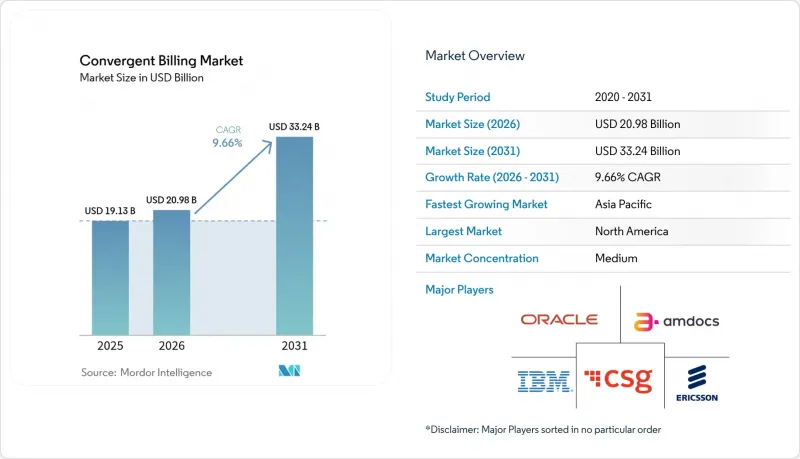
Mordor Intelligence에 의하면, 통합 과금 시장 규모는 2025년 191억 3,000만 달러로 평가되었고, 2026년에는 209억 8,000만 달러로 추정되고, 2026-2031년 CAGR 9.66%로 성장을 지속할 전망이며, 2031년에는 332억 4,000만 달러에 이를 것으로 예측됩니다.
본 보고서는 구성 요소별(솔루션 및 서비스), 도입 모델별(클라우드 및 온프레미스), 솔루션 유형별(청구 주기 최적화, 청구·계정 관리, 청구서 및 청구 명세서 자동 발행, 지불 및 회수, 고객 관계 관리), 사업자 및 용도별(모바일, 유선 통신, 광대역, TV/스트리밍), 지역별로 분류되어 있습니다. 시장 예측은 금액(달러) 기준으로 제시되어 있습니다.
세계의 통합 과금 시장 동향 및 인사이트
실시간 5G 네트워크 슬라이싱의 수익화
상용 슬라이스는 여전히 적으며, 2024년 중반 시점에서 슬라이스 수익화에 성공한 통신 사업자(CSP)는 15% 미만에 그치고 있지만, 초기 프로젝트들은 프리미엄 가격 책정이 실행 가능함을 입증하고 있습니다. TIM Brasil과 에릭슨은 농업용 IoT를 위해 브라질 최초의 독립형 슬라이스를 출시하여, 표준 모바일 광대역보다 30% 높은 프리미엄 요금을 부과하고 있습니다. 2024년에 승인된 ETSI의 OpenSlice API를 통해 멀티 벤더 통합의 리드 타임이 6개월 미만으로 단축됩니다. 슬라이스는 동적으로 확장되기 때문에 15분마다 이용 현황을 일괄 처리하는 기존의 중개 시스템에서는 수익 누수가 발생합니다. 이에 따라 통신 사업자들은 200밀리초 이내에 청구를 유발하는 이벤트 기반 과금 방식으로 전환하고 있습니다. 보다폰의 산업용 프라이빗 5G 서비스는 연결성, 엣지 컴퓨팅, 용도를 융합하고 있어, 각 계층에 비용을 배분하는 통합 과금 체계가 요구됩니다.
통신 사업자, OTT, IoT 서비스의 번들링
버라이즌(Verizon)의 ‘myPlan’에서는 가입자가 넷플릭스(Netflix), 맥스(Max), 디즈니+(Disney+)를 월 단위로 켜고 끌 수 있으므로, 과금 시스템은 제3자의 이용 권한을 실시간으로 대조해야 합니다. T-모바일(T-Mobile)의 ‘Netflix On Us’ 프로모션으로 인해 번들 회선의 해지율은 18퍼센트 포인트 감소했습니다. 차이나 모바일은 2024년에 25억 건의 IoT 연결을 관리했으나, 각각이 마이크로 트랜잭션을 발생시켜 기존 과금 엔진에 부하를 주고 있습니다. 에릭슨의 ‘IoT Accelerator’는 기기 이벤트를 월별 청구서에 통합하여 거래당 비용을 60% 절감합니다. EU의 상호운용성 규정에 따라 통신 사업자는 구독 API 공개가 의무화되어 이익률 관리에 약간의 제약이 발생하고 있지만, 통합 과금 시장의 잠재 수익은 확대되고 있습니다.
레거시 시스템에서 전환하는 데 드는 높은 비용
보더폰의 7년에 걸친 10억 유로 규모의 현대화 프로젝트는 21개 국내 시장과 200개 이상의 용도를 대상으로 하고 있어, 소규모 통신 사업자가 따라잡을 수 없는 수준의 지출이 되고 있습니다. 도이치 텔레콤의 경우, 병행 운영을 통해 최종 전환이 완료될 때까지 연간 1억 3,100만 달러의 추가 비용이 발생하고 있어, 투자 수익률을 떨어뜨리는 이중 지출의 실례가 되고 있습니다. BT 그룹은 영국의 기능 분리 규정에 따라 의무화된 조치로, 소비자용 과금과 도매 과금을 분리하기 위해 5억 파운드를 계상하고 있습니다. TM 포럼에 따르면, 통신 서비스 제공업체(CSP)의 58%가 데이터 정제의 중요성을 과소평가하고 있으며, 전환 전에 중복된 고객 기록을 대조하는 데 최대 14개월을 소비하는 것으로 나타났습니다. 그 결과, 남미와 아프리카의 많은 통신 사업자들은 패치 방식의 유지보수가 기술적 부채를 증가시키고 통합 과금 시장의 혁신을 저해하고 있음에도 불구하고, 레거시 스택을 오랫동안 계속 사용하고 있습니다.
부문 분석
2025년, 통합 과금 시장의 62.05%를 서비스 부문이 차지했습니다. 이는 수년에 걸친 플랫폼 업그레이드에 따른 통합, 컨설팅 및 관리형 운영이 주도한 결과입니다. 보다폰이 시행한 7년간 10억 유로 규모의 변혁 프로젝트에는 400명 이상의 컨설턴트가 참여했으며, 이는 2031년까지 서비스 수익이 연평균 성장률(CAGR) 10.78%로 증가할 것이라는 점을 여실히 보여줍니다. 도이체 텔레콤이 레거시 시스템과 클라우드 시스템을 18개월간 병행 운영한다는 방침을 채택한 결과, 서비스 요금이 1억 3,100만 달러 증가했으며, 외부 전문 지식에 대한 수요가 높아지고 있습니다.
솔루션 라이선싱은 여전히 주류를 이루고 있지만, TM Forum의 표준 API를 통해 여러 벤더를 혼합하여 사용할 수 있게 됨에 따라 가격 면에서 압박을 받고 있습니다. 사내 DevOps 체제가 갖춰지지 않은 Tier 2 통신 사업자에서 매니지드 서비스에 대한 수요가 가장 빠르게 증가하고 있습니다. Comarch사의 2024년 중부 유럽 정액 계약은 자본 지출을 예측 가능한 운영비로 전환하는 것입니다. Amdocs사는 2024년 AT&T사와의 계약 갱신에 5억 달러 규모의 매니지드 서비스 요소를 포함시켜 향후 5년간 지속적인 수익을 확보했습니다. 교육 서비스는 CSP의 67%가 클라우드 네이티브 과금 시스템을 운영하기 위해 벤더 주도의 기술 향상 교육을 필요로 하고 있기 때문에 그 중요성이 과소평가되고 있는 성장 동력입니다. 따라서 통합 과금 시장에서는 소프트웨어와 장기 서비스 계약을 결합한 벤더가 우위를 점하고 있습니다.
2025년 현재, 클라우드 도입은 통합 과금 시장 규모의 45.78%를 차지했으며, 2031년까지 연평균 성장률(CAGR) 10.47%로 온프레미스를 상회하는 성장을 이어갈 전망입니다. 라쿠텐 모바일은 600만 명의 가입자를 대상으로 기존 BSS에 비해 총 소유 비용(TCO)을 40% 절감함으로써 그 경제성을 입증했습니다. Oracle이 보다폰과 체결한 연간 1억 달러 규모의 계약에 따라, 유럽의 과금 워크로드가 Oracle 클라우드 인프라로 이전되고 여러 데이터센터가 폐쇄될 예정입니다. 에어텔은 영구적인 과잉 프로비저닝 없이 디왈리 기간 중 트래픽 피크 시 용량을 확장하기 위해 Amazon Web Services에서 에릭슨 차징을 채택했습니다.
현지화나 지연 시간 제약이 있는 분야에서는 여전히 온프레미스 환경이 남아 있습니다. 차이나 모바일은 국내 데이터 규제를 충족하기 위해 25억 건의 IoT 연결을 위한 국내 설비를 유지하고 있습니다. BT 그룹의 하이브리드 모델에서는 핵심 과금 처리를 온프레미스에서 유지하면서 분석 처리는 클라우드에서 실행하고 있습니다. 보안 우려로 인해 중동 및 아프리카(MEA) 지역의 일부 시장에서는 퍼블릭 클라우드 도입이 억제되고 있으며, GSMA가 조사한 통신 사업자의 42%가 정보 유출 위험을 장벽으로 꼽았습니다. 그러나 벤더에 의존하지 않는 마이크로서비스를 통해 통신 서비스 제공업체(CSP)는 워크로드를 클라우드 간에 재배치할 수 있게 되어 락인(lock-in) 우려가 완화됨에 따라, 통합 과금 시장에서 클라우드의 장기적인 부상이 가속화되고 있습니다.
지역별 분석
2025년, 북미는 통합 과금 시장 규모의 32.30%를 차지했습니다. Verizon과 T-Mobile은 광섬유, 무선, 프리미엄 비디오 번들 제공을 지속하고 있으며, 과금 플랫폼에 대해 1초 미만의 이용권 조정을 추진하고 있습니다. AT&T는 검증된 시스템을 유지하기 위해 Amdocs와 연간 5억 달러 규모의 계약 갱신에 합의했습니다. CSG는 Dish Network로부터 7,500만 달러 규모의 수주를 확보하여 800만 회선을 넘는 후불제 5G 과금 시스템 구축을 담당하게 됩니다. 로저스(Rogers)는 캐나다의 독립형 5G 코어를 지원하기 위해 Oracle 클라우드(Oracle Cloud)를 도입했습니다. 아메리카 모빌(America Movil)은 2026년 완료 목표에 앞서 멕시코 내 과금 시스템을 에릭슨 차징(Ericsson Charging)으로 전환하기 시작했습니다.
아시아태평양은 2031년까지 연평균 성장률(CAGR) 10.19%를 기록하며 통합 과금 시장에서 가장 빠른 지역 성장을 이룰 것으로 전망됩니다. 바티 에어텔(Bharti Airtel)의 에릭슨 차징(Ericsson Charging) 도입은 18개 회선과 3억 5,000만 명의 가입자에 이릅니다. 지오(Geo)는 상거래, 음악, 영화를 단일 지갑에 통합하여 슈퍼 앱 내 과금의 복잡성을 여실히 보여주고 있습니다. 차이나 모바일의 25억 건에 달하는 IoT 연결에는 페타바이트 규모의 마이크로 트랜잭션 과금 시스템이 필요합니다. 일본의 KDDI와 한국의 SK텔레콤은 정책 기반의 실시간 결제가 필요한 네트워크 슬라이싱 요금제를 도입했습니다. 동남아시아의 지갑 시장은 전년 대비 41% 성장했으며, 통신사가 거래량의 72%를 차지함에 따라 결제 시스템이 일상생활에 더욱 깊이 스며들고 있습니다.
유럽에서는 데이터 거주 요건에 따른 비용 상승에 직면해 있습니다. 보다폰은 데이터 법규를 준수하기 위해 18개의 서로 다른 인스턴스를 운영하고 있습니다. 오렌지는 Oracle과 제휴하여 프랑스, 스페인, 폴란드의 과금 시스템을 통합하고 있지만, 국가별로 여전히 별도의 데이터베이스가 필요합니다. BT 그룹은 영국의 기능 분리 규정에 따라 도매 사업과 소비자용 BSS를 분리하고 있습니다. 텔레콤 이탈리아는 기술 격차를 해소하기 위해 컨설턴트 1인당 하루 1,500유로를 지출하고 있으며, 이로 인해 일정이 지연되고 있습니다. 중동에서는 e&가 핀테크로의 전환을 추진하기 위해 클라우드 네이티브 BSS에 2억 달러를 배정했습니다. 아프리카의 1조 4,000억 달러에 달하는 모바일 머니 거래량으로 인해 통합 지갑이 필수적이 되었으며, MTN과 Vodacom은 통화 요금, 데이터 통신 요금, 가맹점 대금을 하나의 청구서로 통합하고 있습니다. 남미의 TIM Brasil은 5G를 활용한 농업 비즈니스 부문을 30%의 프리미엄으로 수익화하며, 실시간 통합 과금를 통한 수익 증대 가능성을 부각시키고 있습니다.
기타 혜택 :
- 엑셀 형식 시장 예측(ME) 시트
- 3개월간 애널리스트 지원
자주 묻는 질문
목차
제1장 서론
제2장 조사 방법
제3장 개요
제4장 시장 구도
제5장 시장 규모 및 성장 예측
제6장 경쟁 구도
제7장 시장 기회 및 향후 전망
AJY 26.09.01According to Mordor Intelligence, the convergent billing market size is expected to grow from USD 19.13 billion in 2025 to USD 20.98 billion in 2026 and is forecast to reach USD 33.24 billion by 2031 at 9.66% CAGR over 2026-2031.
This report is Segmented by Component (Solution, and Services), Deployment Model (Cloud, and On-Premise), Solution Type (Bill-Cycle Optimisation, Billing-Account Management, Automated Invoice and Bill Generation, Payment and Collection, Customer-Relationship Management), Operator/Application (Mobile, Fixed, Broadband, TV/Streaming), and Geography. The Market Forecasts are Provided in Terms of Value (USD).
Global Convergent Billing Market Trends and Insights
Real-Time 5G Network-Slicing Monetization
Commercial slices remain scarce, fewer than 15% of CSPs had monetized slicing by mid-2024, but early projects prove that premium pricing is viable. TIM Brasil and Ericsson launched the first Brazilian standalone slice for agribusiness IoT, charging a 30% premium over standard mobile broadband. ETSI's OpenSlice APIs, ratified in 2024, shorten multi-vendor integration timelines to under six months. Legacy mediation systems that batch usage every 15 minutes leak revenue because slices scale dynamically, so CSPs are shifting to event-driven charging that triggers invoices within 200 milliseconds. Vodafone's private-5G offer for factories blends connectivity, edge computing, and applications, demanding convergent billing that apportions costs across each layer.
Bundling of Telco, OTT, and IoT Services
Verizon's myPlan allows subscribers to toggle Netflix, Max, and Disney+ on a monthly basis, forcing billing stacks to reconcile third-party entitlements in real-time. T-Mobile's "Netflix On Us" promotion reduced churn by 18 percentage points among bundled lines. China Mobile managed 2.5 billion IoT connections in 2024, each generating micro-transactions that strain legacy billing engines. Ericsson's IoT Accelerator aggregates device events into monthly invoices and cuts per-transaction costs by 60%. EU interoperability rules now compel operators to expose subscription APIs, slightly eroding margin control but widening addressable revenue for the convergent billing market.
High Legacy-System Migration Costs
Vodafone's seven-year EUR 1 billion modernization covers 21 national markets and more than 200 applications, an outlay that smaller operators cannot match. Deutsche Telekom's parallel run added USD 131 million per year until the final cutover, illustrating the double-spend that drags down the return on investment. BT Group has set aside GBP 500 million to decouple consumer billing from wholesale, a mandatory step under U.K. functional separation rules. The TM Forum found that 58% of CSPs underestimate the importance of data cleansing and spend up to 14 months reconciling duplicate customer records before migration. Many South American and African operators, therefore, extend the life of legacy stacks, even though patch-based maintenance grows technical debt and stifles innovation in the convergent billing market.
Other drivers and restraints analyzed in the detailed report include:
- Cloud-Native Micro-Services Billing Adoption
- AI-Powered Revenue Assurance and Fraud Analytics
- Data-Sovereignty and Cross-Border Privacy Rules
For complete list of drivers and restraints, kindly check the Table Of Contents.
Segment Analysis
Services represented 62.05% of the convergent billing market share in 2025, driven by integration, consulting, and managed operations that accompany multi-year platform upgrades. Vodafone's seven-year, EUR 1 billion transformation employed more than 400 consultants and exemplifies why service revenue will climb at a 10.78% CAGR to 2031. Deutsche Telekom's policy of running legacy and cloud stacks in parallel for 18 months added USD 131 million to service fees, reinforcing demand for external expertise.
Solution licenses stay dominant, but face pricing pressure as TM Forum standard APIs enable vendor mixing. Managed services are rising fastest among Tier-2 operators that lack in-house DevOps. Comarch's 2024 fixed-fee contract in Central Europe converts capital expense into predictable operating expense. Amdocs bundled a USD 500 million managed-services layer into its 2024 AT&T renewal, locking in five more years of recurring revenue. Training services are an under-appreciated growth lever because 67% of CSPs need vendor-run upskilling to operate cloud-native billing. The convergent billing market, therefore, rewards vendors that pair software with long-term service engagement.
Cloud deployment held 45.78% of the convergent billing market size in 2025 and will outgrow on-premise at a 10.47% CAGR through 2031. Rakuten Mobile validated the economics by cutting the total cost of ownership by 40% relative to traditional BSS for 6 million subscribers. Oracle's USD 100 million annual deal with Vodafone migrates European billing workloads to Oracle Cloud Infrastructure, retiring multiple data centers. Airtel adopted Ericsson Charging on Amazon Web Services to burst capacity during Diwali traffic peaks without permanent over-provisioning.
On-premise persists where localization or latency constraints apply. China Mobile maintains in-country installations for 2.5 billion IoT connections to satisfy national data rules. BT Group's hybrid model keeps core billing on-site while analytics run in the cloud. Security worries curb public-cloud adoption in several MEA markets, 42% of operators surveyed by GSMA cite breach risk as a barrier. Yet, vendor-agnostic microservices reduce perceived lock-in by allowing CSPs to redeploy workloads across clouds, supporting the long-term ascendancy of cloud in the convergent billing market.
Complete Report Scope:
- By Component
- Solution
- Services
- By Deployment Model
- Cloud
- On-premise
- By Solution Type
- Bill-cycle Optimisation
- Billing-account Management
- Automated Invoice and Bill Generation
- Payment and Collection
- Customer-relationship Management
- By Operator / Application
- Mobile
- Fixed
- Broadband
- TV / Streaming
- By Geography
- North America
- United States
- Canada
- Mexico
- South America
- Brazil
- Argentina
- Rest of South America
- Europe
- Germany
- United Kingdom
- France
- Italy
- Spain
- Rest of Europe
- Asia-Pacific
- China
- India
- Japan
- South Korea
- Rest of Asia-Pacific
- Middle East and Africa
- Middle East
- United Arab Emirates
- Saudi Arabia
- Rest of Middle East
- Africa
- South Africa
- Nigeria
- Rest of Africa
- Middle East
- North America
Geography Analysis
North America produced 32.30% of convergent billing market size in 2025. Verizon and T-Mobile continue bundling fiber, wireless, and premium video, pushing billing platforms toward sub-second entitlement reconciliation. AT&T signed a USD 500 million annual renewal with Amdocs to keep proven systems in place. CSG won USD 75 million from Dish Network to stand up postpaid 5G billing for more than 8 million lines. Rogers adopted Oracle Cloud to support Canada's standalone 5G core. America Movil started migrating Mexican billing to Ericsson Charging ahead of its 2026 completion target.
Asia-Pacific will post a 10.19% CAGR through 2031, the fastest regional growth in the convergent billing market. Bharti Airtel's Ericsson Charging rollout spans 18 circles and 350 million subscribers. Jio integrates commerce, music, and cinema under a single wallet, illustrating super-app billing complexity. China Mobile's 2.5 billion IoT connections demand micro-transaction billing at petabyte scale. KDDI in Japan and SK Telecom in South Korea launched network-slicing tariffs that require policy-based real-time charging. Southeast Asian wallets grew 41% year over year, and telecom brands captured 72% of transaction volume, embedding billing deeper into daily life.
Europe confronts cost inflation from data residency. Vodafone runs 18 distinct instances to comply with the Data Act. Orange partners with Oracle to consolidate billing across France, Spain, and Poland, but each country still needs its own database. BT Group decouples wholesale from consumer BSS under U.K. functional separation. Telecom Italia spends EUR 1,500 per consultant day to plug skills gaps, extending timelines. In the Middle East, e& earmarked USD 200 million for cloud-native BSS to power its fintech pivot. Africa's USD 1.4 trillion mobile-money throughput makes unified wallets essential, and MTN plus Vodacom integrate airtime, data, and merchant payments under one bill. South America's TIM Brasil monetizes 5G agribusiness slices at a 30% premium, underscoring revenue upside from real-time convergent billing.
- Amdocs Ltd.
- International Business Machines Corporation
- Oracle Corporation
- Telefonaktiebolaget LM Ericsson
- CSG Systems International Inc.
- Huawei Technologies Co. Ltd.
- Comarch SA
- Tecnotree Oyj
- Netcracker Technology Corp.
- Nokia Corporation
- Optiva Inc.
- Cerillion plc
- Matrixx Software Inc.
- Subex Ltd.
- Mahindra Comviva Ltd.
- Sterlite Technologies Ltd.
- Zuora Inc.
- Aria Systems Inc.
- BillingPlatform LLC
- Chargebee Inc.
- CloudBilling BV
Additional Benefits:
- The market estimate (ME) sheet in Excel format
- 3 months of analyst support
TABLE OF CONTENTS
1 INTRODUCTION
- 1.1 Study Assumptions and Market Definition
- 1.2 Scope of the Study
2 RESEARCH METHODOLOGY
3 EXECUTIVE SUMMARY
4 MARKET LANDSCAPE
- 4.1 Market Overview
- 4.2 Market Drivers
- 4.2.1 Real-Time 5G Network-Slicing Monetisation
- 4.2.2 Bundling Of Telco + OTT/IoT Services
- 4.2.3 Cloud-Native Micro-Services Billing Adoption
- 4.2.4 AI-Driven Revenue-Assurance And Fraud Analytics
- 4.2.5 Rapid Growth Of Prepaid Digital Wallets In Middle East and Africa
- 4.2.6 Emerging B2B Private-Network Billing Demand
- 4.3 Market Restraints
- 4.3.1 High Legacy-System Migration Costs
- 4.3.2 Data-Sovereignty And Cross-Border Privacy Rules
- 4.3.3 Shortage Of OSS/BSS Skilled Talent
- 4.3.4 Vendor Lock-In Risk With Cloud Hyperscalers
- 4.4 Industry Value Chain Analysis
- 4.5 Regulatory Landscape
- 4.6 Technological Outlook
- 4.7 Porter's Five Forces
- 4.7.1 Bargaining Power of Suppliers
- 4.7.2 Bargaining Power of Buyers
- 4.7.3 Threat of New Entrants
- 4.7.4 Threat of Substitutes
- 4.7.5 Competitive Rivalry
5 MARKET SIZE AND GROWTH FORECASTS (VALUE)
- 5.1 By Component
- 5.1.1 Solution
- 5.1.2 Services
- 5.2 By Deployment Model
- 5.2.1 Cloud
- 5.2.2 On-premise
- 5.3 By Solution Type
- 5.3.1 Bill-cycle Optimisation
- 5.3.2 Billing-account Management
- 5.3.3 Automated Invoice and Bill Generation
- 5.3.4 Payment and Collection
- 5.3.5 Customer-relationship Management
- 5.4 By Operator / Application
- 5.4.1 Mobile
- 5.4.2 Fixed
- 5.4.3 Broadband
- 5.4.4 TV / Streaming
- 5.5 By Geography
- 5.5.1 North America
- 5.5.1.1 United States
- 5.5.1.2 Canada
- 5.5.1.3 Mexico
- 5.5.2 South America
- 5.5.2.1 Brazil
- 5.5.2.2 Argentina
- 5.5.2.3 Rest of South America
- 5.5.3 Europe
- 5.5.3.1 Germany
- 5.5.3.2 United Kingdom
- 5.5.3.3 France
- 5.5.3.4 Italy
- 5.5.3.5 Spain
- 5.5.3.6 Rest of Europe
- 5.5.4 Asia-Pacific
- 5.5.4.1 China
- 5.5.4.2 India
- 5.5.4.3 Japan
- 5.5.4.4 South Korea
- 5.5.4.5 Rest of Asia-Pacific
- 5.5.5 Middle East and Africa
- 5.5.5.1 Middle East
- 5.5.5.1.1 United Arab Emirates
- 5.5.5.1.2 Saudi Arabia
- 5.5.5.1.3 Rest of Middle East
- 5.5.5.2 Africa
- 5.5.5.2.1 South Africa
- 5.5.5.2.2 Nigeria
- 5.5.5.2.3 Rest of Africa
- 5.5.5.1 Middle East
- 5.5.1 North America
6 COMPETITIVE LANDSCAPE
- 6.1 Market Concentration
- 6.2 Strategic Moves
- 6.3 Market Share Analysis
- 6.4 Company Profiles (includes Global level Overview, Market level overview, Core Segments, Financials as available, Strategic Information, Market Rank/Share for key companies, Products and Services, and Recent Developments)
- 6.4.1 Amdocs Ltd.
- 6.4.2 International Business Machines Corporation
- 6.4.3 Oracle Corporation
- 6.4.4 Telefonaktiebolaget LM Ericsson
- 6.4.5 CSG Systems International Inc.
- 6.4.6 Huawei Technologies Co. Ltd.
- 6.4.7 Comarch SA
- 6.4.8 Tecnotree Oyj
- 6.4.9 Netcracker Technology Corp.
- 6.4.10 Nokia Corporation
- 6.4.11 Optiva Inc.
- 6.4.12 Cerillion plc
- 6.4.13 Matrixx Software Inc.
- 6.4.14 Subex Ltd.
- 6.4.15 Mahindra Comviva Ltd.
- 6.4.16 Sterlite Technologies Ltd.
- 6.4.17 Zuora Inc.
- 6.4.18 Aria Systems Inc.
- 6.4.19 BillingPlatform LLC
- 6.4.20 Chargebee Inc.
- 6.4.21 CloudBilling BV
7 MARKET OPPORTUNITIES AND FUTURE OUTLOOK
- 7.1 White-space and Unmet-Need Assessment


