

|
시장보고서
상품코드
2116331
중국의 해상 화물 운송 시장 : 점유율 분석, 업계 동향과 통계, 성장 예측(2026-2031년)China Sea Freight Transport - Market Share Analysis, Industry Trends & Statistics, Growth Forecasts (2026 - 2031) |
||||||
 Mordor Intelligence
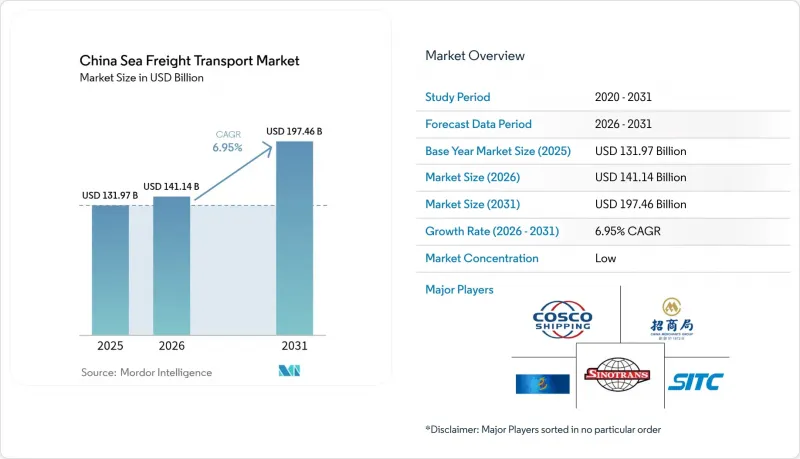
Mordor Intelligence에 의하면, 중국 해상 화물 운송 시장 규모는 2025년에 1,319억 7,000만 달러로 평가되었고 2026년 1,411억 4,000만 달러에서 2031년까지 1,974억 6,000만 달러에 이를 것으로 예측되며, 예측 기간(2026-2031년) CAGR은 6.95%를 나타낼 전망입니다.
본 보고서는 화물 유형(컨테이너 화물, 건식 벌크 화물 등), 최종 사용자 산업(제조·산업용 장비, 자동차, FMCG·소매(전자상거래 포함), 농업·식품 등),무역 경로/수출 지역(아시아 역내, 북미, 유럽, 중동 및 아프리카, 남미, 오세아니아)별로 분류되어 있습니다. 시장 예측은 금액(달러) 기준으로 제시되어 있습니다.
중국 해상 화물 운송 시장 동향 및 인사이트
‘일대일로’의 해상 실크로드 인프라 구축이 수출용 해상 화물량을 확대시키고 있습니다.
‘해상 실크로드’의 틀 아래 중국이 지속적으로 진행하는 항만 투자로 인해, 대부분의 무역 상대국이 감당할 수 있는 속도를 웃도는 속도로 처리량이 확대되고 있으며, 화주들은 최소한의 마찰로 화물 흐름을 재조정할 수 있게 되었습니다. 라틴아메리카 및 동남아시아에 새로 완공된 심수항 허브는 그동안 서비스가 미흡했던 운송 경로의 소요 시간을 단축시키고 있으며, 이러한 변화로 인해 수출업체들은 수출 대상 항만 포트폴리오를 다양화하기가 더 쉬워졌습니다. 중국의 운영 사업자들은 지분 보유와 장기 터미널 운영권을 결합함으로써, 운송량 보장을 위한 우선적인 부두 이용 쿼터를 확보하고 있습니다. 이러한 통합적인 접근 방식은 운임 협상에서의 협상력을 강화하고 있으며, 항만이 보세 창고 등의 부대 서비스를 수익화해 나감에 따라 이러한 우위는 앞으로도 지속될 전망입니다.
크로스보더 전자상거래의 급성장이 중국발 컨테이너 수송을 견인하고 있다.
두 자릿수 성장을 이어가고 있는 크로스보더 온라인 소매는 운송 패턴을 지속적으로 변화시키고 있으며, 소량 화물을 해외 마이크로 풀필먼트 센터로 향하는 혼적 컨테이너로 집약시키고 있습니다. 자유무역지역 내 전자상거래 전용 시범 구역에서는 통관 절차가 효율화되고, 주문 접수부터 출하까지의 리드타임이 단축되기 때문에 과거에는 항공편으로 운송되던 품목도 해상 운송이 현실적인 선택지가 되고 있습니다. 주요 플랫폼 기업들은 현재 해운사와 직접 연간 서비스 계약을 협상 중이며, 운송 능력 계획을 원활하게 하기 위해 최소 운송량을 보장하고 있습니다. 이러한 예측 가능한 수요 동향에 따라, 해운사들은 판매 호조를 보이는 소비재 부문에 냉장 컨테이너와 하이큐브 컨테이너를 더 많이 배정하게 되어, 컨테이너 선단의 전문화가 진행되고 있습니다.
2023년 신조선 붐 이후 컨테이너 선단공급 과잉이 운임을 끌어내리고 있다.
2024년에 정점을 찍었던 미인도 선박의 확대가 현재 현역 선박으로 취항하기 시작했으며, 수요 증가율을 웃도는 속도로 증가하고 있어 주요 항로 전반의 현물 운임에 하락 압력이 가해지고 있습니다. 해운사들은 전략적인 운항 중단을 통해 대응하고 있지만, 선박 인도가 계속되고 있어 특히 8,000-12,000 TEU급 선박의 유휴 용량이 계속 증가하고 있습니다. 이러한 공급 과잉으로 인해 일부 운항사는 선박을 2차 항로로 재배치할 수밖에 없게 되었으며, 이 전략은 수요가 견조한 지역에서도 운임 회복을 둔화시키고 있습니다. 의도치 않은 결과로, 화주들은 계약 협상에서 더 강력한 협상력을 확보하게 되었으며, 더 낮은 기본 운임으로 더 긴 계약 기간을 협상하도록 유도되고 있습니다.
부문 분석
컨테이너 운송 부문은 2025년 중국 해상 화물 운송 시장에서 43.55%의 점유율을 차지하고 있으며, 이러한 위상은 중국의 제조업 규모와 호황을 누리고 있는 전자상거래에 의한 수출에 힘입은 것입니다. 주요 항만의 부두 시설이 지속적으로 확충됨에 따라 24,000 TEU급 선박이 수위 제한 없이 입항할 수 있게 되었으며, 화주들은 운항 일정의 신뢰성을 확신하고 있습니다. 컨테이너 시장 내에서는 의약품 및 신선 식품 수출업체들이 온도 조절이 가능한 운송 환경을 요구함에 따라, 드라이 컨테이너보다 리퍼 컨테이너 수요가 급속히 증가하고 있습니다. 이러한 변화로 인해 해운사는 선단을 고출력 발전기를 갖춘 선박으로 재조정하도록 촉진되고 있으며, 이러한 투자를 통해 항해당 슬롯 수익률이 향상되고 있습니다.
롤온/롤오프(RoRo) 화물은 자동차 수출 증가와 전용 자동차 운반선이 필요한 신에너지차 운송에 힘입어 연평균 성장률(CAGR) 7.95%로 확대될 것으로 예측됩니다. 이 부문의 성장세에 따라 전문 터미널에서는 다층식 램프 증설이 진행되고 있으며, 이를 통해 시간당 처리량이 증가하고 부두 체류 시간의 편차가 줄어들고 있습니다. 건화물 운송량은 여전히 견조하지만, 증가분은 철강 업계의 탈탄소화 목표를 뒷받침하는 고품질 광석에 집중되어 있으며, 이는 단순한 양적 성장이 아닌 질적 변화를 나타냅니다. 액체 벌크 분야에서는 견조한 LNG 수입 계획이 막식 탱커에 대한 수요를 뒷받침하고 있으며, 극저온 선박 건조가 가능한 조선소의 전략적 가치를 높이고 있습니다.
기타 혜택:
- 엑셀 형식 시장 예측(ME) 시트
- 3개월간의 애널리스트 지원
자주 묻는 질문
목차
제1장 서론
제2장 조사 방법
제3장 주요 요약
제4장 시장 구도
제5장 시장 규모와 성장 예측
제6장 경쟁 구도
제7장 시장 기회와 향후 전망
JHS 26.08.28According to Mordor Intelligence, the China sea freight transport market size was valued at USD 131.97 billion in 2025 and estimated to grow from USD 141.14 billion in 2026 to reach USD 197.46 billion by 2031, at a CAGR of 6.95% during the forecast period (2026-2031).
This report is Segmented by Cargo Type (Containerised Cargo, Dry Bulk Cargo and More), End User Industry (Manufacturing & Industrial Equipment, Automotive, FMCG & Retail (incl. E-Commerce), Agriculture & Food Products, and More), Trade Lane/Destination Region (Intra-Asia, North America, Europe, Middle East, Africa, South America, Oceania). The Market Forecasts are Provided in Terms of Value (USD).
China Sea Freight Transport Market Trends and Insights
Belt & Road Maritime Silk Road Infrastructure Build-out Amplifying Outbound Sea Freight Volumes
China's sustained port investments under the Maritime Silk Road banner are adding throughput faster than most trading partners can absorb, enabling shippers to reroute cargo flows with minimal friction. Newly completed deep-water hubs in Latin America and Southeast Asia shorten transit times on previously underserved corridors, a shift that encourages exporters to diversify destination portfolios. By pairing equity stakes with long-term terminal concessions, Chinese operators ensure preferential berth windows that lock in volume commitments. This integrated approach strengthens bargaining power in freight-rate negotiations, an advantage that is likely to endure as ports monetise ancillary services such as bonded warehousing.
Cross-Border E-Commerce Boom Elevating China-Origin Containerized Shipments
Double-digit growth in cross-border online retail continues to reshape shipping patterns, pulling parcelised goods into consolidated container loads bound for micro-fulfilment centres overseas. Dedicated e-commerce pilot zones inside free-trade areas offer streamlined customs clearance, compressing order-to-ship lead times and making sea freight viable for categories once flown by air. Major platforms are now negotiating annual service contracts directly with carriers, guaranteeing baseline volumes that smooth capacity planning. This predictable demand profile is prompting liners to allocate more reefer and high-cube containers to fast-moving consumer segments, nudging equipment fleets toward greater specialisation.
Container Fleet Overcapacity Post-2023 Newbuild Wave Suppressing Freight Rates
The orderbook expansion that peaked in 2024 is now filtering into active service, outpacing incremental demand and placing downward pressure on spot rates across mainline routes. Carriers respond with strategic blank sailings, but persistent vessel deliveries continue to inflate idle capacity, especially in the 8 000-to-12 000 TEU band. This surplus is pushing some operators to reposition tonnage into secondary trades, a tactic that dampens rate recovery even where demand is firm. An unintended consequence is that shippers gain more leverage in contract talks, encouraging them to negotiate longer validity periods at lower base rates.
Other drivers and restraints analyzed in the detailed report include:
- Port Automation & Mega-Vessel Berth Expansion in Yangtze & Pearl River Deltas Enhancing Throughput Capacity
- Rising LNG & Petrochemical Import Demand Driving Specialized Tanker Traffic
- Rail & Pipeline Substitution Curtailing Seaborne Coal and Bulk Commodity Volumes
For complete list of drivers and restraints, kindly check the Table Of Contents.
Segment Analysis
The containerised segment commands a 43.55 % China Sea Freight Transport market share in 2025, a position anchored by the country's manufacturing scale and flourishing e-commerce exports. Continuous berth enhancements at flagship ports allow 24,000-TEU vessels to call without tidal restrictions, giving shippers confidence in schedule reliability. Within the container pool, demand for reefer boxes grows faster than dry units as pharmaceutical and fresh-produce exporters seek temperature-controlled integrity. This evolution nudges carriers to rebalance fleet mix toward higher-power generator sets, an investment that raises slot yields per voyage.
Roll-on/Roll-off cargo is expanding at a forecast CAGR of 7.95 %, fuelled by rising vehicle exports and new-energy-vehicle shipments that require purpose-built car carriers. The segment's momentum is prompting specialised terminals to add multistorey ramps, which increases hourly throughput and reduces berth time variance. Dry-bulk flows remain substantial, yet incremental gains concentrate in premium-grade ores that support steel decarbonisation targets, indicating a qualitative shift rather than pure volume growth. In liquid bulk, robust LNG import programmes sustain demand for membrane-type tankers, reinforcing the strategic value of shipyards capable of cryogenic construction.
Complete Report Scope:
- By Cargo Type
- Containerized Cargo
- Dry
- Reefer
- Dry Bulk Cargo
- Liquid Bulk Cargo
- General Cargo
- Roll-On/Roll-Off Cargo
- Containerized Cargo
- By End-Use Industry
- Manufacturing & Industrial Equipment
- Automotive
- FMCG & Retail (incl. E-commerce)
- Agriculture & Food Products
- Energy & Mining (Coal, Minerals & Ores)
- Chemicals & Petrochemicals
- Pharmaceutical & Healthcare
- Others
- By Trade Lane / Destination Region
- Intra-Asia
- North America
- Europe
- Middle East
- Africa
- South America
- Oceania
List of Companies Covered in this Report:
- COSCO Shipping Lines
- SINOTRANS Limited
- China Merchants Group
- SITC International Holdings Company Limited
- Hebei Ocean Shipping (HOSCO)
- Nanjing Ocean Shipping Co. Ltd.
- C&K Ocean Shipping Company
- Fujian Xiamen Shipping Co., Ltd.
- CTS China Hong Kong International Logistics Co., Ltd.
- China Shipping Tanker Company Limited
- Shandong Shipping Corporation
- CIMC Logistics (China International Marine Containers)
- Shanghai Jinjiang Shipping (Group) Co., Ltd.
- CHINALCO Shipping Corporation Ltd.
- PetroChina International Shipping Co.
- Maersk Line (China Operations)
- Mediterranean Shipping Company (MSC) - China Services
- CMA CGM (China) Shipping Co., Ltd.
- Evergreen Marine Corp. (China) Ltd.
- Ocean Network Express (ONE) - China
- Hapag-Lloyd (China) Ltd.
- Yang Ming Marine Transport Corp. (China)
- PIL (China) Holdings*
Additional Benefits:
- The market estimate (ME) sheet in Excel format
- 3 months of analyst support
TABLE OF CONTENTS
1 Introduction
- 1.1 Study Assumptions & Market Definition
- 1.2 Scope of the Study
2 Research Methodology
3 Executive Summary
4 Market Landscape
- 4.1 Market Overview
- 4.2 Market Drivers
- 4.2.1 Belt & Road Maritime Silk Road Infrastructure Build-out Amplifying Outbound Sea Freight Volumes
- 4.2.2 Cross-Border E-Commerce Boom Elevating China-Origin Containerized Shipments
- 4.2.3 Port Automation & Mega-Vessel Berth Expansion in Yangtze & Pearl River Deltas Enhancing Throughput Capacity
- 4.2.4 Rising LNG & Petrochemical Import Demand Driving Specialized Tanker Traffic
- 4.2.5 Increased High-Grade Iron Ore Imports Fueling Capesize Bulk Carrier Utilization
- 4.2.6 Government Incentives for Green & Dual-Fuel Vessels Accelerating Fleet Renewal
- 4.3 Market Restraints
- 4.3.1 Container Fleet Overcapacity Post-2023 Newbuild Wave Suppressing Freight Rates
- 4.3.2 Rail & Pipeline Substitution Curtailing Seaborne Coal and Bulk Commodity Volumes
- 4.3.3 Escalating IMO / China Emission Compliance Costs Impacting Operator Margins
- 4.3.4 Geopolitical Trade Disruptions Introducing Route Volatility & Demand Uncertainty
- 4.4 Value / Supply-Chain Analysis
- 4.5 Regulatory Outlook
- 4.6 Technological Outlook
- 4.7 Porter's Five Forces
- 4.7.1 Bargaining Power of Buyers
- 4.7.2 Bargaining Power of Suppliers
- 4.7.3 Threat of New Entrants
- 4.7.4 Threat of Substitutes
- 4.7.5 Competitive Rivalry
- 4.8 Transshipment Trade Analysis
- 4.9 Containerized vs Non-Containerized Shipment Insights
- 4.10 Bunkering Services & Marine Fuel Dynamics
- 4.11 Investment & Port Capacity Expansion Trends
- 4.12 Impact of Geo Political Events on the Market
5 Market Size & Growth Forecasts (Value)
- 5.1 By Cargo Type
- 5.1.1 Containerized Cargo
- 5.1.1.1 Dry
- 5.1.1.2 Reefer
- 5.1.2 Dry Bulk Cargo
- 5.1.3 Liquid Bulk Cargo
- 5.1.4 General Cargo
- 5.1.5 Roll-On/Roll-Off Cargo
- 5.1.1 Containerized Cargo
- 5.2 By End-Use Industry
- 5.2.1 Manufacturing & Industrial Equipment
- 5.2.2 Automotive
- 5.2.3 FMCG & Retail (incl. E-commerce)
- 5.2.4 Agriculture & Food Products
- 5.2.5 Energy & Mining (Coal, Minerals & Ores)
- 5.2.6 Chemicals & Petrochemicals
- 5.2.7 Pharmaceutical & Healthcare
- 5.2.8 Others
- 5.3 By Trade Lane / Destination Region
- 5.3.1 Intra-Asia
- 5.3.2 North America
- 5.3.3 Europe
- 5.3.4 Middle East
- 5.3.5 Africa
- 5.3.6 South America
- 5.3.7 Oceania
6 Competitive Landscape
- 6.1 Market Concentration
- 6.2 Market Share Analysis
- 6.3 Company Profiles (includes Global level Overview, Market level overview, Core Segments, Financials as available, Strategic Information, Market Rank/Share, Products & Services, Recent Developments)
- 6.3.1 COSCO Shipping Lines
- 6.3.2 SINOTRANS Limited
- 6.3.3 China Merchants Group
- 6.3.4 SITC International Holdings Company Limited
- 6.3.5 Hebei Ocean Shipping (HOSCO)
- 6.3.6 Nanjing Ocean Shipping Co. Ltd.
- 6.3.7 C&K Ocean Shipping Company
- 6.3.8 Fujian Xiamen Shipping Co., Ltd.
- 6.3.9 CTS China Hong Kong International Logistics Co., Ltd.
- 6.3.10 China Shipping Tanker Company Limited
- 6.3.11 Shandong Shipping Corporation
- 6.3.12 CIMC Logistics (China International Marine Containers)
- 6.3.13 Shanghai Jinjiang Shipping (Group) Co., Ltd.
- 6.3.14 CHINALCO Shipping Corporation Ltd.
- 6.3.15 PetroChina International Shipping Co.
- 6.3.16 Maersk Line (China Operations)
- 6.3.17 Mediterranean Shipping Company (MSC) - China Services
- 6.3.18 CMA CGM (China) Shipping Co., Ltd.
- 6.3.19 Evergreen Marine Corp. (China) Ltd.
- 6.3.20 Ocean Network Express (ONE) - China
- 6.3.21 Hapag-Lloyd (China) Ltd.
- 6.3.22 Yang Ming Marine Transport Corp. (China)
- 6.3.23 PIL (China) Holdings*


