

|
시장보고서
상품코드
2116676
중국의 맘모그래피 시장 : 점유율 분석, 업계 동향과 통계, 성장 예측(2026-2031년)China Mammography - Market Share Analysis, Industry Trends & Statistics, Growth Forecasts (2026 - 2031) |
||||||
 Mordor Intelligence
Mordor Intelligence에 의하면, 2026년 중국 맘모그래피 시장 규모는 1억 4,976만 달러로 추정되고 있어 2025년 1억 3,488만 달러에서 성장하여 2031년에는 2억 5,255만 달러에 이를 것으로 예측됩니다.
2026년부터 2031년까지의 연평균 성장률(CAGR)은 11.03%가 될 것으로 전망됩니다.
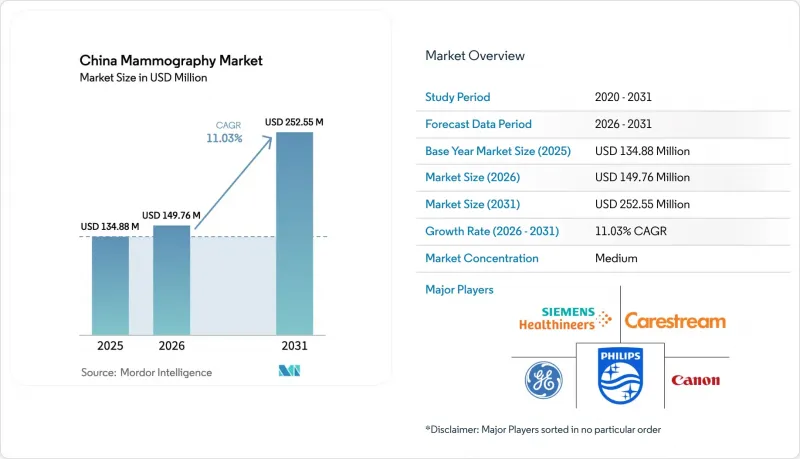
본 보고서는 제품 유형(디지털 시스템, 아날로그 시스템, 유방 토모신테시스(3D), 기타) 및 최종 사용자(병원, 전문 유방 클리닉, 영상 진단센터, 이동형 검진차)별로 분류되어 있습니다. 시장 전망은 금액(달러) 단위로 제시되어 있습니다.
중국 맘모그래피 시장 동향 및 인사이트
증가하는 유방암 부담
중국에서는 2022년에 35만 7,200건의 신규 유방암 사례와 7만 5,000명의 사망자가 기록되었으며, 이는 아시아에서 가장 높은 발병률로, 적극적인 검진에 대한 투자를 촉진하고 있습니다. 발병률은 50-54세 여성에서 정점에 달하고 있으며, 이는 세계 지침과 일치하여 모든 성(省) 수준의 장비 수요를 뒷받침하고 있습니다. 도시와 농촌 간에는 여전히 격차가 존재하며, 발생률은 각각 10만 명당 35.45건 대 29.38건입니다. 이로 인해 의료 서비스가 미치지 못하는 지역에 대한 자원 배분이 진행되고 있습니다. 장기적인 인구 통계학적 변화와 생활 방식의 변화로 인해 유방암의 부담은 증가 추세를 유지하고 있으며, 이는 맘모그래피 검사 능력에 대한 지속적인 수요를 뒷받침하고 있습니다. 그 결과, 중국의 맘모그래피 시장은 공중보건상의 요구와 견실한 상업적 기회를 계속해서 양립시키고 있습니다.
풀필드 디지털 및 3D 토모신테시스로의 기술적 전환
디지털 유방 토모신테시스(DBT)는 기존 디지털 시스템의 80%에 비해 86%의 민감도를 달성하여, 이로 인해 위양성으로 인한 재검사가 대폭 감소합니다. 아시아 여성의 약 70%에서 나타나는 고밀도 유방 조직을 가진 환자에게 특히 유익하며, 이로 인해 3급 병원에서 DBT 도입이 가속화되고 있습니다. 경제 모델에 따르면, QALY(질 조정 생존년)당 증분 비용 대비 효과 비율은 5,971.58달러로, 설비 투자의 타당성이 입증되었습니다. 합성 2D 재구성 기술을 통해 정확도를 저하시키지 않으면서 환자의 방사선 피폭량을 더욱 줄일 수 있습니다. DBT 플랫폼에 통합된 AI 알고리즘은 곡선 아래 면적(AUC) 점수 0.93 이상을 달성하여 병변 감지 정확도를 높일 뿐만 아니라, 이 하이엔드 시스템을 중국 유방촬영 시장의 벤치마크로 자리매김하고 있습니다.
방사선 피폭 위험에 대한 인식
연구에 따르면, 특히 건강 문해력이 제한적인 지역에서 방사선에 대한 두려움이 여전히 검진 참여를 방해하는 주요 요인인 것으로 밝혀졌습니다. 소셜 미디어상의 잘못된 정보가 회의적인 시각을 증폭시키고 있으므로, 저선량 프로토콜을 설명하고 축적된 안전 실적을 강조하는 체계적인 인식 제고 캠페인이 필수적입니다. 각 제조업체는 기존 시스템에 비해 방사선량을 절반으로 줄이는 합성 2D 영상 진단을 추진함으로써 이러한 우려를 완화하고 있습니다. 1차 의료 제공업체를 대상으로 한 지속적인 전문 연수와 지역 여성 단체와의 협력은 불안을 품고 있는 지역사회에서 맘모그래피를 일상적인 검사로 정착시키는 데 기여하고 있으며, 중국 맘모그래피 시장의 검진율을 꾸준히 향상시키고 있습니다.
부문 분석
2025년, 중국 맘모그래피 시장 점유율의 70.68%를 디지털 시스템이 차지하고 있으며, 3차 및 2차 병원에서의 풀필드 디지털 및 DBT 기술의 우위가 두드러지고 있습니다. 신속한 영상 획득, 클라우드 아카이브, AI 기반 CAD 워크플로우와의 원활한 통합이 그 매력의 기반이 되고 있습니다. 아날로그 장비는 예산이 제한된 지방 의료시설에서만 남아 있지만, VBP(가치 기반 지불)로 인해 가격 차이가 줄어들면서 도입 건수는 감소 추세를 보이고 있습니다. 유방 토모신테시스가 성장을 주도하고 있으며, 고밀도 유방 환자군에서 뛰어난 민감도와 우수한 비용 효율성에 힘입어 2031년까지 연평균 성장률(CAGR)은 11.73%를 나타낼 것으로 예측됩니다.
스크리닝 외에도, 스테레오타크틱 생검용 어태치먼트와 조영 모듈이 플랫폼의 범용성을 높여, 시술 기반 보상을 통해 추가 수익을 창출하고 있습니다. 각 제조업체는 소프트웨어 업그레이드를 SaaS(Software-as-a-Service) 형태로 번들로 제공하여, 고객이 최신 진단 기능을 유지할 수 있도록 하는 한편, 제조업체는 지속적인 수익을 확보하고 있습니다. 이러한 추세로 인해 당분간 디지털 시스템이 중국 맘모그래피 시장 규모의 기반이 될 것임이 확고해졌습니다.
기타 혜택:
- 엑셀 형식 시장 예측(ME) 시트
- 3개월간의 애널리스트 지원
자주 묻는 질문
목차
제1장 서론
제2장 조사 방법
제3장 주요 요약
제4장 시장 구도
제5장 시장 규모와 성장 예측
제6장 경쟁 구도
제7장 시장 기회와 향후 전망
JHS 26.08.28According to Mordor Intelligence, China mammography market size in 2026 is estimated at USD 149.76 million, growing from 2025 value of USD 134.88 million with 2031 projections showing USD 252.55 million, growing at 11.03% CAGR over 2026-2031.
This report is Segmented by Product Type (Digital Systems, Analog Systems, Breast Tomosynthesis (3D), Others) and End-User (Hospitals, Specialty Breast Clinics, Diagnostic Imaging Centers, Mobile Screening Units). The Market Forecasts are Provided in Terms of Value (USD).
China Mammography Market Trends and Insights
Growing Burden of Breast Cancer
China recorded 357,200 new breast-cancer cases and 75,000 deaths in 2022, the highest incidence in Asia, prompting aggressive screening investments. Incidence peaks among women aged 50-54, aligning with global guidelines and underpinning equipment demand across all province tiers. Urban-rural gaps persist, with incidence rates of 35.45 versus 29.38 per 100,000, respectively, motivating resource allocation toward underserved regions. Long-term demographic shifts and lifestyle changes sustain the upward trajectory of breast-cancer burden, reinforcing a durable need for mammography capacity. Consequently, the China mammography market continues to align public-health imperatives with robust commercial opportunities.
Technological Shift to Full-Field Digital & 3-D Tomosynthesis
Digital breast tomosynthesis (DBT) achieves a sensitivity of 86%, compared to 80% for conventional digital systems, resulting in a significant reduction in false-positive callbacks.Dense breast tissue, present in roughly 70% of Asian women, benefits most, accelerating DBT installations in Class III hospitals. Economic models show incremental cost-effectiveness ratios of USD 5,971.58 per QALY, validating capital outlays. Synthetic 2-D reconstruction further reduces patient radiation exposure without compromising accuracy. AI algorithms integrated into DBT platforms achieve area-under-the-curve scores exceeding 0.93, enhancing lesion detection and positioning high-end systems as the benchmark for the China mammography market.
Radiation-Exposure Risk Perception
Studies reveal radiation fear remains a leading deterrent to screening participation, especially where health literacy is limited. Misinformation on social media amplifies skepticism, necessitating structured educational campaigns that explain low-dose protocols and highlight cumulative safety records. Manufacturers mitigate concerns by promoting synthetic 2-D imaging that halves radiation relative to legacy systems. Continuous professional training for primary-care providers and collaboration with local women's organizations help normalize mammography in apprehensive communities, steadily improving uptake within the China mammography market.
Other drivers and restraints analyzed in the detailed report include:
- Nation-Wide "Two-Cancer" Screening Expansion
- AI-Powered CAD Adoption in Class III Hospitals
- Inadequate Reimbursement Outside Urban Megacities
For complete list of drivers and restraints, kindly check the Table Of Contents.
Segment Analysis
Digital systems accounted for 70.68% of the China mammography market share in 2025, underscoring the dominance of full-field digital and DBT technology in tertiary and secondary hospitals. Rapid image acquisition, cloud archiving, and seamless integration with AI-based CAD workflows underpin their appeal. Analog units persist only in budget-constrained rural centers but face declining procurement as VBP narrows price differences. Breast tomosynthesis leads growth, posting an 11.73% CAGR projected through 2031, propelled by superior sensitivity in dense-breast populations and favorable cost-effectiveness profiles.
Beyond screening, stereotactic biopsy attachments and contrast-enhanced modules extend platform utility, offering incremental revenue via procedure-based reimbursements. Manufacturers bundle software upgrades as software-as-a-service, ensuring recurring income while customers maintain updated diagnostic functionality. These trends cement digital systems as the cornerstone of the China mammography market size for the foreseeable future.
Complete Report Scope:
- By Product Type
- Digital Systems
- Analog Systems
- Breast Tomosynthesis (3-D)
- Others (e.g., stereotactic biopsy units)
- By End-User
- Hospitals
- Specialty Breast Clinics
- Diagnostic Imaging Centers
- Mobile Screening Units
List of Companies Covered in this Report:
- Hologic
- Siemens Healthineers
- GE Healthcare
- Canon Inc. (Canon Medical)
- Fujifilm Holdings Corp.
- Konica Minolta
- Mindray Bio-Medical Electronics Co.
- United Imaging Healthcare Co.
- Neusoft Medical Systems
- Carestream Health
- General Medical Merate
- Planmed
- Trivitron Healthcare
- Agfa-Gevaert
- Shimadzu
- Toshiba (Alphatec) Medical Systems
- Anke High-Tech Co.
- Perlove Medical
- Shenzhen Xiaolung Medical Tech
- Guangzhou Maya Medical Equipment
Additional Benefits:
- The market estimate (ME) sheet in Excel format
- 3 months of analyst support
TABLE OF CONTENTS
1 Introduction
- 1.1 Study Assumptions & Market Definition
- 1.2 Scope of the Study
2 Research Methodology
3 Executive Summary
4 Market Landscape
- 4.1 Market Overview
- 4.2 Market Drivers
- 4.2.1 Growing Burden of Breast Cancer
- 4.2.2 Technological Shift to Full-Field Digital & 3-D Tomosynthesis
- 4.2.3 Nation-Wide "Two-Cancer" (Breast & Cervical) Screening Expansion
- 4.2.4 AI-Powered CAD Adoption in Class III Hospitals
- 4.2.5 Provincial Volume-Based Procurement Slashing System Prices
- 4.2.6 Mobile Screening Vans Reaching Tier-3/4 Counties
- 4.3 Market Restraints
- 4.3.1 Radiation-Exposure Risk Perception
- 4.3.2 Inadequate Reimbursement Outside Urban Megacities
- 4.3.3 High Capex Versus Ultrasound Alternatives
- 4.3.4 Stringent NMPA Domestic-Content Localisation Quotas
- 4.4 Value / Supply-Chain Analysis
- 4.5 Regulatory Landscape
- 4.6 Technological Outlook
- 4.7 Porter's Five Forces Analysis
- 4.7.1 Threat of New Entrants
- 4.7.2 Bargaining Power of Buyers/Consumers
- 4.7.3 Bargaining Power of Suppliers
- 4.7.4 Threat of Substitute Products
- 4.7.5 Intensity of Competitive Rivalry
5 Market Size & Growth Forecasts
- 5.1 By Product Type
- 5.1.1 Digital Systems
- 5.1.2 Analog Systems
- 5.1.3 Breast Tomosynthesis (3-D)
- 5.1.4 Others (e.g., stereotactic biopsy units)
- 5.2 By End-User
- 5.2.1 Hospitals
- 5.2.2 Specialty Breast Clinics
- 5.2.3 Diagnostic Imaging Centers
- 5.2.4 Mobile Screening Units
6 Competitive Landscape
- 6.1 Market Concentration
- 6.2 Market Share Analysis
- 6.3 Company Profiles (includes Global Level Overview, Market Level Overview, Core Segments, Financials as Available, Strategic Information, Market Rank/Share, Products & Services, Recent Developments)
- 6.3.1 Hologic Inc.
- 6.3.2 Siemens Healthineers AG
- 6.3.3 GE HealthCare
- 6.3.4 Canon Inc. (Canon Medical)
- 6.3.5 Fujifilm Holdings Corp.
- 6.3.6 Konica Minolta Inc.
- 6.3.7 Mindray Bio-Medical Electronics Co.
- 6.3.8 United Imaging Healthcare Co.
- 6.3.9 Neusoft Medical Systems
- 6.3.10 Carestream Health Inc.
- 6.3.11 General Medical Merate SpA
- 6.3.12 Planmed Oy
- 6.3.13 Trivitron Healthcare
- 6.3.14 Agfa-Gevaert N.V.
- 6.3.15 Shimadzu Corporation
- 6.3.16 Toshiba (Alphatec) Medical Systems
- 6.3.17 Anke High-Tech Co.
- 6.3.18 Perlove Medical
- 6.3.19 Shenzhen Xiaolung Medical Tech
- 6.3.20 Guangzhou Maya Medical Equipment


