

|
시장보고서
상품코드
2117351
말레이시아의 박스 트럭 시장 : 점유율 분석, 업계 동향과 통계, 성장 예측(2026-2031년)Malaysia Box Truck - Market Share Analysis, Industry Trends & Statistics, Growth Forecasts (2026 - 2031) |
||||||
 Mordor Intelligence
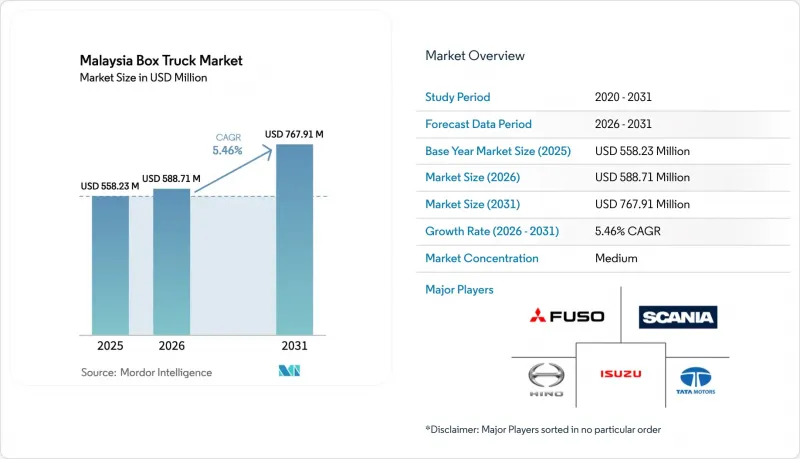
Mordor Intelligence에 의하면, 2026년 말레이시아의 박스 트럭 시장 규모는 5억 8,871만 달러로 추정되고 있어 2025년 5억 5,823만 달러에서 성장하여 2031년의 예측 값은 7억 6,791만 달러로, 2026년부터 2031년까지 CAGR 5.46%로 성장할 전망입니다.
본 보고서는 트럭의 크기/등급(소형(클래스 2-3) 등), 연료 유형(디젤, 가솔린, 전기 등),차체 유형(건화물용 박스, 냉장 박스 등), 소유 형태(자사 소유 차량, 리스 차량, 렌탈 차량), 최종 사용자(운송 회사, 소매업체·도매업체 등)별로 분류되어 있습니다. 시장 예측은 금액(달러)으로 표시되어 있습니다.
말레이시아 박스 트럭 시장 동향 및 인사이트
전자상거래의 급속한 성장과 라스트 마일 배송의 급증
말레이시아 박스 트럭 시장은 빈번한 소량 화물 배송이 필요한 온라인 소매 물량의 급증으로 인해 계속해서 혜택을 받고 있습니다. DHL의 3억 링깃 규모 쿠알라룸푸르 게이트웨이 시설 투자와 클랑 밸리 주변의 자동 분류 허브 도입 등은 소포 처리량의 지속적인 성장을 뒷받침하고 있습니다. 도심 내 집하 센터에서는 좁은 도로를 주행할 수 있고, 하루 주차 시간을 최소화하면서 여러 배송지를 순회할 수 있는 소형 박스 트럭이 선호되고 있습니다. Yes Fleet가 제공하는 5G 지원 솔루션을 포함한 텔레매틱스 플랫폼은 현재 실시간 진단 및 경로 최적화를 실현하고 있으며, 가동률이 높은 차량의 월간 연료 소비량을 4,000리터 이상 절감하고 있습니다. ASEAN 세관 통과 시스템(ACTS)의 24시간 통관 제도 하에서 유통되는 국경을 넘는 소포는 밀폐형이며 세관 규정을 준수하는 차량에 대한 수요를 높이고 있습니다. 이러한 변화들이 종합적으로 작용함에 따라, 전자상거래 물류는 차량 추가 구매 및 차량군의 디지털화를 촉진하는 순환적인 것이 아닌 구조적인 원동력으로 자리 잡아가고 있습니다.
정부 주도의 도로 인프라 정비
진행 중인 고속도로 확장 및 새로운 회랑 프로젝트로 인해 말레이시아 국내 운송 시간이 단축되고 차량 마모가 경감되는 동시에 화물 수요의 점진적인 증가가 촉진되고 있습니다. 주요 사업으로는 조호르-싱가포르 코즈웨이 개보수, KL-카락 구간 용량 확대, 판 보르네오 고속도로 정비 등이 있으며, 이 모든 사업에는 차선 증설, 노면 보강, 주행 중 중량 측정(WIM) 도입이 포함됩니다. 도로 품질이 향상됨에 따라 유지보수로 인한 가동 중단 시간이 단축되고, 자산의 가동률이 향상됩니다. 또한, 1교대당 더 장거리 운송이 가능해짐에 따라 중형 차량의 차량 편대 확충이 촉진됩니다. 스마트 센서와 연동된 실시간 교통 정보 플랫폼을 통해 운송업체는 정체를 우회하는 경로를 선택함으로써 연료비를 절감할 수도 있습니다.
전기 박스 트럭의 높은 초기 비용
배터리식 전기 트럭은 수입 관세가 면제되더라도 동급 디젤 차량에 비해 가격이 70% 더 비싸며, 이로 인해 소규모 운송업체의 도입이 저해되고 있습니다. 또한, 금융사는 기술적 불확실성을 이유로 잔존 가치를 낮게 책정하고 있어, 월별 할부금은 디젤 차량보다 더 높습니다. 거점에서의 충전을 위해서는 전기 설비 개조가 필요하며, 거점당 최대 10만 링깃의 비용이 듭니다. 한편, 주요 간선 도로 이외의 충전 네트워크 밀도는 여전히 낮아, 전국에서 가동 중인 충전소는 1,000곳 미만에 그치고 있습니다. 주행 거리가 많은 경우 5년 후에는 총 소유 비용이 유리해지지만, 현금 흐름의 제약으로 인해 많은 사업자가 조기 전환을 주저하고 있어, 전기화가 시장에 가져다줄 것으로 기대되었던 단기적인 호재가 둔화되고 있습니다.
부문 분석
2025년 현재, 말레이시아 박스 트럭 시장에서 경상용차가 53.05%의 점유율을 차지하고 있으며, 2031년까지 연평균 성장률(CAGR)은 5.78%로 예상됩니다. 이러한 소형 트럭은 정체된 차선을 능숙하게 주행하고 주택 현관 앞까지 접근할 수 있으며, 운전 면허 요건도 최소화되기 때문에 도시 지역의 창고가 허브 앤 스포크 방식을 채택함에 따라 택배 업체와 소매 유통업체에게 당연한 선택지가 되고 있습니다. 운행 빈도가 높아짐에 따라 워크스루 캡이나 테일 리프트를 장착한 기동성이 뛰어난 섀시에 대한 수요도 증가하고 있습니다.
중형 트럭은 더 큰 적재량이 필요하지만 대형 트럭의 전체 용량은 필요하지 않은 도시 간 콜드체인 운송이나 건축자재 배송에 활용되고 있습니다. 한편, 대형 트럭은 클랑항, 페낭항, 조호르항을 연결하는 대량 수송 경로를 담당하고 있지만, 차축 중량 규제가 엄격해짐에 따라 적재량 상한선에 직면하고 있습니다. ADAS(첨단 운전자 지원 시스템), 충돌 회피 기능, 실시간 적재량 모니터링과 같은 기술적 기능은 대형 부문에서 더 경량화된 부문으로 확산되고 있어, 부문 간의 융합을 가져오고 있습니다. 이로 인해 말레이시아 박스 트럭 시장에서 평균 판매 가격이 상승하고, 애프터마켓 수요가 확대되고 있습니다.
2025년 기준, 말레이시아 박스 트럭 시장 점유율의 85.62%를 디젤 엔진 차량이 차지했습니다. 이 부문은 잘 갖춰진 주유 인프라, 매력적인 토크 특성, 그리고 견실한 잔존 가치라는 이점을 누리고 있습니다. 그러나 보조금 폐지로 인해 운영 비용 부담이 커지면서, 스타트-스톱 시스템, 저회전저항 타이어, 고압 연료 분사 등 연비 효율 향상 방안에 대한 관심이 높아지고 있습니다.
관세 면제와 2040년까지 전기차 보급률을 38%로 끌어올리겠다는 국가 목표에 힘입어 전기 박스 트럭은 2031년까지 연평균 성장률(CAGR)이 6.04%로 가장 높은 성장률을 보일 것으로 예측됩니다. 택배 및 음식 배달 사업자가 주도하는 차량 도입 시험에서는 거점으로의 복귀 일정이 200-300킬로미터의 배터리 주행 거리와 일치한다는 사실이 입증되었습니다. 하이브리드 차량 및 CNG/LPG 플랫폼은 과도기의 틈새 시장을 채우고 있지만, 제로 에미션 구동계에 제공되는 것과 같은 정책적 지원이 부족합니다. 장기적으로는 배터리 비용의 하락과 연방 정부의 세액 공제로 인해 2031년까지 전기차 점유율이 10.00%를 넘어설 것으로 예측되며, 이에 따라 말레이시아 박스 트럭 시장의 에너지 구성 다각화가 진행될 것으로 전망됩니다.
기타 혜택:
- 엑셀 형식 시장 예측(ME) 시트
- 3개월간의 애널리스트 지원
자주 묻는 질문
목차
제1장 서론
제2장 조사 방법
제3장 개요
제4장 시장 구도
제5장 시장 규모와 성장 예측
제6장 경쟁 구도
제7장 시장 기회와 향후 전망
JHS 26.09.01According to Mordor Intelligence, Malaysia box truck market size in 2026 is estimated at USD 588.71 million, growing from 2025 value of USD 558.23 million with 2031 projections showing USD 767.91 million, growing at 5.46% CAGR over 2026-2031.
This report is Segmented by Truck Size/Class (Light-Duty (Class 2-3), and More), Fuel Type (Diesel, Gasoline, Electric, and More), Body Type (Dry Freight Box, Refrigerated Box, and More), Ownership Model (Company-Owned Fleet, Leased Fleet, and Rental Fleet), End User (Transportation Companies, Retailers and Wholesalers, and More). The Market Forecasts are Provided in Terms of Value (USD).
Malaysia Box Truck Market Trends and Insights
E-Commerce Boom and Last-Mile Delivery Surge
The Malaysia box truck market continues to benefit from a sharp rise in online retail volumes that require frequent, small-parcel dispatches. Investments such as DHL's RM300 million Kuala Lumpur Gateway facility and the introduction of automated sortation hubs around Klang Valley confirm sustained parcel throughput growth . Urban consolidation centers favor light-duty box trucks able to navigate narrow streets and execute multiple daily stops with minimal dwell time. Telematics platforms, including 5G-enabled solutions offered by Yes Fleet, now deliver real-time diagnostics and route optimization that lower monthly fuel use by more than 4,000 liters for high-utilization vehicles. Cross-border parcels flowing under the ASEAN Customs Transit System's 24-hour clearance window boost demand for sealed, customs-compliant bodies. Collectively, these shifts embed e-commerce logistics as a structural, not cyclical, catalyst for additional vehicle purchases and fleet digitalization.
Government-Led Road Infrastructure Upgrades
Ongoing highway widening and new corridor projects shorten intra-Malaysia transit times, reduce vehicle wear and tear, and spur incremental freight demand. Key initiatives include the Johor-Singapore Causeway overhaul, KL-Karak capacity expansion, and the Pan Borneo Highway rollout, each of which involves adding lanes, reinforcing pavements, and introducing weigh-in-motion enforcement . Improved road quality reduces maintenance downtimes, which raises asset utilization and encourages medium-duty fleet additions that can now complete longer hauls in a single shift. Real-time traffic platforms linked to smart sensors also enable carriers to trim fuel costs by rerouting around congestion.
High Upfront Cost of Electric Box Trucks
Battery-electric models carry price tags 70% higher than comparable diesel units, even after import-duty exemptions, which constrains adoption among small carriers. Finance houses also discount residual values due to technological uncertainty, pushing monthly installments higher than those for diesel alternatives. Depot charging requires electrical upgrades that cost up to RM100,000 per site. Meanwhile, the charging network density outside major corridors remains sparse, with fewer than 1,000 operational points nationwide. Although the total cost of ownership becomes favorable after five years under high mileage, cash-flow constraints deter many operators from early transition, tempering the short-term lift that electrification could otherwise provide to the market.
Other drivers and restraints analyzed in the detailed report include:
- Cold-Chain Expansion for Perishables and Pharma
- Corporate Fleet Renewal Driven by Euro VI Standards
- Volatile Diesel Prices Compressing Freight Margins
For complete list of drivers and restraints, kindly check the Table Of Contents.
Segment Analysis
Light-duty vehicles hold 53.05% of Malaysia's box truck market share in 2025, representing a 5.78% CAGR outlook through 2031. These compact trucks maneuver through congested lanes, reach residential doorsteps, and minimize driver license requirements, making them the default choice of courier and retail distributors as urban warehousing adopts hub-and-spoke designs. As trip frequency rises, demand for nimble chassis with walk-through cabs and tail-lift options also increases.
Medium-duty trucks service inter-city cold-chain and construction supply runs that require greater payload but not the full capacity of heavy rigs. Meanwhile, heavy-duty classes cater to high-volume corridors linking Port Klang, Penang Port, and Johor Port, but they face payload caps under stricter axle-weight enforcement. Technology features such as advanced driver assistance systems, collision avoidance, and real-time load monitoring are spreading from heavy to lighter segments, creating cross-segment convergence that lifts average selling prices and deepens aftermarket demand within the Malaysia box truck market.
Diesel engines powered 85.62% of Malaysia's box truck market share in 2025. The segment benefits from established refueling infrastructure, attractive torque curves, and robust residual values. Nonetheless, subsidy removal magnifies operating-cost exposure and accelerates interest in efficiency upgrades, such as start-stop systems, low-rolling-resistance tires, and high-pressure fuel injection.
Electric box trucks, supported by duty exemptions and a 38% national EV penetration target by 2040, are projected to grow at the fastest rate, with a 6.04% CAGR through 2031. Fleet pilots led by swift-parcel and food-delivery operators demonstrate that depot-return schedules match battery ranges of 200-300 kilometers. Hybrid and CNG/LPG platforms fill transitional niches but lack the policy impetus offered to zero-emission drivetrains. Long-term, declining battery costs and federal tax credits are forecast to lift the electric share above 10.00% by 2031, thereby diversifying energy exposure for the Malaysian box truck market.
Complete Report Scope:
- By Truck Size/Class
- Light-Duty (Class 2-3)
- Medium-Duty (Class 4-6)
- Heavy-Duty (Class 7-8)
- By Fuel Type
- Diesel
- Gasoline
- Electric
- Hybrid
- CNG/LPG
- By Body Type
- Dry Freight Box
- Refrigerated Box
- Curtain Side Box
- Tail-Lift Box
- By Ownership Model
- Company-Owned Fleet
- Leased Fleet
- Rental Fleet
- By End User
- Transportation Companies
- Retailers and Wholesalers
- Courier and Parcel Services
- Construction Firms
- Government Agencies
List of Companies Covered in this Report:
- Isuzu Motors Limited
- Hino Motors Sales (Malaysia) Sdn Bhd.
- Mitsubishi Fuso Truck and Bus Corporation
- Scania (Malaysia) Sdn Bhd.
- Volvo Trucks Malaysia
- MAN Truck and Bus Malaysia
- Tata Motors Limited
- JAC Motors Malaysia
- Dongfeng Commercial Vehicles (Malaysia) Sdn Bhd.
- Iveco S.p.A. (Malaysia)
Additional Benefits:
- The market estimate (ME) sheet in Excel format
- 3 months of analyst support
TABLE OF CONTENTS
1 Introduction
- 1.1 Study Assumptions and Market Definition
- 1.2 Scope of the Study
2 Research Methodology
3 Executive Summary
4 Market Landscape
- 4.1 Market Overview
- 4.2 Market Drivers
- 4.2.1 E-Commerce Boom and Last-Mile Delivery Surge
- 4.2.2 Government-Led Road Infrastructure Upgrades
- 4.2.3 Cold-Chain Expansion for Perishables and Pharma
- 4.2.4 Corporate Fleet Renewal Driven by Euro VI Standards
- 4.2.5 Halal-Logistics Compliance Driving Specialized Box Trucks
- 4.2.6 Road-User-Charging Scheme Favoring Weight-Efficient Designs
- 4.3 Market Restraints
- 4.3.1 High Upfront Cost of Electric Box Trucks
- 4.3.2 Volatile Diesel Prices Compressing Freight Margins
- 4.3.3 Limited Industrial EV-Charging Infrastructure
- 4.3.4 Strict Axle-Weight Enforcement Lowering Payloads
- 4.4 Value / Supply-Chain Analysis
- 4.5 Regulatory Landscape
- 4.6 Technological Outlook
- 4.7 Porter's Five Forces
- 4.7.1 Threat of New Entrants
- 4.7.2 Bargaining Power of Suppliers
- 4.7.3 Bargaining Power of Buyers
- 4.7.4 Threat of Substitutes
- 4.7.5 Industry Rivalry
5 Market Size and Growth Forecasts (Value (USD))
- 5.1 By Truck Size/Class
- 5.1.1 Light-Duty (Class 2-3)
- 5.1.2 Medium-Duty (Class 4-6)
- 5.1.3 Heavy-Duty (Class 7-8)
- 5.2 By Fuel Type
- 5.2.1 Diesel
- 5.2.2 Gasoline
- 5.2.3 Electric
- 5.2.4 Hybrid
- 5.2.5 CNG/LPG
- 5.3 By Body Type
- 5.3.1 Dry Freight Box
- 5.3.2 Refrigerated Box
- 5.3.3 Curtain Side Box
- 5.3.4 Tail-Lift Box
- 5.4 By Ownership Model
- 5.4.1 Company-Owned Fleet
- 5.4.2 Leased Fleet
- 5.4.3 Rental Fleet
- 5.5 By End User
- 5.5.1 Transportation Companies
- 5.5.2 Retailers and Wholesalers
- 5.5.3 Courier and Parcel Services
- 5.5.4 Construction Firms
- 5.5.5 Government Agencies
6 Competitive Landscape
- 6.1 Market Concentration
- 6.2 Strategic Moves
- 6.3 Market Share Analysis
- 6.4 Company Profiles (Includes Global level Overview, Market level overview, Core Segments, Financials as available, Strategic Information, Market Rank/Share for key companies, Products & Services, and Recent Developments)
- 6.4.1 Isuzu Motors Limited
- 6.4.2 Hino Motors Sales (Malaysia) Sdn Bhd.
- 6.4.3 Mitsubishi Fuso Truck and Bus Corporation
- 6.4.4 Scania (Malaysia) Sdn Bhd.
- 6.4.5 Volvo Trucks Malaysia
- 6.4.6 MAN Truck and Bus Malaysia
- 6.4.7 Tata Motors Limited
- 6.4.8 JAC Motors Malaysia
- 6.4.9 Dongfeng Commercial Vehicles (Malaysia) Sdn Bhd.
- 6.4.10 Iveco S.p.A. (Malaysia)


