

|
시장보고서
상품코드
2117424
전기차 충전 케이블 시장 : 점유율 분석, 업계 동향과 통계, 성장 예측(2026-2031년)EV Charging Cable - Market Share Analysis, Industry Trends & Statistics, Growth Forecasts (2026 - 2031) |
||||||
 Mordor Intelligence
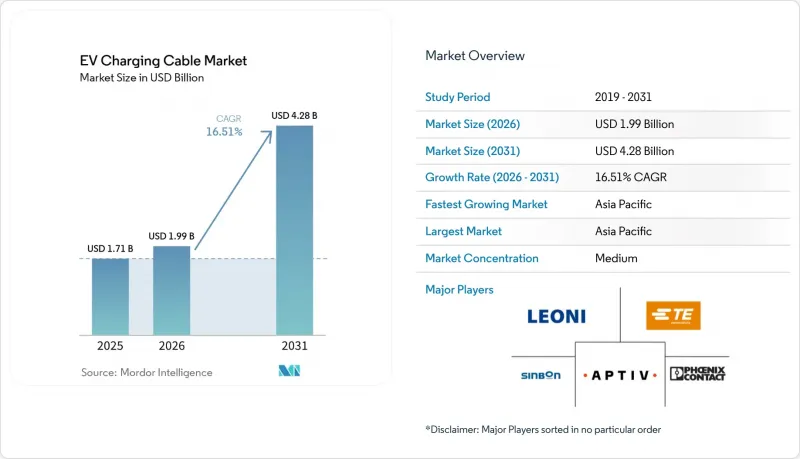
Mordor Intelligence에 의하면, 전기차 충전 케이블 시장 규모는 2025년에 17억 1,000만 달러로 평가되었고 2026년에는 19억 9,000만 달러로 추정되고 있어 2031년까지 42억 8,000만 달러에 이를 것으로 예측됩니다.
2026년부터 2031년까지 연평균 성장률(CAGR) 16.51%로 성장할 것으로 전망됩니다.
본 보고서는 전원 유형(AC 충전 케이블 및 DC 충전 케이블), 케이블 길이(5미터 미만, 5-10미터, 10미터 이상), 충전 레벨(레벨 1, 레벨 2, 레벨 3),용도(개인용 충전, 공공용 충전), 커넥터 유형(유형 1, 유형 2, CCS, CHAdeMO, 테슬라 NACS), 지역별로 분류되어 있습니다. 시장 전망은 금액(미 달러) 기준으로 제시되어 있습니다.
전 세계 전기차 충전 케이블 시장 동향 및 인사이트
수냉식 고전류 케이블의 비용 절감 및 수명 연장
피닉스 컨택트(Phoenix Contact)와 후버+수너(Hoover+Suner) 등이 대규모 생산을 실현함에 따라, 액체 냉각식 어셈블리의 단가는 대폭 하락했습니다. 피닉스 콘택트의 케이블은 현재 수명이 연장되어 공랭식 제품보다 실용성이 높아졌습니다. 후버+수너는 RADOX HPC500 플러그에 PT1000 센서를 내장하여 과열을 방지하기 위한 실시간 열 관리를 실현하고 있습니다. 차지포인트(ChargePoint)사는 배터리 팩에 대한 고출력 공급을 유지하기 위해 유사한 액체 냉각 시스템을 채택하여, 이를 통해 충전 시간을 대폭 단축하고 있습니다. 새로운 IEC 시험 사이클에서는 케이블에 장기간에 걸쳐 고전류가 흐르도록 요구되지만, 액체 냉각 제품은 도체의 직경을 크게 늘릴 필요 없이 이 과제를 해결하고 있습니다.
공공 DC 급속 충전 회랑 구축 가속화
미국에서는 2025년에 18,000기의 DC 급속 충전 포트가 신설되었습니다. 이는 50억 달러 규모의 ‘국가 전기차 인프라(NEVI)’ 자금 지원에 힘입어 30% 증가한 수치입니다. 캘리포니아주에서만 1,200개 이상의 충전소가 설치된 데 이어, 텍사스주와 플로리다주에서도 각각 850개와 720개가 추가되어 동서를 관통하는 고속도로망이 구축되었습니다. 유럽의 ‘대체 연료 인프라 시설(AFIF)’은 2027년까지 우선 화물 수송 회랑을 따라 3,000기의 DC 충전기를 건설하기 위해 6억 유로를 배정했습니다. 테슬라는 2025년에 6,786기의 슈퍼차저 포트를 추가로 개설하고, CCS1 어댑터를 사용하는 테슬라 이외의 차종도 이용할 수 있도록 함으로써 유휴 용량의 수익화를 도모했습니다. EVgo사는 1,100곳의 식료품점을 핵심 거점으로 삼아 약 7,500기의 급속 충전기를 설치하기 위해 12억 5,000만 달러의 연방 정부 대출을 확보함으로써 도심 내 사업 기반을 강화했습니다. ‘회랑 프로젝트’에서는 고속도로 충전 베이의 케이블 길이를 5-10미터로 표준화한 반면, 갓길 충전 스팟에서는 파손 행위를 방지하기 위해 5미터 미만의 케이블이 채택되었습니다.
구리 및 엘라스토머 가격 변동
칠레와 페루의 광산 운영 차질을 배경으로 구리 가격은 사상 최고 수준까지 급등했습니다. 이로 인해 비용이 대폭 증가했고, 헤지 기간이 만료됨에 따라 매출 총이익률이 하락했습니다. 한편, EPDM 및 TPE 엘라스토머도 현저한 가격 급등을 겪었습니다. 이는 액체 냉각 재킷에 필수적인 저쇼어 경도 등급공급을 위축시킨 정제소의 가동 중단이 원인입니다. 이러한 시장 역학에 따라 유럽의 소규모 조립 제조업체들은 생산 능력 확대를 보류했습니다. 조사 대상 기업의 과반수는 비용의 대폭적인 상승을 주된 이유로 금형 발주를 연기하기로 결정했습니다. 알루미늄·구리 피복선은 비용 면에서 이점이 있지만, 케이블의 직경이 커지기 때문에 도시 지역 도로변 설치 시 굽힘 반경 요건이 복잡해집니다.
부문 분석
DC 제품은 전년 대비 16.98%의 성장을 기록하고 있으며, 충전 시간을 20분 미만으로 단축하는 350kW 이상의 디포 솔루션을 차량 플릿이 추구하는 가운데, 2025년 AC 제품의 65.16%라는 점유율 격차를 좁혀가고 있습니다. DC 전기차용 충전 케이블 시장이 확대되는 가운데, 피닉스 컨택트(Phoenix Contact)는 500암페어 어셈블리에서 대폭적인 비용 절감을 실현했습니다. 한편, 메가와트급 시스템은 트럭 시장을 대상으로 프리미엄 틈새 시장을 개척하고 있습니다. 예를 들어, ABB의 케이블은 가격 대비 가치가 뛰어나며, 차량 가동률 향상을 통해 투자 회수가 가능합니다. 이에 뒤지지 않으려는 레오니의 ‘EcoSense Nxt’ 시리즈는 AC 기술을 활용하여 경량화를 실현함으로써, 좁은 배관 내 케이블 인입을 신속하게 진행하고 있습니다.
수냉식 DC 어셈블리는 AC 어셈블리보다 높은 매출 총이익률을 자랑하며, 그 이익은 연구 개발(R&D)에 재투자되고 있습니다. NACS와 CCS2 규격 통합에 따라, DC 벤더는 전기차용 충전 케이블 분야에서 시장 점유율 확대를 전략적으로 활용할 수 있는 입장에 있으며, 자동차 제조업체 및 충전 장비 OEM 모두와 설계 파트너십을 확보하는 것을 목표로 하고 있습니다.
2025년 매출액 중 45.73%를 차지한 것은 5미터 미만의 제품이었습니다. 이는 걸려 넘어지는 사고의 위험을 줄이는 것을 우선시하는 도로 및 차고 설치가 배경에 있습니다. 한편, 10미터를 초과하는 케이블은 고속도로 휴게소가 픽업 트럭 및 트레일러를 수용할 수 있도록 스루형 베이를 추가하는 방식으로 재구성됨에 따라 연평균 성장률(CAGR) 16.85%로 성장하고 있습니다.
테슬라의 V4 규격은 중거리 부문의 지배력이 높아지고 있음을 여실히 보여주며, 이 부문은 현재 전기차 충전 케이블 시장에서 큰 점유율을 차지하고 있습니다. 장거리 배선에 따른 저항 손실로 인한 전력 손실을 상쇄하기 위해 더 굵은 도체가 사용되고 있으며, 이로 인해 케이블 1개당 비용이 증가하고 있습니다. 메가와트급 트럭 차고에서는 팬터그래프식 공중 마운트가 채택됨에 따라 더 긴 케이블이 표준이 되었으며, 이로 인해 운전자의 수작업 처리 부담이 경감되고 있습니다.
지역별 분석
아시아태평양은 2025년에도 매출 점유율 47.41%를 유지했습니다. 중국이 GB/T 규격과 CCS2 규격의 호환성을 의무화함에 따라, 지난해 150만 개의 GB/T 플러그를 출하한 Woer New Energy와 같은 현지 공급업체들이 호황을 누리고 있으며, 2031년까지 연평균 성장률(CAGR) 16.94%를 기록할 전망입니다. 국제에너지기구(IEA)에 따르면, 동남아시아에서는 매년 새로운 충전소가 설치될 전망입니다. 이러한 급증으로 인해 분기별 32암페어 케이블 수요가 크게 증가할 것으로 예측됩니다. 한편, 일본에서는 CHAdeMO 규격에서 CCS2로의 단계적 전환이 진행 중이며, 듀얼 프로토콜을 지원하는 충전 포트가 필요해지고 있습니다. 이러한 전환은 일본의 독자적인 입장을 부각시킬 뿐만 아니라, 업계 동향이 보다 광범위한 표준화로 향하고 있음에도 불구하고 멀티 스탠다드 케이블에 대한 지속적인 수요가 있음을 보여줍니다.
북미는 전기차(EV) 충전 케이블의 표준화를 주도하고 있으며, 북미 충전 규격(NACS)의 채택을 통해 신규 충전 포트의 상당 부분을 차지하게 되었습니다. NEVI 이니셔티브와 테슬라의 야심 찬 충전 포트 확장에 힘입어 주요 교통 회랑에서는 충전 인프라 밀도가 높아지고 있으며, 주로 대용량 케이블이 도입되고 있습니다. 한편, EVgo의 충전 설비 확장은 도시 지역의 식료품점 밀집 지역을 포괄할 전망이며, 이를 통해 고전류·수냉식 케이블에 적합한 예측 가능한 체류 시간이 확립될 것입니다.
유럽에서는 AFIR 규제의 뒷받침을 받아 막대한 AFIF 보조금을 통해 직류(DC) 충전기가 더욱 확대될 전망입니다. 도시 지역의 우량 입지를 둘러싼 경쟁은 ACCIONA Energia가 Cable Energia의 네트워크를 인수한 사실에서도 분명히 드러납니다. 라틴아메리카 및 중동 및 아프리카은 매출에서 차지하는 비중은 작지만, 브라질의 ‘청정 연료 인프라 기금’에 대한 투자와 UAE의 야심 찬 충전기 도입 계획은 수요 증가를 시사하고 있습니다.
기타 혜택:
- 엑셀 형식 시장 예측(ME) 시트
- 3개월간의 애널리스트 지원
자주 묻는 질문
목차
제1장 서론
제2장 조사 방법
제3장 개요
제4장 시장 구도
제5장 시장 규모와 성장 예측
제6장 경쟁 구도
제7장 시장 기회와 향후 전망
JHS 26.09.01According to Mordor Intelligence, the EV charging cable market size was valued at USD 1.71 billion in 2025, is estimated at USD 1.99 billion in 2026, and is projected to reach USD 4.28 billion by 2031, growing at a CAGR of 16.51% over 2026-2031.
This report is Segmented by Power Supply Type (AC Charging Cable and DC Charging Cable), Cable Length (Below 5 M, 5-10 M and Above 10 M), Charging Level (Level 1, Level 2, and Level 3), Application Type (Private Charging and Public Charging), Connector Type (Type 1, Type 2, CCS, Chademo, and Tesla NACS), and Geography. The Market Forecasts are Provided in Terms of Value (USD).
Global EV Charging Cable Market Trends and Insights
Falling Cost and Longer Life of Liquid-Cooled High-Amp Cables
Unit prices for liquid-cooled assemblies decreased significantly as Phoenix Contact, Huber+Suhner, and others achieved large-scale production. Phoenix Contact's cable now offers an extended lifespan, making it more usable than air-cooled counterparts . Huber+Suhner integrates PT1000 sensors into its RADOX HPC500 plug, enabling real-time thermal management to prevent overheating. ChargePoint employs a similar liquid-cooling system to maintain high-power delivery to battery packs, substantially reducing charging times. New IEC test cycles now subject cables to elevated current levels for prolonged periods, a challenge that liquid-cooled products meet without requiring oversized conductors.
Accelerated Rollout of Public DC Fast-Charging Corridors
The United States added 18,000 DC fast-charge ports in 2025, a 30% lift driven by USD 5 billion of National Electric Vehicle Infrastructure (NEVI) funding. California alone installed more than 1,200 stations, while Texas and Florida added 850 and 720, respectively, creating coast-to-coast highway coverage. Europe's Alternative Fuels Infrastructure Facility earmarked EUR 600 million to build 3,000 DC chargers along priority freight corridors by 2027 . Tesla opened 6,786 additional Supercharger ports in 2025 and began welcoming non-Tesla cars that use CCS1 adapters, monetizing idle capacity. EVgo secured a USD 1.25 billion federal loan to deploy about 7,500 fast chargers across 1,100 grocery-anchored sites, tightening its urban-core footprint. Corridor projects are standardizing on 5-10 meter cable lengths for highway bays, whereas curbside sites opt for sub-5 meter lines to curb vandalism.
Copper and Elastomer Price Volatility
Copper prices surged to record levels, driven by mine disruptions in Chile and Peru. This significantly increased costs and cut gross margins as hedge windows expired. Meanwhile, EPDM and TPE elastomers experienced notable price hikes, driven by refinery outages that tightened the supply of low-Shore-hardness grades, which are essential for liquid-cooled jackets. In response to these market dynamics, small European assemblers held back on capacity expansions. A majority of surveyed firms chose to defer tooling orders, citing significant cost spikes as the primary reason. While aluminum-copper-clad wire offers a cost advantage, it also increases cable diameter, complicating bend radius requirements for urban curbside installations.
Other drivers and restraints analyzed in the detailed report include:
- Global Convergence Toward CCS and NACS Connector Standards
- Emergence of Megawatt Charging for HD Trucks
- Safety Recalls Over Thermal-Runaway Incidents
For complete list of drivers and restraints, kindly check the Table Of Contents.
Segment Analysis
DC products grew 16.98% annually and are closing on AC's 65.16% 2025 lead as fleets pursue 350 kW-plus depot solutions that cut charge times to sub-20 minutes. As the market for DC electric vehicle charging cables grows, Phoenix Contact has achieved a significant cost reduction in its 500-amp assembly. Meanwhile, Megawatt systems are carving out a premium niche for trucks; for instance, ABB's cable, priced accordingly, offers a payback due to enhanced vehicle utilization. Not to be outdone, Leoni's EcoSense Nxt family, leveraging AC technology, has achieved reduced mass, facilitating quicker cable pulls through tight conduits.
Liquid-cooled DC assemblies boast higher gross margins than AC, and these profits are reinvested in R&D. With the convergence of NACS and CCS2, DC vendors are strategically positioned to capitalize on their growing market share in the electric vehicle charging cable sector, aiming to secure design partnerships with both automakers and charging-equipment OEMs.
Below-5-meter products led with 45.73% of 2025 revenue, due to curbside and garage installs that prioritize low trip-hazard risk. Yet lines over 10 meters are growing at a 16.85% CAGR as highway plazas reconfigure to add pull-through bays serving pickups and trailers.
Tesla's V4 standard highlights the growing dominance of the mid-range segment, which now holds a significant share of the electric vehicle charging cable market. To counteract resistive loss penalties on extended runs, larger conductors are used, which adds to the per-cable cost. In megawatt truck depots, the adoption of pantograph overhead mounts has made longer lengths the standard, alleviating drivers from manual handling.
Complete Report Scope:
- By Power Supply Type
- AC Charging Cable
- DC Charging Cable
- By Cable Length
- Below 5 m
- 5-10 m
- Above 10 m
- By Charging Level
- Level 1
- Level 2
- Level 3
- By Application Type
- Private Charging
- Public Charging
- By Connector Type
- Type 1
- Type 2
- CCS
- CHAdeMO
- Tesla NACS
- By Region
- North America
- United States
- Canada
- Rest of North America
- South America
- Brazil
- Argentina
- Rest of South America
- Europe
- United Kingdom
- Germany
- Spain
- Italy
- France
- Russia
- Rest of Europe
- Asia Pacific
- India
- China
- Japan
- South Korea
- Rest of Asia Pacific
- Middle East and Africa
- United Arab Emirates
- Saudi Arabia
- Turkey
- Egypt
- South Africa
- Rest of Middle East and Africa
- North America
Geography Analysis
Asia-Pacific maintained 47.41% revenue share in 2025. It will log a 16.94% CAGR through 2031 as China enforces GB/T compatibility with CCS2, stimulating local vendors like Woer New Energy, which shipped 1.5 million GB/T plugs last year. Southeast Asia is set to install new charging points annually, according to the International Energy Agency. This surge is expected to significantly increase demand for 32-amp cables each quarter. Meanwhile, Japan's gradual shift from the CHAdeMO standard to CCS2 necessitates the use of dual-protocol inlets. This transition not only underscores the country's unique position but also highlights the sustained demand for multi-standard cables, even as the industry trends towards broader standardization.
North America leads the charge in standardizing electric vehicle (EV) charging cables, with the adoption of the North American Charging Standard (NACS) now covering a significant share of new ports. Bolstered by the NEVI initiative and Tesla's ambitious expansion of ports, key corridors are becoming denser, predominantly featuring high-capacity cables. Meanwhile, EVgo's rollout of units is set to blanket urban grocery hubs, establishing predictable dwell times that favor high-amp, liquid-cooled lines.
Europe, supported by AFIR regulations, is set to gain additional DC chargers through significant AFIF grants. The competition for premium urban sites is evident in ACCIONA Energia's acquisition of Cable Energia's network. While Latin America and the Middle East & Africa together account for a small share of revenues, Brazil's investment in the Clean Fuels Infrastructure fund and the UAE's ambitious charger initiatives indicate growing demand.
- Leoni AG
- TE Connectivity Ltd.
- Aptiv PLC
- Sinbon Electronics
- Phoenix Contact
- Nexans SA
- Huber+Suhner AG
- Lapp Group
- Sumitomo Electric Ind.
- Amphenol Corp.
- Besen International Group Co., Ltd.
- Woer New Energy
- Chengdu Khons Technology Co., Ltd.
- Brugg eConnect
- Coroplast Group
- Philatron
- BizLink Group
Additional Benefits:
- The market estimate (ME) sheet in Excel format
- 3 months of analyst support
TABLE OF CONTENTS
1 Introduction
- 1.1 Study Assumptions and Market Definition
- 1.2 Scope of the Study
2 Research Methodology
3 Executive Summary
4 Market Landscape
- 4.1 Market Overview
- 4.2 Market Drivers
- 4.2.1 Falling Cost and Longer Life of Liquid-Cooled High-Amp Cables
- 4.2.2 Accelerated Rollout of Public DC Fast-Charging Corridors
- 4.2.3 Global Convergence Toward CCS and NACS Connector Standards
- 4.2.4 Emergence of Megawatt Charging for HD Trucks
- 4.2.5 Fleet "Cable-as-a-Service" Subscription Models
- 4.2.6 Use of Recycled Cu/Al Alloys To De-Risk Raw-Material Supply
- 4.3 Market Restraints
- 4.3.1 Copper and Elastomer Price Volatility
- 4.3.2 Grid-Harmonics Caps on Allowable Cable Current in Cities
- 4.3.3 Safety Recalls Over Thermal-Runaway Incidents
- 4.3.4 Early OEM Shift Toward Wireless Inductive Charging
- 4.4 Value / Supply-Chain Analysis
- 4.5 Regulatory Landscape
- 4.6 Technological Outlook
- 4.7 Porter's Five Forces
- 4.7.1 Threat of New Entrants
- 4.7.2 Bargaining Power of Suppliers
- 4.7.3 Bargaining Power of Buyers
- 4.7.4 Threat of Substitutes
- 4.7.5 Competitive Rivalry
5 Market Size and Growth Forecasts (Value (USD))
- 5.1 By Power Supply Type
- 5.1.1 AC Charging Cable
- 5.1.2 DC Charging Cable
- 5.2 By Cable Length
- 5.2.1 Below 5 m
- 5.2.2 5-10 m
- 5.2.3 Above 10 m
- 5.3 By Charging Level
- 5.3.1 Level 1
- 5.3.2 Level 2
- 5.3.3 Level 3
- 5.4 By Application Type
- 5.4.1 Private Charging
- 5.4.2 Public Charging
- 5.5 By Connector Type
- 5.5.1 Type 1
- 5.5.2 Type 2
- 5.5.3 CCS
- 5.5.4 CHAdeMO
- 5.5.5 Tesla NACS
- 5.6 By Region
- 5.6.1 North America
- 5.6.1.1 United States
- 5.6.1.2 Canada
- 5.6.1.3 Rest of North America
- 5.6.2 South America
- 5.6.2.1 Brazil
- 5.6.2.2 Argentina
- 5.6.2.3 Rest of South America
- 5.6.3 Europe
- 5.6.3.1 United Kingdom
- 5.6.3.2 Germany
- 5.6.3.3 Spain
- 5.6.3.4 Italy
- 5.6.3.5 France
- 5.6.3.6 Russia
- 5.6.3.7 Rest of Europe
- 5.6.4 Asia Pacific
- 5.6.4.1 India
- 5.6.4.2 China
- 5.6.4.3 Japan
- 5.6.4.4 South Korea
- 5.6.4.5 Rest of Asia Pacific
- 5.6.5 Middle East and Africa
- 5.6.5.1 United Arab Emirates
- 5.6.5.2 Saudi Arabia
- 5.6.5.3 Turkey
- 5.6.5.4 Egypt
- 5.6.5.5 South Africa
- 5.6.5.6 Rest of Middle East and Africa
- 5.6.1 North America
6 Competitive Landscape
- 6.1 Market Concentration
- 6.2 Strategic Moves
- 6.3 Market Share Analysis
- 6.4 Company Profiles (Includes Global Level Overview, Market Level Overview, Core Segments, Financials as Available, Strategic Information, Market Rank/Share for Key Companies, Products and Services, SWOT Analysis, and Recent Developments)
- 6.4.1 Leoni AG
- 6.4.2 TE Connectivity Ltd.
- 6.4.3 Aptiv PLC
- 6.4.4 Sinbon Electronics
- 6.4.5 Phoenix Contact
- 6.4.6 Nexans SA
- 6.4.7 Huber+Suhner AG
- 6.4.8 Lapp Group
- 6.4.9 Sumitomo Electric Ind.
- 6.4.10 Amphenol Corp.
- 6.4.11 Besen International Group Co., Ltd.
- 6.4.12 Woer New Energy
- 6.4.13 Chengdu Khons Technology Co., Ltd.
- 6.4.14 Brugg eConnect
- 6.4.15 Coroplast Group
- 6.4.16 Philatron
- 6.4.17 BizLink Group
7 Market Opportunities & Future Outlook
- 7.1 White-space & Unmet-Need Assessment


