

|
시장보고서
상품코드
2117432
전기차 케이블 시장 : 점유율 분석, 산업 동향 및 통계 데이터, 성장 예측(2026-2031년)EV Cables - Market Share Analysis, Industry Trends & Statistics, Growth Forecasts (2026 - 2031) |
||||||
 Mordor Intelligence
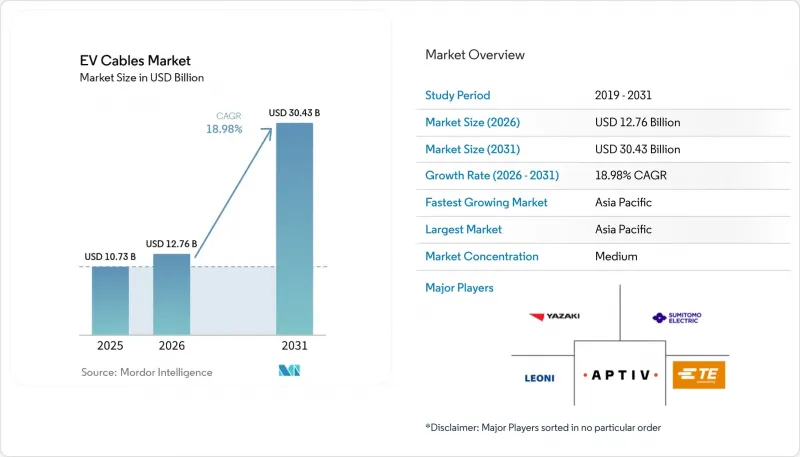
Mordor Intelligence에 의하면, 전기차 케이블 시장 규모는 2025년 107억 3,000만 달러에서 2026년에는 127억 6,000만 달러로 확대되어 2031년까지 304억 3,000만 달러에 이를 것으로 예상되고 있어 예측 기간(2026-2031년)에서 CAGR 18.98%로 성장할 전망입니다.
본 보고서는 전기차의 유형(배터리식 전기차 등), 전압의 유형(저전압 등), 용도(엔진·파워트레인 등), 구성 요소(전선 등), 절연재의 유형(PVC 등), 차폐재의 유형(구리·알루미늄) 및 지역별로 분류되어 있습니다. 시장 전망은 금액(달러) 기준으로 제시되어 있습니다.
전 세계 전기차 케이블 시장 동향 및 인사이트
중국 및 유럽에서의 BEV 생산 급증
최근 중국에서는 배터리식 전기차(BEV) 생산이 대폭 증가하여 전년 대비 현저한 성장을 보이고 있습니다. 마찬가지로 유럽에서도 생산이 눈에 띄게 증가하고 있어 시장의 성장세가 강함을 반영하고 있습니다. 이러한 동향에 대응하여 주요 케이블 제조업체들은 독일 츠비카우와 중국 선전 등 주요 조립 거점 근처에 압출 성형 및 편조 시설을 전략적으로 설립하고 있습니다. 이러한 노력을 통해 물류 비용 절감과 리드타임 단축을 도모하고 있습니다. 중국의 자동차 제조업체(OEM)는 ‘셀-투-팩(cell-to-pack)’ 방식의 배터리 시스템으로의 전환을 추진하고 있습니다. 이를 통해 모듈 배선이 불필요해지며, 버스바 및 열 관리 라인 강화를 위해 자재를 재분배할 수 있게 됩니다. 유럽에서는 고급 자동차 브랜드들이 급속 충전 중 최적의 온도를 유지하는 수냉식 충전 케이블 등 첨단 기능에 대한 수요를 주도하고 있습니다. 이로 인해 XLPE 및 알루미늄·폴리머 소재를 활용한 혁신적인 설계를 전문으로 하는 공급업체들에게 수익성 높은 비즈니스 기회가 창출되고 있습니다.
400-800V 이상의 EV 아키텍처로의 전환
각 자동차 제조업체들은 기존의 400 V 시스템에서 800 V 플랫폼으로 일제히 전환하고 있습니다. 800 V 플랫폼에서는 동등한 출력을 얻기 위한 전류 소비량이 절반으로 줄어들기 때문에 더 얇은 도체나 경량 하네스를 채택할 수 있게 됩니다. 포르쉐, 현대, 기아가 조기 도입을 주도하고 있으며, 현재는 테슬라와 BYD도 이에 뒤따르고 있어 이 설계 전환은 더 이상 되돌릴 수 없는 추세가 되었습니다. 2026년 초 정제 구리 가격이 사상 최고 수준에 도달한 가운데, 이 아키텍처로 인한 차량당 구리 사용량 감소는 이러한 기술적 전환과 완벽하게 부합합니다. 한때 고급 제품으로 여겨졌던 실리콘 카바이드(SiC) 인버터는 가격이 더욱 저렴해져 현재는 주류 예산 범위 내에 들어오게 되었기 때문에 800V로의 채택이 가속화되고 있습니다. 구형 400V 충전기와의 호환성 문제를 해결하기 위해 전압 승압 스테이션이 등장했으나, 이로 인해 사이트별로 추가 비용이 발생하고 있습니다. 이러한 추세로 인해 ISO 19642 클래스 B 고전압 케이블에 대한 수요 증가가 주목받고 있습니다.
구리·알루미늄 가격 변동
2025년 하반기부터 2026년 초에 걸쳐 구리 가격은 대폭 상승했으며, 알루미늄 가격도 마찬가지로 상승했습니다. 이러한 상승 추세는 전기차(EV) 수요 증가에 대응하기 위해 제련소가 생산을 축소한 것이 원인입니다. 구리 현물 가격에 미세한 변동만 발생해도 대형 하네스 제조업체의 이익률에 큰 영향을 미치기 때문에 각사는 적극적인 헤지 전략을 채택할 수밖에 없는 상황입니다. 재정 여력이 제한적인 공급업체는 계약 재협상을 강요받거나 고객의 이탈에 직면하는 경우가 많아, 그 결과 새로운 ISO 19642 규격에 대응하는 생산 라인에 대한 투자가 지연되고 있습니다.
부문 분석
2025년, 배터리식 전기차(BEV)는 전기차 케이블 시장의 63.36%를 차지했습니다. 이는 BEV의 압도적인 생산 규모와 400V-800V 배터리 팩, 인버터, 트랙션 모터에 필요한 대당 케이블 사용량이 많다는 점을 반영한 것입니다. 이 부문의 막대한 도입 대수 덕분에, 자동차 제조업체가 모델 체인지를 진행하거나 추가적인 데이터·전원 라인이 필요한 소프트웨어 업그레이드를 전개함에 따라 고전압 하네스에 대한 꾸준한 교체 수요가 확보되고 있습니다.
연료전지차(FCEV)는 생산 대수가 훨씬 적은 수준에서 시작되기는 했지만, 2026년부터 2031년까지 연평균 성장률(CAGR) 19.01%라는 가장 빠른 성장세를 보일 것으로 예측됩니다. 일본, 한국,및 유럽 일부 노선에서 시행되고 있는 상용 버스 및 대형 트럭 실증 사업에서는 650-750V의 스택 간 연결, 수소 센서용 배선, 그리고 대전류 펌프 컨트롤러가 사양으로 정해져 있으며, 이 모든 요소가 차량당 케이블 가치를 BEV 평균을 상회하는 수준으로 끌어올리고 있습니다. 따라서 이 틈새 시장은 SAE J2578의 수소 투과 한계 및 120°C의 연속 온도 듀티 사이클을 충족할 수 있는 공급업체에게 매우 큰 수익 증대 기회가 될 것입니다.
고전압 케이블은 2025년 전기차 케이블 시장 점유율의 56.73%를 차지하고 있으며, 2031년까지 연평균 성장률(CAGR) 19.05%로 확대될 것으로 예측됩니다. 400V 플랫폼에서 800V 플랫폼으로 전환될 때마다 도체의 단면적과 절연 요구 사항이 증가하기 때문에 고전압 케이블의 점유율은 중전압 및 저전압 부문을 계속해서 상회하고 있습니다. 현재 OEM 사양에서는 ISO 19642 클래스 B(1,000 VAC/1,500 VDC) 정격, 내장형 온도 센서,2m를 초과하는 배선 구간에서 알루미늄 대체가 일상적으로 요구되고 있으며, 이 모든 요소가 부품표(BOM)의 가치를 끌어올리고 있습니다.
중·저전압 케이블은 보조 부하에서 여전히 중요한 역할을 수행하고 있습니다. 그러나 자동차 제조업체들이 12V 기능을 존 컨트롤러에 통합하고, 마일드 하이브리드 아키텍처를 48V 백본으로 전환함에 따라, 이러한 중·저전압 케이블의 총 시장 점유율은 서서히 계속 감소하고 있습니다. 이러한 구조적 변화로 인해 고전압은 전체 부문에서 명백한 가치의 원동력으로 계속 자리 잡고 있습니다.
지역별 분석
아시아태평양은 2025년에 전 세계 매출의 36.74%를 차지하며, 2031년까지 연평균 성장률(CAGR) 19.16%로 성장할 것으로 전망됩니다. 가까운 미래에 중국은 BEV(배터리 전기자동차)의 대량 생산을 통해 지역 수요를 주도할 것으로 예측됩니다. 한편, 인도의 ‘생산 연계 인센티브(PLI)’ 제도에서는 수년 이내에 달성해야 할 국내 부가가치에 대한 상당한 기준이 보조금 지급 조건으로 강조되고 있습니다. 일본과 한국은 프리미엄 BEV 및 FCEV에 주력하고 있으며, 차량 1대당 케이블 사용량은 세계 평균을 크게 상회하고 있습니다.
북미에서는 ‘인플레이션 억제법’에 힘입어 견조한 성장이 나타나고 있습니다. 이 법에 따르면, 소비자 세금 공제 대상이 되려면 차량 부품을 현지에서 조달해야 합니다. 야자키, 액티브, 리어와 같은 주요 기업들은 멕시코와 미국 남부에 신규 공장을 건설하며 사업을 확장하고 있습니다. 그러나 인력 부족이 과제로 대두되며 성장 속도를 둔화시키고 있습니다. 유럽은 북미와 유사한 성장 궤도를 밟고 있으며, 독일, 프랑스, 스페인 등 여러 국가가 전기차 플랫폼 전환에 막대한 투자를 하고 있습니다. 특히 폭스바겐은 전기 부품의 현지화에 막대한 자원을 할당하고 있습니다.
남미, 중동 및 아프리카는 절대적인 수량 면에서는 뒤처져 있지만, 소규모 기반에서 놀라운 성장을 이루고 있습니다. 브라질의 ‘Rota 2030’ 이니셔티브는 BYD나 장성자동차(Great Wall)와 같은 기업들의 현지 조립을 뒷받침하고 있으며, 이들 기업은 현재 현지 조달 요건을 충족하기 위해 인증된 케이블 생산 라인을 모색하고 있습니다. 아랍에미리트(UAE)에서는 향후 몇년내에 두바이-아부다비 회랑을 따라 다수의 DC 충전기를 설치하는 계획이 진행되고 있습니다. 남아프리카공화국의 인센티브 프로그램은 케이블 하네스까지 적용 대상을 확대되고 있습니다. 그러나 이러한 시장에서 대규모 수요가 실현되기 위해서는 충전 인프라의 추가 확충이 필요합니다.
기타 혜택:
- Excel 형식 시장 예측(ME) 시트
- 3개월간의 애널리스트 지원
자주 묻는 질문
목차
제1장 서론
제2장 분석 방법
제3장 주요 요약
제4장 시장 구도
제5장 시장 규모·성장률 예측
제6장 경쟁 구도
제7장 시장 기회와 향후 전망
JHS 26.09.03According to Mordor Intelligence, the EV cables market size is expected to increase from USD 10.73 billion in 2025 to USD 12.76 billion in 2026 and reach USD 30.43 billion by 2031, growing at a CAGR of 18.98% during the forecast period (2026-2031).
This report is Segmented by EV Type (Battery Electric Vehicle and More), Voltage Type (Low Voltage and More), Application (Engine & Powertrain and More), Component (Wire and More), Insulation Type (PVC and More), Shielding Type (Copper and Aluminum), and Geography. The Market Forecasts are Provided in Terms of Value (USD).
Global EV Cables Market Trends and Insights
Rapid BEV Production Ramp-Up in China & Europe
In recent years, China has significantly increased its production of Battery Electric Vehicles (BEVs), showing substantial year-on-year growth. Similarly, Europe has experienced a notable rise in production, reflecting strong market momentum. In response to these trends, leading cable manufacturers have strategically established extrusion and braiding facilities near major assembly hubs like Zwickau in Germany and Shenzhen in China. This approach reduces logistics expenses and shortens lead times. Chinese Original Equipment Manufacturers (OEMs) are transitioning to cell-to-pack battery systems, which eliminate the need for module wiring and enable the reallocation of materials to enhance busbars and thermal lines. In Europe, luxury automotive brands are driving demand for advanced features, including liquid-cooled charging cables that maintain optimal temperatures during rapid charging. This has created a profitable opportunity for suppliers specializing in innovative designs using XLPE and aluminum-polymer materials.
Shift Toward 400-800 V + EV Architectures
Automakers are moving en masse from legacy 400 V systems to 800 V platforms that halve current draw for equal power, enabling thinner conductors and lighter harnesses. Porsche, Hyundai, and Kia led early rollouts, and Tesla and BYD are now following suit, reinforcing an irreversible design pivot . As refined copper prices reached unprecedented levels in early 2026, the architecture's reduction in copper usage per vehicle aligns seamlessly with the technology shift. Once considered a premium, silicon-carbide inverters have become more affordable, now fitting within mainstream budgets, thereby hastening the adoption of 800 V. To address compatibility challenges with older 400 V chargers, voltage-boost stations have emerged, adding additional costs per site. This development has cast a spotlight on the rising demand for ISO 19642 Class B high-voltage cables.
Copper & Aluminum Price Volatility
Between late 2025 and early 2026, copper prices rose significantly, while aluminum prices also increased. Smelter curtailments drove this upward trend in response to growing demand for electric vehicles (EVs). Even a moderate fluctuation in copper's spot price can substantially affect the margins of leading harness manufacturers, prompting them to adopt aggressive hedging strategies. Suppliers with limited financial resources are often forced to renegotiate contracts or face customer attrition, which delays their ability to invest in new ISO 19642 production lines.
Other drivers and restraints analyzed in the detailed report include:
- Stringent Zero-Emission Mandates Elevate HV-Cable Demand
- Government-Funded Fast-Charging Roll-Outs
- Limited Automated EV-Cable Manufacturing Capacity
For complete list of drivers and restraints, kindly check the Table Of Contents.
Segment Analysis
Battery Electric Vehicles accounted for 63.36% of the EV cables market share in 2025, reflecting their dominant production scale and the high cable content per vehicle required for 400 V-800 V battery packs, inverters, and traction motors. The segment's large installed base ensures steady replacement demand for high-voltage harnesses as automakers roll out refreshed models and software-enabled upgrades that call for additional data and power lines.
Fuel Cell Electric Vehicles are projected to post the quickest advance at a 19.01% CAGR over 2026-2031, even though they start from a much smaller volume base. Commercial bus and heavy-truck pilots in Japan, South Korea, and select European corridors specify 650-750 V stack interconnects, hydrogen-sensor wiring, and high-current pump controllers, all of which lift per-vehicle cable value above the BEV average. This niche, therefore, represents an outsized revenue upside for suppliers that can meet SAE J2578 hydrogen-permeation limits and 120 °C continuous-temperature duty cycles.
High-voltage lines captured 56.73% of the 2025 EV cables market share and are forecast to expand at a 19.05% CAGR through 2031. Every migration from 400 V to 800 V platforms increases conductor cross-sections and insulation requirements, keeping high-voltage content ahead of medium- and low-voltage categories. OEM specifications now routinely call for ISO 19642 Class B ratings (1,000 VAC / 1,500 VDC), integrated temperature sensing, and aluminum substitution for runs beyond 2 m, all of which raise bill-of-materials value.
Medium- and low-voltage cables continue to play critical roles in auxiliary loads. Still, their combined share continues to edge down as automakers consolidate 12 V functions into zonal controllers and elevate mild-hybrid architectures to 48 V backbones. This structural shift keeps high voltage the undisputed value engine of the overall segment.
Complete Report Scope:
- By EV Type
- Battery Electric Vehicle (BEV)
- Plug-in Hybrid Electric Vehicle (PHEV)
- Hybrid Electric Vehicle (HEV)
- Fuel Cell Electric Vehicle (FCEV)
- By Voltage Type
- Low Voltage
- Medium Voltage
- High Voltage
- By Application
- Engine & Powertrain
- Battery & Battery Management
- Charging Management
- Power Electronics
- Motor Cables
- Others
- By Component
- Wire
- Connectors
- Fuse
- Insulation & Shielding Materials
- By Insulation Type
- PVC
- XLPE
- TPE
- Others
- By Shielding Type
- Copper
- Aluminum
- By Geography
- North America
- United States
- Canada
- Rest of North America
- South America
- Brazil
- Argentina
- Rest of South America
- Europe
- United Kingdom
- Germany
- Spain
- Italy
- France
- Russia
- Rest of Europe
- Asia-Pacific
- India
- China
- Japan
- South Korea
- Rest of Asia-Pacific
- Middle East and Africa
- United Arab Emirates
- Saudi Arabia
- Turkey
- Egypt
- South Africa
- Rest of Middle East and Africa
- North America
Geography Analysis
Asia-Pacific accounting for 36.74% of global revenue in 2025, and is projected to grow at 19.16 % CAGR through 2031. In the near future, China is expected to lead regional demand with significant BEV production. Meanwhile, India's Production-Linked Incentive scheme emphasizes a substantial domestic value threshold for subsidies to be met within a few years. Japan and South Korea are focusing on premium BEVs and FCEVs, with cable content per vehicle well above the global average.
North America is experiencing robust growth, supported by the Inflation Reduction Act, which requires that vehicles be sourced locally to qualify for consumer credits. Key players like Yazaki, Aptiv, and Lear are expanding operations with new plants in Mexico and the southern U.S. However, labor shortages are presenting challenges, slowing the pace of growth. Europe is matching North America's growth trajectory, with countries like Germany, France, and Spain making significant investments in converting platforms for EVs. Volkswagen, in particular, has allocated substantial resources for localizing electrical components .
Although South America, the Middle East, and Africa are behind in absolute volume, they are achieving notable growth from a smaller base. Brazil's Rota 2030 initiative is encouraging local assembly efforts by companies such as BYD and Great Wall, which are now seeking certified cable lines to meet local-content requirements. In the UAE, plans are underway to establish a substantial number of DC chargers along the Dubai-Abu Dhabi corridor within a few years. South Africa's incentive program is extending to cable harnesses. However, these markets are awaiting more extensive charging infrastructure before large-scale demand can be realized.
- Yazaki Corporation
- Sumitomo Electric Industries
- Leoni AG
- Aptiv PLC
- TE Connectivity
- Prysmian Group
- Nexans SA
- Huber+Suhner AG
- Fujikura Ltd.
- Furukawa Electric
- Lear Corporation
- LS Cable & System
- Amphenol Corp.
- ABB Ltd.
- Brugg Group
- Volex plc
- Rosenberger Group
- BizLink Group
- HELUKABEL GmbH
- Jiangsu Etern Co., Ltd.
Additional Benefits:
- The market estimate (ME) sheet in Excel format
- 3 months of analyst support
TABLE OF CONTENTS
1 Introduction
- 1.1 Study Assumptions & Market Definition
- 1.2 Scope of the Study
2 Research Methodology
3 Executive Summary
4 Market Landscape
- 4.1 Market Overview
- 4.2 Market Drivers
- 4.2.1 Rapid BEV Production Ramp-Up In China & Europe
- 4.2.2 Shift Toward 400-800 V+ Ev Architectures
- 4.2.3 Stringent Zero-Emission Mandates Elevate Hv-Cable Demand
- 4.2.4 Government-Funded Fast-Charging Roll-Outs
- 4.2.5 Automaker Switch To Zonal Harness Topologies
- 4.2.6 XLPO Insulation Adoption Lowers Cable Costs
- 4.3 Market Restraints
- 4.3.1 Copper & Aluminium Price Volatility
- 4.3.2 Limited Automated EV-Cable Manufacturing Capacity
- 4.3.3 Fire-Safety & EMC Qualification Burden
- 4.3.4 Extra Shielding For Ultra-Fast-Charge Heat Loads
- 4.4 Value / Supply-Chain Analysis
- 4.5 Regulatory Landscape
- 4.6 Technological Outlook
- 4.7 Porter's Five Forces
- 4.7.1 Threat of New Entrants
- 4.7.2 Bargaining Power of Suppliers
- 4.7.3 Bargaining Power of Buyers
- 4.7.4 Threat of Substitutes
- 4.7.5 Competitive Rivalry
5 Market Size & Growth Forecasts (Value (USD))
- 5.1 By EV Type
- 5.1.1 Battery Electric Vehicle (BEV)
- 5.1.2 Plug-in Hybrid Electric Vehicle (PHEV)
- 5.1.3 Hybrid Electric Vehicle (HEV)
- 5.1.4 Fuel Cell Electric Vehicle (FCEV)
- 5.2 By Voltage Type
- 5.2.1 Low Voltage
- 5.2.2 Medium Voltage
- 5.2.3 High Voltage
- 5.3 By Application
- 5.3.1 Engine & Powertrain
- 5.3.2 Battery & Battery Management
- 5.3.3 Charging Management
- 5.3.4 Power Electronics
- 5.3.5 Motor Cables
- 5.3.6 Others
- 5.4 By Component
- 5.4.1 Wire
- 5.4.2 Connectors
- 5.4.3 Fuse
- 5.4.4 Insulation & Shielding Materials
- 5.5 By Insulation Type
- 5.5.1 PVC
- 5.5.2 XLPE
- 5.5.3 TPE
- 5.5.4 Others
- 5.6 By Shielding Type
- 5.6.1 Copper
- 5.6.2 Aluminum
- 5.7 By Geography
- 5.7.1 North America
- 5.7.1.1 United States
- 5.7.1.2 Canada
- 5.7.1.3 Rest of North America
- 5.7.2 South America
- 5.7.2.1 Brazil
- 5.7.2.2 Argentina
- 5.7.2.3 Rest of South America
- 5.7.3 Europe
- 5.7.3.1 United Kingdom
- 5.7.3.2 Germany
- 5.7.3.3 Spain
- 5.7.3.4 Italy
- 5.7.3.5 France
- 5.7.3.6 Russia
- 5.7.3.7 Rest of Europe
- 5.7.4 Asia-Pacific
- 5.7.4.1 India
- 5.7.4.2 China
- 5.7.4.3 Japan
- 5.7.4.4 South Korea
- 5.7.4.5 Rest of Asia-Pacific
- 5.7.5 Middle East and Africa
- 5.7.5.1 United Arab Emirates
- 5.7.5.2 Saudi Arabia
- 5.7.5.3 Turkey
- 5.7.5.4 Egypt
- 5.7.5.5 South Africa
- 5.7.5.6 Rest of Middle East and Africa
- 5.7.1 North America
6 Competitive Landscape
- 6.1 Market Concentration
- 6.2 Strategic Moves
- 6.3 Market Share Analysis
- 6.4 Company Profiles (includes Global Level Overview, Market Level Overview, Core Segments, Financials as Available, Strategic Information, Market Rank/Share for Key Companies, Products and Services, SWOT Analysis, and Recent Developments)
- 6.4.1 Yazaki Corporation
- 6.4.2 Sumitomo Electric Industries
- 6.4.3 Leoni AG
- 6.4.4 Aptiv PLC
- 6.4.5 TE Connectivity
- 6.4.6 Prysmian Group
- 6.4.7 Nexans SA
- 6.4.8 Huber+Suhner AG
- 6.4.9 Fujikura Ltd.
- 6.4.10 Furukawa Electric
- 6.4.11 Lear Corporation
- 6.4.12 LS Cable & System
- 6.4.13 Amphenol Corp.
- 6.4.14 ABB Ltd.
- 6.4.15 Brugg Group
- 6.4.16 Volex plc
- 6.4.17 Rosenberger Group
- 6.4.18 BizLink Group
- 6.4.19 HELUKABEL GmbH
- 6.4.20 Jiangsu Etern Co., Ltd.
7 Market Opportunities & Future Outlook
- 7.1 White-space & Unmet-Need Assessment


