|
시장보고서
상품코드
2117976
미국의 와이어 및 케이블 : 시장 점유율 분석, 업계 동향 및 통계, 성장 예측(2026-2031년)United States Wires and Cables - Market Share Analysis, Industry Trends & Statistics, Growth Forecasts (2026 - 2031) |
||||||
 Mordor Intelligence
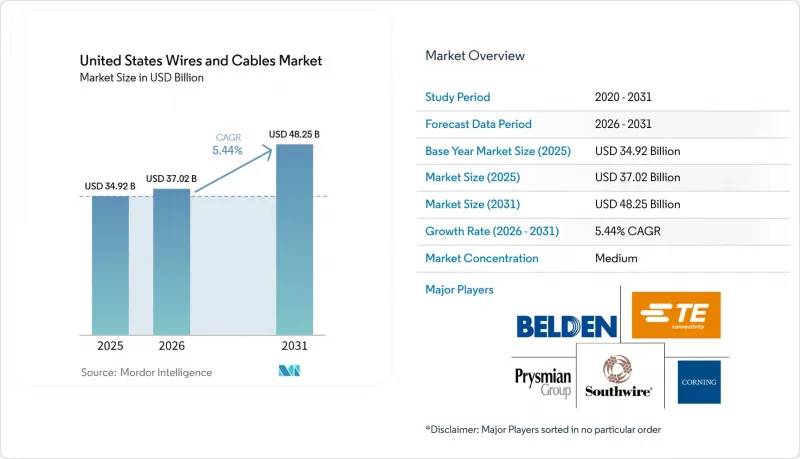
Mordor Intelligence에 의하면, 미국의 와이어 및 케이블 시장 규모는 2025년에 349억 2,000만 달러로 평가되었습니다. 2026년 370억 2,000만 달러에서 2031년까지 482억 5,000만 달러에 이를 것으로 예상되며, 예측 기간(2026-2031년) CAGR은 5.44%를 나타낼 전망입니다.
본 보고서는 케이블 유형(저전압용 전력 케이블, 광섬유 케이블, 기타), 절연 유형(절연형, 비절연형),정격 전압(1kV 미만, 1-35kV, 기타), 설치 유형(가공, 기타), 도체 재료(구리, 알루미늄, 기타), 최종 사용자 산업(산업 제조, 기타)별로 분류되어 있습니다. 시장 예측은 금액(달러) 기준으로 제시되어 있습니다.
미국의 와이어 및 케이블 시장 동향 및 인사이트
인프라 현대화를 위한 지출 증가
연방 정부의 자금 지원은 전력망 및 광대역 구축 프로그램과 직접적으로 연계되어 있어, 미국의 와이어 및 케이블 시장에 있어 가장 확실한 수요 기반이 되고 있습니다. IIJA(인플레이션 억제 및 고용법)에 따라 2021년부터 2026년까지 전력망 업그레이드에 730억 달러, 광대역 확장에 650억 달러가 배정되어, 이를 통해 유틸리티체, 도급업체, 통신 네트워크 사업자에게 명확한 지출 기반이 마련되었습니다. 2023년, 미국의 유틸리티자는 송전에 277억 달러, 배전에 509억 달러를 지출했습니다. 한편, 2023-2026년에 걸쳐 민간 소유 유틸리티자의 송전 건설 투자는 1,210억 달러에 달할 것으로 예측됩니다. 에너지부는 2026년 7월, 데이터센터, 국내 제조업, 전기화가 기존 송전망에 부하를 가하는 수요 증가의 주요 원인이라고 밝혔습니다. 동 조사에 따르면, 미국 송전선의 70%가 건설된 지 25년 이상 된 것으로 지적되었으며, 개별 프로젝트의 진척이 완만하더라도 미국의 와이어 및 케이블 시장에는 견실한 수요 기반이 확보되어 있습니다. 이러한 지출 동향은 현대화가 더 이상 일회성 업그레이드가 아니라 시스템 신뢰성, 산업 성장, 새로운 전력 수요와 밀접하게 연결되어 있기 때문에 안정적인 수주 전망을 뒷받침하고 있습니다.
송전망 강화 및 스마트 그리드로의 개조
송전망 강화는 미국의 와이어 및 케이블 시장에서 케이블 수요 증가와 그에 따른 평균 기술 사양의 향상을 가져오고 있습니다. 에너지부는 ‘그리드 복원력 및 혁신 파트너십(GRIP)’ 프로그램을 통해, 해당 프로그램이 2026년에 SPARK 프레임워크로 전환될 때까지 약 50억 달러를 운용했습니다. 또한, 34개 프로젝트에 걸쳐 30억 달러가 투입된 스마트 그리드 보조금을 통해 전력 도체와 함께 광섬유 통신 회선이 설치되고 있으며, 이전의 그리드 주기에 비해 케이블 조달이 보다 통합된 형태로 이루어지고 있습니다. 화재나 폭풍우가 자주 발생하는 지역에 위치한 전력 회사들은 피복 도체, 지하 시스템, 고성능 절연재로 전환하고 있으며, 이를 통해 노선 마일이 그리 빠르게 증가하지 않더라도 수익 구성이 개선되고 있습니다. 이러한 전환은 수요가 단순한 범용 전선에서 가격 결정력이 더 높은 제품으로 이동함에 따라 주요 제조업체들에게 특히 중요합니다. 그 결과, 복원력 기준이 예외적인 지출이 아닌 일상적인 자본 계획의 일부가 됨에 따라 미국의 와이어 및 케이블 시장의 수익 구조는 더욱 견고해지고 있습니다.
높은 설치 비용과 토목 공사비
설치 비용은 큰 제약 요인으로 작용하고 있습니다. 이는 현재 지하 매설이 가공 매설에 비해 훨씬 더 큰 토목 공사 부담을 수반하기 때문입니다. 파이버 브로드밴드 협회(Fiber Broadband Association)와 카르테시안(Cartesian)의 보고서에 따르면, 2025년 지하 매설 비용의 중앙값은 1피트당 18달러인 반면, 공중 매설은 1피트당 8달러로, 이러한 비용 격차가 2026년 케이블 경로 선정에 영향을 미치고 있습니다. 같은 2026년 조사에서 사업자의 88%는 인건비, 자재비, 인허가 취득, 부설 준비 요건으로 인해 비용이 다시 상승할 것으로 예상했습니다. 중전압 및 고전압 프로젝트의 경우, 자재비에 더해 도랑 파기, 도관 공사, 변전소 연결, 도로 복구 등의 비용이 발생하기 때문에 더욱 큰 부담을 안게 됩니다. 이러한 압박으로 인해 케이블 수요가 감소하는 것은 아니지만, 프로젝트가 승인에서 설치에 이르기까지의 속도가 늦어질 가능성은 있습니다. 미국에서는 와이어 및 케이블 시장이 견조한 수요에 힘입어 호조를 보이고 있지만, 구매자들이 토목 공사 계약을 미루고 있어 여전히 시기 차이로 인한 차질이 발생하고 있습니다.
부문별 분석
2025년에는 저전압 에너지 케이블이 케이블 유형별 부문의 32.86%를 차지했습니다. 이 점유율은 일상적인 배선 수요가 여전히 광범위하고 지속적인 주택, 상업, 경공업 건설 분야에서 안정적인 수요를 반영한 것입니다. 광섬유 케이블은 가장 빠르게 성장하는 유형으로, 디지털 인프라에 대한 투자가 가속화됨에 따라 2026년부터 2031년까지 연평균 성장률(CAGR) 6.74%를 나타낼 것으로 예측됩니다. 파이버 브로드밴드 협회(Fiber Broadband Association)와 RVA는 2029년까지 설치된 광섬유 마일 수가 2배 이상 증가해야 한다고 밝혔으며, 이는 케이블 제조업체들이 하이퍼스케일 및 광대역 수요에 특화하여 생산 능력을 확대하고 있는 이유를 설명해 줍니다.
코닝(Corning)사의 히코리 공장 확장은 미국 내 와이어 및 케이블 시장이 이러한 수요 변화에 실시간으로 어떻게 대응하고 있는지를 기업 차원에서 명확히 보여주는 좋은 사례입니다. 중전압 전력 케이블, 고전압 및 초고전압 케이블, 신호·제어 케이블, 동축 케이블 및 데이터 케이블, 그리고 특수 전선은 송전망, 자동화, 국방, 방송 시스템 분야에서 용도는 제한적이지만 기술적으로 중요한 역할을 계속 수행하고 있습니다. 또한, 전력 회사는 새로운 송전망 건설 시 전력 도체를 광섬유용 접지선과 함께 묶어 사용하고 있어, 통신 케이블과 전력 케이블 조달에 있어 기존의 경계가 점차 모호해지고 있습니다. 분산형 에너지 자원 관리 및 산업 자동화의 확대에 따라 신호·제어 케이블에 대한 수요도 증가하고 있습니다. 이러한 분야에서는 배선 거리와 마찬가지로 차폐 성능 및 신뢰성이 중요시되고 있습니다. 또한, 모터, 변압기, 전기차(EV) 충전 설비의 국내 생산이 확대됨에 따라 하류 수요의 상당 부분이 미국의 와이어 및 케이블 산업 내에 머물게 되어, 특수 전선도 그 혜택을 보고 있습니다.
절연 케이블은 대부분의 전압 등급 및 용도에서 폴리머에 의한 보호가 요구되므로, 2025년에는 이 부문의 84.48%를 차지하며 계속해서 주요 카테고리가 되었습니다. 이 부문에서 절연 케이블은 2025년에 미국의 와이어 및 케이블 시장 점유율의 84.48%를 차지했으며, 2031년까지 연평균 성장률(CAGR) 5.50%를 나타낼 것으로 예측됩니다. 이러한 규모가 큰 이유는 안전성, 열적 성능, 내환경성이 필수적인 건축물, 유틸리티 네트워크, 교통 시스템, 데이터 인프라 등 광범위한 분야에서 활용되기 때문입니다. 이러한 주도적 지위는 단일 최종 시장에 의존하지 않기 때문에 절연 케이블은 미국의 와이어 및 케이블 시장에서 가장 안정적인 분야 중 하나가 되고 있습니다.
이 부문에서 주요 경쟁 과제는 절연 제품의 전반적인 위상보다는 절연재의 화학적 조성 조합에 있습니다. 중전압 및 고전압 용도에서 XLPE는 기존 PVC 배합을 대체하며 점유율을 지속적으로 확대되고 있습니다. 이는 전력 회사들이 XLPE의 뛰어난 열 성능과 내습성을 중시하기 때문입니다. 또한, 할로겐이 포함되지 않은 난연성 화합물도 연기 및 독성 특성이 중요한 데이터센터, 터널, 교통 시스템 등 고밀도 설치 환경에서 더욱 널리 채택되고 있습니다. 비절연 케이블은 특히 첨단 도체 설계를 통해 기존 송전선의 성능이 향상됨에 따라, 노출된 가공 도체나 접지 용도에서 여전히 중요한 역할을 수행하고 있습니다. 2024년 PNAS지에 게재된 첨단 도체에 관한 연구는 고성능 노출 도체 기술이 기존 송전 권한 구역 내에서 송전 용량을 대폭 향상시킬 수 있음을 보여주고 있으며, 이는 미국의 와이어 및 케이블 시장의 이 분야를 뒷받침하고 있습니다.
기타 혜택
- 엑셀 형식 시장 예측(ME) 시트
- 3개월간의 애널리스트 지원
자주 묻는 질문
목차
제1장 서론
제2장 조사 방법
제3장 개요
제4장 시장 구도
제5장 시장 규모 및 성장 예측
제6장 경쟁 구도
제7장 시장 기회 및 향후 전망
KTH 26.09.02According to Mordor Intelligence, the United States wires and cables market size was valued at USD 34.92 billion in 2025 and estimated to grow from USD 37.02 billion in 2026 to reach USD 48.25 billion by 2031, at a CAGR of 5.44% during the forecast period (2026-2031).
This report is Segmented by Cable Type (Low-Voltage Energy, Fiber-Optic Cable, and More), Insulation (Insulated, and Non-Insulated), Voltage Rating (Less Than1 KV, 1-35 KV, and More), Installation Type (Overhead, and More), Conductor Material (Copper, Aluminum, and More), and End-User Industry (Industrial Manufacturing, and More). The Market Forecasts are Provided in Terms of Value (USD).
United States Wires and Cables Market Trends and Insights
Rising Infrastructure Modernization Spending
Federal funding remains the clearest demand support for the United States wires and cables market because it is tied directly to power grid and broadband build programs. The IIJA allocated USD 73 billion for power grid upgrades and USD 65 billion for broadband expansion across 2021 to 2026, which set a clear spending base for utilities, contractors, and communications network operators. U.S. utilities spent USD 27.7 billion on transmission and USD 50.9 billion on distribution in 2023, while investor-owned utility transmission construction investment for 2023 to 2026 is projected at USD 121 billion. The Department of Energy stated in July 2026 that data centers, domestic manufacturing, and electrification are key sources of load growth that are pressing on the existing grid. The same study also noted that 70% of U.S. transmission lines are 25 or more years old, which provides the USA wires and cables market with a durable replacement floor, even when individual projects move slowly. This spending profile supports steady order visibility because modernization is now tied to system reliability, industrial growth, and new electricity demand rather than to one-time upgrades.
Grid Hardening and Smart-Grid Retrofits
Grid hardening is raising both cable demand and the average technical specification of that demand across the United States wires and cables market. The Department of Energy administered close to USD 5 billion through the Grid Resilience and Innovation Partnerships program before the program moved into the SPARK structure in 2026. Smart grid grant funding of USD 3 billion across 34 projects is also deploying fiber-optic communication links alongside power conductors, making cable procurement more integrated than in earlier grid cycles. Utilities in fire- and storm-prone territories are shifting toward covered conductors, underground systems, and higher-performance insulation, which improves the value mix even when route miles do not rise as quickly. That shift is especially important for large manufacturers because it moves demand away from simpler commodity wire and toward products with better pricing power. The result is a stronger revenue mix for the US wires and cables market as resilience standards become part of routine capital plans rather than exceptional spending.
High Installation and Civil Work Costs
Installation costs are a major restraint because underground deployment now carries a much larger civil works burden than aerial alternatives. Fiber Broadband Association and Cartesian reported median underground deployment at USD 18 per foot versus USD 8 per foot for aerial in 2025, and this cost gap shapes cable route selection in 2026. In the same 2026 survey, 88% of operators expected costs to rise again because of labor, materials, permitting, and make-ready requirements. Medium-voltage and high-voltage projects face an even heavier burden because trenching, conduit work, substation connections, and roadway restoration are added to the material bill. This pressure does not reduce the need for cable, but it can slow the pace at which projects move from approval to installation. In the USA, the wires and cables market faces strong demand but is still hampered by timing friction as buyers delay civil work commitments.
Other drivers and restraints analyzed in the detailed report include:
- Data Center Fiber Build-Out
- Utility-Scale Renewable Transmission Demand
- Copper And Aluminum Price Volatility
For complete list of drivers and restraints, kindly check the Table Of Contents.
Segment Analysis
Low-voltage energy cable is expected to account for 32.86% of the by-cable-type segment in 2025. This position reflects steady demand from residential, commercial, and light industrial construction, where routine wiring requirements remain broad and recurring. Fiber-optic cable is the fastest-growing type and is projected to record a 6.74% CAGR from 2026 to 2031 as digital infrastructure spending accelerates. The Fiber Broadband Association and RVA stated that the installed fiber-mile base will need to more than double by 2029, which explains why cable producers are adding capacity specifically for hyperscale and broadband demand.
Corning's Hickory expansion provides a clear company-level example of how the United States wires and cables market is responding to this demand shift in real time. Medium-voltage power cable, high- and extra-high-voltage cable, signal and control cable, coaxial and data cable, and specialty wire continue to serve narrower but technically important roles across grid, automation, defense, and broadcast systems. Utilities are also bundling power conductors with fiber-enabled ground wire in new transmission builds, reducing the historical separation between communications cable and power cable procurement. Demand for signal and control cable is rising as distributed energy resource management and industrial automation expand, where shielding and reliability matter as much as route miles. Specialty wire is also benefiting as domestic production of motors, transformers, and EV charging equipment keeps more downstream demand within the US wires and cables industry.
Insulated cable is expected to account for 84.48% of the segment in 2025 and to remain the dominant category, as most voltage classes and end uses require polymeric protection. In this segment, insulated cable is expected to account for 84.48% of the USA wires and cables market share in 2025 and to grow at a 5.50% CAGR through 2031. Its scale comes from broad use across buildings, utility networks, transportation systems, and data infrastructure, where safety, thermal performance, and environmental resistance are essential. This leadership does not depend on a single end market, making insulated cable one of the most stable parts of the US wires and cables market.
The main competitive question within this segment is the mix of insulation chemistry rather than the overall position of insulated products. XLPE continues to gain ground over older PVC formulations in medium-voltage and high-voltage applications because utilities value its improved heat performance and moisture resistance. Halogen-free flame-retardant compounds are also gaining wider adoption in dense installations, such as data centers, tunnels, and transit systems, where smoke and toxicity profiles matter. Non-insulated cable remains relevant in bare overhead conductors and grounding applications, especially as advanced conductor designs improve the performance of older line corridors. The 2024 PNAS study on advanced conductors supports this part of the United States wires and cables market by showing that premium bare-conductor technologies can unlock major transmission gains within existing rights-of-way.
Complete Report Scope:
- By Cable Type
- Low-Voltage Energy Cable
- Medium-Voltage Power Cable
- High / Extra-High-Voltage Cable
- Fiber-Optic Cable
- Signal and Control Cable
- Coaxial and Data Cable
- Specialty Wire (Magnet, Stranded, etc.)
- By Insulation Type
- Insulated
- Non-Insulated
- By Voltage Rating
- Less Than 1 kV
- 1 - 35 kV
- 36 - 69 kV
- 70 - 220 kV
- By Installation Type
- Overhead
- Underground
- Submarine
- Indoor and Building
- Aerial Micro-Duct
- By Conductor Material
- Copper
- Aluminum
- Copper-Clad Aluminum
- Composite and High-Strength Core
- By End-User Industry
- Construction (Residential and Commercial)
- Power Transmission and Distribution Utilities
- Telecommunications and Data Centers
- Industrial Manufacturing
- Automotive and Transportation, EV and Rail
- Renewable Energy, Solar and Wind
- Oil, Gas, and Mining
- Military and Defense
- Other End-User Industries
List of Companies Covered in this Report:
- Prysmian Group USA, LLC
- AmerCable Incorporated (Mattr Corp.)
- Southwire Company, LLC
- The Okonite Company
- Belden Inc.
- Corning Incorporated
- TE Connectivity plc
- Amphenol Corporation
- LS Cable & System USA, Inc.
- Furukawa Electric Co., Ltd.
- Leoni Cable Inc.
- Sumitomo Electric Wiring Systems, Inc.
- Nexans SA
- American Wire Group, LLC
- LAPP Group
- Philatron Wire & Cable
- Superior Essex Inc.
- AFL Telecommunications LLC (Fujikura Ltd.)
- NKT North America Inc. (NKT A/S)
- Incab America LLC (Taihan Fiberoptics)
Additional Benefits:
- The market estimate (ME) sheet in Excel format
- 3 months of analyst support
TABLE OF CONTENTS
1 INTRODUCTION
- 1.1 Study Assumptions and Market Definition
- 1.2 Scope of the Study
2 RESEARCH METHODOLOGY
3 EXECUTIVE SUMMARY
4 MARKET LANDSCAPE
- 4.1 Market Overview
- 4.2 Market Drivers
- 4.2.1 Rising Infrastructure Modernization Spending
- 4.2.2 Grid Hardening and Smart-Grid Retrofits
- 4.2.3 Data Center Fiber Build-Out
- 4.2.4 Utility-Scale Renewable Transmission Demand
- 4.2.5 Buy America-Driven Domestic Sourcing Preference
- 4.2.6 Underground and Submarine Transmission Projects
- 4.3 Market Restraints
- 4.3.1 Copper and Aluminum Price Volatility
- 4.3.2 High Installation and Civil Work Costs
- 4.3.3 Skilled Labor Shortages for Cable Installation
- 4.3.4 Permitting Delays and Right-of-Way Constraints
- 4.4 Industry Value Chain Analysis
- 4.5 Regulatory Landscape
- 4.6 Technological Outlook
- 4.7 Porter's Five Forces Analysis
- 4.7.1 Threat of New Entrants
- 4.7.2 Bargaining Power of Suppliers
- 4.7.3 Bargaining Power of Buyers
- 4.7.4 Threat of Substitutes
- 4.7.5 Rivalry Among Existing Competitors
- 4.8 Impact of Key Macroeconomic Trends on Market
5 MARKET SIZE AND GROWTH FORECASTS (VALUE)
- 5.1 By Cable Type
- 5.1.1 Low-Voltage Energy Cable
- 5.1.2 Medium-Voltage Power Cable
- 5.1.3 High / Extra-High-Voltage Cable
- 5.1.4 Fiber-Optic Cable
- 5.1.5 Signal and Control Cable
- 5.1.6 Coaxial and Data Cable
- 5.1.7 Specialty Wire (Magnet, Stranded, etc.)
- 5.2 By Insulation Type
- 5.2.1 Insulated
- 5.2.2 Non-Insulated
- 5.3 By Voltage Rating
- 5.3.1 Less Than 1 kV
- 5.3.2 1 - 35 kV
- 5.3.3 36 - 69 kV
- 5.3.4 70 - 220 kV
- 5.4 By Installation Type
- 5.4.1 Overhead
- 5.4.2 Underground
- 5.4.3 Submarine
- 5.4.4 Indoor and Building
- 5.4.5 Aerial Micro-Duct
- 5.5 By Conductor Material
- 5.5.1 Copper
- 5.5.2 Aluminum
- 5.5.3 Copper-Clad Aluminum
- 5.5.4 Composite and High-Strength Core
- 5.6 By End-User Industry
- 5.6.1 Construction (Residential and Commercial)
- 5.6.2 Power Transmission and Distribution Utilities
- 5.6.3 Telecommunications and Data Centers
- 5.6.4 Industrial Manufacturing
- 5.6.5 Automotive and Transportation, EV and Rail
- 5.6.6 Renewable Energy, Solar and Wind
- 5.6.7 Oil, Gas, and Mining
- 5.6.8 Military and Defense
- 5.6.9 Other End-User Industries
6 COMPETITIVE LANDSCAPE
- 6.1 Market Concentration
- 6.2 Strategic Moves
- 6.3 Market Share Analysis
- 6.4 Company Profiles (includes Global Level Overview, Market Level Overview, Core Segments, Financials as available, Strategic Information, Market Rank/Share, Products and Services, Recent Developments)
- 6.4.1 Prysmian Group USA, LLC
- 6.4.2 AmerCable Incorporated (Mattr Corp.)
- 6.4.3 Southwire Company, LLC
- 6.4.4 The Okonite Company
- 6.4.5 Belden Inc.
- 6.4.6 Corning Incorporated
- 6.4.7 TE Connectivity plc
- 6.4.8 Amphenol Corporation
- 6.4.9 LS Cable & System USA, Inc.
- 6.4.10 Furukawa Electric Co., Ltd.
- 6.4.11 Leoni Cable Inc.
- 6.4.12 Sumitomo Electric Wiring Systems, Inc.
- 6.4.13 Nexans SA
- 6.4.14 American Wire Group, LLC
- 6.4.15 LAPP Group
- 6.4.16 Philatron Wire & Cable
- 6.4.17 Superior Essex Inc.
- 6.4.18 AFL Telecommunications LLC (Fujikura Ltd.)
- 6.4.19 NKT North America Inc. (NKT A/S)
- 6.4.20 Incab America LLC (Taihan Fiberoptics)
7 MARKET OPPORTUNITIES AND FUTURE OUTLOOK
- 7.1 White-Space and Unmet-Need Assessment