

|
시장보고서
상품코드
2119123
쿠키리스 광고 서비스 : 시장 점유율 분석, 업계 동향 및 통계, 성장 예측(2026-2031년)Cookie-less Advertising Services - Market Share Analysis, Industry Trends & Statistics, Growth Forecasts (2026 - 2031) |
||||||
 Mordor Intelligence
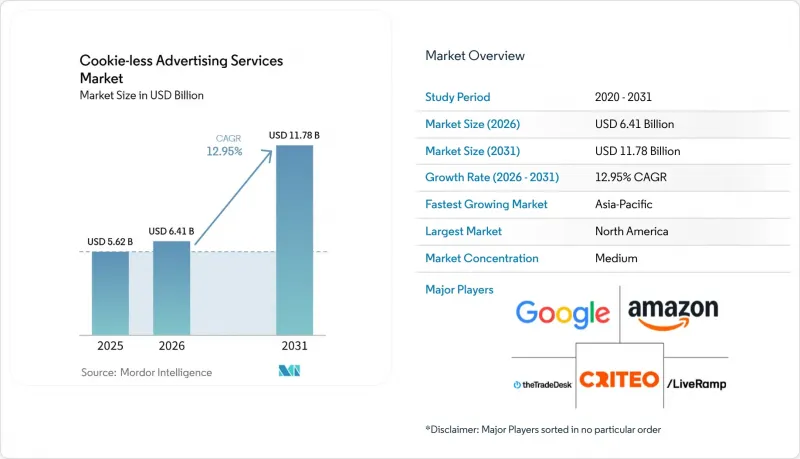
Mordor Intelligence에 의하면, 쿠키리스 광고 서비스 시장 규모는 2025년 56억 2,000만 달러로 평가되었습니다. 2026년 64억 1,000만 달러에서 2031년까지 117억 8,000만 달러로 확대되며 2026년부터 2031년까지 연평균 성장률(CAGR)은 12.95%를 나타낼 전망입니다.
본 보고서는 서비스 유형(컨텍스트 타겟팅 서비스, 퍼스트파티 데이터 활용 서비스, 데이터 클린룸 서비스 등), 최종 사용자 산업(소매 및 전자상거래,미디어 및 엔터테인먼트, 헬스케어 및 생명과학, 여행 및 호스피탈리티, 자동차, 통신·기술 등) 및 지역별로 분류되어 있습니다. 시장 예측은 금액(미 달러) 기준으로 제시되어 있습니다.
세계의 쿠키리스 광고 서비스 시장 동향 및 인사이트
써드파티 신호의 상실이 광고 인프라의 구조적 재편을 촉진
쿠키리스 광고 서비스 시장은 주요 브라우저 및 모바일 환경에서 제3자 식별자의 쇠퇴에 대응하고 있습니다. Safari와 Firefox는 오랫동안 기본적으로 제3자 쿠키를 차단해 왔으며, Chrome은 사용자의 선택에 맡기는 접근 방식을 채택하고 있어, 광고주는 기존 식별자에 대한 접근을 예측하기 어려워지고 있습니다. 또한, 애플의 ‘앱 추적 투명성(App Tracking Transparency)’ 프레임워크로 인해 앱 간 추적도 제한되고 있어, 모바일 광고주는 동의를 얻은 신호를 수집하고 활용하기 위한 별도의 수단이 필요합니다. 이러한 변화로 인해 지출은 자사 데이터 파이프라인, 서버 측 이벤트 수집, ID 대체 수단, 컨텍스트 서비스 및 측정 도구로 이동하고 있습니다. 이러한 기능을 조기에 구축한 브랜드는 캠페인 기획부터 보고서 작성에 이르기까지 자사의 고객 데이터와 이벤트 데이터를 계속해서 활용할 수 있습니다. 반면, 전환을 늦춘 브랜드는 데이터 수집, 동의 획득 절차, 활용 프로세스에 대한 대규모 재설계를 강요받고 있습니다.
이러한 영향은 미디어 구매에만 국한되지 않습니다. 캠페인 보고서는 노출, 참여도, 전환 이벤트 간의 안정적인 연관성에 의존하기 때문입니다. 쿠키 기반 측정은 제3자가 소비자 여정의 더 많은 부분을 관찰할 수 있는 브라우저 환경을 위해 설계되었습니다. 식별자를 사용할 수 없거나, 제한되거나, 브라우저와 앱의 정책에 의해 분리된 경우, 이 접근 방식의 신뢰성은 떨어집니다. 따라서 쿠키리스 광고 서비스 업계에서는 태그 관리, 고객 관계 관리(CRM) 시스템, 동의 획득 도구, 광고 플랫폼을 연동하는 보다 광범위한 운영상의 변혁이 추진되고 있습니다. 이러한 필요성은 웹, 모바일, 리테일 미디어, 커넥티드 TV 등 여러 채널에서 사업을 전개하는 광고주에게 특히 분명합니다. 또한, e-프라이버시 지침 및 각국의 개인정보 보호법에 따른 동의 의무는 기술적으로 쿠키를 사용할 수 있는 경우에도 여전히 적용되므로, 거버넌스는 독립적인 법적 업무가 아니라 운영 모델의 일부가 됩니다.
개인정보 보호를 고려한 문맥 타겟팅이 행동 타겟팅 광고와 동등한 측정 가능한 성과를 실현
컨텍스트 타겟팅은 개인의 검색 기록에 의존하지 않고 광고를 둘러싼 콘텐츠를 활용할 수 있기 때문에 더 큰 역할을 담당하게 되었습니다. 쿠키리스 광고 서비스 시장에서는 단순한 키워드 매칭이 아닌, 언어, 이미지, 동영상, 콘텐츠의 주제를 평가하는 시맨틱 시스템이 점점 더 많이 활용되고 있습니다. 2025년, 미국의 디지털 광고 수익은 2,946억 달러에 달했으며, 커머스 미디어는 634억 달러를 창출했습니다. 이는 디지털 미디어 활동에서 퍼스트파티 구매 데이터와 컨텍스트 신호의 중요성이 높아지고 있음을 반영합니다. 쿠키리스 광고 서비스 시장은 콘텐츠를 프로그램, 에피소드, 혹은 장면 단위로 평가할 수 있는 커넥티드 TV 분야로도 진출하고 있습니다. 이를 통해 광고주는 적절한 콘텐츠 설정을 선택하여 메시지와 시청 환경 간의 불일치를 줄일 수 있습니다. 또한 퍼블리셔 입장에서는 오디언스 수준의 데이터를 전송하지 않고도 프리미엄 인벤토리를 설명할 수 있는 새로운 수단이 됩니다.
이러한 변화가 중요한 이유는 컨텍스트 신호를 행동 타겟팅과 마찬가지로 개인 데이터를 처리하지 않고도 활용할 수 있기 때문입니다. 이를 통해 동의율 변동에 따른 영향을 줄이고, 캠페인 전달을 인증된 시청자에 대한 의존도를 낮출 수 있습니다. 또한, 쿠키리스 광고 서비스 시장은 프로그래매틱 거래에서 컨텍스트 부문 전달을 용이하게 하는 공급자 측 표준 규격의 혜택도 받고 있습니다. IAB Tech Lab은 2024년 12월, ‘Seller-Defined Audiences’라는 명칭을 ‘Curated Audiences’로 변경하고, 퍼블리셔에게 입찰 스트림 내에서 표준화된 오디언스 및 컨텍스트 신호를 제시하기 위한 프레임워크를 제공했습니다. 퍼블리셔는 이러한 신호를 활용하여 콘텐츠를 패키징할 수 있으며, 바이어는 원시 사용자 데이터를 수신하지 않고도 브랜드 적합성 요건을 적용할 수 있습니다. 이 모델은 측정 필요성을 배제하는 것은 아니지만, 행동 신호가 불완전하거나 이용할 수 없는 경우 실용적인 대안을 제공합니다.
분산된 개인정보 보호 규제가 시장 전체에 복합적인 규정 준수 비용을 부과하고 있습니다.
개인정보 보호 규제는 전 세계 광고 시스템이 관할 구역마다 다른 규칙에 따라 운영되어야 하기 때문에 제약 요인이 되고 있습니다. 쿠키리스 광고 서비스 시장은 광범위한 워크플로우에 걸쳐 동의 획득, 데이터 이용 관리, 계약상 요건 및 감사 가능성을 충족해야 합니다. 2025년, 프랑스 CNIL은 광고에서 쿠키 동의 획득 미흡을 이유로 구글에 3억 2,500만 유로의 벌금을 부과했습니다. 이 사례는 광고주들이 써드파티 쿠키에서 벗어나고 있는 상황에서도 동의 설계와 사용자 선택이 여전히 중요한 과제임을 보여줍니다. GDPR(EU 개인정보보호규정)에서는 옵트인 방식이 채택된 반면, 미국에서는 옵트아웃 권리나 기타 요건이 적용될 수 있습니다. 여러 시장에 서비스를 제공하는 플랫폼은 병행된 기술적 통제가 필요할 수 있으며, 이로 인해 캠페인 및 데이터 흐름 관리 비용이 증가합니다.
독립 퍼블리셔나 소규모 기술 제공업체의 경우, 이 과제는 더욱 심각합니다. 동의 거버넌스에는 비용이 수반되지만, 그 비용은 거래량 감소로 쉽게 절감할 수 없기 때문입니다. IAB의 ‘제5차 개정 다주(多州) 개인정보 보호 협정’은 2026년 6월에 발효되어, 디지털 광고 분야의 개인정보 보호 의무에 관한 미국 전역의 공통 계약 프레임워크를 제공합니다. 이 프레임워크를 통해 상업 계약의 불일치를 완화할 수는 있지만, 도입에는 여전히 법적 검토와 플랫폼 및 파트너 간의 기술적 통합이 필요합니다. 따라서 쿠키리스 광고 서비스 업계는 일상적인 캠페인 운영에서 규정 준수 기능을 효과적으로 활용할 수 있도록 해야 합니다. 확립된 엔지니어링, 정책 및 구현 리소스를 보유한 제공업체는 더 적은 리소스로 동일한 요구 사항을 충족해야 하는 소규모 기업에 비해 우위를 점하고 있습니다. 이로 인해 독립적인 솔루션에 대한 수요가 여전히 높은 상황에서도 대규모 플랫폼의 입지가 강화될 가능성이 있습니다.
부문별 분석
2025년, 퍼스트 파티 데이터 활용 서비스는 쿠키리스 광고 서비스 시장 규모의 33.71%를 차지하며 가장 큰 서비스 카테고리가 되었습니다. 이 부문에는 동의 기반 데이터 수집, 데이터 보강, 고객 관계 관리(CRM) 온보딩, 서버사이드 이벤트 파이프라인, 전환 인터페이스 및 오디언스 활용이 포함됩니다. 광고주는 계획, 전달, 보고의 각 단계에서 활용할 수 있는 신뢰할 수 있는 신호를 필요로 하기 때문에 이러한 기능들은 현재 캠페인 운영의 핵심을 이루고 있습니다. IAB와 PwC의 보고서에 따르면, 2025년 미국 커머스 미디어 시장은 18.0% 성장하여 소매 데이터 환경 내 퍼스트파티 활성화에 대한 수요를 촉진했습니다. ‘컨텍스트 타겟팅 서비스’, ‘신원 대체 서비스’, 그리고 ‘측정 및 어트리뷰션 적응 서비스’ 역시 유사한 신호 상실의 압박으로부터 혜택을 보고 있지만, 신원 및 어트리뷰션 도구에는 도달 범위와 통합 측면에서 한계가 존재합니다.
데이터 클린룸 서비스는 2026년부터 2031년까지 연평균 성장률(CAGR) 13.74%로 확대될 것으로 예측되며, 이는 쿠키리스 광고 서비스 시장 내 서비스 유형 중 가장 높은 성장률입니다. IAB에 따르면, 기업들은 소매업체, 퍼블리셔, 브랜드,플랫폼의 데이터 간에 개인정보를 보호하며 협업할 필요가 있기 때문에 2025년에는 2024년 대비 29% 증가한 투자를 클린룸에 했습니다. 연방거래위원회(FTC)는 클린룸이 본질적으로 개인정보를 보호하는 것은 아니라고 밝히며, 거버넌스,출력 관리, 모니터링이 도입에 있어 중요한 요소라고 밝혔습니다. 2026년 5월, 퍼블리시스 그룹이 LiveRamp를 21억 6,700만 달러에 인수하기로 합의함에 따라, 데이터 연동을 위한 독립형 및 클라우드 기반 대안 수단에 대한 관심이 높아졌습니다. 이 분야는 쿠키리스 광고 서비스 업계에서 실질적인 상호 운용성, 명확한 거버넌스, 그리고 더 폭넓은 광고주층에 적합한 비용을 제공할 수 있는 공급업체에 의존하게 될 것입니다.
지역별 분석
북미는 2025년, 프로그래매틱 인프라, 리테일 미디어 네트워크, 고객 데이터 플랫폼 및 클린룸 도입이 집중된 것을 배경으로 쿠키리스 광고 서비스 시장 규모의 51.28%를 차지했습니다. 미국은 대규모 디지털 광고 기반을 보유하고 있으며, 리테일 미디어, 커넥티드 TV, 개인정보 보호 중심 데이터 인프라에 대한 적극적인 투자가 이루어지고 있어 이 지역 수요 중심지 역할을 하고 있습니다. 2025년 미국의 디지털 광고 수익은 2,946억 달러에 달했으며, 커머스 미디어는 634억 달러를 창출했습니다. 이러한 카테고리들은 퍼스트 파티 데이터, 컨텍스트 데이터 및 동의 기반 데이터 신호에 대한 의존도를 점점 더 높이고 있습니다. 캐나다에서는 퍼블리셔와 광고주가 개인정보 보호를 고려한 데이터 관행을 도입함에 따라 수요가 발생하고 있습니다. 한편, 멕시코에서는 전자상거래의 발전과 병행하여 퍼스트파티 데이터 역량 구축이 진행되고 있습니다. 또한, 이 지역에서는 클린룸 도입에 따른 실무적 비용이 영향을 미치고 있어, 이로 인해 일부 독립 구매자가 최첨단 협업 환경에서 소외될 가능성이 있습니다. IAB의 다주 간 개인정보 보호 협정에 따라 국내 플랫폼에는 공통된 계약 기준이 마련되어 있지만, 이를 이행하기 위해서는 여전히 각 파트너사의 운영상 변경이 필요합니다.
유럽은 두 번째로 큰 지역 블록으로, GDPR(EU 개인정보보호규정) 및 각국의 개인정보 보호 감독 기관에 의해 형성된 규제 환경 하에서 운영되고 있습니다. 이 지역에서는 데이터 이용 관리가 디지털 광고 운영에 통합되어 있기 때문에 동의에 기반한 신원 확인, 컨텍스트 타겟팅 및 측정 인프라에 대한 수요가 증가하고 있습니다. IAB Europe의 ‘투명성 및 동의 프레임워크’ 버전 2.3은 2026년 3월 1일부터 퍼블리셔 및 동의 관리 플랫폼에 의무화되어, 프로그래매틱 활동을 위한 최신 규정 준수 기준이 확립되었습니다. 독일, 영국, 프랑스는 클린룸 및 큐레이션된 오디언스를 기업 차원에서 도입하는 데 앞장서고 있으며, 네덜란드는 여전히 중요한 프로그래매틱 인프라 허브로서의 위상을 유지하고 있습니다. 영국은 유럽연합(EU) 탈퇴 후에도 독자적인 개인정보 보호 프레임워크를 계속 운영하고 있으며, 이로 인해 개인정보 보호를 고려한 타겟팅 옵션에 대한 수요가 유지되고 있습니다. 스페인과 이탈리아에서는 전자상거래 활동의 확대와 함께, 쿠키 저장에 대한 동의 요건이 여전히 중요하기 때문에 이러한 기능들이 도입되고 있습니다. 유럽공급업체들은 성숙한 수요와 상세한 규정 준수 요건, 그리고 분산된 현지 도입 요구 사항 간의 균형을 맞추어야 합니다.
중동은 2026년부터 2031년까지 연평균 성장률(CAGR) 13.81%를 나타낼 것으로 예측되며, 이는 쿠키리스 광고 서비스 시장에서 지역별 가장 높은 성장률입니다. 사우디아라비아와 아랍에미리트(UAE)의 전자상거래 성장과 디지털 광고의 보급 확대가 맞물려, 새로운 거버넌스 프레임워크 하에서 운영 가능한 타겟팅 및 측정 도구에 대한 수요를 뒷받침하고 있습니다. 아시아태평양도 주요 성장 영역입니다. 모바일 우선의 방대한 사용자층과 국가별로 상이한 데이터 규제로 인해, 현지 상황에 적합한 신원 확인 및 데이터 활용 옵션에 대한 수요가 증가하고 있기 때문입니다. 중국의 데이터 현지화 요건과 동남아시아국가연합(ASEAN) 시장 전반의 개인정보 보호 규제로 인해, 각국의 데이터 주권 조건을 존중할 수 있는 서비스가 촉진되고 있습니다. 일본과 호주는 많은 지역 시장을 앞서 국제 표준에 기반한 쿠키리스 기술을 채택하고 있습니다. 남미와 아프리카는 절대적인 규모는 작지만, 브라질과 남아프리카공화국에서는 수요가 나타나고 있습니다. 이들 국가에서는 개인정보 보호 규정 준수를 위한 투자가 브랜드의 퍼스트파티 데이터 인프라 구축을 뒷받침하고 있습니다. 쿠키리스 광고 서비스 시장은 현지 동의 획득 관행, 퍼블리셔 생태계, 광고주의 자원에 맞추어 서비스를 조정할 수 있는 제공업체에게 이러한 지역에서 장기적인 기회를 제공합니다.
기타 혜택 :
- 엑셀 형식 시장 예측(ME) 시트
- 3개월간의 애널리스트 지원
자주 묻는 질문
목차
제1장 서론
제2장 조사 방법
제3장 개요
제4장 시장 구도
제5장 시장 규모 및 성장 예측
제6장 경쟁 구도
제7장 시장 기회 및 향후 전망
KTH 26.09.02According to Mordor Intelligence, the cookie-less advertising services market size is projected to expand from USD 5.62 billion in 2025 and USD 6.41 billion in 2026 to USD 11.78 billion by 2031, registering a CAGR of 12.95% between 2026 to 2031.
This report is Segmented by Service Type (Contextual Targeting Services, First-Party Data Activation Services, Data Clean Room Services, and More), End-User Industry (Retail and E-Commerce, Media and Entertainment, Healthcare and Life Sciences, Travel and Hospitality, Automotive, Telecom and Technology, and More), and Geography. The Market Forecasts are Provided in Terms of Value (USD).
Global Cookie-less Advertising Services Market Trends and Insights
Third-Party Signal Loss Drives Structural Reallocation of Advertising Infrastructure
The cookie-less advertising services market is responding to the erosion of third-party identifiers across major browsers and mobile environments. Safari and Firefox have blocked third-party cookies by default for years, while Chrome uses a user-choice approach that leaves advertisers with less predictable access to traditional identifiers. Apple's App Tracking Transparency framework has also limited cross-app tracking, so mobile advertisers need other ways to collect and activate consented signals. These changes shift spending toward first-party data pipelines, server-side event collection, identity alternatives, contextual services, and measurement tools. Brands that established these capabilities earlier can continue using their own customer and event data across campaign planning and reporting. Brands that delayed the transition face a more extensive redesign of their data collection, consent flows, and activation processes.
The effect extends beyond media buying because campaign reporting depends on stable links between exposure, engagement, and conversion events. Cookie-based measurement was designed for a browser environment where a third party could observe more of the consumer journey. That approach is less reliable when identifiers are unavailable, restricted, or separated by browser and app policies. The cookie-less advertising services industry therefore supports a broader operational change that connects tag management, customer relationship management systems, consent tools, and advertising platforms. The need is especially clear for advertisers that operate across web, mobile, retail media, and connected TV channels. Consent obligations under the ePrivacy Directive and state privacy laws also remain relevant even when a cookie is technically available, which makes governance part of the operating model rather than a separate legal task.
Privacy-Safe Contextual Targeting Gains Measurable Performance Parity With Behavioral Advertising
Contextual targeting is taking on a larger role because it can use the content surrounding an advertisement instead of relying on an individual's browsing history. The cookie-less advertising services market increasingly uses semantic systems that assess language, images, video, and content themes rather than simple keyword matching. U.S. digital advertising revenue reached USD 294.6 billion in 2025, and commerce media generated USD 63.4 billion, reflecting the expanding importance of first-party purchase and contextual signals in digital media activity. The cookie-less advertising services market is also moving into connected TV, where content can be assessed at the program, episode, or scene level. This allows buyers to select suitable content settings and reduce mismatches between a message and the viewing environment. It gives publishers another way to describe premium inventory without transferring audience-level data.
The change is important because contextual signals can be used without processing personal data in the same manner as behavioral targeting. That can reduce exposure to changes in consent rates and make campaign delivery less dependent on authenticated audiences. The cookie-less advertising services market is also benefiting from supply-side standards that make contextual segments easier to communicate in programmatic transactions. IAB Tech Lab renamed Seller-Defined Audiences as Curated Audiences in December 2024, providing publishers with a framework to expose standardized audience and contextual signals in the bid stream. Publishers can use those signals to package content, while buyers can apply brand suitability requirements without receiving raw user data. This model does not eliminate the need for measurement, but it creates a workable alternative when behavioral signals are incomplete or unavailable.
Fragmented Privacy Regulations Impose Compounding Compliance Costs Across Markets
Privacy regulation is a restraint because global advertising systems must operate under rules that differ by jurisdiction. The cookie-less advertising services market must support consent collection, data use controls, contractual requirements, and auditability across a wide range of workflows. In 2025, France's CNIL imposed a EUR 325 million fine on Google for advertising cookie consent failures. The case shows that consent design and user choice remain material issues even when advertisers are moving away from third-party cookies. GDPR uses an opt-in approach, while U.S. state rules can use opt-out rights and other requirements. Platforms serving several markets may need parallel technical controls, which increases the cost of managing campaigns and data flows.
The challenge is more significant for independent publishers and smaller technology providers because consent governance introduces costs that do not decline easily with lower transaction volume. The IAB's Fifth Amended Multi-State Privacy Agreement became effective in June 2026 and provides a common U.S. contracting framework for digital advertising privacy obligations. The framework can reduce variation in commercial agreements, but deployment still requires legal review and technical integration across platforms and partners. The cookie-less advertising services industry must therefore make compliance functions usable within daily campaign operations. Providers with established engineering, policy, and implementation resources have an advantage over smaller firms that must absorb the same requirements with fewer resources. This can strengthen the position of scaled platforms even where demand for independent solutions remains high.
Other drivers and restraints analyzed in the detailed report include:
- First-Party Data Activation and Retail Media Partnerships Reconfigure the Programmatic Value Chain
- AI-Led Semantic, Video, and CTV Contextual Analysis Creates a New Buying Category
- Limited Match Rates for Authenticated Identity Constrain Open-Web Addressability
For complete list of drivers and restraints, kindly check the Table Of Contents.
Segment Analysis
First-Party Data Activation Services held a 33.71% share of the cookie-less advertising services market size in 2025, making them the largest service category. The segment covers consented data collection, enrichment, customer relationship management onboarding, server-side event pipelines, conversion interfaces, and audience activation. These capabilities are now central to campaign operations because advertisers need dependable signals that can be used across planning, delivery, and reporting. IAB and PwC reported that U.S. commerce media expanded 18.0% in 2025, reinforcing demand for first-party activation in retail data environments. Contextual Targeting Services, Identity Alternative Services, and Measurement and Attribution Adaptation Services benefit from the same signal-loss pressure, though identity and attribution tools face reach and integration limits.
Data Clean Room Services are projected to expand at a 13.74% CAGR from 2026 to 2031, the highest rate among service types in the cookie-less ad services market. IAB stated that companies planned to invest 29% more in clean rooms in 2025 than in 2024 because they need privacy-safe collaboration across retailer, publisher, brand, and platform data. The Federal Trade Commission stated that clean rooms are not inherently privacy-preserving, making governance, output controls, and monitoring important parts of an implementation. Publicis Groupe's May 2026 agreement to acquire LiveRamp for USD 2.167 billion increased attention on independent and cloud-based alternatives for data collaboration. The segment will depend on providers that can deliver practical interoperability, clear governance, and costs suited to a wider group of advertisers in the cookie-less advertising services industry.
Complete Report Scope:
- By Service Type
- Contextual Targeting Services
- First-Party Data Activation Services
- Data Clean Room Services
- Identity Alternative Services
- Measurement and Attribution Adaptation Services
- By End-user Industry
- Retail and E-commerce
- Media and Entertainment
- Banking, Financial Services, and Insurance
- Healthcare and Life Sciences
- Travel and Hospitality
- Automotive
- Telecom and Technology
- Other End-user Industries
- By Geography
- North America
- United States
- Canada
- Mexico
- South America
- Brazil
- Argentina
- Chile
- Rest of South America
- Europe
- Germany
- United Kingdom
- France
- Italy
- Spain
- Netherlands
- Russia
- Rest of Europe
- Asia-Pacific
- China
- Japan
- India
- South Korea
- Australia
- Singapore
- Indonesia
- Rest of Asia-Pacific
- Middle East
- Saudi Arabia
- United Arab Emirates
- Turkey
- Rest of Middle East
- Africa
- South Africa
- Nigeria
- Kenya
- Rest of Africa
- North America
Geography Analysis
North America held 51.28% of the cookie-less advertising services market size in 2025, supported by a concentration of programmatic infrastructure, retail media networks, customer data platforms, and clean room deployments. The United States is central to regional demand because it has a large digital advertising base and active investment in retail media, connected TV, and privacy-oriented data infrastructure. U.S. digital advertising revenue reached USD 294.6 billion in 2025, while commerce media generated USD 63.4 billion. These categories rely increasingly on first-party purchase, contextual, and consented data signals. Canada contributes demand through publisher and advertiser adoption of privacy-aware data practices, while Mexico is building first-party data capabilities alongside e-commerce development. The region is also affected by the practical cost of clean room implementation, which can keep some independent buyers outside the most advanced collaboration environments. The IAB's multi-state privacy agreement gives national platforms a common contracting baseline, though implementation still requires operational changes across partners.
Europe is the second-largest regional block and operates under a regulatory environment shaped by GDPR and national privacy oversight. The region has a strong need for consent-compatible identity, contextual targeting, and measurement infrastructure because data use controls are embedded in digital advertising operations. IAB Europe's Transparency and Consent Framework version 2.3 became mandatory for publishers and consent management platforms on March 1, 2026, creating an updated compliance baseline for programmatic activity. Germany, the United Kingdom, and France lead enterprise adoption of clean rooms and curated audiences, while the Netherlands remains an important programmatic infrastructure hub. The United Kingdom continues to operate its own privacy framework after leaving the European Union, which sustains demand for privacy-safe targeting options. Spain and Italy are adopting these capabilities as e-commerce activity expands and consent requirements remain relevant for cookie storage. European providers must balance mature demand with detailed compliance expectations and fragmented local implementation needs.
The Middle East is projected to expand at a 13.81% CAGR from 2026 to 2031, the highest regional rate in the cookie-less advertising services market. E-commerce growth in Saudi Arabia and the United Arab Emirates, together with broader digital advertising adoption, supports demand for targeting and measurement tools that can operate under emerging governance frameworks. Asia-Pacific is also a major growth area because large mobile-first audiences and different national data rules increase the need for locally suitable identity and data activation options. China's data localization requirements and privacy rules across Association of Southeast Asian Nations markets encourage services that can respect national data sovereignty conditions. Japan and Australia have adopted international standards-based cookie-less technologies earlier than many regional markets. South America and Africa have lower absolute volumes but show demand in Brazil and South Africa, where privacy compliance investments encourage brands to build first-party data infrastructure. The cookie-less advertising services market offers longer-term opportunities in these regions for providers that can adapt their services to local consent practices, publisher ecosystems, and advertiser resources.
- Google LLC
- Amazon.com, Inc.
- The Trade Desk, Inc.
- LiveRamp Holdings, Inc.
- Criteo S.A.
- Adobe Inc.
- PubMatic, Inc.
- Integral Ad Science Holding Corp.
- Lotame Solutions, Inc.
- Quantcast Corporation
- Snowflake Inc.
- Acxiom LLC
- InfoSum Ltd.
- InMobi Pte. Ltd.
- Microsoft Corporation
- Oracle Corporation
- Nexxen International Ltd.
- Permutive, Inc.
- ID5 Technology Limited
- OpenX Software Ltd.
Additional Benefits:
- The market estimate (ME) sheet in Excel format
- 3 months of analyst support
TABLE OF CONTENTS
1 INTRODUCTION
- 1.1 Study Assumptions and Market Definition
- 1.2 Scope of the Study
2 RESEARCH METHODOLOGY
3 EXECUTIVE SUMMARY
4 MARKET LANDSCAPE
- 4.1 Market Overview
- 4.2 Impact of Macroeconomic Factors on the Market
- 4.3 Market Drivers
- 4.3.1 Third-Party Signal Loss Across Browsers and Mobile IDs
- 4.3.2 Rising Spend on Privacy-Safe Contextual Targeting
- 4.3.3 Growth of First-Party Data Activation and Retail Media Partnerships
- 4.3.4 Expansion of AI-Led Semantic, Video, and CTV Contextual Analysis
- 4.3.5 Standardization of Clean Room Interoperability
- 4.3.6 Supply-Side Curation and Seller-Defined Audiences
- 4.4 Market Restraints
- 4.4.1 Fragmented Privacy Regulations and Consent Governance Costs
- 4.4.2 Limited Scale and Match Rates for Authenticated Identity
- 4.4.3 Browser Storage Caps and Cookie Partitioning Weaken Persistence
- 4.4.4 Publisher Yield Compression in Privacy-Safe Testing Environments
- 4.5 Industry Value Chain Analysis
- 4.6 Regulatory Landscape
- 4.7 Technological Outlook
- 4.8 Porter's Five Forces Analysis
- 4.8.1 Bargaining Power of Buyers
- 4.8.2 Bargaining Power of Suppliers
- 4.8.3 Threat of New Entrants
- 4.8.4 Threat of Substitutes
- 4.8.5 Competitive Rivalry
5 MARKET SIZE AND GROWTH FORECASTS (VALUE)
- 5.1 By Service Type
- 5.1.1 Contextual Targeting Services
- 5.1.2 First-Party Data Activation Services
- 5.1.3 Data Clean Room Services
- 5.1.4 Identity Alternative Services
- 5.1.5 Measurement and Attribution Adaptation Services
- 5.2 By End-user Industry
- 5.2.1 Retail and E-commerce
- 5.2.2 Media and Entertainment
- 5.2.3 Banking, Financial Services, and Insurance
- 5.2.4 Healthcare and Life Sciences
- 5.2.5 Travel and Hospitality
- 5.2.6 Automotive
- 5.2.7 Telecom and Technology
- 5.2.8 Other End-user Industries
- 5.3 By Geography
- 5.3.1 North America
- 5.3.1.1 United States
- 5.3.1.2 Canada
- 5.3.1.3 Mexico
- 5.3.2 South America
- 5.3.2.1 Brazil
- 5.3.2.2 Argentina
- 5.3.2.3 Chile
- 5.3.2.4 Rest of South America
- 5.3.3 Europe
- 5.3.3.1 Germany
- 5.3.3.2 United Kingdom
- 5.3.3.3 France
- 5.3.3.4 Italy
- 5.3.3.5 Spain
- 5.3.3.6 Netherlands
- 5.3.3.7 Russia
- 5.3.3.8 Rest of Europe
- 5.3.4 Asia-Pacific
- 5.3.4.1 China
- 5.3.4.2 Japan
- 5.3.4.3 India
- 5.3.4.4 South Korea
- 5.3.4.5 Australia
- 5.3.4.6 Singapore
- 5.3.4.7 Indonesia
- 5.3.4.8 Rest of Asia-Pacific
- 5.3.5 Middle East
- 5.3.5.1 Saudi Arabia
- 5.3.5.2 United Arab Emirates
- 5.3.5.3 Turkey
- 5.3.5.4 Rest of Middle East
- 5.3.6 Africa
- 5.3.6.1 South Africa
- 5.3.6.2 Nigeria
- 5.3.6.3 Kenya
- 5.3.6.4 Rest of Africa
- 5.3.1 North America
6 COMPETITIVE LANDSCAPE
- 6.1 Market Concentration
- 6.2 Strategic Moves
- 6.3 Market Share Analysis
- 6.4 Company Profiles (includes Global Level Overview, Market Level Overview, Core Segments, Financials as available, Strategic Information, Market Rank/Share, Products and Services, Recent Developments)
- 6.4.1 Google LLC
- 6.4.2 Amazon.com, Inc.
- 6.4.3 The Trade Desk, Inc.
- 6.4.4 LiveRamp Holdings, Inc.
- 6.4.5 Criteo S.A.
- 6.4.6 Adobe Inc.
- 6.4.7 PubMatic, Inc.
- 6.4.8 Integral Ad Science Holding Corp.
- 6.4.9 Lotame Solutions, Inc.
- 6.4.10 Quantcast Corporation
- 6.4.11 Snowflake Inc.
- 6.4.12 Acxiom LLC
- 6.4.13 InfoSum Ltd.
- 6.4.14 InMobi Pte. Ltd.
- 6.4.15 Microsoft Corporation
- 6.4.16 Oracle Corporation
- 6.4.17 Nexxen International Ltd.
- 6.4.18 Permutive, Inc.
- 6.4.19 ID5 Technology Limited
- 6.4.20 OpenX Software Ltd.
7 MARKET OPPORTUNITIES AND FUTURE OUTLOOK
- 7.1 White-Space and Unmet-Need Assessment


