
|
시장보고서
상품코드
2119166
생리활성 펩티드 : 시장 점유율 분석, 업계 동향 및 통계, 성장 예측(2026-2031년)Bioactive Peptides - Market Share Analysis, Industry Trends & Statistics, Growth Forecasts (2026 - 2031) |
||||||
 Mordor Intelligence
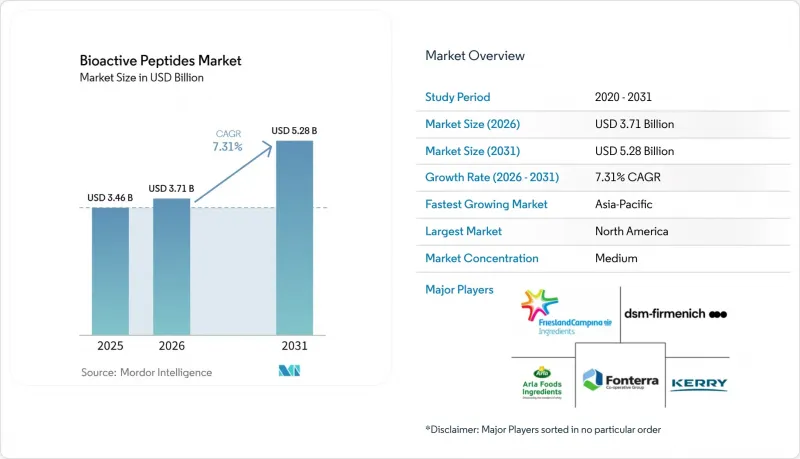
Mordor Intelligence에 의하면, 생리활성 펩티드 시장 규모는 2025년에 34억 6,000만 달러로 평가되었습니다. 2026년에 37억 1,000만 달러에 달하고, 2031년까지 52억 8,000만 달러에 이를 것으로 예측되며, 2026년부터 2031년에 걸쳐 CAGR 7.31%로 성장할 전망입니다.
본 보고서는 원료별(동물 유래 펩타이드, 식물 유래 펩타이드 등), 생물학적 활성별(혈압 강하 펩타이드, 항산화 펩타이드 등), 형태별(분말, 액체, 정제 등),최종 사용자(식품 및 음료 제조업체, 영양 보조 식품 제조업체 등), 지역(북미, 유럽, 아시아태평양 등)별로 분류되어 있습니다. 예측치는 금액(달러)으로 표시되어 있습니다.
세계의 생리활성 펩티드 시장 동향 및 인사이트
기능성 식품 및 뉴트라슈티컬의 확대
식품 기업들이 임상적으로 입증된 서열 특이적 성분을 추구하는 가운데, 생리활성 펩티드 시장은 그 혜택을 누리고 있습니다. 소비자 수요는 일반적인 단백질 보충제에서 심혈관·대사, 면역, 장 건강과 관련된 제품으로 이동하고 있습니다. 2025년 리뷰에서는 식품 유래 펩타이드가 IRS-1/PI3K/Akt의 활성화 및 AMPK를 매개로 한 GLUT4의 전위를 통해 혈당 조절에 영향을 미칠 가능성이 보고되었습니다. 또한, 해당 리뷰에서는 아디포카인, HMG-CoA 환원효소 및 NF-κB/MAPK 신호전달과 관련된 효과에 대해서도 기술되어 있습니다. 이러한 다양한 작용기전을 통해 영양이 강화된 유제품, 음료, 바류 제품은 보다 구체적인 건강 효과를 내세울 수 있게 됩니다. 작용기전과 효과를 모두 뒷받침하는 자료를 제시할 수 있는 공급업체는 특히 브랜드 식품 기업이 제품 개발, 기술적 협의 및 소비자를 대상으로 한 건강 홍보에 일관되게 활용할 수 있는 근거를 필요로 하는 경우, 더 높은 부가가치의 계약 및 장기적인 공급 관계 구축을 지원할 수 있습니다.
헬스케어 및 건강한 노화 솔루션에 대한 수요 증가
북미, 일본, 서유럽의 고령화는 근감소증, 고혈압, 대사 기능 저하에 대한 영양 보충제로 사용되는 펩타이드에 대한 수요를 뒷받침하고 있습니다. 2025년에 실시된 고혈압 전단계 및 고혈압 환자 114명을 대상으로 한 무작위 이중 맹검 위약 대조 시험에서 HCP-C7C12는 8주 동안 수축기 혈압을 9.41%,이완기 혈압을 9.53% 낮추는 것으로 밝혀졌습니다. 또한 이 연구에서는 프리바이오틱스와 같은 장내 미생물 군집에 미치는 영향과 부티르산 생성과 관련된 경로의 활성화도 보고되었습니다. 이러한 연구 결과는 혈압 강하 성분이 혈압 관리에 그치지 않고 대사적 측면에서도 유익한 효과를 가져온다는 것을 시사합니다. 따라서 바이오액티브 펩티드 시장은 고령화가 진행되는 지역에서 건강 지향적인 견고한 수요 기반을 갖추고 있습니다. ACE 억제 작용, 미생물군집에 미치는 영향, 그리고 내피 기능 개선을 통해 이 카테고리는 소비자의 다양한 건강 요구를 충족시키며, 혈압 관리, 소화기 건강, 건강한 노화, 그리고 보다 광범위한 대사 지원을 목적으로 하는 제품에서 과학적 근거가 충분히 입증된 단일 성분을 채택할 수 있게 해줍니다.
높은 제조·정제·임상 검증 비용
고순도 펩타이드 생산은 분리, 정제, 검증의 각 단계를 거쳐 여전히 높은 비용이 소요됩니다. 2025년 리뷰에 따르면, 고속 액체 크로마토그래피(HPLC)는 의약품 등급의 순도에 필요한 분리를 실현할 수 있지만, 식품 등급의 대규모 생산에서는 설비 투자 및 처리 능력에 제약이 있습니다. 또한, 해당 리뷰에서는 한외여과 과정에서 발생하는 막 오염이 처리 효율을 저하시키고, 막 교체 비용을 발생시킨다는 점도 지적하고 있습니다. 임상 검증은 건강 기능 표기를 뒷받침하고자 하는 공급업체에게 추가적인 투자 요건이 됩니다. 이러한 비용 구조는 임상 프로그램에 자금을 지원하고 규제 당국과의 관계를 유지할 수 있는 입지가 확고한 원료 제조업체에게 유리하게 작용합니다. 따라서 생리활성 펩티드 시장에서는 제품 수명 주기 전반에 걸친 연구를 지원하고, 실패한 프로그램의 비용을 상쇄하며, 확립된 상업적 관계를 활용하여 성공적인 원료를 식품, 보충제, 임상 채널에 각각 전개할 수 있는 폭넓은 포트폴리오를 보유한 기업에 가치가 집중될 가능성이 있습니다.
부문별 분석
동물 유래 펩타이는 확립된 유청, 카제인, 콜라겐, 젤라틴 공급망에 힘입어 2025년 전 세계 매출의 42.31%를 차지했습니다. 발효유 유래 유제품 IPP 및 VPP 서열은 혈압에 미치는 효과에 대한 임상적 근거가 있습니다. 임상 메타분석에 따르면, 수축기 혈압이 5.0 mmHg, 이완기 혈압이 2.3 mmHg 감소하는 것으로 나타났습니다. 식물 유래 펩타이드의 경우, 콩류, 곡물, 씨앗에서 주목을 받고 있습니다. 병아리콩, 유채, 대마 단백질의 경우, ACE 억제, DPP-IV 억제 및 항산화 작용을 가진 후보 서열에 대한 스크리닝이 진행되고 있습니다. 동물 유래 공급망은 안정적인 원료 공급과 확립된 가수분해 공정을 제공하기 때문에 여전히 중요합니다. 동시에, 유제품 및 콜라겐 생산자는 익숙한 조달 시스템, 알려진 단백질 분획, 그리고 식품 및 보충제 제형 제조업체와의 기존 관계를 활용할 수 있습니다.
해양 유래 펩타이드의 경우, 일반적으로 부가가치가 낮은 용도로만 사용되는 생선 껍질, 뼈, 내장 및 갑각류 껍질을 활용합니다. 어류 유래 단백질 가수분해물에는 60-90%의 단백질과 심혈관계와 관련된 필수 아미노산이 포함되어 있습니다. 미생물 및 발효 유래 펩타이는 식품 등급의 기질을 이용한 또 다른 제조 경로를 제공합니다. 락토바실러스속이나 페디오코커스속을 이용한 정밀 발효를 통해 항산화 작용, 항염증 작용, 항당뇨 작용을 가진 펩타이드를 생성할 수 있습니다. 합성 및 재조합 펩타이드가 가장 빠르게 성장하는 원료 카테고리이며, 이 부문의 생리활성 펩티드 시장 규모는 2031년까지 연평균 성장률(CAGR) 11.58%로 확대될 것으로 예측됩니다. 고체상 펩타이드 합성을 위한 제약 CDMO의 생산 능력이 이러한 성장을 뒷받침하고 있습니다. 이는 설비, 숙련된 인력, 정제 능력, 품질 시스템에 대한 투자를 통해 특수 펩타이드 생산과 관련된 제조 자원의 가용성을 높일 수 있기 때문입니다. 2026년 리뷰에서는 광촉매법과 전기화학이 기존의 비용 및 지속가능성 제약을 해결하는 새로운 기법으로 언급되었습니다.
2025년에는 혈압 강하 펩타이드가 이 부문을 주도하며 34.24%의 점유율을 차지했습니다. 유래, 해양 유래, 식물 유래 서열의 경우, ACE 억제 작용 및 혈압에 대한 효과가 입증된 바 있습니다. 고혈압은 예방 영양학 분야에서 큰 관심을 받고 있어, 생체활성 펩티드 시장에서는 이러한 제품에 대한 수요가 유지되고 있습니다. 3 kDa 미만의 분획과 페닐알라닌, 트립토판, 티로신을 풍부하게 함유한 분획은 더 강력한 라디칼 소거 활성을 보였습니다. 항균 펩타이드도 제약 업계의 관심을 끌고 있는데, 이는 새로운 항균 서열의 탐색이 기존의 세균 유래 출처에 그치지 않고, 차별화된 생물학적 특성을 가진 후보 물질의 조사를 촉진하고 있기 때문입니다.
2025년 연구에서는 딥러닝을 통한 예측을 통해 1만 2,000종 이상의 고세균 유래 추정 항균 펩타이드가 확인되었습니다. 항당뇨 펩타이드 및 DPP-IV 억제 펩타이드는 가장 빠르게 성장하는 생물학적 활성 카테고리이며, 이 부문의 생물학적 활성 펩티드 시장 규모는 2031년까지 연평균 성장률(CAGR) 9.22%로 확대될 것으로 예측됩니다. 이러한 펩타이드들은 CaSR 의존성 GLP-1 분비, DPP-4 억제, 그리고 α-아밀라아제 및 α-글루코시다아제 억제를 통해 혈당 조절을 지원할 수 있습니다. 2025년 리뷰에서는 생물학적 활성을 저해하지 않으면서 DPP-IV 억제 펩타이드를 기능성 식품에 배합하기 위한 효소 가수분해, 발효 및 캡슐화 기법에 대해 논의되었습니다. 면역 조절 및 항염증 펩타이드는 면역에 초점을 맞춘 영양 요구를 충족시킵니다. 반면, 항암 및 신경 보호 작용을 가진 펩타이드의 상업적 기회는 아직 초기 단계에 머물러 있지만, 임상적 증거, 전달 시스템 및 규제 경로가 더욱 발전함에 따라 더 중요한 위치를 차지하게 될 가능성이 있습니다.
지역별 분석
2025년, 북미는 전 세계 생리활성 펩티드 시장 매출의 37.61%를 차지했습니다. 임상적으로 입증된 성분에 대한 높은 지불 의향, 성숙한 건강기능식품 소매 시장, 그리고 확립된 규제 경로가 이러한 위상을 뒷받침하고 있습니다. 2024년 FDA의 승인을 통해 Arla Foods Ingredients사의 유청 단백질 가수분해물이 알레르기 관리를 목적으로 하는 유아용 조제분유에 사용될 수 있게 되었습니다. 이 조치는 성분 혁신에 대한 규제 당국의 적극적인 관여를 반영합니다. 캐나다와 멕시코는 미국을 중심으로 한 공급망을 갖춘 제조업체에게 중요한 유통 거점이 되고 있습니다. 이는 지역 내 생산, 창고 보관, 규제 측면의 조정, 그리고 확립된 고객 관계가 원료 공급업체가 인접한 북미 시장에 얼마나 신속하게 공급할 수 있는지에 영향을 미치기 때문입니다.
유럽은 소비자 수요와 마찬가지로 규제가 원료 전략을 크게 좌우하는 주요 지역입니다. 규정(EU) 2015/2283에 기반한 EU의 ‘신규 식품(Novel Food)’ 절차는 품질 심사 역할을 수행하는 동시에 진입 장벽으로도 기능하고 있습니다. 2026년 7월 난막 가수분해물이 승인됨에 따라 Eggnovo SL사는 유럽연합 집행위원회 규정에 따라 5년간의 독점권을 획득했습니다. 콜라겐 펩타이드가 유럽 건강기능식품 시장에서 중요한 역할을 하고 있으며, GELITA, Weishardt, Rousselot가 주요 공급업체로 자리 잡고 있습니다. 이탈리아와 스페인에서는 수산물별 공급원에 인접해 있다는 점과 유럽의 순환형 바이오 경제에 대한 인센티브로 인해 해양 유래 펩타이드의 성장 기회가 예상됩니다. 이러한 요인들은 가공업체들이 저부가가치 폐기 경로에서 단백질 회수, 가수분해, 그리고 특수 기능성 원료로의 활용으로 원자재를 전환하도록 촉진할 가능성이 있습니다.
아시아태평양은 가장 빠른 성장이 예상되며, 바이오액티브 펩티드 시장 규모는 2031년까지 연평균 성장률(CAGR) 8.25%로 확대될 것으로 전망됩니다. 중국의 기능성 식품 부문, 인도의 스포츠 및 임상 영양 분야 수요, 그리고 일본의 FOSHU(기능성 식품 표시) 체계에 기반한 콜라겐 수요가 이 지역의 성장을 뒷받침하고 있습니다. 인도는 비용 효율이 뛰어난 고상 펩타이드 합성을 전문으로 하는 반면, 중국은 위탁 합성 및 정밀 발효 분야를 확대되고 있습니다. GCC 국가들의 할랄 인증 원료에 대한 수요가 중동 및 아프리카을 견인하는 한편, 남미에서는 브라질과 아르헨티나가 대두, 해양 및 소 유래 단백질 원료를 공급하고 있습니다. 2026년 리뷰에서는 남미의 농업 및 공업 부산물을 기능성 원료로 전환하는 발효 및 친환경 추출법이 소개되었으며, 생산자가 신뢰할 수 있는 원료 조달과 적절한 추출, 품질 관리, 상업화 시스템을 결합함으로써 농업 및 가공 부산물이 원료 개발을 뒷받침할 수 있음을 시사하고 있습니다.
기타 혜택 :
- 엑셀 형식 시장 예측(ME) 시트
- 3개월간의 애널리스트 지원
자주 묻는 질문
목차
제1장 서론
제2장 조사 방법
제3장 개요
제4장 시장 구도
제5장 시장 규모 및 성장 예측
제6장 경쟁 구도
제7장 시장 기회 및 향후 전망
KTH 26.09.02According to Mordor Intelligence, the bioactive peptides market size is projected to be USD 3.46 billion in 2025, USD 3.71 billion in 2026, and reach USD 5.28 billion by 2031, growing at a CAGR of 7.31% from 2026 to 2031.
This report is Segmented by Source (Animal-Derived Peptides, Plant-Derived Peptides, and More), Bioactivity (Antihypertensive Peptides, Antioxidant Peptides, and More), Form (Powder, Liquid, Tablets, and More), End User (Food and Beverage Manufacturers, Dietary Supplement Companies, and More), and Geography (North America, Europe, Asia-Pacific, and More). Forecasts are Provided in Value (USD).
Global Bioactive Peptides Market Trends and Insights
Expansion of Functional Foods and Nutraceuticals
The Bioactive Peptides Market benefits as food companies seek sequence-specific ingredients with clinical support. Consumer demand is moving beyond generic protein supplements toward products associated with cardiometabolic, immune, and gut health. A 2025 review reported that food-derived peptides can influence glycemic control through IRS-1/PI3K/Akt activation and AMPK-mediated GLUT4 translocation. The review also described effects involving adipokines, HMG-CoA reductase, and NF-κB/MAPK signaling. These multiple mechanisms allow fortified dairy, beverages, and bars to support more specific health positions. Suppliers that document the mechanism as well as the outcome can support higher-value contracts and longer supply relationships, particularly when branded food companies need evidence that can be used consistently in product development, technical discussions, and consumer-facing health positions.
Rising Demand for Preventive Healthcare and Healthy Aging Solutions
Aging populations in North America, Japan, and Western Europe support demand for peptides used in nutrition for sarcopenia, hypertension, and metabolic decline. A 2025 randomized, double-masked, placebo-controlled study of 114 prehypertensive and hypertensive participants found that HCP-C7C12 reduced systolic blood pressure by 9.41% and diastolic blood pressure by 9.53% over 8 weeks. The study also reported prebiotic-like microbiota effects and activation of pathways associated with butyrate production. This evidence links antihypertensive ingredients to metabolic benefits beyond blood pressure management. The bioactive peptides market, therefore, has a durable health-focused demand base in regions with older populations. ACE inhibition, microbiome effects, and endothelial function give the category relevance across several consumer health needs, allowing a single well-supported ingredient to be considered in products aimed at blood pressure, digestive health, healthy aging, and broader metabolic support.
High Production, Purification and Clinical-Validation Costs
High-purity peptide production remains expensive across the separation, purification, and validation stages. A 2025 review found that high-performance liquid chromatography can achieve the required separation for pharmaceutical-grade purity but has capital and throughput constraints for large food-grade volumes. The review also noted that membrane fouling in ultrafiltration lowers processing efficiency and creates replacement costs. Clinical validation creates another investment requirement for a supplier seeking a supported health claim. These costs favor established ingredient companies that can fund clinical programs and maintain regulatory relationships. The Bioactive Peptides Market can therefore concentrate value among companies with broad portfolios that can support research across product cycles, absorb the cost of unsuccessful programs, and use established commercial relationships to place successful ingredients into multiple food, supplement, and clinical channels.
Other drivers and restraints analyzed in the detailed report include:
- Advances in Enzymatic Hydrolysis, Purification and Peptide Synthesis
- AI-Assisted Peptide Discovery and Bioactivity Prediction
- Stringent Health-Claim, Novel-Food and Ingredient-Approval Requirements
For complete list of drivers and restraints, kindly check the Table Of Contents.
Segment Analysis
Animal-Derived Peptides held 42.31% share of global revenue in 2025, supported by established whey, casein, collagen, and gelatin supply chains. Dairy-derived IPP and VPP sequences from fermented milk have clinical evidence base for blood pressure outcomes. The evidence described systolic reductions of 5.0 mm Hg and diastolic reductions of 2.3 mm Hg in clinical meta-analyses. Plant-Derived Peptides are gaining attention from legumes, cereals, and seeds. Chickpea, rapeseed, and hemp proteins have been screened for ACE-inhibitory, DPP-IV-inhibitory, and antioxidant candidate sequences. Animal supply chains remain important because they offer mature raw material availability and established hydrolysis processes. At the same time, dairy and collagen producers can draw on familiar procurement systems, known protein fractions, and existing relationships with food and supplement formulators.
Marine-Derived Peptides use fish skin, bones, viscera, and crustacean shells that would otherwise have lower-value uses. Fish protein hydrolysates can contain 60-90% protein and essential amino acids associated with cardiovascular relevance. Microbial and Fermentation-Derived Peptides offer a separate route using food-grade substrates. Precision fermentation using Lactobacillus and Pediococcus can yield antioxidant, anti-inflammatory, and antidiabetic peptides. Synthetic and Recombinant Peptides represent the fastest-growing source category, with Bioactive Peptides Market size for this segment projected to expand at an 11.58% CAGR through 2031. Pharmaceutical CDMO capacity for solid-phase peptide synthesis supports this growth because investments in equipment, skilled personnel, purification capability, and quality systems can increase the availability of manufacturing resources that are relevant to specialized peptide production. A 2026 review described photocatalysis and electrochemistry as emerging routes that address earlier cost and sustainability limits.
Antihypertensive Peptides led this segment with 34.24% share in 2025. Dairy, marine, and plant sequences are supported by evidence around ACE inhibition and blood pressure outcomes. The Bioactive Peptides Market maintains demand for these products because hypertension has a large preventive-nutrition audience. Fractions below 3 kDa and fractions rich in phenylalanine, tryptophan, and tyrosine showed stronger radical-scavenging activity. Antimicrobial Peptides are also attracting pharmaceutical interest, because the search for new antimicrobial sequences extends beyond conventional bacterial sources and supports investigation of candidates with differentiated biological properties.
A 2025 study identified more than 12,000 putative archaeal antimicrobial peptides through deep-learning prediction. Antidiabetic and DPP-IV-Inhibitory Peptides are the fastest-growing bioactivity category, with the Bioactive Peptides Market size for this segment projected to increase at a 9.22% CAGR through 2031. These peptides can support blood glucose control through CaSR-dependent GLP-1 secretion, DPP-4 inhibition, and inhibition of a-amylase and a-glucosidase. A 2025 review discussed enzymatic hydrolysis, fermentation, and encapsulation methods for placing DPP-IV-inhibitory peptides in functional foods without compromising bioactivity. Immunomodulatory and anti-inflammatory peptides serve the immunity-focused nutrition demand. At the same time, anticancer and neuroprotective sequences remain earlier-stage commercial opportunities that could become more relevant as clinical evidence, delivery systems, and regulatory pathways develop further.
Complete Report Scope:
- By Source
- Animal-Derived Peptides
- Plant-Derived Peptides
- Marine-Derived Peptides
- Microbial and Fermentation-Derived Peptides
- Synthetic and Recombinant Peptides
- By Bioactivity and Function
- Antihypertensive Peptides
- Antioxidant Peptides
- Antimicrobial Peptides
- Anti-Inflammatory Peptides
- Antidiabetic and DPP-IV-Inhibitory Peptides
- Immunomodulatory Peptides
- Others
- By Form
- Powder
- Liquid
- Tablets
- Capsules
- Gels, Oral Films and Semi-Solids
- Other Forms
- By End User
- Food and Beverage Manufacturers
- Dietary Supplement Companies
- Pharmaceutical and Biotechnology Companies
- Cosmetic and Personal Care Manufacturers
- Contract Development and Manufacturing Organizations
- Other End users
- By Geography
- North America
- United States
- Canada
- Mexico
- Europe
- Germany
- United Kingdom
- France
- Italy
- Spain
- Rest of Europe
- Asia-Pacific
- China
- Japan
- India
- Australia
- South Korea
- Rest of Asia-Pacific
- Middle East and Africa
- GCC
- South Africa
- Rest of Middle East and Africa
- South America
- Brazil
- Argentina
- Rest of South America
- North America
Geography Analysis
North America held 37.61% of the global Bioactive Peptides Market revenue in 2025. High willingness to pay for clinically supported ingredients, mature supplement retail, and established regulatory pathways support this position. A 2024 FDA confirmation allowed Arla Foods Ingredients' whey protein hydrolysates to be used in infant formula for allergy management. This action reflects active regulatory engagement with ingredient innovation. Canada and Mexico are relevant distribution corridors for manufacturers with United States-centered supply chains, since regional production, warehousing, regulatory coordination, and established customer relationships can influence how quickly ingredient suppliers can serve adjacent North American markets.
Europe is a major region where regulation shapes ingredient strategy as strongly as consumer demand. The EU Novel Food pathway under Regulation (EU) 2015/2283 functions as a quality screen and a barrier to entry. The July 2026 authorization of egg membrane hydrolysate gave Eggnovo SL a 5-year exclusivity under the Commission regulation. Collagen peptides are important in the European supplement channel, where GELITA, Weishardt, and Rousselot are major suppliers. Italy and Spain offer growth opportunities for marine-derived peptides due to proximity to fishery by-product streams and European circular-bioeconomy incentives, which can encourage processors to move material from lower-value disposal pathways toward protein recovery, hydrolysis, and specialized functional ingredient uses.
Asia-Pacific has the fastest forecast growth, with the Bioactive Peptides Market size projected to rise at an 8.25% CAGR through 2031. China's functional food sector, India's sports and clinical nutrition demand, and Japan's collagen demand under the FOSHU framework support regional growth. India specializes in cost-efficient solid-phase peptide synthesis, while China is expanding custom synthesis and precision fermentation. GCC demand for halal-certified ingredients supports the Middle East and Africa, while Brazil and Argentina provide soy, marine, and bovine protein inputs in South America. A 2026 review described fermentation and green extraction routes that convert South American agro-industrial coproducts into functional ingredients, indicating that agricultural and processing residues can support ingredient development when producers combine reliable feedstock access with suitable extraction, quality-control, and commercialization systems.
- Angel Yeast Co., Ltd.
- Archer Daniels Midland Company
- Arla Foods Ingredients Group P/S
- Corden Pharma International
- Darling Ingredients Inc.
- dsm-firmenich AG
- Fonterra Co-operative Group Limited
- FrieslandCampina Ingredients
- GELITA AG
- Genscript
- Glanbia plc
- Hilmar Ingredients
- Ingredia SA
- Kerry Group plc
- Nitta Gelatin Inc.
- Nuritas Limited
- PolyPeptide Group AG
- Roquette Freres
- Rousselot S.A.S.
- Seagarden AS
- Weishardt International
Additional Benefits:
- The market estimate (ME) sheet in Excel format
- 3 months of analyst support
TABLE OF CONTENTS
1 Introduction
- 1.1 Study Assumptions and Market Definition
- 1.2 Scope of the Study
2 Research Methodology
3 Executive Summary
4 Market Landscape
- 4.1 Market Overview
- 4.2 Market Drivers
- 4.2.1 Expansion of Functional Foods and Nutraceuticals
- 4.2.2 Rising Demand for Preventive Healthcare and Healthy Aging Solutions
- 4.2.3 Growth in Sports Nutrition and Medical Nutrition
- 4.2.4 Advances in Enzymatic Hydrolysis, Purification and Peptide Synthesis
- 4.2.5 AI-Assisted Peptide Discovery and Bioactivity Prediction
- 4.2.6 Upcycling of Dairy, Marine and Agro-Industrial Protein Side Streams
- 4.3 Market Restraints
- 4.3.1 High Production, Purification and Clinical-Validation Costs
- 4.3.2 Stringent Health-Claim, Novel-Food and Ingredient-Approval Requirements
- 4.3.3 Bioactivity Loss Across Processing, Digestion and Storage Conditions
- 4.3.4 Fragmented Evidence Standards Across Food, Supplement and Pharmaceutical Channels
- 4.4 Supply-Chain Analysis
- 4.5 Regulatory Landscape
- 4.6 Technological Outlook
- 4.7 Porter's Five Forces Analysis
- 4.7.1 Bargaining Power of Suppliers
- 4.7.2 Bargaining Power of Buyers
- 4.7.3 Threat of New Entrants
- 4.7.4 Threat of Substitutes
- 4.7.5 Competitive Rivalry
5 Market Size & Growth Forecasts (Value, USD)
- 5.1 By Source
- 5.1.1 Animal-Derived Peptides
- 5.1.2 Plant-Derived Peptides
- 5.1.3 Marine-Derived Peptides
- 5.1.4 Microbial and Fermentation-Derived Peptides
- 5.1.5 Synthetic and Recombinant Peptides
- 5.2 By Bioactivity and Function
- 5.2.1 Antihypertensive Peptides
- 5.2.2 Antioxidant Peptides
- 5.2.3 Antimicrobial Peptides
- 5.2.4 Anti-Inflammatory Peptides
- 5.2.5 Antidiabetic and DPP-IV-Inhibitory Peptides
- 5.2.6 Immunomodulatory Peptides
- 5.2.7 Others
- 5.3 By Form
- 5.3.1 Powder
- 5.3.2 Liquid
- 5.3.3 Tablets
- 5.3.4 Capsules
- 5.3.5 Gels, Oral Films and Semi-Solids
- 5.3.6 Other Forms
- 5.4 By End User
- 5.4.1 Food and Beverage Manufacturers
- 5.4.2 Dietary Supplement Companies
- 5.4.3 Pharmaceutical and Biotechnology Companies
- 5.4.4 Cosmetic and Personal Care Manufacturers
- 5.4.5 Contract Development and Manufacturing Organizations
- 5.4.6 Other End users
- 5.5 By Geography
- 5.5.1 North America
- 5.5.1.1 United States
- 5.5.1.2 Canada
- 5.5.1.3 Mexico
- 5.5.2 Europe
- 5.5.2.1 Germany
- 5.5.2.2 United Kingdom
- 5.5.2.3 France
- 5.5.2.4 Italy
- 5.5.2.5 Spain
- 5.5.2.6 Rest of Europe
- 5.5.3 Asia-Pacific
- 5.5.3.1 China
- 5.5.3.2 Japan
- 5.5.3.3 India
- 5.5.3.4 Australia
- 5.5.3.5 South Korea
- 5.5.3.6 Rest of Asia-Pacific
- 5.5.4 Middle East and Africa
- 5.5.4.1 GCC
- 5.5.4.2 South Africa
- 5.5.4.3 Rest of Middle East and Africa
- 5.5.5 South America
- 5.5.5.1 Brazil
- 5.5.5.2 Argentina
- 5.5.5.3 Rest of South America
- 5.5.1 North America
6 Competitive Landscape
- 6.1 Market Concentration
- 6.2 Market Share Analysis
- 6.3 Company Profiles (includes Global Level Overview, Market Level Overview, Core Segments, Financials as available, Strategic Information, Market Rank/Share, Products and Services, Recent Developments)
- 6.3.1 Angel Yeast Co., Ltd.
- 6.3.2 Archer Daniels Midland Company
- 6.3.3 Arla Foods Ingredients Group P/S
- 6.3.4 CordenPharma International
- 6.3.5 Darling Ingredients Inc.
- 6.3.6 dsm-firmenich AG
- 6.3.7 Fonterra Co-operative Group Limited
- 6.3.8 FrieslandCampina Ingredients
- 6.3.9 GELITA AG
- 6.3.10 GenScript Biotech Corporation
- 6.3.11 Glanbia plc
- 6.3.12 Hilmar Ingredients
- 6.3.13 Ingredia SA
- 6.3.14 Kerry Group plc
- 6.3.15 Nitta Gelatin Inc.
- 6.3.16 Nuritas Limited
- 6.3.17 PolyPeptide Group AG
- 6.3.18 Roquette Freres
- 6.3.19 Rousselot S.A.S.
- 6.3.20 Seagarden AS
- 6.3.21 Weishardt International
7 Market Opportunities and Future Outlook
- 7.1 White-Space and Unmet-Need Assessment