|
시장보고서
상품코드
2119362
폴리에틸렌 : 시장 점유율 분석, 업계 동향 및 통계, 성장 예측(2026-2031년)Polyethylene - Market Share Analysis, Industry Trends & Statistics, Growth Forecasts (2026 - 2031) |
||||||
 Mordor Intelligence
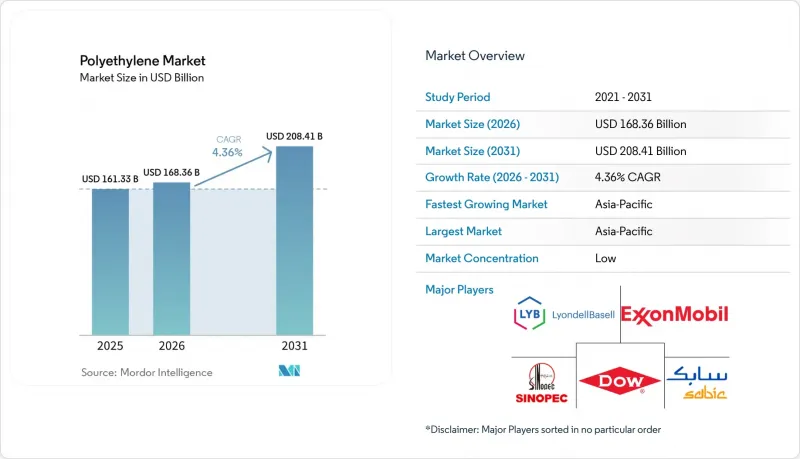
Mordor Intelligence에 의하면, 폴리에틸렌 시장은 2025년에 1,613억 3,000만 달러 규모로 평가되었습니다. 2026년 1,683억 6,000만 달러에서 성장을 계속해 2031년까지 2,084억 1,000만 달러에 이를 것으로 예측됩니다.
예측 기간(2026-2031년) 동안 연평균 성장률(CAGR)은 4.36%가 될 것으로 전망됩니다.
본 보고서는 제품 유형(고밀도 폴리에틸렌(HDPE) 등), 형태(시트·필름, 분말 등),제조 공정(압출 성형, 블로우 성형 등), 최종 이용 산업(포장, 건축 및 건설 등), 지역(아시아태평양, 북미, 유럽, 남미, 중동 및 아프리카)별로 분류되어 있습니다. 시장 예측은 금액(미 달러) 기준으로 제시되어 있습니다.
세계의 폴리에틸렌 시장 동향 및 인사이트
식품, 음료 및 전자상거래 채널의 포장 수요
2025년, 포장 부문은 폴리에틸렌 최종 용도 수요의 54.20%를 차지했으며, 식품, 음료 및 전자상거래 용도가 계속해서 수지 소비를 뒷받침할 것입니다. 인도에서는 퀵 커머스 서비스의 확대에 따라 연포장, 특히 스트레치 필름 및 우편용 봉투에 사용되는 선형 저밀도 폴리에틸렌(LLDPE) 수요가 증가하고 있습니다. 신흥 시장의 전자상거래 공급망에서는 기존의 저밀도 폴리에틸렌(LDPE) 필름보다 얇으면서 내구성이 뛰어난 LLDPE 필름이 선호되고 있습니다. 이러한 변화는 메탈로센계 LLDPE 수요를 촉진하고 있습니다. 필름 제조업체가 밀봉 강도와 내천자성을 유지하면서 두께를 얇게 만들 수 있기 때문입니다. 식품 및 음료용 폴리에틸렌 포장은 연포장 시장의 확대에 따라 성장이 예상되는 반면, 재활용 가능한 디자인을 추구하는 브랜드들 사이에서는 단일 소재 필름이 주목받고 있습니다. 따라서 고성능 LLDPE 등급공급업체는 특히 해당 소재를 통해 컨버터가 밀봉 강도 및 내천자성 시험을 통과하면서도 더 얇은 기재를 사용할 수 있게 되는 경우, 표준 수지 공급량을 넘어 폴리에틸렌 시장에서 부가가치를 창출할 수 있습니다. 이로 인해 폴리에틸렌 시장에서는 차별화되지 않은 수지 단독 제품보다 차별화된 필름 등급이 더 유리한 상황을 보이고 있습니다.
상수도, 가스, 관개 인프라 확충
고밀도 폴리에틸렌(HDPE) 파이프에 대한 수요는 북미의 파이프 교체 프로그램, 아프리카 및 남아시아의 상수도망 프로젝트, 그리고 동남아시아의 하수 처리 시설 개보수에 힘입어 증가하고 있습니다. 미국 상수도 협회(AWWA)는 2025년에 HDPE 파이프 규격을 개정하여 이음매에 대한 요건을 추가하고, 무연 용도에 대해 명확히 규정했습니다. 이번 개정을 통해 0.75-65인치 급수, 배수 및 송수 배관에 대해 HDPE가 미국국가표준협회(ANSI) 및 미국수도협회(AWWA)의 규격 대상 재료로서 입지가 강화되었습니다. 아프리카에서 수요도 상수도, 하수도, 광업, 농업 및 난연성 파이프 용도에 걸쳐 확대되고 있습니다. 물 부족으로 어려움을 겪는 농업 경제권에서의 관개 현대화는 단기적인 국내총생산(GDP) 변동에 덜 영향을 받는 지속적인 투자 채널을 창출하고 있습니다. 사우스다코타주의 70마일에 달하는 농촌 용수 파이프라인과 콜로라도주의 27마일에 달하는 ‘Vita H2O 프로젝트’는 농촌 지역의 물 공급에서 서비스 네트워크 현대화 프로젝트에 이르기까지, 인프라 등급 HDPE 수요를 뒷받침하는 프로젝트의 폭이 얼마나 넓은지를 보여줍니다.
원유 및 에틸렌 원료 가격 변동
원료 가격 변동은 미국의 에탄 크래킹 지역 이외의 지역에서 폴리에틸렌의 이익률을 계속해서 압박하고 있습니다. 유럽 및 동북아시아의 나프타 의존형 생산자들은 공급 과잉 상황에서 원유 가격 변동의 영향을 계속 받고 있으며, 그 영향을 가공업체에 완전히 전가할 수는 없습니다. 리욘-르바셀(Lyonerbasel)은 북미 및 유럽 사업 전반에 걸쳐 마진이 축소됨에 따라, 2024년 순이익 13억 6,700만 달러에 비해 2025년에는 7억 3,800만 달러의 순손실을 기록했습니다. 마진 압박으로 인해 합리화 결정이 가속화되어, 2025년 말까지 다우, SABIC, 리오넬 바셀의 유럽 거점에서의 에틸렌 생산 능력은 총 연간 190만 메트르톤 감소했습니다. 2025년 하반기에는 싱가포르에 거점을 둔 일부 사업자의 나프타 및 에틸렌 이익률이 마이너스로 전환되면서, 이로 인해 수지 가격의 추가 인하 여지가 제한되었습니다. 에탄 수입 터미널을 보유한 생산자, 가스 기반 크래킹을 수행하는 생산자, 혹은 중동산 저비용 에틸렌에 접근할 수 있는 생산자는 보다 견고한 입지를 확보하고 있으나, 원료에 대한 의존도는 여전히 단기 및 중기적인 제약 요인으로 작용하고 있습니다.
부문별 분석
HDPE는 블로우 성형 병, 가스 배관, 음용수용 배관, 골판지 파이프, 산업용 보호 필름 및 지오멤브레인 라이너에 대한 수요에 힘입어 2025년에는 폴리에틸렌 시장 점유율의 49.12%를 차지했습니다. 이 소재는 내식성이 뛰어나고 용융 접합이 가능하며, 기존의 기계적 연결과는 다른 일체형 접합부를 형성할 수 있기 때문에 북미 및 오세아니아의 도시 상수도 시스템에서 널리 채택되고 있습니다. 용기, 파이프, 건설, 환경 격리 용도 등 광범위한 분야에서 사용되고 있어, 대량 처리 체인 전반에 걸쳐 견고한 수요 기반을 형성하고 있습니다. LDPE는 저온 포장, 압출 코팅 및 필름 블렌드 용도에서 그 가공 특성이 여전히 유용하기 때문에 일정한 역할을 유지하고 있습니다. 한편, 각 변환업체들은 동일한 두께라도 더 높은 강도가 요구되는 필름에 LLDPE를 채택할 기회를 평가했습니다. 각 변환업체들은 스트레치 필름 및 농업용 필름 분야에서 LDPE를 LLDPE로 대체하는 경향이 강해지고 있습니다. 이는 인장 강도가 높아 필요한 필름 성능을 저하시키지 않으면서도 동일한 두께에서도 수지 사용량을 줄일 수 있기 때문입니다.
LLDPE는 2031년까지 연평균 성장률(CAGR) 4.74%로 확대될 것으로 예측되며, 이는 제품 유형 중 가장 높은 성장률입니다. 이러한 성장은 경질 포장에서 연질 포장으로의 전환, 신흥 시장에서 스트레치 필름에 대한 전자상거래 수요 증가, 그리고 메탈로센 촉매 기술에 의해 뒷받침되고 있습니다. 이 기술을 통해 제조업체는 특정 필름 용도에 맞추어 분자 구조를 조정하고, 필요한 밀봉 강도와 내천공성을 갖춘 필름을 공급할 수 있게 됩니다. 이는 전자상거래용 포장, 식품용 랩, 그리고 얇아진 유연 구조에서 특히 중요합니다. 단일 소재의 LLDPE 필름은 밀봉 강도와 방습 성능을 유지한 채 다층 라미네이트를 대체할 가능성이 있으며, 이는 유럽과 북미의 조달에 영향을 미치고 있는 ‘확대 생산자 책임(EPR)’ 체계에 부합하는 것입니다. NOVA Chemicals는 2025년 9월, 비불소계 폴리머 가공 보조제를 포함한 ‘9 SURPASS’, ‘SCLAIR’, ‘NOVAPOL’ 각 등급을 출시하여, 성능 기반의 경쟁에 규제 준수라는 요소를 추가했습니다.
2025년, 시트 및 필름은 폴리에틸렌 시장 점유율의 38.81%를 차지했으며, 2031년까지 연평균 성장률(CAGR) 4.89%로 확대될 것으로 예측됩니다. 이러한 구성은 좁은 용도 기반이라기보다는 포장, 농업, 건설 분야의 광범위한 수요를 반영하고 있습니다. 전자상거래는 얇고 내구성이 뛰어난 소재가 필요한 스트레치 필름, 우편용 봉투, 보호 포장 및 기타 연포장 형태에 대한 수요를 뒷받침하고 있습니다. 농업용 필름도 수요를 뒷받침하고 있습니다. LLDPE로 제작된 온실용 필름과 사일리지용 필름은 자외선에 대한 안정성과 여러 계절에 걸친 내구성을 갖추고 있어, 생산자가 반복적인 노출 주기를 통해 일관된 소재 성능을 필요로 하는 보호 재배에 활용되고 있습니다. 필름 용도가 시트 및 필름의 더 빠른 성장을 주도하는 한편, 펠릿은 사출 성형 및 블로우 성형 공정에 사용되는 버진 수지의 주요 상업적 공급 형태로 남아 있습니다.
분말 형태의 폴리에틸렌은 회전 성형, 전선 및 케이블 피복, 핫멜트 접착제에 사용됩니다. 미세한 입자 크기는 펠릿을 사용하지 않는 가공 시스템에서 일관된 열 전달과 용융을 가능하게 합니다. 과립, 파이프, 튜브 등의 기타 형태는 원료 변환업체의 원료라기보다는 인프라 조달 주기와 연계된 완제품입니다. 다우(Dow)사는 2025년, 이축 연신 폴리에틸렌(BOPE) 필름용 정밀 포장용 수지 ‘INNATE TF 220’을 출시했습니다. BOPE 필름은 연포장재로 사용되는 기존의 연신 필름에 비해 강성, 투명성 및 재활용성을 향상시킬 수 있습니다. 이러한 제품 개발은 시트 및 필름 분야의 소재 혁신에 초점을 맞춘 것으로, 이 분야에서는 각 브랜드 기업들도 재활용 요건을 충족할 수 있는 포장 구조를 필요로 하고 있습니다.
지역별 분석
아시아태평양은 2025년에 폴리에틸렌 시장 점유율의 47.67%를 차지했으며, 2031년까지 연평균 성장률(CAGR) 5.06%로 확대될 것으로 전망됩니다. 일본 및 한국의 지역적 생산 능력 합리화는 예측 기간 동안 공급 상황에 영향을 미칠 가능성이 있습니다. 이 지역은 최대의 생산 거점과 가장 강력한 소비 성장세를 모두 갖추고 있습니다. 인도 및 동남아시아 국가 연합(ASEAN) 국가들도 전자상거래, 식품 포장의 현대화, 인프라 투자를 통해 시장을 확대되고 있습니다. 일본은 제3차 석유화학 산업 재편 주기에 접어들었으며, 2028년까지 240만 미터톤의 에틸렌 생산 능력을 감축하는 것을 목표로 하고 있습니다. 한국은 2025년 8월, 주요 석유화학 기업 10곳에 370만 메트르톤의 생산 능력 감축을 목표로 한 사업 재편 및 경쟁력 강화 계획의 제출을 요구했습니다.
북미에서는 미국 멕시코만 연안의 에탄을 원료로 하는 크래킹이 호재로 작용하고 있습니다. 수요는 포장, 인프라용 파이프, 자동차 용도에서 발생하고 있습니다. 텍사스주 프보고서에 위치한 다우의 ‘Poly-7’ 라인은 연간 59만 메트르톤의 HDPE 또는 LLDPE 생산 능력으로 가동을 시작했습니다. 텍사스주 오렌지에 위치한 골든 트라이앵글 폴리머스는 2026년 하반기에 완공될 예정이며, 총 2기의 HDPE 생산 설비를 통해 연간 총 200만 미터톤의 생산 능력을 갖추게 됩니다. 멕시코는 2025년에 브라스크엠(Braskem)사가 5억 8,000만 달러 규모의 에탄 수입 터미널을 개설하고, 베라크루스에 위치한 브라스크엠-이데사(Braskem-Idesa) 공장의 원료 물류 시스템이 개선됨에 따라 신흥 수요 거점으로 부상했습니다.
남미, 중동 및 아프리카는 폴리에틸렌 시장에서 성장세가 두드러지는 지역입니다. 브라질에서는 포장 식품 수요, 육류 수출용 포장 수요, 그리고 미국산 폴리에틸렌 수입품에 대한 톤당 199.04달러의 잠정 반덤핑 관세가 국내 수지 가격에 영향을 미치고 있습니다. 아르헨티나를 비롯한 남미 국가들에서는 농업용 필름과 소비재 포장 수요가 시장을 지탱하고 있습니다. 걸프협력회의(GCC) 회원국의 생산자들은 천연가스를 원료로 하는 비용 우위를 유지하고 있으며, 전 세계적인 공급 과잉에도 불구하고 생산 능력에 대한 투자가 계속되고 있습니다. 사하라 이남 아프리카에서는 도시화와 상수도 인프라 부족을 배경으로, 나이지리아와 남아프리카공화국에서 고밀도 폴리에틸렌(HDPE) 파이프에 대한 조달 수요가 증가하고 있습니다.
기타 혜택 :
- 엑셀 형식 시장 예측(ME) 시트
- 3개월간의 애널리스트 지원
자주 묻는 질문
목차
제1장 서론
제2장 조사 방법
제3장 개요
제4장 시장 구도
제5장 시장 규모 및 성장 예측
제6장 경쟁 구도
제7장 시장 기회 및 향후 전망
KTH 26.09.02According to Mordor Intelligence, the polyethylene market was valued at USD 161.33 billion in 2025 and is estimated to grow from USD 168.36 billion in 2026 to reach USD 208.41 billion by 2031, at a CAGR of 4.36% during the forecast period (2026-2031).
This report is Segmented by Product Type (High-Density Polyethylene (HDPE), and More), Form (Sheets and Films, Powder, and More), Manufacturing Process (Extrusion, Blow Molding, and More), End-Use Industry (Packaging, Building and Construction, and More), and Geography (Asia-Pacific, North America, Europe, South America, and Middle-East and Africa). The Market Forecasts are Provided in Terms of Value (USD).
Global Polyethylene Market Trends and Insights
Packaging Demand from Food, Beverage and E-Commerce Channels
Packaging captured 54.20% of polyethylene end-use demand in 2025, and food, beverage, and e-commerce uses continue to support resin consumption. In India, the expansion of quick-commerce services is increasing demand for flexible packaging, especially linear low-density polyethylene (LLDPE) used in stretch films and mailer bags. Emerging-market e-commerce supply chains favor thin, durable LLDPE films over traditional low-density polyethylene (LDPE) films. This shift supports metallocene-grade LLDPE because it allows film producers to reduce thickness while maintaining seal strength and puncture resistance. Polyethylene packaging for food and beverages is expected to grow with flexible packaging, while mono-material films are gaining attention from brands seeking recyclable designs. Suppliers of higher-performance LLDPE grades can therefore capture value in the polyethylene market beyond standard resin volumes, particularly when their materials let converters use thinner substrates without failing seal-strength or puncture-resistance tests. This makes the polyethylene market more favorable to differentiated film grades than to undifferentiated resin alone.
Water, Gas and Irrigation Infrastructure Expansion
High-density polyethylene (HDPE) pipe demand is supported by replacement programs in North America, water grid projects in Africa and South Asia, and wastewater upgrades in Southeast Asia. The American Water Works Association updated its HDPE pipe standard in 2025 to add fitting requirements and clarify lead-free applications. The update reinforced HDPE as a material covered by American National Standards Institute and American Water Works Association standards for service, distribution, and transmission piping from 0.75 to 65 inches. African demand has also expanded across water, sewage, mining, agriculture, and fire-retardant pipe applications. Irrigation modernization in water-stressed agricultural economies creates a continuing investment channel that is less dependent on short-term gross domestic product cycles. The 70-mile rural water pipeline in South Dakota and the 27-mile Vita H2O Project in Colorado illustrate the range of projects supporting infrastructure-grade HDPE demand, from rural water supply to projects that modernize service networks.
Crude Oil and Ethylene Feedstock Price Volatility
Feedstock volatility continues to compress polyethylene margins outside the U.S. ethane-cracking corridor. Naphtha-dependent producers in Europe and Northeast Asia remain exposed to crude oil movements that they cannot fully pass on to converters in an oversupplied environment. LyondellBasell reported a USD 738 million net loss in 2025, compared with USD 1.367 billion net income in 2024, as margins declined across North American and European operations. Margin pressure accelerated rationalization decisions, and ethylene capacity at Dow, SABIC, and LyondellBasell sites in Europe declined by a combined 1.9 million metric tons per year by the end of 2025. Some Singapore-based operators had negative naphtha and ethylene margins in late 2025, which limited the scope for further resin-price reductions. Producers with ethane import terminals, gas-based cracking, or access to low-cost Middle Eastern ethylene have a stronger position, although feedstock exposure remains a near- and medium-term constraint.
Other drivers and restraints analyzed in the detailed report include:
- Circular Polyethylene and Recycled-Content Mandates
- Hydrogen-Ready Gas Networks Requiring PE-100-RC Pipes
- Single-Use Plastic Restrictions and Sustainable Material Substitution
For complete list of drivers and restraints, kindly check the Table Of Contents.
Segment Analysis
HDPE held 49.12% of the polyethylene market share in 2025, supported by demand for blow-molded bottles, gas distribution pipe, potable water pipe, corrugated pipe, protective industrial films, and geomembrane liners. The material is widely specified for municipal water systems in North America and Oceania because it resists corrosion and can be joined through fusion, creating monolithic joints that differ from conventional mechanical connections. Its broad use across containers, pipes, construction, and environmental containment provides a substantial demand base across high-volume processing chains. LDPE retained a role in low-temperature packaging, extrusion coatings, and film-blending uses where its processing characteristics remain useful, even as converters assess opportunities to use LLDPE in films that need more strength at the same gauge. Converters are increasingly replacing LDPE with LLDPE in stretch and agricultural films because greater tensile strength can reduce resin use at an equivalent gauge without sacrificing the required film performance.
LLDPE is projected to advance at a 4.74% CAGR through 2031, the fastest rate among product types. Its growth is supported by a shift from rigid to flexible packaging, stronger e-commerce demand for stretch film in emerging markets, and metallocene catalyst technology. This technology allows producers to tailor molecular architecture for specific film applications and to supply films with the required seal strength and puncture resistance, which is particularly relevant for e-commerce packaging, food wraps, and downgauged flexible structures. Mono-material LLDPE films can replace multilayer laminates while maintaining seal strength and moisture-barrier performance, aligning with extended producer responsibility frameworks that are influencing procurement in Europe and North America. NOVA Chemicals launched 9 SURPASS, SCLAIR, and NOVAPOL grades with a non-fluorinated polymer processing aid in September 2025, adding a regulatory-compliance element to performance-based competition.
Sheets and films held 38.81% of the polyethylene market share in 2025 and are projected to advance at a 4.89% CAGR through 2031. This combination reflects the depth of demand from packaging, agriculture, and construction rather than a narrow application base. E-commerce supports demand for stretch films, mailer bags, protective wrapping, and other flexible packaging formats that need thin, durable materials. Agricultural film also supports demand because LLDPE greenhouse and silage films provide ultraviolet stability and multi-season durability in protected cultivation, where growers depend on consistent material performance across repeated exposure cycles. Pellets remained the principal commercial delivery form for virgin resin used in injection-molding and blow-molding operations, even while film applications drove the faster growth of sheets and films.
Powder form polyethylene serves rotational molding, wire and cable coatings, and hot-melt adhesives. Its fine particle size supports consistent heat transfer and fusion in processing systems that do not use pellets. Other forms, including granules, pipes, and tubes, are finished industrial products tied to infrastructure purchasing cycles rather than raw converter feedstock. Dow introduced INNATE TF 220 precision packaging resin in 2025 for biaxially oriented polyethylene (BOPE) films. BOPE films can improve stiffness, transparency, and recyclability compared with conventional oriented films used in flexible packaging. These product developments concentrate material innovation in the sheets and films category, where brands also need packaging structures that can meet recyclability requirements.
Complete Report Scope:
- By Product Type
- High-Density Polyethylene (HDPE)
- Low-Density Polyethylene (LDPE)
- Linear Low-Density Polyethylene (LLDPE)
- Other Product Types (Medium-Density Polyethylene (MDPE))
- By Form
- Sheets and Films
- Pellets
- Powder
- Other Forms (Granules, Pipes and Tubes)
- By Manufacturing Process
- Extrusion
- Blow Molding
- Injection Molding
- Other Manufacturing Processes (Rotational Molding, Compression Molding, Thermoforming)
- By End-Use Industry
- Packaging
- Building and Construction
- Automotive
- Other End-Use Industries (Electrical and Electronics, Consumer Goods, Healthcare, Agriculture, Industrial Manufacturing)
- By Geography
- Asia-Pacific
- China
- India
- Japan
- South Korea
- ASEAN Countries
- Rest of Asia-Pacific
- North America
- United States
- Canada
- Mexico
- Europe
- Germany
- United Kingdom
- France
- Italy
- Spain
- NORDIC Countries
- Russia
- Rest of Europe
- South America
- Brazil
- Argentina
- Rest of South America
- Middle-East and Africa
- Saudi Arabia
- South Africa
- Egypt
- Nigeria
- Rest of Middle-East and Africa
- Asia-Pacific
Geography Analysis
Asia-Pacific held 47.67% of the polyethylene market share in 2025 and is projected to advance at a 5.06% CAGR through 2031. Regional capacity rationalization in Japan and South Korea can affect supply conditions through the forecast period. The region combines the largest production base with the strongest consumption growth. India and the Association of Southeast Asian Nations (ASEAN) countries are also expanding through e-commerce, food-packaging modernization, and infrastructure investment. Japan is in a third petrochemical rationalization cycle, targeting the removal of 2.4 million metric tons of ethylene capacity by 2028. South Korea requested restructuring and competitiveness plans from 10 major petrochemical companies in August 2025, targeting 3.7 million metric tons of capacity reduction.
North America benefits from ethane-based cracking on the U.S. Gulf Coast. Demand comes from packaging, infrastructure pipes, and automotive uses. Dow's Poly-7 line in Freeport, Texas, has started up with 590,000 metric tons per year of HDPE or LLDPE capacity. Golden Triangle Polymers in Orange, Texas, is scheduled for completion in the second half of 2026 with 2 HDPE units totaling 2 million metric tons per year. Mexico is an emerging demand center after Braskem opened a USD 580 million ethane import terminal in 2025, improving feedstock logistics at the Braskem Idesa plant in Veracruz.
South America, and the Middle-East and Africa are growing parts of the polyethylene market. Brazil's packaged food demand, meat-export packaging needs, and a preliminary antidumping duty of USD 199.04 per metric ton on U.S. polyethylene imports are affecting domestic resin pricing. Argentina and other South American countries are supported by agricultural film and consumer-goods packaging demand. Gulf Cooperation Council producers retain a cost advantage from gas-based feedstocks, supporting capacity investment despite global oversupply. In Sub-Saharan Africa, urbanization and water infrastructure gaps support HDPE pipe procurement in Nigeria and South Africa.
- Braskem
- Chevron Phillips Chemical Company LLC
- China Petrochemical Corporation
- Dow
- Exxon Mobil Corporation
- Formosa Plastics Corporation
- INEOS
- LG Chem
- LOTTE Chemical CORPORATION
- LyondellBasell Industries Holdings N.V.
- Mitsui Chemicals, Inc.
- NOVA Chemicals Corporate
- PetroChina Company Limited
- Qatar Petrochemical Company (QAPCO)
- Reliance Industries Limited
- Repsol
- SABIC
- TotalEnergies
- Westlake Corporation
Additional Benefits:
- The market estimate (ME) sheet in Excel format
- 3 months of analyst support
TABLE OF CONTENTS
1 Introduction
- 1.1 Study Assumptions and Market Definition
- 1.2 Scope of the Study
2 Research Methodology
3 Executive Summary
4 Market Landscape
- 4.1 Market Overview
- 4.2 Market Drivers
- 4.2.1 Packaging Demand from Food, Beverage and E-Commerce Channels
- 4.2.2 Water, Gas and Irrigation Infrastructure Expansion
- 4.2.3 Lightweighting and Performance Requirements Across End-Use Industries
- 4.2.4 Circular Polyethylene and Recycled-Content Mandates
- 4.2.5 Hydrogen-Ready Gas Networks Requiring PE-100-RC Pipes
- 4.2.6 Pellet-Loss Compliance and Resin Traceability Investments
- 4.3 Market Restraints
- 4.3.1 Crude Oil and Ethylene Feedstock Price Volatility
- 4.3.2 Single-Use Plastic Restrictions and Sustainable Material Substitution
- 4.3.3 Food-Contact and Medical-Grade Recycled Resin Qualification Constraints
- 4.3.4 Fragmented Mass-Balance Certification and Chain-of-Custody Standards
- 4.4 Value Chain Analysis
- 4.5 Porter's Five Forces Analysis
- 4.5.1 Bargaining Power of Suppliers
- 4.5.2 Bargaining Power of Buyers
- 4.5.3 Threat of New Entrants
- 4.5.4 Threat of Substitutes
- 4.5.5 Competitive Rivalry
5 Market Size and Growth Forecasts (Value)
- 5.1 By Product Type
- 5.1.1 High-Density Polyethylene (HDPE)
- 5.1.2 Low-Density Polyethylene (LDPE)
- 5.1.3 Linear Low-Density Polyethylene (LLDPE)
- 5.1.4 Other Product Types (Medium-Density Polyethylene (MDPE))
- 5.2 By Form
- 5.2.1 Sheets and Films
- 5.2.2 Pellets
- 5.2.3 Powder
- 5.2.4 Other Forms (Granules, Pipes and Tubes)
- 5.3 By Manufacturing Process
- 5.3.1 Extrusion
- 5.3.2 Blow Molding
- 5.3.3 Injection Molding
- 5.3.4 Other Manufacturing Processes (Rotational Molding, Compression Molding, Thermoforming)
- 5.4 By End-Use Industry
- 5.4.1 Packaging
- 5.4.2 Building and Construction
- 5.4.3 Automotive
- 5.4.4 Other End-Use Industries (Electrical and Electronics, Consumer Goods, Healthcare, Agriculture, Industrial Manufacturing)
- 5.5 By Geography
- 5.5.1 Asia-Pacific
- 5.5.1.1 China
- 5.5.1.2 India
- 5.5.1.3 Japan
- 5.5.1.4 South Korea
- 5.5.1.5 ASEAN Countries
- 5.5.1.6 Rest of Asia-Pacific
- 5.5.2 North America
- 5.5.2.1 United States
- 5.5.2.2 Canada
- 5.5.2.3 Mexico
- 5.5.3 Europe
- 5.5.3.1 Germany
- 5.5.3.2 United Kingdom
- 5.5.3.3 France
- 5.5.3.4 Italy
- 5.5.3.5 Spain
- 5.5.3.6 NORDIC Countries
- 5.5.3.7 Russia
- 5.5.3.8 Rest of Europe
- 5.5.4 South America
- 5.5.4.1 Brazil
- 5.5.4.2 Argentina
- 5.5.4.3 Rest of South America
- 5.5.5 Middle-East and Africa
- 5.5.5.1 Saudi Arabia
- 5.5.5.2 South Africa
- 5.5.5.3 Egypt
- 5.5.5.4 Nigeria
- 5.5.5.5 Rest of Middle-East and Africa
- 5.5.1 Asia-Pacific
6 Competitive Landscape
- 6.1 Market Concentration
- 6.2 Strategic Moves
- 6.3 Market Share (%)/Ranking Analysis
- 6.4 Company Profiles (includes Global Overview, Market Overview, Core Segments, Financials as available, Strategic Information, Products and Services, and Recent Developments)
- 6.4.1 Braskem
- 6.4.2 Chevron Phillips Chemical Company LLC
- 6.4.3 China Petrochemical Corporation
- 6.4.4 Dow
- 6.4.5 Exxon Mobil Corporation
- 6.4.6 Formosa Plastics Corporation
- 6.4.7 INEOS
- 6.4.8 LG Chem
- 6.4.9 LOTTE Chemical CORPORATION
- 6.4.10 LyondellBasell Industries Holdings N.V.
- 6.4.11 Mitsui Chemicals, Inc.
- 6.4.12 NOVA Chemicals Corporate
- 6.4.13 PetroChina Company Limited
- 6.4.14 Qatar Petrochemical Company (QAPCO)
- 6.4.15 Reliance Industries Limited
- 6.4.16 Repsol
- 6.4.17 SABIC
- 6.4.18 TotalEnergies
- 6.4.19 Westlake Corporation
7 Market Opportunities and Future Outlook
- 7.1 White-Space and Unmet-Need Assessment