

|
시장보고서
상품코드
2119563
석면 : 시장 점유율 분석, 업계 동향 및 통계, 성장 예측(2026-2031년)Asbestos - Market Share Analysis, Industry Trends & Statistics, Growth Forecasts (2026 - 2031) |
||||||
 Mordor Intelligence
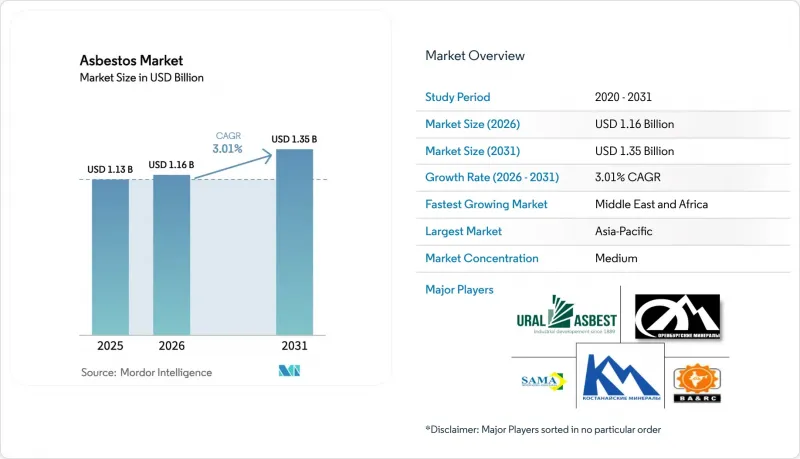
Mordor Intelligence에 의하면, 석면 시장 규모는 2025년 11억 3,000만 달러로 평가되었습니다. 2026년에는 11억 6,000만 달러로 확대되어 2026년부터 2031년에 걸쳐 CAGR 3.01%로 성장을 지속하여, 2031년에는 13억 5,000만 달러에 이를 것으로 예측됩니다.
본 보고서는 유형별(크리소타일, 아모사이트, 크로시드라이트, 트레몰라이트,악티놀라이트, 안토필라이트), 용도별(건축자재, 전기 절연재, 마찰 제품, 포장재, 개스킷, 기타 용도), 지역별(아시아태평양, 북미, 유럽, 남미, 중동 및 아프리카)로 분류되어 있습니다. 시장 전망은 금액(미 달러) 기준으로 제시되어 있습니다.
세계의 석면 시장 동향 및 인사이트
아시아태평양 및 아프리카의 인프라 급속한 확장이 저비용 석면 시멘트 수요를 뒷받침하고 있습니다.
인도, 중국, 나이지리아, 에티오피아의 대규모 주택 및 교통 인프라 계획에서는 가격 경쟁력과 안정적인 공급을 이유로 석면 시멘트가 계속해서 선호되고 있습니다. 인도는 2019년부터 2020년에 걸쳐 주로 러시아에서 36만 1,164톤을 수입하여, 저렴한 가격의 주택 건설을 주축으로 하는 지붕 및 배관 프로젝트에 공급했습니다. 에티오피아와 앙골라에 진출한 중국 건설사들은 농촌 지역의 학교나 창고에 석면 시멘트 판을 지정하는 경우가 많아, 아시아 생산자와 아프리카 건설업자를 연결하는 수요 경로가 강화되고 있습니다. 나이지리아 건설 부문에서는 지금까지 여러 프로젝트에서 100만 톤 이상이 소비되었으며, 이 자재의 내구성을 여전히 중시하는 고정된 사용자층이 존재함을 보여주고 있습니다. WHO는 석면 관련 질환으로 전 세계에서 매년 12만 5,000명이 사망하고 있다고 경고하고 있지만, 비용 절감을 우선시하는 각국 정부는 계속해서 수입을 승인하고 있습니다. 전 세계적으로 금지 조치가 강화되는 가운데에도, 이러한 인프라 주도형 수요가 석면 시장의 기반을 지탱하고 있습니다.
석면이 사용된 기존 건물의 개보수 활동 증가
금지 조치 이전에 설치된 수백만 개의 지붕, 상수도 본관, 벽판이 현재 유지 관리가 필요하며, 이로 인해 봉쇄용 코팅, 제거 서비스, 교체용 패널에 대한 안정적인 수요가 발생하고 있습니다. 전문 계약업체들은 음압 인클로저, HEPA 필터, 인증된 폐기물 처리에 투자하고 있으며, 업계 조사에 따르면 이로 인해 초기 비용이 15만 달러 이상에 달하고 있습니다. 미국에서는 2024년에 비축분에서 110톤의 크리소타일이 소비되었으나, 그 전량이 여전히 석면 다이어프램에 의존하고 있는 염소-알칼리 공장의 유지보수에 사용되었습니다. 라트비아의 2024년 제거 시범 사업에서는 예산이 몇 달이나 앞당겨 소진되어, 오래된 주택 재고에 숨겨진 막대한 작업량이 부각되었습니다. 이러한 개보수 활동은 석면 시장의 수명을 연장하는 동시에, 설계 변경 없이 기존 설비에 통합할 수 있는 대체 재료의 병행적인 성장을 가속하고 있습니다.
각국의 금지 조치 가속화(예 : 2024년 미국 EPA의 크리소타일 단계적 폐지)
미국은 2024년 3월부터 크리소타일 수입을 금지하고, 특수 용도에 대해서는 2037년까지 단계적 전환 기한을 설정했습니다. 멕시코 의회는 2024년 1월 전면 금지안을 가결하여 북미 전역에서 사용 금지 구역을 확대했습니다. 현재 60개국 이상이 전면 금지를 시행하고 있으며, WHO 등 다자간 기구도 대체화 노력을 지속적으로 추진하고 있습니다. 개정된 규제 하에서는 크롤·알칼리 부문만으로도 28억-34억 달러의 전환 비용이 발생할 것으로 예측됩니다. 주요 경제국들이 잇달아 규제를 시행함에 따라 공급업체들은 시장 접근성을 상실하고 있으며, 그 결과 전 세계 소비량이 감소하고 섬유 공급처가 규제가 완화된 소수의 지역으로 이동하고 있습니다.
부문별 분석
2025년, 크리소타일은 석면 시장 점유율의 94.23%를 차지했습니다. 이는 건설업체, 자동차 제조업체 및 염소-알칼리 사업자들이 이 섬유의 유연성과 비교적 쉬운 입수성을 선호하기 때문입니다. 2025년, 러시아는 전 세계 광산 생산량의 48%를 차지했고, 카자흐스탄, 브라질, 중국이 그 뒤를 이었으나, 제재 및 물류 문제로 인해 2020년 이후 러시아의 수출 점유율은 65%에서 48%로 축소되었습니다. 트레몰라이트는 대체재가 여전히 고가인 특수 야금 및 내열 용도에 힘입어 2031년까지 연평균 성장률(CAGR)이 3.16%로, 석면 시장 내에서 가장 높은 성장세를 보였습니다. EPA의 2024년 금지 조치로 인해 크리소타일은 수익성이 높은 미국 시장에 대한 접근권을 상실하게 되었으며, 앰피볼계 석면이 나머지 점유율을 확보할 수 있는 것은 금지 조치가 없는 관할 구역으로 한정될 것으로 보입니다. WHO의 권고를 따르는 국가가 늘어남에 따라, 각 유형에 대한 수요는 좁은 지리적 틈새 시장으로 분산되고, 공급의 변동성이 높아질 것입니다.
많은 생산자들은 이미 수출지에 따라 재고를 구분하고 있습니다. 러시아 광산에서는 고품질 크리소타일을 인도와 중국에 공급하는 한편, 중품질 섬유는 건설 기준이 비교적 완화된 아프리카와 라틴아메리카로 선적되고 있습니다. 대조적으로, 앰피볼라이트계 석면 수요는 현재 거의 전적으로 연구 목적으로만 발생하고 있으며, 대학 및 재료과학 관련 기업들이 여과 및 고온 세라믹 분야의 통제된 실험을 위해 미량만 주문하고 있습니다. 이러한 변화는 석면 시장이 양극화되고 있음을 보여주며, 시장 규모는 축소되고 있지만 높은 정밀도가 요구되는 특정 분야에서는 여전히 수요가 유지되고 있습니다.
지역별 분석
2025년, 아시아태평양은 석면 시장 매출의 70.62%를 차지했으며, 그 견인차 역할을 한 것은 전 세계 수입량의 44%를 차지하는 세계 최대 수입국인 인도였습니다. 이 지역에는 100개 이상의 공장에서 약 30만 명의 근로자가 고용되어 있으며, 건강상의 이유로 추진되는 개혁에 저항하는 경제적 관성이 발생하고 있습니다. 중국은 여전히 주요 소비국이자 생산국이며, 공중보건 예측에 따르면 2035년까지 석면 관련 질환으로 인한 연간 사망자 수는 1만 5,000명에 달할 것으로 예상되어, 사용 지속에 따른 사회적 비용이 부각되고 있습니다. 인도네시아, 베트남, 필리핀도 여전히 규제가 느슨하여, 러시아와 카자흐스탄의 광산에서 생산된 섬유가 지붕재나 배관 자재로 유입되고 있습니다. 이러한 요인으로 인해 국제적인 반대 운동이 고조되는 와중에도, 아시아태평양의 석면 시장에서 석면이 차지하는 지배적인 지위는 흔들림이 없습니다.
북미에서는 2024년 미국이 크리소타일을 금지함에 따라 구조적인 변화가 일어났습니다. 국내 소비량은 전적으로 과거 재고에서 비롯된 110톤으로 감소했으며, 염소-알칼리 공장은 2037년까지 막 공정으로의 전환을 완료해야 합니다. 한때 주요 생산국이었던 캐나다는 현재 채굴된 석면의 거의 전량을 아시아로 수출하고 있지만, 가동 중단을 요구하는 외부 압력에 직면해 있습니다. 멕시코의 금지 법안이 통과되면 이 지역의 마지막 판로가 막히게 되어, 세계 무역 경로에 영향을 미치는 대륙 규모의 모라토리엄이 정착될 것입니다. 소송은 여전히 이 지역을 특징짓는 과거의 부정적인 유산이며, 수십억 규모의 미해결 청구 건들이 건설, 산업용 가스, 소비재 각 부문의 재무 상황을 압박하고 있습니다.
유럽에서는 1990년대에 회원국 전체가 금지 조치를 시행한 이래, 석면의 신규 사용에 대해 무관용 정책을 유지하고 있습니다. 현재는 학교나 공공 건축물에서 단열판을 철거하는 등 과거의 잔존 문제를 시정하는 것이 활동의 중심이 되고 있습니다. 유럽연합 집행위원회는 안전한 해체가 기술적으로 어려운 저전압 염소-알칼리 전해조에 대해 여전히 제한적인 특례를 인정하고 있지만, 이러한 예외는 축소되는 추세에 있습니다. 라트비아의 2024년 시범 사업과 같은 각국의 프로그램은 제거 수요가 재정 능력을 초과하는 경우가 많음을 보여주고 있으며, 석면 관련 서비스에 대한 수요가 장기적으로 지속될 것임을 시사하고 있습니다. 이러한 경험은 대체재인 섬유 시멘트 판이나 막 기술의 혁신을 촉진하고 있으며, 수출 기업들은 현재 이러한 제품을 아시아, 아프리카, 라틴아메리카에 판매하고 있습니다.
기타 혜택 :
- 엑셀 형식 시장 예측(ME) 시트
- 3개월간의 애널리스트 지원
자주 묻는 질문
목차
제1장 서론
제2장 조사 방법
제3장 주요 요약
제4장 시장 구도
제5장 시장 규모 및 성장 예측
제6장 경쟁 구도
제7장 시장 기회 및 향후 전망
KTH 26.09.10According to Mordor Intelligence, the asbestos market size is expected to grow from USD 1.13 billion in 2025 to USD 1.16 billion in 2026 and is forecast to reach USD 1.35 billion by 2031 at 3.01% CAGR over 2026-2031.
This report is Segmented by Type (Chrysotile, Amosite, Crocidolite, Tremolite, Actinolite, and Anthophyllite), Application (Building Materials, Electrical Insulation, Friction Products, Packaging, Gaskets, and Other Applications), and Geography (Asia-Pacific, North America, Europe, South America, and Middle East and Africa). The Market Forecasts are Provided in Terms of Value (USD).
Global Asbestos Market Trends and Insights
Rapid infrastructure growth in APAC and Africa sustaining low-cost asbestos cement demand
Large-scale housing and transport programs across India, China, Nigeria, and Ethiopia continue to favor asbestos cement because of its price advantage and ready supply. India imported 361,164 tonnes in 2019-2020, mainly from Russia, to feed roof and pipe projects that dominate affordable housing. Chinese construction firms expanding into Ethiopia and Angola often specify asbestos cement sheets for rural schools and warehouses, reinforcing demand corridors that link Asian producers with African builders. Nigeria's construction sector historically consumed more than 1 million tons across multiple projects, indicating an entrenched user base that still values the material's durability. WHO warns that asbestos-related diseases cause 125,000 annual deaths worldwide, yet governments prioritizing cost control continue to approve imports. This infrastructure-led demand underpins the asbestos market even as global bans intensify.
Rising retrofit and repair activity in legacy asbestos-built stock
Millions of roofs, water mains, and wallboards installed before bans now require upkeep, prompting steady demand for encapsulation coatings, removal services, and replacement panels. Specialized contractors invest in negative-pressure enclosures, HEPA filtration, and certified disposal, which pushes startup costs to USD 150,000 and beyond according to industry surveys. The United States consumed 110 tons of chrysotile from stockpiles in 2024, entirely for maintenance in chlor-alkali plants that still rely on asbestos diaphragms. Latvia's 2024 pilot removal scheme exhausted its budget months early, underscoring the latent workload in older housing stock. These retrofit activities extend the asbestos market life cycle while fostering the parallel growth of alternative materials that can slot into existing fittings without design changes.
Acceleration of national bans (e.g., EPA 2024 US chrysotile phase-out)
The United States outlawed chrysotile imports in March 2024 and set phased conversion deadlines that extend through 2037 for specialty uses. Mexico's Congress advanced a blanket prohibition in January 2024, widening the no-use zone across North America. More than 60 countries now enforce full bans, and multilateral bodies such as WHO continue to promote substitution initiatives. The chlor-alkali sector alone faces USD 2.8 billion to USD 3.4 billion in conversion costs under the updated rule set. As each major economy implements restrictions, suppliers lose market access, compressing global consumption and redirecting fiber toward fewer permissive destinations.
Other drivers and restraints analyzed in the detailed report include:
- Cost advantage of chrysotile over synthetic substitutes for chlor-alkali diaphragms
- Weak enforcement of asbestos bans in high-growth emerging economies
- Escalating litigation and insurance costs for producers and downstream users
For complete list of drivers and restraints, kindly check the Table Of Contents.
Segment Analysis
Chrysotile captured 94.23% of asbestos market share in 2025 because builders, automakers, and chlor-alkali operators favor its flexible fibers and relative availability. Russia accounted for 48% of global mine output in 2025, followed by Kazakhstan, Brazil, and China, yet sanctions and logistics issues trimmed Russian exports from 65% to 48% since 2020. Tremolite exhibited a 3.16% CAGR through 2031, the fastest within the asbestos market, due to specialized metallurgical and heat-shield applications where substitutes remain costly. EPA's 2024 ban removed chrysotile access to the lucrative United States, signaling that amphibole types could inherit a residual share only in jurisdictions without bans. As more countries align with WHO recommendations, type demand will splinter into narrow geographic niches, making supply more volatile.
Many producers already segment inventory by destination. Russian mines channel premium chrysotile grades to India and China, whereas mid-grade fiber moves to Africa and Latin America where construction standards are lower. In contrast, amphibole demand is now almost entirely research-driven, with universities and material science firms ordering micro quantities for controlled experiments in filtration and high-temperature ceramics. Such shifts illustrate a bifurcated asbestos market that simultaneously contracts in volume yet persists in high-precision pockets.
Complete Report Scope:
- By Type
- Chrysotile
- Amosite
- Crocidolite
- Tremolite
- Actinolite
- Anthophyllite
- By Application
- Building Materials
- Electrical Insulation
- Friction Products
- Packaging
- Gaskets
- Other Applications
- By Geography
- Asia-Pacific
- China
- India
- Japan
- South Korea
- Rest of Asia-Pacific
- North America
- United States
- Canada
- Mexico
- Europe
- Germany
- United Kingdom
- France
- Italy
- Russia
- Rest of Europe
- South America
- Brazil
- Argentina
- Rest of South America
- Middle East and Africa
- Saudi Arabia
- South Africa
- Rest of Middle East and Africa
- Asia-Pacific
Geography Analysis
Asia-Pacific generated 70.62% of asbestos market revenue in 2025, led by India's position as the world's top importer at 44% of global volume. The region employed about 300,000 workers across more than 100 plants, creating economic inertia that resists health-based reforms. China remained both a major consumer and producer, and public health projections forecast 15,000 annual asbestos disease deaths by 2035, underscoring the social costs of continued use. Indonesia, Vietnam, and the Philippines also retain permissive rules, funneling fiber from Russian and Kazakhstan mines into roofing and piping lines. These factors cement Asia-Pacific's dominance in the asbestos market even as international advocacy builds against it.
North America underwent structural change after the United States banned chrysotile in 2024. Domestic consumption fell to 110 tons sourced entirely from legacy stockpiles, and chlor-alkali plants must complete membrane conversions by 2037. Canada, once a significant producer, now exports almost all mined asbestos to Asia but faces external pressure to shutter operations. Mexico's draft ban would seal off the final regional outlet, consolidating a continental moratorium that influences global trade lanes. Litigation remains the region's defining legacy burden, with billions in outstanding claims that squeeze balance sheets across the construction, industrial gas, and consumer goods sectors.
Europe maintains a zero-tolerance policy on new asbestos use, having implemented bans across member states in the 1990s. Legacy remediation now dominates activity, including the removal of insulating boards from schools and public buildings. The European Commission still grants narrow derogations for low-voltage chlor-alkali cells where safe dismantling is technically complex, but those exceptions are shrinking. National programs such as Latvia's 2024 pilot demonstrate that remediation demand often outstrips fiscal capacity, suggesting a long tail of asbestos service activity. These experiences feed innovation in alternative fiber-cement boards and membrane technologies that exporting firms now sell to Asia, Africa, and Latin America.
- BHARAT ASBESTOS & RUBBER CO.
- JSC Orenburg Minerals
- Kostanay Minerals JSC
- Ningbo Xinyan Friction Materials Co., Ltd.
- PJSC Uralasbest
- SAMA Mineracao de Amianto Ltda.
- Visaka Industries Ltd
Additional Benefits:
- The market estimate (ME) sheet in Excel format
- 3 months of analyst support
TABLE OF CONTENTS
1 Introduction
- 1.1 Study Assumptions and Market Definition
- 1.2 Scope of the Study
2 Research Methodology
3 Executive Summary
4 Market Landscape
- 4.1 Market Overview
- 4.2 Market Drivers
- 4.2.1 Rapid Infrastructure Growth in APAC and Africa Sustaining Low-Cost Asbestos Cement Demand
- 4.2.2 Rising Retrofit and Repair Activity in Legacy Asbestos-Built Stock (Roofing, Pipes)
- 4.2.3 Cost Advantage of Chrysotile Over Synthetic Substitutes for Chlor-Alkali Diaphragms
- 4.2.4 Weak Enforcement of Asbestos Bans in High-Growth Emerging Economies
- 4.2.5 Niche Demand from Specialised Gaskets in Chemical and Oil Processing
- 4.3 Market Restraints
- 4.3.1 Acceleration of National Bans (E.G., EPA 2024 US Chrysotile Phase-Out)
- 4.3.2 Escalating Litigation and Insurance Costs for Producers and Downstream Users
- 4.3.3 Rapid Commercialisation of Non-Asbestos Fibre-Cement and Brake Friction Materials
- 4.4 Value Chain Analysis
- 4.5 Porter's Five Forces
- 4.5.1 Bargaining Power of Suppliers
- 4.5.2 Bargaining Power of Buyers
- 4.5.3 Threat of New Entrants
- 4.5.4 Threat of Substitute Products and Services
- 4.5.5 Degree of Competition
5 Market Size and Growth Forecasts (Value)
- 5.1 By Type
- 5.1.1 Chrysotile
- 5.1.2 Amosite
- 5.1.3 Crocidolite
- 5.1.4 Tremolite
- 5.1.5 Actinolite
- 5.1.6 Anthophyllite
- 5.2 By Application
- 5.2.1 Building Materials
- 5.2.2 Electrical Insulation
- 5.2.3 Friction Products
- 5.2.4 Packaging
- 5.2.5 Gaskets
- 5.2.6 Other Applications
- 5.3 By Geography
- 5.3.1 Asia-Pacific
- 5.3.1.1 China
- 5.3.1.2 India
- 5.3.1.3 Japan
- 5.3.1.4 South Korea
- 5.3.1.5 Rest of Asia-Pacific
- 5.3.2 North America
- 5.3.2.1 United States
- 5.3.2.2 Canada
- 5.3.2.3 Mexico
- 5.3.3 Europe
- 5.3.3.1 Germany
- 5.3.3.2 United Kingdom
- 5.3.3.3 France
- 5.3.3.4 Italy
- 5.3.3.5 Russia
- 5.3.3.6 Rest of Europe
- 5.3.4 South America
- 5.3.4.1 Brazil
- 5.3.4.2 Argentina
- 5.3.4.3 Rest of South America
- 5.3.5 Middle East and Africa
- 5.3.5.1 Saudi Arabia
- 5.3.5.2 South Africa
- 5.3.5.3 Rest of Middle East and Africa
- 5.3.1 Asia-Pacific
6 Competitive Landscape
- 6.1 Market Concentration
- 6.2 Strategic Moves
- 6.3 Market Share(%)/ Ranking Analysis
- 6.4 Company Profiles (includes Global level Overview, Market level overview, Core Segments, Financials as available, Strategic Information, Market Rank/Share for key companies, Products and Services, and Recent Developments)
- 6.4.1 BHARAT ASBESTOS & RUBBER CO.
- 6.4.2 JSC Orenburg Minerals
- 6.4.3 Kostanay Minerals JSC
- 6.4.4 Ningbo Xinyan Friction Materials Co., Ltd.
- 6.4.5 PJSC Uralasbest
- 6.4.6 SAMA Mineracao de Amianto Ltda.
- 6.4.7 Visaka Industries Ltd
7 Market Opportunities and Future Outlook
- 7.1 White-space and Unmet-need Assessment


