

|
시장보고서
상품코드
2121586
크실렌 : 시장 점유율 분석, 업계 동향과 통계, 성장 예측(2026-2031년)Xylene - Market Share Analysis, Industry Trends & Statistics, Growth Forecasts (2026 - 2031) |
||||||
 Mordor Intelligence
Mordor Intelligence에 의하면, 크실렌 시장 규모는 2026년에 5,312만 톤으로 추정되며, 예측 기간(2026-2031년)에 CAGR 4.12%로 확대되어 2031년에는 6,500만 톤에 이를 전망입니다.
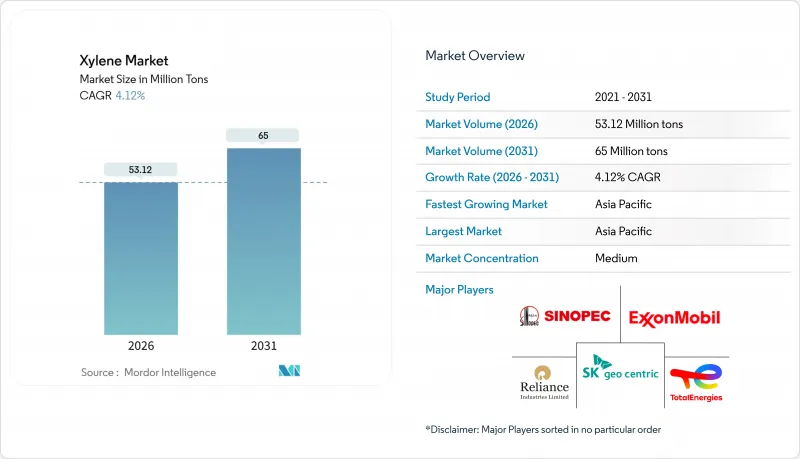
본 보고서는 유형(오르토자일렌, 메타자일렌 등), 등급(테크니컬 등급 및 고순도 등급), 원료(석유 유래 및 바이오 유래), 용도(용제, 모노머, 기타 용도), 최종 사용자 산업(플라스틱·폴리머,페인트 및 코팅, 기타), 지역(아시아태평양, 북미, 유럽, 기타)별로 분류되어 있습니다. 시장 예측은 수량(톤) 단위로 제시되어 있습니다.
세계 크실렌 시장 동향 및 인사이트
PET 및 폴리에스터 섬유 수요 급증(PX-PTA 밸류체인)
PET 포장재 및 폴리에스터 섬유의 지속적인 성장에 힘입어, 업스트림 파라자일렌 수요는 계속해서 확대되고 있습니다. 2024년에 가동을 시작한 중국석유화공(Sinopec) 이정의 연간 300만 톤 규모 PTA 플랜트와 튀르키예에 위치한 SASA Polyester의 175만 톤 규모 시설이 이러한 연계의 기반이 되고 있습니다. 2023년 인도네시아, 베트남, 태국에서 두 자릿수 성장률을 기록함에 따라 아시아의 PET 소비량은 4% 증가한 8,800만 톤에 달했으며, 같은 해 인도의 PET 수요도 13% 급증했습니다. 그러나 중국의 막대한 PTA 및 PET 생산 능력 계획(2022년 기준 약 7,100만 톤)은 국내 과잉 생산 능력을 초래하여 PX 마진을 압박하는 한편, 일본과 유럽에서 공장 폐쇄를 불러오고 있습니다.
통합형 방향족 복합 시설의 생산 능력 확대(중동 및 아시아)
원유에서 화학제품을 제조하는 공정 구성은 기존 정유시설의 병목 현상을 피하고, 최대 40%의 방향족 화합물을 생산합니다. 사우디 아람코와 시노펙이 계획하고 있는 얌부 콤플렉스는 2030년까지 방향족 화합물의 생산 능력을 연간 150만 톤 증대할 예정입니다. 2028년 완공을 목표로 하는 ChemOne Malaysia의 35억 달러 규모 펭겔란 프로젝트는 이러한 그린필드 건설 열풍을 상징합니다. 헝리 석유화학(Hengli Petrochemical)과 절강 석유화학(Zhejiang Petroleum &Chemical)은 이미 세계 무역 흐름을 재편하고 중국의 오르토자일렌을 수출 시장으로 밀어내고 있는 거대한 시설을 운영하고 있습니다.
유럽 및 북미의 엄격한 VOC 규제로 인해 방향족 용제 사용이 제한되고 있습니다.
EU의 CLP 규정 2024/2865 및 영국의 환경 허가 체계는 자일렌 함유 제제에 대해 더 엄격한 노출 한계치와 디지털 표시를 의무화하고 있습니다. 소규모 배합 제조업체들은 규정 준수 비용 증가에 직면하고 있으며, 수성 도료나 적용 제외 용제로의 배합 전환이 가속화되고 있습니다. 한편, 미국의 NESHAP 규정은 허가 취득 부담을 가중시키고 있습니다.
부문 분석
파라자일렌은 PTA로의 직접 전환 및 하류 폴리에스테르 체인에서의 활용을 통해 2025년에도 자일렌 시장에서 90.12%라는 압도적인 점유율을 유지했습니다. 중국과 중동 수요 변동으로 인해 파라자일렌의 이익률은 계속 변동하고 있지만, 절대적인 생산량은 PET 수요 증가에 따라 증가하고 있습니다. 오르토-자일렌은 4.11%의 예측 CAGR이 예상되지만, 무수 프탈산의 이용률이 57%에 달하고, 코퍼스(Copper’s)사의 스틱니(Stickney) 공장 등의 폐쇄에 직면해 있습니다. 메타자일렌 수요는 이소프탈산 및 고성능 섬유에 국한된 틈새 시장에 머물러 있으며, 2025년 미쓰비시 가스화학의 로테르담 공장 폐쇄의 영향을 받았습니다.
오르토자일렌공급 과잉은 중국에서 가장 심각하며, 국내 공급이 수입을 대체한 결과 2024년 수출량은 전년 대비 29.4% 증가했습니다. 메타자일렌 가격은 혼합 자일렌의 하락세를 따르며 생산자들을 밸류체인에서 배제했습니다. 대조적으로, 파라자일렌은 아시아 및 튀르키예의 신규 PTA 플랜트 건설의 혜택을 받아 자일렌 시장의 성장 동력을 유지하고 있습니다.
2025년에는 벌크 용제, 코팅, 농약용 테크니컬 등급이 85.33%의 점유율을 차지했습니다. 반도체 제조가 인도와 동남아시아로 이동하면서 불순물 함량이 ppm 미만인 사양이 요구됨에 따라, 2031년까지 고순도 등급은 4.78%의 성장률로 확대될 것입니다. 인도의 100억 달러 규모의 반도체 장려 정책이 현지에서 고순도 용매 수요를 견인하고 있습니다.
유럽 및 북미의 규제적 제약이 테크니컬 등급의 성장을 저해하고 있으며, 이에 따라 배합 제조업체들은 수성 시스템으로 전환하고 있습니다. 또한, 의약품 합성 분야에서도 FDA 및 EMA의 용매 제한을 충족하기 위해 시약 등급의 재료가 선호되고 있어, 산업용 등급에 비해 15-25%의 프리미엄 가격이 형성되고 있습니다.
지역별 분석
아시아태평양은 2025년에 크실렌 시장 점유율의 55.22%를 차지할 것으로 예상되며, 2031년까지 연평균 4.55%의 성장률을 보일 것으로 전망됩니다. 저장석유화학의 1,180만 톤 규모의 방향족 화합물 허브와 헝리석유화학의 450만 톤 규모 PX 플랜트와 같은 대규모 확장 계획은 이 지역의 우위를 뒷받침하고 있습니다. 인도의 잠나가르 콤플렉스와 말레이시아의 펭게란 프로젝트는 이 지역의 자급률을 더욱 높이고 있습니다.
북미는 셰일가스의 경제성 혜택을 누리고 있지만, 자일렌의 신규 생산 능력 증가는 극히 미미합니다. 걸프 코스트의 복합 시설은 여전히 공급의 핵심이지만, 성장 전망은 전기차와 관련된 엔지니어링 플라스틱 수요에 달려 있습니다. 한편, 유럽은 높은 에너지 비용과 강화되는 환경 규제로 어려움을 겪고 있으며, 2023년 이후 약 1,400만 톤 규모의 방향족 화합물 생산 능력을 폐쇄하고 있습니다.
중동은 저비용 원료를 활용하여 수출 지향적인 생산 능력을 확충하고 있습니다. 사우디 아람코와 시노펙의 얌부 확장 계획은 방향족 화합물 밸류체인 전반에 걸쳐 부가가치를 창출하려는 이 지역의 전략적 노력을 상징합니다. 남미와 아프리카는 여전히 기여도가 낮으며, 국내 공급이 현지 수요를 거의 충당하고 있습니다.
기타 혜택:
- 엑셀 형식 시장 예측(ME) 시트
- 3개월간의 애널리스트 지원
자주 묻는 질문
목차
제1장 서론
제2장 조사 방법
제3장 주요 요약
제4장 시장 구도
제5장 시장 규모와 성장 예측
제6장 경쟁 구도
제7장 시장 기회와 향후 전망
LSH 26.09.09According to Mordor Intelligence, the xylene market size is estimated at 53.12 Million tons in 2026, and is expected to reach 65 Million tons by 2031, at a CAGR of 4.12% during the forecast period (2026-2031).
This report is Segmented by Type (Ortho-Xylene, Meta-Xylene, and More), Grade (Technical Grade and High-Purity Grade), Source (Petroleum-Based and Bio-Based), Application (Solvents, Monomer, and Other Applications), End-User Industry (Plastics and Polymers, Paints and Coatings, and More), and Geography (Asia-Pacific, North America, Europe, and More). The Market Forecasts are Provided in Terms of Volume (Tons).
Global Xylene Market Trends and Insights
Surging PET and Polyester Fiber Demand (PX-PTA Value Chain)
Sustained growth in PET packaging and polyester textiles continues to amplify upstream para-xylene requirements. Sinopec Yizheng's 3.0 million-ton per annum PTA unit and SASA Polyester's 1.75 million-ton facility in Turkey, both started in 2024, anchor this linkage. Asia's PET consumption climbed 4% to 88 million tons in 2023 as Indonesia, Vietnam, and Thailand posted double-digit gains, while India's PET demand surged 13% in the same year. Yet China's vast slate of PTA and PET capacity - roughly 71 million tons by 2022 - has created local overcapacity, compressing PX margins and prompting plant closures in Japan and Europe.
Capacity Expansions in Integrated Aromatics Complexes (Middle East and Asia)
Crude-to-chemicals configurations bypass traditional refinery bottlenecks and yield up to 40% aromatics. Saudi Aramco and Sinopec's planned Yanbu complex will add 1.5 million tons per annum of aromatics by 2030. ChemOne Malaysia's USD 3.5 billion Pengerang project, scheduled for 2028 completion, exemplifies this greenfield wave. Hengli Petrochemical and Zhejiang Petroleum & Chemical already operate mega-sites that are redrawing global trade flows and pushing Chinese ortho-xylene into export markets.
Stringent VOC Norms Limiting Aromatic Solvent Use in Europe and North America
The EU's CLP Regulation 2024/2865 and the UK's Environmental Permitting framework impose tighter exposure limits and digital labeling for xylene-containing formulations. Small formulators face higher compliance costs, accelerating reformulation toward water-borne coatings and exempt solvents, while U.S. NESHAP rules add permitting burdens.
Other drivers and restraints analyzed in the detailed report include:
- Automotive Lightweighting Boosting Engineering Plastics (North America)
- Strategic Stockpiling of Solvents by Pharma Amid Supply-Chain Shocks
- Health-Toxicity Concerns Prompting Shift to Oxygenated Solvents
For complete list of drivers and restraints, kindly check the Table Of Contents.
Segment Analysis
Para-xylene retained a commanding 90.12% xylene market share in 2025 owing to its direct conversion into PTA and the downstream polyester chain. Mixed additions in China and the Middle East keep para-xylene margins volatile, yet absolute volumes grow in tandem with PET. Ortho-xylene, despite a 4.11% forecast CAGR, grapples with phthalic anhydride utilization near 57% and plant closures such as Koppers' Stickney site. Meta-xylene demand remains niche, focused on isophthalic acid and high-performance fibers, and suffered from Mitsubishi Gas Chemical's Rotterdam shutdown in 2025.
Overcapacity in ortho-xylene is most acute in China, where domestic supply displaced imports, sending exports up 29.4% year-on-year in 2024. Meta-xylene prices followed mixed-xylene declines, pushing producers out of the value chain. Para-xylene, by contrast, benefits from new PTA plants across Asia and Turkey, maintaining the growth engine for the xylene market.
Technical grade held 85.33% share in 2025, addressing bulk solvents, coatings, and agrochemicals. High-purity grade expands at 4.78% through 2031 as chip fabrication shifts to India and Southeast Asia, requiring sub-ppm impurity specifications. India's USD 10 billion semiconductor incentive drives local high-purity solvent demand.
Regulatory constraints in Europe and North America weigh on technical-grade growth, steering formulators toward water-borne systems. Pharmaceutical synthesis also favors reagent-grade material to satisfy FDA and EMA solvent limits, locking in premiums of 15-25% over industrial grades.
Complete Report Scope:
- By Type
- Ortho-xylene
- Meta-xylene
- Para-xylene
- Mixed xylene
- By Grade
- Technical Grade
- High-Purity Grade (99.9 %)
- By Source
- Petroleum-based Xylene
- Bio-based Xylene
- By Application
- Solvents
- Monomer
- Other Applications
- By End-user Industry
- Plastics and Polymers
- Paints and Coatings
- Adhesives
- Other End-user Industries
- Geography
- Asia-Pacific
- China
- India
- Japan
- South Korea
- Rest of Asia-Pacific
- North America
- United States
- Canada
- Mexico
- Europe
- Germany
- United Kingdom
- France
- Italy
- Rest of Europe
- South America
- Brazil
- Argentina
- Rest of South America
- Middle-East and Africa
- Saudi Arabia
- South Africa
- Rest of Middle-East and Africa
- Asia-Pacific
Geography Analysis
Asia-Pacific held 55.22% xylene market share in 2025 and is projected to grow at 4.55% through 2031. Massive expansions such as Zhejiang Petroleum & Chemical's 11.8 million-ton aromatics hub and Hengli Petrochemical's 4.5 million-ton PX unit underscore the region's dominance. India's Jamnagar complex and Malaysia's Pengerang project deepen regional self-sufficiency.
North America benefits from shale-gas economics but adds minimal new xylene capacity. Gulf Coast complexes remain supply linchpins, though growth prospects rest on engineering-plastics demand linked to electric vehicles. Europe, grappling with high energy costs and stricter environmental rules, has shuttered roughly 14 million tons of aromatics capacity since 2023.
The Middle East leverages low-cost feedstocks to mount export-oriented capacity. Saudi Aramco and Sinopec's Yanbu build-out exemplifies the region's strategic push to capture value along the aromatics chain. South America and Africa remain small contributors, with domestic supply largely meeting local demand.
- Braskem
- Chevron Phillips Chemical Company LLC
- China Petrochemical Corporation
- CNPC
- ENEOS Corporation
- Exxon Mobil Corporation
- Formosa Chemicals & Fibre Corp
- FUJAN REFINING & PETROCHEMICAL COMPANY LIMITED
- GS Caltex Corporation
- Indian Oil Corporation Ltd
- INEOS AG
- LOTTE Chemical Corporation
- Mangalore Refinery and Petrochemicals limited
- MITSUBISHI GAS CHEMICAL COMPANY, INC.
- Mitsui Chemicals, Inc.
- Petro Rabigh
- PTT Global Chemical Public Company Limited
- QatarEnergy
- Reliance Industries Limited
- SK Geocentric Co., Ltd.
- S-OIL CORPORATION
- TotalEnergies
Additional Benefits:
- The market estimate (ME) sheet in Excel format
- 3 months of analyst support
TABLE OF CONTENTS
1 Introduction
- 1.1 Study Assumptions and Market Definition
- 1.2 Scope of the Study
2 Research Methodology
3 Executive Summary
4 Market Landscape
- 4.1 Market Overview
- 4.2 Market Drivers
- 4.2.1 Surging PET and Polyester Fibre Demand (PX-PTA Value Chain)
- 4.2.2 Capacity Expansions in Integrated Aromatics Complexes (Mideast and Asia)
- 4.2.3 Automotive Lightweighting Boosting Engineering Plastics (North America)
- 4.2.4 Strategic Stockpiling of Solvents by Pharma Amid Supply-Chain Shocks
- 4.2.5 Carbon-Aware Procurement by Brand-Owners Favouring Bio-Xylene Blends
- 4.3 Market Restraints
- 4.3.1 Stringent VOC Norms Limiting Aromatic Solvent Use in Europe and North America
- 4.3.2 Health-toxicity Concerns Prompting Shift to Oxygenated Solvents
- 4.3.3 Volatile Naphtha Prices Compressing Producer Margins
- 4.4 Value Chain Analysis
- 4.5 Porter's Five Forces Analysis
- 4.5.1 Bargaining Power of Suppliers
- 4.5.2 Bargaining Power of Buyers
- 4.5.3 Threat of New Entrants
- 4.5.4 Threat of Substitutes
- 4.5.5 Degree of Competition
5 Market Size and Growth Forecasts (Volume)
- 5.1 By Type
- 5.1.1 Ortho-xylene
- 5.1.2 Meta-xylene
- 5.1.3 Para-xylene
- 5.1.4 Mixed xylene
- 5.2 By Grade
- 5.2.1 Technical Grade
- 5.2.2 High-Purity Grade (99.9 %)
- 5.3 By Source
- 5.3.1 Petroleum-based Xylene
- 5.3.2 Bio-based Xylene
- 5.4 By Application
- 5.4.1 Solvents
- 5.4.2 Monomer
- 5.4.3 Other Applications
- 5.5 By End-user Industry
- 5.5.1 Plastics and Polymers
- 5.5.2 Paints and Coatings
- 5.5.3 Adhesives
- 5.5.4 Other End-user Industries
- 5.6 Geography
- 5.6.1 Asia-Pacific
- 5.6.1.1 China
- 5.6.1.2 India
- 5.6.1.3 Japan
- 5.6.1.4 South Korea
- 5.6.1.5 Rest of Asia-Pacific
- 5.6.2 North America
- 5.6.2.1 United States
- 5.6.2.2 Canada
- 5.6.2.3 Mexico
- 5.6.3 Europe
- 5.6.3.1 Germany
- 5.6.3.2 United Kingdom
- 5.6.3.3 France
- 5.6.3.4 Italy
- 5.6.3.5 Rest of Europe
- 5.6.4 South America
- 5.6.4.1 Brazil
- 5.6.4.2 Argentina
- 5.6.4.3 Rest of South America
- 5.6.5 Middle-East and Africa
- 5.6.5.1 Saudi Arabia
- 5.6.5.2 South Africa
- 5.6.5.3 Rest of Middle-East and Africa
- 5.6.1 Asia-Pacific
6 Competitive Landscape
- 6.1 Market Concentration
- 6.2 Strategic Moves
- 6.3 Market Share(%)/Ranking Analysis
- 6.4 Company Profiles {(includes Global level Overview, Market level overview, Core Segments, Financials as available, Strategic Information, Products and Services, and Recent Developments)}
- 6.4.1 Braskem
- 6.4.2 Chevron Phillips Chemical Company LLC
- 6.4.3 China Petrochemical Corporation
- 6.4.4 CNPC
- 6.4.5 ENEOS Corporation
- 6.4.6 Exxon Mobil Corporation
- 6.4.7 Formosa Chemicals & Fibre Corp
- 6.4.8 FUJAN REFINING & PETROCHEMICAL COMPANY LIMITED
- 6.4.9 GS Caltex Corporation
- 6.4.10 Indian Oil Corporation Ltd
- 6.4.11 INEOS AG
- 6.4.12 LOTTE Chemical Corporation
- 6.4.13 Mangalore Refinery and Petrochemicals limited
- 6.4.14 MITSUBISHI GAS CHEMICAL COMPANY, INC.
- 6.4.15 Mitsui Chemicals, Inc.
- 6.4.16 Petro Rabigh
- 6.4.17 PTT Global Chemical Public Company Limited
- 6.4.18 QatarEnergy
- 6.4.19 Reliance Industries Limited
- 6.4.20 SK Geocentric Co., Ltd.
- 6.4.21 S-OIL CORPORATION
- 6.4.22 TotalEnergies
7 Market Opportunities and Future Outlook
- 7.1 White-space and Unmet-need Assessment


