

|
시장보고서
상품코드
2122337
엑소좀 : 시장 점유율 분석, 업계 동향과 통계, 성장 예측(2026-2031년)Exosomes - Market Share Analysis, Industry Trends & Statistics, Growth Forecasts (2026 - 2031) |
||||||
 Mordor Intelligence
Mordor Intelligence에 의하면, 엑소좀 시장 규모는 2025년 7억 1,000만 달러에서 2026년에는 8억 9,000만 달러로 확대되어 2031년까지 27억 8,000만 달러에 이르고, 2026-2031년 CAGR 25.55%를 기록할 전망입니다.
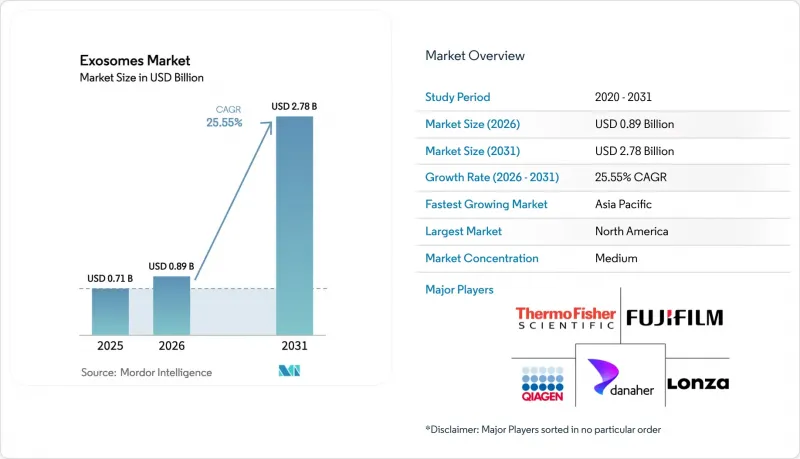
본 보고서는 제품별(키트 및 시약, 기타), 워크플로우별(분리법(초원심분리 등), 하류 분석), 생체분자 유형별(단백질·펩타이드, 기타), 유래(세포 유형)별(MSC 유래, 기타),용도별(진단, 치료), 최종 사용자별(병원 및 클리닉, 기타), 지역별(북미, 기타)로 분류되어 있습니다. 시장 예측은 금액(미화) 기준으로 제시되어 있습니다.
전 세계 엑소좀 시장 동향 및 인사이트
암 부담 증가에 따른 엑소좀을 활용한 액체 생검 및 치료에 대한 수요 증가
2024년, 전 세계 신규 암 환자 수는 2,000만 명을 넘어섰으며, 돌연변이 특이적 DNA나 발암성 마이크로RNA를 운반하는 종양 유래 엑소좀에 대한 관심이 더욱 높아지고 있습니다. 순환 소포를 분리하는 액체 생검 플랫폼은 비소세포폐암의 EGFR 돌연변이를 조직 생검과 92%의 일치율로 검출할 수 있으며, 48시간 이내에 결과를 제공함으로써 치료 시작까지의 시간을 단축하고 있습니다. 치료제 개발도 가속화되고 있으며, 2024년에 완료된 흑색종 1상 임상시험에서는 유전자 변형된 수지상세포 유래 엑소좀이 38%의 객관적 반응률을 달성했습니다. 규제 측면의 명확화가 진행되면서, FDA는 엑소좀 치료가 351(a) 생물학적 제제 채널에 해당하며, 기능 분석을 통해 효능을 입증해야 함을 확인했습니다. 동반 진단에 관한 제휴도 확대되고 있으며, 2025년 Qiagen 및 Bio-Techne와 각각 체결한, 분리 키트와 차세대 시퀀싱 패널을 세트로 구성한 제휴가 그 대표적인 사례입니다.
고수율 엑소좀 분리 기술의 급속한 발전에 따른 제조 원가 절감
기존의 초원심 분리법에서는 16시간이 소요되고, 1ml당 입자 수가 101개 이하로 제한되어 있어 규모 확대에 한계가 있었습니다. 2024년에 도입된 새로운 마이크로유체 칩은 크기 배제법과 면역 친화성 포집법을 결합하여 분리 시간을 2시간 이하로 단축하고, 10¹¹개의 입자를 회수합니다. 고분자를 이용한 침전법은 더 빠르지만, 지단백질도 동시에 분리되기 때문에 다운스트림 공정에서 여과가 필요해져 비용 면에서의 우위가 떨어집니다. 면역 친화성 포집법은 95%의 순도를 실현하지만, 항체 소비량 및 비드 재생과 관련된 과제로 인해 여전히 비용이 높습니다. 2025년 인도에서 실시된 파일럿 테스트에서는 음향 트래핑 기술을 채택한 현장 진단용 휴대용 장치가 50 마이크로리터의 전혈에서 엑소좀을 분리했으며, 검사당 비용은 8달러였습니다.
표준화된 특성 평가 프로토콜의 부재로 인한 재현성 저하
MISEV 2023에서는 입자 수, 크기 분포, 단백질 마커, 핵산 함량에 대한 보고가 요구되고 있지만, 2024년에는 320건의 연구 중 이 4가지 기준을 모두 충족한 연구는 불과 28%에 그쳤습니다. 나노 입자 추적 분석에서는 지단백질을 구별할 수 없기 때문에 엑소좀 수가 300% 과대평가되는 결과가 나타납니다. 전자 현미경에서는 시야당 1,000개 이하의 소포만 관찰할 수 있어 선택적 편향이 발생합니다. FDA는 현재 개발자들에게 기능 분석을 통해 유효성을 입증할 것을 요구하고 있으며, 이로 인해 50만 달러 규모의 하이컨텐츠 이미징 시스템에 대한 투자가 촉진되고 있습니다. 조화를 도모하기 위해 NIST는 2025년, 유세포 분석기와 ELISA 교정용 지질 나노입자 기반 표준 물질을 공개했습니다.
부문 분석
'서비스 소프트웨어' 부문은 다중 오믹스 데이터를 임상적 인사이트로 변환하는 클라우드 플랫폼에 대한 실험실 수요가 증가함에 따라 연평균 성장률(CAGR) 39.25%로 성장하고 있습니다. ‘키트 및 시약’ 부문은 2025년에도 여전히 매출의 45.56%를 차지하고 있지만, 저비용 아시아 공급업체들로 인해 이익 마진이 압박받고 있습니다. 18만 달러에 달하는 초원심분리기 등 고가 장비는 GMP 시설에서 여전히 필수적입니다. Illumina사가 2025년에 출시한 엑소좀 분석 모듈 덕분에 바이오인포매틱스 처리 시간이 40시간에서 2시간으로 단축되었습니다. ISO 13485 인증은 현재 표준 요건이 되어, 품질이 보장된 시약 제조업체 간의 통합을 촉진하고 있습니다.
시료에서 보고서에 이르는 사이클을 단축하는 워크플로우 자동화 도구가 가장 빠른 성장을 뒷받침하고 있습니다. 소프트웨어 공급업체는 사용자를 생태계에 묶어두기 위해 분석 도구와 시약을 묶음 판매하고 있는 반면, 소모품 공급업체는 가격 경쟁에 직면해 있습니다. 일상적인 GMP 출시 검사에서는 여전히 초원심분리, 나노플로우 세포계측법, 투과형 전자현미경이 필수적이기 때문에 대형 제약 기업에게 장비는 여전히 전략적으로 중요한 위치를 차지하고 있습니다.
2025년 매출액 중 분리법이 55.53%를 차지했으나, 규제 당국이 상호 보완적인 특성 평가를 요구함에 따라 나노플로우 세포계측법, 전자현미경, 질량분석은 연평균 성장률(CAGR) 38.85%로 성장하고 있습니다. 초원심 분리법의 이용은 감소 추세에 있습니다. 16시간에 달하는 가동 시간과 로터 유지보수가 필요하기 때문에 임상 실험실에는 적합하지 않기 때문입니다. 2시간 만에 10¹¹개의 입자를 회수할 수 있는 마이크로플루이딕스 분리 플랫폼이 현재 신규 임상 시설 도입에서 주류를 이루고 있습니다. 면역 친화성 포획법은 95%의 순도를 확보할 수 있지만 여전히 비용이 높은 반면, 침전 키트는 순도를 희생하고 속도를 우선시합니다.
후속 분석은 각 공급업체의 차별화 요소가 되고 있습니다. 나노 유동 세포 계측법은 단일 베시클프로파일을 분석하고, 질량 분석은 약물 내성과 관련된 단백질의 번역 후 변형을 매핑하며, 전자 현미경은 표본 수가 적은 경우의 형태를 검증합니다. 다중 모드 데이터 파일은 임상의가 치료 방침을 결정하는 데 활용하는 머신러닝 파이프라인에 공급되어, 통합형 분석 제품군에 대한 수요를 촉진하고 있습니다.
지역별 분석
북미는 2025년 매출의 48.13%를 차지했습니다. 이는 FDA의 지침이 새로운 IND 신청을 촉진하고, NIH가 4,700만 달러의 보조금을 지급하며, 벤처 투자가 6억 달러를 초과했기 때문입니다. 시장 규모가 크다는 점에도 불구하고, CMS가 2025년에 할당한 신기술 지급 코드가 단 하나에 그쳤기 때문에 보험 환급의 진전은 더딘 상황입니다. 캐나다와 멕시코는 2상 승인 절차의 신속화 및 자궁경부암 신속 심사 제도에 힘입어 임상시험의 거점으로서의 입지를 확고히 하고 있습니다.
유럽은 2위를 차지했으며, 독일, 영국, 프랑스는 시장 출시까지의 기간을 연장하는 동시에 품질 향상에 기여하는 EMA의 2025년 안정성 요건을 채택했습니다. 독일은 엑소좀 요법을 이용한 폼페병 1상 임상시험을 승인했으며, 영국 규제 당국은 3가지 진단법에 ‘획기적 치료법(Breakthrough Designation)’을 부여하고 심사 기간을 6개월로 단축했습니다. 남유럽에서는 재생의학 컨소시엄에 자금이 지원되는 한편, 스위스와 네덜란드에서는 백신 보조제 플랫폼을 위해 벤처 캐피털을 유치하고 있습니다.
아시아태평양은 2026년부터 2031년까지 연평균 성장률(CAGR) 39.51%를 기록하며 가장 빠르게 성장하는 지역입니다. 중국은 2025년에 간세포암용 액체 생검 키트 3종을 승인했으며, 베이징 국가암센터는 1만 명의 환자를 대상으로 폐암 소포 검사를 도입하여 치료 결정까지 걸리는 시간을 2주에서 3일로 단축했습니다. 일본의 재생의료법에서는 2상 임상시험 데이터를 바탕으로 한 조건부 승인이 허용되어 신속한 시장 진입이 가능합니다. 인도는 1그램당 50달러로 분리 생산이 가능하며, 2가지 유형의 휴대용 결핵 진단 장치에 대한 승인도 획득하여 비용 효율성이 뛰어난 제조 거점으로 부상하고 있습니다. 호주와 한국은 진단 부문에서 주도권을 확보하기 위해 노력하는 반면, 싱가포르와 태국은 뎅기열 및 간암 선별 검사에 주력하고 있습니다.
중동 및 아프리카와 남미는 규모는 작지만 여전히 매력적인 시장으로 남아 있습니다. 2025년 우간다에서 실시된 현장 테스트에서는 50달러짜리 분석 장비를 이용한 45분간의 HIV 바이러스 부하 검사가 입증되었으며, 브라질에서는 지카바이러스 감염증에 대한 체액 생검 플랫폼이 신속 승인을 받았습니다. 걸프 국가들은 정밀의료 허브를 구축하고 있으며, 아르헨티나에서는 샤가스병용 현장 진단 분석기가 승인되었습니다.
기타 혜택
- 엑셀 형식 시장 예측(ME) 시트
- 3개월간 애널리스트 지원
자주 묻는 질문
목차
제1장 서론
제2장 조사 방법
제3장 주요 요약
제4장 시장 구도
제5장 시장 규모와 성장 예측
제6장 경쟁 구도
제7장 시장 기회와 향후 전망
LSH 26.09.04According to Mordor Intelligence, the exosomes market size is expected to increase from USD 0.71 billion in 2025 to USD 0.89 billion in 2026 and reach USD 2.78 billion by 2031, growing at a CAGR of 25.55% over 2026-2031.
This report is Segmented by Product (Kits and Reagents, and More), Workflow (Isolation Methods [Ultracentrifugation, and More] and Downstream Analysis), Biomolecule Type (Proteins & Peptides, and More), Source (MSC-Derived, and More), Application (Diagnostics and Therapeutics), End-User (Hospitals & Clinics, and More), and Geography (North America, and More). The Market Forecasts are Provided in Terms of Value (USD).
Global Exosomes Market Trends and Insights
Escalating Oncology Burden Fueling Demand for Exosome-Based Liquid Biopsy & Therapeutics
Worldwide cancer incidence surpassed 20 million new cases in 2024, intensifying interest in tumor-derived exosomes that carry mutation-specific DNA and oncogenic microRNAs. Liquid-biopsy platforms that isolate circulating vesicles detect EGFR mutations in non-small-cell lung cancer with 92% concordance to tissue biopsy and deliver results in 48 hours, shortening time-to-treatment. Therapeutic development is accelerating; an engineered dendritic-cell exosome achieved a 38% objective response rate in a Phase I melanoma trial completed in 2024. Regulatory clarity arrived when FDA confirmed that exosome therapeutics fall under the 351(a) biologics pathway and must demonstrate potency through functional assays. Companion-diagnostic alliances are expanding, exemplified by the 2025 Qiagen-Bio-Techne pact that bundles isolation kits with next-generation sequencing panels.
Rapid Advances in High-Yield Exosome Isolation Technologies Lowering Cost of Goods
Legacy ultracentrifugation requires 16 hours and yields fewer than 101° particles per milliliter, limiting scalability. New microfluidic chips introduced in 2024 cut isolation time to under 2 hours and recover 1011 particles by combining size-exclusion with immuno-affinity capture. Polymer-based precipitation is faster but co-isolates lipoproteins, forcing downstream filtration that erodes cost advantages. Immuno-affinity capture offers 95% purity yet remains expensive due to antibody consumption and bead regeneration challenges. Point-of-care handheld devices using acoustic trapping isolated exosomes from 50 microliters of whole blood at a per-test cost of USD 8 in a 2025 Indian pilot.
Lack of Standardized Characterization Protocols Undermining Reproducibility
MISEV2023 calls for reporting particle count, size distribution, protein markers, and nucleic-acid content, yet only 28% of 320 studies met all four criteria in 2024. Nanoparticle tracking analysis cannot distinguish lipoproteins, leading to 300% overestimation of exosome counts. Electron microscopy samples fewer than 1,000 vesicles per field, introducing selection bias. FDA now asks developers to prove potency through functional assays, prompting investment in USD 500,000 high-content imaging systems. To aid harmonization, NIST released a 2025 liposome-based reference material for calibrating flow cytometers and ELISAs.
Other drivers and restraints analyzed in the detailed report include:
- Growing VC & Big-Pharma Investments in Extracellular-Vesicle Drug-Delivery Pipelines
- Expansion of Companion-Diagnostics Partnerships in Precision Medicine
- Stringent GMP Compliance Elevating Manufacturing Cost & Complexity
For complete list of drivers and restraints, kindly check the Table Of Contents.
Segment Analysis
Services & Software is advancing at 39.25% CAGR as laboratories need cloud platforms that transform multi-omic data into clinical insights. Kits & Reagents still delivered 45.56% of revenue in 2025, but low-cost Asian suppliers are squeezing margins. High-priced instruments such as USD 180,000 ultracentrifuges remain essential in GMP suites. Illumina's 2025 launch of an exosome-analysis module trimmed bioinformatics time from 40 hours to 2 hours. ISO 13485 accreditation is now a default requirement, spurring consolidation among quality-assured reagent manufacturers.
Workflow automation tools that shorten sample-to-report cycles underpin the fastest growth. Software vendors bundle analytics with reagents to lock users into ecosystems, while consumables suppliers face price competition. Instruments remain strategic for large pharmaceutical clients because routine GMP release testing still mandates ultracentrifugation, nano-flow cytometry, and transmission electron microscopy.
Although isolation methods generated 55.53% of 2025 revenue, nano-flow cytometry, electron microscopy, and mass spectrometry are climbing at 38.85% CAGR because regulators insist on orthogonal characterization. Ultracentrifugation use is falling as 16-hour runs and rotor maintenance make it unsuited for clinical labs. Microfluidic isolation platforms that recover 1011 particles in 2 hours now dominate new clinical installations. Immuno-affinity capture secures 95% purity but remains expensive, while precipitation kits trade purity for speed.
Downstream analysis differentiates providers; nano-flow cytometry profiles single vesicles, mass spectrometry maps post-translational protein changes linked to drug resistance, and electron microscopy validates morphology albeit at low sample counts. Multi-modal data files feed machine-learning pipelines that clinicians use for treatment decisions, reinforcing demand for integrated analytics suites.
Complete Report Scope:
- By Product
- Kits & Reagents
- Instruments
- Services & Software
- By Workflow
- Isolation Methods
- Ultracentrifugation
- Immuno-affinity Capture
- Polymer-based Precipitation
- Microfluidic Isolation
- Down-stream Analysis
- Nano-flow Cytometry
- Electron Microscopy
- Mass Spectrometry
- Isolation Methods
- By Biomolecule Type
- Non-coding RNA (miRNA, lncRNA)
- Proteins & Peptides
- Lipids
- mRNA
- DNA Fragments
- By Source (Cell Type)
- MSC-derived
- Tumour-cell-derived
- Dendritic-cell-derived
- Platelet-derived
- Others
- By Application
- Diagnostics
- Cancer
- Neuro-degenerative Diseases
- Cardiovascular Diseases
- Infectious Diseases
- Therapeutics
- Oncology
- Regenerative Medicine
- Drug-Delivery Platforms
- Diagnostics
- By End-user
- Pharmaceutical & Biotechnology Companies
- Academic & Research Institutes
- Hospitals & Clinics
- Diagnostic Centres
- Geography
- North America
- United States
- Canada
- Mexico
- Europe
- Germany
- United Kingdom
- France
- Italy
- Spain
- Rest of Europe
- Asia-Pacific
- China
- Japan
- India
- Australia
- South Korea
- Rest of Asia-Pacific
- Middle East & Africa
- GCC
- South Africa
- Rest of Middle East & Africa
- South America
- Brazil
- Argentina
- Rest of South America
- North America
Geography Analysis
North America produced 48.13% of 2025 revenue as FDA guidance spurred new IND filings, NIH disbursed USD 47 million in grants, and venture investment surpassed USD 600 million. Despite market scale, reimbursement lags because CMS assigned only one new-technology payment code in 2025. Canada and Mexico position themselves as trial hubs, aided by accelerated Phase II approvals and fast-track diagnostics for cervical cancer.
Europe ranked second, with Germany, the United Kingdom, and France adopting EMA's 2025 stability requirement that lengthens time-to-market but drives quality. Germany cleared a Phase I Pompe-disease trial for an exosome therapy, and U.K. regulators granted breakthrough status to three diagnostics, reducing review cycles to six months. Southern Europe funds regenerative-medicine consortia, while Switzerland and the Netherlands attract venture capital for vaccine adjuvant platforms.
Asia-Pacific is the fastest-growing region at 39.51% CAGR during 2026-2031. China approved three liquid-biopsy kits for hepatocellular carcinoma in 2025, and Beijing's National Cancer Center rolled out a lung-cancer vesicle test for 10,000 patients, shrinking treatment-decision time from two weeks to three days. Japan's regenerative-medicine statute permits conditional approval based on Phase II data, enabling quick market entry. India emerges as a cost-effective manufacturing base, offering isolation at USD 50 per gram and clearing two handheld tuberculosis analyzers. Australia and South Korea pursue diagnostic leadership, while Singapore and Thailand focus on dengue and liver-cancer screening.
The Middle East & Africa and South America remain smaller but attractive. A 2025 Ugandan field trial demonstrated a 45-minute HIV viral-load test using a USD 50 analyzer, and Brazil fast-tracked a Zika liquid-biopsy platform. Gulf states build precision-medicine hubs, and Argentina cleared a point-of-care analyzer for Chagas disease.
- Abcam
- Aegle Therapeutics
- Aethlon Medical Inc.
- Aruna Bio
- Bio-Techne Corp. (Exosome Diagnostics)
- Biovision
- Capricor Therapeutics
- Danaher Corp. (Beckman Coulter)
- Evox Therapeutics Ltd.
- ExoCoBio Co. Ltd.
- ExonanoRNA LLC
- Fujifilm Holdings Corp.
- Hologic
- Illumina
- JSR Corp. (MBL International)
- Lonza Group Ltd.
- Malvern Panalytical Ltd.
- Miltenyi Biotec
- Mursla Ltd.
- NanoSomix Inc.
- QIAGEN
- Thermo Fisher Scientific
Additional Benefits:
- The market estimate (ME) sheet in Excel format
- 3 months of analyst support
TABLE OF CONTENTS
1 Introduction
- 1.1 Study Assumptions & Market Definition
- 1.2 Scope of the Study
2 Research Methodology
3 Executive Summary
4 Market Landscape
- 4.1 Market Overview
- 4.2 Market Drivers
- 4.2.1 Escalating oncology burden fuelling demand for exosome-based liquid biopsy & therapeutics
- 4.2.2 Rapid advances in high-yield exosome isolation technologies lowering cost of goods
- 4.2.3 Growing VC & Big-Pharma investments in extracellular-vesicle drug-delivery pipelines
- 4.2.4 Expansion of companion-diagnostics partnerships in precision medicine (under-reported)
- 4.2.5 Rise of point-of-care microfluidic exosome analysers in low-resource settings (under-reported)
- 4.2.6 Favorable Regulatory Initiatives Defining CMC Guidelines for Exosome Products
- 4.3 Market Restraints
- 4.3.1 Lack of standardized characterization protocols undermining reproducibility
- 4.3.2 Stringent GMP compliance elevating manufacturing complexity & cost
- 4.3.3 Limited long-term safety data slowing large-scale therapeutic approvals
- 4.3.4 Intellectual-property fragmentation creating freedom-to-operate uncertainty (under-reported)
- 4.4 Supply-Chain Analysis
- 4.5 Regulatory Landscape
- 4.6 Technological Outlook
- 4.7 Porter's Five Forces
- 4.7.1 Threat of New Entrants
- 4.7.2 Bargaining Power of Buyers
- 4.7.3 Bargaining Power of Suppliers
- 4.7.4 Threat of Substitutes
- 4.7.5 Intensity of Competitive Rivalry
5 Market Size & Growth Forecasts (Value, USD)
- 5.1 By Product
- 5.1.1 Kits & Reagents
- 5.1.2 Instruments
- 5.1.3 Services & Software
- 5.2 By Workflow
- 5.2.1 Isolation Methods
- 5.2.1.1 Ultracentrifugation
- 5.2.1.2 Immuno-affinity Capture
- 5.2.1.3 Polymer-based Precipitation
- 5.2.1.4 Microfluidic Isolation
- 5.2.2 Down-stream Analysis
- 5.2.2.1 Nano-flow Cytometry
- 5.2.2.2 Electron Microscopy
- 5.2.2.3 Mass Spectrometry
- 5.2.1 Isolation Methods
- 5.3 By Biomolecule Type
- 5.3.1 Non-coding RNA (miRNA, lncRNA)
- 5.3.2 Proteins & Peptides
- 5.3.3 Lipids
- 5.3.4 mRNA
- 5.3.5 DNA Fragments
- 5.4 By Source (Cell Type)
- 5.4.1 MSC-derived
- 5.4.2 Tumour-cell-derived
- 5.4.3 Dendritic-cell-derived
- 5.4.4 Platelet-derived
- 5.4.5 Others
- 5.5 By Application
- 5.5.1 Diagnostics
- 5.5.1.1 Cancer
- 5.5.1.2 Neuro-degenerative Diseases
- 5.5.1.3 Cardiovascular Diseases
- 5.5.1.4 Infectious Diseases
- 5.5.2 Therapeutics
- 5.5.2.1 Oncology
- 5.5.2.2 Regenerative Medicine
- 5.5.2.3 Drug-Delivery Platforms
- 5.5.1 Diagnostics
- 5.6 By End-user
- 5.6.1 Pharmaceutical & Biotechnology Companies
- 5.6.2 Academic & Research Institutes
- 5.6.3 Hospitals & Clinics
- 5.6.4 Diagnostic Centres
- 5.7 Geography
- 5.7.1 North America
- 5.7.1.1 United States
- 5.7.1.2 Canada
- 5.7.1.3 Mexico
- 5.7.2 Europe
- 5.7.2.1 Germany
- 5.7.2.2 United Kingdom
- 5.7.2.3 France
- 5.7.2.4 Italy
- 5.7.2.5 Spain
- 5.7.2.6 Rest of Europe
- 5.7.3 Asia-Pacific
- 5.7.3.1 China
- 5.7.3.2 Japan
- 5.7.3.3 India
- 5.7.3.4 Australia
- 5.7.3.5 South Korea
- 5.7.3.6 Rest of Asia-Pacific
- 5.7.4 Middle East & Africa
- 5.7.4.1 GCC
- 5.7.4.2 South Africa
- 5.7.4.3 Rest of Middle East & Africa
- 5.7.5 South America
- 5.7.5.1 Brazil
- 5.7.5.2 Argentina
- 5.7.5.3 Rest of South America
- 5.7.1 North America
6 Competitive Landscape
- 6.1 Market Concentration
- 6.2 Market Share Analysis
- 6.3 Company Profiles (includes Global level Overview, Market level overview, Core Segments, Financials as available, Strategic Information, Market Rank/Share for key companies, Products & Services, and Recent Developments)
- 6.3.1 Abcam plc
- 6.3.2 Aegle Therapeutics
- 6.3.3 Aethlon Medical Inc.
- 6.3.4 Aruna Bio
- 6.3.5 Bio-Techne Corp. (Exosome Diagnostics)
- 6.3.6 BioVision Inc.
- 6.3.7 Capricor Therapeutics Inc.
- 6.3.8 Danaher Corp. (Beckman Coulter)
- 6.3.9 Evox Therapeutics Ltd.
- 6.3.10 ExoCoBio Co. Ltd.
- 6.3.11 ExonanoRNA LLC
- 6.3.12 Fujifilm Holdings Corp.
- 6.3.13 Hologic Inc.
- 6.3.14 Illumina Inc.
- 6.3.15 JSR Corp. (MBL International)
- 6.3.16 Lonza Group Ltd.
- 6.3.17 Malvern Panalytical Ltd.
- 6.3.18 Miltenyi Biotec GmbH
- 6.3.19 Mursla Ltd.
- 6.3.20 NanoSomix Inc.
- 6.3.21 Qiagen N.V.
- 6.3.22 Thermo Fisher Scientific Inc.
7 Market Opportunities & Future Outlook
- 7.1 White-space & Unmet-need Assessment


