

|
시장보고서
상품코드
2124402
인지 운영 시장 : 점유율 분석, 업계 동향과 통계, 성장 예측(2026-2031년)Cognitive Operations - Market Share Analysis, Industry Trends & Statistics, Growth Forecasts (2026 - 2031) |
||||||
 Mordor Intelligence
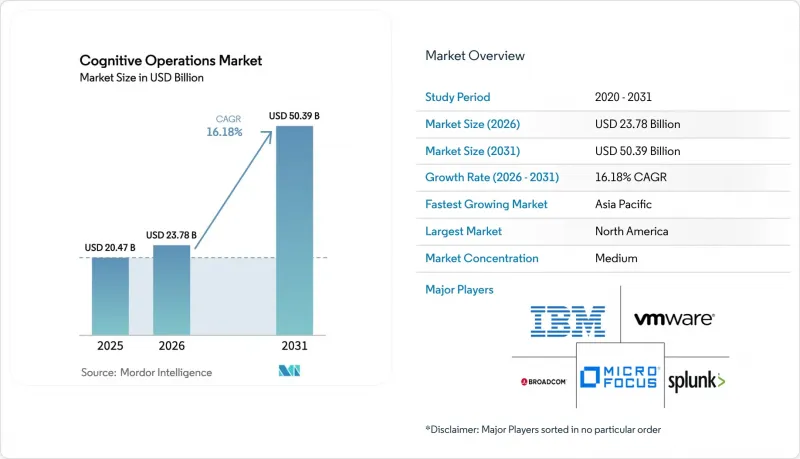
Mordor Intelligence에 의하면, 인지 운영 시장 규모는 2025년에 204억 7,000만 달러로 평가되었고 2026년 237억 8,000만 달러에서 2031년까지 503억 9,000만 달러에 이를 것으로 예측되며, 예측 기간(2026-2031년) CAGR은 16.18%를 나타낼 전망입니다.
본 보고서는 구성 요소별(솔루션 및 서비스), 배포 모드별(클라우드 및 On-Premise), 기업 규모별(대기업 및 중소기업), 용도별(IT 운영 분석, 용도 성능 관리, 네트워크 분석, 기타),산업 부문별(은행, 금융서비스 및 보험(BFSI), 헬스케어 및 생명과학, IT 및 통신, 소매 및 전자상거래, 기타), 지역별로 분류되어 있습니다.
세계 인지 운영 시장 동향 및 인사이트
클라우드 기반 인지 IT 운영에 대한 관심 증가
클라우드 네이티브 인지 운영 플랫폼은 기존 On-Premise형 도구로는 실현할 수 없는 온디맨드 확장성을 제공합니다. 기업들은 전 세계 클라우드 공급자가 제공하는 내장형 AI 서비스를 활용하여 1초 미만의 경보 알림을 유지하면서 페타바이트 규모의 텔레메트리 데이터를 수집, 저장 및 분석했습니다. 이 모델을 통해 인프라 오버헤드가 감소하고 평균 복구 시간(MTTR)이 최대 40% 단축되므로, 엔지니어링 팀은 부가가치가 더 높은 업무에 집중할 수 있게 됩니다. 또한, 클라우드 도입으로 기능 제공 속도도 가속화되어 벤더는 이상 감지 정확도를 높이는 기능 강화를 매일 제공할 수 있게 됩니다. 그 결과, 조직은 ‘자체 개발인가, 외부 조달인가’라는 전략을 재검토하여, 사용량에 따른 과금 체계를 기반으로 하는 구독 모델을 압도적으로 지지하게 되었습니다.
복잡한 IT 환경 모니터링에 대한 수요 증가
마이크로서비스, 컨테이너, 서버리스 함수, 엣지 노드는 이제 디지털 비즈니스의 기반을 형성하고 있습니다. 단일 고객 트랜잭션이 여러 클라우드를 아우르는 수십 개의 느슨하게 결합된 서비스를 가로지르는 경우가 있어, 장애 원인을 파악하기가 어려워지고 있습니다. 인지 운영 플랫폼은 비지도 학습을 적용하여 이러한 광범위한 환경 전반에 걸친 미묘한 신호를 상관 분석함으로써, 밀리초 단위로 사용자 경험을 저하시킬 가능성이 있는 연쇄적인 장애를 미연에 방지합니다. 보고된 계획 외 다운타임이 최대 80% 감소했다는 사실은 디지털 퍼스트 기업에게 순추천지수(NPS) 향상과 수익 유지로 직결됩니다.
레거시 시스템과의 통합에 따른 과제
수십년전으로 거슬러 올라가는 메인프레임이나 자체 개발 용도는 대개 최신 가시성 기능과의 연동 지점이 부족하여, 맞춤형 커넥터를 도입할 수밖에 없어 프로젝트 비용과 위험을 가중시키고 있습니다. 금융 기관들은 트랜잭션 처리 능력을 저해하지 않으면서 AI 기반 분석 시스템과 안전하게 데이터를 교환해야 하는 COBOL 기반 핵심 뱅킹 엔진으로 인해 고심하고 있습니다. 이러한 통합 작업은 전체 도입 예산의 최대 절반을 소모하고 투자 회수 기간을 길어지게 할 가능성이 있습니다. 레거시 아키텍처와 AIOps를 모두 이해하는 전문가의 부족이 지연을 더욱 악화시키고 있습니다.
부문 분석
2025년, 이 솔루션은 인지 운영 시장에서 64.30%의 점유율을 유지하며, 텔레메트리 수집, 상관 분석, 자동화 분야에서 아키텍처의 기반으로서의 역할을 확고히 했습니다. 그러나 기업들이 알고리즘 튜닝, 지속적인 모델 재학습, 조직 변화 관리가 최종 ROI를 결정하는 요소임을 인식함에 따라, 서비스 부문의 매출은 2031년까지 연평균 성장률(CAGR) 17.05%로 증가할 것으로 예측됩니다. 전문 서비스 부문의 인지 운영 시장 규모는 2031년까지 188억 달러에 달할 것으로 예측되며, 이는 라이선싱에서 성과 기반 계약으로의 전환을 반영합니다.
플랫폼은 새로운 마이크로서비스, 진화하는 위협 상황, 규정 준수 요구 사항에 대응하기 위해 끊임없는 조정이 필요하기 때문에 지속적인 최적화 계약 및 관리형 서비스 제공이 활발해지고 있습니다. 서비스 제공업체는 연중무휴 24시간 모니터링을 제공하여 사내 팀의 사고 대응 부담을 줄이는 동시에 감지까지 걸리는 평균 시간을 단축합니다. 전문 인력 부족이 지속되는 가운데, 자원이 제한된 기업에게 자문 서비스 및 관리형 서비스는 운영 성숙도를 달성하기 위한 가장 빠른 경로가 되고 있습니다.
클라우드는 인지 운영 시장 규모의 71.20%를 차지하고 있으며, 기업들이 모놀리식 데이터센터에서 탄력적인 멀티 클라우드 환경으로 전환하고 있는 상황을 반영하여 연평균 성장률(CAGR) 17.55%로 계속 확대될 전망입니다. 벤더들은 매주 플랫폼을 업데이트하고, 고객의 개입 없이 새로운 분석 모델을 통합함으로써 혁신 주기를 단축하고 감지 정확도를 향상시키고 있습니다.
데이터 주권이 최우선으로 고려되는 국방 및 금융 서비스 부문에서는 On-Premise 배포가 여전히 주류를 이루고 있지만, 이러한 부문조차도 원시 데이터를 로컬에 보관하면서 고부하 분석 처리를 클라우드로 오프로드하는 하이브리드 모델을 채택하고 있습니다. 서브밀리초 단위의 추론이 필요한 5G 및 산업용 IoT 이용 사례에 대해서는 엣지 네이티브 AIOps가 보완적인 접근 방식으로 부상하고 있습니다. 클라우드, On-Premise, 엣지 각 옵션 간의 상호작용으로 인해 벤더 간의 차별화는 기능적 측면에 그치지 않고 데이터 중력, 지연 시간, 규제적 고려 사항까지 확대되고 있습니다.
지역별 분석
북미는 AWS, Microsoft Azure, Google Cloud의 클라우드 서비스 포트폴리오와 가시성의 긴밀한 통합에 힘입어 2025년 매출의 37.40%를 차지하고 있습니다. AIOps 스타트업에 대한 벤처 캐피탈 투자액은 2024년부터 2025년까지 46억 달러를 넘어설 것으로 예상되며, 이는 제품의 성숙도와 생태계의 심화를 가속화하고 있습니다. 시스코의 스플렁크(Splunk) 인수를 대표로 하는 대규모 인수합병을 통해 플랫폼의 기능은 로그 분석에서 풀스택 보안 및 네트워크 텔레메트리로 확대되고 있습니다. 미국의 금융 기관과 하이퍼스케일러가 주요 고객으로 자리 잡고 있으며, 벤더들에게 FedRAMP 및 SOC 2 인증 취득을 촉구하고 있습니다. 이러한 인증을 취득하면 인접한 공공 부문의 비즈니스 기회가 열립니다.
아시아태평양은 가장 빠르게 성장하는 지역으로, 연평균 성장률(CAGR) 17.61%를 기록하며 확대되고 있습니다. 일본과 한국의 통신 사업자들은 엣지 네이티브 분석을 활용하여 5G 네트워크 슬라이스를 오케스트레이션하고 있는 반면, 중국의 클라우드 제공업체들은 제조업 및 전자상거래 산업 고객을 위해 AIOps를 IaaS(Infrastructure-as-a-Service) 계층에 직접 통합하고 있습니다. 인도의 주요 매니지드 서비스 제공업체들은 전 세계 고객들의 엄격한 서비스 수준 목표를 달성하기 위해 인지 운영을 도입하고 있으며, 이로 인해 인도 아대륙은 AIOps 엔지니어링 인재 허브로 변모하고 있습니다. 한편, 각 지역의 정부는 연구 지원 및 기업의 AI 도입 장벽을 낮추는 국가 AI 전략에 투자하고 있습니다.
유럽에서는 꾸준하면서도 규정 준수를 중시하는 성장세가 나타나고 있습니다. EU의 AI 법과 GDPR(EU 개인정보보호규정)에 따라 ‘프라이버시 바이 디자인(Privacy by Design)’을 기반으로 한 데이터 파이프라인이 필수화되었으며, 벤더들은 세밀한 텔레메트리 필터링 및 주권 클라우드 도입 옵션을 구현해야 합니다. 독일의 자동차 OEM 기업들은 인지 운영을 스마트 팩토리 구축과 연계하여 로봇의 가동 시간과 에너지 소비를 최적화하고 있습니다. 영국에서는 금융 서비스 분야의 운영 복원력이 강조되고 있으며, 연례 영향 허애플리케이션 테스트가 의무화됨에 따라 자동화된 페일오버 및 카오스 엔지니어링 도구에 대한 지출이 촉진되고 있습니다. 또한, 지속가능성 관련 규제로 인해 이산화탄소 배출량을 정량화하고, 보다 친환경적인 데이터센터 간 워크로드 재분배를 제안하는 GreenOps 모듈이 더욱 활성화되고 있습니다.
기타 혜택
- 엑셀 형식 시장 예측(ME) 시트
- 3개월간 애널리스트 지원
자주 묻는 질문
목차
제1장 서론
제2장 조사 방법
제3장 주요 요약
제4장 시장 구도
제5장 시장 규모와 성장 예측
제6장 경쟁 구도
제7장 시장 기회와 향후 전망
JHS 26.09.11According to Mordor Intelligence, the cognitive operations market size was valued at USD 20.47 billion in 2025 and estimated to grow from USD 23.78 billion in 2026 to reach USD 50.39 billion by 2031, at a CAGR of 16.18% during the forecast period (2026-2031).
This report is Segmented by Component (Solutions and Services), Deployment Mode (Cloud and On-Premises), Enterprise Size (Large Enterprises and Small and Medium-Sized Enterprises), Application (IT Operations Analytics, Application Performance Management, Network Analytics, and More), Industry Vertical (BFSI, Healthcare And& Life Sciences, IT and Telecom, Retail and E-Commerce, and More), and Geography.
Global Cognitive Operations Market Trends and Insights
Growing Focus on Cloud-Based Cognitive IT Operations
Cloud-native cognitive operations platforms deliver on-demand scalability that traditional on-premises tools cannot match. Enterprises leverage built-in AI services from global cloud providers to ingest, store, and analyse petabytes of telemetry while maintaining sub-second alerting. The model lowers infrastructure overhead and cuts mean time to recovery by up to 40%, freeing engineering teams for higher-value tasks. Cloud adoption also accelerates feature velocity, allowing vendors to push daily enhancements that sharpen anomaly detection accuracy. As a result, organisations re-evaluate build-versus-buy strategies and overwhelmingly favour subscription models anchored in usage-based pricing.
Rising Demand for Monitoring Complex IT Environments
Microservices, containers, serverless functions, and edge nodes now form the backbone of digital business. A single customer transaction may traverse dozens of loosely coupled services spanning multiple clouds, making fault isolation arduous. Cognitive operations platforms apply unsupervised learning to correlate subtle signals across this sprawl, preventing cascading failures that could degrade user experience in milliseconds. Reported reductions of up to 80% in unplanned downtime translate directly into higher Net Promoter Scores and revenue retention for digital-first enterprises.
Integration Challenges with Legacy Systems
Mainframe and proprietary applications dating back decades often lack modern observability hooks, forcing bespoke connectors that inflate project cost and risk. Financial institutions contend with COBOL-based core banking engines that must exchange data securely with AI-driven analytics without disrupting transaction throughput. Such integration work can consume up to half of total deployment budgets and elongate payback periods. The scarcity of professionals who understand both legacy architectures and AIOps exacerbates delays.
Other drivers and restraints analyzed in the detailed report include:
- Surge in IT-Ops Data Volume from Digital Transformation
- AI-Driven Proactive Incident Management Adoption
- Dearth of Skills and Expertise
For complete list of drivers and restraints, kindly check the Table Of Contents.
Segment Analysis
Solutions retained a 64.30% share of the cognitive operations market in 2025, cementing their role as the architectural backbone for telemetry collection, correlation, and automation. Yet Services revenue is projected to climb at 17.05% CAGR to 2031 as enterprises recognise that algorithm tuning, continuous model retraining, and organisational change management dictate ultimate ROI. The cognitive operations market size for professional services is forecast to reach USD 18.8 billion by 2031, reflecting a shift from license sales to outcome-based engagements.
Ongoing optimisation contracts and managed service offerings flourish because platforms require constant calibration to accommodate new microservices, evolving threat landscapes, and compliance mandates. Service providers deliver 24/7 monitoring, reducing incident fatigue for in-house teams and accelerating mean time to detection. As the scarcity of specialised talent persists, advisory and managed offerings become the fastest route to operational maturity for resource-constrained enterprises.
Cloud accounts for 71.20% of the cognitive operations market size and will continue expanding at a 17.55% CAGR, mirroring enterprise migration from monolithic data centres to elastic multi-cloud footprints. Vendors deliver platform updates weekly, embedding new analytics models without customer intervention, which shortens innovation cycles and lifts detection accuracy.
On-premises deployments persist in defence and financial services where data sovereignty is paramount, but even these sectors adopt hybrid models that offload heavy-duty analytics to the cloud while keeping raw data local. Edge-native AIOps emerges as a complementary approach for 5G and industrial IoT use cases requiring sub-millisecond inference. The interplay of cloud, on-premises, and edge options expands vendor differentiation beyond features to encompass data-gravity, latency, and regulatory considerations.
Complete Report Scope:
- By Component
- Solutions
- Services
- By Deployment Mode
- Cloud
- On-Premises
- By Enterprise Size
- Large Enterprises
- Small and Medium-Sized Enterprises
- By Application
- IT Operations Analytics
- Application Performance Management
- Network Analytics
- Security Analytics
- Infrastructure Management
- Other Applications
- By Industry Vertical
- BFSI
- Healthcare and Life Sciences
- IT and Telecom
- Retail and E-commerce
- Other Industry Verticals
- By Geography
- North America
- United States
- Canada
- Mexico
- South America
- Brazil
- Argentina
- Rest of South America
- Europe
- Germany
- United Kingdom
- France
- Italy
- Spain
- Rest of Europe
- Asia-Pacific
- China
- Japan
- India
- South Korea
- Rest of Asia-Pacific
- Middle East and Africa
- Middle East
- United Arab Emirates
- Saudi Arabia
- Turkey
- Rest of Middle East
- Africa
- South Africa
- Nigeria
- Egypt
- Rest of Africa
- Middle East
- North America
Geography Analysis
North America commands 37.40% of 2025 revenue, buoyed by the tight integration of observability with cloud-service portfolios from AWS, Microsoft Azure, and Google Cloud. Venture-capital inflows into AIOps start-ups surpassed USD 4.6 billion between 2024 and 2025, accelerating product maturity and ecosystem depth. Major acquisitions, exemplified by Cisco's purchase of Splunk, broaden platform capability from log analytics to full-stack security and network telemetry. US financial institutions and hyperscalers act as anchor tenants, pushing vendors toward FedRAMP and SOC 2 certifications that, once achieved, unlock adjacent public-sector opportunities.
Asia Pacific is the fastest-growing region, expanding at an 17.61% CAGR. Telecommunications operators in Japan and South Korea rely on edge-native analytics to orchestrate 5G network slices, while Chinese cloud providers embed AIOps directly into Infrastructure-as-a-Service layers for manufacturing and ecommerce customers. India's managed-service giants deploy cognitive operations to meet stringent service-level objectives for global clients, turning the subcontinent into a talent hub for AIOps engineering. Regional governments, meanwhile, invest in national AI strategies that subsidize research and lower barriers to enterprise adoption.
Europe exhibits steady but compliance-conscious growth. The EU's AI Act and GDPR necessitate privacy-by-design data pipelines, compelling vendors to implement granular telemetry filtering and sovereign-cloud deployment options. German automotive OEMs tie cognitive operations to smart-factory rollouts, optimizing robotics uptime and energy consumption. The United Kingdom emphasizes operational resilience in financial services, requiring annual impact tolerance tests that stimulate spending on automated failover and chaos-engineering tools. Sustainability mandates further spur GreenOps modules that quantify carbon emissions and suggest workload re-balancing across greener data centers.
- IBM Corporation
- Splunk Inc.
- Broadcom Inc.
- Dynatrace LLC
- BMC Software Inc.
- HCL Technologies Ltd.
- VMware Inc.
- Micro Focus International Plc
- ServiceNow Inc.
- New Relic Inc.
- ScienceLogic Inc.
- CloudFabrix Software Inc.
- Devo Technology Inc.
- Interlink Software Services Ltd.
- Correlata Solutions Inc.
- Loom Systems Inc.
- Moogsoft Inc.
- Elastic NV
- Datadog Inc.
- OpsRamp Inc.
- PagerDuty Inc.
- Sumo Logic Inc.
- AppDynamics LLC (Cisco)
Additional Benefits:
- The market estimate (ME) sheet in Excel format
- 3 months of analyst support
TABLE OF CONTENTS
1 INTRODUCTION
- 1.1 Study Assumptions and Market Definition
- 1.2 Scope of the Study
2 RESEARCH METHODOLOGY
3 EXECUTIVE SUMMARY
4 MARKET LANDSCAPE
- 4.1 Market Overview
- 4.2 Market Drivers
- 4.2.1 Growing focus on cloud-based cognitive IT operations
- 4.2.2 Rising demand for monitoring complex IT environments
- 4.2.3 Surge in IT-ops data volume from digital transformation
- 4.2.4 AI-driven proactive incident management adoption
- 4.2.5 Edge-native AIOps for 5G network slices (under-the-radar)
- 4.2.6 GreenOps push for energy-optimised AI-ops (under-the-radar)
- 4.3 Market Restraints
- 4.3.1 Integration challenges with legacy systems
- 4.3.2 Dearth of skills and expertise
- 4.3.3 Proprietary algorithms create governance risk (under-the-radar)
- 4.3.4 Privacy regulations limit telemetry capture (under-the-radar)
- 4.4 Value/Supply-Chain Analysis
- 4.5 Regulatory Landscape
- 4.6 Technological Outlook
- 4.7 Porter's Five Forces Analysis
- 4.7.1 Bargaining Power of Suppliers
- 4.7.2 Bargaining Power of Buyers
- 4.7.3 Threat of New Entrants
- 4.7.4 Threat of Substitutes
- 4.7.5 Intensity of Competitive Rivalry
- 4.8 Pricing Analysis
- 4.9 Assessment of COVID-19 Impact
- 4.10 Investment Analysis
5 MARKET SIZE AND GROWTH FORECASTS (VALUE)
- 5.1 By Component
- 5.1.1 Solutions
- 5.1.2 Services
- 5.2 By Deployment Mode
- 5.2.1 Cloud
- 5.2.2 On-Premises
- 5.3 By Enterprise Size
- 5.3.1 Large Enterprises
- 5.3.2 Small and Medium-Sized Enterprises
- 5.4 By Application
- 5.4.1 IT Operations Analytics
- 5.4.2 Application Performance Management
- 5.4.3 Network Analytics
- 5.4.4 Security Analytics
- 5.4.5 Infrastructure Management
- 5.4.6 Other Applications
- 5.5 By Industry Vertical
- 5.5.1 BFSI
- 5.5.2 Healthcare and Life Sciences
- 5.5.3 IT and Telecom
- 5.5.4 Retail and E-commerce
- 5.5.5 Other Industry Verticals
- 5.6 By Geography
- 5.6.1 North America
- 5.6.1.1 United States
- 5.6.1.2 Canada
- 5.6.1.3 Mexico
- 5.6.2 South America
- 5.6.2.1 Brazil
- 5.6.2.2 Argentina
- 5.6.2.3 Rest of South America
- 5.6.3 Europe
- 5.6.3.1 Germany
- 5.6.3.2 United Kingdom
- 5.6.3.3 France
- 5.6.3.4 Italy
- 5.6.3.5 Spain
- 5.6.3.6 Rest of Europe
- 5.6.4 Asia-Pacific
- 5.6.4.1 China
- 5.6.4.2 Japan
- 5.6.4.3 India
- 5.6.4.4 South Korea
- 5.6.4.5 Rest of Asia-Pacific
- 5.6.5 Middle East and Africa
- 5.6.5.1 Middle East
- 5.6.5.1.1 United Arab Emirates
- 5.6.5.1.2 Saudi Arabia
- 5.6.5.1.3 Turkey
- 5.6.5.1.4 Rest of Middle East
- 5.6.5.2 Africa
- 5.6.5.2.1 South Africa
- 5.6.5.2.2 Nigeria
- 5.6.5.2.3 Egypt
- 5.6.5.2.4 Rest of Africa
- 5.6.5.1 Middle East
- 5.6.1 North America
6 COMPETITIVE LANDSCAPE
- 6.1 Market Concentration
- 6.2 Strategic Moves
- 6.3 Market Share Analysis
- 6.4 Company Profiles (includes Global level Overview, Market level overview, Core Segments, Financials as available, Strategic Information, Market Rank/Share for key companies, Products and Services, and Recent Developments)
- 6.4.1 IBM Corporation
- 6.4.2 Splunk Inc.
- 6.4.3 Broadcom Inc.
- 6.4.4 Dynatrace LLC
- 6.4.5 BMC Software Inc.
- 6.4.6 HCL Technologies Ltd.
- 6.4.7 VMware Inc.
- 6.4.8 Micro Focus International Plc
- 6.4.9 ServiceNow Inc.
- 6.4.10 New Relic Inc.
- 6.4.11 ScienceLogic Inc.
- 6.4.12 CloudFabrix Software Inc.
- 6.4.13 Devo Technology Inc.
- 6.4.14 Interlink Software Services Ltd.
- 6.4.15 Correlata Solutions Inc.
- 6.4.16 Loom Systems Inc.
- 6.4.17 Moogsoft Inc.
- 6.4.18 Elastic NV
- 6.4.19 Datadog Inc.
- 6.4.20 OpsRamp Inc.
- 6.4.21 PagerDuty Inc.
- 6.4.22 Sumo Logic Inc.
- 6.4.23 AppDynamics LLC (Cisco)
7 MARKET OPPORTUNITIES AND FUTURE OUTLOOK
- 7.1 White-space and Unmet-Need Assessment


