

|
시장보고서
상품코드
2154296
트럭 트레일러 : 시장 점유율 분석, 업계 동향과 통계, 성장 예측(2026-2031년)Truck Trailer - Market Share Analysis, Industry Trends & Statistics, Growth Forecasts (2026 - 2031) |
||||||
 Mordor Intelligence
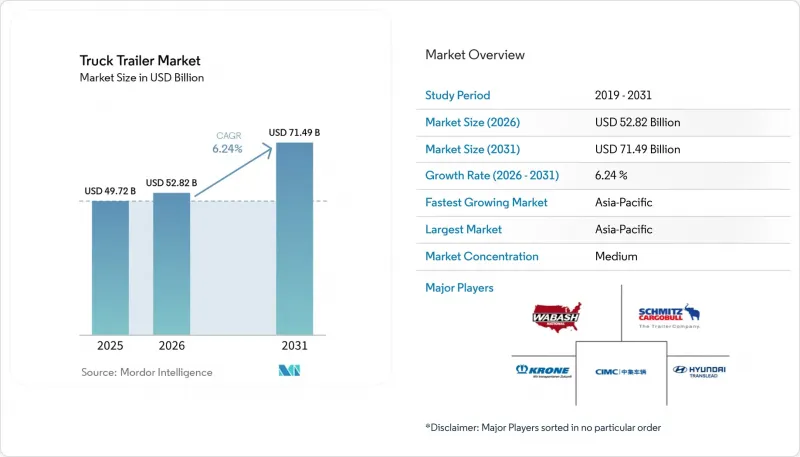
에 따르면 트럭용 트레일러 시장 규모는 2025년에 497억 2,000만 달러로 평가되며, 2026년에는 528억 2,000만 달러에 달할 것으로 추정되고 있습니다.
또한 예측 기간(2026-2031년) 동안 연평균 성장률(CAGR)은 6.24%로, 2031년까지 714억 9,000만 달러에 달할 것으로 전망됩니다.
글로벌 트럭 트레일러 시장의 동향 및 인사이트
E-Commerce에 따른 소포 처리량 증가
당일 배송을 실현하기 위해 구축된 소포 네트워크는 마이크로 풀필먼트 센터와 분류 허브 간의 고밀도 셔틀 루프에 의존하고 있으며, 이로 인해 빈 트럭(무적재)의 일일 운행 횟수가 증가하고 있습니다. 아마존이 프라임 배송을 위해 자사 브랜드 트레일러를 도입한 것은 소매업체들이 서비스 수준을 유지하기 위해 운송 역량을 자체적으로 확보하고 있음을 보여주는 사례입니다. 표준 도크 높이 구성은 효율적인 크로스 도킹을 가능하게 하며, 리프트 게이트가 장착된 차량은 도시 지역의 배송 밀도를 높이고 있습니다. 또한 포장 최적화에 대한 관심이 높아짐에 따라 다양한 골판지 상자의 높이에 대응할 수 있도록 설계된, 조절 가능한 E-트랙 및 물류 포스트를 갖춘 트레일러에 대한 수요가 확대되고 있습니다. 실시간 위치 정보 및 체류 시간 분석을 활용함으로써, 차량 관리자는 지역 허브를 통한 트레일러 이동을 보다 효과적으로 최적화할 수 있으며, 그 결과 유휴 시간을 줄이고 시스템 내에서 지금까지 활용되지 않았던 운송 능력을 효율적으로 활용할 수 있게 됩니다.
인프라·건설 업계의 호황
중국, 인도, 동남아시아의 새로운 도로, 철도, 재생에너지 프로젝트로 인해 플랫베드 및 로우보이 조립 라인은 계속해서 풀가동되고 있습니다. 중국의 ‘일대일로’ 구상에 따라 시멘트, 구조용 강재, 터빈 블레이드 등의 벌크 화물이 대륙 횡단 회랑을 통해 운송되고 있으며, 신축식 및 다축 트레일러에 대한 수요가 증가하고 있습니다. 인도의 ‘국가 인프라 계획’에는 9,000건 이상의 프로젝트가 포함되어 있으며, 중장비 운송을 위해 적재량 51톤에서 100톤 규모의 차량을 현지 운송 사업자가 도입하도록 장려하고 있습니다. 풍력발전소 개발에서는 지방의 진입로를 효율적으로 주행하기 위해 유압 조향 시스템을 갖춘 블레이드 운반차가 요구되고 있는 반면, 태양광발전소 개발업체들은 모듈 적재 밀도를 최적화하도록 설계된 드롭 프레임식 플랫베드를 선호하고 있습니다. 장기적인 민관 협력을 통한 자금 조달이 가능해짐에 따라 OEM(주문자 상표 제조업체)은 주요 프로젝트 거점 근처에 현지화된 용접 및 도장 시설을 계획하고 설립할 기회를 얻고 있습니다.
철강·알루미늄 가격 변동
2024년, 열연 코일의 벤치마크 가격은 40%의 변동폭을 보였으며, 이는 OEM의 매출 총이익률에 큰 영향을 미쳐 장기 수주 가격 책정에 어려움을 초래했습니다. 미국의 알루미늄 수입 관세 도입으로 톤당 250달러의 추가 비용이 발생했고, 그 결과알루미늄 제품과 복합재 제품의 비용 차이가 축소되었습니다. 이러한 과제에 대처하기 위해 각 제조사는 분기별 가격 조정 조항을 도입했으나, 소규모 딜러들은 이러한 추가 비용을 최종사용자에게 전가하는 데 어려움을 겪었습니다. 헤지 계약을 통해 가격 변동의 영향을 부분적으로 완화할 수는 있었으나, 이를 위해서는 현금 담보가 필요하여 운전 자금에 제약이 발생했습니다. 그 결과, 일부 차량 보유 기업은 교체 주기를 연기했고, 원자재 가격이 더 안정될 때까지 수요가 일시적으로 감소하게 되었습니다.
부문별 분석
2025년, 드라이밴은 트럭 트레일러 시장 점유율의 36.17%를 차지했으며, 부피를 중시하는 소량 화물 및 일반 화물 운송에 적합하다는 점이 강조되었습니다. 냉장 트레일러는 시장 점유율은 작지만, 신선 식품 및 의약품 물류 분야의 수요 증가에 힘입어 2031년까지 연평균 성장률(CAGR) 6.55%로 성장할 것으로 예측됩니다. 플랫베드는 건설용 강재, 목재, 기계의 운송, 특히 측면이나 상단에서 적재가 필요한 상황에서 중요한 역할을 하고 있습니다. 또한 로보이는 인프라 프로젝트에 사용되는 초대형 굴착기의 운송에 필수적입니다. 탱커는 여전히 위험 액체 운송에 필수적인 반면, 신축식 블레이드 캐리어는 풍력발전 프로젝트 지원에서 그 중요성이 커지고 있습니다.
E-Commerce 사업자들은 소포 적재 밀도를 높이기 위해 드라이 밴에 전용 물류 포스트나 화물 고정 바를 사후 장착하고 있습니다. 한편, 콜드 체인 전문 업체들은 도시 지역의 배기가스 규제를 준수하기 위해 수소 또는 전기 대기 시스템을 갖춘 멀티존형 냉동 트레일러에 투자하고 있습니다. 예측 기간 중 트럭 트레일러 시장에서는 모든 트레일러 유형에 텔레매틱스 도입이 진행되어, 실시간 화물 모니터링 및 예측 유지보수 일정 설정이 가능해질 것으로 전망됩니다. 표준 보증 패키지의 일환으로 커넥티비티 기능을 제공하는 OEM(주문자 상표 제조업체)은 장기 차량 대여 계약을 확보할 가능성이 높으며, 이로 인해 분산되어 있는 공급업체 시장이 더욱 통합될 것입니다.
2025년, 트럭 트레일러 시장 점유율의 63.22%를 강재가 차지하고 있으며, 그 배경에는 우수한 가성비와 확립된 서비스 네트워크가 있습니다. 그러나 차량 운영사가 연비 효율과 내식성을 점점 더 중시함에 따라 복합재 및 알루미늄 제품은 연평균 성장률(CAGR) 6.28%로 성장할 것으로 예상되며, 2031년까지 신규 생산 대수의 3분의 1을 차지할 가능성이 있습니다. 강재의 재활용 가능성과 초기 비용 면에서의 우위는 비용을 중시하는 드라이밴 및 차량 운영 분야에서 그 입지를 확고히 하고 있습니다. 그럼에도 불구하고 중량에 민감한 냉장차 및 탱크로리 운영 사업자들은 운영 비용 절감을 주요 요인으로 삼아, 설비 투자 비용이 높은 첨단 소재를 점차 선택하고 있습니다.
기존의 강철 외판과 달리, 복합재 샌드위치 패널은 층간 박리에 강하고 단열 성능(R값)을 장기간 유지하므로, 전체 수명 주기 동안 에너지 소비를 줄여줍니다. 또한 하이브리드 설계에서는 강철 연결부와 알루미늄 사이드 레일을 조합하여 비용과 중량의 균형을 실현하고 있습니다. 재료 공급업체는 OEM 설계 스튜디오와 협력하여 유한 요소법을 활용한 모델링을 통해 패널의 적층 구조를 최적화하고 있으며, 불필요한 과잉 설계를 피하면서도 충분한 강도 여유를 확보하고 있습니다. 지속가능성을 중시하는 조달 방침이 더욱 확산됨에 따라 생애주기 평가(LCA) 결과가 대체 소재를 채택하는 수주 증가로 이어질 것으로 예상되며, 트럭 트레일러 시장에서 강재와 복합 소재의 점유율이 점차 재분배될 것으로 전망됩니다.
지역별 분석
2025년, 아시아태평양은 트럭 트레일러 시장의 38.74%라는 큰 점유율을 차지했습니다. 이는 중국의 광범위한 제조 거점과 상품 및 서비스세(GST)에 의해 촉진된 인도의 물류 통합에 힘입은 결과입니다. E-Commerce 보급률의 상승과 꾸준한 인프라 투자를 배경으로, 이 지역은 2031년까지 연평균 성장률(CAGR) 6.34%로 시장을 주도할 것으로 예상됩니다. 또한 유로 VI에 상응하는 배기가스 기준을 추진하는 정부의 인센티브로 인해 차량 교체 주기가 가속화되고 있으며, 그 결과 지역 OEM(주문자 상표 제조업체)의 생산이 확대되고 있습니다.
시장 규모 2위를 차지하는 북미에서는 텔레매틱스 도입 및 경량 소재 활용에 대한 진전이 지속적으로 추진되고 있습니다. 미국에서는 대형 소포 배송업체들이 복합 소재 채택을 확대하고 있는 반면, 캐나다에서는 자원 의존형 경제 구조로 인해 다축 탱크로리 및 벌크 트레일러에 대한 수요가 유지되고 있습니다. 미국·멕시코·캐나다 협정(USMCA)의 틀은 국경을 넘는 운송 능력의 재조정을 촉진하고 있으며, 운송사는 신규 구매 없이 지역 간 자산을 재배치함으로써 계절적인 화물량 급증에 대응할 수 있게 되었습니다.
유럽에서는 지속가능성이 중시되고 있으며, EU 그린딜에 따라 각 OEM 업체에 재활용 가능한 복합 소재 및 대체 연료식 냉장 유닛의 도입이 장려되고 있습니다. 회원국 간의 축중량 규제 차이는 장거리 노선에서 과제로 대두되고 있으나, 운송 회랑의 조화를 위한 지속적인 노력으로 예측 기간 내에 총중량 44톤이라는 표준화된 제한이 실현될 가능성이 있습니다. 브렉시트에 따라 영국은 수입 관세에 대응하기 위해 완성 트레일러 수입을 늘리고, 국내 개조 능력을 강화함으로써 공급망을 재구축하여 자산의 수명을 연장하려 하고 있습니다. 한편, 동유럽의 신흥 조립 제조업체들은 낮은 운영 비용을 활용하여 가격에 민감한 플릿를 타깃으로 삼음으로써 서유럽 지역의 기존 제조업체들에 도전하고 있습니다.
기타 혜택:
- 엑셀 형식의 시장 예측(ME) 시트
- 3개월간의 애널리스트 지원
자주 묻는 질문
목차
제1장 서론
- 조사 전제조건과 시장 정의
- 조사 범위
제2장 조사 방법
제3장 개요
제4장 시장 구도
- 시장 개요
- 시장 성장 촉진요인
- 시장 성장 억제요인
- 밸류·공급망 분석
- 규제 상황
- 기술 전망
- Porter's Five Forces 분석
제5장 시장 규모와 성장 예측
- 트레일러 유형별
- 소재별
- 운송 능력별
- 길이별
- 최종 용도 산업별
- 지역별
- 북미
- 미국
- 캐나다
- 기타 북미 국가
- 남미
- 브라질
- 아르헨티나
- 기타 남미 국가
- 유럽
- 영국
- 독일
- 스페인
- 이탈리아
- 프랑스
- 러시아
- 기타 유럽 국가
- 아시아태평양
- 인도
- 중국
- 일본
- 한국
- 기타 아시아태평양 국가
- 중동 및 아프리카
- 아랍에미리트
- 사우디아라비아
- 튀르키예
- 이집트
- 남아프리카공화국
- 기타 중동 및 아프리카 국가
- 북미
제6장 경쟁 구도
- 시장 집중도
- 전략적 동향
- 시장 점유율 분석
- 기업 개요
- CIMC Vehicles(Group) Co., Ltd.
- Wabash National Corporation
- Utility Trailer Manufacturing Company
- Great Dane LLC
- Hyundai Translead
- Schmitz Cargobull AG
- Fahrzeugwerk Bernard Krone GmbH
- Kogel Trailer GmbH & Co. KG
- Stoughton Trailers LLC
- Lamberet SAS
- Randon Implementos
- Kassbohrer
- Fontaine Trailer Company
- Vanguard National Trailer Corp.
- Titan Trailers Inc.
- MAC Trailer Enterprises Inc.
- Schwarzmuller Group
- SDC Trailers Ltd.
제7장 시장 기회와 향후 전망
KSA 26.10.23According to Mordor Intelligence, the truck trailer market size was valued at USD 49.72 billion in 2025 and is estimated to reach USD 52.82 billion in 2026, and is projected to reach USD 71.49 billion by 2031, at a CAGR of 6.24% during the forecast period (2026-2031).
Global Truck Trailer Market Trends and Insights
E-Commerce-Driven Parcel Volumes
Parcel networks built for same-day fulfillment rely on dense shuttle loops between micro-fulfillment centers and sorting hubs, increasing dry van turns per day. Amazon's rollout of branded trailers for Prime fulfillment demonstrates how retailers internalize capacity to safeguard service levels. Standard dock height configurations facilitate efficient cross-docking, while lift gate-equipped vehicles enhance urban delivery density. Furthermore, the increasing focus on packaging right-sizing is driving the demand for trailers equipped with adjustable e-tracks and logistics posts, which are designed to accommodate varying carton heights. The use of real-time location and dwell-time analytics allows fleet managers to optimize trailer movement through regional hubs more effectively, thereby reducing idle time and unlocking previously unused capacity within the system.
Infrastructure and Construction Up-Cycle
New road, rail, and renewable-energy projects in China, India, and Southeast Asia keep flatbed and lowboy assembly lines busy. China's Belt and Road Initiative channels bulk cement, structural steel, and turbine blades across transcontinental corridors, elevating demand for extendable and multi-axle trailers. India's National Infrastructure Pipeline includes more than 9,000 projects, encouraging local fleets to adopt rigs with capacities ranging from 51 to 100 tons for heavy equipment transportation. Wind farm developments require blade carriers equipped with hydraulic steering systems to effectively navigate rural access roads, while solar farm developers prefer drop-frame flatbeds designed to optimize module stack density. The availability of long-term public-private funding provides original equipment manufacturers (OEMs) with the opportunity to plan and establish localized welding and painting facilities in proximity to major project hubs.
Volatile Steel and Aluminum Prices
Benchmark hot-rolled coil prices experienced a fluctuation of 40% in 2024, which significantly impacted OEM gross margins and created challenges in determining the pricing of long-term order books. The introduction of aluminum import tariffs in the United States resulted in an additional cost of USD 250 per ton, thereby reducing the cost difference between aluminum and composite builds. To address these challenges, manufacturers adopted quarterly price-adjustment clauses; however, smaller dealers encountered difficulties in transferring these surcharges to end users. Although hedging contracts provided partial mitigation against price volatility, they required cash collateral, which placed constraints on working capital. Consequently, some fleets deferred their replacement cycles, leading to a temporary reduction in demand until raw material prices achieved greater stability.
Other drivers and restraints analyzed in the detailed report include:
- Cold-Chain Network Expansion
- Fleet Renewal to Lightweight Materials
- Axle-Weight Regulatory Limits
For complete list of drivers and restraints, kindly check the Table Of Contents.
Segment Analysis
In 2025, dry vans accounted for 36.17% of the truck trailer market share, emphasizing their suitability for cube-oriented parcels and general merchandise transportation. While refrigerated trailers represent a smaller market segment, they are projected to grow at a CAGR of 6.55% through 2031, driven by increasing demand in fresh grocery and pharmaceutical logistics. Flatbeds play a critical role in transporting construction steel, lumber, and machinery, particularly in scenarios where side or top loading is required. Additionally, lowboys are essential for moving oversized excavators used in infrastructure projects. Tankers remain indispensable for the transportation of hazardous liquids, while extendable blade carriers are gaining importance in supporting wind-energy projects.
E-commerce operators are retrofitting dry vans with captive logistics posts and load bars to enhance parcel cube density. In contrast, cold-chain specialists are investing in multi-zone reefers equipped with hydrogen or electric standby systems to comply with urban emissions regulations. Over the forecast period, the truck trailer market is expected to witness increased adoption of telematics across all trailer types, enabling real-time load monitoring and predictive maintenance scheduling. Original Equipment Manufacturers (OEMs) that offer connectivity features as part of standard warranty packages are likely to secure long-term fleet contracts, further consolidating the fragmented supplier landscape.
In 2025, steel accounted for 63.22% of the truck trailer market share, driven by its cost-effectiveness and established service networks. However, as fleets increasingly prioritize fuel efficiency and corrosion resistance, composite and aluminum variants are anticipated to grow at a 6.28% CAGR, potentially representing one-third of new builds by 2031. Steel's recyclability and upfront cost advantage continue to secure its position in cost-sensitive dry van fleets. Nevertheless, operators of weight-sensitive reefers and tankers are progressively opting for advanced materials with higher capital expenditures, citing reduced operating expenses as a key factor.
Composite sandwich panels, in contrast to traditional steel skins, demonstrate resistance to delamination and maintain insulation R-values for extended periods, thereby reducing energy consumption over their life cycle. Additionally, hybrid designs integrate steel coupler regions with aluminum side rails, achieving a balance between cost and weight. Material suppliers, in collaboration with OEM design studios, are utilizing finite-element modeling to optimize panel lay-ups, ensuring adequate strength margins without unnecessary over-engineering. As sustainability-focused procurement policies become more widespread, life-cycle assessments are expected to influence a greater number of orders toward alternative materials, gradually redistributing the truck trailer market size shares between steel and composites.
Complete Report Scope:
- By Trailer Type
- Dry Van Trailers
- Flatbed Trailers
- Refrigerated (Reefer) Trailers
- Lowboy Trailers
- Tankers
- Extendable Trailers
- By Material
- Steel
- Aluminum
- Composite Materials
- By Tonnage Capacity
- Below 25 Tons
- 25 to 50 Tons
- 51 to 100 Tons
- Above 100 Tons
- By Length
- Up to 40 Feet
- 28 to 45 Feet
- Above 45 Feet
- By End-Use Industry
- Food and Beverage
- Construction
- Oil and Gas
- Agriculture
- Retail and E-Commerce
- Chemicals
- Others
- By Geography
- North America
- United States
- Canada
- Rest of North America
- South America
- Brazil
- Argentina
- Rest of South America
- Europe
- United Kingdom
- Germany
- Spain
- Italy
- France
- Russia
- Rest of Europe
- Asia-Pacific
- India
- China
- Japan
- South Korea
- Rest of Asia-Pacific
- Middle East and Africa
- United Arab Emirates
- Saudi Arabia
- Turkey
- Egypt
- South Africa
- Rest of Middle East and Africa
- North America
Geography Analysis
In 2025, Asia-Pacific accounted for a significant 38.74% share of the truck trailer market, supported by China's extensive manufacturing corridor and India's logistics consolidation facilitated by the Goods and Services Tax (GST). With rising e-commerce penetration and steady infrastructure investment, the region is expected to lead with a 6.34% CAGR through 2031. Additionally, government incentives promoting Euro-VI-equivalent emission standards are accelerating fleet replacement cycles, thereby boosting production for regional original equipment manufacturers (OEMs).
North America, which holds the second-largest market volume, continues to drive advancements in telematics adoption and the use of lightweight materials. In the United States, large parcel carriers are increasingly adopting composites, while Canada's resource-dependent economy sustains demand for multi-axle tankers and bulk trailers. The United States-Mexico-Canada Agreement (USMCA) framework facilitates cross-border capacity rebalancing, enabling fleets to reposition assets across regions to manage seasonal freight surges without necessitating new purchases.
Europe is emphasizing sustainability, encouraging OEMs to incorporate recyclable composites and alternative-fuel refrigeration units in alignment with the EU Green Deal. Although axle-weight disparities among member states present challenges for long-haul routes, ongoing efforts to harmonize corridors could enable standardized 44-ton gross limits during the forecast period. Following Brexit, the United Kingdom is restructuring its supply chains by increasing imports of finished trailers and enhancing domestic refurbishment capabilities to extend asset lifespans in response to import tariffs. Meanwhile, emerging assemblers in Eastern Europe are targeting price-sensitive fleets by leveraging lower operating costs, thereby challenging established players in the western regions.
- CIMC Vehicles (Group) Co., Ltd.
- Wabash National Corporation
- Utility Trailer Manufacturing Company
- Great Dane LLC
- Hyundai Translead
- Schmitz Cargobull AG
- Fahrzeugwerk Bernard Krone GmbH
- Kogel Trailer GmbH & Co. KG
- Stoughton Trailers LLC
- Lamberet SAS
- Randon Implementos
- Kassbohrer
- Fontaine Trailer Company
- Vanguard National Trailer Corp.
- Titan Trailers Inc.
- MAC Trailer Enterprises Inc.
- Schwarzmuller Group
- SDC Trailers Ltd.
Additional Benefits:
- The market estimate (ME) sheet in Excel format
- 3 months of analyst support
TABLE OF CONTENTS
1 Introduction
- 1.1 Study Assumptions and Market Definition
- 1.2 Scope of the Study
2 Research Methodology
3 Executive Summary
4 Market Landscape
- 4.1 Market Overview
- 4.2 Market Drivers
- 4.2.1 E-Commerce-Driven Parcel Volumes
- 4.2.2 Infrastructure and Construction Up-Cycle
- 4.2.3 Cold-Chain Network Expansion
- 4.2.4 Fleet Renewal to Lightweight Materials
- 4.2.5 Smart Telematics for Trailer Utilization
- 4.2.6 Hydrogen-Powered Refrigeration Adoption
- 4.3 Market Restraints
- 4.3.1 Volatile Steel and Aluminum Prices
- 4.3.2 Axle-Weight Regulatory Limits
- 4.3.3 Shortage of Certified Trailer Mechanics
- 4.3.4 Cyber-Security Risks in Connected Fleets
- 4.4 Value/Supply-Chain Analysis
- 4.5 Regulatory Landscape
- 4.6 Technological Outlook
- 4.7 Porter's Five Forces Analysis
- 4.7.1 Bargaining Power of Suppliers
- 4.7.2 Bargaining Power of Buyers
- 4.7.3 Threat of New Entrants
- 4.7.4 Threat of Substitutes
- 4.7.5 Competitive Rivalry
5 Market Size and Growth Forecasts (Value (USD) and Volume (Units))
- 5.1 By Trailer Type
- 5.1.1 Dry Van Trailers
- 5.1.2 Flatbed Trailers
- 5.1.3 Refrigerated (Reefer) Trailers
- 5.1.4 Lowboy Trailers
- 5.1.5 Tankers
- 5.1.6 Extendable Trailers
- 5.2 By Material
- 5.2.1 Steel
- 5.2.2 Aluminum
- 5.2.3 Composite Materials
- 5.3 By Tonnage Capacity
- 5.3.1 Below 25 Tons
- 5.3.2 25 to 50 Tons
- 5.3.3 51 to 100 Tons
- 5.3.4 Above 100 Tons
- 5.4 By Length
- 5.4.1 Up to 40 Feet
- 5.4.2 28 to 45 Feet
- 5.4.3 Above 45 Feet
- 5.5 By End-Use Industry
- 5.5.1 Food and Beverage
- 5.5.2 Construction
- 5.5.3 Oil and Gas
- 5.5.4 Agriculture
- 5.5.5 Retail and E-Commerce
- 5.5.6 Chemicals
- 5.5.7 Others
- 5.6 By Geography
- 5.6.1 North America
- 5.6.1.1 United States
- 5.6.1.2 Canada
- 5.6.1.3 Rest of North America
- 5.6.2 South America
- 5.6.2.1 Brazil
- 5.6.2.2 Argentina
- 5.6.2.3 Rest of South America
- 5.6.3 Europe
- 5.6.3.1 United Kingdom
- 5.6.3.2 Germany
- 5.6.3.3 Spain
- 5.6.3.4 Italy
- 5.6.3.5 France
- 5.6.3.6 Russia
- 5.6.3.7 Rest of Europe
- 5.6.4 Asia-Pacific
- 5.6.4.1 India
- 5.6.4.2 China
- 5.6.4.3 Japan
- 5.6.4.4 South Korea
- 5.6.4.5 Rest of Asia-Pacific
- 5.6.5 Middle East and Africa
- 5.6.5.1 United Arab Emirates
- 5.6.5.2 Saudi Arabia
- 5.6.5.3 Turkey
- 5.6.5.4 Egypt
- 5.6.5.5 South Africa
- 5.6.5.6 Rest of Middle East and Africa
- 5.6.1 North America
6 Competitive Landscape
- 6.1 Market Concentration
- 6.2 Strategic Moves
- 6.3 Market Share Analysis
- 6.4 Company Profiles (Includes Global Level Overview, Market Level Overview, Core Segments, Financials as Available, Strategic Information, Market Rank/Share for Key Companies, Products and Services, SWOT Analysis, and Recent Developments)
- 6.4.1 CIMC Vehicles (Group) Co., Ltd.
- 6.4.2 Wabash National Corporation
- 6.4.3 Utility Trailer Manufacturing Company
- 6.4.4 Great Dane LLC
- 6.4.5 Hyundai Translead
- 6.4.6 Schmitz Cargobull AG
- 6.4.7 Fahrzeugwerk Bernard Krone GmbH
- 6.4.8 Kogel Trailer GmbH & Co. KG
- 6.4.9 Stoughton Trailers LLC
- 6.4.10 Lamberet SAS
- 6.4.11 Randon Implementos
- 6.4.12 Kassbohrer
- 6.4.13 Fontaine Trailer Company
- 6.4.14 Vanguard National Trailer Corp.
- 6.4.15 Titan Trailers Inc.
- 6.4.16 MAC Trailer Enterprises Inc.
- 6.4.17 Schwarzmuller Group
- 6.4.18 SDC Trailers Ltd.
7 Market Opportunities and Future Outlook
- 7.1 White-space and Unmet-Need Assessment


