

|
시장보고서
상품코드
2154301
자동차 섀시 : 시장 점유율 분석, 업계 동향과 통계, 성장 예측(2026-2031년)Automotive Chassis - Market Share Analysis, Industry Trends & Statistics, Growth Forecasts (2026 - 2031) |
||||||
 Mordor Intelligence
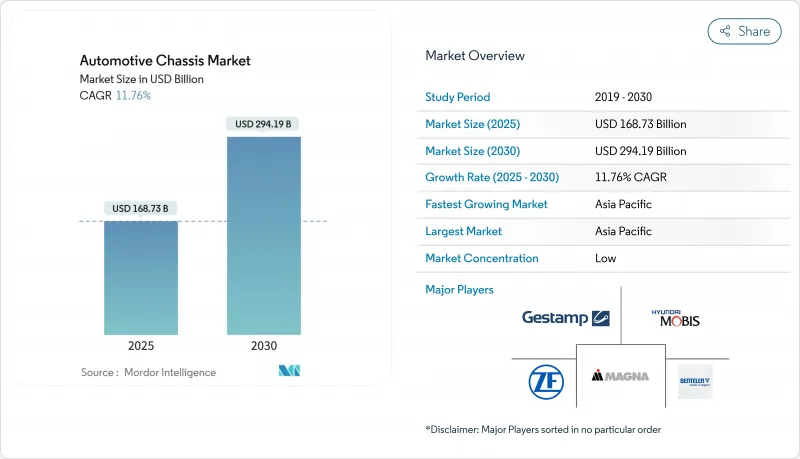
에 따르면 자동차 섀시 시장 규모는 2025년에 1,612억 5,000만 달러로 평가되며, 2026년에는 1,802억 1,000만 달러로 추정되고 있으며, 2031년까지 2,786억 5,000만 달러에 달할 것으로 예측됩니다.
2026-2031년에 연평균 성장률(CAGR) 9.11%로 성장할 것으로 전망됩니다.
세계 자동차 섀시 시장의 동향 및 인사이트
전기자동차(EV) 생산의 급증으로 스케이트보드/플랫폼형 섀시 시장 견인
배터리식 전기자동차 아키텍처에서는 스케이트보드형 프레임의 채택이 점점 더 확대되고 있습니다. 이 프레임에서는 배터리, 전기 모터, 전력 전자 장치 및 냉각 회로가 평평한 바닥 아래에 배치됩니다. 이러한 혁신을 통해 실내 공간이 확대되고, 파생 모델 간의 금형 전환이 효율화됩니다. 리비안(Rivian)은 탄소섬유로 제작된 배터리 인클로저가 토션 박스 역할을 하도록 독창적으로 설계하여, 기존의 강철 인클로저에 비해 대폭적인 경량화를 실현했습니다. 한편, 현대모비스는 하나의 생산 라인에서 승용차와 크로스오버 차량을 모두 생산할 수 있는 적응성이 뛰어난 휠베이스를 선보였습니다. 구조용 접착제 및 갭 필러 페이스트를 전문으로 하는 공급업체들은 새로운 수주를 확보하고 있습니다. 그러나 기존의 프레스 가공 업체들은 고전압 절연에 관한 전문 지식을 습득하지 않는 한 시장에서 도태될 가능성이 있습니다.
연비 및 전기자동차 주행 거리 목표 달성을 위한 경량화
2025-2029년까지 등록되는 신형 승용차에 대한 EU의 CO₂ 배출량 상한선이 93.6 g/km로 강화됨에 따라 원자재 비용 상승에도 불구하고 자동차 제조사들은 강재를 알루미늄이나 탄소섬유로 대체할 수밖에 없게 되었습니다. GM의 ‘Ultium’ 배터리 트레이는 노벨리스(Novelis)사의 ‘Advanz 7 시리즈’ 합금을 채택함으로써 대폭적인 경량화를 실현하여 주행 거리 향상으로 이어졌습니다. 포드의 ‘F-150 Lightning’은 알루미늄 사용으로 인해 상당한 경량화 효과를 얻었으나, 관세의 영향으로 조달 비용이 급등했습니다. SGL 카본사의 열가소성 복합재료는 현재 신속하게 성형이 가능하지만, 높은 가격 때문에 주로 고급 사양에 한정하여 사용되고 있습니다.
복합재료 및 다중 재료 제조에 필요한 고액의 설비 투자
복합재 생산 라인을 새로 구축하려면 막대한 투자가 필요하며, 그 운영은 프리미엄 시장 부문으로 한정되어 있습니다. SGL 카본은 CFRP 생산 라인 1개를 가동하는 데 따르는 막대한 비용을 지적하고 있습니다. 한편, 벤텔러(Benteler)사는 설비 개보수에 추가 투자를 했음에도 불구하고 신규 프로그램 가동에 차질이 발생했습니다. ISO 14125에 따른 파괴 시험 대상인 복합재료의 인증 주기는 강재의 경우보다 더 길어졌습니다. 또한 신흥 지역의 중견(Tier 2) 제조업체들은 장기적인 관점을 바탕으로 자금을 확보하는 데 어려움을 겪고 있습니다.
부문별 분석
2025년, 자동차 섀시 시장 점유율의 68.15%를 모노코크 설계가 차지하며, 승용차에서 충돌 에너지 효율과 경량화의 장점이 두드러지고 있습니다. 래더 프레임은 무게가 무겁고, 전기 밴 및 클래스 4-6 트럭에서 세로 방향 레일 사이에 볼트로 고정되는 모듈식 배터리 트레이가 채택됨에 따라 2031년까지 연평균 성장률(CAGR) 12.56%로 성장할 것으로 예측됩니다. 라이드셰어용 셔틀버스가 평평한 바닥과 신속한 배터리 교체를 필요로 하므로 래더 프레임 자동차 섀시 시장 규모는 급격히 확대될 것으로 전망됩니다.
핫 스탬핑 기술의 발전으로 모노코크 구조에서 측면 충돌 성능을 유지하면서 B필러의 두께를 줄일 수 있게 되어, 화이트 바디 1대당 대폭적인 경량화가 실현되고 있습니다. 리비안의 아마존 배송용 밴은 복합재 크로스 멤버를 적용하여 래더 프레임의 무게를 줄일 수 있었으며, 이는 강재에 비해 대폭적인 경량화가 가능함을 보여주었습니다. 이 두 가지 진화의 궤적을 통해 자동차 섀시 시장에서 금형의 가동률이 확보되었으며, 공급업체는 SUV와 중형 섀시 캡에 걸쳐 프레스 비용을 효율적으로 상각할 수 있게 되었습니다.
2025년, 자동차 섀시 시장 규모에서 강재는 알루미늄이나 CFRP에 비해 비용이 대폭 낮기 때문에 66.33%의 점유율을 유지했습니다. 그러나 EV 프로그램에서 경량화에 대한 관심이 높아지는 것을 배경으로, 탄소섬유 복합재는 2026-2031년에 연평균 성장률(CAGR) 14.38%로 성장할 것으로 예상됩니다. 알루미늄 합금은 특히 배터리 인클로저에서 뛰어난 방열성을 발휘하여 능동형 냉각 시스템의 필요성을 줄여주므로, 중간 소재로서의 역할을 수행하고 있습니다.
SGL Carbon사의 열가소성 CFRP 언더바디 패널은 대폭적인 경량화와 생산 시간 단축을 실현하고 있지만, 비용이 높기 때문에 보급에는 한계가 있습니다. 강도와 연신 특성이 향상된 첨단 고장력 강재는 중량 차이를 줄여주고 있으며, 비용에 민감한 OEM(Original Equipment Manufacturer)에 막대한 설비 투자 없이도 Euro NCAP 2026 기준을 충족하는 실용적인 해결책을 제공하고 있습니다. 이러한 소재 기술의 발전으로 인해 자동차 섀시 업계는 2031년 이후에도 다양성을 유지할 것으로 예상됩니다.
지역별 분석
아시아태평양은 2025년에 자동차 섀시 시장 점유율의 49.28%를 차지할 것으로 예상되며, 2031년까지 연평균 성장률(CAGR) 9.76%로 확대될 것으로 전망됩니다. 이는 중국의 950만 대 이상의 BEV 생산과 인도의 알루미늄을 많이 사용하는 모노코크 부문으로의 외국인 직접 투자 유입이 주도할 것으로 보입니다. 일본과 한국은 고장력강 및 탄소섬유에 관한 노하우를 활용하고 있으나, 국내 시장의 정체로 인해 생산량이 정체 상태에 이르렀으며, 도요타 방직 및 아이신 등의 공급업체들은 하이브리드 섀시 키트 수출에 주력하고 있습니다.
북미에서는 섹션 232에 따른 관세가 부과되어 알루미늄 프리미엄 가격이 상승하고 있으므로 각 OEM 업체들은 국내 제련소에서 조달하거나 추가 비용을 감수할 수밖에 없는 상황입니다. 미국의 차량 플릿에서는 클래스 8 전기 트랙터가 도입됨에 따라 총 중량 상한선에 도달하고 있으며, 알루미늄제 래더 프레임의 사용이 촉진되고 있습니다. 이러한 프레임은 강철제 프레임에 비해 비용이 대폭 높아 투자 회수(ROI) 기간을 단축시키고 있습니다. 유럽도 유사한 추세를 보이고 있습니다. 더욱 엄격해진 CO₂ 배출량 목표에 따라 독일의 OEM 업체들은 이미 플랫폼에 막대한 설비 투자를 진행 중이며, 그 일환으로 부품 수를 대폭 줄이는 폭스바겐의 MEB 및 PPE 스케이트보드형 섀시에 대한 투자도 포함되어 있습니다.
남미 및 중동 및 아프리카는 자동차 섀시 시장 전체에서 차지하는 점유율은 미미하지만, 국지적인 성장이 나타나고 있습니다. 브라질의 ‘Rota 2030’ 세제 혜택 조치에 따라 스텔란티스와 GM은 경량 강철 섀시를 탑재한 플렉스 연료 하이브리드차량의 출시를 추진하고 있습니다. 한편, 아르헨티나의 수출 지향형 래더 프레임 공장에서는 국내 시장의 변동에도 불구하고 픽업 트럭용 서브프레임 출하량이 증가하고 있습니다. 남아프리카공화국은 영국이나 호주 등 목표 시장의 부식성이 강한 해안 환경에 대응하기 위해 아연 도금 프레임을 장착한 차량을 수출하고 있습니다.
기타 혜택:
- 엑셀 형식의 시장 예측(ME) 시트
- 3개월간의 애널리스트 지원
자주 묻는 질문
목차
제1장 서론
- 조사 전제조건과 시장 정의
- 조사 범위
제2장 조사 방법
제3장 개요
제4장 시장 구도
- 시장 개요
- 시장 성장 촉진요인
- 시장 성장 억제요인
- 밸류·공급망 분석
- 규제 상황
- 기술 전망
- Porter's Five Forces 분석
제5장 시장 규모와 성장 예측
- 섀시 유형별
- 소재 유형별
- 차종별
- 추진 유형별
- 판매 채널별
- 지역별
- 북미
- 미국
- 캐나다
- 기타 북미 국가
- 남미
- 브라질
- 아르헨티나
- 기타 남미 국가
- 유럽
- 영국
- 독일
- 스페인
- 이탈리아
- 프랑스
- 러시아
- 기타 유럽 국가
- 아시아태평양
- 인도
- 중국
- 일본
- 한국
- 기타 아시아태평양 국가
- 중동 및 아프리카
- 아랍에미리트
- 사우디아라비아
- 튀르키예
- 이집트
- 남아프리카공화국
- 기타 중동 및 아프리카 국가
- 북미
제6장 경쟁 구도
- 시장 집중도
- 전략적 동향
- 시장 점유율 분석
- 기업 개요
- ZF Friedrichshafen AG
- Magna International Inc.
- Benteler International AG
- Hyundai Mobis Co., Ltd.
- Gestamp Automocion S.A.
- E&E Manufacturing
- Press Kogyo Co., Ltd.
- Tenneco Inc.
- Autocomp Corporation Panse Pvt Ltd(ACPPL)
- F&P America Mfg., Inc.
- ALF Engineering Pvt Ltd
- CIE Automotive
제7장 시장 기회와 향후 전망
KSA 26.10.23According to Mordor Intelligence, the automotive chassis market size was valued at USD 161.25 billion in 2025, is estimated at USD 180.21 billion in 2026, and is projected to reach USD 278.65 billion by 2031, growing at a CAGR of 9.11% between 2026 and 2031.
Global Automotive Chassis Market Trends and Insights
Surging EV Production Driving Skateboard/Platform Chassis
Battery electric architectures are increasingly adopting skateboard frames. These frames position batteries, e-motors, power electronics, and cooling circuits beneath flat floors. This innovation enhances cabin space and streamlines tool changeovers across derivative models. Rivian has ingeniously designed its carbon-fiber battery enclosure to serve as a torsion box, achieving significant weight reduction compared to traditional steel enclosures. Meanwhile, Hyundai Mobis showcased adaptable wheelbases, enabling a single production line to cater to both cars and crossovers. Suppliers specializing in structural adhesives and gap-filler pastes are securing new contracts. However, traditional stampers face potential displacement unless they acquire expertise in high-voltage isolation.
Lightweighting to Meet Fuel-Economy and EV-Range Targets
Stricter EU CO2 emission caps of 93.6 g/km for new passenger cars registered between 2025 and 2029 are compelling automakers to replace steel with aluminum and carbon fiber, despite rising raw material costs. GM's Ultium battery trays achieved significant weight reduction due to Novelis' Advanz 7-series alloy, resulting in improved range. Ford's F-150 Lightning benefited from substantial weight savings through the use of aluminum but faced higher procurement costs due to tariffs. SGL Carbon's thermoplastic composites can now be formed rapidly, but their premium price tag restricts their use to mainly premium trims.
High Capex for Composite and Multi-Material Manufacturing
Establishing greenfield composite lines involves significant investment, limiting operations to premium market segments. SGL Carbon highlights the substantial costs associated with setting up a single CFRP line. Meanwhile, Benteler faced delays in launching new programs despite additional investments in retrofits. Qualification cycles for composites subjected to ISO 14125 destructive testing are longer than those for steel. Furthermore, smaller tier-two players in emerging regions face challenges in securing patient capital.
Other drivers and restraints analyzed in the detailed report include:
- Megacasting and Structural Battery Packs Creating New Value Pools
- Tightening Crash-Safety Norms Elevating Material Complexity
- Raw-Material Price Volatility (Steel, Aluminum, CFRP)
For complete list of drivers and restraints, kindly check the Table Of Contents.
Segment Analysis
Monocoque designs accounted for 68.15% of the automotive chassis market share in 2025, underscoring their crash energy efficiency and mass advantage for passenger cars. Ladder frames, though heavier, are forecast to grow at a 12.56% CAGR through 2031 as electric vans and Class 4-6 trucks adopt modular battery trays that bolt between longitudinal rails. The automotive chassis market size for ladder frames is projected to rise sharply as ride-hailing shuttles demand flat floors and quick battery swaps.
Advances in hot-stamping have enabled monocoques to reduce B-pillar thickness while maintaining side-impact performance, achieving significant weight savings per body-in-white. Rivian's Amazon delivery van has shown that ladder frames can be made lighter by incorporating composite cross-members, offering a substantial reduction compared to steel. This dual-track evolution has ensured high tooling utilization in the automotive chassis market, enabling suppliers to efficiently amortize press costs across SUVs and medium-duty chassis cabs.
Steel retained 66.33% of the automotive chassis market size in 2025 due to its significantly lower cost compared to aluminum and CFRP. However, carbon-fiber composite is expected to grow at a 14.38% CAGR between 2026 and 2031, driven by the increasing focus on weight reduction in EV programs. Aluminum alloys serve as a middle-ground material, particularly in battery enclosures, where they offer superior heat dissipation and reduce the need for active cooling systems.
SGL Carbon's thermoplastic CFRP under-body panels provide substantial weight savings and faster production times, although their higher cost limits widespread adoption. Advanced high-strength steels with improved strength and elongation properties are narrowing the weight gap, offering cost-conscious OEMs a practical solution to meet Euro NCAP 2026 standards without significant capital investments. These material advancements are expected to keep the automotive chassis industry diversified well into 2031.
Complete Report Scope:
- By Chassis Type
- Ladder Frame
- Monocoque
- By Material Type
- Steel
- Aluminum Alloy
- Carbon Fiber Composite
- Others
- By Vehicle Type
- Passenger Cars
- Light Commercial Vehicles (LCVs)
- Medium and Heavy Commercial Vehicles (MHCVs)
- Buses and Coaches
- By Propulsion Type
- Internal Combustion Engine
- Battery Electric Vehicle (BEV)
- Plug-in Hybrid EV (PHEV)
- Hybrid Electric Vehicle (HEV)
- Fuel-Cell Electric Vehicle (FCEV)
- By Sales Channel
- OEM
- Aftermarket
- By Geography
- North America
- United States
- Canada
- Rest of North America
- South America
- Brazil
- Argentina
- Rest of South America
- Europe
- United Kingdom
- Germany
- Spain
- Italy
- France
- Russia
- Rest of Europe
- Asia-Pacific
- India
- China
- Japan
- South Korea
- Rest of Asia-Pacific
- Middle East and Africa
- United Arab Emirates
- Saudi Arabia
- Turkey
- Egypt
- South Africa
- Rest of Middle-East and Africa
- North America
Geography Analysis
Asia-Pacific accounted for 49.28% of the automotive chassis market share in 2025 and is forecast to expand at a CAGR of 9.76% through 2031, driven by China's production of more than 9.5 million BEV units and foreign direct investment inflows into India's aluminum-intensive monocoque segment . Japan and South Korea leverage high-strength steel and carbon-fiber know-how, yet home-market stagnation caps output, pushing suppliers such as Toyota Boshoku and Aisin to export hybrid chassis kits.
North America faces Section 232 tariffs that have increased aluminum premiums, prompting OEMs to source from domestic smelters or absorb the additional costs. As fleets in the United States adopt electric Class 8 tractors, they are reaching gross-weight ceilings, driving the use of aluminum ladder frames. These frames cost significantly more than steel alternatives and compress ROI timelines. Europe faces similar dynamics. Stricter CO2 fleet targets have already driven substantial platform capital expenditure among German OEMs, including investments in Volkswagen's MEB and PPE skateboard chassis, which reduce part counts considerably.
South America and the Middle East & Africa collectively hold a modest slice of the automotive chassis market but post pockets of growth. Brazil's Rota 2030 tax credits are prompting Stellantis and GM to deploy flex-fuel hybrids with lightweight steel chassis, while Argentina's export-oriented ladder-frame plants are increasing pickup subframe shipments despite domestic volatility. South Africa exports vehicles equipped with galvanized frames designed for corrosive coastal conditions in target markets, including the United Kingdom and Australia.
- ZF Friedrichshafen AG
- Magna International Inc.
- Benteler International AG
- Hyundai Mobis Co., Ltd.
- Gestamp Automocion S.A.
- E&E Manufacturing
- Press Kogyo Co., Ltd.
- Tenneco Inc.
- Autocomp Corporation Panse Pvt Ltd (ACPPL)
- F&P America Mfg., Inc.
- ALF Engineering Pvt Ltd
- CIE Automotive
Additional Benefits:
- The market estimate (ME) sheet in Excel format
- 3 months of analyst support
TABLE OF CONTENTS
1 Introduction
- 1.1 Study Assumptions & Market Definition
- 1.2 Scope of the Study
2 Research Methodology
3 Executive Summary
4 Market Landscape
- 4.1 Market Overview
- 4.2 Market Drivers
- 4.2.1 Surging EV Production Driving Skateboard/Platform Chassis
- 4.2.2 Lightweighting to Meet Fuel-Economy and EV-Range Targets
- 4.2.3 Megacasting and Structural Battery Packs Creating New Value Pools
- 4.2.4 Tightening Crash-Safety Norms Elevating Material Complexity
- 4.2.5 Coastal-Region Corrosion-Resistance Demand-Boosting Coated Frames
- 4.2.6 Autonomous Shuttle "Pod" Designs Requiring Flat-Floor Chassis
- 4.3 Market Restraints
- 4.3.1 High Capex for Composite and Multi-Material Manufacturing
- 4.3.2 Raw-Material Price Volatility (Steel, Aluminum, CFRP)
- 4.3.3 EV Weight Pushing GVWR Limits, Hurting Fleet Economics
- 4.3.4 Skilled-Labor Shortages in Advanced Joining and Bonding
- 4.4 Value / Supply-Chain Analysis
- 4.5 Regulatory Landscape
- 4.6 Technological Outlook
- 4.7 Porter's Five Forces Analysis
- 4.7.1 Threat of New Entrants
- 4.7.2 Bargaining Power of Suppliers
- 4.7.3 Bargaining Power of Buyers
- 4.7.4 Threat of Substitutes
- 4.7.5 Industry Rivalry
5 Market Size & Growth Forecasts (Value (USD))
- 5.1 By Chassis Type
- 5.1.1 Ladder Frame
- 5.1.2 Monocoque
- 5.2 By Material Type
- 5.2.1 Steel
- 5.2.2 Aluminum Alloy
- 5.2.3 Carbon Fiber Composite
- 5.2.4 Others
- 5.3 By Vehicle Type
- 5.3.1 Passenger Cars
- 5.3.2 Light Commercial Vehicles (LCVs)
- 5.3.3 Medium and Heavy Commercial Vehicles (MHCVs)
- 5.3.4 Buses and Coaches
- 5.4 By Propulsion Type
- 5.4.1 Internal Combustion Engine
- 5.4.2 Battery Electric Vehicle (BEV)
- 5.4.3 Plug-in Hybrid EV (PHEV)
- 5.4.4 Hybrid Electric Vehicle (HEV)
- 5.4.5 Fuel-Cell Electric Vehicle (FCEV)
- 5.5 By Sales Channel
- 5.5.1 OEM
- 5.5.2 Aftermarket
- 5.6 By Geography
- 5.6.1 North America
- 5.6.1.1 United States
- 5.6.1.2 Canada
- 5.6.1.3 Rest of North America
- 5.6.2 South America
- 5.6.2.1 Brazil
- 5.6.2.2 Argentina
- 5.6.2.3 Rest of South America
- 5.6.3 Europe
- 5.6.3.1 United Kingdom
- 5.6.3.2 Germany
- 5.6.3.3 Spain
- 5.6.3.4 Italy
- 5.6.3.5 France
- 5.6.3.6 Russia
- 5.6.3.7 Rest of Europe
- 5.6.4 Asia-Pacific
- 5.6.4.1 India
- 5.6.4.2 China
- 5.6.4.3 Japan
- 5.6.4.4 South Korea
- 5.6.4.5 Rest of Asia-Pacific
- 5.6.5 Middle East and Africa
- 5.6.5.1 United Arab Emirates
- 5.6.5.2 Saudi Arabia
- 5.6.5.3 Turkey
- 5.6.5.4 Egypt
- 5.6.5.5 South Africa
- 5.6.5.6 Rest of Middle-East and Africa
- 5.6.1 North America
6 Competitive Landscape
- 6.1 Market Concentration
- 6.2 Strategic Moves
- 6.3 Market Share Analysis
- 6.4 Company Profiles (includes Global Level Overview, Market Level Overview, Core Segments, Financials as Available, Strategic Information, Market Rank/Share for Key Companies, Products and Services, SWOT Analysis, and Recent Developments)
- 6.4.1 ZF Friedrichshafen AG
- 6.4.2 Magna International Inc.
- 6.4.3 Benteler International AG
- 6.4.4 Hyundai Mobis Co., Ltd.
- 6.4.5 Gestamp Automocion S.A.
- 6.4.6 E&E Manufacturing
- 6.4.7 Press Kogyo Co., Ltd.
- 6.4.8 Tenneco Inc.
- 6.4.9 Autocomp Corporation Panse Pvt Ltd (ACPPL)
- 6.4.10 F&P America Mfg., Inc.
- 6.4.11 ALF Engineering Pvt Ltd
- 6.4.12 CIE Automotive


