

|
시장보고서
상품코드
2154516
산세정 화학제품 : 시장 점유율 분석, 업계 동향과 통계, 성장 예측(2026-2031년)Pickling Chemicals - Market Share Analysis, Industry Trends & Statistics, Growth Forecasts (2026 - 2031) |
||||||
 Mordor Intelligence
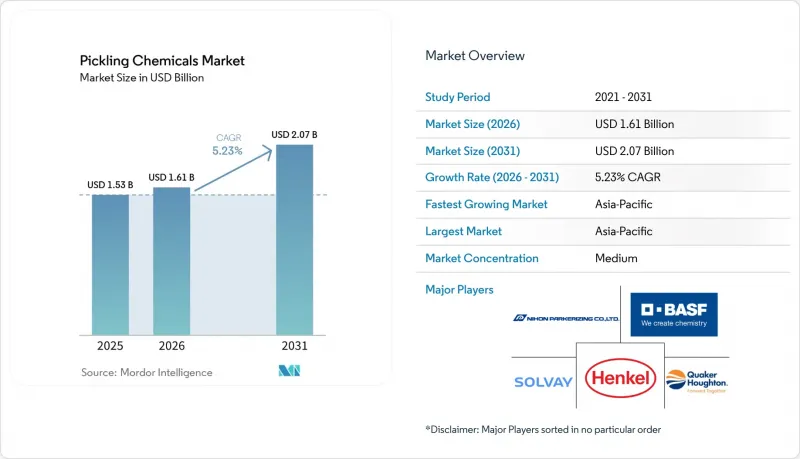
에 따르면 산세정 화학제품 시장 규모는 2025년에 15억 3,000만 달러로 추정되며, 예측 기간(2026-2031년) 동안 CAGR 5.23%로 확대되어, 2026년 16억 1,000만 달러에서 2031년에는 20억 7,000만 달러에 달할 것으로 전망됩니다.
전 세계 산세정 화학제품 시장의 동향 및 인사이트
철강 산세정 및 표면 처리 능력 확대
철강 가공 라인에 대한 설비 투자로 인해 산세정 화학제품에 대한 단기적인 수요가 발생하고 있습니다. 2025년 12월, 존 코카렐(John Coccarell)사는 규소강의 산세정 폐산을 대상으로 한 산 재생 프로젝트의 가동에 성공했다고 보고했습니다. 산 재생 기술을 통해 고처리량 라인에서도 일관된 표면 처리에 필요한 조건을 유지하면서 폐액을 적절히 관리할 수 있게 됩니다. 전자철판이나 고기능 등급의 강재는 범용 등급에 비해 체류 시간, 산 농도, 욕온의 허용 범위가 좁습니다. 이러한 라인에서는 압연, 코팅 및 기타 후공정 전에 산화물을 확실하게 제거해야 합니다. 이에 따라 가공업체들이 더 높은 사양의 생산능력을 확충함에 따라, 산세정 화학제품 시장에서 특수 배합 제품에 대한 수요가 증가하고 있습니다.
고품질 피복강 및 고강도 강재에 대한 수요
자동차 구조 부재에 첨단 고장력강이 사용됨에 따라 산세욕에 요구되는 요건도 변화하고 있습니다. 2025년 11월, WorldAutoSteel은 ‘첨단 고장력강 적용 지침’을 개정하여, 코팅된 고장력강의 용도에 있어 검증된 접근 방식을 강조했습니다. 규소 합금강 종류는 열간 압연 과정에서 실리카를 풍부하게 함유한 스케일을 형성할 수 있으며, 이는 기존의 산화철보다 제거하기 어렵습니다. 가공업체는 표면 품질 요건을 충족하기 위해 산의 작용 촉진제나 더 긴 처리 시간이 필요할 수 있습니다. 2025년, 타타 스틸 네덜란드와 폭스바겐 그룹은 자동차 충돌 구조용 아연도금 3세대 첨단 고강도 강재의 개발 진행 상황을 보고했습니다. 고품질 강재가 일관되고 적합한 표면 처리의 가치를 높임에 따라 산세제 시장은 그 혜택을 누리게 될 것입니다.
유해 산 취급, 폐수처리 및 배출 규제 준수에 드는 비용
유해 산의 관리에는, 특히 규제가 엄격한 지역에서, 운영 비용 및 설비 투자 비용이 발생합니다. 2025년 9월 통합판 EU 화학제품의 등록, 평가, 허가 및 제한에 관한 규정(REACH)에서는 대상 물질을 연간 10톤 이상 취급하는 등록자에게 화학제품의 안전성 평가를 의무화하고 있습니다. 이 기준치는 많은 산업용 산세정 공정에 적용됩니다. 북아일랜드의 금속 생산 및 가공에 관한 2026년 화학제품 규정 준수 보고서에서는 33건의 경미한 미준수 사항이 기록되었으며, 9곳의 시설에서 영국 REACH 문서가 구식인 것으로 밝혀졌습니다. 스테인리스강 가공에 사용되는 불화수소산 및 질산 시스템의 경우, 신중한 중화 처리, 금속 회수 및 폐수 배출 허가를 취득해야 합니다. 이러한 의무로 인해 소규모 화학 산세정의 경제성이 저하될 가능성이 있습니다. 따라서 산세정 화학제품 시장은 전용 처리 시스템을 유지할 수 있는 대규모 가공업체에 대한 의존도가 높아질 가능성이 있습니다.
부문 분석
2025년, 산 종류별 부문에서 염산은 산세정 화학제품 시장 점유율의 35.23%를 차지했습니다. 이러한 위상은 탄소강, 아연도금강 및 규소강의 연속 생산 라인에서 광범위하게 사용되고 있음을 반영합니다. 신속한 헹굼, 산세정 속도 및 확립된 재생 설비가 이러한 대규모 사용을 뒷받침하고 있습니다. 황산은 스테인리스강 스트립의 산세정 및 알루미늄의 양극 산화 처리에서 여전히 중요하며, 특히 폐산 처리 시스템이 이미 구축된 현장에서는 그 중요성이 두드러집니다. 질산 및 인산계 제제는 항공우주 분야와 스테인리스강 패시베이션에 사용되며, 이러한 분야에서는 투입 비용보다 OEM(주문자 상표 제조업체)의 인증 요건이 더 중요할 수 있습니다. 염류와 킬레이트제는 무기산계 및 유기산계 시스템에서 용액의 안정성, 부식 억제 및 패시베이션을 촉진합니다. 산세정 화학제품 업계는 염산을 상당량 유지하면서도 단위당 부가가치를 높이는 제제로 전환하고 있습니다.
유기산은 2026년부터 2031년까지 연평균 성장률(CAGR) 6.14%로 확대될 것으로 예측되며, 이는 화학약품 종류 중 가장 높은 성장률입니다. 유해한 무기산 사용을 줄이도록 요구하는 규제적 압력과 기술적 성능이 입증된 점이 이러한 성장을 뒷받침하고 있습니다. 2025년 'Journal of The Electrochemical Society'지에 게재된 연구에 따르면, 항공우주용 합금 AA2024-T3의 양극 산화 처리를 위해 7종류의 유기산 전해액을 비교한 결과, 말산이 시험 대상 중 가장 우수한 배리어막 특성을 보이는 것으로 밝혀졌습니다. 이 결과는 크롬 프리 화학 처리가 점점 더 주목받고 있는 항공우주 분야의 표면 처리와 관련이 있습니다. 또한 유기산은 강산에 비해 폐액 처리가 용이합니다. 폐루프 처리에 필요한 투자 비용이 적기 때문에 소규모 정밀 마감 업체나 특수 코팅 업체도 도입하기 쉬워졌습니다. 이에 따라 대량으로 사용되는 염산계 제품이 여전히 자리 잡고 있는 반면, 산세정 화학제품 시장에서는 보다 전문성이 높은 화학 약품으로의 단계적인 전환이 진행되고 있습니다.
지역별 분석
아시아태평양은 2025년에 산세정 화학제품 시장 점유율의 46.47%를 차지할 것으로 예상되며, 2031년까지 연평균 성장률(CAGR) 5.87%로 성장할 것으로 전망됩니다. 이 지역은 철강 가공, 전자기기 제조, 자동차 생산 확대의 혜택을 받고 있습니다. 중국, 인도, 일본, 한국 및 동남아시아국가연합(ASEAN)이 모두 수요 증대에 기여하고 있습니다. 인프라 건설, 철도망 확장, 자동차 산업에 대한 투자가 세계 평균을 상회하는 수요를 뒷받침하고 있습니다. 일본과 한국은 자동차 및 전자기기 수출 산업에서 사용되는 고사양 화학 약품의 중요한 공급원으로 자리 잡고 있습니다. 아시아태평양의 산세정 화학제품 시장은 새로운 다운스트림 생산능력의 확대와 관련 설비 투자의 혜택도 받고 있습니다.
북미와 유럽은 수요의 두 번째 및 세 번째 축을 형성하고 있지만, 두 지역 모두 아시아태평양에 비해 규제가 엄격하여 생산량 주도형이 아닙니다. 북미에서는 혼합 금속으로 제작된 자동차 플랫폼으로 인해 기존의 산을 이용한 산세정 외에도 티타늄, 지르코늄 및 유기 관능기 실란을 이용한 전처리 수요가 발생하고 있습니다. 또한, 전기자동차 생산 확대에 따라 배터리용 구리박 처리 및 전기 모터 부품 전처리에 대한 수요도 증가하고 있습니다. 유럽에서는 새로운 처리 능력 확충보다는 재생 시스템 및 환경 개선에 대한 투자에 중점을 두고 있습니다. 포트 탈보트에서의 재생 시스템 수주 사례는 유럽의 사업자가 기존 라인을 업그레이드하면서 처리 능력을 향상시킬 수 있음을 보여줍니다. EU의 배기가스 규제 및 화학제품 규제는 저위험성 배합을 문서로 증명하고, 규정 준수 지원을 제공할 수 있는 공급업체를 우대하고 있습니다.
남미, 중동 및 아프리카는 산세정 화학제품 시장 규모는 작지만 중요한 수요 지역입니다. 브라질과 아르헨티나에는 염산 및 황산 시스템을 사용하는 평판강 제조업체와 자동차 공급망이 확립되어 있습니다. 세계철강협회(World Steel Association)에 따르면, 호르무즈 해협의 긴장에 따른 해운 혼란으로 인해 2026년에는 중동의 철강 수요가 감소했습니다. 사우디아라비아의 산업 다각화 및 걸프 국가들의 인프라 정비 계획은 물류가 안정될 경우 수요 회복을 뒷받침할 가능성이 있습니다. 진달 스테인리스(Jindal Stainless)는 2027 회계연도를 목표로 연간 110만 톤(MTPA) 규모의 열간 압연·어닐링·산세정 설비와 0.17 MTPA 규모의 냉간 압연·어닐링·산세정 설비의 가동을 시작했습니다. 아프리카의 건설 활동은 철강 가공 수요를 뒷받침하고 있지만, 이 지역은 수입된 특수 배합 제품에 의존하고 있습니다. 이러한 높은 의존도로 인해 현지 구매자들은 세계 산 가격 및 물류 상황의 영향을 받기 쉬운 실정입니다.
기타 혜택:
- 엑셀 형식의 시장 예측(ME) 시트
- 3개월간의 애널리스트 지원
자주 묻는 질문
목차
제1장 소개
- 조사 가정과 시장 정의
- 조사 범위
제2장 조사 방법
제3장 주요 요약
제4장 시장 구도
- 시장 개요
- 시장 성장 촉진요인
- 시장 성장 억제요인
- 밸류체인 분석
- Porter's Five Forces 분석
제5장 시장 규모와 성장 예측
- 유형별
- 용도별
- 지역별
- 아시아태평양
- 중국
- 인도
- 일본
- 한국
- ASEAN 국가
- 기타 아시아태평양 국가
- 북미
- 미국
- 캐나다
- 멕시코
- 유럽
- 독일
- 영국
- 프랑스
- 이탈리아
- 북유럽 국가
- 기타 유럽 국가
- 남미
- 브라질
- 아르헨티나
- 기타 남미 국가
- 중동 및 아프리카
- 사우디아라비아
- 남아프리카공화국
- 기타 중동 및 아프리카 국가
- 아시아태평양
제6장 경쟁 구도
- 시장 집중도
- 전략적 동향
- 시장 점유율·순위 분석
- 기업 개요
- BASF
- Callington Group
- Chemtex Speciality Limited
- Columbia Chemical
- Crown Technology, Inc.
- Henkel AG & Co. KGaA
- Hubbard-Hall Inc.
- Nihon Parkerizing Co., Ltd.
- Novel Surface Treatments
- Quaker Houghton
- Solvay
- Surface Innovators LLP
- Surtec Suisse GmbH
- TIB Chemicals AG
- voestalpine Bohler Welding Group GmbH
제7장 시장 기회와 향후 전망
KSM 26.10.29According to Mordor Intelligence, the pickling chemicals market size was estimated at USD 1.53 billion in 2025 and is estimated to grow from USD 1.61 billion in 2026 to USD 2.07 billion by 2031, at a CAGR of 5.23% during the forecast period (2026-2031).
Global Pickling Chemicals Market Trends and Insights
Expansion of Steel Pickling and Surface-Treatment Capacity
Capital investment in steel processing lines is creating near-term demand for pickling chemicals. In December 2025, John Cockerill reported the successful operation of an acid regeneration project for silicon steel pickling waste acid. Acid regeneration allows high-throughput lines to manage waste streams while maintaining the conditions required for consistent surface treatment. Electrical steel and advanced grades require narrower operating ranges for dwell time, acid strength, and bath temperature than commodity grades. Such lines require reliable oxide removal before rolling, coating, and other downstream processes. This gives the pickling chemicals market greater exposure to specialty formulations as processors add higher-specification capacity.
Demand for Higher-Quality Coated and Advanced-Strength Steels
The use of advanced high-strength steel in automotive structures changes the requirements placed on pickling baths. In November 2025, WorldAutoSteel updated its Advanced High-Strength Steel Application Guidelines, emphasizing validated approaches for coated high-strength steel applications. Silicon-alloyed grades can form silica-rich scale during hot rolling, which is more difficult to remove than conventional iron oxide. Processors may need acid accelerators or longer treatment periods to meet surface-quality requirements. In 2025, Tata Steel Nederland and Volkswagen Group reported progress on third-generation advanced high-strength steel with zinc coating for automotive crash structures. The pickling chemicals market benefits when higher-grade steel increases the value of consistent, qualified surface treatment.
Hazardous-Acid Handling, Wastewater, and Emission Compliance Costs
Managing hazardous acids incurs operating and capital costs, particularly in more regulated regions. The consolidated September 2025 edition of the EU Registration, Evaluation, Authorization and Restriction of Chemicals (REACH) Regulation requires chemical safety assessments for registrants handling 10 or more tons of covered substances per year. This threshold applies to many industrial pickling operations. Northern Ireland's 2026 chemical compliance report for metal production and processing recorded 33 minor non-conformances and identified outdated UK REACH documentation at 9 sites. Hydrofluoric and nitric acid systems used in stainless steel processing require careful neutralization, metal recovery, and wastewater permitting. These obligations can reduce the economic viability of small-scale chemical pickling. The pickling chemicals market may, therefore, become more dependent on larger processors capable of supporting dedicated treatment systems.
Other drivers and restraints analyzed in the detailed report include:
- Growth of Automotive, Construction, Aerospace, and Electronics Manufacturing
- Adoption of Acid Regeneration and Closed-Loop Pickling Systems
- Volatility in Mineral-Acid and Specialty-Additive Costs
For complete list of drivers and restraints, kindly check the Table Of Contents.
Segment Analysis
Hydrochloric acid held 35.23% of the pickling chemicals market share in the type segment in 2025. Its position reflects widespread use in continuous lines for carbon steel, galvanized steel, and silicon steel. Fast rinsing, pickling speed, and established regeneration equipment support its use at scale. Sulfuric acid remains important for stainless steel strip pickling and aluminum anodizing, particularly where spent-acid handling systems are already in place. Nitric and phosphoric acid formulations are used in aerospace and stainless steel passivation, where original equipment manufacturer qualification requirements can matter more than input cost. Salts and chelating agents support bath stability, inhibition, and passivation across mineral-acid and organic systems. The pickling chemicals industry is shifting toward formulations that deliver higher value per unit while retaining substantial quantities of hydrochloric acid.
Organic acids are forecast to expand at a 6.14% CAGR from 2026 to 2031, the fastest rate among chemical types. Regulatory pressure to reduce hazardous mineral-acid use and evidence of technical performance support this growth. A 2025 study in the Journal of The Electrochemical Society compared seven organic acid electrolytes for AA2024-T3 aerospace alloy anodization and found that malic acid produced the highest barrier-film properties among the candidates tested. This result is relevant to aerospace surface treatment, where chromium-free chemistry is receiving greater attention. Organic acids can also offer simpler spent-liquor disposal than strong mineral acids. Their lower closed-loop investment requirement can make them more accessible to smaller precision finishers and specialty coating operations. This supports a gradual shift in the pickling chemicals market toward more specialized chemistry, even as high-quantity hydrochloric acid lines remain established.
Complete Report Scope:
- By Type
- Hydrochloric Acid
- Sulfuric Acid
- Nitric and Phosphoric Acids
- Organic Acids
- Salts and Chelating Agents
- Others
- By Application
- Steel and Metallurgy
- Electroplating and Metal Finishing
- Metal Recycling and Recovery
- Electronics and Precision Manufacturing
- Food and Beverage Processing
- Industrial Chemical Processing
- Others
- By Geography
- Asia-Pacific
- China
- India
- Japan
- South Korea
- ASEAN Countries
- Rest of Asia-Pacific
- North America
- United States
- Canada
- Mexico
- Europe
- Germany
- United Kingdom
- France
- Italy
- NORDIC Countries
- Rest of Europe
- South America
- Brazil
- Argentina
- Rest of South America
- Middle East and Africa
- Saudi Arabia
- South Africa
- Rest of Middle East and Africa
- Asia-Pacific
Geography Analysis
Asia-Pacific held 46.47% of the pickling chemicals market share in 2025 and is forecast to grow at a 5.87% CAGR through 2031. The region benefits from the expansion of steel processing, electronics manufacturing, and automotive production. China, India, Japan, South Korea, and the Association of Southeast Asian Nations all contribute to demand. Infrastructure construction, rail expansion, and automotive investment support demand above the global average. Japan and South Korea remain important sources of high-specification chemistries used in the automotive and electronics export industries. The pickling chemicals market in Asia-Pacific also benefits from new downstream capacity and related investments in equipment.
North America and Europe form the second and third demand pillars, although both are more regulated and less output-driven than the Asia-Pacific. In North America, mixed-metal vehicle platforms create demand for titanium, zirconium, and organo-functional silane pretreatments alongside conventional acid pickling. Electric vehicle production is also increasing the requirements for battery copper foil treatment and electric motor component preparation. In Europe, investment is focused more on regeneration systems and environmental improvement than on greenfield processing capacity. The Port Talbot regeneration order demonstrates how European operators can upgrade existing lines while increasing throughput. EU emissions and chemical regulations favor suppliers that can provide documented low-hazard formulations and compliance support.
South America, the Middle East, and Africa are smaller but relevant demand areas for the pickling chemicals market. Brazil and Argentina have established flat-steel producers and automotive supply chains that use hydrochloric and sulfuric acid systems. Middle East steel demand contracted in 2026 amid shipping disruption linked to Strait of Hormuz tensions, according to the World Steel Association. Saudi Arabian industrial diversification and Gulf infrastructure programs can support recovery when logistics stabilize. Jindal Stainless commissioned 1.1 million tons per annum (MTPA) of hot-rolled annealed and pickled capacity and 0.17 MTPA of cold-rolled annealed and pickled capacity for FY27. African construction activity supports demand for steel processing, but the region depends on imported specialty formulations. This reliance exposes local buyers to global acid prices and logistics conditions.
- BASF
- Callington Group
- Chemtex Speciality Limited
- Columbia Chemical
- Crown Technology, Inc.
- Henkel AG & Co. KGaA
- Hubbard-Hall Inc.
- Nihon Parkerizing Co., Ltd.
- Novel Surface Treatments
- Quaker Houghton
- Solvay
- Surface Innovators LLP
- Surtec Suisse GmbH
- TIB Chemicals AG
- voestalpine Bohler Welding Group GmbH
Additional Benefits:
- The market estimate (ME) sheet in Excel format
- 3 months of analyst support
TABLE OF CONTENTS
1 Introduction
- 1.1 Study Assumptions and Market Definition
- 1.2 Scope of the Study
2 Research Methodology
3 Executive Summary
4 Market Landscape
- 4.1 Market Overview
- 4.2 Market Drivers
- 4.2.1 Expansion of Steel Pickling and Surface-Treatment Capacity
- 4.2.2 Demand for Higher-Quality Coated and Advanced-Strength Steels
- 4.2.3 Growth of Automotive, Construction, Aerospace, and Electronics Manufacturing
- 4.2.4 Adoption of Acid Regeneration and Closed-Loop Pickling Systems
- 4.2.5 Real-Time Bath Monitoring and Automated Chemical Dosing
- 4.2.6 Application-Specific Low-Fume and Nitric-Acid-Free Formulations
- 4.3 Market Restraints
- 4.3.1 Hazardous-Acid Handling, Wastewater, and Emission Compliance Costs
- 4.3.2 Volatility in Mineral-Acid and Specialty-Additive Costs
- 4.3.3 Substitution by Mechanical, Abrasive, Laser, and Dry-Cleaning Technologies
- 4.3.4 Qualification Bottlenecks for Advanced Alloys and Regenerated-Acid Chemistries
- 4.4 Value Chain Analysis
- 4.5 Porter's Five Forces Analysis
- 4.5.1 Threat of New Entrants
- 4.5.2 Bargaining Power of Suppliers
- 4.5.3 Bargaining Power of Buyers
- 4.5.4 Threat of Substitutes
- 4.5.5 Competitive Rivalry
5 Market Size and Growth Forecasts (Value)
- 5.1 By Type
- 5.1.1 Hydrochloric Acid
- 5.1.2 Sulfuric Acid
- 5.1.3 Nitric and Phosphoric Acids
- 5.1.4 Organic Acids
- 5.1.5 Salts and Chelating Agents
- 5.1.6 Others
- 5.2 By Application
- 5.2.1 Steel and Metallurgy
- 5.2.2 Electroplating and Metal Finishing
- 5.2.3 Metal Recycling and Recovery
- 5.2.4 Electronics and Precision Manufacturing
- 5.2.5 Food and Beverage Processing
- 5.2.6 Industrial Chemical Processing
- 5.2.7 Others
- 5.3 By Geography
- 5.3.1 Asia-Pacific
- 5.3.1.1 China
- 5.3.1.2 India
- 5.3.1.3 Japan
- 5.3.1.4 South Korea
- 5.3.1.5 ASEAN Countries
- 5.3.1.6 Rest of Asia-Pacific
- 5.3.2 North America
- 5.3.2.1 United States
- 5.3.2.2 Canada
- 5.3.2.3 Mexico
- 5.3.3 Europe
- 5.3.3.1 Germany
- 5.3.3.2 United Kingdom
- 5.3.3.3 France
- 5.3.3.4 Italy
- 5.3.3.5 NORDIC Countries
- 5.3.3.6 Rest of Europe
- 5.3.4 South America
- 5.3.4.1 Brazil
- 5.3.4.2 Argentina
- 5.3.4.3 Rest of South America
- 5.3.5 Middle East and Africa
- 5.3.5.1 Saudi Arabia
- 5.3.5.2 South Africa
- 5.3.5.3 Rest of Middle East and Africa
- 5.3.1 Asia-Pacific
6 Competitive Landscape
- 6.1 Market Concentration
- 6.2 Strategic Moves
- 6.3 Market Share (%)/Ranking Analysis
- 6.4 Company Profiles (includes Global Overview, Market Overview, Core Segments, Financials as available, Strategic Information, Products and Services, and Recent Developments)
- 6.4.1 BASF
- 6.4.2 Callington Group
- 6.4.3 Chemtex Speciality Limited
- 6.4.4 Columbia Chemical
- 6.4.5 Crown Technology, Inc.
- 6.4.6 Henkel AG & Co. KGaA
- 6.4.7 Hubbard-Hall Inc.
- 6.4.8 Nihon Parkerizing Co., Ltd.
- 6.4.9 Novel Surface Treatments
- 6.4.10 Quaker Houghton
- 6.4.11 Solvay
- 6.4.12 Surface Innovators LLP
- 6.4.13 Surtec Suisse GmbH
- 6.4.14 TIB Chemicals AG
- 6.4.15 voestalpine Bohler Welding Group GmbH
7 Market Opportunities and Future Outlook
- 7.1 White-Space and Unmet-Need Assessment


