

|
시장보고서
상품코드
2155275
IoT 청구 및 수익화 소프트웨어 : 시장 점유율 분석, 업계 동향과 통계, 성장 예측(2026-2031년)IoT Billing and Monetization Software - Market Share Analysis, Industry Trends & Statistics, Growth Forecasts (2026 - 2031) |
||||||
 Mordor Intelligence
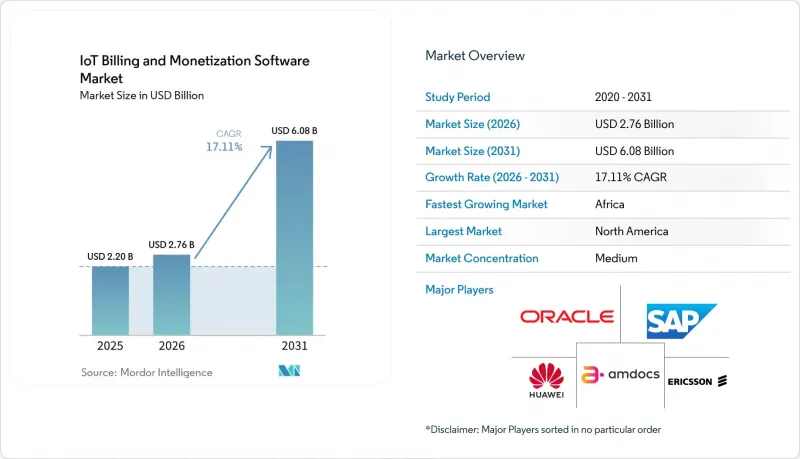
에 따르면 IoT 빌링·수익화 소프트웨어 시장 규모는 2025년 22억 달러에서 2026년에는 27억 6,000만 달러로 확대하며, 2031년까지 60억 8,000만 달러에 달할 것으로 예상되고 있으며, 2026-2031년에 CAGR 17.11%로 성장할 것으로 전망되고 있습니다.
전 세계 IoT 과금 및 수익화 소프트웨어 시장의 동향과 인사이트
연결 기기 수 및 이용 이벤트의 확대
2025년 말 기준으로 셀룰러 IoT 연결 건수는 45억 건에 달할 것이며, IoT 총 연결 건수는 2031년까지 연평균 성장률(CAGR) 13%를 기록하며 471억 건에 달할 것으로 예측됩니다. 이러한 규모 확대에 따라 과금 플랫폼이 수집, 분류, 평가, 대조해야 하는 이벤트의 양도 증가할 것입니다. 예를 들어 공공요금 계량기는 소량의 데이터를 정기적으로 전송하는 반면, 5G RedCap을 지원하는 비디오 기기는 변동하는 서비스 품질(QoS) 조건의 영향을 받는 지속적인 트래픽을 생성할 가능성이 있습니다. 이러한 서로 다른 패턴에 대응하기 위해서는 기기 유형, 이용 수준, 네트워크 상황 및 지불 책임자를 인식하는 요금 설정 규칙이 필요합니다. 독일에서는 2026년 말까지 9,600만 장 이상의 기계용 SIM 카드가 도입될 것으로 예상되며, 이는 기계용 과금 프로세스가 필요한 기기 기반이 대폭 확대됨을 의미합니다. 따라서 통신사업자가 보다 단순한 소비자용 트래픽을 위해 설계된 시스템을 다양한 이벤트 구조를 처리할 수 있는 플랫폼으로 대체함에 따라 IoT 과금 및 수익화 소프트웨어 시장은 그 혜택을 누리게 될 것입니다.
구독 및 사용량 기반 비즈니스 모델의 도입
커넥티드 제품 제공업체들은 기기의 일회성 판매에서 구독, 사용량 기반 요금, 서비스 번들로 전환하고 있습니다. 이러한 전환에는 측정된 사용량을 처리하고, 하이브리드 가격 책정 규칙을 적용하며, 단일 워크플로우 내에서 수익 인식을 지원할 수 있는 플랫폼이 필요합니다. Stripe는 2026년 3월, 자율적인 기계 간 결제 오케스트레이션을 실현하는 개방형 접근 방식으로서 ‘Machine Payments Protocol’을 도입했습니다. 이러한 동향은 기계에서 발생하는 결제 이벤트가 커넥티드 서비스 제공업체에게 현실적인 과제가 되고 있음을 보여줍니다. Golioth사가 모듈식 사용량 기반 가격 책정으로 전환한 것도 다양한 기기군에 걸친 세밀한 기기 활동을 적절히 할당할 필요성을 반영한 것입니다. 프로바이더가 기기가 무엇을 소비했는지, 어떤 계약이 적용되었는지, 어떤 고객이나 파트너에게 청구해야 하는지에 대한 신뢰할 수 있는 기록을 필요로 함에 따라 IoT 과금 및 수익화 소프트웨어 시장의 중요성은 점점 더 커지고 있습니다.
레거시 OSS/BSS 통합의 복잡성
구형 비즈니스 지원 시스템에서는 제품 카탈로그, 요금 산정 규칙, 프로비저닝 프로세스, 고객 기록이 밀접하게 연동된 구성 요소 내에 통합되어 있는 경우가 많습니다. 가동중인 과금을 중단하지 않고 이러한 기능을 분리하려면 병렬 운영, 데이터 동기화, 그리고 각 제품 라인에 대한 철저한 테스트가 필요합니다. 또한 새로운 IoT 서비스의 경우 네트워크 운영 시스템과 과금 시스템 간의 추가적인 연동이 필요할 수도 있습니다. 이로 인해 통신사업자가 여러 디바이스 플랫폼, 파트너 애플리케이션, 네트워크 기술을 연결해야 할 때 도입 부담이 커집니다. 아울러 현대화 프로젝트 시작 후 문서화되지 않은 비즈니스 규칙이 드러나면서 예정된 서비스 개시가 지연될 가능성도 있습니다. 이러한 문제들은 특히 제공업체가 다수의 도입 기반을 보유하고 있으며, 과금 업무 중단에 대한 허용도가 낮은 경우, IoT 과금 및 수익화 소프트웨어 시장에서의 도입을 지연시키는 요인이 될 수 있습니다.
부문 분석
2025년, 소프트웨어 솔루션은 IoT 과금 및 수익화 소프트웨어 시장 점유율의 71.98%를 차지했습니다. 이 결과는 연결형 서비스 제공에 있으며, 요금 산정, 과금, 청구, 중개, 결제 소프트웨어가 수행하는 핵심적인 역할을 반영한 것입니다. 요금 산정 엔진이 통신사업자의 운영 환경에 통합되면, 그 변경은 기존 고객, 제품 카탈로그, 파트너 계약에 영향을 미칠 가능성이 있습니다. 이로 인해 높은 전환 비용이 발생하며, 수년에 걸친 라이선스, 지원, 유지보수 계약 관계가 유지됩니다. 이 분야에서는 플랫폼의 완전한 교체가 아닌, AI를 활용한 구성 관리 및 컴포저블 소프트웨어로의 전환이 진행되고 있습니다. Amdocs사는 2026년 3월, 대규모 서비스 제공을 위한 전용 수익화 에이전트와 구성 주도형 통합 과금 기능을 갖춘 ‘CES26’을 발표했습니다. Aria Systems는 2026년 5월, 전체 스택을 교체하지 않고도 도입 가능한 과금 컴포넌트에 대한 수요를 반영하여 ‘Aria Allegro’를 독립형 제품으로 발표했습니다. TM Forum의 ‘Open Digital 아키텍처’ 준수 또한 중요합니다. 이는 향후 통합에 대한 의존도를 줄여주는 개방형 인터페이스를 요구하는 구매자가 늘어나고 있기 때문입니다.
서비스에는 통합, 컨설팅, 마이그레이션, 설정 및 매니지드 빌링 운영이 포함됩니다. 통신사업자가 기존 BSS 시스템에서 클라우드 기반 환경으로 전환할 때, 이러한 활동은 여전히 중요합니다. 서비스 제공업체는 조직이 레거시 요금 산정 로직을 매핑하고, 데이터를 대조하며, 청구 결과를 테스트하고, 운영 중인 고객의 마이그레이션을 지원하도록 돕습니다. 통신사업자가 기존의 소비자 및 기업용 제품에 더해 새로운 IoT 사용 사례를 도입할 때, 서비스에 대한 수요가 가장 높아질 가능성이 있습니다. 동시에, AI를 활용한 규칙 설정을 통해 노동 집약적인 전문 서비스에 대한 장기적인 필요성이 줄어들 수 있습니다. 따라서 벤더는 단기적인 도입 수익과 더 간소하고 재현성이 높은 소프트웨어 도입의 가치 사이에서 균형을 맞춰야 합니다. IoT 과금 및 수익화 소프트웨어 업계는 두 가지 범주 모두에 의존하고 있지만, 소프트웨어는 지속적인 과금 프로세스에 계속 통합되므로 더 큰 가치를 차지합니다. 안정적인 소프트웨어 기반은 고객이 신제품, 파트너 또는 기기 그룹을 도입할 때도 서비스 수익을 지원할 수 있습니다.
2025년, IoT 과금 및 수익화 소프트웨어 시장 점유율의 67.11%를 클라우드 기반 도입이 차지했습니다. 통신사업자는 수요 피크마다 동등한 인프라를 구축하지 않고도 클라우드 용량을 활용하여 기기 수나 트랜잭션량의 변동에 대응하고 있습니다. 클라우드 네이티브 과금 시스템은 구성 가능한 서비스와 컨테이너화된 워크로드를 통해 새로운 이용 요금제를 도입할 수 있습니다. 이를 통해 데이터 사용량, 기기 상태, 서비스 계층 또는 네트워크 품질에 따라 변화하는 커넥티드 서비스가 지원됩니다. 또한 제공업체가 API를 통해 과금 기능과 고객용 애플리케이션을 연동하는 데에도 도움이 됩니다. 태국의 AIS는 B2C, B2B 및 IoT 서비스를 위해 Netcracker의 클라우드 네이티브 BSS 플랫폼을 도입하여, 여러 사업 부문에 걸쳐 공통 플랫폼을 활용하는 사례를 보여주었습니다. 이번 도입을 통해 더 높은 확장성이 실현되었으며, 새로운 커넥티드 서비스 출시까지 소요되는 시간이 단축되었습니다. 이러한 기능 덕분에 IoT 과금 및 수익화 소프트웨어 시장에서 클라우드 제공의 역할이 강화되고 있습니다.
개인정보 보호 규정, 보안 정책 또는 데이터 거주 요건으로 인해 클라우드 호스팅이 제한되는 경우, 온프레미스 도입은 여전히 유효합니다. 또한 기존 과금 프로세스가 사내 애플리케이션과 밀접하게 연동되어 있으므로 로컬 시스템을 유지하고 있는 통신사업자도 있습니다. EU 데이터법의 데이터 접근 요건은 고객이 온프레미스 환경을 유지하고 있는 경우에도 인터페이스 현대화를 위한 압력을 높일 가능성이 있습니다. 레거시 시스템에서는 문서화된 데이터 접근 프로세스를 지원하기 위해 맞춤형 커넥터가 필요할 수 있지만, 클라우드 네이티브 시스템에는 대개 API 기능이 표준 요소로 포함되어 있습니다. Cerillion은 2025년 MVNX와의 제휴를 통해 사업을 확장하여 선불 및 후불 가입자용 모듈을 추가하는 한편, MVNO 고객을 위한 멀티테넌트 과금을 가능하게 했습니다. 이 사례는 SaaS 지향적인 제공 형태가 서비스 제공업체의 자본 부담과 도입 부담을 어떻게 경감시킬 수 있는지를 보여줍니다. 도입 선택은 앞으로도 고객의 운영 모델, 규정 준수 의무, 그리고 구형 시스템의 현대화 능력에 따라 좌우될 것입니다.
지역별 분석
2025년, 북미는 IoT 과금 및 수익화 소프트웨어 시장 점유율의 32.22%를 차지했습니다. 이 지역의 입지는 Tier 1 통신사업자의 현대화 및 기업의 커넥티드 서비스 플랫폼 도입에 힘입어 강화되었습니다. Amdocs와 AWS는 2026년 2월, AI 서비스, 네트워크 API, IoT 연결을 위한 클라우드 기반 플랫폼에 초점을 맞춘 다년간의 전략적 제휴를 발표했습니다. 이는 공통 운영 환경을 통해 여러 디지털 서비스의 가격 책정이 가능한 플랫폼에 대한 수요를 반영한 것입니다. 또한 CMS 코드 변경으로 인해 텔레메트리 기록과 청구 워크플로우를 연동하는 시스템에 대한 의료 관련 수요도 발생하고 있습니다. 캐나다는 제조업 및 공공사업 분야의 기업 대상 프로그램을 통해 시장에 기여하고 있습니다. 멕시코는 커넥티드 카의 텔레매틱스 및 스마트 공공사업 프로그램을 통해 기여하고 있습니다.
유럽에서는 대규모 기업 도입 파이프라인과 엄격한 규제 환경이 공존하고 있습니다. EU 데이터법, 데이터 수집에 대한 기대의 변화, 그리고 향후 시행될 사이버 복원력법의 의무 사항으로 인해 벤더들은 접근, 보안 및 보고와 관련된 관리 기능을 제품 기능으로 포함시켜야 합니다. 독일에서는 2026년 말까지 9,600만 장 이상의 기계용 SIM 카드가 도입될 것으로 예상되며, 이로 인해 기계용 과금 및 정산이 필요한 연결 건수가 증가하게 될 것입니다. 또한 도이치 통신이 2028년 6월에 예정하고 있는 2G 서비스 종료는 구형 IoT 기기를 지원하는 통신사업자들에게 요금 체계 재검토에 따른 전환 기한이 될 것입니다. 영국 정보위원회(ICO)는 2026년 6월 11일, 소비자용 IoT 제품 및 서비스에 관한 지침을 업데이트했습니다. 한센 테크놀러지스는 수백만 명의 고객을 클라우드, AI 및 API를 활용한 BSS 솔루션으로 전환하기 위해 2026년 5월 텔레포니카 독일과의 파트너십을 갱신했습니다. 이러한 상황에서 유럽은 규정 준수를 충족하고 적응성이 높은 과금 플랫폼을 위한 중요한 시장이 되고 있습니다.
아프리카는 2031년까지 연평균 성장률(CAGR) 18.84%로 확대될 것으로 예측되며, 이는 IoT 과금 및 수익화 소프트웨어 시장에서 지역별 가장 높은 성장률입니다. 아시아태평양은 가장 큰 연결 기반을 보유하고 있으며, 2025년 말 기준으로 동북아시아가 셀룰러 IoT 연결의 70%를 차지하고 있습니다. 일본, 한국, 중국, 인도에서는 높은 처리량의 과금 처리 능력이 필요한 대규모 기기군이 운영되고 있습니다. 중동에서는 Cerillion사가 Omantel사를 대상으로 진행한 혁신 사례가 현지 호스팅 요건이 플랫폼 아키텍처를 어떻게 형성하는지를 보여주었습니다. 모바일 기술은 2025년에 아프리카 전역에서 2,400억 달러의 경제적 가치를 창출할 것으로 예상되며, 2030년까지 2,900억 달러에 달할 것으로 전망됩니다. GSMA 보고서에 따르면 2026년 5월 기준으로 아프리카 37개 시장의 61개 통신사업자가 5G 서비스를 개시했습니다. 남미에서는 브라질과 아르헨티나에서 스마트 유틸리티 계량 및 기업 차량 관리 프로그램이 진전되고 있습니다.
기타 혜택:
- 엑셀 형식의 시장 예측(ME) 시트
- 3개월간의 애널리스트 지원
자주 묻는 질문
목차
제1장 서론
- 조사 전제조건과 시장 정의
- 조사 범위
제2장 조사 방법
제3장 개요
제4장 시장 구도
- 시장 개요
- 거시경제 요인이 시장에 미치는 영향
- 시장 성장 촉진요인
- 시장 성장 억제요인
- 업계 밸류체인 분석
- 규제 상황
- 기술 전망
- Porter's Five Forces 분석
제5장 시장 규모와 성장 예측
- 컴포넌트별
- 배포 모드별
- 조직 규모별
- 용도별
- 최종사용자별
- 지역별
- 북미
- 미국
- 캐나다
- 멕시코
- 남미
- 브라질
- 아르헨티나
- 기타 남미 국가
- 유럽
- 독일
- 영국
- 프랑스
- 이탈리아
- 기타 유럽 국가
- 아시아태평양
- 중국
- 일본
- 인도
- 한국
- 호주
- 기타 아시아태평양 국가
- 중동
- 아랍에미리트
- 사우디아라비아
- 기타 중동 국가
- 아프리카
- 남아프리카공화국
- 나이지리아
- 기타 아프리카 국가
- 북미
제6장 경쟁 구도
- 시장 집중도
- 전략적 동향
- 시장 점유율 분석
- 기업 개요
- Amdocs Limited
- Oracle Corporation
- SAP SE
- Telefonaktiebolaget LM Ericsson(publ)
- Huawei Technologies Co., Ltd.
- CSG Systems International, Inc.
- Nokia Corporation
- Comarch S.A.
- MATRIXX Software, Inc.
- Cerillion plc
- Aria Systems, Inc.
- Zuora, Inc.
- LogiSense Corporation
- PortaOne, Inc.
- Optiva, Inc.
- Netcracker Technology Corporation
- Hansen Technologies Limited
- Eseye Limited
- Aeris Communications, Inc.
제7장 시장 기회와 향후 전망
KSA 26.10.28According to Mordor Intelligence, the IoT billing and monetization software market size is expected to increase from USD 2.20 billion in 2025 to USD 2.76 billion in 2026 and reach USD 6.08 billion by 2031, growing at a CAGR of 17.11% over 2026-2031.
Global IoT Billing and Monetization Software Market Trends and Insights
Expansion of Connected Device Fleets and Usage Events
Cellular IoT connections reached 4.5 billion at the end of 2025, while total IoT connections are projected to reach 47.1 billion by 2031 at a 13% CAGR. This scale increases the volume of events that billing platforms must collect, classify, rate, and reconcile. A utility meter may send periodic low-volume data, while a 5G RedCap video device can create continuous traffic that is subject to changing quality-of-service terms. These different patterns require pricing rules that recognize device type, usage level, network conditions, and the party responsible for payment. Germany was expected to have more than 96 million machine SIM cards by the end of 2026, adding a substantial device base that requires machine-oriented billing processes. The IoT billing and monetization software market therefore benefits when operators replace systems designed for simpler consumer traffic with platforms that handle diverse event structures.
Subscription and Usage-Based Business Model Adoption
Connected-product providers are shifting from one-time device sales toward subscriptions, usage charges, and service bundles. That shift requires a platform that can process metered usage, apply hybrid pricing rules, and support revenue recognition in one workflow. Stripe introduced its Machine Payments Protocol in March 2026 as an open approach for autonomous machine-to-machine payment orchestration. The development indicates that machine-originated payment events are becoming a practical consideration for connected-service providers. Golioth's move to modular usage-based pricing also reflected the need to attribute granular device activity across mixed fleets. The IoT billing and monetization software market gains relevance as providers need a reliable record of what a device consumed, which contract applied, and which customer or partner should be charged.
Legacy OSS/BSS Integration Complexity
Older business support systems often combine product catalogs, rating rules, provisioning processes, and customer records in tightly connected components. Separating these functions without disrupting active billing requires parallel operations, data synchronization, and extensive testing for each product line. New IoT services can also require additional links between network operations systems and billing systems. This creates an implementation burden when operators need to connect several device platforms, partner applications, and network technologies. Undocumented business rules may emerge after a modernization project starts and delay the intended service launch. These issues can slow adoption in the IoT billing and monetization software market, especially where a provider has a large installed base and limited tolerance for billing disruption.
Other drivers and restraints analyzed in the detailed report include:
- Cloud-Native Transformation of Telecom and Enterprise BSS
- Real-Time Revenue Assurance and Billing Accuracy Requirements
- Data Privacy, Cybersecurity, and Data Sovereignty Requirements
For complete list of drivers and restraints, kindly check the Table Of Contents.
Segment Analysis
Software solutions held 71.98% of the IoT billing and monetization software market share in 2025. The result reflected the central role of rating, charging, invoicing, mediation, and settlement software in a connected-service offering. Once a rating engine is integrated into an operator's production environment, changing it can affect active customers, product catalogs, and partner arrangements. This creates high switching costs and supports multiyear license, support, and maintenance relationships. The category is moving toward AI-supported configuration and composable software rather than complete platform replacement. Amdocs introduced CES26 in March 2026 with specialized monetization agents and configuration-driven convergent charging for large-scale service delivery. Aria Systems introduced Aria Allegro as a standalone product in May 2026, reflecting demand for billing components that can be adopted without replacing an entire stack. TM Forum Open Digital Architecture alignment also matters because buyers increasingly seek open interfaces that reduce future integration dependence.
Services include integration, consulting, migration, configuration, and managed billing operations. These activities remain important when operators move from older BSS systems to cloud-based environments. Service providers help organizations map legacy rating logic, reconcile data, test billing outcomes, and support the transition of live customers. The demand for services can be strongest when an operator adds new IoT use cases alongside existing consumer and enterprise products. At the same time, AI-supported rule configuration may reduce the long-term need for labor-intensive professional-service work. Vendors must therefore balance near-term implementation revenue with the value of simpler and more repeatable software deployment. The IoT billing and monetization software industry depends on both categories, but software retains the larger value position because it stays embedded in the recurring billing process. A stable software base can also support services revenue when customers introduce new products, partners, or device groups.
Cloud-based deployment accounted for 67.11% of the IoT billing and monetization software market share in 2025. Operators use cloud capacity to accommodate changes in device counts and transaction volumes without building equivalent infrastructure for every demand peak. Cloud-native billing systems can introduce new usage plans through configurable services and containerized workloads. This supports connected offers that change by data usage, device status, service tier, or network quality. It also helps providers connect billing functions with customer applications through APIs. AIS in Thailand deployed a Netcracker cloud-native BSS platform for B2C, B2B, and IoT services, illustrating the use of a common platform across several business lines. The deployment supported greater scalability and shorter time to launch new connected offerings. These capabilities strengthen the role of cloud delivery in the IoT billing and monetization software market.
On-premises installations remain relevant when privacy rules, security policies, or data residency requirements limit cloud hosting. Some operators also retain local systems because existing billing processes are deeply connected to internal applications. The EU Data Act's data-access requirements can increase the pressure to modernize interfaces, even where a customer retains an on-premises environment. Legacy systems may need custom connectors to support documented data-access processes, while cloud-native systems often include API functions as a standard element. Cerillion's 2025 expansion with MVNX added modules for prepaid and postpaid subscribers and enabled multi-tenant billing for MVNO customers. The case shows how SaaS-oriented delivery can reduce the capital and implementation burden for service providers. Deployment choices will remain shaped by a customer's operating model, compliance obligations, and ability to modernize older systems.
Complete Report Scope:
- By Component
- Software Solutions
- Services
- By Deployment Mode
- Cloud-Based
- On-Premises
- By Organization Size
- Large Enterprises
- Small and Medium-Sized Enterprises
- By Application
- Connected Vehicle and Fleet Services
- Industrial IoT and Predictive Maintenance
- Smart Utilities and Meter-to-Cash
- Smart Cities and Smart Buildings
- Connected Healthcare and Medical Devices
- Retail, Payments, and Connected Commerce
- Other Applications
- By End User
- Telecom Operators
- Enterprises
- Managed Service Providers
- Government and Public-Sector Organizations
- By Geography
- North America
- United States
- Canada
- Mexico
- South America
- Brazil
- Argentina
- Rest of South America
- Europe
- Germany
- United Kingdom
- France
- Italy
- Rest of Europe
- Asia-Pacific
- China
- Japan
- India
- South Korea
- Australia
- Rest of Asia-Pacific
- Middle East
- United Arab Emirates
- Saudi Arabia
- Rest of Middle East
- Africa
- South Africa
- Nigeria
- Rest of Africa
- North America
Geography Analysis
North America held 32.22% of the IoT billing and monetization software market share in 2025. The region's position was supported by Tier-1 telecom modernization and enterprise adoption of connected-service platforms. Amdocs and AWS announced a multiyear strategic collaboration in February 2026 that focused on cloud-based platforms for AI services, network APIs, and IoT connectivity. This reflects the demand for platforms that can price several digital services through a common operating environment. The CMS code changes also add a healthcare-related demand stream for systems that connect telemetry records with reimbursement workflows. Canada contributes through enterprise programs in manufacturing and utilities. Mexico contributes through connected-vehicle telematics and smart-utility programs.
Europe combines a substantial enterprise deployment pipeline with a demanding regulatory environment. The EU Data Act, changing data-collection expectations, and forthcoming Cyber Resilience Act obligations require vendors to treat access, security, and reporting controls as product capabilities. Germany was expected to have more than 96 million machine SIM cards by the end of 2026, increasing the number of connections that require machine-oriented charging and settlement. Deutsche Telekom's planned June 2028 2G shutdown also creates a deadline for re-rating migrations among operators supporting older IoT devices. The UK Information Commissioner's Office updated its guidance for consumer IoT products and services on June 11, 2026. Hansen Technologies renewed its Telefonica Germany partnership in May 2026 to support the migration of several million customers to cloud, AI, and API-powered BSS solutions. These conditions make Europe an important market for compliant and adaptable billing platforms.
Africa is projected to expand at an 18.84% CAGR through 2031, the fastest regional rate in the IoT billing and monetization software market. Asia-Pacific has the largest connection base, with North East Asia accounting for 70% of cellular IoT connections at the end of 2025. Japan, South Korea, China, and India operate large device fleets that require high-throughput billing capacity. In the Middle East, Cerillion's Omantel transformation showed how local hosting requirements can shape platform architecture. Mobile technologies generated USD 240 billion in economic value across Africa in 2025 and are projected to reach USD 290 billion by 2030. GSMA reported that 61 operators in 37 African markets had launched 5G services by May 2026. South America is progressing through smart-utility metering and enterprise fleet-management programs in Brazil and Argentina.
- Amdocs Limited
- Oracle Corporation
- SAP SE
- Telefonaktiebolaget LM Ericsson (publ)
- Huawei Technologies Co., Ltd.
- CSG Systems International, Inc.
- Nokia Corporation
- Comarch S.A.
- MATRIXX Software, Inc.
- Cerillion plc
- Aria Systems, Inc.
- Zuora, Inc.
- LogiSense Corporation
- PortaOne, Inc.
- Optiva, Inc.
- Netcracker Technology Corporation
- Hansen Technologies Limited
- Eseye Limited
- Aeris Communications, Inc.
Additional Benefits:
- The market estimate (ME) sheet in Excel format
- 3 months of analyst support
TABLE OF CONTENTS
1 INTRODUCTION
- 1.1 Study Assumptions and Market Definition
- 1.2 Scope of the Study
2 RESEARCH METHODOLOGY
3 EXECUTIVE SUMMARY
4 MARKET LANDSCAPE
- 4.1 Market Overview
- 4.2 Impact of Macroeconomic Factors on the Market
- 4.3 Market Drivers
- 4.3.1 Expansion of Connected Device Fleets and Usage Events
- 4.3.2 Subscription and Usage-Based Business Model Adoption
- 4.3.3 Cloud-Native Transformation of Telecom and Enterprise BSS
- 4.3.4 Real-Time Revenue Assurance and Billing Accuracy Requirements
- 4.3.5 Autonomous Device and Machine-to-Machine Commerce
- 4.3.6 Multi-Party Settlement for Shared IoT Infrastructure
- 4.4 Market Restraints
- 4.4.1 Legacy OSS/BSS Integration Complexity
- 4.4.2 Data Privacy, Cybersecurity, and Data Sovereignty Requirements
- 4.4.3 Fragmented Device Protocols and Inconsistent Usage Telemetry
- 4.4.4 Difficulty Proving Economic Value for Low-ARPU Deployments
- 4.5 Industry Value Chain Analysis
- 4.6 Regulatory Landscape
- 4.7 Technological Outlook
- 4.8 Porter's Five Forces Analysis
- 4.8.1 Threat of New Entrants
- 4.8.2 Bargaining Power of Suppliers
- 4.8.3 Bargaining Power of Buyers
- 4.8.4 Threat of Substitutes
- 4.8.5 Competitive Rivalry
5 MARKET SIZE AND GROWTH FORECASTS (VALUE)
- 5.1 By Component
- 5.1.1 Software Solutions
- 5.1.2 Services
- 5.2 By Deployment Mode
- 5.2.1 Cloud-Based
- 5.2.2 On-Premises
- 5.3 By Organization Size
- 5.3.1 Large Enterprises
- 5.3.2 Small and Medium-Sized Enterprises
- 5.4 By Application
- 5.4.1 Connected Vehicle and Fleet Services
- 5.4.2 Industrial IoT and Predictive Maintenance
- 5.4.3 Smart Utilities and Meter-to-Cash
- 5.4.4 Smart Cities and Smart Buildings
- 5.4.5 Connected Healthcare and Medical Devices
- 5.4.6 Retail, Payments, and Connected Commerce
- 5.4.7 Other Applications
- 5.5 By End User
- 5.5.1 Telecom Operators
- 5.5.2 Enterprises
- 5.5.3 Managed Service Providers
- 5.5.4 Government and Public-Sector Organizations
- 5.6 By Geography
- 5.6.1 North America
- 5.6.1.1 United States
- 5.6.1.2 Canada
- 5.6.1.3 Mexico
- 5.6.2 South America
- 5.6.2.1 Brazil
- 5.6.2.2 Argentina
- 5.6.2.3 Rest of South America
- 5.6.3 Europe
- 5.6.3.1 Germany
- 5.6.3.2 United Kingdom
- 5.6.3.3 France
- 5.6.3.4 Italy
- 5.6.3.5 Rest of Europe
- 5.6.4 Asia-Pacific
- 5.6.4.1 China
- 5.6.4.2 Japan
- 5.6.4.3 India
- 5.6.4.4 South Korea
- 5.6.4.5 Australia
- 5.6.4.6 Rest of Asia-Pacific
- 5.6.5 Middle East
- 5.6.5.1 United Arab Emirates
- 5.6.5.2 Saudi Arabia
- 5.6.5.3 Rest of Middle East
- 5.6.6 Africa
- 5.6.6.1 South Africa
- 5.6.6.2 Nigeria
- 5.6.6.3 Rest of Africa
- 5.6.1 North America
6 COMPETITIVE LANDSCAPE
- 6.1 Market Concentration
- 6.2 Strategic Moves
- 6.3 Market Share Analysis
- 6.4 Company Profiles (includes Global Level Overview, Market Level Overview, Core Segments, Financials as available, Strategic Information, Market Rank/Share, Products and Services, Recent Developments)
- 6.4.1 Amdocs Limited
- 6.4.2 Oracle Corporation
- 6.4.3 SAP SE
- 6.4.4 Telefonaktiebolaget LM Ericsson (publ)
- 6.4.5 Huawei Technologies Co., Ltd.
- 6.4.6 CSG Systems International, Inc.
- 6.4.7 Nokia Corporation
- 6.4.8 Comarch S.A.
- 6.4.9 MATRIXX Software, Inc.
- 6.4.10 Cerillion plc
- 6.4.11 Aria Systems, Inc.
- 6.4.12 Zuora, Inc.
- 6.4.13 LogiSense Corporation
- 6.4.14 PortaOne, Inc.
- 6.4.15 Optiva, Inc.
- 6.4.16 Netcracker Technology Corporation
- 6.4.17 Hansen Technologies Limited
- 6.4.18 Eseye Limited
- 6.4.19 Aeris Communications, Inc.
7 MARKET OPPORTUNITIES AND FUTURE OUTLOOK
- 7.1 White-Space and Unmet-Need Assessment


