
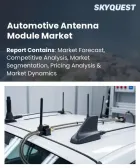
|
시장보고서
상품코드
2068984
자동차용 안테나 모듈 시장 규모, 점유율 및 성장 분석 : 안테나 유형별, 주파수대별, 용도별, 차종별, 판매채널별, 지역별 - 업계 예측(2026-2033년)Automotive Antenna Module Market Size, Share, and Growth Analysis, By Antenna Type (Shark Fin Antennas, Rod Antennas), By Frequency Band, By Application, By Vehicle Type, By Sales Channel, By Region - Industry Forecast 2026-2033 |
||||||

세계의 자동차용 안테나 모듈 시장 규모는 2024년에 36억 달러로 평가되었고, 2025년 38억 6,000만 달러에서 2033년까지 67억 3,000만 달러로 성장하여 예측 기간(2026-2033년)에 CAGR 7.2%를 기록할 전망입니다.
세계 자동차용 안테나 모듈 시장은 차량 간 통신, 위성 내비게이션, 인포테인먼트 연결을 가능하게 하는 범용성이 높은 다중 주파수 송수신기가 특징입니다. 어댑티브 크루즈 컨트롤 및 V2X 통신을 포함한 첨단 안전 시스템에 대한 수요가 급증함에 따라, 다양한 주파수 대역에 걸친 안정적인 신호 수신이 필수적입니다. 기존에는 안테나 모듈이 독립된 단일 대역 유닛으로 작동했으나, 커넥티드카 기능의 등장으로 제조업체들은 공간 최적화와 경량화를 도모하기 위해 여러 개의 안테나를 하나의 모듈로 통합하게 되었습니다. 배출가스 규제 및 자율주행 기능 강화와 관련된 규제 요건 역시 이러한 모듈에 대한 수요를 더욱 높이고 있습니다. 이는 ADAS(첨단 운전자 지원 시스템)가 끊김 없는 고주파 데이터 스트림에 의존하고 있기 때문입니다. AI가 이 분야에 점점 더 큰 영향을 미치면서, 머신러닝을 활용한 스마트 신호 관리가 연결성을 향상시키고 모듈 설계를 합리화함으로써 혁신과 시장 성장을 주도하고 있습니다.
세계 자동차용 안테나 모듈 시장의 성장 요인
자동차 제조업체들의 다양한 통신 시스템 통합이 진행됨에 따라, 폭넓은 주파수 대역을 지원할 수 있는 소형 고성능 안테나 모듈에 대한 수요가 증가하고 있습니다. 이러한 통합을 통해 인포테인먼트, 내비게이션, 텔레매틱스 서비스의 향상이 촉진됨에 따라, 제조업체들은 연결성에 대한 소비자의 기대에 부응하는 첨단 안테나 솔루션을 모색하고 있습니다. 그 결과, 신뢰성이 높은 멀티밴드 안테나 모듈을 전문으로 하는 공급업체에 대한 관심이 급증하고 있으며, 이는 시장 성장에 크게 기여하고 있습니다. 전 세계의 다양한 자동차 부문에 대응하기 위해 차량에는 첨단 커넥티비티 인프라가 요구되고 있으며, 혁신적인 안테나 솔루션에 대한 수요는 더욱 높아지고 있습니다. 이를 통해 활기가 넘치며 지속적으로 성장하는 시장 상황이 유지되고 있습니다.
세계 자동차용 안테나 모듈 시장의 제약 요인
세계 자동차용 안테나 모듈 시장은 안테나 모듈에 대해 광범위한 시험 및 인증 절차가 요구되는 엄격한 전자파 방출 기준과 안전 규제로 인해 큰 과제에 직면해 있습니다. 제조업체는 자사의 설계가 다양한 지역 및 전 세계의 지침을 충족하고 있음을 보장해야 하므로, 이러한 규정 준수 요건은 개발 기간을 연장하고 공급업체의 비용을 증가시킵니다. 그 결과, 설계 수정이 수차례 이루어지는 경우가 많으며, 전문 지식이 요구되기 때문에 중소기업 시장 진입을 저해하는 요인이 되고 있습니다. 또한, 규제에 지속적으로 적응해야 한다는 점은 OEM(원청 브랜드 제조업체) 및 부품 공급업체에 추가적인 복잡성을 초래하며, 결국 경쟁 역학을 저해하고 시장 성장을 정체시키는 요인이 되고 있습니다.
세계 자동차용 안테나 모듈 시장 동향
세계 자동차용 안테나 모듈 시장에서는 5G 연결 통합을 원동력으로 하는 큰 흐름이 나타나고 있으며, 제조업체들은 더 높은 주파수 대역을 지원하고 저지연 통신을 보장하는 첨단 안테나 시스템을 탑재할 수밖에 없는 상황입니다. 이러한 진화를 통해 고해상도 미디어 스트리밍에 대한 원활한 접속, 실시간 내비게이션 기능의 강화, 그리고 ADAS(첨단 운전자 지원 시스템)의 향상이 가능해집니다. 각 공급업체들은 성능을 저하시키지 않으면서 더 소형화된 모듈을 설계함으로써 혁신을 추진하고 있으며, 한편 자동차 설계자들은 멀티밴드 시스템에 대응할 수 있도록 차량 아키텍처를 조정하고 있습니다. 통신 사업자들이 인프라를 강화함에 따라, 차량의 커넥티비티에 대한 집중 투자가 중요한 차별화 요소로 부상하고 있으며, 이는 커넥티드 서비스의 도입을 촉진하는 동시에 제조업체와 서비스 제공업체 모두에게 새로운 수익 기회를 열어주고 있습니다.
자주 묻는 질문
목차
서론
조사 방법
주요 요약
시장 역학과 전망
주요 시장 인사이트
세계의 자동차용 안테나 모듈 시장 규모 : 안테나 유형별
세계의 자동차용 안테나 모듈 시장 규모 : 주파수대별
세계의 자동차용 안테나 모듈 시장 규모 : 용도별
세계의 자동차용 안테나 모듈 시장 규모 : 차종별
세계의 자동차용 안테나 모듈 시장 규모 : 판매채널별
세계의 자동차용 안테나 모듈 시장 규모 : 지역별
경쟁 정보
주요 기업 개요
결론과 제안
LSH 26.07.02Global Automotive Antenna Module Market size was valued at USD 3.6 Billion in 2024 and is poised to grow from USD 3.86 Billion in 2025 to USD 6.73 Billion by 2033, growing at a CAGR of 7.2% during the forecast period (2026-2033).
The global automotive antenna module market is characterized by versatile, multi-frequency transceivers that facilitate critical vehicle-to-vehicle communication, satellite navigation, and infotainment connectivity. The surge in demand for advanced safety systems, including adaptive cruise control and V2X messaging, necessitates robust signal reception across various frequency bands. Traditionally, antenna modules functioned as discrete, single-band units; however, the advent of connected car functionalities has prompted manufacturers to consolidate multiple antennas into a single module to optimize space and reduce weight. Regulatory demands for emissions control and enhanced autonomous capabilities further amplify the need for these modules, as advanced driver-assistance systems rely on uninterrupted high-frequency data streams. As AI increasingly influences the sector, smart signal management through machine learning enhances connectivity and streamlines module design, driving innovation and market growth.
Top-down and bottom-up approaches were used to estimate and validate the size of the Global Automotive Antenna Module market and to estimate the size of various other dependent submarkets. The research methodology used to estimate the market size includes the following details: The key players in the market were identified through secondary research, and their market shares in the respective regions were determined through primary and secondary research. This entire procedure includes the study of the annual and financial reports of the top market players and extensive interviews for key insights from industry leaders such as CEOs, VPs, directors, and marketing executives. All percentage shares split, and breakdowns were determined using secondary sources and verified through Primary sources. All possible parameters that affect the markets covered in this research study have been accounted for, viewed in extensive detail, verified through primary research, and analyzed to get the final quantitative and qualitative data.
Global Automotive Antenna Module Market Segments Analysis
Global automotive antenna module market is segmented by antenna type, frequency band, application, vehicle type, sales channel and region. Based on antenna type, the market is segmented into Shark Fin Antennas, Rod Antennas, Screen Antennas and Smart Antennas. Based on frequency band, the market is segmented into High Frequency, Very High Frequency and Ultra High Frequency. Based on application, the market is segmented into Satellite Radio Navigation, Cellular Communication, Wi-Fi Connection and Vehicle-to-Everything Communication. Based on vehicle type, the market is segmented into Passenger Cars and Commercial Vehicles. Based on sales channel, the market is segmented into Original Equipment Manufacturer and Aftermarket. Based on region, the market is segmented into North America, Europe, Asia Pacific, Latin America and Middle East & Africa.
Driver of the Global Automotive Antenna Module Market
The increasing integration of various communication systems by automakers is driving the demand for compact, high-performance antenna modules capable of supporting a range of frequency bands. This integration facilitates enhanced infotainment, navigation, and telematics services, pushing manufacturers to seek advanced antenna solutions that align with consumer expectations for connectivity. In turn, suppliers specializing in reliable, multi-band antenna modules are witnessing a surge in interest, significantly contributing to market growth. As vehicles require sophisticated connectivity infrastructures to cater to diverse automotive segments worldwide, the demand for innovative antenna solutions is further bolstered, ensuring a vibrant and expanding market landscape.
Restraints in the Global Automotive Antenna Module Market
The Global Automotive Antenna Module market faces significant challenges due to rigorous electromagnetic emission standards and safety regulations that necessitate extensive testing and certification protocols for antenna modules. This compliance requirement extends development timelines and escalates costs for suppliers, as manufacturers must ensure that their designs meet diverse regional and global directives. Consequently, this often leads to multiple design revisions and demands specialized expertise, which can deter smaller companies from entering the market. Additionally, the need for ongoing regulatory adaptation introduces further complexity for original equipment manufacturers and component providers, ultimately hindering competitive dynamics and stalling market growth.
Market Trends of the Global Automotive Antenna Module Market
The Global Automotive Antenna Module market is experiencing a significant trend driven by the integration of 5G connectivity, compelling manufacturers to embed advanced antenna systems that cater to higher-frequency bands and ensure low-latency communication. This evolution facilitates seamless access to high-definition media streaming, real-time navigation enhancements, and improved driver-assistance features. Suppliers are innovating by designing more compact modules without compromising on performance, while automotive designers are adapting vehicle architectures to accommodate multi-band systems. As telecom operators enhance their infrastructure, the emphasis on vehicle connectivity becomes a critical differentiator, propelling the adoption of connected services and unlocking new revenue opportunities for both manufacturers and service providers.
Table of Contents
Introduction
- Objectives of the Study
- Market Definition & Scope
Research Methodology
- Research Process
- Secondary & Primary Data Methods
- Market Size Estimation Methods
Executive Summary
- Global Market Outlook
- Key Market Highlights
- Segmental Overview
- Competition Overview
Market Dynamics & Outlook
- Macro-Economic Indicators
- Drivers & Opportunities
- Restraints & Challenges
- Supply Side Trends
- Demand Side Trends
- Porters Analysis & Impact
- Competitive Rivalry
- Threat of Substitute
- Bargaining Power of Buyers
- Threat of New Entrants
- Bargaining Power of Suppliers
Key Market Insights
- Key Success Factors
- Market Impacting Factors
- Top Investment Pockets
- Ecosystem Mapping
- Market Attractiveness Index 2025
- PESTEL Analysis
- Regulatory Landscape
Global Automotive Antenna Module Market Size by Antenna Type & CAGR (2026-2033)
- Market Overview
- Shark Fin Antennas
- Rod Antennas
- Screen Antennas
- Smart Antennas
Global Automotive Antenna Module Market Size by Frequency Band & CAGR (2026-2033)
- Market Overview
- High Frequency
- Very High Frequency
- Ultra High Frequency
Global Automotive Antenna Module Market Size by Application & CAGR (2026-2033)
- Market Overview
- Satellite Radio Navigation
- GPS Systems
- GLONASS Systems
- Cellular Communication
- Wi-Fi Connection
- Vehicle-to-Everything Communication
Global Automotive Antenna Module Market Size by Vehicle Type & CAGR (2026-2033)
- Market Overview
- Passenger Cars
- Commercial Vehicles
Global Automotive Antenna Module Market Size by Sales Channel & CAGR (2026-2033)
- Market Overview
- Original Equipment Manufacturer
- Aftermarket
Global Automotive Antenna Module Market Size & CAGR (2026-2033)
- North America (Antenna Type, Frequency Band, Application, Vehicle Type, Sales Channel)
- US
- Canada
- Europe (Antenna Type, Frequency Band, Application, Vehicle Type, Sales Channel)
- Germany
- Spain
- France
- UK
- Italy
- Rest of Europe
- Asia Pacific (Antenna Type, Frequency Band, Application, Vehicle Type, Sales Channel)
- China
- India
- Japan
- South Korea
- Rest of Asia-Pacific
- Latin America (Antenna Type, Frequency Band, Application, Vehicle Type, Sales Channel)
- Mexico
- Brazil
- Rest of Latin America
- Middle East & Africa (Antenna Type, Frequency Band, Application, Vehicle Type, Sales Channel)
- GCC Countries
- South Africa
- Rest of Middle East & Africa
Competitive Intelligence
- Top 5 Player Comparison
- Market Positioning of Key Players, 2025
- Strategies Adopted by Key Market Players
- Recent Developments in the Market
- Company Market Share Analysis, 2025
- Company Profiles of All Key Players
- Company Details
- Product Portfolio Analysis
- Company's Segmental Share Analysis
- Revenue Y-O-Y Comparison (2023-2025)
Key Company Profiles
- TE Connectivity
- Company Overview
- Business Segment Overview
- Financial Updates
- Key Developments
- Continental AG
- Company Overview
- Business Segment Overview
- Financial Updates
- Key Developments
- Denso Corporation
- Company Overview
- Business Segment Overview
- Financial Updates
- Key Developments
- Yokowo Co. Ltd.
- Company Overview
- Business Segment Overview
- Financial Updates
- Key Developments
- Laird Connectivity
- Company Overview
- Business Segment Overview
- Financial Updates
- Key Developments
- Ficosa International SA
- Company Overview
- Business Segment Overview
- Financial Updates
- Key Developments
- Furuno Electric Co. Ltd.
- Company Overview
- Business Segment Overview
- Financial Updates
- Key Developments
- Harada Industry Co. Ltd.
- Company Overview
- Business Segment Overview
- Financial Updates
- Key Developments
- Kathrein SE
- Company Overview
- Business Segment Overview
- Financial Updates
- Key Developments
- Kymeta Corporation
- Company Overview
- Business Segment Overview
- Financial Updates
- Key Developments
- Intellian Technologies Inc.
- Company Overview
- Business Segment Overview
- Financial Updates
- Key Developments
- Amphenol Corporation
- Company Overview
- Business Segment Overview
- Financial Updates
- Key Developments
- Molex LLC
- Company Overview
- Business Segment Overview
- Financial Updates
- Key Developments
- Taoglas
- Company Overview
- Business Segment Overview
- Financial Updates
- Key Developments
- PCTEL Inc.
- Company Overview
- Business Segment Overview
- Financial Updates
- Key Developments
- Panorama Antennas Ltd.
- Company Overview
- Business Segment Overview
- Financial Updates
- Key Developments
- Ace Technologies Corporation
- Company Overview
- Business Segment Overview
- Financial Updates
- Key Developments
- Calearo Antenne SpA
- Company Overview
- Business Segment Overview
- Financial Updates
- Key Developments
- Schaffner Holding AG
- Company Overview
- Business Segment Overview
- Financial Updates
- Key Developments
- Smarteq Wireless AB
- Company Overview
- Business Segment Overview
- Financial Updates
- Key Developments


