|
시장보고서
상품코드
2119412
오프셋 인쇄판 시장 규모, 점유율 및 성장 분석 : 판 유형별, 소재별, 용도별, 최종사용자별, 노광 기술별, 지역별 - 업계 예측(2026-2033년)Offset Printing Plate Market Size, Share, and Growth Analysis, By Plate Type (Thermal Plates, Violet Plates), By Material (Aluminum, Polyester), By Application, By End User, By Imaging Technology, By Region - Industry Forecast 2026-2033 |
||||||

세계의 오프셋 인쇄판 시장 규모는 2024년에 41억 6,000만 달러로 평가되며, 2025년 43억 2,000만 달러에서 2033년까지 58억 7,000만 달러로 확대하며, 예측 기간(2026-2033년)에 CAGR 3.9%로 성장할 것으로 전망되고 있습니다.
포토폴리머 및 알루미늄 시트로 구성된 전 세계 오프셋 인쇄판 시장은 잉크를 종이에 효율적으로 전사함으로써 대량 인쇄에서 매우 중요한 역할을 하고 있습니다. 이 방식은 잡지, 카탈로그, 패키지 제조에서 여전히 높은 비용 대비 효과를 발휘하고 있으며, 상업 인쇄량의 약 60%를 차지하고 있습니다. 이 업계는 설정 시간을 단축하고 효율을 높이는 디지털 워크플로우 도입 등 기술 발전에 따라 현저히 진화해 왔습니다. 지속가능한 포장에 대한 소비자 수요가 증가함에 따라 성장이 가속화되고 있으며, 각 브랜드는 폐기물을 최소화하는 보다 친환경적인 솔루션으로 오프셋 인쇄를 선택하고 있습니다. 이에 대응하여 각 제조사들은 저배출형 포토폴리머 및 초박형 인쇄판 도입 등 혁신적인 노력을 추진하고 있습니다. 인쇄판 제조사에게 주요 비즈니스 기회는 생분해성 기판의 제공과 시장 출시를 가속화하기 위한 워크플로우 서비스 강화에 있습니다.
세계 오프셋 인쇄판 시장 촉진요인
환경적으로 지속가능한 포장 솔루션에 대한 수요가 증가함에 따라 인쇄업체들은 재생 소재를 지원하고 폐기물을 최소화하는 오프셋 인쇄판의 채택을 추진하고 있습니다. 이에 대응하여 각 제조사는 휘발성 유기 화합물(VOC) 배출량을 줄이고 생분해성 잉크와의 호환성을 높인 인쇄판을 개발함으로써 혁신을 도모하고, 자사 제품을 지속가능성 목표에 효과적으로 부합시키고 있습니다. 이러한 환경 친화적 노력은 환경 의식이 높은 소비자들 사이에서 브랜드 이미지를 향상시키고 재구매를 촉진함으로써, 시장 성장을 지원하는 지속적인 수요를 창출하고 있습니다. 그 결과, 이러한 추세는 전 세계 인쇄 업계에서 보다 친환경적인 인쇄판 기술에 대한 투자를 촉진하고, 환경 규제 및 기준을 장기적으로 준수하기 쉽게 만들고 있습니다.
세계 오프셋 인쇄판 시장의 제약 요인
전 세계 오프셋 인쇄판 시장은 현대의 오프셋 인쇄판에 사용되는 고성능 포토폴리머 및 세라믹 화합물에 따른 원자재 비용 급등으로 인해 과제에 직면해 있습니다. 제조사는 고품질 원자재를 조달하고, 엄격한 품질 기준을 준수하며, 전문적인 취급 방법을 시행해야 하는데, 이 모든 것이 생산 비용 상승으로 이어지고 있습니다. 그 결과, 자금력이 제한적인 인쇄 회사는 더 고성능의 인쇄판으로의 교체를 미루거나, 저비용이지만 품질이 떨어지는 대체품을 선택하기도 하는데, 이는 시장 전체의 성장을 저해하는 요인이 되고 있습니다. 이러한 가격에 대한 민감성은, 특히 합리적인 가격이 구매 결정에 큰 영향을 미치는 경쟁이 치열한 지역에서 보급을 저해하는 요인으로 작용하고 있습니다.
세계 오프셋 인쇄판 시장의 동향
전 세계 오프셋 인쇄판 시장에서는 기존 오프셋 판과 디지털 UV 경화형 잉크의 통합에 의해 주도되는 중요한 동향이 나타나고 있습니다. 이 혁신적인 접근 방식은 색상의 선명도를 높이고 건조 시간을 단축시켜 전반적인 인쇄 효율을 향상시킵니다. 인쇄 업체들은 짧은 납기 및 소량 주문형 인쇄에 주력하는 가운데, 더 높은 인쇄 품질을 요구하는 고객의 요청에 부응하는 동시에 폐기물 감축에도 힘쓰고 있습니다. 공급업체와 제조업체 간의 협력을 통해 잉크와 판의 호환성을 개선하고, 인쇄 가능한 소재의 범위를 넓히는 것을 목표로 하고 있습니다. 이러한 동향은 상업 인쇄의 성장을 지원할 뿐만 아니라, 지속가능성을 위한 노력과도 부합하여 업계를 더욱 환경 친화적인 미래로 이끌고 있습니다.
자주 묻는 질문
목차
서론
조사 방법
개요
시장 역학과 전망
주요 시장 인사이트
세계의 오프셋 인쇄판 시장 규모 : 판 유형별
세계의 오프셋 인쇄판 시장 규모 : 소재별
세계의 오프셋 인쇄판 시장 규모 : 용도별
세계의 오프셋 인쇄판 시장 규모 : 최종사용자별
세계의 오프셋 인쇄판 시장 규모 : 이미징 기술별
세계의 오프셋 인쇄판 시장 규모 : 지역별
경쟁 정보
주요 기업 개요
결론과 제안
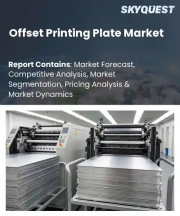
KSA 26.08.28Global Offset Printing Plate Market size was valued at USD 4.16 Billion in 2024 and is poised to grow from USD 4.32 Billion in 2025 to USD 5.87 Billion by 2033, growing at a CAGR of 3.9% during the forecast period (2026-2033).
The global offset printing plate market, comprising photopolymer and aluminum sheets, plays a pivotal role in high-volume printing by efficiently transferring ink to paper. This method remains highly cost-effective for producing magazines, catalogs, and packaging, representing around 60% of the commercial print volume. The industry has evolved significantly with technological advancements, including the adoption of digital workflows that streamline setup time and enhance efficiency. Increasing consumer demand for sustainable packaging propels growth, prompting brands to opt for offset printing as a more eco-friendly solution that minimizes waste. In response, manufacturers are innovating with low-emission photopolymers and thinner plates. Key opportunities for plate manufacturers lie in offering biodegradable substrates and enhancing workflow services to accelerate market readiness.
Top-down and bottom-up approaches were used to estimate and validate the size of the Global Offset Printing Plate market and to estimate the size of various other dependent submarkets. The research methodology used to estimate the market size includes the following details: The key players in the market were identified through secondary research, and their market shares in the respective regions were determined through primary and secondary research. This entire procedure includes the study of the annual and financial reports of the top market players and extensive interviews for key insights from industry leaders such as CEOs, VPs, directors, and marketing executives. All percentage shares split, and breakdowns were determined using secondary sources and verified through Primary sources. All possible parameters that affect the markets covered in this research study have been accounted for, viewed in extensive detail, verified through primary research, and analyzed to get the final quantitative and qualitative data.
Global Offset Printing Plate Market Segments Analysis
Global offset printing plate market is segmented by plate type, material, application, end user, imaging technology and region. Based on plate type, the market is segmented into Thermal Plates, Violet Plates, Processless Plates and Conventional Plates. Based on material, the market is segmented into Aluminum and Polyester. Based on application, the market is segmented into Commercial Printing, Newspaper Printing, Packaging Printing and Label Printing. Based on end user, the market is segmented into Commercial Printers, Packaging Companies and Publishing Houses. Based on imaging technology, the market is segmented into Computer-to-Plate (CTP) and Computer-to-Film (CTF). Based on region, the market is segmented into North America, Europe, Asia Pacific, Latin America and Middle East & Africa.
Driver of the Global Offset Printing Plate Market
The increasing demand for environmentally sustainable packaging solutions is driving printers to utilize offset printing plates that accommodate recycled materials and minimize waste. In response, manufacturers are innovating by creating plates that emit lower levels of volatile organic compounds and are more compatible with biodegradable inks, effectively aligning their products with sustainability objectives. This focus on eco-friendliness enhances brand image among environmentally conscious consumers and promotes repeat business, generating a continuous demand that fuels market growth. Consequently, this trend encourages investments in greener plate technologies within printing industries worldwide, facilitating long-term compliance with environmental regulations and standards.
Restraints in the Global Offset Printing Plate Market
The Global Offset Printing Plate market faces challenges due to the elevated material costs associated with high-performance photopolymer and ceramic compounds used in modern offset plates. Manufacturers are required to procure premium raw materials, adhere to strict quality standards, and implement specialized handling methods, all contributing to higher production costs. As a result, print shops operating with limited financial resources may delay upgrades to more advanced plates or choose lower-cost, inferior alternatives, hindering overall market growth. This sensitivity to pricing acts as an obstacle to widespread adoption, especially in competitive regions where affordability heavily influences purchasing choices.
Market Trends of the Global Offset Printing Plate Market
The Global Offset Printing Plate market is witnessing a significant trend driven by the integration of digital UV-curable inks with traditional offset plates. This innovative approach enhances color vibrancy and minimizes drying times, thereby improving overall print efficiency. As print manufacturers focus on quick job turnarounds and short on-demand runs, they are responding to client demands for higher print quality while simultaneously reducing waste. Collaborative efforts between suppliers and manufacturers aim to enhance ink-plate compatibility, broadening the range of printable substrates available. This trend not only supports commercial printing growth but also aligns with sustainability initiatives, propelling the industry toward a more environmentally responsible future.
Table of Contents
Introduction
- Objectives of the Study
- Market Definition & Scope
Research Methodology
- Research Process
- Secondary & Primary Data Methods
- Market Size Estimation Methods
Executive Summary
- Global Market Outlook
- Key Market Highlights
- Segmental Overview
- Competition Overview
Market Dynamics & Outlook
- Macro-Economic Indicators
- Drivers & Opportunities
- Restraints & Challenges
- Supply Side Trends
- Demand Side Trends
- Porters Analysis & Impact
- Competitive Rivalry
- Threat of Substitute
- Bargaining Power of Buyers
- Threat of New Entrants
- Bargaining Power of Suppliers
Key Market Insights
- Key Success Factors
- Market Impacting Factors
- Top Investment Pockets
- Ecosystem Mapping
- Market Attractiveness Index 2025
- PESTEL Analysis
- Regulatory Landscape
Global Offset Printing Plate Market Size by Plate Type & CAGR (2026-2033)
- Market Overview
- Thermal Plates
- Violet Plates
- Processless Plates
- Conventional Plates
Global Offset Printing Plate Market Size by Material & CAGR (2026-2033)
- Market Overview
- Aluminum
- Polyester
Global Offset Printing Plate Market Size by Application & CAGR (2026-2033)
- Market Overview
- Commercial Printing
- Newspaper Printing
- Packaging Printing
- Label Printing
Global Offset Printing Plate Market Size by End User & CAGR (2026-2033)
- Market Overview
- Commercial Printers
- Packaging Companies
- Publishing Houses
Global Offset Printing Plate Market Size by Imaging Technology & CAGR (2026-2033)
- Market Overview
- Computer-to-Plate (CTP)
- Computer-to-Film (CTF)
Global Offset Printing Plate Market Size & CAGR (2026-2033)
- North America (Plate Type, Material, Application, End User, Imaging Technology)
- US
- Canada
- Europe (Plate Type, Material, Application, End User, Imaging Technology)
- Germany
- Spain
- France
- UK
- Italy
- Rest of Europe
- Asia Pacific (Plate Type, Material, Application, End User, Imaging Technology)
- China
- India
- Japan
- South Korea
- Rest of Asia-Pacific
- Latin America (Plate Type, Material, Application, End User, Imaging Technology)
- Mexico
- Brazil
- Rest of Latin America
- Middle East & Africa (Plate Type, Material, Application, End User, Imaging Technology)
- GCC Countries
- South Africa
- Rest of Middle East & Africa
Competitive Intelligence
- Top 5 Player Comparison
- Market Positioning of Key Players, 2025
- Strategies Adopted by Key Market Players
- Recent Developments in the Market
- Company Market Share Analysis, 2025
- Company Profiles of All Key Players
- Company Details
- Product Portfolio Analysis
- Company's Segmental Share Analysis
- Revenue Y-O-Y Comparison (2023-2025)
Key Company Profiles
- FUJIFILM Holdings Corporation
- Company Overview
- Business Segment Overview
- Financial Updates
- Key Developments
- Eastman Kodak Company
- Company Overview
- Business Segment Overview
- Financial Updates
- Key Developments
- Agfa-Gevaert NV
- Company Overview
- Business Segment Overview
- Financial Updates
- Key Developments
- Toray Industries, Inc.
- Company Overview
- Business Segment Overview
- Financial Updates
- Key Developments
- Lucky HuaGuang Graphics Co., Ltd.
- Company Overview
- Business Segment Overview
- Financial Updates
- Key Developments
- Xingraphics Co., Ltd.
- Company Overview
- Business Segment Overview
- Financial Updates
- Key Developments
- Bottcher Systems GmbH
- Company Overview
- Business Segment Overview
- Financial Updates
- Key Developments
- Presstek LLC
- Company Overview
- Business Segment Overview
- Financial Updates
- Key Developments
- Flint Group
- Company Overview
- Business Segment Overview
- Financial Updates
- Key Developments
- Mitsubishi Paper Mills Limited
- Company Overview
- Business Segment Overview
- Financial Updates
- Key Developments
- Hangzhou CRON Machinery & Electronics Co., Ltd.
- Company Overview
- Business Segment Overview
- Financial Updates
- Key Developments
- Huafeng Printing Plate Co., Ltd.
- Company Overview
- Business Segment Overview
- Financial Updates
- Key Developments
- Ronsein Printing Material Co., Ltd.
- Company Overview
- Business Segment Overview
- Financial Updates
- Key Developments
- Siegwerk Druckfarben AG & Co. KGaA
- Company Overview
- Business Segment Overview
- Financial Updates
- Key Developments
- T&K TOKA Co., Ltd.
- Company Overview
- Business Segment Overview
- Financial Updates
- Key Developments
- Toyo Ink SC Holdings Co., Ltd.
- Company Overview
- Business Segment Overview
- Financial Updates
- Key Developments
- DIC Corporation
- Company Overview
- Business Segment Overview
- Financial Updates
- Key Developments
- Sakai Chemical Industry Co., Ltd.
- Company Overview
- Business Segment Overview
- Financial Updates
- Key Developments
- Zhejiang Konita New Material Co., Ltd.
- Company Overview
- Business Segment Overview
- Financial Updates
- Key Developments
- Mark Andy, Inc.
- Company Overview
- Business Segment Overview
- Financial Updates
- Key Developments