

|
시장보고서
상품코드
2043837
하이브리드 차량 시장 : 점유율 분석, 업계 동향과 통계, 성장 예측(2026-2031년)Hybrid Vehicle - Market Share Analysis, Industry Trends & Statistics, Growth Forecasts (2026 - 2031) |
||||||
 Mordor Intelligence
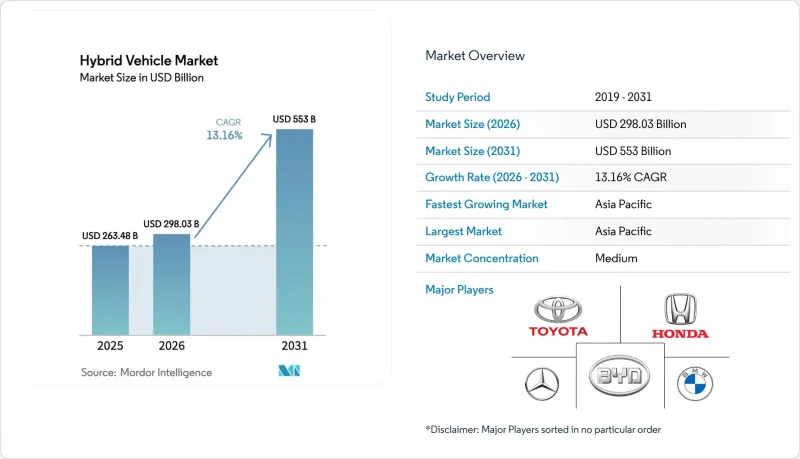
하이브리드 차량 시장 규모는 2025년 2,634억 8,000만 달러에서 2026년에는 2,980억 3,000만 달러로 확대되어 예측 기간(2026-2031년) CAGR 13.16%로 성장을 지속하여, 2031년까지 5,530억 달러에 이를 것으로 예측됩니다.
세계 온실가스 규제 강화, 배터리 비용 하락, 다각화된 파워트레인 전략으로 인해 수요가 확대되는 동시에 자동차 제조업체들은 불확실한 전동화 속도에 대비할 수 있게 되었습니다. 배터리 팩의 가격 하락과 전기로만 주행거리를 평가하는 정책적 혜택으로 인해 플러그인 하이브리드가 가장 빠르게 성장하고 있는 구성이 되었습니다. 반면, 기존 하이브리드 차량은 충전 인프라에 대한 부담이 가장 적기 때문에 판매량 1위를 유지하고 있습니다. 영구 자석 모터가 여전히 주류이지만, 제조업체가 희토류 공급 위험에 대한 의존도를 낮추면서 유도 모터의 채택도 확대되고 있습니다. 리튬인산철 배터리는 비용, 안전성, 사이클 수명의 균형이 뛰어나 현재 대부분의 하이브리드 차량에 최적의 선택이 되고 있습니다. 일본의 기존 제조업체들이 기술적 우위를 지키려는 반면, 자체 생산 배터리를 활용해 가격 경쟁력을 높이는 중국 브랜드와의 경쟁이 심화되고 있습니다.
세계 하이브리드 차량 시장 동향과 인사이트
2027년까지 PHEV의 배터리 비용이 동등한 수준에 도달하는 전환점
중기적으로 자동차 제조업체들은 리튬 이온 배터리 팩의 비용을 크게 낮추는 방향으로 방향을 잡고 있습니다. 포드는 최근 실적 설명회에서 F-150 PowerBoost의 팩 비용이 전년 대비 크게 감소했다고 밝혔으며, 그 요인으로 미국산 수산화리튬 조달 계약을 꼽았습니다. 제너럴모터스(GM)는 경쟁력 있는 가격 프리미엄을 붙인 플러그인 크로스오버 차량 도입을 목표로 하고 있으며, 이는 과거 비용 측면의 불리함을 해소하기 위한 전략적 움직임이라고 할 수 있습니다. 토요타는 최신 보고서에서 프리우스 프라임의 배터리 비용(kWh당)이 가격 인하에도 불구하고 건전한 영업 이익률을 유지할 수 있는 수준까지 떨어졌습니다고 밝혔습니다. 셀-투-팩 통합의 급속한 발전, 코발트 함량 감소, LFP(리튬인산철리튬) 배터리 채택 확대에 따라 플러그인 하이브리드 차량은 다음 모델 사이클에 가솔린 차량과 동등한 판매 가격을 달성할 것으로 예측됩니다.
세계 각국의 CAFE/GHG 규제 강화 및 제로 배출 의무화
규제 강화는 하이브리드 차량 보급 급증의 주요 요인입니다. 미국 환경보호청(EPA)은 가까운 미래에 엄격한 소형차 기준을 설정하고, 차량군의 배출가스를 대폭 감축할 것을 의무화하고 있습니다. 이러한 움직임으로 인해 제조업체들은 전동화 드라이브 트레인을 도입해야 하며, 그렇지 않으면 막대한 벌금이 부과될 수 있습니다. 한편, 유럽에서 도입 예정인 규제는 모든 환경 조건에서 실제 주행 배출가스 기준을 준수하도록 요구하고 있습니다. 이에 따라 소형차에서도 마일드 하이브리드 차량의 채택이 진행되고 있습니다. 중국에서는 듀얼 크레딧 제도를 통해 플러그인 하이브리드 차량 1대당 많은 인센티브를 제공합니다. 이 인센티브를 통해 자동차 제조업체는 내연기관차의 배출량 부족을 상쇄할 수 있습니다. 캘리포니아 주에서는 'Advanced Clean Cars II' 이니셔티브에서 특정 전기 주행거리 요건을 충족하는 플러그인 하이브리드 차량이 제로 에미션 쿼터로 인정받고 있습니다. 이 요구사항은 배터리용량 확대를 촉진할 뿐만 아니라 규제 준수를 위한 여유를 창출하고 있습니다. 이러한 규제 조치들이 복합적으로 작용하여 하이브리드 차량 시장을 형성하고 있으며, 2020년대 말까지 수요가 지속될 것으로 보입니다.
도시 지역에서의 차량 운영에서 BEV의 총 소유 비용이 동등한 수준에 도달했습니다.
전기 요금이 저렴하고 차고에서 충전할 수 있는 도시 지역에서는 배터리 전기 밴이 장기적으로 플러그인 하이브리드 차량보다 더 비용 효율적임이 입증되었습니다. 2025년 초, 아마존은 리비아의 배터리 전기자동차(BEV)가 가동 시간이 길고 유지보수 비용도 절감할 수 있다는 이유로 몇년안에 플러그인 하이브리드 밴을 단계적으로 폐지할 계획을 발표했습니다. 마찬가지로, UPS는 유럽의 도시 노선을 운행하는 모든 전기 트럭의 마일당 비용이 크게 절감되었다는 점을 강조하며, 고정된 노선을 운행하는 차량에서 플러그인 하이브리드로부터 멀어지는 광범위한 업계 추세를 뒷받침합니다. 런던의 초저공해 구역(ULEZ)에서는 제로 에미션 모드로 주행하지 않는 하이브리드 차량에 대한 일별 요금이 도입되어 BEV에 대한 경제적 이점이 줄어들고 있습니다. 더 많은 도시가 유사한 조치를 도입함에 따라 도시 차량은 하이브리드 차량을 완전히 뛰어 넘어 디젤 차량에서 직접 완전 전기 차량으로 전환 할 수 있습니다.
부문 분석
2025년 기준, 기존 하이브리드 전기차는 하이브리드 차량 시장 점유율의 41.37%를 차지했지만, 플러그인 하이브리드 차량는 2031년까지 연평균 복합 성장률(CAGR) 13.17%를 나타낼 것으로 예측됩니다. 이러한 장점은 표준 하이브리드 차량의 충전 의존도가 낮기 때문에 공공 충전기가 여전히 부족한 지역에서는 결정적인 이점이 될 수 있습니다. 그러나 플러그인 하이브리드 차량은 더 큰 정책적 혜택의 혜택을 받고 있고, 배터리 비용도 꾸준히 하락하고 있어 OEM 업체들은 가솔린 차량과 동등한 가격대로 판매할 수 있게 되었습니다. BYD의 'Qin Plus DM-i'는 18.3kWh의 LFP 배터리 팩을 탑재해 55km의 전기 주행거리를 구현하면서도 중국 시장에서 기존 세단보다 저렴한 가격으로 판매되고 있습니다.
차량 수요는 지속적으로 플러그인 하이브리드에 편중되어 있으며, 도시 지역의 저공해 규제에서는 무배출 주행이 평가되고 있습니다. 스텔란티스는 2026년 랭글러 4xe의 배터리용량을 21.5kWh로 확대하여 캘리포니아주의 '50마일 전기 주행거리' 규제 요건을 충족시킬 것을 약속하고 있습니다. 현재 북미의 많은 픽업트럭에 표준으로 장착된 마일드 하이브리드 차량은 풀 하이브리드 모델보다 훨씬 적은 비용으로 8-12%의 연비 향상을 실현하여 차량 수요와 균형을 맞추고 있습니다. 그러나 충전 인프라가 제한된 지역에서는 HEV가 여전히 절대적인 판매량에서 가장 큰 점유율을 차지할 것입니다.
2025년 하이브리드 차량 시장 점유율에서 승용차는 77.31%를 차지했지만, 2031년까지 연평균 13.24%의 연평균 복합 성장률(CAGR)을 기록할 소형 상용차가 가장 빠르게 성장하는 카테고리입니다. 포드는 2025년 초 유럽에서 '트랜짓 커스텀' 플러그인 하이브리드 모델을 출시했습니다. 적당한 전기 주행거리를 갖춘 이 차량은 도심에서의 무배출 배송을 가능하게 하는 동시에 충분한 총 주행거리를 제공합니다. 독일에서는 메르세데스-벤츠가 자사의 'e스프린터' 하이브리드 모델의 주문이 BEV(배터리 전기자동차) 모델을 크게 앞질렀다고 지적하며, 충전으로 인한 가동 중단 시간을 피하려는 차량 사용자들의 의지가 부각되고 있다고 밝혔습니다. 한편, 중형 및 대형 트럭에는 현재 마일드 하이브리드 시스템이 도입되어 적재량을 손상시키지 않고 도시 간 이동 중 제동 에너지를 회수하고 있습니다.
2020년대 말까지, 특히 저배출 지역 규제가 유럽에서 남미 주요 도시로 확대됨에 따라 LCV(소형 상용차)의 하이브리드 차량 시장 점유율은 축소될 가능성이 있습니다. 승용 하이브리드 차량, 특히 소형 크로스오버는 아시아태평양에서 지속적인 성장세를 유지할 것으로 예상되며, 도시 소비자들이 보다 저렴한 BEV로 전환함에 따라 성장세가 둔화될 것으로 예측됩니다. 반면, 상업용 밴은 특히 도시와 지방을 오가는 다양한 노선과 일별 주행거리 변동에 따라 하이브리드 차량이 제공하는 연료 보급의 유연성을 중요하게 여깁니다.
지역별 분석
아시아태평양은 2025년 하이브리드 차량 시장 점유율의 38.73%를 차지해, 2031년까지 연평균 13.21%의 성장률을 보일 것으로 전망됩니다. 최근 중국에서는 생산과 판매를 장려하는 지원 정책과 주요 제조업체의 경쟁력 있는 가격 전략에 힘입어 플러그인 하이브리드 차량 판매가 급증하고 있습니다. 일본은 여전히 세계 최대 하이브리드 차량 수출국이며, 동남아시아, 중동, 중남미 등 주요 시장에 공급하고 있습니다. 인도의 하이브리드 차량에 대한 감세 조치로 디젤 차량과의 가격 차이가 줄어들면서 하이브리드 차량 등록대수가 눈에 띄게 증가하고 있습니다. 국내에서는 인기 모델의 플러그인 하이브리드 차량에 대해 국가 보조금을 대폭 지원하여 보급을 촉진하고 있습니다.
북미에서는 자동차 제조업체들이 배터리 전기자동차(BEV)를 둘러싼 불확실성에 대처하면서 하이브리드 차량에 대한 수요가 다시 증가하고 있습니다. 미국에서는 하이브리드 차량 판매가 크게 증가하고 있으며, 주요 제조업체들이 시장을 독점하고 있습니다. 캐나다에서는 전기 주행거리가 긴 플러그인 하이브리드 차량에 대한 혜택이 연장되어 인기 모델에 대한 수요가 유지되고 있습니다.
반면, 유럽에서는 주요 시장에서의 보조금 중단과 향후 제로 에미션 크레딧 정책을 둘러싼 불확실성으로 인해 플러그인 하이브리드 차량 등록 대수가 감소하고 있습니다. 영국에서는 저렴한 플러그인 차량에 대한 보조금이 축소된 채로 유지되고 있으며, 소비자의 관심은 프리미엄 하이브리드 차량에서 주류 크로스오버 차량으로 이동하고 있습니다.
남미와 중동에서는 하이브리드 차량의 보급이 아직 초기 단계에 있지만 급속한 성장세를 보이고 있습니다. 브라질에서는 하이브리드 차량에 대한 관세 인하로 주요 모델 시장 점유율이 크게 확대되었습니다. 아랍에미리트에서는 주행거리가 긴 플러그인 하이브리드 차량에 대한 무료 주차 및 통행료 면제 등의 혜택으로 고급 브랜드들이 이러한 요건을 충족하는 모델을 출시하도록 장려하고 있습니다. 사우디는 '비전 2030'의 지속가능성 목표의 일환으로 향후 몇 년 동안 정부 관용차로 하이브리드 차량를 대량 도입할 계획입니다. 현재 판매량은 아직 상대적으로 적은 편이지만, 충전 인프라가 구축됨에 따라 이러한 노력들이 향후 수요를 견인할 것으로 예측됩니다.
기타 특전:
- 엑셀 형식 시장 예측(ME) 시트
- 3개월간 애널리스트 지원
자주 묻는 질문
목차
제1장 서론
제2장 조사 방법
제3장 주요 요약
제4장 시장 구도
제5장 시장 규모 및 성장 예측(금액(달러) 및 수량(대수))
제6장 경쟁 구도
제7장 시장 기회와 향후 전망
JHS 26.06.11The hybrid vehicle market size is expected to grow from USD 263.48 billion in 2025 to USD 298.03 billion in 2026, and is forecast to reach USD 553 billion by 2031, at a CAGR of 13.16% during the forecast period (2026-2031).
Tightening global greenhouse gas rules, falling battery costs, and multipathway powertrain strategies are simultaneously expanding demand and protecting automakers from an uncertain pace of electrification. Plug-in hybrids are the fastest-growing configuration due to declines in battery pack costs and policy credits that reward electric-only range. In contrast, conventional hybrids maintain volume leadership because they impose the lightest burden on charging infrastructure. Permanent-magnet motors still dominate, but induction architectures are gaining as manufacturers reduce exposure to rare-earth supply risks. Lithium-iron-phosphate chemistry is now the battery of choice in most hybrids because it strikes a balance between cost, safety, and cycle life. Competition is intensifying as Japanese incumbents defend engineering leads against Chinese brands that leverage in-house battery production to undercut prices.
Global Hybrid Vehicle Market Trends and Insights
Battery Cost-Parity Tipping Point for PHEVs by 2027
By the mid-term future, automakers are steering towards significantly lower lithium-ion pack costs. Ford, in its recent earnings call, revealed a substantial year-on-year drop in the F-150 PowerBoost pack cost, attributing the decline to the United States-sourced lithium-hydroxide contracts . General Motors has set its sights on introducing plug-in crossovers with a competitive price premium, a strategic move that would negate the cost penalty seen in earlier years. Toyota, in its latest report, affirmed that the Prius Prime's battery cost per kilowatt-hour has fallen to a level that allows the company to maintain a healthy operating margin despite price reductions . With rapid cell-to-pack integration, reduced cobalt content, and a surge in LFP usage, plug-in hybrids are on track to match the sticker prices of gasoline models in the upcoming cycle.
Stricter Global CAFE/GHG Norms & Zero-Emission Mandates
Regulatory tightening is the primary driver of the surge in hybrid adoption. The U.S. Environmental Protection Agency has set stringent light-duty standards for the near future, mandating significantly lower fleet emissions. This move pushes manufacturers to integrate electrified drivetrains or face hefty penalties. Meanwhile, Europe's upcoming regulations will require real-world emissions compliance under all ambient conditions. This has led to the adoption of mild-hybrids, even in compact cars. In China, the dual-credit scheme offers substantial incentives for each plug-in hybrid electric vehicle. This incentive enables OEMs to balance out their internal-combustion deficits . In California, the Advanced Clean Cars II initiative recognizes plug-in hybrids in zero-emission quotas, provided they meet a specific electric range requirement. This requirement is not only boosting battery sizes but also providing a buffer for compliance. Together, these regulatory measures are shaping the hybrid landscape, ensuring sustained demand through the end of the decade.
BEV Total-Cost-of-Ownership Parity Achieved in Urban Fleets
In cities with affordable electricity and depot charging, battery-electric vans are proving to be more cost-effective over the long term than their plug-in hybrid counterparts. In early 2025, Amazon announced plans to phase out its plug-in hybrid vans within a few years, citing that Rivian's battery-electric vehicles (BEVs) offer superior uptime and reduced maintenance costs. Similarly, UPS highlighted a significant reduction in the cost per mile for its all-electric trucks operating on European city routes, underscoring a broader industry trend away from plug-in hybrids for fleets with set routes. London's Ultra Low Emission Zone has introduced daily fees for hybrids not operating in a zero-emission mode, diminishing their financial advantage over BEVs. With more cities likely to adopt similar measures, urban fleets might leap directly from diesel to fully electric vehicles, bypassing hybrids altogether.
Other drivers and restraints analyzed in the detailed report include:
- Soaring Fuel-Price Volatility Post-2024
- OEM Multi-Pathway Carbon Strategies
- Scarcity of Sustainably Mined Nickel & Cobalt
For complete list of drivers and restraints, kindly check the Table Of Contents.
Segment Analysis
Traditional hybrid electric vehicles held 41.37% of the hybrid vehicle market share in 2025, whereas plug-in hybrids are on track to log a 13.17% CAGR to 2031. This leadership reflects the minimal charging dependency of standard hybrids, a decisive advantage in grids where public chargers remain scarce. Plug-in hybrids, however, benefit from larger policy credits, and their batteries are steadily dropping in cost, allowing OEMs to price them near gasoline trim levels. BYD's Qin Plus DM-i undersells conventional sedans in China, bundling a 55 km electric range with an 18.3 kWh LFP pack.
Fleet demand continues to skew toward plug-in hybrids, where urban low-emission rules reward zero-tailpipe operation. Stellantis is committed to expanding the Wrangler 4xe battery capacity to 21.5 kWh in 2026, thereby qualifying for California's 50-mile electric range rule. Mild hybrids, now standard on many North American pickups, strike a balance between fleet needs by offering 8-12% fuel savings at a fraction of the cost of full-hybrid models. However, HEVs will still account for the largest absolute volume in regions with limited charging infrastructure.
Passenger cars accounted for 77.31% of the hybrid vehicle market share in 2025; however, light commercial vehicles are the fastest-growing class, with a 13.24% CAGR through 2031. Ford rolled out its Transit Custom plug-in hybrid in Europe in early 2025. With a moderate electric range, the vehicle enables emission-free deliveries in city centers, while also offering a substantial total driving radius. In Germany, Mercedes-Benz noted that orders for its eSprinter hybrid significantly outpaced those for BEV variants, highlighting fleet preferences to sidestep charging downtimes. Meanwhile, medium and heavy trucks are now integrating mild-hybrid systems, capturing braking energy during intercity journeys without compromising payload capacity.
By the end of the decade, the hybrid vehicle market share for LCVs may dwindle, especially as low-emission zone regulations extend from Europe to major capitals in South America. While passenger-car hybrids, particularly compact crossovers, will continue to hold a foothold in the Asia Pacific, their growth is expected to slow as urban consumers shift towards more affordable BEVs. On the other hand, commercial vans value the fueling flexibility that hybrids offer, especially for their diverse urban-rural routes and varying daily mileage.
The Hybrid Vehicle Market Report is Segmented by Hybrid Vehicle Type (Mild-Hybrid and More), Vehicle Type (Passenger Cars, Light Commercial Vehicles, and Medium and Heavy Commercial Vehicles), Motor Type (PMSM, Induction AC Motor, and More), Battery Type (Nickel-Metal Hydride, Lithium-Iron Phosphate, and Others), and Geography. Market Forecasts are Provided in Value (USD) and Volume (Units).
Geography Analysis
Asia Pacific commanded 38.73% of the hybrid vehicle market share in 2025 and is projected to grow at a 13.21% CAGR through 2031. In recent years, China's sales of plug-in hybrids have surged, driven by supportive policies that incentivize production and sales, as well as competitive pricing strategies by leading manufacturers. Japan remains the world's leading exporter of conventional hybrids, serving key markets in Southeast Asia, the Middle East, and Latin America. Tax reductions on hybrid vehicles in India have narrowed the price gap with diesel vehicles, leading to a notable increase in hybrid vehicle registrations. In South Korea, national subsidies are providing substantial support to plug-in hybrid variants of popular models, boosting their adoption.
North America is witnessing a resurgence in hybrids as automakers address uncertainties surrounding battery-electric vehicles. Hybrid sales in the United States have grown significantly, with major players dominating the market. Canada has extended incentives for plug-in hybrids with longer electric ranges, sustaining demand for popular models.
In contrast, Europe has experienced a decline in plug-in hybrid registrations, mainly due to the withdrawal of subsidies in key markets and uncertainty surrounding future zero-emission credit policies. The United Kingdom has maintained a reduced grant for affordable plug-in vehicles, shifting consumer interest towards mainstream crossovers rather than premium hybrids.
While South America and the Middle East are still in the early stages of hybrid adoption, they are experiencing rapid growth. In Brazil, tariff reductions on hybrids have significantly boosted the market share of leading models. In the United Arab Emirates, incentives such as free parking and toll exemptions for plug-in hybrids with longer electric ranges have encouraged luxury brands to introduce models that comply with these requirements. Saudi Arabia, as part of its Vision 2030 sustainability goals, plans to procure a substantial number of hybrid vehicles for its government fleets in the coming years. Although current volumes remain relatively low, these initiatives are expected to drive future demand as charging infrastructure develops.
- Toyota Motor Corporation
- Honda Motor Co., Ltd.
- Nissan Motor Co., Ltd.
- Hyundai Motor Company
- Kia Corporation
- Ford Motor Company
- General Motors Company
- Stellantis N.V.
- BMW AG
- Mercedes-Benz Group AG
- Volkswagen AG
- BYD Co., Ltd.
- SAIC Motor Corporation
- Geely Automobile Holdings Ltd.
- Renault S.A.
- AB Volvo
- Subaru Corporation
- Mazda Motor Corporation
- Mitsubishi Motors Corporation
Additional Benefits:
- The market estimate (ME) sheet in Excel format
- 3 months of analyst support
TABLE OF CONTENTS
1 Introduction
- 1.1 Study Assumptions & Market Definition
- 1.2 Scope of the Study
2 Research Methodology
3 Executive Summary
4 Market Landscape
- 4.1 Market Overview
- 4.2 Market Drivers
- 4.2.1 Battery Cost-Parity Tipping Point For PHEVs By 2027
- 4.2.2 Stricter Global CAFE/GHG Norms & Zero-Emission Mandates
- 4.2.3 Soaring Fuel-Price Volatility Post-2024
- 4.2.4 OEM Multi-Pathway Carbon Strategies (ICE + BEV + HEV)
- 4.2.5 48-V Architecture Standardisation In Light Trucks
- 4.2.6 Grid-Independent Emergency-Power Use Case In Disaster-Prone Regions
- 4.3 Market Restraints
- 4.3.1 BEV Total-Cost-Of-Ownership Parity Achieved in Urban Fleets
- 4.3.2 Scarcity Of Sustainably Mined Nickel & Cobalt
- 4.3.3 Consumer Range-Anxiety Bias Shifting Straight To BEV
- 4.3.4 Looming End-Of-Life Recycling Liabilities for Ni-MH Packs
- 4.4 Value / Supply-Chain Analysis
- 4.5 Regulatory Landscape
- 4.6 Technological Outlook
- 4.7 Porter's Five Forces
- 4.7.1 Bargaining Power of Suppliers
- 4.7.2 Bargaining Power of Buyers
- 4.7.3 Threat of New Entrants
- 4.7.4 Threat of Substitutes
- 4.7.5 Competitive Rivalry
5 Market Size & Growth Forecasts (Value (USD) and Volume (Units))
- 5.1 By Hybrid Vehicle Type
- 5.1.1 Mild-Hybrid
- 5.1.2 Hybrid Electric Vehicle (HEV)
- 5.1.3 Plug-in Hybrid (PHEV)
- 5.2 By Vehicle Type
- 5.2.1 Passenger Cars
- 5.2.2 Light Commercial Vehicles
- 5.2.3 Medium and Heavy Commercial Vehicles
- 5.3 By Motor Type
- 5.3.1 Permanent Magnet Synchronous AC Motor (PMSM)
- 5.3.2 Induction (Asynchronous) AC Motor
- 5.3.3 Switched Reluctance Motor (SRM)
- 5.3.4 Axial-Flux Motor
- 5.4 By Battery Type
- 5.4.1 Nickel-Metal Hydride
- 5.4.2 Lithium-iron Phosphate Battery
- 5.4.3 Others
- 5.5 By Geography
- 5.5.1 North America
- 5.5.1.1 United States
- 5.5.1.2 Canada
- 5.5.1.3 Rest of North America
- 5.5.2 South America
- 5.5.2.1 Brazil
- 5.5.2.2 Argentina
- 5.5.2.3 Rest of South America
- 5.5.3 Europe
- 5.5.3.1 Germany
- 5.5.3.2 United Kingdom
- 5.5.3.3 France
- 5.5.3.4 Italy
- 5.5.3.5 Spain
- 5.5.3.6 Rest of Europe
- 5.5.4 Asia-Pacific
- 5.5.4.1 China
- 5.5.4.2 India
- 5.5.4.3 Japan
- 5.5.4.4 South Korea
- 5.5.4.5 Rest of Asia-Pacific
- 5.5.5 Middle East and Africa
- 5.5.5.1 United Arab Emirates
- 5.5.5.2 Saudi Arabia
- 5.5.5.3 South Africa
- 5.5.5.4 Turkey
- 5.5.5.5 Rest of Middle East and Africa
- 5.5.1 North America
6 Competitive Landscape
- 6.1 Market Concentration
- 6.2 Strategic Moves
- 6.3 Market Share Analysis
- 6.4 Company Profiles (Includes Global Level Overview, Market Level Overview, Core Segments, Financials as Available, Strategic Information, Market Rank/Share for Key Companies, Products and Services, SWOT Analysis, and Recent Developments)
- 6.4.1 Toyota Motor Corporation
- 6.4.2 Honda Motor Co., Ltd.
- 6.4.3 Nissan Motor Co., Ltd.
- 6.4.4 Hyundai Motor Company
- 6.4.5 Kia Corporation
- 6.4.6 Ford Motor Company
- 6.4.7 General Motors Company
- 6.4.8 Stellantis N.V.
- 6.4.9 BMW AG
- 6.4.10 Mercedes-Benz Group AG
- 6.4.11 Volkswagen AG
- 6.4.12 BYD Co., Ltd.
- 6.4.13 SAIC Motor Corporation
- 6.4.14 Geely Automobile Holdings Ltd.
- 6.4.15 Renault S.A.
- 6.4.16 AB Volvo
- 6.4.17 Subaru Corporation
- 6.4.18 Mazda Motor Corporation
- 6.4.19 Mitsubishi Motors Corporation
7 Market Opportunities & Future Outlook
- 7.1 White-space & Unmet-need Assessment


