

|
시장보고서
상품코드
2113744
북미의 마이크로 하이브리드차 : 시장 점유율 분석, 업계 동향과 통계, 성장 예측(2026-2031년)North America Micro Hybrid Vehicles - Market Share Analysis, Industry Trends & Statistics, Growth Forecasts (2026 - 2031) |
||||||
 Mordor Intelligence
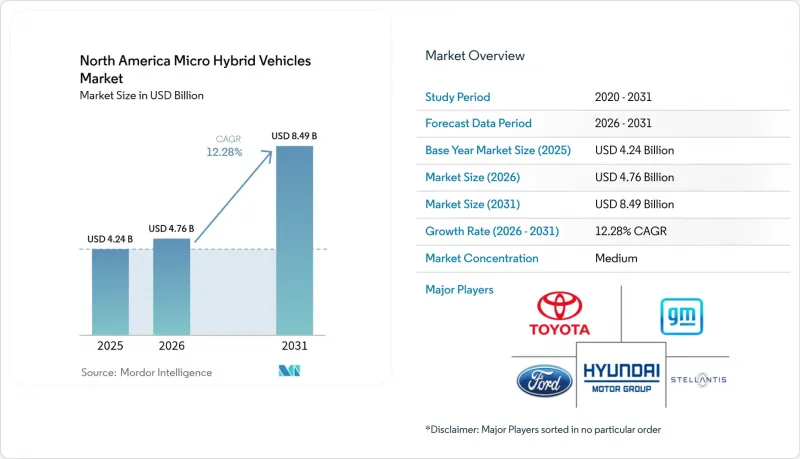
북미의 마이크로 하이브리드차 시장 규모는 2025년에 42억 4,000만 달러로 평가되며, 2026년 47억 6,000만 달러에서 2031년까지 84억 9,000만 달러에 달할 것으로 추정되고 있으며, 예측 기간(2026-2031년)에 CAGR은 12.28%에 달할 전망입니다.
이 보고서는 용량 유형(12V 마이크로 하이브리드, 24V 마이크로 하이브리드, 기타), 배터리 유형(납산, 리튬이온, 기타),차종(승용차, 소형 상용차, 기타), 최종사용자(OEM 탑재 차량, 애프터마켓/플릿용 사후 장착) 및 국가(미국 등)별로 분류되어 있습니다. 시장 예측은 금액(달러) 및 수량(대수)으로 제시되어 있습니다.
북미 마이크로 하이브리드차량 시장의 동향 및 인사이트
더욱 엄격해진 CAFE 및 온실가스(GHG) 배출 기준이 마이크로 하이브리드차량의 보급을 촉진
미국 환경보호청(EPA)의 다중 오염 물질 배출 기준에 따르면 2032년까지 플릿의 CO₂ 배출량을 85 g/mi까지 감축해야 하며, 이는 2026년 수준보다 거의 절반으로 줄이는 것을 의미합니다. 한편, 미국 도로교통안전국(NHTSA)의 CAFE 규제는 2031년까지 약 50.4 mpg를 달성할 것을 요구하고 있습니다. 각 자동차 제조사들은 48V 마일드 하이브리드가 두 자릿수의 연비 향상을 실현하고, 기존의 내연기관(ICE) 플랫폼과 통합할 수 있으며, 수익성을 유지할 수 있다는 점에서 규제 준수를 위한 즉각적인 수단으로 간주하고 있습니다. 포드는 2030년까지 나머지 모든 내연기관(ICE) 차종에 하이브리드 모델을 출시할 계획이며, GM은 당초 전기자동차(EV) 전용을 목표로 하는 방침을 내세웠으나, 2027년부터 플러그인 하이브리드차량을 출시하겠다고 발표했습니다. 이 프로그램의 일정은 2027-2032년에 걸친 단계적 도입 계획과 잘 부합하며, 각 OEM사는 일반적인 모델 변경 주기에 맞춰 투자를 분산할 수 있습니다.
OEM에 의한 48V 마일드 하이브리드 아키텍처의 급속한 도입
자동차 제조사들이 48V 시스템을 채택하는 속도는 기술적 성숙도와 규제상의 필요성이 결합되어 나타난 결과입니다. 테슬라가 12V 부품을 폐지하고 48V 배선을 채택한 결정은 하네스의 경량화와 저항 손실 감소를 향한 움직임을 상징합니다. 콘티넨탈은 48V 벨트식 스타터 제너레이터를 통해 배기 CO₂를 최대 15%까지 감축할 수 있을 뿐만 아니라, 전동 터보차저 및 회생 제동의 구동도 가능해질 것이라고 지적하고 있습니다. 보그워너나 발레오와 같은 Tier 1 공급업체들은 2028년까지 출시될 플랫폼을 위한 48V 전동 모터 및 파워 일렉트로닉스에 대해 다년간의 계약을 확보했으며,이는 각 OEM 업체들이 기본적인 스톱-스타트 기능에서부터 ADAS(첨단 운전자 지원 시스템) 지원에 이르기까지 확장 가능한 모듈식 전략을 선호하고 있음을 보여줍니다.
기존 12V 스톱-스타트 시스템에 비해 높은 추가 비용
48V 마일드 하이브리드는 표준 12V 스톱-스타트 시스템에 비해 차량당 약 800-1,500달러의 추가 비용이 듭니다. 이는 미국 평균 판매 가격의 2-4%에 해당합니다. 조사 대상 구매자의 40%는 평생 연료비 절감액이 600달러를 초과할 가능성이 있음에도 불구하고 초기 비용을 가장 큰 장벽으로 꼽고 있습니다. 규모의 경제와 부품 공통화가 진행됨에 따라 2027년까지 시스템 비용이 20-30% 절감될 것으로 예상되지만, 단기적인 가격 민감도가 여전히 보급을 저해하고 있습니다.
부문 분석
2025년 시점에 48V 클래스는 북미 마이크로 하이브리드차량 시장 점유율의 63.45%를 차지하고 있으며, 2031년까지 연평균 성장률(CAGR) 13.4%를 기록할 것으로 예측됩니다. 48V 벨트식 스타터 제너레이터는 고전압 안전 규제를 적용하지 않고도 10-20kW의 전력을 공급할 수 있으므로 각 OEM 업체들은 이를 신속한 효율 향상을 실현하기 위한 최적의 선택지로 보고 있습니다. 테슬라가 12V 배선을 폐지하겠다는 방침을 밝힌 것은 표준화가 진행될 가능성을 지원하며, 저전압 커넥터 규격의 도입으로 플랫폼 간 호환성 문제도 해소되고 있습니다. 12V 부문은 특히 애프터마켓 개조 분야에서 가성비를 중시하는 모델에게 여전히 매력적입니다. 한편, 24V 솔루션은 다소 높은 출력이 필요한 경우나 48V 아키텍처 도입을 정당화할 수 없는 특수한 상용 차량에 활용되고 있습니다.
또한 48V 아키텍처는 대대적인 재설계를 필요로 하지 않으면서도 전동 슈퍼차저, 액티브 서스펜션, 스티어링 어시스트에 전력을 공급할 수 있으므로, 추가적인 ADAS 기능을 지원하는 미래 지향적인 차량 설계를 실현합니다. ICE, MHEV 및 향후 PHEV 플랫폼 간에 부품을 공통화함으로써, 공급업체는 금형 비용을 상각하고 보다 신속하게 양산 체제를 구축할 수 있게 됩니다. 더 많은 OEM이 전기 시스템 기반을 통합함에 따라 예측 기간 내에 12V 스톱-스타트 시스템과의 가격 평준화가 달성될 가능성이 높으며, 이를 통해 북미 마이크로 하이브리드차량 시장에서 해당 부문의 주도적 입지가 강화될 것입니다.
납산 기술은 성숙한 재활용 시스템과 킬로와트시당 낮은 비용에 힘입어 2025년에는 72.55%의 점유율을 차지했습니다. AGM 및 EFB 유형은 충전 수용 능력과 수명 주기 전반에 걸친 안정성이 향상되어 빈번한 시동-정지 주기에 적합합니다. 리튬이온 배터리의 연평균 성장률(CAGR) 15.75%는 셀 가격 하락이 지속되는 가운데, 더 높은 출력이 필요한 48V 기능으로의 급속한 전환을 시사하고 있지만, 공급 안정성에 대한 우려와 원자재 가격 변동이 단기적인 보급을 억제하고 있습니다.
슈퍼커패시터와 납산 배터리를 결합한 하이브리드 커패시터 프로젝트가 평가 단계에 있으며, 회생 제동을 지원하는 급속 충전의 실현이 기대되고 있습니다. 클라리오스를 비롯한 각 공급업체들은 리튬이온 배터리가 성숙기에 접어든 상황에서도 납산 배터리의 존재 가치를 유지하기 위해 이러한 화학 조성의 시범 운영을 추진하고 있습니다. 그 결과, 북미의 마이크로 하이브리드차량 시장에서 비용, 에너지 밀도, 조달 리스크의 균형을 갖춘 다양화된 배터리 시장이 형성될 전망입니다.
기타 혜택:
- 엑셀 형식의 시장 예측(ME) 시트
- 3개월간의 애널리스트 지원
자주 묻는 질문
목차
제1장 서론
제2장 조사 방법
제3장 개요
제4장 시장 구도
제5장 시장 규모와 성장 예측
제6장 경쟁 구도
제7장 시장 기회와 향후 전망
KSA 26.08.25According to Mordor Intelligence, the North America micro-hybrid vehicles market size was valued at USD 4.24 billion in 2025 and estimated to grow from USD 4.76 billion in 2026 to reach USD 8.49 billion by 2031, at a CAGR of 12.28% during the forecast period (2026-2031).
This report is Segmented by Capacity Type (12 V Micro-Hybrid, 24 V Micro-Hybrid, and More), Battery Type (Lead-Acid, Lithium-Ion, and More), Vehicle Type (Passenger Cars, Light Commercial Vehicles, and More), by End-User (OEM-Fitted Vehicles and Aftermarket/Fleet Retrofit), and Country (United States and More). The Market Forecasts are Provided in Terms of Value (USD) and Volume (Units).
North America Micro Hybrid Vehicles Market Trends and Insights
Stricter CAFE and GHG standards drive micro-hybrid adoption
The Environmental Protection Agency's Multi-Pollutant Emissions Standards require fleet CO2 emissions to fall to 85 g/mi by 2032, nearly halving 2026 levels, while NHTSA's CAFE rules demand roughly 50.4 mpg by 2031 . Automakers view 48V mild-hybrids as an immediate route to compliance because they deliver double-digit efficiency gains, integrate with existing ICE platforms, and maintain profitability. Ford plans hybrid variants across all remaining ICE nameplates by 2030, and GM has announced plug-in hybrids starting in 2027 after earlier EV-only ambitions. Program timing aligns well with the 2027-2032 phase-in schedule, letting OEMs spread investment over normal model updates.
Rapid OEM rollout of 48 V mild-hybrid architectures
The speed at which automakers are adopting 48 V systems reflects a confluence of technology readiness and regulatory necessity. Tesla's decision to eliminate 12 V components in favor of 48 V wiring exemplifies the shift toward lighter harnesses and lower resistive losses. Continental notes that a 48 V belt-starter generator can trim tailpipe CO2 by up to 15% and power electric turbochargers and regenerative braking. Tier-1 suppliers such as BorgWarner and Valeo have secured multi-year contracts for 48 V e-motors and power electronics on platforms launching through 2028, indicating that OEMs favor a modular strategy that scales from basic stop-start to ADAS support.
High incremental cost vs. legacy 12 V stop-start
A 48 V mild-hybrid adds roughly USD 800-1,500 per vehicle over a standard 12 V stop-start system, equal to 2-4% of an average U.S. transaction price. Forty percent of surveyed buyers cite upfront cost as the biggest barrier, even though lifetime fuel savings can exceed USD 600. Economies of scale and broader parts commonality are expected to trim system costs 20-30% by 2027, but short-term price sensitivity still curbs uptake.
Other drivers and restraints analyzed in the detailed report include:
- 48 V power net enables ADAS power loads without HV packs
- Consumer shift to fuel-efficient pickups and SUVs
- Tightening lithium-ion supply may crowd R&D budgets
For complete list of drivers and restraints, kindly check the Table Of Contents.
Segment Analysis
The 48 V class represented 63.45% of the North America micro-hybrid vehicles market share in 2025 and is projected to record a 13.4% CAGR through 2031. Because a 48 V belt-starter generator delivers 10-20 kW without triggering high-voltage safety rules, OEMs view it as the sweet spot for quick efficiency gains. Tesla's blueprint to retire 12 V wiring reinforces a likely standardization path, while the Low-Voltage Connector Standard removes cross-platform headaches. The 12 V segment still appeals to value-oriented models, especially in aftermarket retrofits. Meanwhile, 24 V solutions serve specialized commercial assets that need slightly higher power but cannot justify a 48 V architecture.
The 48 V pathway also future-proofs vehicles for additional ADAS content because it can power electric superchargers, active suspension, and steering boosts without major redesign. Parts commonality across ICE, MHEV, and future PHEV platforms lets suppliers amortize tooling costs and reach volume quicker. As more OEMs unify electrical backbones, price parity with 12 V stop-start is likely within the forecast horizon, strengthening the segment's leadership in the North America micro-hybrid vehicles market.
Lead-acid technologies held a 72.55% share in 2025, underpinned by mature recycling systems and a low cost per kilowatt-hour. AGM and EFB variants offer enhanced charge acceptance and life-cycle stability suited to high-frequency start-stop cycles. Lithium-ion's 15.75% CAGR signals a swift shift for more power-intensive 48 V functions as cell prices continue to moderate, but supply security concerns and raw-material volatility temper short-term penetration.
Hybrid capacitor projects that blend supercapacitors with lead-acid are under evaluation, promising rapid charge delivery that supports regenerative braking. Clarios and other suppliers are piloting these chemistries to keep lead-acid relevant even as lithium-ion matures. The net result is a diversified battery landscape that balances cost, energy density, and sourcing risk across the North America micro-hybrid vehicles market size.
Complete Report Scope:
- By Capacity Type
- 12 V Micro-hybrid
- 24 V Micro-hybrid
- 48 V Micro-hybrid
- By Battery Type
- Lead-acid (AGM/EFB)
- Lithium-ion (LFP, LTO, NMC)
- Others
- By Vehicle Type
- Passenger Cars
- Light Commercial Vehicles
- Medium and Heavy Commercial Vehicles
- By End-User
- OEM-fitted Vehicles
- Aftermarket/Fleet Retrofit
- By Country
- United States
- Canada
- Rest of North America
List of Companies Covered in this Report:
- Toyota Motor Corporation
- Ford Motor Company
- Stellantis N.V.
- General Motors Company
- Hyundai Motor Group (Hyundai, Kia)
- BMW Group
- Daimler AG (Mercedes-Benz)
- Volkswagen AG
- Nissan Motor Co.
- Honda Motor Co.
- Kia Motors Corporation
- Subaru Corporation
- Mazda Motor Corporation
- Magna International Inc.
- BorgWarner Inc.
- Valeo SA
- Continental AG
- Robert Bosch GmbH
Additional Benefits:
- The market estimate (ME) sheet in Excel format
- 3 months of analyst support
TABLE OF CONTENTS
1 Introduction
- 1.1 Study Assumptions & Market Definition
- 1.2 Scope of the Study
2 Research Methodology
3 Executive Summary
4 Market Landscape
- 4.1 Market Overview
- 4.2 Market Drivers
- 4.2.1 Stricter CAFE and GHG standards
- 4.2.2 Rapid OEM rollout of 48 V mild-hybrid architectures
- 4.2.3 48 V power net enables ADAS power loads without HV packs
- 4.2.4 Consumer shift to fuel-efficient pick-ups and SUVs
- 4.2.5 Cost-down curve of advanced AGM/EFB lead-acid batteries
- 4.2.6 US-Mexico battery-supply incentives shorten lead-times
- 4.3 Market Restraints
- 4.3.1 High incremental cost vs. legacy 12 V stop-start
- 4.3.2 Tightening lithium-ion supply may crowd R&D budgets
- 4.3.3 Limited consumer awareness of "micro-hybrid" value proposition
- 4.3.4 Absence of US-wide 48 V component repair/after-sales ecosystem
- 4.4 Value/Supply-Chain Analysis
- 4.5 Regulatory Landscape
- 4.6 Technological Outlook
- 4.7 Porter's Five Forces
- 4.7.1 Threat of New Entrants
- 4.7.2 Bargaining Power of Buyers
- 4.7.3 Bargaining Power of Suppliers
- 4.7.4 Threat of Substitutes
- 4.7.5 Intensity of Competitive Rivalry
5 Market Size & Growth Forecasts (Value (USD) and Volume (Units))
- 5.1 By Capacity Type
- 5.1.1 12 V Micro-hybrid
- 5.1.2 24 V Micro-hybrid
- 5.1.3 48 V Micro-hybrid
- 5.2 By Battery Type
- 5.2.1 Lead-acid (AGM/EFB)
- 5.2.2 Lithium-ion (LFP, LTO, NMC)
- 5.2.3 Others
- 5.3 By Vehicle Type
- 5.3.1 Passenger Cars
- 5.3.2 Light Commercial Vehicles
- 5.3.3 Medium and Heavy Commercial Vehicles
- 5.4 By End-User
- 5.4.1 OEM-fitted Vehicles
- 5.4.2 Aftermarket/Fleet Retrofit
- 5.5 By Country
- 5.5.1 United States
- 5.5.2 Canada
- 5.5.3 Rest of North America
6 Competitive Landscape
- 6.1 Market Concentration
- 6.2 Strategic Moves
- 6.3 Market Share Analysis
- 6.4 Company Profiles (includes Global Level Overview, Market Level Overview, Core Segments, Financials as Available, Strategic Information, Market Rank/Share for Key Companies, Products and Services, SWOT Analysis, and Recent Developments)
- 6.4.1 Toyota Motor Corporation
- 6.4.2 Ford Motor Company
- 6.4.3 Stellantis N.V.
- 6.4.4 General Motors Company
- 6.4.5 Hyundai Motor Group (Hyundai, Kia)
- 6.4.6 BMW Group
- 6.4.7 Daimler AG (Mercedes-Benz)
- 6.4.8 Volkswagen AG
- 6.4.9 Nissan Motor Co.
- 6.4.10 Honda Motor Co.
- 6.4.11 Kia Motors Corporation
- 6.4.12 Subaru Corporation
- 6.4.13 Mazda Motor Corporation
- 6.4.14 Magna International Inc.
- 6.4.15 BorgWarner Inc.
- 6.4.16 Valeo SA
- 6.4.17 Continental AG
- 6.4.18 Robert Bosch GmbH
7 Market Opportunities & Future Outlook
- 7.1 White-space & Unmet-need Assessment


