

|
시장보고서
상품코드
2061614
레저용 차량(RV) : 시장 점유율 분석, 업계 동향 및 통계, 성장 예측(2026-2031년)Recreational Vehicle - Market Share Analysis, Industry Trends & Statistics, Growth Forecasts (2026 - 2031) |
||||||
 Mordor Intelligence
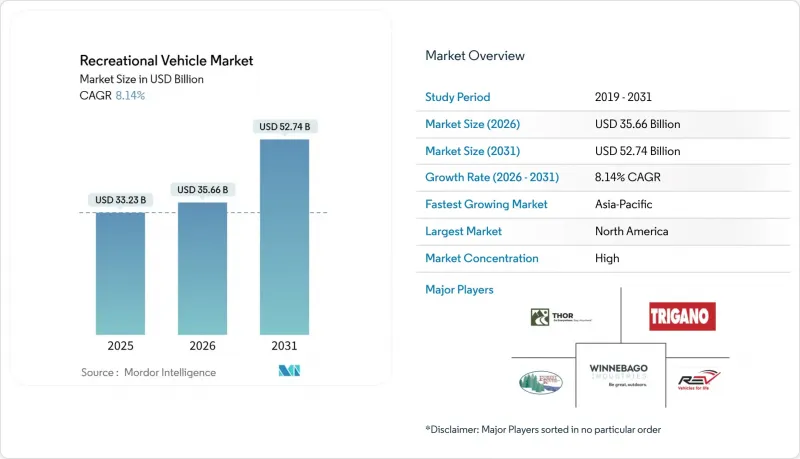
Mordor Intelligence에 의하면, 레저용 차량(RV) 시장 규모는 2025년에 332억 3,000만 달러로 평가되었습니다. 2026년 356억 6,000만 달러에서 2031년까지 527억 4,000만 달러에 이를 것으로 예상되며, 예측 기간(2026-2031년) CAGR은 8.14%를 나타낼 전망입니다.
본 보고서는 유형(견인식 레크리에이션 차량 및 모터홈), 용도(가정용/개인용 및 상업용), 추진 방식(내연기관, 하이브리드 및 배터리식 전기 레크리에이션 차량), 전장 카테고리(20피트 미만, 20-30피트, 30피트 이상), 그리고 지역별로 분류되어 있습니다. 시장 전망은 금액(달러) 및 수량(대) 단위로 제시되어 있습니다.
세계의 레저용 차량(RV) 시장 동향 및 인사이트
재택근무 문화가 모바일 라이프 수요를 뒷받침합니다.
레크리에이션 차량 시장에서 2025년에는 많은 캠핑카 이용자들이 캠핑장에서 업무를 수행했으며, 레크리에이션 차량(RV)이 현재 하이브리드 사무실로서의 역할도 수행하고 있는 것으로 나타났습니다. 젊은 소유주들은 LTE 라우터, 태양광 패널, 접이식 책상이 장착된 클래스 B 밴에 매력을 느끼고 있으며, 이에 따라 각 OEM 업체들은 2025년형 모델에 스타링크 호환 마운트와 120볼트 인버터를 기본 사양으로 추가하고 있습니다. 이에 따라 캠핑장 운영 측은 전원 설비를 50암페어 대응으로 업그레이드하고, 광섬유 Wi-Fi를 도입했습니다. KOA에서는 장기 체류 예약을 확보하기 위해 공원 소유주가 재투자를 실시한 결과, 프랜차이즈 계약 갱신률이 95%에 달했습니다. 이러한 변화로 인해 레저용 부동산과 주거용 부동산의 경계가 모호해지면서, 비수기에도 안정적인 이용률을 확보하고, 장기 부지 임대를 통한 부수적 수익을 높이고 있습니다. 그러나 모바일 오피스의 감가상각 공제와 관련된 세무 지침이 아직 확정되지 않아 규정 준수상의 위험이 발생하고 있으며, 이로 인해 보급이 더뎌질 가능성이 있습니다.
국내 관광 붐과 캠핑장 인프라의 성장
2020년대 초반 국경 폐쇄로 인해 여가 지출이 국내 로드트립으로 전환되었으며, 2025년 항공사들이 유류할증료를 다시 부과하기 시작한 후에도 이러한 추세는 지속되었습니다. 호주에서는 2023년에 1,530만 건의 캐러밴 및 캠핑 여행이 기록되었으며, 143억 호주 달러(95억 달러)의 소비를 창출했습니다. 미국에서는 주립공원 시스템이 2024년에 전기 설비 및 배수 설비 정비에 총 2억 달러 이상을 배정하여, 대형 모터홈에 대한 대응 능력을 강화했습니다. Sun Communities 등 사모펀드 그룹은 12곳의 RV 리조트 포트폴리오를 인수하여 편의 시설을 표준화하는 한편, 수요가 높은 지역에서는 1박당 요금을 8%-12% 인상했습니다. 레저용 차량(RV) 시장은 이러한 수용 능력 확충으로 인해 직접적인 혜택을 보고 있지만, 주요 공원의 성수기 이용률이 95% 이상의 상황에서 계획에 없던 여행객들이 서비스가 최소한으로 제공되고 규제 집행도 일관되지 않은 곳곳에 흩어져 있는 공공 부지로 몰리고 있습니다. 임금 상승이 이를 따라가지 못할 경우, 이용료 인상은 캠핑 초보자들에게 비용 부담에 대한 우려를 불러일으킬 수 있습니다.
고금리 환경이 대출 비용을 끌어올리고 있습니다.
금리가 완화되었음에도 불구하고, 대출 여건은 여전히 까다로워 가격에 민감한 견인식 RV 부문 수요를 억제하고 있습니다. 연방준비제도이사회(FRB)가 2025년 한 해 동안 정책 금리를 5.25%-5.50%로 동결함에 따라, RV 대출의 연이율(APR)은 9.5%-13.5% 범위로 상승하게 되어, 15년 만기 대출로 5만 달러 상당의 견인식 RV를 구매할 경우월상환액에 150-250달러가 추가될 것입니다. 서브프라임 계층의 차입자들은 20%에 가까운 금리에 직면하면서 사실상 신차 시장에서 배제되게 되었고, 이에 따라 노후화된 중고차 재고에 대한 수요가 급증했습니다. 위네바고사의 2025 회계연도 1분기 매출액은 19.5% 감소한 5억 5,060만 달러를 기록했으며, 재고 자금에 대한 이자 부담이 딜러들의 주문에 압박을 가했습니다. 금융기관은 계약금의 최저 비율을 15%로 인상했으며, 이로 인해 첫 주택 구매 고객의 방문 건수가 더욱 감소했습니다. 통화 완화는 판매 대수를 단기간에 끌어올리는 요인이 될 것이지만, 금리 변동에 따라 구매 부담 능력이 여전히 가장 큰 관심사가 될 것입니다.
부문별 분석
견인형 레크리에이션 차량(RV)은 합리적인 가격과 기존 픽업 트럭과의 호환성을 바탕으로, 2025년 RV 시장의 출하 대수의 62.44%를 차지했습니다. 트래블 트레일러는 16-35피트 규모의 평면도를 아우르며, 미니멀리스트 커플부터 대가족에 이르기까지 폭넓은 고객층을 대상으로 하는 반면, 피프스 휠은 구스넥의 안정성을 중시하는 장거리 여행객들의 관심을 끌고 있습니다. 접이식 캠핑카와 트럭 베드 유닛은 차고 높이나 오프로드 주행의 제약에 대응함으로써, 대상 고객층을 확대되고 있습니다.
모터홈 시장은 주행 성능을 중시하는 젊은 구매층에게 인기를 끌고 있는 메르세데스 스프린터와 포드 트랜짓의 섀시를 채택한 소형 클래스 B 밴의 인기에 힘입어, 2031년까지 연평균 성장률(CAGR) 9.26%를 기록하며 견인식 RV를 앞지르는 성장이 예상됩니다. 접이식 캠핑카는 수납 공간이 제한적인 소유주들에게 적합하지만, 마이크로모터홈과의 경쟁으로 인해 성장 전망은 둔화되고 있습니다. THOR사가 엔테그라 코치사의 디젤 푸셔형 모터홈 생산을 티핀사 산하로 통합한 움직임은 규모의 경제를 높이고 고가대 모터홈 제품 라인에서의 합리화를 지속해 나갈 것임을 시사합니다. A급 고급 코치는 여전히 프리미엄 위상을 유지하고 있지만, 치솟는 연료비와 20만 달러를 넘는 가격 책정으로 인해 판매량 감소라는 압박에 직면해 있습니다. C급 차량은 균형 잡힌 주행 성능과 넓은 실내 공간을 제공하여 젊은 가족층에게 인기를 끌고 있습니다. 전동화와 하이브리드화로 인해 각 OEM 업체들이 배송용 밴의 플랫폼을 주거 공간으로 재활용하고, 레저용 차량(RV) 시장 규모를 확대함에 따라 경쟁은 더욱 치열해질 것입니다.
2025년 수요의 70.63%를 국내 소유가 차지했으며, 이는 주말 캠핑, 장기 로드트립, 그리고 약 100만 가구에 달할 것으로 추정되는 상주 거주자 증가를 반영한 것입니다. 은퇴자들은 계절마다 이동할 때 A급 캠핑카를 선호하는 반면, 일하는 가족들은 계절마다 주차할 수 있는 견인형 RV를 선택하고 있습니다. 재택근무를 하는 가구의 54%는 RV 안에서 업무를 처리하며, 여가와 생계를 결합하고 있습니다.
연평균 성장률(CAGR) 8.54%로 성장하고 있는 상업 분야에서는 개인 간 대여, 행사용 차량 서비스, 이동식 지휘 센터 등이 활용되고 있습니다. 크루즈 아메리카와 엘 몬테는 총 약 8,000대의 기존 렌터카를 운영하고 있지만, 플랫폼에 등록된 차량 수는 5만 대를 넘어섰으며, 공급이 중고차 시장으로 분산되고 있습니다. 법인 고객들은 고급 코치를 ‘바퀴 달린 회의실’로 개조하여, 하루에 1,000달러가 넘는 요금을 책정하고 있습니다. 상업적 이용 증가는 수익원을 다각화하여 레저용 차량(RV) 시장을 순수한 소매 경기 사이클의 영향으로부터 보호하고 있습니다.
지역별 분석
2025년, 북미는 전 세계 RV 매출의 59.52%라는 압도적인 점유율을 차지했습니다. 이는 미국 내 1,120만 가구의 RV 소유 가구와 2,500개에 달하는 탄탄한 딜러 네트워크에 힘입은 결과입니다. 그러나 Thor Industries는 어려움을 겪으며, 2026 회계연도 1분기 북미 매출은 전년 동기 대비 13.4% 감소한 16억 8,000만 달러를 기록했습니다. 이는 주로 높은 연이율(APR)이 딜러들의 주문을 위축시킨 데 기인합니다. 딜러의 재고 수준이 변동하는 한편, 그 밖의 요인들도 영향을 미쳤습니다. 중고차 가격 하락과 캘리포니아주 각 지자체에서 시행한 주차 금지 조치로 인해 여행객들은 유료 캠핑장을 이용하게 되었고, 이는 캠핑장 운영자들에게는 반가운 소식이 되었습니다. 캐나다의 강점은 미국 공급망과의 근접성과 환율을 바탕으로 한 국경을 초월한 구매의 매력에 있습니다. 반면, 멕시코의 RV 시장은 캠핑장 밀도가 낮은 탓에 여전히 틈새 시장 수준에 머물러 있습니다.
아시아태평양은 연평균 성장률(CAGR) 9.54%를 나타낼 것으로 예측되며, 가장 빠르게 성장하고 있는 지역입니다. 이를 주도하고 있는 것은 호주로, 등록된 캐러밴과 모터홈은 90만 8,513대에 달하며, 2019년 이후 21% 증가했습니다. 이 나라는 2024년에 2만 5,185대를 생산했으나, 2만 대에 가까운 차량을 수입했으며, 그중 95%는 중국 공장에서 생산된 것으로, 현지 가격보다 8,000-1만 2,000달러 저렴한 가격으로 책정되어 있습니다. 중국에서는 1만 4,365대가 판매되었으며, 인프라 부족(광둥성에는 전용 캠핑장이 20곳도 채 되지 않습니다)에도 불구하고 4위 국내 시장이 되었습니다. 일본과 한국 수요는 좁은 도심 도로를 주행할 수 있는 토요타 하이에이스나 현대 스타리아의 플랫폼을 기반으로 한 마이크로 캠퍼에 집중되어 있습니다.
유럽의 유서 깊은 제조업체인 트리거노, 쿠나우스 타브바트, 하이머는 소비자들의 신중한 태도라는 상황에 직면해 있습니다. 트리가노의 2024/25 회계연도 상반기 매출액은 5.9% 감소한 15억 6,000만 유로(16억 9,000만 달러)를 기록했습니다. 독일에서는 배기가스 규제 구역과 디젤 가격 급등이 캠핑카 수요를 위축시키고 있으며, 영국에서는 브렉시트 이후의 관세 마찰이 계속해서 영향을 미치고 있습니다. 스페인이나 포르투갈 등 남유럽 시장은 온화한 기후 덕분에 비수기에도 이용률이 유지되고 있습니다. 동유럽은 아직 개발되지 않은 잠재력을 지니고 있지만, 수요를 창출하기 위해서는 캠핑장 정비와 자금 조달 방안이 필요합니다. 전반적으로 유럽은 레저용 차량(RV) 시장의 약 4분의 1을 차지하고 있지만, 성장률은 북미 및 아시아태평양에 뒤처지고 있습니다.
기타 혜택 :
- 엑셀 형식 시장 예측(ME) 시트
- 3개월간의 애널리스트 지원
자주 묻는 질문
목차
제1장 서론
제2장 조사 방법
제3장 주요 요약
제4장 시장 구도
제5장 시장 규모 및 성장 예측
제6장 경쟁 구도
제7장 시장 기회 및 향후 전망
KTH 26.06.22According to Mordor Intelligence, the recreational vehicle market size was valued at USD 33.23 billion in 2025 and estimated to grow from USD 35.66 billion in 2026 to reach USD 52.74 billion by 2031, at a CAGR of 8.14% during the forecast period (2026-2031).
This report is Segmented by Type (Towable Recreational Vehicles and Motorhomes), Application (Domestic/Personal Use and Commercial), Propulsion (Internal Combustion Engine, Hybrid, and Battery Electric Recreational Vehicles), Length Category (Below 20 Feet, 20 To 30 Feet, and Above 30 Feet), and Geography. The Market Forecasts are Provided in Terms of Value (USD) and Volume (Units).
Global Recreational Vehicle Market Trends and Insights
Remote-Work Culture Sustaining Mobile Living Demand
In the recreational vehicle market, Most of the campers worked from campsites in 2025, indicating that recreational vehicles (RVs) are now doubling as hybrid offices. Younger owners gravitate toward Class B vans outfitted with LTE routers, solar arrays, and fold-down desks, prompting OEMs to add Starlink-ready mounts and 120-volt inverters as standard features on 2025 models. Campground operators responded by upgrading electrical pedestals to 50-amp service and installing fiber-optic Wi-Fi; KOA registered a 95% franchise-renewal rate as park owners reinvested to capture extended-stay bookings. The shift blurs the boundary between leisure and residential real estate, creating dependable off-season occupancy and elevating ancillary revenue from long-term site leases. However, unresolved tax guidance on depreciation deductions for mobile offices creates compliance risk that could temper adoption.
Domestic Tourism Boom and Campground Infrastructure Growth
Border closures earlier in the decade redirected leisure spending to domestic road trips, and the habit persisted as airlines reinstated fuel surcharges in 2025. Australia logged 15.3 million caravan and camping trips in 2023, generating AUD 14.3 billion (USD 9.5 billion) in spending. In the United States, state park systems collectively earmarked more than USD 200 million in 2024 for electrification and wastewater hookups, increasing suitability for larger motorhomes. Private-equity groups such as Sun Communities acquired 12 RV-resort portfolios, standardized amenities, and lifted nightly rates 8%-12% in high-demand corridors. The recreational vehicle market benefits directly from the capacity build-out, yet peak-season occupancy exceeding 95% at flagship parks funnels spontaneous travelers toward dispersed public lands where services are minimal and regulatory enforcement is inconsistent. Rising fees could spark affordability concerns for entry-level campers if wage growth lags.
High Interest-Rate Environment Inflating Loan Costs
Credit remains tight even as rates ease, curbing demand in price-sensitive towable categories. The Federal Reserve held its target rate at 5.25%-5.50% throughout 2025, pushing RV loan APRs into a 9.5%-13.5% band, adding USD 150-USD 250 to monthly payments on a USD 50,000 towable financed over 15 years. Subprime borrowers faced rates near 20%, effectively excluding them from the new-unit market and swelling demand for aging used inventory. Winnebago's Q1 FY 2025 revenue slid 19.5% to USD 550.6 million, with floorplan interest expense squeezing dealer orders. Lenders raised minimum down payments to 15%, further dampening first-time buyer traffic. Monetary easing would provide an immediate volume catalyst, but rate volatility will keep affordability center stage.
Other drivers and restraints analyzed in the detailed report include:
- Expansion of RV Financing and Peer-To-Peer Rental Platforms
- OEM Electrification Road-Maps For Zero-Emission RV Lines
- Oversupply of Used RVs Driving Price Depreciation
For complete list of drivers and restraints, kindly check the Table Of Contents.
Segment Analysis
Towable recreational vehicles accounted for 62.44% of 2025 shipments within the recreational vehicle market, buoyed by lower entry prices and compatibility with existing pickups. Travel trailers span 16- to 35-foot floorplans, serving everyone from minimalist couples to large families, whereas fifth-wheels attract long-haul travelers who value gooseneck stability. Folding campers and truck-bed units address garage-height or off-road constraints, broadening demographic reach.
Motorhomes are projected to outpace towables at a 9.26% CAGR through 2031, powered by compact Class B vans on Mercedes Sprinter and Ford Transit chassis that resonate with younger buyers prioritizing drivability. Folding campers cater to storage-challenged owners, but competition from micro motorhomes dampens growth prospects. THOR's move to consolidate Entegra Coach's diesel-pusher production under Tiffin enhances scale efficiencies and signals continued rationalization in high-price motorhome lines. Class A luxury coaches maintain premium status but face volume pressure from high fuel costs and price tags north of USD 200,000. Class C rigs offer balanced handling and interior space, appealing to young families. Electrification and hybridization will intensify competition as OEMs repurpose delivery-van platforms into human-habitat configurations, expanding the recreational vehicle market footprint.
Domestic ownership represented 70.63% of 2025 demand, reflecting weekend camping, extended road trips, and a growing cohort of full-timers estimated at 1 million United States households. Retirees gravitate toward Class A rigs for seasonal migrations, while working families choose towables that can be parked seasonally. Fifty-four percent of remote-work households perform their jobs from an RV, blending leisure and livelihood.
Commercial deployments, advancing at an 8.54% CAGR, leverage peer-to-peer rentals, fleet hospitality at events, and mobile command centers. Cruise America and El Monte operate roughly 8,000 traditional rentals, but platform listings exceed 50,000, dispersing supply to secondary markets. Corporate users retrofit luxury coaches as boardrooms on wheels, commanding daily rates above USD 1,000. Rising commercial utilization diversifies revenue and insulates the recreational vehicle market from pure retail cycles.
Geography Analysis
North America commanded a dominant 59.52% share of the global RV revenue in 2025, buoyed by 11.2 million RV-owning households in the United States and a robust network of 2,500 dealers. However, Thor Industries faced a setback, with North American sales dipping 13.4% year-over-year to USD 1.68 billion in Q1 FY 2026, primarily due to high APRs that tempered dealer orders. While dealer inventory levels shifted, other dynamics played out: used-unit depreciation and municipal parking bans in California nudged travelers towards fee-based campsites, much to the delight of campground operators. Canada's advantage lies in its closeness to the United States supply chains and the allure of currency-driven cross-border purchases. In contrast, Mexico's RV market remains a niche player, hampered by a sparse campground density.
Asia-Pacific is the fastest-growing territory at a projected 9.54% CAGR, led by Australia's 908,513 registered caravans and motorhomes, up 21% since 2019. The country manufactured 25,185 units in 2024 but imported nearly 20,000, 95% from Chinese factories that undercut local pricing by USD 8,000-USD 12,000. China sold 14,365 units, becoming the fourth-largest national market despite infrastructure shortfalls-Guangdong hosts fewer than 20 dedicated campsites. Japanese and South Korean demand centers on micro campers based on the Toyota HiAce and Hyundai Staria platforms that navigate narrow urban streets.
Europe's entrenched players-Trigano, Knaus Tabbert, and Hymer-face a cautious consumer backdrop: Trigano's half-year FY 2024/25 revenue slipped 5.9% to EUR 1.56 billion (USD 1.69 billion). Germany's emissions zones and elevated diesel prices weigh on motorhome appetite, while the United Kingdom digests post-Brexit tariff friction. Southern markets such as Spain and Portugal enjoy milder climates, sustaining off-season utilization. Eastern Europe represents untapped potential but requires campground investment and financing access to unlock demand. Collectively, Europe contributes roughly one-quarter of the recreational vehicle market, though growth lags North America and Asia-Pacific.
- Thor Industries Inc.
- Forest River Inc.
- Winnebago Industries Inc.
- REV Group Inc.
- Trigano SA
- Knaus Tabbert AG
- Jayco Inc.
- Grand Design RV Co.
- Keystone RV Co.
- Airstream Inc.
- Hymer GmbH
- Burstner GmbH
- Dethleffs GmbH
- Hobby-Wohnwagenwerk
- Adria Mobil d.o.o
- Triple E Recreational Vehicles
- Tiffin Motorhomes Inc.
- Coachmen RV
- Gulf Stream Coach Inc.
- Leisure Travel Vans
Additional Benefits:
- The market estimate (ME) sheet in Excel format
- 3 months of analyst support
TABLE OF CONTENTS
1 Introduction
- 1.1 Study Assumptions and Market Definition
- 1.2 Scope of the Study
2 Research Methodology
3 Executive Summary
4 Market Landscape
- 4.1 Market Overview
- 4.2 Market Drivers
- 4.2.1 Remote-Work Culture Sustaining Mobile Living Demand
- 4.2.2 Domestic Tourism Boom and Campground Infrastructure Growth
- 4.2.3 Expansion of RV Financing and Peer-to-Peer Rental Platforms
- 4.2.4 OEM Electrification Road-Maps for Zero-Emission RV Lines
- 4.2.5 OTA Connectivity Unlocking Subscription Revenue Streams
- 4.2.6 Direct-to-Consumer Online Sales Shrinking Dealer Margins
- 4.3 Market Restraints
- 4.3.1 High Interest-Rate Environment Inflating Loan Costs
- 4.3.2 Persistent Chassis and Component Supply Bottlenecks
- 4.3.3 Oversupply of Used RVs Driving Price Depreciation
- 4.3.4 Municipal Crack-Downs On Urban Overnight Parking
- 4.4 Value/Supply-Chain Analysis
- 4.5 Regulatory Landscape
- 4.6 Technological Outlook
- 4.7 Porter's Five Forces Analysis
- 4.7.1 Bargaining Power of Suppliers
- 4.7.2 Bargaining Power of Buyers
- 4.7.3 Threat of New Entrants
- 4.7.4 Threat of Substitutes
- 4.7.5 Competitive Rivalry
5 Market Size and Growth Forecasts (Value (USD) and Volume (Units))
- 5.1 By Type
- 5.1.1 Towable RVs
- 5.1.1.1 Travel Trailers
- 5.1.1.2 Fifth-Wheel Trailers
- 5.1.1.3 Folding Camp Trailers
- 5.1.1.4 Truck Campers
- 5.1.2 Motorhomes
- 5.1.2.1 Class A
- 5.1.2.2 Class B (Camper Vans)
- 5.1.2.3 Class C
- 5.1.1 Towable RVs
- 5.2 By Application
- 5.2.1 Domestic/Personal Use
- 5.2.2 Commercial (Rental Fleets, Mobile Offices, Events)
- 5.3 By Propulsion
- 5.3.1 Internal-Combustion Engine (ICE)
- 5.3.2 Hybrid
- 5.3.3 Battery-Electric RVs
- 5.4 By Length Category
- 5.4.1 Below 20 feet
- 5.4.2 20 to 30 feet
- 5.4.3 Above 30 feet
- 5.5 By Geography
- 5.5.1 North America
- 5.5.1.1 United States
- 5.5.1.2 Canada
- 5.5.1.3 Rest of North America
- 5.5.2 South America
- 5.5.2.1 Brazil
- 5.5.2.2 Argentina
- 5.5.2.3 Rest of South America
- 5.5.3 Europe
- 5.5.3.1 Germany
- 5.5.3.2 United Kingdom
- 5.5.3.3 France
- 5.5.3.4 Spain
- 5.5.3.5 Italy
- 5.5.3.6 Netherlands
- 5.5.3.7 Rest of Europe
- 5.5.4 Asia-Pacific
- 5.5.4.1 China
- 5.5.4.2 Japan
- 5.5.4.3 India
- 5.5.4.4 South Korea
- 5.5.4.5 Australia and New Zealand
- 5.5.4.6 Rest of Asia-Pacific
- 5.5.5 Middle East and Africa
- 5.5.5.1 GCC
- 5.5.5.2 Turkey
- 5.5.5.3 South Africa
- 5.5.5.4 Nigeria
- 5.5.5.5 Kenya
- 5.5.5.6 Rest of Middle East and Africa
- 5.5.1 North America
6 Competitive Landscape
- 6.1 Market Concentration
- 6.2 Strategic Moves
- 6.3 Market Share Analysis
- 6.4 Company Profiles (Includes Global level Overview, Market level Overview, Core Segments, Financials as available, Strategic Information, Market Rank/Share for key companies, Products and Services, Recent Developments)
- 6.4.1 Thor Industries Inc.
- 6.4.2 Forest River Inc.
- 6.4.3 Winnebago Industries Inc.
- 6.4.4 REV Group Inc.
- 6.4.5 Trigano SA
- 6.4.6 Knaus Tabbert AG
- 6.4.7 Jayco Inc.
- 6.4.8 Grand Design RV Co.
- 6.4.9 Keystone RV Co.
- 6.4.10 Airstream Inc.
- 6.4.11 Hymer GmbH
- 6.4.12 Burstner GmbH
- 6.4.13 Dethleffs GmbH
- 6.4.14 Hobby-Wohnwagenwerk
- 6.4.15 Adria Mobil d.o.o
- 6.4.16 Triple E Recreational Vehicles
- 6.4.17 Tiffin Motorhomes Inc.
- 6.4.18 Coachmen RV
- 6.4.19 Gulf Stream Coach Inc.
- 6.4.20 Leisure Travel Vans


