
|
시장보고서
상품코드
2098562
GPU용 메모리 서브시스템 : 시장 점유율 분석, 업계 동향 및 통계, 성장 예측(2026-2031년)Memory Subsystem For GPUs - Market Share Analysis, Industry Trends & Statistics, Growth Forecasts (2026 - 2031) |
||||||
 Mordor Intelligence
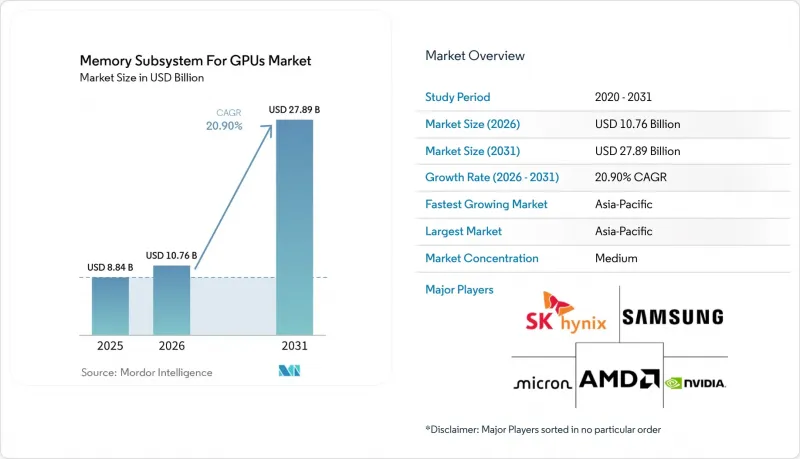
Mordor Intelligence에 의하면, GPU용 메모리 서브시스템 시장 규모는 2025년 88억 4,000만 달러로 평가되었습니다. 2026년 107억 6,000만 달러에서 2031년까지 278억 9,000만 달러로 확대되어 2026년부터 2031년까지 CAGR 20.90%를 나타낼 것으로 예측됩니다.
본 보고서는 메모리 아키텍처(GDDR 기반 메모리, HBM 기반 메모리), 메모리 용량(8GB 이하, 8GB-16GB, 16GB-32GB, 32GB-64GB, 64GB 이상), 용도(게임용 GPU, 데이터센터 및 AI용 GPU, 전문가용 시각화, 기타), 지역(북미, 유럽, 아시아태평양, 남미, 기타)별로 분류되어 있습니다. 시장 전망은 금액(달러) 기준으로 제시되어 있습니다.
세계의 GPU용 메모리 서브시스템 시장 동향 및 인사이트
AI 가속기에서 높아지는 메모리 밀도 요구 사항
GPU용 메모리 서브시스템 시장이 확대되고 있는 이유는 각 가속기에 탑재되는 메모리 용량이 전체 출하 대수 증가율을 상회하는 속도로 증가하고 있기 때문입니다. 현재 높은 메모리 밀도는 AI 훈련 및 대규모 추론 플랫폼에 있어 기본적인 요건이 되었으며, 공급업체는 이전보다 더 빈번하게 스택 수, 열 특성 및 패키징 공정을 재설계해야 합니다. 이러한 변화가 중요한 이유는 동일한 시스템 실적 내에서 더 많은 메모리를 탑재함으로써 GPU 1대당 수익이 증가하기 때문입니다. 또한, 메모리 대역폭과 메모리 용량이 코어의 연산 성능과 마찬가지로 가속기의 유용성에 영향을 미치게 된 점도 시장에 호재로 작용하고 있습니다. 이로 인해 하이퍼스케일러 및 기업의 조달 프로그램에서 프리미엄 메모리는 단순한 옵션이 아니라 플랫폼 인증에 있어 더욱 핵심적인 역할을 수행하게 되었습니다. 그 결과, GPU용 메모리 서브시스템 시장은 출하량뿐만 아니라 시스템 사양의 세부 수준과도 연동된 수요 패턴의 혜택을 누리고 있습니다.
프리미엄 GPU 플랫폼에서의 GDDR에서 HBM으로의 전환
GPU용 메모리 서브시스템 시장은 최고 성능의 GPU 플랫폼에서 GDDR에서 HBM으로의 전환에 의해서도 뒷받침되고 있습니다. HBM에는 더 복잡한 통합 공정이 요구되며, 이로 인해 메모리 공급이 첨단 패키징 및 GPU 다이 조립과 더욱 밀접하게 연결됩니다. Samsung Electronics는 자사의 차세대 HBM4가 1c급 DRAM 공정과 4nm 로직 기반 다이를 채택하여 최대 13Gbps의 속도와 최대 3.3TB/s의 대역폭을 실현할 것이라고 발표했습니다. 이는 프리미엄 메모리의 요구 사항이 기존 그래픽스 DRAM의 기준을 얼마나 뛰어넘고 있는지를 보여줍니다. 이러한 전환은 GPU용 메모리 서브시스템 시장을 견인할 것입니다. HBM으로의 전환이 이루어질 때마다 GPU의 총 부품 원가(BOM)에서 메모리 부품의 기술적 가치가 높아지기 때문입니다. 또한, 프리미엄 플랫폼을 대규모로 지원할 수 있는 공급업체의 범위도 좁아집니다. 그 결과, 시간이 지남에 따라 GPU용 메모리 서브시스템 시장은 하이엔드 공정 실행에 대한 의존도를 높이고, 범용 메모리의 경제성에 대한 의존도는 낮추게 될 것입니다.
HBM 패키징 능력의 제약
GPU용 메모리 서브시스템 시장의 단기적인 주요 제약 요인은 최종 사용자 수요가 아니라, 고대역폭 메모리를 대규모로 패키징하는 데 따르는 어려움에 있습니다. HBM의 생산량은 표준 그래픽 DRAM의 집적보다 복잡한 고도의 조립 공정에 의존하고 있기 때문에 AI 가속기에 대한 수요만큼 신속하게 생산을 확대할 수 없습니다. 메모리 패키징이 부족할 경우, GPU 출하량이 완전히 수익으로 이어지지 않기 때문에 이 병목 현상은 GPU용 메모리 서브시스템 시장 전체에 영향을 미칩니다. 또한, 입수 가능한 프리미엄 메모리는 우선적으로 부가가치가 가장 높은 프로그램에 배정되어야 하므로, 공급업체의 가격 결정력이 강화되는 결과로 이어집니다. 이러한 제약은 AI 하드웨어에서 특히 중요한데, 플랫폼이 HBM을 전제로 설계되면 성능 등급이 높은 시스템에서는 저가형 메모리로 쉽게 대체할 수 없기 때문입니다. 고도의 패키징 역량이 실질적으로 확대되기 전까지는 GPU용 메모리 서브시스템 시장은 조달 수요의 부진이 아니라 공급 측의 실행 능력으로 인해 발생하는 상한선에 계속해서 직면하게 될 것입니다.
부문 분석
2025년, GDDR 기반 메모리는 GPU용 메모리 서브시스템 시장 점유율의 52.55%를 차지했으며, 이는 기존 도입 기반이 여전히 기존 그래픽스 DRAM을 강력하게 뒷받침하고 있음을 보여주었습니다. 게임, 크리에이터 및 전문가용 시각화 시스템이 비용과 대역폭의 균형을 고려하여 GDDR6 및 GDDR7에 계속 의존하고 있기 때문에 이 부문은 여전히 최대의 수익원으로 자리 잡고 있습니다. GPU 메모리 서브시스템 시장에서 GDDR은 기판 수준에서의 통합이 용이하고, 메인스트림 및 고성능 소비자용 설계에 널리 채택되고 있다는 점에서도 이점을 얻고 있습니다. 이러한 도입 기반을 바탕으로, AI 하드웨어에 대한 지출이 더 고밀도 메모리 형식으로 이동하고 있는 상황에서도 이 부문은 견조한 모습을 유지하고 있습니다. 많은 용도이 HBM급 패키징이나 고비용 구조를 필요로 하지 않기 때문에 GPU 메모리 서브시스템 업계는 여전히 규모 확대에 있어 GDDR에 의존하고 있습니다.
HBM 기반 메모리는 2031년까지 연평균 성장률(CAGR) 21.52%를 나타낼 것으로 예측되며, GPU 메모리 서브시스템 시장 규모에 대한 논의에서 가장 빠르게 성장하는 아키텍처로 꼽히고 있습니다. 이러한 성장은 메모리 대역폭과 메모리 밀도가 실질적인 연산 처리량을 직접 좌우하는 AI 가속기와 밀접한 관련이 있습니다. Samsung Electronics는 자사의 HBM4 플랫폼이 최대 13Gbps 및 3.3TB/s에 달할 것이라고 발표했으며, 이는 현재 하이엔드 GPU 프로그램에서 요구되는 성능의 비약을 반영하고 있습니다. NVIDIA와 SK 하이닉스도 차세대 AI 메모리를 위한 다년간의 공동 개발에 착수했으며, 이는 HBM이 프리미엄 가속기의 로드맵에서 계속해서 중심적인 위치를 차지할 것이라는 전망을 뒷받침합니다. 이 메모리 등급을 핵심으로 설계된 하이엔드 플랫폼이 늘어남에 따라, 단위 판매량 중심의 부문에서는 GDDR이 계속해서 주도권을 쥐고 있더라도, GPU용 메모리 서브시스템 시장에서 HBM이 가치 기준 점유율을 더욱 확대해 나갈 가능성이 높다고 볼 수 있습니다.
지역별 분석
아시아태평양은 2025년에 GPU 메모리 서브시스템 시장 점유율의 42.44%를 차지했으며, 2031년까지 연평균 성장률(CAGR) 21.56%로 성장할 것으로 전망됩니다. 이 지역이 주도적인 위치를 차지하는 이유는 한국이 선진적인 DRAM 및 HBM 생산의 중심지로 계속 자리 잡고 있으며, 대만이 하이엔드 GPU 메모리 통합을 뒷받침하는 패키징 인프라에서 여전히 중요한 역할을 수행하고 있기 때문입니다. 아시아태평양의 GPU용 메모리 서브시스템 시장은 메모리 제조, 패키징, 전자기기 제조 생태계가 인접해 있다는 점에서도 혜택을 받고 있습니다. 이러한 집적 덕분에 이 지역은 밸류체인 전반에 걸쳐 신속한 공급 대응과 기술적 협력이라는 두 가지 측면에서 구조적인 우위를 점하고 있습니다. 인도 및 동남아시아는 현재로서는 시장에 기여하는 비중이 작지만, 현지 클라우드 및 AI 인프라 관련 활동이 확대됨에 따라 그 중요성이 높아지고 있습니다.
북미는 최대 규모의 하이퍼스케일러와 가속기 프로그램이 집중되어 있어, 금액 기준으로 볼 때 프리미엄 AI 메모리의 주요 소비 거점이 되고 있습니다. 이 지역의 GPU용 메모리 서브시스템 시장은 하이엔드 메모리를 대규모로 흡수할 수 있는 AI 플랫폼 개발자 및 클라우드 사업자의 활발한 조달 활동에 의해 형성되고 있습니다. 수출 정책도 이러한 추세를 뒷받침하고 있습니다. BIS(미국 상무부 산업안보국)가 중국 관련 사업체와 연관된 첨단 컴퓨팅 제품에 대해서는 수령자가 중국 이외의 지역에 소재하더라도 계속해서 라이선스가 필요하다고 밝혔기 때문입니다. 이러한 체제 하에서 더 고도화된 메모리의 도입은 동맹국 지역으로 유도되고 있으며, 북미 프로그램에 대한 할당량의 가시성이 향상되고 있습니다. 그 결과, 북미의 GPU용 메모리 서브시스템 시장은 최종 수요의 부진보다는 이용 가능한 공급량의 제약에 더 큰 영향을 받고 있습니다.
유럽에서는 신뢰할 수 있는 공급과 시스템 품질이 중시되는 자동차용 AI, 전문 컴퓨팅, 클라우드 인프라와 같은 이용 사례에 여전히 집중되어 있습니다. 유럽의 GPU용 메모리 서브시스템 시장은 견고한 산업 및 자동차 산업 기반의 혜택을 받고 있으며, 특히 첨단 운전자 보조 시스템(ADAS)이나 시뮬레이션 워크로드에서 신뢰성 높은 GPU 메모리 지원이 요구되고 있습니다. 남미 시장은 여전히 규모가 작으며, 대규모 AI 가속기 조달보다는 소비자용 그래픽스 수요에 의해 주도되고 있습니다. 중동 및 아프리카는 여전히 발전 단계에 있지만, 각국 정부 주도의 AI 프로그램을 통해 데이터센터용 GPU 도입을 위한 로드맵이 점차 명확해지고 있습니다. 이러한 지역들이 합쳐져 GPU용 메모리 서브시스템 시장 수요 범위를 넓혀가고 있지만, 아시아태평양공급 주도력과 북미의 AI 수요가 여전히 세계 수급 균형에 가장 큰 영향을 미치고 있습니다.
기타 혜택 :
- 엑셀 형식 시장 예측(ME) 시트
- 3개월간의 애널리스트 지원
자주 묻는 질문
목차
제1장 서론
제2장 조사 방법
제3장 주요 요약
제4장 시장 구도
제5장 시장 규모 및 성장 예측
제6장 경쟁 구도
제7장 시장 기회 및 향후 전망
KTH 26.08.10According to Mordor Intelligence, the memory subsystem for GPUs market size is projected to expand from USD 8.84 billion in 2025 and USD 10.76 billion in 2026 to USD 27.89 billion by 2031, registering a CAGR of 20.90% between 2026 to 2031.
This report is Segmented by Memory Architecture (GDDR-Based Memory, and HBM-Based Memory), Memory Capacity (Up To 8 GB, 8 GB To 16 GB, 16 GB To 32 GB, 32 GB To 64 GB, and Above 64 GB), Application (Gaming GPUs, Data Center and AI GPUs, Professional Visualization, and More), and Geography (North America, Europe, Asia-Pacific, South America and More). The Market Forecasts are Provided in Terms of Value (USD).
Global Memory Subsystem For GPUs Market Trends and Insights
Rising AI Accelerator Memory Density Requirements
The memory subsystem for GPUs market is moving higher because the amount of memory attached to each accelerator is rising faster than overall unit shipments. Higher memory density is now a basic requirement for AI training and large-scale inference platforms, so suppliers have to redesign stack counts, thermal behavior, and packaging flow more often than before. This shift matters because revenue per GPU deployment rises when the same system footprint carries more memory content. The market also benefits from the fact that memory bandwidth and memory capacity now influence accelerator usefulness as much as core compute performance. That makes premium memory less optional and more central to platform qualification across hyperscaler and enterprise buying programs. As a result, the memory subsystem for GPUs market is benefiting from a demand pattern that is tied to system specification depth, not only to shipment volume.
Transition From GDDR to HBM in Premium GPU Platforms
The memory subsystem for GPUs market is also being lifted by the move from GDDR toward HBM in the highest-performance GPU platforms. HBM requires a more involved integration process, which links memory supply more tightly with advanced packaging and GPU die assembly. Samsung stated that its next-generation HBM4 uses a 1c-class DRAM process and a 4 nm logic base die, with speeds up to 13 Gbps and bandwidth up to 3.3 TB/s, which shows how far premium memory requirements have moved beyond earlier graphics DRAM norms. This migration supports the memory subsystem for GPUs market because every transition to HBM raises the technical value of memory content within the total GPU bill of materials. It also narrows the field of suppliers that can serve premium platforms at scale. Over time, that makes the memory subsystem for GPUs market more dependent on high-end process execution and less dependent on commodity memory economics.
HBM Packaging Capacity Constraints
The main near-term restraint on the memory subsystem for GPUs market is not end demand but the difficulty of packaging high-bandwidth memory at scale. HBM output depends on advanced assembly steps that are more complex than standard graphics DRAM integration, so production cannot expand as quickly as demand for AI accelerators. This bottleneck affects the full memory subsystem for GPUs market because GPU shipments cannot fully convert into revenue when memory packaging remains tight. It also reinforces supplier pricing power, since available premium memory must be directed toward the highest-value programs first. The constraint is especially important in AI hardware because performance-class systems cannot easily substitute lower-end memory once a platform is designed around HBM. Until advanced packaging capacity broadens in a meaningful way, the memory subsystem for GPUs market will continue to face a ceiling that is created by supply execution rather than weak procurement interest.
Other drivers and restraints analyzed in the detailed report include:
- Rapid Adoption of GDDR7 in Gaming and Creator GPUs
- Co-Design Between GPU Vendors and Memory Suppliers
- High Cost Premium Versus Conventional Graphics DRAM
For complete list of drivers and restraints, kindly check the Table Of Contents.
Segment Analysis
GDDR-Based Memory held 52.55% of the memory subsystem for GPUs market share in 2025, which shows how strongly the installed base still supports conventional graphics DRAM. The segment remained the larger revenue contributor because gaming, creator, and professional visualization systems continue to rely on GDDR6 and GDDR7 for balanced cost and bandwidth. In the memory subsystem for GPUs market, GDDR also benefits from simpler board-level integration and wider use across mainstream and performance consumer designs. That installed base gives the segment durability even as AI hardware spending shifts toward denser memory formats. The memory subsystem for GPUs industry still depends on GDDR for scale because many applications do not need HBM-class packaging or cost intensity.
HBM-Based Memory is projected to record a 21.52% CAGR through 2031, which makes it the fastest-growing architecture in the memory subsystem for GPUs market size discussion. Growth is tied to AI accelerators where memory bandwidth and memory density directly shape usable compute throughput. Samsung said its HBM4 platform reaches up to 13 Gbps and 3.3 TB/s, which reflects the performance step that premium GPU programs now require. NVIDIA and SK hynix also moved into multiyear co-development for next-generation AI memory, which supports the view that HBM will remain central to premium accelerator roadmaps. As more top-end platforms are designed around this memory class, the memory subsystem for GPUs market is likely to see HBM capture a larger share of value even if GDDR continues to lead in unit-driven categories.
Complete Report Scope:
- By Memory Architecture
- GDDR-Based Memory
- HBM-Based Memory
- By Memory Capacity
- Up to 8 GB
- 8 GB to 16 GB
- 16 GB to 32 GB
- 32 GB to 64 GB
- Above 64 GB
- By Application
- Gaming GPUs
- Data Center and AI GPUs
- Professional Visualization
- Edge AI and Embedded
- By Geography
- North America
- United States
- Canada
- Mexico
- Europe
- Germany
- United Kingdom
- France
- Italy
- Rest of Europe
- Asia Pacific
- China
- Japan
- South Korea
- India
- Southeast Asia
- Rest of Asia-Pacific
- South America
- Middle East and Africa
- North America
Geography Analysis
Asia-Pacific held 42.44% of the memory subsystem for GPUs market share in 2025 and is projected to grow at a 21.56% CAGR through 2031. The region leads because South Korea remains central to advanced DRAM and HBM production, while Taiwan remains critical for the packaging infrastructure that supports high-end GPU memory integration. The memory subsystem for GPUs market in Asia-Pacific also benefits from the close proximity of memory fabrication, packaging, and electronics manufacturing ecosystems. This concentration gives the region a structural edge in both supply responsiveness and technical coordination across the value chain. India and Southeast Asia remain smaller contributors today, but they are gaining relevance as local cloud and AI infrastructure activity expands.
North America is the main consumption center for premium AI memory by value, since the largest hyperscaler and accelerator programs are concentrated there. The memory subsystem for GPUs market in this region is shaped by procurement intensity from AI platform developers and cloud operators that can absorb high-end memory at scale. Export policy is reinforcing this position, since the BIS said advanced computing items tied to China-linked entities continue to require licensing regardless of the recipient's physical location outside those countries. That framework directs more advanced memory deployments toward allied geographies and supports stronger allocation visibility for North American programs. As a result, the memory subsystem for GPUs market in North America is constrained more by available supply than by weak end demand.
Europe remains concentrated in automotive AI, professional computing, and cloud infrastructure use cases where reliable supply and system quality matter. The memory subsystem for GPUs market in Europe benefits from a strong industrial and automotive base, especially where advanced driver assistance and simulation workloads need dependable GPU memory support. South America stays smaller and is led more by consumer graphics demand than by large-scale AI accelerator procurement. Middle East and Africa is still emerging, but sovereign AI programs are starting to generate a clearer path for data center GPU deployments. Together, these regions broaden the demand map for the memory subsystem for GPUs market, even though Asia-Pacific supply leadership and North American AI demand still shape the global balance most strongly.
- Samsung Electronics Co., Ltd.
- SK hynix Inc.
- Micron Technology, Inc.
- NVIDIA Corporation
- Advanced Micro Devices, Inc.
- Taiwan Semiconductor Manufacturing Company Limited
- Intel Corporation
- Qualcomm Technologies, Inc.
- ASE Technology Holding Co., Ltd.
- Rambus Inc.
- Cadence Design Systems, Inc.
- Synopsys, Inc.
- Broadcom Inc.
- Marvell Technology, Inc.
- Amkor Technology, Inc.
- Powerchip Semiconductor Manufacturing Corp.
- Winbond Electronics Corporation
- ChangXin Memory Technologies Inc.
- GigaDevice Semiconductor Inc.
- Kioxia Corporation
- Arm Limited
Additional Benefits:
- The market estimate (ME) sheet in Excel format
- 3 months of analyst support
TABLE OF CONTENTS
1 INTRODUCTION
- 1.1 Study Assumptions and Market Definition
- 1.2 Scope of the Study
2 RESEARCH METHODOLOGY
3 EXECUTIVE SUMMARY
4 MARKET LANDSCAPE
- 4.1 Market Overview
- 4.2 Impact of Macroeconomic Factors on the Market
- 4.3 Market Drivers
- 4.3.1 Rising AI Accelerator Memory Density Requirements
- 4.3.2 Transition From GDDR to HBM in Premium GPU Platforms
- 4.3.3 Rapid Adoption of GDDR7 in Gaming and Creator GPUs
- 4.3.4 Co-Design Between GPU Vendors and Memory Suppliers
- 4.3.5 Export-Control-Driven Supply Reallocation to Friendly Markets
- 4.3.6 On-Package and Chiplet Integration Improving Bandwidth Per Watt
- 4.4 Market Restraints
- 4.4.1 HBM Packaging Capacity Constraints
- 4.4.2 High Cost Premium Versus Conventional Graphics DRAM
- 4.4.3 Qualification Complexity Across GPU and Memory Generations
- 4.4.4 Power and Thermal Limits in Compact GPU Designs
- 4.5 Industry Value Chain Analysis
- 4.6 Regulatory Landscape
- 4.7 Technological Outlook
- 4.8 Porter's Five Forces Analysis
- 4.8.1 Bargaining Power of Suppliers
- 4.8.2 Bargaining Power of Buyers
- 4.8.3 Threat of New Entrants
- 4.8.4 Threat of Substitutes
- 4.8.5 Intensity of Competitive Rivalry
5 MARKET SIZE AND GROWTH FORECASTS (VALUE)
- 5.1 By Memory Architecture
- 5.1.1 GDDR-Based Memory
- 5.1.2 HBM-Based Memory
- 5.2 By Memory Capacity
- 5.2.1 Up to 8 GB
- 5.2.2 8 GB to 16 GB
- 5.2.3 16 GB to 32 GB
- 5.2.4 32 GB to 64 GB
- 5.2.5 Above 64 GB
- 5.3 By Application
- 5.3.1 Gaming GPUs
- 5.3.2 Data Center and AI GPUs
- 5.3.3 Professional Visualization
- 5.3.4 Edge AI and Embedded
- 5.4 By Geography
- 5.4.1 North America
- 5.4.1.1 United States
- 5.4.1.2 Canada
- 5.4.1.3 Mexico
- 5.4.2 Europe
- 5.4.2.1 Germany
- 5.4.2.2 United Kingdom
- 5.4.2.3 France
- 5.4.2.4 Italy
- 5.4.2.5 Rest of Europe
- 5.4.3 Asia Pacific
- 5.4.3.1 China
- 5.4.3.2 Japan
- 5.4.3.3 South Korea
- 5.4.3.4 India
- 5.4.3.5 Southeast Asia
- 5.4.3.6 Rest of Asia-Pacific
- 5.4.4 South America
- 5.4.5 Middle East and Africa
- 5.4.1 North America
6 COMPETITIVE LANDSCAPE
- 6.1 Market Concentration
- 6.2 Strategic Moves
- 6.3 Market Positioning Analysis
- 6.4 Company Profiles (includes Global Level Overview, Market Level Overview, Core Segments, Financials as available, Strategic Information, Market Rank/Share, Products and Services, Recent Developments)
- 6.4.1 Samsung Electronics Co., Ltd.
- 6.4.2 SK hynix Inc.
- 6.4.3 Micron Technology, Inc.
- 6.4.4 NVIDIA Corporation
- 6.4.5 Advanced Micro Devices, Inc.
- 6.4.6 Taiwan Semiconductor Manufacturing Company Limited
- 6.4.7 Intel Corporation
- 6.4.8 Qualcomm Technologies, Inc.
- 6.4.9 ASE Technology Holding Co., Ltd.
- 6.4.10 Rambus Inc.
- 6.4.11 Cadence Design Systems, Inc.
- 6.4.12 Synopsys, Inc.
- 6.4.13 Broadcom Inc.
- 6.4.14 Marvell Technology, Inc.
- 6.4.15 Amkor Technology, Inc.
- 6.4.16 Powerchip Semiconductor Manufacturing Corp.
- 6.4.17 Winbond Electronics Corporation
- 6.4.18 ChangXin Memory Technologies Inc.
- 6.4.19 GigaDevice Semiconductor Inc.
- 6.4.20 Kioxia Corporation
- 6.4.21 Arm Limited
7 MARKET OPPORTUNITIES AND FUTURE OUTLOOK
- 7.1 White-Space and Unmet-Need Assessment