

|
시장보고서
상품코드
2099489
차세대 HBM : 시장 점유율 분석, 업계 동향 및 통계, 성장 예측(2026-2031년)Next-Generation HBM - Market Share Analysis, Industry Trends & Statistics, Growth Forecasts (2026 - 2031) |
||||||
 Mordor Intelligence
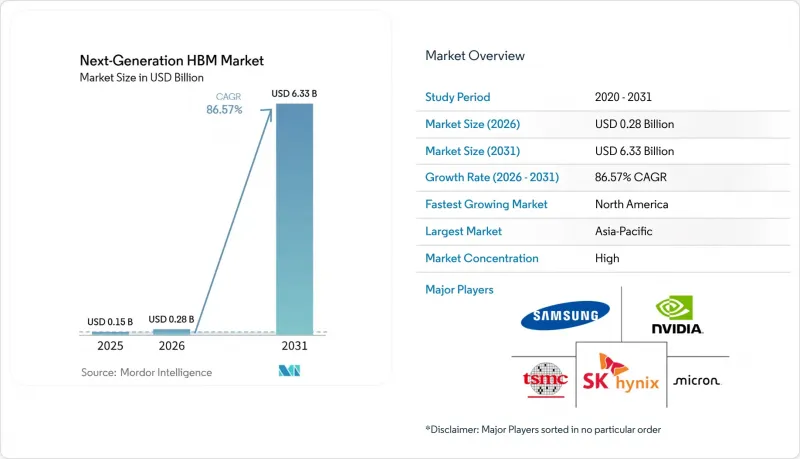
Mordor Intelligence에 의하면, 차세대 HBM 시장 규모는 2025년에 1억 5,000만 달러로 평가되었습니다. 2026년부터 2031년에 걸쳐 CAGR 86.57%로 확대되어 2031년에는 63억 3,000만 달러에 이를 것으로 예측됩니다.
본 보고서는 기술별(HBM2, HBM2E, HBM3, HBM3E, HBM4), 스택당 메모리 용량별(4GB, 8GB, 16GB, 24GB, 32GB 이상), 프로세서 인터페이스별(GPU, CPU, AI 가속기 및 ASIC, FPGA 등), 용도별(AI 및 데이터센터 서버 등), 최종 이용 산업별(클라우드 서비스 제공업체 등), 그리고 지역별로 분류되어 있습니다. 시장 전망은 금액(달러) 기준으로 제시되어 있습니다.
세계의 차세대 HBM 시장 동향 및 인사이트
AI 서버의 보급 및 GPU 탑재율
현재 주요 AI 플랫폼은 모두 이전 세대에 비해 프로세서당 HBM 탑재량이 증가하고 있으며, 이는 차세대 HBM 시장이 가속기 유닛 수요만으로는 설명할 수 없을 정도로 빠르게 성장하고 있음을 보여줍니다. NVIDIA는 Vera Rubin NVL72가 72개의 GPU에 걸쳐 20.7 TB의 HBM4와 1,580 TB/s의 메모리 대역폭을 사용한다고 밝히며, 시스템 수준의 메모리 집약도가 얼마나 빠르게 높아지고 있는지를 입증했습니다. SK하이닉스도 2025 회계연도 HBM 사업이 전년 대비 2배 이상 확대되었다고 보고했으며, 이는 AI 서버 도입이 이미 초대용량 메모리 매출의 대폭적인 증가로 이어지고 있음을 뒷받침합니다. 따라서 차세대 HBM 시장은 신규 서버 도입과 설치된 각 랙 내 메모리 구성의 고도화라는 두 가지 요인에 의해 견인되고 있습니다. 이러한 추세는 랙 스케일 AI 시스템으로의 전환에 따라 더욱 강화되고 있습니다. 이 시스템에서 플랫폼의 경제적 가치는 단순한 연산 밀도뿐만 아니라 지속적인 메모리 처리량에 달려 있기 때문입니다. 그 결과, 인증된 제품을 신속하게 양산할 수 있는 공급업체는 단순히 제품이 ‘서류상’으로만 구할 수 있는 공급업체보다 더 유리한 입장에 있습니다.
차세대 AI 가속기에서 HBM4의 채택
HBM4는 대역폭의 대폭적인 향상과 향후 AI 플랫폼을 위한 보다 세밀한 최적화를 가능하게 하는 아키텍처 변경을 결합함으로써 차세대 HBM 시장을 주도하고 있습니다. 마이크론은 자사의 HBM4 36GB 12-high 제품이 2.8TB/s를 초과하는 대역폭을 실현하고, HBM3E에 비해 전력 효율이 20% 이상 향상되었음을 밝히며, 2026년 초에 양산을 시작했습니다. Samsung Electronics도 2026년 2월에 HBM4 양산 출하를 시작했으며, 이후 HBM4의 누적 매출액이 130일 이내에 10억 달러에 달했다고 발표했습니다. 이는 차세대 메모리치고는 이례적으로 빠른 상용화 확대를 보여줍니다. HBM4로의 전환에 따라 기술적 요구 사항도 높아지고 있습니다. 이전 세대에 비해 다이당 I/O 수가 2배로 늘어나기 때문에 스택 수율, 베이스 다이와의 통합, 그리고 패키지 수준 검증 등이 더욱 어려워지기 때문입니다. 실제로 이러한 복잡성으로 인해 시장 진입이 제한되고 있으며, 차세대 HBM 시장은 DRAM 공정 기술과 패키징 기술을 모두 갖춘 공급업체를 중심으로 형성되고 있습니다. 또한 이로 인해 맞춤형 HBM 프로그램의 가치가 높아지고 있으며, 최상위급 AI 가속기 출시에서 직접적인 차별화 요소로 자리 잡고 있습니다.
CoWoS 및 SoIC를 통한 첨단 패키징의 생산 능력 제약
차세대 HBM 시장에서 단기적으로 가장 큰 제약 요인은 여전히 첨단 패키징공급 상황에 있습니다. 인증을 완료한 메모리 스택은 가속기 제품으로 출하되기 전에 제한된 통합 슬롯을 확보해야 하기 때문입니다. TSMC는 CoPoS와 같은 더 고도화된 패키징으로의 전환이 유리 인터포저의 균일성 및 뒤틀림 제어와 관련된 기술적 과제로 인해 지연되고 있음을 시사하고 있으며, 이로 인해 현재 패키징 공정에 대한 부담이 장기화되고 있습니다. 이는 수율이 양호한 HBM의 생산량이라 하더라도, 특히 이미 엄격한 공정 제어가 필요한 고스택 제품의 경우, 통합 단계에서 발생하는 두 번째 병목 현상으로 인해 출하가 저해될 가능성이 있음을 의미합니다. 고객이 최신 구성을 필요로 할 경우, 이러한 제약은 더욱 심각해집니다. HBM4 및 HBM4E 제품은 열 관리, 범프 무결성, 패키지 검증 측면에서 더 높은 요구 사항을 부과하기 때문입니다. 공급업체들은 백엔드 투자를 확대하여 대응하고 있지만, 차세대 HBM 시장에서는 여전히 발표된 패키징 능력과 신뢰성이 높고 인증된 처리량 사이에 시차가 발생하고 있습니다. 이러한 시차로 인해 할당량이 계속해서 부족하고, 프리미엄 가격 책정이 유지되며, 주요 AI 플랫폼 수요 동향을 공급이 따라잡는 속도가 제한되고 있습니다.
부문 분석
2025년에는 HBM3E가 기술 부문의 51.84%를 차지했으나, HBM4는 2031년까지 연평균 성장률(CAGR) 87.58%로 확대될 것으로 예측됩니다. HBM3E는 현재 AI 인프라 전반에 걸쳐 이미 의미 있는 도입 실적을 보유하고 있으며, HBM4의 양산이 본격화될 때까지 고객에게 검증된 가교 솔루션을 제공하기 때문에 차세대 HBM 시장에서 여전히 중요한 위치를 차지하고 있습니다. 각 하이퍼스케일러 기업들은 차세대 메모리로의 전환 준비를 진행하면서도 기존 가속기 시스템의 도입을 지속하고 있기 때문에 NVIDIA의 현재 및 단기적인 플랫폼 출시 주기가 HBM3E의 중요성을 유지하는 한 요인이 되고 있습니다. 그러나 HBM4는 훨씬 더 높은 대역폭, 맞춤형 설계에 대한 유연성 향상, 그리고 향후 등장할 랙스케일 AI 시스템과의 더욱 견고한 연동을 제공함으로써 이 분야의 흐름을 바꾸고 있습니다. 마이크론에 따르면, 자사의 HBM4 36GB 12-high 제품은 2.8TB/s를 초과하며, HBM3E에 비해 전력 효율을 20% 이상 향상시켰다고 합니다. 이것이 고객들이 새로운 노드의 인증을 서두르는 이유를 설명해 줍니다.
차세대 HBM 시장은 또한 기술적 리더십이 더 이상 DRAM의 밀도나 속도로만 정의되지 않는다는 점을 보여주고 있습니다. 이전 메모리 주기에 비해 베이스 다이 설계와 파운드리와의 협력이 훨씬 더 중요해졌기 때문입니다. 삼성은 자사의 HBM4가 4nm 베이스 다이를 채택하고 있다고 밝혔으며, 이후 핀당 최대 16Gbps, 대역폭 3.6TB/s를 실현하는 HBM4E 12-high 샘플을 출하함으로써 기술 경쟁이 급속도로 격화되고 있음을 보여주었습니다. SK하이닉스는 2026년 6월에 HBM4E 샘플을 출시하며, 맞춤형 HBM을 전략적 우선 과제로 삼았습니다. 이는 차세대 HBM 시장이 단순한 표준 부품 간의 경쟁이 아니라, 고객별 최적화로 전환되고 있음을 시사합니다. HBM2, HBM2E, HBM3 등의 구세대 제품은 절대적인 대역폭보다 비용이나 인증 실적이 중시되는 네트워크 및 레거시 HPC 용도에서 여전히 수요가 있습니다. 하지만 이러한 전환 경로로 인해 신규 업체 시장 진입은 더욱 어려워지고 있습니다. 이는 현재 공급업체에게 메모리 공정 기술, 첨단 패키징, 그리고 베이스 다이와의 연동 측면에서 동시에 확실한 역량이 요구되기 때문입니다.
2025년에는 24GB급이 출하 점유율의 47.12%를 차지하며 1위를 차지했으나, 32GB 이상은 2031년까지 연평균 성장률(CAGR) 87.51%를 나타낼 것으로 예측됩니다. 24GB급은 말하자면 차세대 HBM 시장의 도입 기반의 핵심에 위치하고 있습니다. 이는 많은 현행 AI 시스템에서 사용되고 있는 구성과 일치하며, 고객에게 성능, 수율, 도입 가능 수량의 균형이 확립되어 있기 때문입니다. 기존 서버 군과 조달 주기가 이 용량 범위의 인증된 HBM3E 스택에 대한 견고한 수요를 계속해서 뒷받침하고 있으므로, 이 도입 기반은 당분간 사라지지 않을 것입니다. 그러나 새로운 AI 시스템에서는 기존 플랫폼보다 가속기당 메모리 용량과 훈련 클러스터당 대역폭이 더 많이 필요하기 때문에 성장의 중심은 이미 상위 용량으로 이동하고 있습니다. 마이크론은 2026년 1분기에 HBM4 48GB 16-high 샘플을 여러 고객에게 출하했다고 발표했는데, 이는 제품 로드맵이 현재의 주류 용량 대역을 얼마나 빠르게 넘어서는지를 보여줍니다.
이러한 변화가 중요한 이유는 대용량 스택을 위한 차세대 HBM 시장이 플랫폼 세대마다 확대되고 있으며, AI 관련 메모리의 최소 요구 사항이 꾸준히 높아지고 있기 때문입니다. 스택 높이가 증가함에 따라 다이의 박형화, 정렬, 열 제어 등이 더욱 정교해져야 하므로 기술적 부담도 커집니다. 이로 인해 웨이퍼 공급 상황이 양호해 보일지라도 실질적인 완제품 생산량은 감소할 가능성이 있습니다. IEEE 및 출처가 되는 초안의 관련 패키징 분석에 따르면, 단일 패키지에 층이 추가될수록 실리콘 관통 비아(TSV)의 복잡성과 고스택 조립 시 발생하는 손실이 더욱 심각해진다고 지적되고 있습니다. 4GB, 8GB, 16GB와 같은 소용량 등급은 네트워크 장비, 엣지 추론 하드웨어, 그리고 1달러당 대역폭이 여전히 구매 결정 요인으로 작용하는 레거시 컴퓨팅 노드에서 계속해서 중요한 역할을 하고 있습니다. 그렇지만 차세대 HBM 시장의 장기적인 방향성은 분명합니다. 대용량 등급이 고립된 하이엔드 옵션이 아닌 상업적인 양산 제품으로 자리 잡고 있기 때문입니다.
지역별 분석
2025년, 아시아태평양은 차세대 HBM 시장 점유율의 71.04%를 차지했습니다. 이 지역이 주도적인 위치를 차지하고 있는 이유는 한국이 SK하이닉스와 Samsung Electronics를 통해 상용 HBM 생산을 집중하고 있는 한편, 대만이 첨단 패키징 및 집적화의 중심지로 자리매김하고 있기 때문입니다. SK하이닉스는 출처 초안에 기재된 2025년 IRS 연간 평균 환율을 적용하여 2025년도 매출이 97조 1,467억 원(702억 달러)이었다고 보고했으며, HBM 매출은 전년 대비 2배 이상 증가했다고 밝혔습니다. 한국은 2026년 6월, 4개의 신규 메모리 공장, HBM 패키징 허브 및 AI 데이터센터에 대한 대규모 자금 지원을 포함한 국가 투자 계획을 발표하며 그 위상을 더욱 공고히 했습니다. 2026년 1월 22일 시행된 한국의 ‘AI 기본법’은 국내 AI 인프라를 지원하고, 장기적인 메모리 투자처로서 한국의 매력을 높이기 위한 정책적 틀을 마련했습니다.
북미는 2031년까지 연평균 성장률(CAGR) 87.38%를 나타낼 것으로 예측되며, 차세대 HBM 시장에서 가장 빠르게 확대되는 지역 블록이 될 전망입니다. 최대 규모의 하이퍼스케일러와 가속기 구매 기업들이 미국에 기반을 두고 있어 수요가 미국에 집중되고 있으며, 이로 인해 주요 AI 플랫폼 소유자 인근에서 조달 역량이 유지되고 있습니다. 미국에 거점을 둔 유일한 HBM 제조업체인 마이크론은 아이다호주 및 뉴욕주에 DRAM 팹을 건설하기 위해 CHIPS법에 따라 최대 64억 달러의 보조금을 확보하는 한편, 국내 HBM 관련 역량 강화도 추진하고 있습니다. 또한 SK하이닉스도 인디애나주에 첨단 패키징 시설을 건설 중이며, 이를 통해 수요 집중에 그치지 않고 북미 시장 진출을 더욱 심화하고 있습니다. 유럽은 여전히 2차 수요 지역이며, 독일의 자동차용 컴퓨팅 수요와 영국 등 시장의 하드웨어 정책에 대한 폭넓은 관심이 견인 역할을 하고 있습니다.
남미, 중동 및 아프리카는 차세대 HBM 시장에서 여전히 초기 단계에 있는 지역이지만, 모두 현지 메모리 생산보다는 AI 인프라 구축을 통해 그 중요성을 높여가고 있습니다. 남미는 주로 클라우드 및 엔터프라이즈 데이터센터의 확장에 힘입고 있으며, 지역 내 AI 워크로드가 증가함에 따라 수입되는 가속기 수요가 높아지고 있습니다. 중동 및 아프리카는 특히 정부가 대규모 연산 능력 확충을 지원하고 있는 지역에서 국가 주도의 AI 전략과 대규모 데이터센터 구축 계획에 힘입고 있습니다. 어느 지역이든 2026년부터 2031년 사이에 자국 내 HBM 생산 체제를 확립할 가능성은 낮기 때문에 그 수요 전망은 전 세계 공급 배분, 수출 규제, 그리고 주요 생산자 간의 가격 규율에 계속해서 밀접하게 좌우될 것입니다.
기타 혜택 :
- 엑셀 형식 시장 예측(ME) 시트
- 3개월간의 애널리스트 지원
자주 묻는 질문
목차
제1장 서론
제2장 조사 방법
제3장 주요 요약
제4장 시장 구도
제5장 시장 규모 및 성장 예측
제6장 경쟁 구도
제7장 시장 기회 및 향후 전망
KTH 26.08.10According to Mordor Intelligence, the next-generation HBM market size was valued at USD 0.15 billion in 2025 and is projected to reach USD 6.33 billion by 2031, at a CAGR of 86.57% during 2026-2031.
This report is Segmented by Technology (HBM2, HBM2E, HBM3, HBM3E, and HBM4), Memory Capacity Per Stack (4 GB, 8 GB, 16 GB, 24 GB, and 32 GB and Above), Processor Interface (GPU, CPU, AI Accelerator and ASIC, FPGA, and More), Application (AI and Data Center Servers, and More), End Use Industry (Cloud Service Providers, and More), and Geography. The Market Forecasts are Provided in Terms of Value (USD).
Global Next-Generation HBM Market Trends and Insights
AI Server Proliferation and GPU Attach Rates
Every major AI platform now carries a larger HBM load per processor than the previous one, indicating the next-generation HBM market is growing faster than accelerator unit demand alone. NVIDIA disclosed that Vera Rubin NVL72 uses 20.7 TB of HBM4 and 1,580 TB/s of memory bandwidth across 72 GPUs, demonstrating how quickly system-level memory intensity is rising. SK Hynix also reported that its HBM business more than doubled year over year in FY2025, confirming that AI server deployments are already translating into significant expansion in very large memory revenue. The next-generation HBM market is therefore being pulled forward by both new server installations and richer memory configurations within each installed rack. That pattern is reinforced by the move toward rack-scale AI systems, where the economic value of the platform depends on sustained memory throughput rather than raw compute density alone. As a result, suppliers that can ramp qualified volume quickly are in a stronger position than those that simply have product availability on paper.
HBM4 Adoption In Next-Generation AI Accelerators
HBM4 is driving the next-generation HBM market by combining a significant increase in bandwidth with architectural changes that enable tighter optimization for upcoming AI platforms. Micron stated that its HBM4 36 GB 12-high product delivered more than 2.8 TB/s of bandwidth and over 20% better power efficiency than HBM3E, while entering high-volume production in early 2026. Samsung also began mass production shipments of HBM4 in February 2026 and later said cumulative HBM4 sales reached USD 1 billion within 130 days, pointing to an unusually fast commercial ramp for a new memory generation. The move to HBM4 also raises technical demands, as the I/O count per die doubles compared with earlier generations, making stack yield, base-die integration, and package-level validation more difficult. In practice, that complexity limits broad participation and keeps the next-generation HBM market centered on suppliers that can pair DRAM process strength with packaging discipline. It also raises the value of custom HBM programs, which are becoming a direct differentiator in top-tier AI accelerator launches.
Limited CoWoS and SoIC Advanced-Packaging Capacity
The largest near-term restraint on the next-generation HBM market remains the availability of advanced packaging, as qualified memory stacks still need scarce integration slots before they can ship in accelerator products. TSMC has indicated that more advanced packaging transitions, such as CoPoS, have been delayed by engineering challenges tied to glass interposer uniformity and warpage control, which keeps pressure on current packaging flows for longer. This means even well-yielding HBM output can be held back by a second bottleneck at the integration stage, especially for high-stack products that already require tighter process control. The restraint is more severe when customers need the newest configurations, because HBM4 and HBM4E products place additional demands on thermal handling, bump integrity, and package validation. Suppliers are responding with higher backend investment, but the next-generation HBM market still faces a lag between announced packaging capacity and dependable, qualified throughput. That lag keeps allocation tight, supports premium pricing, and limits how quickly supply can match the demand profile of leading AI platforms.
Other drivers and restraints analyzed in the detailed report include:
- Advanced Packaging Capacity Expansion
- Sovereign AI and Local Memory Localization Incentives
- Export Controls on Advanced AI Accelerators And HBM-Linked Supply Chains
For complete list of drivers and restraints, kindly check the Table Of Contents.
Segment Analysis
HBM3E held 51.84% of the technology segment in 2025, while HBM4 is projected to expand at 87.58% CAGR through 2031. HBM3E remains important in the next-generation HBM market because it already supports meaningful deployment across current AI infrastructure and gives customers a qualified bridge while HBM4 volume ramps. NVIDIA's current and near-term platform cadence has helped keep HBM3E relevant, since hyperscalers continue to deploy existing accelerator systems even as they prepare for the next memory generation. HBM4, however, is changing the pace of this category by offering much higher bandwidth, greater flexibility for customized designs, and stronger alignment with upcoming rack-scale AI systems. Micron said its HBM4 36 GB 12-high product exceeded 2.8 TB/s and improved power efficiency by more than 20% compared with HBM3E, which explains why customers are moving quickly to qualify the new node.
The next-generation HBM market also shows that technology leadership is no longer defined only by DRAM density or speed, because base-die design and foundry coordination now matter much more than they did in earlier memory cycles. Samsung stated that its HBM4 uses a 4-nm base die and later shipped HBM4E 12-high samples with up to 16 Gbps per pin and 3.6 TB/s bandwidth, showing how quickly the technology ladder is tightening. SK Hynix followed with HBM4E samples in June 2026 and highlighted custom HBM as a strategic priority, which signals that the next-generation HBM market is moving toward customer-specific optimization rather than simple standard part competition. Older generations such as HBM2, HBM2E, and HBM3 still have room in networking and legacy HPC uses, where cost and qualification history can matter more than absolute bandwidth. Even so, the transition path makes entry harder for new participants, because suppliers now need credible strength in memory process technology, advanced packaging, and base-die coordination at the same time.
The 24 GB tier led with 47.12% share in 2025, while 32 GB and above is projected to grow at 87.51% CAGR through 2031. The 24 GB tier sits at the center of the installed base in the next-generation HBM market because it matches the configuration used in many current AI systems and gives customers a known balance between performance, yield, and deployable volume. That installed base will not disappear quickly, as existing server fleets and procurement cycles continue to support strong demand for qualified HBM3E stacks in this capacity range. The growth center has already moved higher, however, because newer AI systems need more memory per accelerator and more bandwidth per training cluster than earlier platforms required. Micron said it shipped HBM4 48 GB 16-high samples to multiple customers in Q1 2026, indicating how quickly the product roadmap is moving beyond the current mainstream tier.
This shift matters because the next-generation HBM market for higher-capacity stacks is growing with each platform generation, and the new floor for AI-relevant memory content is steadily rising. As stack height increases, the technical burden also rises because die thinning, alignment, and thermal control become more sensitive, which can reduce effective finished-unit output even when wafer availability appears healthy. IEEE and related packaging analysis in the source draft highlighted that through-silicon-via complexity and high-stack assembly losses become more serious as more layers are added to a single package. Smaller tiers such as 4 GB, 8 GB, and 16 GB remain relevant in networking devices, edge inference hardware, and legacy compute nodes where bandwidth per dollar still shapes purchasing decisions. Still, the long-term direction of the next-generation HBM market is clear, because premium capacity tiers are becoming commercial volume products rather than isolated high-end options.
Complete Report Scope:
- By Technology
- HBM2
- HBM2E
- HBM3
- HBM3E
- HBM4
- By Memory Capacity per Stack
- 4 GB
- 8 GB
- 16 GB
- 24 GB
- 32 GB and Above
- By Processor Interface
- GPU
- CPU
- AI Accelerator and ASIC
- FPGA
- Other Processor Interfaces
- By Application
- AI and Data Center Servers
- Networking
- High-Performance Computing
- Consumer Electronics
- Automotive and Transportation
- Other Applications
- By End Use Industry
- Cloud Service Providers
- Enterprise Data Centers
- Telecommunications Operators
- Automotive OEMs
- Other End Use Industries
- By Geography
- North America
- United States
- Canada
- Mexico
- Europe
- Germany
- United Kingdom
- France
- Italy
- Rest of Europe
- Asia-Pacific
- China
- Japan
- South Korea
- Taiwan
- India
- Rest of Asia-Pacific
- South America
- Middle East and Africa
- North America
Geography Analysis
Asia-Pacific held 71.04% of the next-generation HBM market share in 2025. The region leads because South Korea concentrates commercial HBM production at SK Hynix and Samsung Electronics, while Taiwan remains central to advanced packaging and integration. SK Hynix reported FY2025 revenue of KRW 97,146.7 billion (USD 70.2 billion), using the IRS 2025 yearly average exchange rate provided in the source draft, and said HBM revenue more than doubled year over year. South Korea strengthened that position in June 2026 with a national investment plan that included four new memory fabs, an HBM packaging hub, and major funding for AI data centers. The South Korean AI Framework Act, effective January 22, 2026, added a policy layer to support domestic AI infrastructure and reinforce the country's appeal as a destination for long-term memory investment.
North America is projected to grow at 87.38% CAGR through 2031, making it the fastest-expanding regional block in the next-generation HBM market. Demand is concentrated in the United States because the largest hyperscaler and accelerator buyers are based there, and that keeps procurement power close to the leading AI platform owners. Micron, the only U.S.-based HBM producer, secured CHIPS Act grants of up to USD 6.4 billion for DRAM fab construction in Idaho and New York, while also advancing domestic HBM-related capability. SK Hynix is also building advanced packaging facilities in Indiana, which deepens North American participation beyond demand concentration alone. Europe remains a secondary demand region, led by automotive compute needs in Germany and by broader hardware policy interest in markets such as the United Kingdom.
South America and the Middle East and Africa are still early-stage regions in the next-generation HBM market, but both are gaining relevance through AI infrastructure build-outs rather than through local memory production. South America is driven mainly by cloud and enterprise data center expansion, which increases imported accelerator demand as regional AI workloads grow. The Middle East and Africa are being supported by sovereign AI and large data center ambitions, especially where governments are backing compute capacity at scale. Neither region is likely to establish indigenous HBM production during 2026-2031, so their demand outlook remains closely tied to global supply allocation, export compliance, and price discipline among the established producers.
- SK Hynix Inc.
- Samsung Electronics Co., Ltd.
- Micron Technology, Inc.
- NVIDIA Corporation
- Taiwan Semiconductor Manufacturing Company Limited
- Advanced Micro Devices, Inc.
- Intel Corporation
- Broadcom Inc.
- Marvell Technology, Inc.
- Applied Materials, Inc.
- ASML Holding N.V.
- TSMC
- Amkor Technology, Inc.
- ASE Technology Holding Co., Ltd.
- Powertech Technology Inc.
- United Microelectronics Corporation
- Cadence Design Systems, Inc.
- Synopsys, Inc.
- Rambus Inc.
- JCET Group Co., Ltd.
Additional Benefits:
- The market estimate (ME) sheet in Excel format
- 3 months of analyst support
TABLE OF CONTENTS
1 INTRODUCTION
- 1.1 Study Assumptions and Market Definition
- 1.2 Scope of the Study
2 RESEARCH METHODOLOGY
3 EXECUTIVE SUMMARY
4 MARKET LANDSCAPE
- 4.1 Market Overview
- 4.2 Market Drivers
- 4.2.1 AI Server Proliferation and GPU Attach Rates
- 4.2.2 HBM4 Adoption in Next-Generation AI Accelerators
- 4.2.3 Advanced Packaging Capacity Expansion
- 4.2.4 Sovereign AI and Local Memory Localization Incentives
- 4.2.5 Edge AI Inference in Automotive ADAS
- 4.2.6 Photonics-Ready HBM Roadmaps
- 4.3 Market Restraints
- 4.3.1 Limited CoWoS and SoIC Advanced-Packaging Capacity
- 4.3.2 TSV Yield Losses in High-Stack Designs
- 4.3.3 Export Controls on Advanced AI Accelerators and HBM-Linked Supply Chains
- 4.3.4 Thermal Density Limits in Ultra-High-Bandwidth Devices
- 4.4 Industry Value Chain Analysis
- 4.5 Impact of Macroeconomic Factors on the Market
- 4.6 Regulatory Landscape
- 4.7 Technological Outlook
- 4.8 Porter's Five Forces Analysis
- 4.8.1 Bargaining Power of Buyers
- 4.8.2 Bargaining Power of Suppliers
- 4.8.3 Threat of New Entrants
- 4.8.4 Threat of Substitutes
- 4.8.5 Intensity of Competitive Rivalry
5 MARKET SIZE AND GROWTH FORECASTS (VALUE)
- 5.1 By Technology
- 5.1.1 HBM2
- 5.1.2 HBM2E
- 5.1.3 HBM3
- 5.1.4 HBM3E
- 5.1.5 HBM4
- 5.2 By Memory Capacity per Stack
- 5.2.1 4 GB
- 5.2.2 8 GB
- 5.2.3 16 GB
- 5.2.4 24 GB
- 5.2.5 32 GB and Above
- 5.3 By Processor Interface
- 5.3.1 GPU
- 5.3.2 CPU
- 5.3.3 AI Accelerator and ASIC
- 5.3.4 FPGA
- 5.3.5 Other Processor Interfaces
- 5.4 By Application
- 5.4.1 AI and Data Center Servers
- 5.4.2 Networking
- 5.4.3 High-Performance Computing
- 5.4.4 Consumer Electronics
- 5.4.5 Automotive and Transportation
- 5.4.6 Other Applications
- 5.5 By End Use Industry
- 5.5.1 Cloud Service Providers
- 5.5.2 Enterprise Data Centers
- 5.5.3 Telecommunications Operators
- 5.5.4 Automotive OEMs
- 5.5.5 Other End Use Industries
- 5.6 By Geography
- 5.6.1 North America
- 5.6.1.1 United States
- 5.6.1.2 Canada
- 5.6.1.3 Mexico
- 5.6.2 Europe
- 5.6.2.1 Germany
- 5.6.2.2 United Kingdom
- 5.6.2.3 France
- 5.6.2.4 Italy
- 5.6.2.5 Rest of Europe
- 5.6.3 Asia-Pacific
- 5.6.3.1 China
- 5.6.3.2 Japan
- 5.6.3.3 South Korea
- 5.6.3.4 Taiwan
- 5.6.3.5 India
- 5.6.3.6 Rest of Asia-Pacific
- 5.6.4 South America
- 5.6.5 Middle East and Africa
- 5.6.1 North America
6 COMPETITIVE LANDSCAPE
- 6.1 Market Concentration
- 6.2 Strategic Moves
- 6.3 Market Share Analysis
- 6.4 Company Profiles (includes Global Level Overview, Market Level Overview, Core Segments, Financials as available, Strategic Information, Market Rank/Share, Products and Services, Recent Developments)
- 6.4.1 SK Hynix Inc.
- 6.4.2 Samsung Electronics Co., Ltd.
- 6.4.3 Micron Technology, Inc.
- 6.4.4 NVIDIA Corporation
- 6.4.5 Taiwan Semiconductor Manufacturing Company Limited
- 6.4.6 Advanced Micro Devices, Inc.
- 6.4.7 Intel Corporation
- 6.4.8 Broadcom Inc.
- 6.4.9 Marvell Technology, Inc.
- 6.4.10 Applied Materials, Inc.
- 6.4.11 ASML Holding N.V.
- 6.4.12 TSMC
- 6.4.13 Amkor Technology, Inc.
- 6.4.14 ASE Technology Holding Co., Ltd.
- 6.4.15 Powertech Technology Inc.
- 6.4.16 United Microelectronics Corporation
- 6.4.17 Cadence Design Systems, Inc.
- 6.4.18 Synopsys, Inc.
- 6.4.19 Rambus Inc.
- 6.4.20 JCET Group Co., Ltd.
7 MARKET OPPORTUNITIES AND FUTURE OUTLOOK
- 7.1 White-Space and Unmet-Need Assessment


